Awe

Awe takes a crack at some familiar material, trying to deliver something new. And it is something new in the context of mainstream Telugu film, far from the usual mass hero driven shenanigans. But it reminded me of a couple of  Hollywood films, and Prasanth Varma is a bit heavy handed and clearly doesn’t want anyone to miss out on his cleverness. This was a film I wanted to love but I was left mildly underwhelmed.

SPOILER ALERT! I want to mention a couple of ideas the film plays with so I will have a few spoilers. But I will leave a few surprises.

Radha (Eesha Rebba) waits at a restaurant with her parents. They’re going to meet her partner, Krish, for the first time. Krish sounds like exactly what her parents wanted for Radha; a doctor, same caste, only child. But Krish is a woman (Nityha Menen). We jump into the story of Nala (Priyardarshi Pullikonda) a down on his luck man trying out for a job as a cook. He is clueless but luckily a wise talking fish (voiced by Nani) is there to help and a talking tree (voiced by Ravi Teja) is there because there weren’t enough comedy uncles in the cast. The episodes spool by. A precocious little girl Moksha (Kaitlyn) has a battle of magic and wits with a rude, overbearing magician (Murli Sharma). A doorman (Srinivas Avasarala) is building a time machine so he can go find his parents. But then the mysterious Parvathi (Devadarshini) arrives from the future to stop him. Mira (Regina Cassandra) is plotting a heist with her boyfriend, and the stress and the drugs she takes trigger interesting hallucinations or maybe something more sinister. In between the scene shifts to Kali (Kajal Aggarwal), a woman in obvious distress who is waiting for a sign.

The stories and their locations seem unrelated initially so the jumping around was a bit irritating as episodes terminate in a cliffhanger. As the film loops back to pick up the various stories the location and times merge into one quirky looking food court, and the characters start to be seen in each other’s worlds. The set design is kind of shoddy and obviously fake which also puzzled me at first. The morse code device looked like a prop from a low budget school play. But like Pizza, a lot of things make much more sense after a point. It’s a bit risky leaving things looking half baked until that clicks for the audience. If you miss all the hints it is spelled out by the end. The one dimensional characters also make more sense once you realise how they relate back to one particular person and how they colour the way the others are depicted.

Because the story is told in quite a gimmicky way I didn’t feel the actors were all able to rise above the material. Murli Sharma is trapped in a tedious story and not even his wild overacting could get him out of it. Priyadarshi didn’t really hit his stride until the latter part of his story. And no matter how I consider it, I can’t see how the fish and the tree fit into the overarching conceit of the film other than to get some more star names on the poster. Rohini was fun and still heartfelt as Radha’s mum, struggling not to let her disapproval break a vow of silence.. Regina Cassandra has presence and Mira is a challenging role in some respects, being an unlikeable and untrustworthy person. She seems like a misfit in the largely family friendly ensemble of characters but may be the most real.

Prasanth Varma was ambitious in his treatment of a film without a Hero. A bit of research on female psychology and gender would have helped enormously with the execution. Kajal was unusually sombre as Kali and did her best to show the confusion and pain of long term mental illness and emotional damage. Her character made one particular choice that didn’t ring true and a cursory Google would have told the writer to choose something else. But having a happy and openly lesbian couple is such a positive change in representation in Indian films, I can’t whinge too much. And good on Nithya Menen for giving Krish a go. She was cheeky, a bit irreverent, loved the ladies and all in all embraced her namesake as a role model. But Krish’s explanation of why Radha identified as gay was more driven by the plot than any nuanced analysis, overly simplistic but I think well intentioned. There is some truth in saying some women could reduce psychological issues if they spoke up about being assaulted and got help, but there was almost no consideration that the better solution is for men to stop raping women. Everything comes back to women having to save themselves.

It’s a good film but I wanted great. I saw the big reveal coming from a mile away, so I wanted more from the characterisation and the detail of living this life. See it and see what you think.

Tikli and Laxmi Bomb

Note: I was given the opportunity to see Tikli and Laxmi Bomb when one of the producers got in touch. I was free to write about the film if I wanted to, and they haven’t asked for content approval or seen the review.

The poster is regrettable, as I think it is unnecessarily salacious and makes the film look like a tacky sex comedy. Aditya Kripalani’s film is more of a study of women who want a fair go in their field of employment, which happens to be sex work. I read some articles about the movie and they seem to take a superficial view, maybe taking a cue from the poster, that this was all happy girl power shenanigans. There are moments of dark humour that provide some levity, but the women are vulnerable and the system is rigged against them. I hope that PR misdirection isn’t detrimental to the film when it is released.

Laxmi (Vibhawari Deshpande) has been around for a while and is given a new girl, Putul (Chitrangada Chakraborty), to train. Laxmi is decidedly non glamorous and businesslike, maybe more like the wives her clients have at home. Putul is younger, more confident in her looks and with a sassy personality. Putul, also known as Tikli, is outraged that while a cut of her earnings goes towards protection and police bribes, it’s all meaningless. The men she pays view her protection money as their income, not a service she is entitled to. If she pays A.T (Mayur More) for security, how is it that he can ignore her calls for help and she ends up being at fault. If the police accept bribes, why do they still raid the women and why is raping a prostitute one of the perks of their job? Tikli wants a revolution and Laxmi knows how to work the system. The women set up on their own, cutting out the useless men who lived off their labour. Will they be allowed to succeed? Can they beat the system?

This isn’t Pretty Woman.

Laxmi is struggling emotionally, and does her best to get her life back under control. She doesn’t have family and the women become that for her. Vibhawari Deshpande has a stolid, enduring strength with flashes of warmth and a bit of sarcasm. She has no expectations on anyone else and often says “our safety, our responsibility”. Tikli is impulsive and seems brash but is a damaged young woman, more lonely than she lets on. Chitrangada Chakraborty doesn’t try to make Tikli glamorous or even particularly nice, but explores the emotions driving her character. She snores like a truffle pig, which is not a great characteristic for a room mate. Laxmi initially mocks Putul’s indignation but slowly they become friends and co-conspirators, and the actors bring that to life beautifully and believably. Tikli has the daring they need to contemplate a different way, and Laxmi knows how to get shit done. Tikli’s rallying cry is “our business, our bodies, our pain, our shame”. If she has to wear the shame and the fear, she wants the benefits of her business.

Sparky Tsamchoe (Kritika Pande) welcomes Tikli, takes care of those around her, and embraces the new way of working. Her girlfriend, doll faced Sharanya (Divya Unny) is sweetly dim, and an easy target. Veteran Manda (Suchitra Pillai) is reluctant to change and sacrifice what little security she has. Her work persona is a little old school too. But the money talks and hope starts to spring. Their growing friendships and collaboration is one of the film’s strengths and the scenes have a lively and often spontaneous feel. Conversations in the small hours are full of ribald jokes about punters, wistful plans, and gossip.

These women are smart and resourceful, and I found myself getting caught up in the same hopes they had. That they would find a place in this man’s world, and live comfortably and safely. Such a small dream, but so powerful. When the women realise they need a safety plan when jumping into a car with men, they come up with a way to spin that into a value added service. When they are chased off the street and the dodgy hotel triples it’s prices they use their local knowledge to find another option. Mobile phone technology can work for them too. And their female security guards never get distracted. The gang grows as other working girls hear of how Tikli and Laxmi Bomb treat their team and how much they earn.

They all run up against men who believe that consent is not necessary. If a man pays for a quickie, can a hooker refuse his friends who suddenly turn up or decline to perform some sex acts? If you’re paying for sex, does that give you the right to be insulting or threatening? Laxmi and the ladies want to be able to earn their living without it costing their lives, but Tikli is the one who puts the wind up the local punters. The men in the film are almost entirely awful. Mhatre (Upendra Limaye) is a slimebag, and corrupt policeman More (Uday Atrolia) is worse, both using brutality and rape to assert their dominance. There is always a hint of violence surrounding the women, but also a lot of strength and warmth in their own small gang. Actually, there is one seemingly decent man in the film – the dude who runs the cigarette store and lends the girls a scooter. And sparks a nice little Sholay moment as Laxmi and Tikli drive home.

There are some clunky scenes, and I found some things a little predictable, or maybe just inevitable given the subject matter. The largely female crew has done a good job of avoiding unnecessary graphic sleaze and objectification while still revealing the brutality of this world. The male gaze is there in scenes where pimps are auditioning new girls or assessing their assets. But when the women are together they are shown as people who sell sex, not sex objects. The film is shot on location and with synch sound so it has an immediacy and a sense of life in Mumbai. The city is both huge and incredibly tiny and intimate. The girls who work their back street are a diverse bunch, often speaking a hit and miss Hinglish to communicate through regional language barriers. Mumbai is where everyone comes to chase their dreams. Laxmi sings to Mumba Devi as another woman who is constantly besieged by freeloaders and gives her all, taken for granted and treated like a possession.

I’m always interested in seeing more women represented on screen, and seeing diverse stories. The cast delivers a good ensemble performance and don’t fall into filmi clichés. Tikli and Laxmi Bomb is full of heart but not too preachy or idealised, sometimes funny, and doesn’t shy away from the harsh realities.

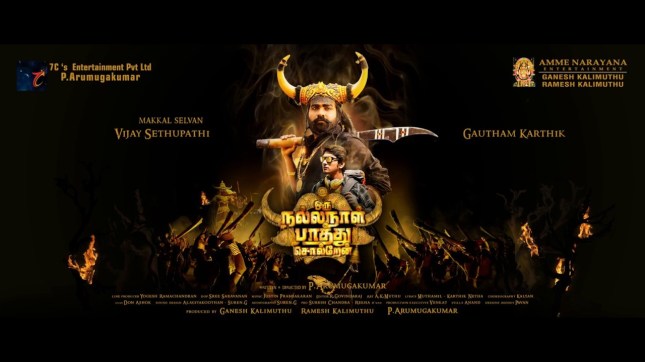
Oru Nalla Naal Paathu Solren

Poster

Arumuga Kumar’s debut movie Oru Nalla Naal Paathu Solren is a quirky comedy drama that’s a bit hit and miss. When it’s right, the film is pretty funny, but more often than not, the situations and the dialogue aren’t amusing at all, and it’s hard to know exactly what Arumuga Kumar was trying to achieve. It’s frustrating too since there are some good ideas that should have worked much better, mixed in with a few too many tired and clichéd scenes. According to the subtitles, the title means “I’ll tell you when the auspicious time is right”, and a number of the characters repeat this line at various intervals. Since it’s impossible to tell what is really going on for the first hour of the film, I was hoping that someone would finally decide that the auspicious time was right sooner rather than later, but it does all finally come clear at the end.

The film starts with a short astronomy and geography lesson voiced by Vijay Sethupathi, starting in deep space and finishing in a small village somewhere in Andhra Pradesh – Yamasingapuran. The village is inhabited by around 200 tribal villagers, who wear black, drape themselves in gold and worship Yama. They are led by Yeman (Vijay Sethupathi) and his mother Arumugakumar (Viji Chandrasekhar) who appear appropriately outlandish and over the top to rule a group of death-god worshipers somewhere out in the forest.

The villagers are a very proficient clan of thieves, and as their star performer, Yeman is sent to Chennai on a mission to steal more gold. Also, along on the trip are his two side-kicks, the competent if rather unenterprising Purushothaman (Ramesh Thilak) and Sathish (Daniel Annie Pope) – a bumbling failure whose antics must have sounded funnier on paper than they turn out on film.

While robbing a house in Chennai, Yeman spots a photograph of someone he calls Abhaayalakshmi, but who is actually Soumiya (Niharika Konidela), a fresher college student who is blissfully unaware of the existence of Yeman and Yamasingapuran. Unfortunately for her, she is about to become closely acquainted with both. Convinced that Soumiya is Abhaayalakshmi, Yeman and his inept associates fumble around using various ridiculous disguises in an attempt to ‘steal’ (ie kidnap) Soumiya and take her back to their village. Foiling their plans is Harish (Gautham Karthik) and his best friend Narasimhan (Rajkumar), for no real reason other than Harish finds Soumiya attractive.

Harish is a male version of a typical ditzy Tamil heroine, complete with half-baked ideas, ridiculous clothes that are totally unsuitable for a rescue mission to a forest, and an unnatural attraction to his sunglasses. This works well, for the most part, although some of the situations are too predictable to be funny, while others are simply not funny in the first place. However, there are some moments where dialogue, situation and character all come together and work perfectly – there just needed to be a few more of these. Gautham Karthik is fine but since his character is such an idiot it’s difficult to empathise and feel much connection to Harish. It’s quite a departure from his last role in Rangoon though and he doesn’t do badly with the comedy he has, so it will be interesting to see what he does next.

More reliably amusing is Vijay Sethupathi’s laconic portrayal of a desperate man in search of his long-lost bride. He gets to wear a succession of ridiculous wigs and costumes, but it’s the matter of fact attitude that Vijay Sethupathi exudes that makes his appearance so funny. Adding to this is his rationality when faced with all the absurdity of his mother, Harish and his misguided rescue attempt, and the multitude of mistakes made by Purushothaman and Sathish. Although Yeman is more subdued when in Chennai, once the action moves back to the village, the film does get funnier as everyone gets more and more outrageous.

Less successful are the characters of Narasimhan and Sathish. Both are bumbling idiots whose slapstick is presumably supposed to add more humour, but mostly falls flat while having two similar characters just makes it even more obvious that this type of comedy really isn’t funny. Both actors do their best with what they are given, but none of their dialogue is even remotely funny, and even their interactions with Harish and Yeman fail to raise more than the odd smile. I also have little to say about Niharika Konidela who didn’t live much of an impression at all. This is through no real fault of the actress, but she just had very little to do for most of the film.

Gayathrie Shankar is the one person who gets to play a reasonably straight role and she does it beautifully, making me wish that she had more to do in the film. She is so much better here than in her last outing with Vijay in Puriyaatha Puthir which has made me move Naduvula Konjam Pakkatha Kaanom to the top of the ‘to-be-watched’ pile. While Gayathrie needs to ensure her character Godavari is relatively sensible to make the role work wihin the story, Viji Chandrasekhar needed to be crazier as Yeman’s mother Arumugakumar. Apart from a few wide-eyed stares, she’s actually quite restrained which is a shame since the film needed the sort of boost that only a totally OTT ma character can bring. A lost opportunity for sure!

Oru Nalla Naal Paathu Solren is a film that is funny in short bursts, and the overall impression is of a screenplay that didn’t get enough time to fully mature before being harvested for the big screen. Vijay Sethupathi is as watchable as ever and there are enough funny moments to make this worth seeing in the cinema, but expect to be mildly entertained rather than crying with laughter.