Aruvi

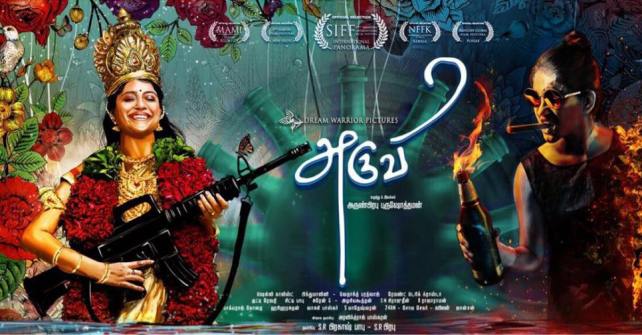
Aruvi poster

Arun Prabhu Purushothaman’s debut film is a difficult film to categorise. It’s a drama, a satire, even at times a comedy, but mainly it’s a delicious slap at reality TV, patriarchal society and that god of us all, money. Although by the end the film becomes overly mawkish and drags out the remaining scenes, Aditi Balan puts in a tremendous performance as Aruvi that powers through the final sentimentalism. Her top-notch performance, along with an absolutely incredible Anjali Varathan ensure that Aruvi is a memorable watch and another excellent addition to the new wave of Tamil cinema.

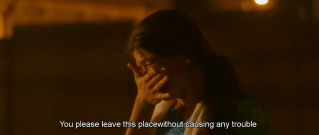
The film starts with a police interview. Aruvi (Aditi Balan) is a suspected terrorist and as Special Investigator Shakeel (Mohammad Ali Baig) tries to understand just who Aruvi is, Arun Prabhu fills in the background for the audience with short vignettes that dip into Aruvi’s life story. We see Arvui as a young child, growing up in the countryside with her adoring father, who stops smoking just because she tells him it smells bad. If only everyone else would listen to this simple truth! As she grows up Aruvi gets a brother, Karuna (Arnold Mathew) and the family moves into the city.

Aruvi misses the countryside and tells her father that she doesn’t like the move, but she soon adapts and fits easily into school life. She’s not a particularly nice person – she teases other students and in one memorable scene refuses to give a fellow student a sanitary pad – but she is a typical teenager making it hard to understand how she ended up being interviewed by the police as a suspected terrorist.

These background scenes are interspersed with the aftermath of whatever event has led to Aruvi’s arrest. Her father is called to be interviewed, her friend Emily (Anjali Varathan) is also arrested, and we see snippets of how they have interacted with Aruvi in brief flashes, just as if each question has stimulated the memory of the character. It’s beautifully done and keeps the audience guessing before slipping into a more traditional flashback starting with Aruvi in college. Aruvi is studying psychology along with her best friend Jessy (Shwetha Shekar) and the two seem totally normal until the day Aruvi throws up in class. Anyone who has ever watched an Indian movie before knows exactly what this means, and as the story then moves on to Aruvi arguing with her parents and brother before finally being thrown out of the house, that assumption seems logical. Except that Arun Prabhu keeps the reason for Aruvi’s estrangement from her family ambiguous until later events reveal exactly why her family has turned against her.

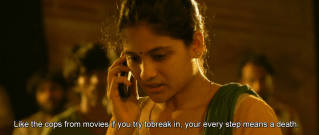
Aruvi takes shelter first with Jessy, but then moves in with Emily, a transgender who helps take care of Aruvi and helps her find a job. Emily then helps Aruvi get accepted on to a reality TV show, where guests tell their stories and are invited to confront the people they feel have ‘done them wrong’. Here, Aruvi gets to confront three men whom she accuses of raping her, and this is where everything starts to go wrong, leading to the terrorist accusations.

The TV show is a brilliant idea, and allows Arun Prabhu to satirise such shows, as well as the media in general – the headline chasing tactics, talking head opinions shows (of which India seems to have hundreds!), but also shows the police having to act responsibly due to the media presence. The hypocrisy is stunning. Presenter Shoba Parathsarathy (Lakshmi Gopalaswamy) acts like a diva despite working for a small TV company as a reality talk show host – she’s no Oprah! Shoba turns on the charm as soon as the camera is rolling and moves easily from discussing Aruvi’s trauma one moment to a tacky advertisement line for the sponsors before cutting to a break the next, something Aruvi parodies brilliantly later on. The hierarchy of the studio is lampooned, with the little people including the security guard, a runner for the show and the junior producer also getting their share of the ridicule as Aruvi turns the tables on the entire production. This section is brilliantly done and Arun Prabhu uses the talk show as a way for Aruvi to highlight the helplessness of women in Indian society. But Aruvi also comments on the evils of more than just rapacious men, describing the middle class as spending machines who further enrich the wealthy of the world, while themselves gorging on the poor and trampling them further into the ground.

What’s disappointing is that Aruvi forgives the three men, one of whom is unconscionably violent, and the full horror of their crimes is never brought to bear. Although Aruvi initially goes onto the TV show to demand an apology from these men, they are instead made out to be the victims of her ‘attack’, when in reality all three deserve to be arrested rather than Aruvi. But then that is part of the point. The patriarchy of Aruvi’s society does not allow her to be the victim here, and she has no right to complain about her life even though she has had no control over what has happened to her.

Aditi Balan is incredibly powerful in the lead role, first as a typical teen, then student and finally a young woman trying to cope when her whole world has fallen in around her. Her final dialogues, which could have come across as overly cloying and maudlin are instead transformed simply because of her poignant and heartfelt performance. Perfect casting and an excellent performance are what make Aruvi such a compelling story.

While all the cast are excellent, Anjali Varathan shines as Emily and it’s a lovely change in Tamil cinema to have a transgender as a sympathetic character. She’s easily the most compassionate and decent person in the entire film with some of the best lines too. Anjali makes her character come alive in after only a few short scenes, making Emily the most memorable character after Aruvi. I love her introduction as she good-naturedly searches for a possible underwear thief in their building, and her care of Aruvi is beautifully shown. In a film that’s all about those on the margins of society, Emily is an outstanding standard bearer to prove that people are just people. No more, no less.

There are many small throwaway moments that also help lift the film above the ordinary. Jessy’s reaction to Aruvi when she goes to see her after the arrest is perfect middle-class guilt. The interactions between the crew members in the TV studio are well captured as are the reactions of the various homeowners and a funeral party as the police prepare to storm the TV studio. The décor too rings true, while Aruvi and Emily’s wardrobe choices are perfect for the characters they play. No glamour and OTT make-up here, except for Lakshini Gopalaswamy as she hits the nail on the head with her portrayal of TV persona Shoba.

AruviAruviAruviAruvi

There is a secondary theme that deals with another issue that society in India seems to brush under the carpet, but I don’t want to reveal too much since Aruvi does a much better job of explaining. Suffice to say that Arun Prabhu wants to draw our attention to how poorly society treats those who are perceived to be different, although he does rather draw out the final scenes as a result.

The music from Bindhu Malini and Vedanth Bharadwaj is beautiful and suits the film perfectly. The songs develop naturally from the events and are incorporated well into the narrative. Shelley Calist’s cinematography makes the countryside stunning particularly whenever Aruvi visits one of her namesake waterfalls. The comparison between the clear water and Aruvi’s own problems might be a trifle clichéd but it’s effective, as is Aruvi’s gradual isolation in ever smaller rooms as a symbol of her shrinking horizons. Aruvi is not a perfect film, but it is different. It’s rare to get a female-centred film that doesn’t include a major romance or have male characters eventually take centre stage. This is a film that talks about the difficulties women face day to day but not as a rampaging feminist agenda, but rather simply shows how time and time again women are made to feel at fault even when this is blatantly untrue. One to watch for the excellent performances, novel approach to a story and a real heroine for our times. 4 stars.

Aruvi

Bharat Ane Nenu

Koratala Siva and Mahesh Babu team up for this smart political thriller. It’s a good looking film with a fairly solid story, but you’ll need to turn your logic-meter off, or even inside out, at times. And not just for the gravity defying action scenes.

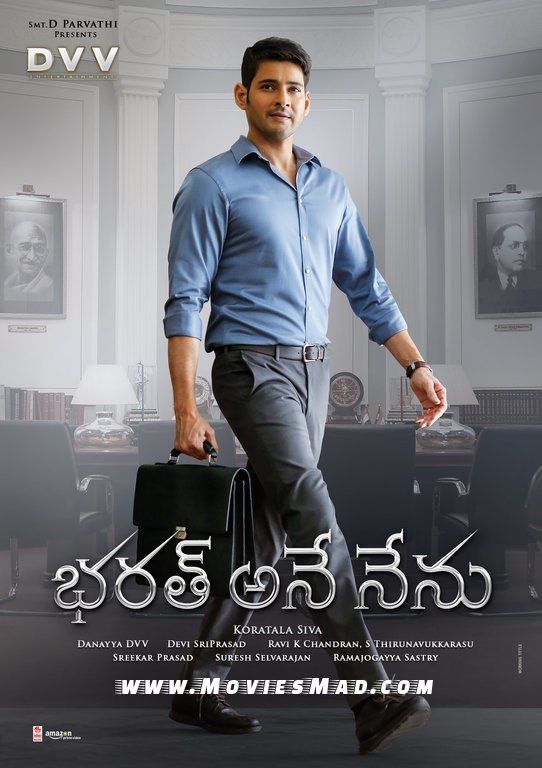
Bharat (Mahesh) is a perennial student in a London populated by white people with bizarre accents. He is on his 5th university degree, and has no immediate plans to stop studying. He is smart and curious, but might lack a bit of focus or motivation. Called home after the sudden death of his politician father (R Sarathkumar), Bharat is inveigled into taking up the apparently hereditary role of CM by his dad’s friend and colleague Varadarajulu (Prakash Raj). But while Bharat may be clueless about local Andhra Pradesh issues, he’s very rules driven and task focussed and likes to act decisively. He will bring back the FEAR, RESPONSIBILITY and ACCOUNTABILITY (caps courtesy of the subtitles team) that he thinks society needs. And that sets him on a collision course with pretty much everyone in politics.

There are some odd inconsistencies in Bharat’s logic at times and it felt like there was an often unacknowledged conflict or contradiction in the film between what he stood for and what he did. Bharat left home to go live with friends in the UK when he was just a kid. He stayed away for years, but he still remembers his mother telling him stories about duty and doing the right thing (underscored by her death when he broke a promise so….). He seemed happy to follow his own whims while abroad and had no firm plans. However Hyderabad traffic sets him ablaze with indignation. He’s a true believer, fighting to see his vision brought to life, and at odds with the career politicians who feather their own nests. A benevolent dictator is still a dictator so I found it interesting that apparently I was supposed to see this as democratic representation of the will of the people. He was never elected, just chosen first by calculating party men and then by public acclaim. And the film shows that acclaim can turn very quickly to scorn. I really did like that in what could have been a clichéd scene of people coming to the Hero to rid their village of a problem, he turned the tables and asked why they didn’t save themselves. It’s a tired trope that needs to be retired or examined, and having Bharat say he would support people but they had to get off their butts and do something to help themselves was excellent. He sees a girl at a bus stop every morning and has no qualms about using state resources to get her number, but he does ask for her consent at key junctures so there is that. He asks why the roads have to be closed for his ministerial convoy but again, no issue with taking over an entire restaurant so he can have a coffee date with Vasumathi. There’s a bit of “don’t do as I do, do as I say” in Bharat.

Mahesh is convincing as the driven reformer who wants to remind people of the rule of law, and he can carry off the grand speeches. Bharat starts out using his intelligence and will, but at a point his awesome fighting skillz surface. It’s fitting that at the moment he went from protagonist to Hero, he was surrounded by swirling movie tickets just like the paper thrown by a cinema audience to greet a hero’s entrance. The action scenes are highly stylised, relying on Mahesh’s ability to stare down the camera while sauntering past wearing a baddie as a backpack. I laughed loudly and alone at that visual! Koratala Siva knows exactly what he is doing with the mass tropes and with his actor. I don’t think there is anything in the role that challenged Mahesh’s abilities but he gives a committed and smartly layered performance. For those who rely on me for other insights about layering, yes he wears t-shirts and even flashes his knees. I suspect in one scene that he might have had two white t-shirts stitched together to avoid any hint of transparency. But it’s modern, minimal layer Mahesh in terms of wardrobe.

Kiara Advani is Vassu, the object of the CM’s affections. While Vasumathi is interchangeable with just about every other newbie Telugu film heroine, she is vaguely intelligent and has a life. She obviously likes Bharat, but is nervous because of his position and just because she’s a middle class girl. Her giving him a stick on moustache was a stroke of genius. Seeing Bharat happily at one with the crowds on their low key dates because of his dodgy mo was very funny. Unfortunately after a promising start, Vassu loses all agency as soon as men start on about their own honour. I’m neither here nor there as far as Kiara Advani is concerned. She is fine but there’s so little to the character that I couldn’t say she brought anything unique to the role either. Her outfits were boho student in daily life but the songs are where the costume department run amok.

The Devi Sri Prasad soundtrack is full of tracks that sound like other tracks, and the lyrics are loaded with dubious English rhyming nonsense. Perhaps I am being harsh and Vasumathi likes to be called “my lovely harmonica”! Mahesh’s prime dancing days are a thing of the past, I think, so the choreography was largely of the walking and pointing variety. The big set number Vachadayyo Saami is a standout mostly for the colour and spectacle (which includes the aforementioned knees).

The supporting ensemble is full of competent actors, well cast, and most with a bit of depth or development to their characters. Prakash Raj is excellent as the avuncular Varadarajulu, completely believable as the long time friend and frenemy. Anish Kuruvilla, house favourite occasional director/That Guy, plays a slightly slimy but not unlikeable Chief Secretary caught between the party and the CM. He gets to give his appalled expression a good workout, along with a bit of side eye. Brahmaji is the CMs assistant and like most people dragged along in Bharat’s wake he alternates between flustered and tickled pink at the goings on. Another favourite That Guy, Ajay, has a small but sensible role too. And I was very pleased to see good old Mukhtar (Mukhtar Khan) was not forgotten after one pivotal and quite brutal scene. Bharat might be swept away by the public but the continuity and attention to detail and people was there, as befits his character and this film.

If you like the idea of a well-acted, well directed, and more violent story somewhat along the lines of Mr Smith Goes to Washington but with dodgy subtitles do see Bharat Ane Nenu!

Gultoo (2018)

Gultoo

Gultoo, the debut release from director Janardhan Chikkanna couldn’t be any more topical right now given the recent revelations of data-mining from Facebook. Data theft is central to the plot, and this cyber-thriller mixes action, romance and comedy with a story that fits neatly into Bangalore and the city’s IT industry. Although at times the images are shaky and the editing could do with some polish, the dialogue is snappy and on-target while the story is novel with plenty of sneaky twists along the way. Definitely a film to look out for, and the subtitles are pretty good too!

Alok (Naveen Shankar) is a scholarship student in engineering who has a flair for hacking his way into computer systems, something which gets him out of trouble at college. After graduation he has grand plans of a start-up company that will allow him to follow his dreams, but three years out from college he’s working in a coffee shop, while his best friend and roommate Aasthi (Ram Dhanush) works at an internet café. Alok also works part-time as an instructor in a small computer teaching centre where he meets Pooja (Sonu Gowda) on her first day in the job. Although Alok is initially rather shy, eventually a romance blossoms between the two as Pooja succeeds in drawing Alok out of his shell.

Aasthi on the other hand has no such problems and is a complete flirt, which provides some excellent comedy as he chats to various women on WhatsApp while also meeting his current girlfriend of the day at her flat. The two men are a study in contrasts – Alok is a typical computer geek, quiet and shy but he’s smart and has big plans for his future. Aasthi has no ambition himself and is waiting for Alok’s success with his loud, brash persona simply a front for his inability to make his own decisions in life.

Gultoo

Things take a sinister turn when a woman is found gruesomely murdered and Aasthi may be a suspect. At the same time, Alok and Aasthi are also implicated in a major data theft and are taken in for questioning by an investigator from Delhi, even though the evidence seems largely circumstantial. The film moves back and forwards throwing glimpses of past and present together and just as it all seems to be coming together, Janardhan Chikkanna throws in another twist that ups the tension even more. He also blends the action well with some comedy, even in some of the most blood-thirsty scenes, that works well to prevent the film from becoming yet another crime flick.

What works really well here is the plausibility of the plot. The theft of information is from a Government database called Sudhaar which collates personal information for every Indian citizen, including their bank data. There are some similarities with the current Government Aadhaar identity card scheme which makes it seem quite possible that such a situation could happen.  Alok and Aasthi are typical young men, but Alok has the knowledge and ability to break into a Government system. The question is, does he have a criminal mentality too? It’s a more cerebral crime than a simple credit card scam or bank fraud, and more credible too with anonymous hackers breaking into systems where security is lax. We all know that this occurs and it seems that every day there is yet another news story about a data breach.

I did love the excellent depiction of cybercrime as a shadowy underworld where thieves run amok stealing data and selling it to the highest bidder. Like much of the screenplay, it’s funny, smart and informative all at once. Alok’s classes for example, teach the audience just as much about computer programming as they do his students. The social references are all just as topical and the dialogue has plenty of current slang that fits the characters perfectly.

The other selling point of the film is that none of the characters are simply black or white. There is plenty of ambiguity in everyone’s actions (except perhaps Aasthi who just wants to get laid), and no-one is exactly who they seem to be. This uncertainty ensures that the climax comes as a surprise and even though the film goes back to point out all the clues that were there all along, this feels like a revelation and not the writer gloating over how clever he is.

Naveen Shankar and Ram Dhanush are both appearing in their first film, but both do an excellent job with their roles and effortlessly get under the skin of their characters. Naveen is just serious and shy enough to be believable – he’s a computer nerd after all, while Ram Dhanush never lets his Aasthi get too much out of control. He’s a typical bloke, but not obnoxiously childish or patronising, and at heart he comes across as a nice guy. Sonu Gowda is also very good, especially in the second half where she gets the chance to really sink her teeth into a rather grey character indeed. Avinash is perfectly cast as the police officer determined to torture a confession out of his suspects, whoever they may be, as too is Rangayana Raghu as the ostensibly ‘honest’ Chief Minister Anantharamaiah. Pawan Kumar makes an appearance as a consultant IT specialist called Phaneesh and does just as good a job in front of the camera as he usually does from the other side.

Although I enjoyed the soundtrack, for the most part the dance sequences look awkward and more like the sort of routines you’d do in front of your bedroom mirror. The placing of some of the songs is also a little off, although this could partly be due to the clunky choreography which makes these sequences rather amateurish. Also initially confusing are the switches between past and present at the start of the film, since there is no timeline at this point, or any explanation of who the different characters are who only appear briefly and aren’t mentioned again until much later in the film. However, apart from these issues (mainly those dodgy dance sequences), the rest of the film really is excellent, with some very clever ideas and smart thinking behind an intelligent and carefully plotted thriller. Kudos too for the ‘loading’ symbol before the opening credits and the clever use of a film within a film idea that ensures the name of the movie is frequently repeated. Gultoo = Log Out for anyone who wants to know what the title means and hasn’t seen the movie’s FB page.

There is a freshness and vitality about this film and with great performances, a clever and realistic plot and very funny dialogue this is one not to miss. Highly recommended.