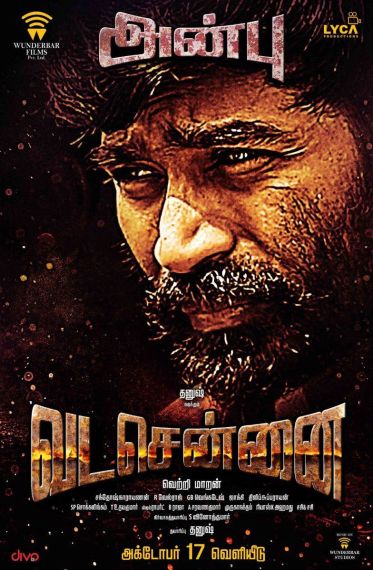
Vada Chennai (2018)

Vada Chennai

Vetrimaaran’s Vada Chennai is an excellent gangster film and a promising start to his planned trilogy. As with his earlier work, Vetrimaaran’s characters here are complex and their relationships with each other are tangled and multilayered, while the action is more straightforward although often brutally violent. The film lays a solid base for the character of Anbu (Dhanush) but also provides a detailed introduction to a multitude of other characters, all of whom contribute to Anbu’s development and his gradual fall into rowdyism. However, this isn’t a film solely about Anbu, but rather a story about an area of Northern Madras and the people who live in ‘the hood’, which ensures the film delivers more of an impact and gives a larger canvas to develop the main players. With an exceptional cast, detailed characters including strong female roles, and the exemplary performance of Dhanush, Vada Chennai is a compelling story that has all the elements to be a classic of the genre.

The first half of the film switches back and forth in time as various key characters are introduced and their background story revealed in a series of ‘chapters’. Anbu wants to be a carrom player, and Vetrimaaran plays on this throughout the film, using the analogy to show that every small action starts a reaction, the impact of which start yet more reactions, and so on in an ever-widening ripple effect. From that perspective it’s hard to say where the story of the film starts. Is it at the beginning of the film where there is a gruesome murder, or where Anbu saves one of Senthil’s men from being knifed during their registration at Chennai prison? Or is it when Anbu meets Padma (Aishwarya Rajesh) during a thieving spree when a riot breaks out after Rajiv Gandhi’s death? The constant throughout is Anbu’s reluctance to enter into the violence he sees all around, and his desire to succeed as a carrom player, although his ambition seems doomed almost from the start.

Initially the film revolves around the rivalry between two gangsters, Senthil (Kishore) and Guna (Samuthirakani). Both are out to kill each other and they each control separate wings in Chennai prison. However, they don’t start out as enemies and the beginning of the film shows Senthil and Guna along with Velu (Pawan) and Pazhani (Sai Dheena) collaborating in a murder. In a particularly grisly moment, they throw their blood-stained weapons, still festooned with goblets of flesh, onto the table in a restaurant before discussing the recent death of MGR and the likelihood of Jayalalitha replacing him as Chief Minister. After the murder, Guna and Velu go to jail, expecting to be swiftly bailed out by Senthil, but when this isn’t the case, their rivalry is quickly escalated to an all-out war between the two factions.  Vetrimaaran brings politics into the story early, showing that the gangsters are canny enough to use the politicians for their own ends, but also as a foreshadowing that politics; local, gangster and state are behind much of the skulduggery later in the film.

Anbu enters this atmosphere in the prison and after a number of incidents finally manages to fall under the protection of Senthil, with whom he shares a common bond in their love of carrom. Anbu is almost an ‘accidental gangster’ having grown up in a shady area of North Chennai and associated with various gang members for all his life. But it’s after he meets Padma and the two begin their relationship that his problems really start. When local rowdies start to give Padma a hard time, Anbu is moved to protest their actions. One thing leads to another, and Anbu is suddenly running for his life along with Padma’s brother (Saran Shakthi). From here Anbu continually tries to get back to life as a carrom player, but it turns out that the gangsters have another role for him to play.

The rich detail in every part of the film ensures that every character is realistic and the various events occur organically within the plot. Every aspect of prison life seems to be captured by the camera, including the method used by the inmates to smuggle drugs in and out of the jail, while life in the slum area of North Chennai is just as intimately shown. Each character is built up from numerous different interactions along with the flashbacks that add depth and a rationale for their behaviour. Ameer is brilliant as Rajan, a smuggler and gangster who was also a protector of the people and who stood up to the local politicians when they wanted to clear the entire area for their own money-making projects. Rajan is the man who first encouraged Anbu to take up carrom and his influence is felt across the story, although he doesn’t appear until late in the film.

Also excellent are Samuthirakani and Kishore as Guna and Senthil, while Daniel Balaji is another standout in his role as Thambi. In contrast to Vetrimaaran’s previous films, he has two strong female characters here who also have important roles to play in the story. Aishwarya Rajesh’s Padma bursts onto the screen as a foul-mouthed thief, but her interactions with Dhanush are brilliantly done, with the romance between the two always feeling realistic and plausible. The scene where Anbu goes to ask her father for her hand in marriage is a rare spot of comedy in a generally dark film, but it still fits well into the narrative, as does Padma’s insistence that Anbu shaves before his wedding. Unfortunately the gangsters intervene and it seems as if Padma will also take a second place with her husband.

Andrea Jeremiah is also superb and has an almost Shakespearean role as first Rajan’s and then Guna’s wife, Chandra. She has a godmother who interprets various omens and predicts the future, most notably proclaiming Anbu as ‘the one’, while Chandra herself is a complex character whose dialogues always seem to have a number of meanings. Andrea Jeremiah initially seemed out of place, but as the film develops and her character evolves she ends up fitting perfectly into the role and her initial aloofness makes perfect sense. Dhanush is perfect as Anbu and completely fulfils the role of a gentle man, driven to violence by events outside his control. He easily slips into the role of a teenager but his real strength lies in the more complex older Anbu who has to deal with his time in prison where everyone seems out to get him. The gradual development of Anbu’s character over the course of the film is brilliantly done and Dhanush captures each facet of his personality and slowly allows the persona to develop. It’s another masterful performance and it’s only at the very end where the change from gangster to ‘voice of the people’ seems rather too abrupt, perhaps because the rest of the characterisation has been so slow and detailed in development.

This rushed feeling at the end is really the only downside to the film. In interviews Vetrimaaran has said that he initially had over 5 hours of film which he has condensed to 164 minutes, which may account for the hurried feeling and the final fast metamorphosis of Anbu. However, despite this, the detail included in the film is comprehensive and the layering of events and characters is a major plus that works to build the entire world of North Chennai inhabited by the characters. There are also some stand-out action scenes in the midst of all the character development. A fight that breaks out at a carrom competition in the jail is beautifully filmed as the protagonists battle it out while simultaneously holding up the shelter over their heads. The initial murder, which is shown in detail later on, is also excellent with a brilliant build-up of tension in the moments leading up to the actual attack. Velraj perfectly captures all the action and despite the dark tones, his cinematography paints a surprisingly colourful picture of life in the area, while some scenes, such as a pursuit though lines of hanging washing are excellent in their picturisation.

Although there are a number of songs in the film, these are used only in short bursts to highlight a particular scene, but Santhosh Narayanan’s background score is perfect and thoroughly enhances the film without being intrusive. Some of the melodies are beautiful and it seems a shame that they aren’t heard in full in the film, but there really is no opportunity for any love songs or dance numbers and with so much else in the film, they really aren’t missed.

After working together on Polladhavan and Aadukalam, Vetrimaaran and Dhanush have again produced another excellent collaboration in Vada Chennai. As the first part of a trilogy there is inevitably a lot of time spent on setting up the story, but here that is so detailed with numerous interwoven threads, that the film is almost complete in itself. The strong cast and compelling storyline ensure that even at almost three hours the film doesn’t feel overlong and the final scenes deliver plenty of anticipation for the next instalment. Hopefully there won’t be too long to wait!
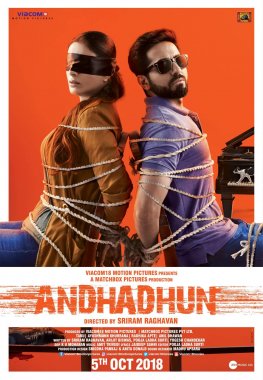


Andhadhun


What a smart, darkly funny, thriller this is. I’m going to try to avoid too many major spoilers but really if you haven’t seen this yet, stop now. Go see it. Then come back and let’s talk.

Akash (Ayushmann Khurrana) is a blind musician who teaches privately while practicing for a competition. Sophie (Radhika Apte) is a kind girl who accidentally runs him over and then finds him a job playing piano in her dad’s restaurant. As Sophie leaves Akash’s apartment it seems he can actually see. He meets Pramod Sinha a.k.a Pammi (Anil Dhawan), a star of yesteryear, at the restaurant when he plays one of the old man’s signature tunes. Pammi then hires Akash to play a private concert in his apartment as an anniversary surprise for his wife Simi (Tabu). Akash turns up and sees signs that something disturbing has happened. He keeps playing blind and makes his excuses to leave. Does Simi suspect he is a witness? What did he really see? Simi is paranoid, and decides to take further investigative action. And then things get really crazy.

This is a rare film where the entire cast and crew is completely in synch. The dialogues flow, beautifully delivered by a superb cast, and underscored by great visuals and sensitive use of music. The comedy and the drama both veer into dark territory but despite my finding some acts repugnant, I was so invested in finding out what on earth would happen next. Relationships are complex and can change. I liked that while most of the people were kind of despicable, it was often unclear who was playing it for real or faking it at any given time. There are double crosses and shady deals happening all over the place as Akash and Simi both try to hide their secrets and protect their dreams.

Simi takes to crime with elan. She is a hard edged almost star, with the drive and ego to do what she believes is necessary to protect her brand. She married the much older Pammi to boost her career but her breakthrough is elusive. Tabu is awesome as she has to do deliberately bad acting, just plain bad acting, and also delivering some exceptionally good comedic acting, sometimes all in the same scene. Her facial expressions are superb as calculating and narcissistic Simi tries to find the best way out of any adverse situation. Simi is a recognisable “type” but she isn’t played as a caricature when it would have been so easy to do that. It’s a fine balance, and Tabu nails it.

Ayushmann Khurrana’s blind acting, and the transitions between pretending to be blind and using his sight, are beautifully played. Whether the scene is funny or tense, he literally does it in the blink of an eye. As things go from great to bad to worse he keeps believing things will sort themselves out if he could just get a break. He’s manipulative and uses other people but when backed into a corner he can also be vicious. Akash tells a lot of his own backstory so it’s impossible to know how much is genuine and how much is self-serving, especially when he is trying to impress Sophie. Akash is a slippery character and I felt that Khurrana gave a fully developed characterisation of an unreliable and untrustworthy character. I never felt that there was anything missing but I also knew that Akash wasn’t what he seemed or that we had seen the real man. Like Tabu, he really gets his character so he can push the pathos and comedy without becoming a parody. And hurrah for an actor who bothers to learn how to look like they may actually be playing their instrument.

Sophie is a good person. She helps Akash because she feels she owes him after the bingle. Later when attraction sparks between them, she doesn’t agonise over her feelings or his blindness. She goes for it, accepts him for who he is, and tries to understand how life is for him. When she discovers that much of his identity is a lie, her reaction is equally frank and fully articulated. Radhika Apte is the straight man to Tabu and Ayushmann and her role is small, but she has impact. Someone in the film had to have a moral compass, and that was Sophie.

Tonally similar to films like Lock, Stock and Smoking Barrel or In Bruges, the movie sweeps between witty one liners to shocking confrontation to observation driven humour. Based on a French short film L’Accordeur I prefer this extended mix, I have to say. The high and lows, the tension and release, are all masterfully orchestrated by Sriram Raghavan. I loved the set design and locations. I got a real sense of Akash’s neighbourhood and the disorientation when he was outside of his literal comfort zone. Simi’s apartment screamed nouveau riche socialite. I don’t often like Amit Trivedi’s soundtracks as they can sound a bit samey and repetitive. But in this case, the music is intrinsic to the story and the mix of retro songs and original pieces is excellent.

I didn’t really know what to expect from Andhadhun and I was absolutely delighted. It’s a smart, pacey thriller with great, and very flawed, characters driving the crazy action along. Every time I would think “surely they won’t?” they did! One of the best of 2018!

Comrade Kim Goes Flying (2012)

Who says North Koreans can’t have dreams and be fun?

The film is a European-DPRK co-production, directed by Kim Gwang Hun, Nicholas Bonner and Anja Daelemans and written by Sin Myong Sik and Kim Chol. The film is shot in the DPRK, mostly Pyongyang, and stars a North Korean cast.

Kim Yong Mi, the titular Comrade Kim, works at a coal mine. She’s an enthusiastic worker but her true passion is acrobatics, specifically the trapeze. She admires Ri Su Hyon, a famous performer at the prestigious Pyongyang Circus. When Yong Mi gets the opportunity to work in Pyongyang for a year, she not only gets to see the circus, she decides to try out at an open audition. She meets many set backs – including her unexpected fear of heights and some snobbery among the other trapeze artists – and ultimately fails the test. But she also finds great support from her fellow workers, and honestly has the best boss ever. She works hard, puts on a show at the Workers Festival for her construction unit and just as it seems she might get another chance at her dream, her year is up and she returns home. Will Yong Mi’s father let her go back to the big smoke? Will judgemental Pak Jang Phil realise she is the perfect replacement for Ri Su Hyon? You betcha, and the training montages come thick and fast. But will she ever master the legendary quadruple somersault?

It’s interesting to see how the DPRK Juche philosophy plays out in a standard Western style rom com. And it’s a surprisingly fun blend of socialist work ethic and follow your dreams movie magic. The challenges and obstacles that Yong Mi confronts are usually resolved through her persistence and hard work, with an emphasis on teamwork and sacrificing individual glory for a greater goal. Her clashes with the leading man start to settle once he respects the potential of a working class person. At a point when she feels like she should give in, colleagues and friends turn up to cheer her on, all feeling that her achievement will be their victory. Sure, some scenes lay it on a bit thick but overall the tone is cheerfully naive and earnest.

I holidayed in the DPRK a couple of months ago and despite the extremely different way of life and society there, found many of the people I met to be warm, often funny, and very much my cup of tea. So I think the film strikes a chord because I could relate to some things and others reminded me of places or things I saw on my trip. The colour palette and the slightly retro look of the city suits the story too. And the use of animated sequences in some transition scenes draws on the North Korean propaganda artistic style.

Yong Mi gets a second chance because of all the people helping her. She is cheeky and smart but what they respond to is her effort and determination, not just her smile and jokes. She might have her head in the clouds but her work teams hit their targets and she contributes to their achievements. She uses her wit and charm to overcome obstacles and I liked how people would find a way so everybody could win. Ha Jong Sim is likeable and invests Yong Mi with energy and warmth, I could see why people liked her. She is a model worker and when her boss Commander Sok Gun says they should put on an acrobatics display with her teaching the workers, she throws herself into the practices too. I absolutely love that her way of putting Pak Jang Phil back in his box is by challenging him to a cement mixing contest.


Commander Sok Gun (Ri Yong Ho) tells his brigade that putting on a show for the workers festival is about the team not the individuals, and that everything can be achieved with self-belief and revolutionary spirit. He goes out of his way to help Yong Mi achieve her dream because he is a lovely person but also because he doesn’t like the snide elitism of some of the circus performers. He will support the working classes and show how much potential they have. He’s a great boss for Yong Mi and his salt of the earth calm is a good foil for her more emotional character.

Pak Jang Phil (Pak Chung Guk) is Ri Su Hyon’s trapeze partner, going through a crisis when she retires. He is obviously living a fairly cushy life and believes his skills make him special. He resists helping Yong Mi at first but of course her grit and talent opens his eyes to considering her as a possible performer. And there are the stirrings of a romantic relationship. But I kept telling her she could do better than him. He is very much a pampered city boy who has to learn some respect for the people whose toil allows him to live so well. I think he could afford to put in a bit more effort before she decides he has learned his lesson.

The support cast are all good and represent all the essentials in a social drama – family elders, best friends, work mates, and various authorities. Kim Son Nam had that thankless role of film dad who doesn’t support his kid until right at the end, but his reservations were because he was worried for her. So he was a wet blanket, but a well-meaning one. I particularly liked gruff Kim Chol as the foundry foreman, Sin Gwang Son as the nerdy youngest steel worker and his cute fanboying over Yong Mi, and Kim Song Ran as Yong Mi’s bestie.

This is not a film that will rock your world, but it’s a competent and highly enjoyable movie about following a dream. I watched it in a week when I needed some good news, and this put a smile on my face. 3 ½  stars!