Badhaai Ho (2018)

The Kaushiks live in a cramped old apartment in a colony overflowing with other lower middle class families. Priyamvada (Neena Gupta) runs the household and her husband Jeetu (Gajraj Rao) is a ticket inspector on the railways and sometime poet. They have two sons, 20-something Nakul (Ayushmann Khurrana) and stroppy teenager Gular (Shardul Rana), and Jeetu’s overbearing mother (Surekha Sikri). After a particularly trying evening, tired of keeping the peace, Priyam retires to her room. Jeetu reads his latest poem to try and sooth her hurt feelings. The poetry, the stormy night, the emotion…one thing leads to another. And 19 weeks later, the Kaushiks find out Priyam is pregnant.

When people find out about the pregnancy, reactions are varied to put it mildly. The GP and his wife are supportive of Priyamvada but give Jeetu the side eye as though to say he should have been more careful. The boys are just horrified that their parents still have sex, and are embarrassed by their degenerate behaviour. The mother-in-law goes full harpy mode and criticises Priyamvada, saying she is no better than she ought to be. And the gossip mill goes in to overdrive as news spreads.

Jeetu tells Priyamvada he’d prefer she had an abortion, but she won’t contemplate that option. He gently tries to make her see the downside, but says finally it’s her body so it should be her decision. Good man, Jeetu. I really enjoyed seeing an older couple as the focus of the story, and Neena Gupta and Gajraj Rao are wonderful. They are both conditioned to defer to their elders and maintain the peace. She looks elegantly middle aged, her face showing gentle lines and character. He is sweetly reticent, all business and stingy as hell on the surface but secretly romantic.

I loved a scene at a family wedding where he manoeuvred his way to be close to her in a photo, his face alight with booze and proud affection. The female relatives and wedding guests are less happy with the pregnancy and make free with their remarks, tormenting mild-mannered Priyamvada. Neena Gupta was quietly compelling but easily switched to perfectly timed comedic beats. Seeing Jeetu and Priyam navigate their way through a life changing surprise, their relationship, and all the reactions was highly engaging without being overly dramatic. It was disappointing when the film shifted focus to Nakul and his girlfriend as their relationship is one you see in every other film. I liked seeing the often invisible people get their time front and centre.

In the midst of all the talk of reproductive rights and safe sex, the male characters’ idea of masculinity rarely strays from the often toxic manly man stereotypes. Jeetu is in demand as a fertility coach among his peers, asked to counsel a troublesome nephew who remains childless despite two marriages. The nephew is introduced dancing enthusiastically to a Sridevi hit song as onlookers make snide comments. Gular is considered to be fine once he has beaten up a bully and asserted his masculinity. Nakul made fun of an impotent friend and hides lest he be on the receiving end. His jokes are funny, in a mean spirited and rehearsed way, but it is kind of telling that his friends are really frenemies. The men seem less supportive and rarely get real in their conversations with each other. The women bitch and bicker but ultimately they seem to get that family is what it is and in the end all they may have is each other. And bingo.

Ayushmann is delightful as the sooky, moody manchild Nakul who is the centre of the universe. His timing in the dialogues and his physical reactions are just about perfection, and when Nakul isn’t brooding he has a goofy energy that lights up the screen. But Nakul is an entitled dick and everything is about him. Everything. And although I was happy to see some character growth, I grew tired of the perfection of reformed Nakul, Best Son Ever. Even when the baby is born, he makes it about him. I just never really got why the boys were so horrible. Shocked, sure. But feeling betrayed – why!?! When the film detoured over to focus on him and Renee, I did lose some interest. On the upside he and Sanya Malhotra are great together and also do some excellent eyebrow choreo in the big production number, Morni Banke, that closes the film. I love an all-in end titles extravaganza!

Sanya Malhotra is charming but Renee is a little under-written, a standard issue modern girl. I liked that she has a career and that she straight up called Nakul out on some things. But when her supposedly progressive mother, played by the elegant and considered Sheeba Chaddha, criticises the Kaushiks and Nakul fires back, Renee breaks up with him. It seemed a bit convenient for the plot given her previous behaviour, but I didn’t care so much about that relationship. She has appealing looks and energy, and was a good match for Ayushmann.

Jeetu’s mum likes an orderly world where people pay attention to god and their elders, but she might not be as backward as she seems. Surekha Sikri is over the top as cantankerous Dadi at first, but when restraint was needed she wound it back nicely. Dadi helped demonstrate the strong familial love and support that helped the Kaushiks get through everything. Mostly by demanding maximum forbearance from everyone around her.

I was so relieved that Priyamvada is not simply fodder for tacky jokes, despite the dreadful poster designs. Writer Akshat Ghildial and director Amit Ravindernath Sharma deliver humour, pathos, social critique and a warm respect and affection for most of their characters. I like a good slice of life middle class social comedy and this delivers in spades. A great cast, a smart screenplay, and beautifully immersive visuals make this a delight to watch.
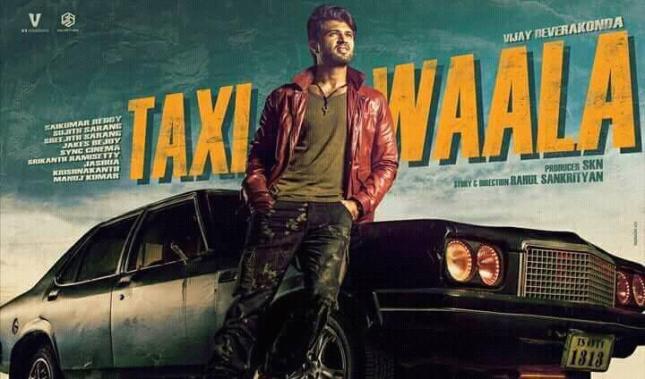
Taxiwaala (2018)

Taxiwaala

Rahul Sankrityan’s Taxiwaala is a supernatural comedy based around a taxi driver’s relationship with his car – which turns out to have a few more extras than he bargained for. The film has plenty of laughs, mixed in with a smattering of uncanny moments and just enough to jump scares to keep it interesting, although it does start to falter a little in the second half. Thankfully Vijay Devarakonda, Madhunandan and Vishnu Oi make an excellent team, helping to keep the film on track as it attempts to veer off down a number of side alleys. Their top-notch performances and a well written story ensure Taxiwaala is entertaining, even if it does end with an overly sentimental finale.

The film starts with a few set-up scenes to introduce the concept of a haunted car and it doesn’t really take off until Shiva (Vijay Devarakonda) arrives at his uncle’s garage in Hyderabad, looking for work. His uncle Babai (Madhunandan) runs the garage along with his apprentice (Vishnu Oi) called Hollywood because of his interest in American films. Babai suggests a number of jobs for Shiva, but since all of these involve major effort for little reward, Shiva struggles to stay in any of them longer than a day. So when an advert for taxi drivers goes up on a billboard near the garage, it seems like the answer to Shiva’s problems. Except that he needs a car… and he doesn’t have any money…

Luckily for Shiva his brother (Ravi Prakash) and sister-in-law (Kalyani) come to his rescue and raise the money he needs. With his limited funds, Shiva doesn’t have much choice, but is overjoyed when a broker finds him a vintage Contessa car at the right price. Even though the owner Raghu Ram (Sijju Menon) seems dodgy, and we already know that the car has given its previous owner some issues, Shiva is ecstatic with his purchase and takes time to fully restore the vintage car before starting work as a taxi driver. Although Shiva does well as a taxi driver, it doesn’t take long for the true nature of his car to make itself known and Shiva has to decide if the risk is worth the reward. It’s not as simple as just giving up either, since Shiva is paying for his sister-in-law’s vital medical treatment now that he is in a position to pay his brother back.

What works really well here is the character of Shiva and his petrol-head fuelled love of his car. It’s easy to understand how he falls heads over heels for the vintage automobile at first sight and why it becomes such an integral part of his life so quickly. His girlfriend Anu even comments that she takes second place to the car, and that is very definitely true. Vijay Devakonda has plenty of charisma and he turns it on full for much of this film, endearing himself to his passengers and ultimately the audience too as he comes to grips with working as a taxi driver and dealing with customers. Vijay has great comedic timing and uses it to good effect throughout the film so that his actions come across as totally spontaneous, which is a hard thing to get right. Madheenandan and Vishnu Oi are also hilarious and writer Saikumar Reddy has done an excellent job with the dialogues which really are laugh-out-loud funny. Adding a more traditional comedy actor can completely change the tone of a film and move the comedy focus away from the action, however here Chammak Chandra enhances the story in his support role without taking anything away from the main leads. Also, a major plus is the fact that his comedy comes through dialogue rather than slapstick and his involvement is kept in context with the main action.

Newcomer Priyanka Jawalkar plays the role of Anu, a taxi passenger who ends up in a relationship with Shiva after he behaves chivalrously when she is very drunk one night. After the initial meeting, Priyanka has very little to do here, the entire romance is pretty much all contained in one song, and she doesn’t have much chemistry with Vijay so it’s hard to say too much about her capabilities. However she’s fine with what she has to work with and it will be interesting to see her in a more central role. Malavika Nair has a little more to do as Sisira Bharadwaj and there is an extended flashback in the second half that explains her story. She still doesn’t have enough screen time to make much of an impact but her performance is competent even if I didn’t quite buy into the reasoning behind her choices. The flashback involves Yamuna as Sisira’s mother, Shijju as her stepfather and Ravi Varma as a paranormal professor who explains the concept of astral projection, all of which means that the flashback is rather too long. While the length means it detracts somewhat from the main story, it does provide a neat explanation for everything that has happened so far and sets up the finale reasonably well.

Overall the film looks good and the special effects are well done, especially those centered on the car. The jump scares are genuinely unexpected and mostly tied in with some comedy which works really well. Jakes Bejoy’s music also fits the mood, particularly the background score, and the songs themselves are reasonably catchy. Sujith Sarang provides excellent cinematography and the action is all well choreographed and suits the characterisation of Shiva. There are no big all out fight scenes, but instead plenty of small action scenes, the most impressive of which require Vijay to act against the car. It’s to his credit that he makes these believable with his reactions. Rekhs and her team (credited for a change!) do a magnificent job ensuring that the subtitles make sense in English, and they have also subtitled the written captions, which are so often forgotten in films. I love the yellow font too, which is so much more visible and easier to read than white.

The only real issues here are the long diversions in the second half to explain the supernatural element and a rather schmaltzy finale which all happens a little too easily for me. For the most part the story moves along well and although there are some obvious plot holes I think that is to be expected when talking about something so unrealistic. The best part of the film is undoubtedly the comedy but with great performances and a well written story, Taxiwaala is definitely another hit for Vijay Devarakonda. It’s clear he’s going places too – last night’s Melbourne show was the first Telugu film in a long time that played to a full cinema and the film had an appreciative reception. This is one definitely worth catching on the big screen to get the full impact of the special effects and really appreciate the comedy.


Sarkar (2018)

Sarkar

2018 seems to be the year for political movies, particularly those where the hero is an outsider deciding to run for office. After NOTA and Bharat Ane Nenu, this time it’s Sundar Ramasamy (Vijay) a self-styled ‘corporate criminal’ who decides to take on the corrupt Chief Minister during elections in Tamil Nadu. A.R. Murugadoss has added in some real-life scenarios which help add interest to a plot that otherwise features little more than a routine ‘Vijay saves the world’ storyline. After his recent films supporting education for women and rights for farmers, Sarkar seems to be Vijay’s most overt statement so far that he is considering a career in politics, although I do hope that if he ever does follow through, he has a better campaign manager than Sundar does here.

I’m not sure that being a ‘corporate criminal’, ‘monster’ or ‘the Genghis Khan of the corporate world’ are particularly desirable qualities for the CEO of a company in the USA, but that is how Sundar is described by both his rivals and his colleagues. Sundar himself seems to be more of a wealthy playboy as he runs around Las Vegas with an entourage of women and bodyguards before hopping onto a private jet back to India. Apparently we are to believe that Sundar makes this trip solely to cast a vote in the upcoming elections, which seems fairly extreme and makes him more of an environmental terrorist rather than corporate criminal. However, various CEO’s and company directors are able to breathe a sigh of relief that Sundar isn’t planning a takeover of their company, but is simply a strong believer in exercising his democratic right. Instead, after finding out that someone has already cast his vote due to the corrupt practices of the incumbent political party, Sundar turns his adversarial sights to CM Masilamani (Pala. Karuppiah) and his side-kick Malarvannan (Radha Ravi) aka Rendu.

Vijay is always excellent in these sorts of roles where he has to mix stirring speeches with action and a stern but righteous expression. He still looks incredibly young, but this time sports a salt and pepper beard, which does give him some maturity and suits the more serious situations. However, for the most part his character’s actions are not believable and many of the political issues are dealt with too simplistically to be completely engaging. Still, Vijay has plenty of charisma and is able to carry the film easily.

Sundar gives up his day job to run for office, which doesn’t ring true despite his spirited speech to an antagonist crowd about his lowly origins as a fisherman’s son. However the speech itself is excellent with a well thrown tomato is used as a metaphor for greed and the plight of humble workers. Later, Sundar uses his missed vote as a way to educate everyone about regulation 49-P and to convince his audience that every single vote is important. These are some of the best parts of the film, where Sundar motivates the masses and exposes the corruption at every level of government. When Vijay is in full speechifying mode he is very impressive but when it comes back to individual dialogue the unlikeliness of some scenarios does reduce their impact.

Both Pala. Karuppiah and Radha Ravi excel at traditional-minded, self-serving and corrupt politicians, but their conventional behaviour means that most of the confrontations between Sundar, Masilamani and Rendu follow an entirely predictable path.  As their power, prestige and ability to make millions in easy money is threatened, Rendu employs the police and multitudes of disposable minions to remove Sundar from the public eye. He never considers that every action will be recorded by the common man on his/her mobile phone, and that the media is on hand too to record every shady deal, even going as far as to walk out of a TV interview when Sundar arrives. However, Sundar’s response is also classic underdog reaction and despite all the wonderful slow-motion fight scenes and rousing rhetoric, for the most part Sundar is just as predictable as the politicians he opposes.

Perhaps to counteract this old-school predictability, Murugadoss adds another villain in the form of Komalavalli (Varalaxmi Sarathkumar), Masilamani’s daughter. This could have worked well, except for Varalaxmi’s stilted dialogue and odd expression, as if there is continually a bad smell right under her nose. I can’t understand how such a usually expressive actor is so lifeless here, but then little about her character makes sense. She tells her father not to worry, that while Sundar may be a corporate criminal she has been a criminal since birth, but there is no explanation of why. Why is Komalavalli the brains behind her father’s political career?  Why then was she in Canada instead of Tamil Nadu when the elections were being held? So many questions and absolutely no answers. Instead Komalavalli is a one-dimensional character whose sole reason to exist seems to be to cause general misery wherever she goes. While at least her presence does give Sundar an opponent with the smarts to fight back, she’s too little too late and just too shallow to be a completely worthy adversary.

Even worse though is the inclusion of Keerthy Suresh as Sundar’s love interest, Nila. Nila is Sundar’s sister-in-law, although the marriage between Nila’s sister and Sundar’s brother has broken down. Sundar and Nila restart a relationship seems to be more friendship rather than anything else apart from one dream sequence song. For most of the time Nila follows Sundar around, stands in the background, and then follows him around some more. This type of political film doesn’t need a romance, certainly not a nothing of a romance that doesn’t even deserve the word, and there really seems to be little point in including Nila or her jealous reaction when Sundar dances with someone else.

Sarkar isn’t a bad film, it’s just a surprisingly ordinary offering from a film-maker who normally delivers a more exciting and well-polished story. Vijay is excellent and the film technically looks great with well choreographed fight sequences and good use of crowd scenes. A shout-out to for the generally very good subtitles, although none of the writing (including a very long piece of text at the start of the film) was subbed. Still, good to see other groups using the same style as Rekhs and adding English idiom rather than direct and nonsensical translations. The other departments are all fine too. A.R. Rahman’s music doesn’t particularly stand out apart from Oru Viral Puratchi, but it is well placed in the film and works as a rousing to action song while the others generally blend into the screenplay without disrupting the action.

The support cast, including Yogi Babu and a large number of students, voters and election officials are all very good and the parts of the story that deal with the mobilisation and politicalisation of the ‘common man’ are well handled. It’s really the predictability of the film that brings it back to earth and the knowledge that whatever happens, Sundar will best his political foes. His path to power seems to happen very easy, and very quickly here – there are massive poll swings from 5% to 80% literally in the course of one day, and a voting result that can be swayed in just a few hours. If only it were that simple! Overall, Sarkar is a watchable and reasonably entertaining film that works fine as a political stepping stone for Vijay but just could have been that little bit better. Worth watching for Vijay, Radha Ravi and the idea of what could happen when ‘ common people’ take action!