Kannathil Muthamittal

I watched Kannathil Muthamittal when a number of people recommended it to me after I worked in refugee camps in Sri Lanka. I think that my experiences there have really coloured my view of the film as I do focus more on Shyama’s story and less on the main characters. That said, I think the story is well told and the actors all do a good job – it’s just not the story I wanted to see.  It’s a classic Mani Ratnam film with strong female characters, great cinematography and attention to detail, so it’s no surprise that the film won six National Awards.

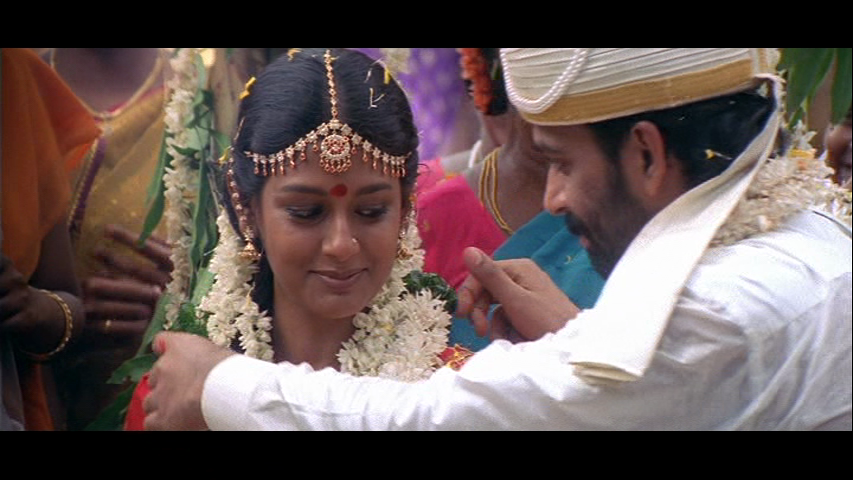
The film opens with the wedding of Shyama (Nandita Das) and Dileepan (J. D. Chakravarthi) in their village located in northern Sri Lanka. Despite this happy start it’s not long before Shyama is pregnant and on a boat heading for a refugee camp in India while her husband is missing, presumably fighting for the LTTE. Once she gives birth in the refugee camp, Shyama leaves her daughter behind and heads back to Sri Lanka to try and find her husband.
From here the film skips forward in time to introduce G. Thiruchelvan or Thiru (Madhavan) and his family, as seen through the eyes of his adopted daughter Amudha. Convincingly played by P S Keerthana, she appears to be a typical precocious 9 year old; playing with her friends at school, teasing her two younger brothers and very definitely the princess in the family. The story of her adoption is told in flashback and shows the development of the romance between Thiru and Indra (Simran).  I really like this part of the story as the two leads play their parts well and the intertwining of the adoption story and the romance is really sweet.

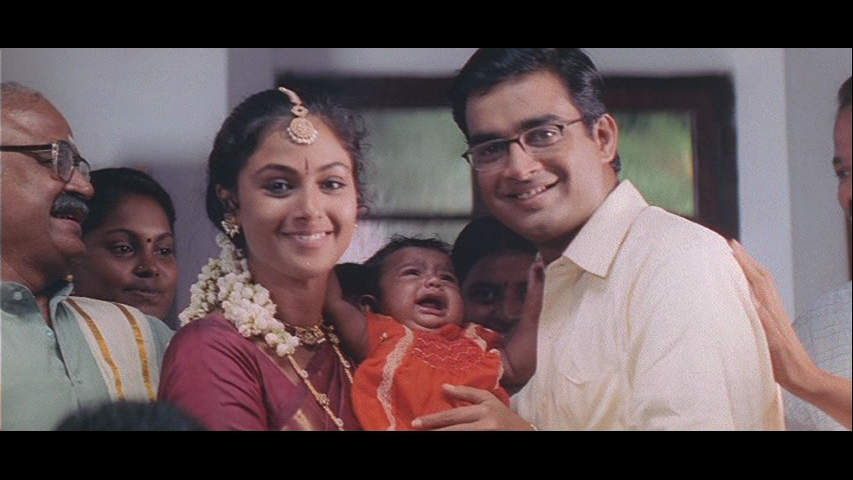
After she is told by her father on her ninth birthday that she is adopted, Amudha becomes moody and withdrawn and finally demands a chance to meet her real mother in Sri Lanka. For some inexplicable reason her parents accede to her demands and the family head off to the war-torn nation, although they did have the good sense to leave their other two sons behind.

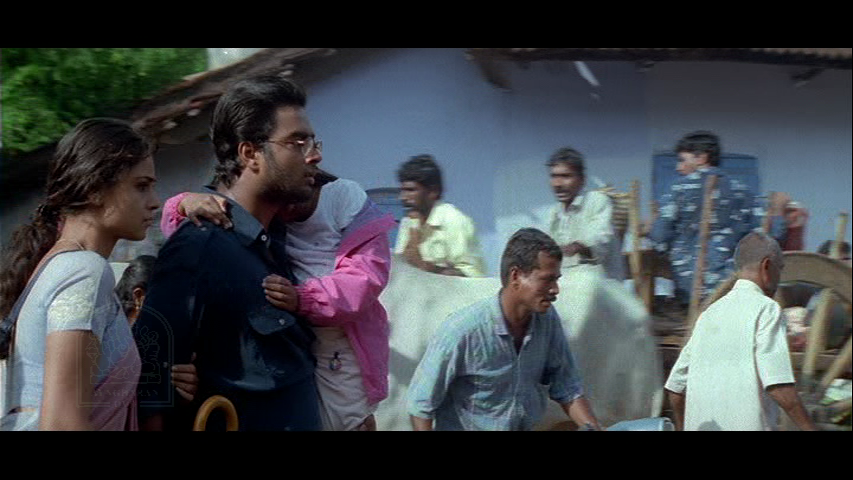
The scenes in Sri Lanka make me cry every time I watch this film. I have seen the same mix of resignation and total despair on people’s faces that is shown here when a village is evacuated. I worked on the East Coast and regularly travelled between LTTE and government controlled areas. The incredibly young soldiers with their automatic weapons shown in the film is very much true to what I experienced and for me this total realism clashes with the more idealistic search for Shyama. Mani Ratnam wisely doesn’t attempt to explain any of the conflict, only showing its effects on Indra and Thiru as they realise why Shyama left her baby behind.

Amudha becomes bratty and rude as she deals with her feelings of alienation from her family and as a consequence I lose much of my sympathy for her. I also disagree with her parents’ decision to try and find her birth mother, no matter how essential it is to the plot. However both Simran and P S Keerthana convey their conflicting emotions and fluctuating relationship well and Indra’s  inner conflict as she worries about her two sons left behind in India is effectively depicted. Although Amudha is irritating the young actor does hold her own against the more experienced cast and it may be more due to the over emotional story that I lose interest in her search. Madhavan’s character, although impressive in the beginning, seems to have little impact in the latter half of the film and Prakash Raj is wasted in his role as the doctor taking the family around Colombo. So while I enjoy the first half of the film, the second half tends to drag with the adoption story and the peripheral action is more engaging . Some of Amudha’s rebellion in this section could have been cut without losing the feeling of her isolation and separation from the rest of the family. The ending is also a little disappointing but Mani Ratnam shows restraint in not turning the final scenes into melodrama, which could easily have occurred given the subject matter.

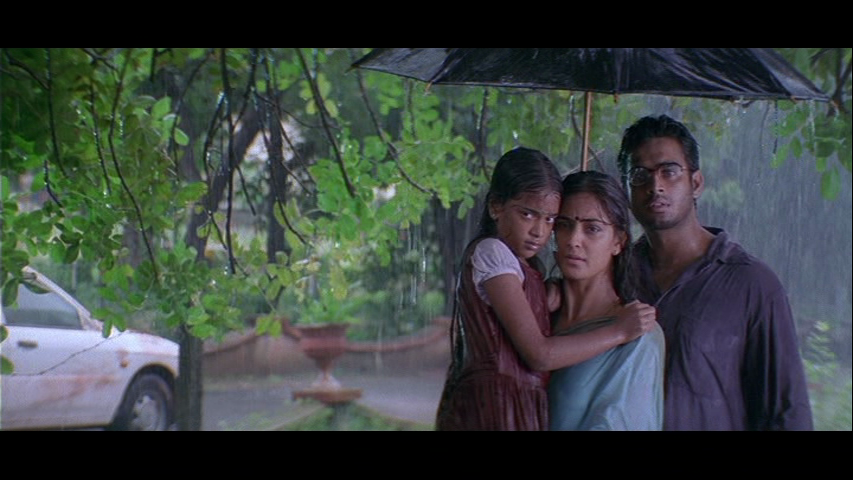
What I do like about the film is that it looks beautiful and is well shot by cinematographer Ravi K Chanran. Lighting is used to good effect as the early scenes in the family home are filled with warmth in contrast to the rain and grey skies in the later part of the film. While the background score of the film by A. R. Rahman is both beautiful and haunting, some of the songs are a little intrusive. The story doesn’t really need dance numbers and they seem to interrupt rather than move the film forward.

This isn’t a film I particularly enjoy watching, probably more because of the memories it evokes, although I can see why it won awards and I do think it’s generally well acted. It’s just that I would have preferred to see more of Shyama’s story and less of the family drama.  3 stars from me, mainly for the first half.

Temple says: This is one of the first Tamil films I saw a few years ago, and I was prompted to pick it up because of the storyline and for Madhavan.

Thiru (Madhavan) fell in love with the idea of giving Amudha a home and family, and I always feel that if Indra hadn’t agreed, then someone else would have been procured to play wifey. His decisions all revolve around what he wants – the way he courts Indra, the adoption, telling Amudha and persisting when it was clear she wasn’t ready for this birthday surprise, and on it goes.  The job of explaining and reassuring was left mostly to Indra, and she had to bear the emotional burden of seeing her little girl in torment as she herself struggled to cope. Simran is lovely as Indra, but her character is surprisingly weak considering the way she met Maddy, and her being a news anchor. I expected more backbone, but the women in Mani Ratnam films are often written like this – a strong outline and not a lot of finer detail to make them seem more real.

I was adopted and my mother told me every day, long before I even knew what words were, so it would never come as a shock to me and to make it clear that ‘adoption’ isn’t a dirty word. My perspective is coloured by that and while I can understand the bratty Amudha wanting to know her own story, I will never understand her adoptive parents taking her into a war zone no matter how much she sulked.  Still, the treatment of her story in terms of her developing understanding, the legal adoption process, and the fallout once the truth emerged was handled in a much more credible manner than many other films with orphans scattered around the streets, under cabbage leaves, going free to a good home.

The prologue was excellent in setting the scene, but beyond that Shyama and Dileepa didn’t really fit. The context of the Sri Lankan conflict added another dimension, but also made the second half of the film too dramatic and improbable when they went looking for Shyama. So although a fascinating and moving topic, here it is just used as a background for the  family weepfest.

The soundtrack works well in the film, but I find the songs bland. The picturisations are beautiful, most are very stylised, however I can only take so much fabric blowing around and children running on the beach. They suit the mood of the film, but having seen them before, I made a cup of tea during a couple of songs this time. I felt the same about the story device for the flashback – the handwriting and drawings became a distraction and took my focus off the action. Pretty visuals just aren’t enough to keep the film on track.

When Mani Ratnam wants to belt you over the head with a message about peace, unity, love and what makes a family, he can make Bono seem subtle. I give it 3 stars.
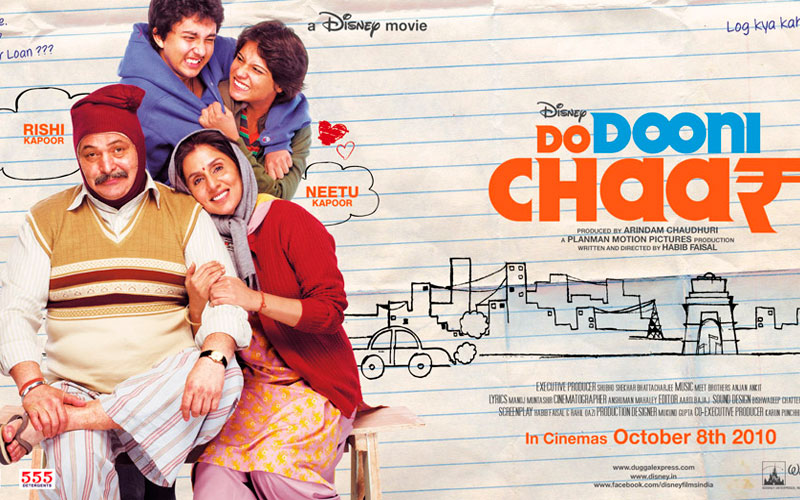
Do Dooni Chaar (2010)

I was pleased to see this as part of the Indian Film Festival as Do Dooni Chaar didn’t get a cinema release here, despite starring legendary couple Rishi and Neetu Kapoor. It only attracted a very small audience at this showing—maybe 20 people —which really surprised me. Half of that number ran for the door when the subtitles failed to materialise, in search of someone in charge. But all was OK. The film was restarted (the Indian audience members complained loudly and jokingly about having to watch the titles again), the subs kicked in and we all settled down. Well, I hadn’t moved. I was going to watch it regardless so it was more fun to listen to all the huffing and grumbling!

The film was picked up for distribution by Disney and that tells you almost everything you need to know. It’s a nice film with message about decency and family, all wrapped up in a sweet sentimental shell. There’s nothing to object to, but I didn’t feel there was much to get excited about either. It was just… nice. And sometimes a nice film is just what you want.

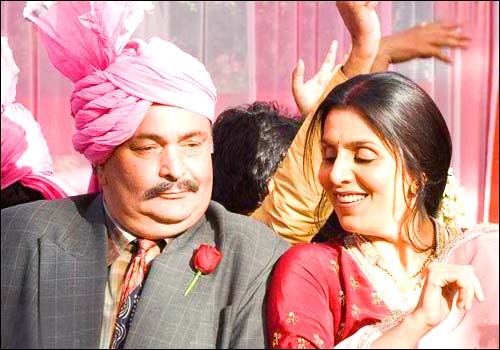
Rishi Kapoor plays Santosh Duggal, a maths teacher and father of two. His wife Kusum (Neetu Kapoor) runs the household on his very limited income and maintains the cramped apartment to the best of her ability.


The kids, Payal (Aditi Vasudev) and Deepu (Archit Krishna), are typical teenagers and want all the latest things and best brands. They don’t have a lot of respect for their father, and see his poverty and lowly job rather than his values and intelligence.

The film opens to an argument about how Santosh’s INR7700 tax refund would be spent. The Duggals are a noisy, argumentative family, and the scene is punctuated by doors slamming and lots of shouting as people careen around the tiny flat. Kusum wants a fridge while the kids want everything from an iPod to dish TV. Payal, depressed by her lack of cash and stylish clothes, is a moody teen who bosses her weedy boyfriend around.  Deepu, or as he prefers to be called, Sandy is cruising by on charm. Until he comes unstuck, Sandy is a slick character with an eye for the girls and an unusual fried chicken based romantic style.


The central issue of the film is the pressure on Santosh to buy a car to replace his antique scooter. The car represents so many things to the Duggal family; success, status, independence, pride. But they can’t afford it. They have to budget carefully to have chicken for dinner so a car is a huge deal. The stress of this situation almost drives Santosh to make some extremely dubious decisions and accept money for giving a bad student a passing grade. He seems to embody the nice guy who finishes last, held back by his honesty and simplicity. He refuses to allow Payal to take a call centre job, ostensibly because it will delay her education, but as Kusum points out he also forced her to leave work on their marriage. She is at her wit’s end trying to keep up with the needs of her family when outgoings always exceed their income. The clash of old school and new world thinking is played really well and the arguments have the authentic ring of conversations that have been had over and over.

Rishi is so effective in the quieter, more soulful, moments when he drops some of his actorly mannerisms and he really looks and sounds like a tired dad.  He has a lovely conversation with Deepu/Sandy where they talk about why Santosh didn’t fly into a rage over a discovery and ends with him quietly asking the boy to make the right choices. Santosh’s relationship with Payal is more challenging and those scenes are more vocal and aggressive. But Payal discovers a new admiration when she sees how much he meant to his old students, and how highly they thought of him for his work ethic and standards. I have to say, Rishi didn’t look at all at home in the tiny apartment and I wonder if he went to boot camp to learn to handle an iron. Neetu plays Kusum as the driving force inside the family home, channelling her energy into alternately cajoling and threatening her husband and kids.  She is charming and energetic, refusing to let the exhaustion of her routine slow her down. Santosh and Kusum have a very delicately played scene where they try not to discuss the potential bribe, and Kusum is all for taking it although she doesn’t want to do anything seriously wrong. In a scene at a family wedding, Neetu drags Rishi out to dance and they prove the old sparkle is still there, even if his moves are suspect. There would be something a bit amiss if they didn’t have great chemistry!

I wish I hadn’t read some interviews with the Kapoors about the making of the film. They both went on a bit too much about how their costumes were just average off the rack shop bought clothes and how they didn’t mind wearing something so common to make the film work (I’m paraphrasing). So every time Rishi pulled on another of his knitted vests, I felt an eyeroll coming on. But Rishi IS synonymous with knitwear so it was also quite pleasing.

The supporting cast were all good. I especially liked Aditi Vasudev’s performance. She was bratty and whiny but also had Kusum’s strength of will. She wasn’t at all glamorous, and looked like a typical student. Akhilendra Mishra was also fun as the neighbour Farooqui. He and Rishi had some lovely scenes as the men tried to avoid their warring wives.

I really enjoyed the family scenes, and thought the dialogue was excellent in those episodes. I was less taken in by the scenes with the neighbours, and the final ‘I just make sweets but a good teacher makes great human beings’ speech was just too much for my taste. The message had been coming through loud and clear so being hit over the head with it for the final fifteen minutes or so was overkill.

I also loved the neighbourhood locations and the glimpses of shops, houses, schools and other settings. I always like a film that gives me a strong sense of place and Habib Faisal did an excellent job in making the locations seem so real. The soundtrack is punchy and matched the inner city feel perfectly.

It was a pleasant enough way to spend a couple of hours, and always nice to see old favourites show they still have form. It’s an almost old-fashioned film, and it promotes values of decency and honesty. It is very sentimental, but not too syrupy. I give Do Dooni Chaar 3 stars.

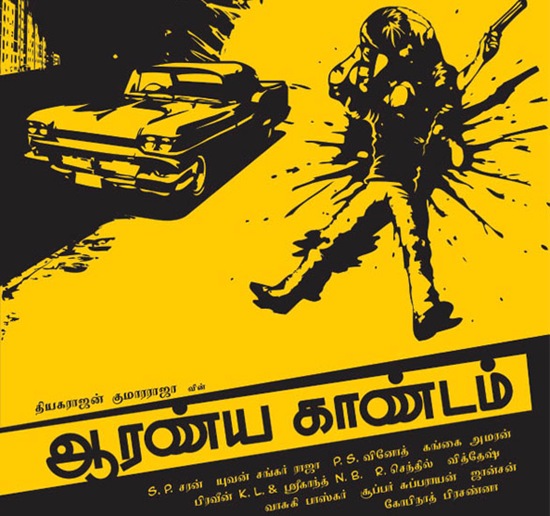
Aaranya Kaandam

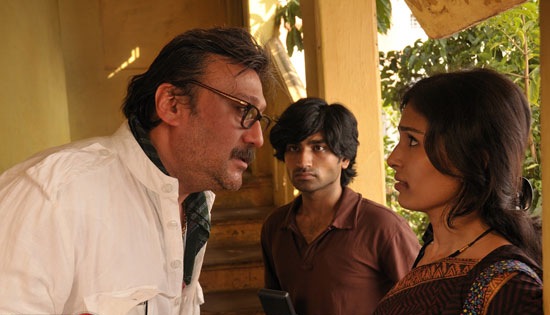
Aaranya Kaandam should come with a warning – an excess of fake violence, actual real life violence against chickens and naked Jackie Shroff. Yes really! Jackie Shroff takes his clothes off in this film.  We have no idea why the organisers of the Indian Film Festival decided to choose this film over many other excellent Tamil releases this year. Perhaps they wanted to see Jackie with his kit off, but why we all had to suffer is a mystery!

The film is a long (too long) tale of double crosses by Pasupathy (Sampath Raj) when he is caught between two rival factions of gangsters. One gang is led by the aging Ayya (Jackie Shroff) and Pasupathy starts out as his more adventurous and able lieutenant. Ayya resents his younger henchman and when Pasupathy organises a drug deal through a corrupt cop to steal cocaine from a rival gang we know it’s all going to turn out badly. Adding to the mix are Ayya’s mistress Subbu who wants to escape, Kaalayan who manages to stumble across the drugs, his competent little son Kodukkapuli, and the other gang leaders Gajapathy (who has an impressive pair of ears) and his brother Gajendran.

Although the overall story is interesting there is too much time spent setting the scene and explaining exactly who is who.  First time writer and director Thiagarajan Kumararaja seems to have been heavily influenced by films such as Traffic and Pulp Fiction where there are a number of apparently unrelated threads which come together to form the climax of the film. But while he manages to  bring the various storylines to a more or less satisfactory conclusion, they don’t all work as well as each other. In addition to the pacing problems, there is a heavy reliance on gimmicky edits and lighting effects that lose their impact through over use. The actual cinematography was excellent, and the street and interior scenes were saturated with colour. Again, we suspect some of the highly stylised angles and use of colour filters was influenced by films like Traffic but it lacked structure so it looked a bit too try-hard.

The soundtrack is a mish mash of musical styles and sounds. We think this might have been meant to create an art house feel, but really it sounds more like someone bought a world music CD and used that instead of going to the trouble of composing anything special. Like the gimmicky editing the music became intrusive and sometimes detracted from the scenes, often simply because it was too loud.

The story of Kaalayan and his son is rather laboured and the inclusion of some rather nasty cock-fighting scenes with lots of lingering slow motion shots and buckets of gore was quite unnecessary. A lot of this could have been cut without losing any of the backstory in our opinion.  The child actor was fairly effective, and the audience certainly responded to his performance.

Sampath Raj puts in an impressive performance as the man trying to work his way out of a difficult situation. He has a good hero run, and puts it to use frequently throughout the film.

We know that traditionally anyone who is Jackie’s friend in a film seems to be marked for a horrible death or at least significant misfortune so we were expecting the wheels to fall off for Pasupathy. Jackie Shroff grunts his way through a series of inexplicable grimaces and as we mentioned decides to bare all. Thankfully there is pixilation but just not enough of it. Jackie Shroff himself may have preferred a larger area of pixilation as frankly it appears there was not all that much to be covered up! It’s not surprising that Subbu wants to escape from his early morning coughs and gurgles as well as the obvious horror of naked Jackie. Ravi Krishna is the gullible Loser who gets caught up in her plans for flight. Both he and Yasmin Ponnappa in her debut role turn in good performances despite a hackneyed plotline.

What does work is the dialogue, which seems snappy and funny despite the overuse of swearing in the subtitles. According to our Tamil language expert the characters weren’t actually swearing most of the time, so it seems strange that the subtitles decided to include as much profanity as they did. Especially when it seemed that every second word out of the kid’s mouth was something that our parents would still disapprove of. Maybe they knew there wasn’t enough plot to last the distance?

Temple says: This was a bore and a disappointment. The entertaining moments were few and far between, and the direction wasn’t focussed enough to make the incident heavy plot stay on track. I quite like Sampath Raj and if the story had been better balanced, this might have been a good gangland thriller. As it is, it’s a mess. I give it 2 stars – for Sampath Raj and so the torture of the poor roosters wasn’t in vain.

Heather says: While I didn’t find this film boring, it really wasn’t pleasant to sit through. There was a lot of really unnecessary violence of the gruesome and graphic kind, and the rooster fight scenes were totally unwarranted. Jackie Shroff was a real disappointment, although I didn’t have high expectations from him anyway. I can think of many actors who would have played this role much more convincingly – although all preferably without the nude scene! There were some good moments hidden amongst the carnage, some reasonable performances from a number of the actors, and even some good comedy. But not enough to save this film from collapsing under the weight of all the various plot threads. 2 stars from me.