Aa Gale Lag Jaa

There is a scene that gets me every time. Shashi Kapoor heartbroken, on roller skates, in a white safari suit, playing the accordion and yodelling (thanks to Kishore Kumar and RD Burman) as he sweeps around an empty skating rink at night. It should be ridiculous and yet it’s strangely affecting. And that sums up my feelings for this fabulous Desai film. Aa Gale Lag Ja is convoluted, goes off the rails at the end and relies heavily on coincidences, but I find it beautiful and touching as well. I recently re-watched it with the the excellent company of Beth and Ira, and couldn’t pass up the opportunity to revisit this masala classic for Kapoor Khazana.

I love the leads, it has one of my all time favourite soundtracks (indeed, it changed my views on accordion solos), and the writing is far more interesting than I expected from a retro filmi romance. And they don’t waste time on building up to a song – they just go for it.

Shashi Kapoor is Prem, a poor but honest roller skating enthusiast. He lives up in the mountains so roller skating, as well as life, is very challenging. The beautiful Sharmila Tagore is Preeti, a minxy medical student.

I appreciate Shashi’s wobbly attempts to skate. It lacks flair, but he is endearingly earnest. Sharmila is very good at fake skating and her pretend waterskiing in Evening in Paris was also excellent. I also applaud her efforts to look like she is gliding majestically under all that Spare Hair. The wig is bigger than she is! Prem is poor, Preeti is rich, they’re both good looking and there is no doubt about the results. Especially after he sells himself to science for an afternoon so Preeti can test hypothermia treatments on this most willing of guinea pigs.

After a song related mishap, the two spend a night fighting off hypothermia.  What an amazing coincidence! Given that Shashi’s innate hotness seems to dry out his clothes in no time flat, the ‘cure’ did raise some questions.

This episode has sparked much debate about whether Preeti was conscious, was it consensual, why didn’t someone keep their pants on … I say she looks rather pleased with herself the morning after and does not strike me as a woman with regrets. My diagnosis is that she woke up, saw what she saw and thought ‘Hello!’
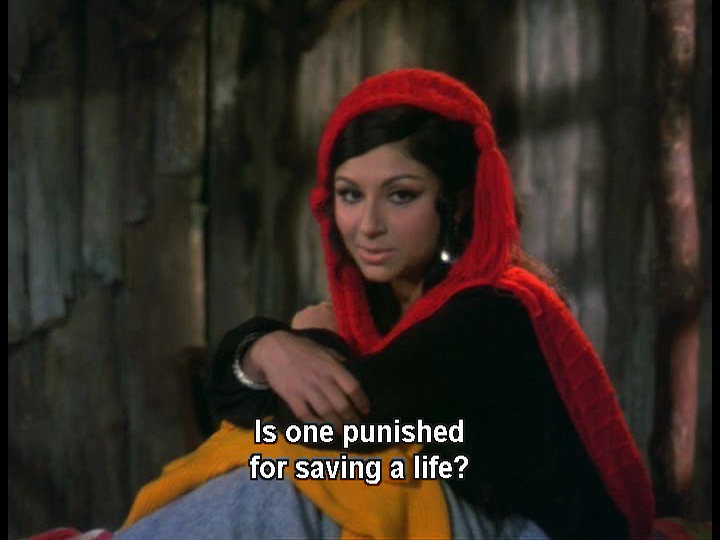
The youngsters want to marry but Preeti’s father Hirachand (Om Prakash) pulls a few swift moves to alienate the lovers. Preeti fell pregnant to Prem That Night and is sent to a sanatorium to have the child in secret. Hirachand and Prem’s ailing mother (Sulochana) play their parts in the drama and Preeti believes the child was stillborn. In a typically filmi twist, Shashi acquires his own son and loses his Ma. Everyone judges everyone else, and the misunderstandings send the protagonists off on their separate paths.

Apart from a spectacular display of acting – Shashi looks so joyous, and unperturbed yet loving, as that baby bawls its head off – this song is quite lovely and sets up the very caring single parent family.


Prem and son Rahul (Master Titoo, one of the few dreaded child artistes I like) have a really lovely relationship. Prem felt no need to marry a substitute for Preeti just so there was a woman to look after them both. He embraced his parenting role and did the best he could. I do think there could be a case for child cruelty when we consider the poor kid’s wardrobe, which features purple and ruffles as well as some hideous short and vest ensembles, but apart from that Prem was a thoughtful and loving dad.

Preeti crosses his path again, and has no idea that Rahul is her child, or that Prem had always loved her and never moved on. Prem thinks that Preeti jilted him to keep her luxe lifestyle and that she never cared about her child.

The ‘will she won’t she realise’ tension is heightened as her fiancé Amar (Shatrughan Sinha) takes over treatment of the crippled boy and so the families draw closer. Shotgun’s entrance is so amazingly filmi, I can’t believe I almost always forget he is in the film until that moment! And his treatment of what he decides is a psychological rather than physical condition is unconventional to say the least. The contrast between Prem and Amar’s economic circumstances couldn’t be more pointed.

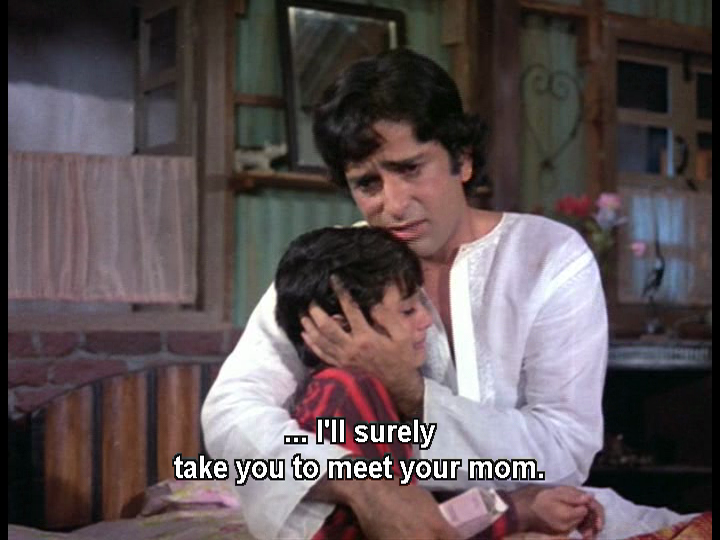
Despite the high level of coincidence and near revelation, the performances of Shashi and Sharmila along with Master Titoo made me care so much about what would become of them. Shashi shows his pain and anger, but also his love for both Preeti and his boy. Sharmila is poised and beautiful, and she shows the uncertainty and hope when she sees her old flame. I also really like that the story is about a man who becomes a single dad while the woman moves on with her life and has no idea she has a living child.

Preeti lives with her father, who of course knows about the child, but there are no great histrionics about her lost honour or anything. She has had a long engagement to Shotgun and her future seems assured. Om Prakash is shown as a lonely old man in his opulent home, and the development of his relationship with grandson Rahul is fun as they bring out each other’s competitive and playful traits.  The winning enthusiasm of the child and his belief that his mother will come back for him one day makes his grandfather realise the gravity of his deception. There’s a lot of quiet heartache in amongst the more dramatic antics.

As for the who’s who and what of the story…There’s a Significant Song, a secret photo, Ticky (Amar’s sister, played by Ruhi) loves Prem, Prem loves Preeti, Preeti loves Prem (again), Amar loves Preeti, Rahul just wants everyone to be happy. We have the flaming roller skates of death, and then the happy roller skates of ever after. Almost everyone ends up on wheels at some stage, even the token thugs who hang around menacing young ladies.

But the mad masala trappings never really get in the way of the story so I think Desai and Prayagraj must have had some robust conversations of their own to make sure they kept the balance right. The dialogue by K.B Pathak is marvellous, shadowed with meaning and laden with emotions. When Prem and Preeti meet again, and he sees her as the rich girl who has done well for herself, the polite bitterness is pitch perfect. There is great use of eavesdropping, particularly in a ‘musical chairs’ scene that throws the protagonists into proximity and under stress where much is explained in small bites of barbed civility.

And then, I’m left with that image of Shashi on roller skates playing the accordion.

See this as a great example of Manmohan Desai’s masala excellence, for the beauty and appeal of Sharmila and Shashi, for the marvellous songs by R.D Burman and for the passionate and romantic love story that produced a happy family but didn’t feature a wedding.  5 stars!

Pithamagan

Pithamagan is not a film for the faint hearted. Like other Bala films, it deals with society’s poorest and most disadvantaged – in this case, he delves into the world of cremators, petty con artists and drug pedlars.  And yet it’s very watchable, with excellent performances from Vikram, Suriya and the rest of the cast making Pithamagan much more than just another film about the miseries of being poor and outcast.

The focus of the film is the relationship between Chittan, an orphaned cremator and Sakthi who is a small time criminal. Chittan is born in a graveyard and brought up there by the cremator who seems to do his best for the child. However Chittan grows up to be unable to deal with society; he cannot communicate in words, and is unable to understand the basic tenets of normal behaviour.

After his guardian dies, Chittan ventures into the local town where he creates mayhem before being rescued by Golmathi, a local cannabis dealer. He ends up following Golmathi home, and since she has a kind heart and feels sorry for another orphan like herself, she helps him to find a job. This turns out to be at a cannabis farm and when it is raided by police, Chittan ends up in jail. There he meets Sakthi who also feels sorry for Chittan and tries to help him cope with life inside prison. Sakthi is a petty crook who runs street tricks and confidence games which seems to have given him a performers approach to life. He has a sunny disposition and a positive outlook despite his circumstances and occasional rather interesting dress sense.

After Sakthi is released from jail he works with Golmathi to secure Chittan’s release, and along with Manju, a student who was once victim to Sakthi’s confidence tricks, the friends then spend most of their time together. They work on improving Chittan’s appearance and behaviour, and try to get him away from the drug trade with mixed results.  However, the local drug baron has other ideas and the final conclusion is as bloody and gruesome as you might expect.

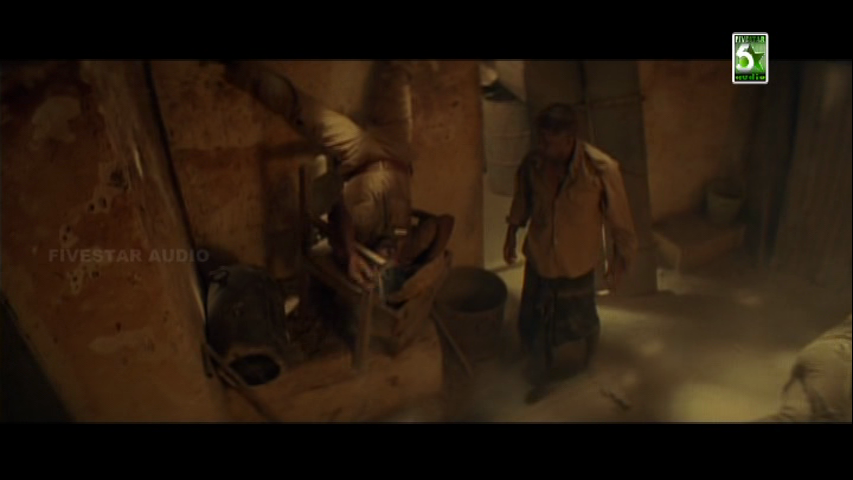
While the story itself is rather predictable, overall the film works well and this is down to the chemistry between Vikram and Suriya. Vikram seems to be able to take any disability and make it instantly realistic. I really believed that he was blind in Kasi and here he is totally convincing as the mentally disturbed Chittan. His facial expressions are just perfect and he really does appear to be totally wild and uncontrolled. It’s hard to define exactly what Chittan’s problem is, but as a scientist (and brain researcher!) I’m immediately intrigued and want to analyse the cause of his condition.  Is he simply a wild child – raised without the benefit of society and therefore unable to function within its rules? Or is it more organic and he has a functional neural developmental problem? I tend to favour the latter as the cremator who took him in was able to speak and obviously had some idea of how to interact with the townspeople. So the total inability of Chittan to communicate and relate seems to be something more than just growing up with little social contact. It also doesn’t explain why he was able to fight so well, but obviously that was essential to the plot and we can’t ask for too much realism I guess. I love that he left the policeman upside down in the shot below – the fight scenes really were good in this.

I also find it interesting that in so many of Vikram’s films, his character is somewhat crazed, and he is completely convincing each time! But as good as Vikram’s performance here is, I think that Suriya manages to equal it. This is the first film where I have really ‘got’ Suriya’s appeal. I’ve seen him in a number of films and while I thought he was good as the cop, or the good guy, or even as the bad guy, I’ve never felt that he’s been anything more than that . But Suriya is absolutely fantastic in this film. He is funny and charming, and breathes life into the story. Most of the comedy comes from Sakthi and his various cons, and without this balance Pithamagan would have been very grim indeed. Suriya’s character has plenty of flaws but at heart he is kind and his relationship with Chittan allows this side of his character to flourish.

Sakthi’s friendship with Chittan is cleverly developed throughout the story and makes it credible that the two would end up as constant companions. Chittan seems initially perplexed by Sakthi’s benevolence towards him but soon realises the benefit of a friend. And later, Chittan’s obvious jealousy when Manju is spending time with Sakthi is both childlike and logical since Sakthi has become the centre of his world.

Sangitha is perfect as Golmathi with her paan-stained lips and philosophical approach to life. Her character is another orphan and her initial pity for Chittan seems similar to how she would feel for a stray dog. But as a drug dealer and someone who is shunned by the local community (unless they want her product), she is able to empathise with his alienation and is the first person to start opening up his world. Golmathi’s emotions and reactions are all plain to see on her face which helps make her character much more sympathetic.

On the other hand, the first time I watched this film I really didn’t like Laila’s character and felt that she over played the schoolgirl. But on re-watching, I think she was supposed to be a fun character with a sense of adventure and an awareness of the possibilities of life which was intriguing to Sakthi. However I think Manju is a much less believable character than the others, and her presence is often more irritating than anything else. Initially her father seemed to be quite strict, even taking her to the jail to beg for Sakti’s forgiveness for her actions, which in itself seemed a really strange thing to do. But then later on in the story, her family seem to let her do whatever she wants, despite knowing that the man she is involved with is a convicted criminal. They do turn up to support Manju in the end, by which time it seems to be too late and is perhaps just a way to make a contrast to the other characters  whose only family is each other. Manju’s presence also provides another dynamic to the relationship between the two men since she becomes a barrier between them. But my biggest issue with her character is her inability to articulate what had happened to Sakthi, and this is a major flaw in the story for me. While I’m quite sure that in real life people become too distressed to be able to communicate, here it just didn’t seem to suit her personality, even allowing for her youth. It was also just a bit too over the top and filmi for a story that relies so much on gritty realism – at least for most of the film.

There is one other odd note, which is the protracted interlude with Simran. This completely changes the nature of the film and lasts just a bit too long. In fact it reminded me of the Hindi film Shakti, where Shah Rukh Khan turns up for an item song and ends up taking over a large part of the final scenes. While the song here is fantastic, and I love it, it stops the flow of the story and the subsequent scenes initially feel out of place as the pace abruptly changes again. But here it is anyway, since both Simran and Suriya are brilliant and it’s very funny.

I think Pithamagan is an excellent film despite a few flaws with the pacing. The friendships are successfully portrayed and the action is fast and well choreographed. Vikram’s grunting and animal noises are interesting and effective, and so much better than his singing which is absolutely brilliant in its tonelessness. I wonder just how hard Vikram had to work to make it sound that bad! The music by Ilayaraja is quite beautiful but not particularly memorable, especially since it’s often used as a backdrop for more of the story. Overall though it’s the performances that make this film worth watching and I would recommend it for Vikram and Suriya who are both outstanding. 4 stars.

Sri Anjaneyam

Sri Anjaneyam is one of those films that I find it hard to make up my mind about. There are a lot of things I enjoy; it has great special effects, an interesting storyline and excellent performances by Nitin and Arjun. But I really don’t like Charmy’s character in this at all, and I find the whole romance sub-plot unnecessary and irritating. Re-watching it for this review, I found that it’s perhaps growing on me and on balance there is more to like than not. But I still wish Krishna Vamshi had left the romance out.

The opening credits have some beautiful pictures which show scenes from Lord Hanuman’s part in the Ramayana.

The film starts, as many Telugu films do, with Prakash Raj. He’s a civil engineer who has come to the drought strickenvillage of Ramapuramto build a dam which should solve the area’s water woes. But he meets with opposition from a local with political aspirations who organises protests and a legal challenge to stop the project. Brahmam is annoyed that he hasn’t got control of the project himself, and thinks that the dam will allow the villagers to become wealthy and independent from him. I love the model below which comes complete with water and gates to change the flow – no wonder Prakash Raj looks happy.

Finally Brahmam sends his brother (who goes by the rather unlikely name of Tarzan), to kill the engineer and his wife. Tarzan isn’t aware that the couple have a son and as a result he is overlooked by the thugs. Alone on a rainy night, the young boy is led to the local temple by a helpful monkey, and takes refuge there. The priest and the villagers take it on themselves to look after him and he grows up devoted to Lord Anjaneya, leading to the villagers calling him Anji.

He’s very devout and grateful to the people of the village, spending his time between helping the priest in the temple, running errands for the villagers and worshiping his ‘boss’ Lord Anjaneya. The story has an almost fairy tale effect in these scenes as the colours are bright and initially Anji’s character is quite simplistic as a spiritual man who is lives to serve to his God.

Anji is a target for the local trouble makers, but he has a stalwart defender in the form of his childhood friend Pardhu. She’s not afraid of a fight and threatens anyone who tries to hurt Anji. When he saves her from a snake bite, she falls in love with him and puts a lot of effort into her campaign to ensure he marries her. Her attempts are probably why Anji looks horrified every time he sees her and runs quickly in the opposite direction. This whole side plot with Pardhu is the part that I don’t like. I think her character is supposed to be feisty and independent but she comes across as an over powering bully and her attempts to attract Anji are quite repulsive. She has a song during which she rolls around very unattractively in mud and while there are a few good moments they are few and far between. I usually like Charmy and I think she is a good actress, so I find it disappointing that her character here is so annoying and has some really terrible lines.

Meanwhile, Brahmam is still scheming and conspires with an evil magician to get rid of his political rival. He discovers a potential source of wealth underneath the local temple and immediately starts planning a way to get rid of the priest and demolish the temple.  However, he has reckoned without Anji, who has supreme confidence that Lord Anjaneya is already on the case and will once again sort out Lord Rama’s problems. His confidence is well placed as Lord Anjaneya does turn up although his aid is more to point Anji in the right direction to fulfil his fathers dream.

There are some really good special effects in this film and a few that don’t work quite so well. But they do make the appearance of Lord Anjaneya quite spectacular, and there is one particularly good sequence when he takes over a statue to fight off the local thugs.

The film develops slowly in the first half, but the pace picks up when Lord Anjaneya (Arjun) arrives. Arjun excels in his role and walks as if he had a tail, scratches perpetually and absentmindedly, and adds in some authentic shrieks and noises as he advises Anji.  He also has the ability to pass on some of his super strength, both of body and mind, which enables Anji to fight Brahmam’s men successfully. The rapport between Anji and his mentor is the best part of the film and the two actors work together very well to bring their relationship to life. Lord Anjaneya is very mischievous and there are some lovely comedic moments amongst the more serious and spiritual advice.

Nitin looks young and innocent as Anji which fits with the character’s spiritual side very well. I could also appreciate his horrified looks every time he ran into Pardhu as I felt much the same. As his character grew in the film Nitin showed an increase in Anji’s confidence while still maintaining his simplicity and this worked very well. Anji was charming and also goofy and funny enough to be a very watchable character.

The various actors who played Brahmam, the evil magician and assorted thugs were all good in their roles. The demon summoned by the magician was one of the special effects that didn’t really work, but the magician himself was quite evil enough to compensate. Interestingly Tarzan was shown to have a conscience and told his brother that all his bad deeds were the reason behind his miserable life. I thought this was a different approach, and helped to explain the conversion of the rowdies at the end of the film.

The story is one of good versus evil both spiritually with the evil magician and his demon against Lord Anjaneya and physically with Brahmam and his thugs against the priest and Anji. But there is also a coming of age part to the story as Anji decides to take on his father’s dam project. I must admit that there seemed to be plenty of water in the village and it was really quite green so a dam didn’t seem to be terribly necessary, but perhaps they’d just had a really good rainfall that year. Other plus points to the film are the wonderful colours and cinematography which, along with the special effects, make it a beautiful film to watch. The music by Mani Sharma is based on chants and this blends in very well to the film. The more modern duets don’t work quite as well but this one is very pretty.

The film is worth watching for the excellent performance by Arjun and his interaction with Nitin. And if like me you don’t like the romance, it’s easy to fast forward past those sections. Generally an enjoyable watch, but could have been better. 3 ½ stars

Temple says: This is a muddle of a film that ends up being an unsatisfying venture. Anji (Nitin) is a holy innocent – a simple man who finds his happiness and strength in his faith, and views his life as a blessing given by god. He has a childlike naivete but also the adamant strength that an uncomplicated resolve can bestow. Pardhu (Charme) didn’t strike me as a real bully. I felt she was also quite childlike, getting by on bluster and clearly being allowed to indulge in her histrionics by people like the smitten local rowdy rather than having any real force to exert. Certainly when a bit of dishoom would have been useful she was firmly on the sidelines.

The acting style was quite cartoonish and upbeat, the visual effects were mostly aimed at younger viewers and this had a family friendly feel initially. It reminded me a little of Krishna Vamsi’s earlier ‘Murari’ but with a more overt devotional aspect.

So I am mystified by the decision to add a highly sexualised and out of place relationship (I can’t call it a romance) track. Pardhu was a bit freaked out by her reaction to Anji sucking snake venom from her chest, and he was horrified by her and her girl germs. These two childlike characters were then placed in songs where Charme had to thrust her scantily clad groin into a stream of pouring milk, roll in mud and so forth. I’m very pleased I’m not one of the parents who had to answer the question ‘Mummy what is that lady doing? And where are her pants?’. When Pardhu suddenly started obsessing about Anji, her relatives said they would help her to tie him to a tree, take his pants and leave her to rape him. This advice horrified her.  It made no sense in terms of their characters and really didn’t work in the overall tone of the film.

The costume designers worked hard for the songs and certainly put the F back in Fugly. It was disappointing again as the rest of the film was quite beautiful, and the cinematography made the most of the lovely temple and village scenery. The other major let down was Nitin. He needed more spontaneity in his expressions rather than stop-think-react-pull a face as it all felt a bit tired, and like I was watching the 17th take of some shots. The story itself needed work – the dramatic aspect of the dam scheme and the murders kept getting sidelined and then would come back then fade out again.

I agree with Heather that Arjun is very good as Sri Anjaneyam and he gave the scenes with Nitin some much needed energy. He showed his confusion at learning to act human, and brought mischief and compassion to his character. Charme did all she could with a ridiculous role.  Prakash Raj was seen all too briefly, but made a great impression with his excellent use of props and his commitment to dying a memorable death.

I can’t recommend the film as there are too many things I didn’t enjoy. You know it’s bad when I have so many things to complain about I can’t even be bothered mentioning the dreaded Comic Side Plot. 2 ½ stars.