Filmi Snake Spotter’s Field Guide

We are delighted to have a special guest post for Liz’s Nag Panchami Film Fesssstival by BollyWhat’s resident snake fancier, jenni.

THE ILLUSTRATED FILMI SNAKE SPOTTER’S FIELD GUIDE

If you have ever seen the film Nagin (1976) you will know what I mean.  That is, that you are really much better off if you can identify a vengeful snake, before you are…well….dead.

If only they had been able to access my handy Snake Spotter’s Field Guide.

 original photograph located at  http://www.flickr.com/photos/dramaqueennorma/122105967/

Introduction

In this guide we will illustrate only a small sample of the many hundreds of filmi snake species featured in subcontinental movies, but sufficient, we hope, to show enough of those commonly spotted varieties, and a selection of rarities, to satisfy the beginner and excite the specialist.

Habitat

We have concentrated on snakes that are hardy enough to have tolerated subtitling and You Tube exposure.  The filmi snakes in this Guide are restricted to the DVD and VCD habitats.   Those filmi snakes only found on videotape and 18mm film are extremely rare and outside the scope of this particular guide.  Indeed, VCD snakes are often difficult to glimpse and are dwindling in numbers to the extent that some may even be endangered.  This is due to years of neglect and the gradual encroachment upon, and degradation of, their natural environment.

Methodology

The following observations are based on extensive work in the field and hours of YouTube research.  Although scientific validation has been undertaken through consultation with both acknowledged experts and enthusiastic amateurs in the area, hypotheses are always subject to revision with an expanded evidence base.

Instructions:

It is a simple case of frequency.  The more of the following identifying characteristics present in any film, the more likely you are to have bagged yourself a filmi snake!


General Filmi Snake Identifying Characteristics

1. Sex

Most important filmi snakes are female.  Male filmi snakes are generally underrepresented and play a comparatively small role in the proceedings.

2.  Actors

If the actor is an item girl (or even an actor who has repeatedly appeared in item numbers), the likelihood of that person being a snake is increased.

3.  Clothing:

a.  Amount of clothing

It is particularly the case in post 70’s movies, that more of a  ‘reverse proportionate’  factor in clothing increases the likelihood of the wearer of said clothing being a snake.  i.e.  the less, and more skanky, the clothing the more likely the wearer is to be a snake.  This appears to be a rapidly developing characteristic of the filmi snake, likely a genetic evolutionary response set in motion to impede the threat of extinction.

b.  Style of clothing

(i)  Female:  Body hugging attire is generally favoured by filmi snakes, therefore traditional south Indian sari tying styles or short half saris are often seen.

In more western style garb they are not averse to a body suit.

(ii)  Male:  Fairy tale princely garb often involving some kind of tunic, puffy shirt or ruffles are often found in the male of the species in the north of the subcontinent.

Southern males appear to prefer the body hugging styles of their female counterparts.

c.  Jewellery

Snakes are, by and large, nicely accessorised.  In human form one has to forego scales which have a natural glitter and sheen, and frequent attempts are made by filmi snakes to replicate this characteristic.  This is generally achieved with either metallic fabric, or substantial amounts of jewellery.

d.  Headwear

Most snakes appear to have headwear, ranging from

(i)  Everyday Use Headdress: a more subtle form (although still often elaborate from a human perspective) often daywear, frequently features a simple cobra head, usually in gold (often a give-away this one).

(ii)  Big Night Out or Ceremonial Headgear. Most snakes appear to have elaborate and bejewelled headwear for special occasions.

(iii) Confrontational Headgear:  Even more elaborate and intimidating than ceremonial headgear. As in their reptilian form, (e.g. cobra hood), this serves to make them appear more impressive and sexually desirable, more commanding and important, or just more threatening.

4.  Eyes

a.  The more eyeliner that is worn, the more likely that the wearer of said eyeliner is in fact a snake.  Heavy application of eyeliner cannot be underestimated as a hot spot indicator for the filmi snake spotting novice.

b.  Coloured contact lenses are currently popular in the filmi snake community.  There appears to be an evolutionary factor to this characteristic, in that the widespread availability of coloured contact lenses has only occurred since the mid 1980’s.

c. The “I am a snake experiencing murderous thoughts and I mean business”  Look.  Often, The Look will be highlighted with a lurid coloured camera lens filter for extra impact.  Sadly, if you are only recognising the snake at this point, you do not have much longer to live.  However, if you can identify this look when it is directed at others you still have a chance, not only of accurate filmi snake identification, but to execute a hasty exit.

5. Habitat

a.  If the said scantily dressed woman is out late at night in an isolated and often forested place, there is an increased chance that she is a snake.

b.  If there is a snake charmer/holy man present with a bedazzled snake charmer’s pipe (been), it is likely that a filmi snake is nearby.  If said snake pipe is being played, the chance a snake is likely to be revealed soon, is high (see Sound).

c.  Actual snakes or snake houses in the frame increase the likelihood of a genuine filmi snake sighting.

d.  Likewise, an environment filled with snake statues is generally a dead giveaway.

e.  (i)  The Jeetendra Effect 1 – Jeetendra Proper:    For reasons unknown Jeteendra’s presence in any film increases the chance of an appearance by a filmi snake.

(ii) The Jeetendra Effect 2 – Munchausen’s Jeetendra:  Sometimes even a Jeetendra look alike will serve this function (e.g. Naag Muni).

6.  Snake (Been) Music

Snake music appears to serve a number of functions and consequently has a complex relationship with the snakes themselves.  Essentially, snake music can provide a state of ecstatic release and abandon for the snake while in human form, through the medium of dance, albeit only briefly  (for more on Snake Dancing see Activity, part b).  Whilst initially snake music can liberate the snake from the confines of the human form, if this state is maintained for too long, or with sufficient intensity, all vestiges of the human state will be shed and the snake will revert to their inner reptilian nature and eventually, their reptilian form.

Reaction to snake music is not always helpful in discriminating filmi snakes from filmi humans in that both snakes and humans will typically experience strong reactions.  It is the underlying reason for the reactivity, however, that is the singular determinant in accurate identification.  Snake music is often cacophonous to human hearing so they will often cover their ears as a deterrent to an adverse auditory stimulus.  Snakes however, though they might also attempt to mitigate the auditory stimulus, have an adverse reaction only because the snake music in the presence of humans renders their camouflage ineffective and therefore exposes them to increased environmental threat. This is because, as previously mentioned, prolonged exposure, particularly at the hands of a trained professional (i.e. sadhu or another snake), can force any snake in human form back to its reptilian state.

Despite the complexities of the interaction between snakes and their music, for the purpose of snake identification the following is a given: If there is snake music, there are generally snakes.

6.  Activity

a.  A snake orchestra usually indicates that filmi snakes are nearby.

b.  Snake dancing provides a reasonable likelihood of a filmi snake sighting in many instances, as long as the following provisos, contraindications, and cautions are observed:

(i) Proviso

Snake devotees rather than the snakes themselves perform a number of snake dances.  These can generally be distinguished by their comparative lack of eyeliner and relatively modest attire.

(ii)  Contra-indication

For the beginner, an oft-made mistake is the misidentification of women emerging from wicker baskets being real snakes.  Although snakes in their reptile form will often perform for human audiences in a wicker basket under contract to snake charmers, snakes in human form will generally not, and if they do, it is usually only as a ruse.  The tradition of women emerging from wicker baskets draws heavily upon both snake myth and stereotype.  These snake charlatans are generally involved in the entertainment industry and bear nothing more than a passing resemblance to the real filmi snake.  At most this is a symbolic plot device to illustrate an underlying jealous or vengeful nature on the part of the character. Otherwise known as the Snakeus Imposterus or, more commonly, Fake Snake.

Snakes love dancing. Genuine snake dancing most commonly can be categorised into five major categories (there are also minor categories beyond the scope of this guide).  An illustrative example for each category is provided.

1. Discovering Your Inner Snaky Nature dance.

When snakes have been reared with humans, they are sometimes unaware of their inner reptilian nature.  Snake music at maturity will allow these naïve snakes to touch their inner nature and sexuality, eliciting both a sense of freedom and power, sometimes conflicted with a great deal of associated confusion and fear (similar in some ways to the experience of human adolescence).

2.  Mating dance.

Can take the form of either an anticipatory mating/attracting the mate or an actual mating dance with the partner.

3.  Work dance.

Either undertaken in royal snake courts, temples, or (usually in snake form) in conjunction with snake charmers for mostly human audiences.

4. Hunting dance.

This dance has the sole purpose of attracting prey (this skilled re-enactment rather than actual footage is provided for illustrative purposes, given that the actual dance is rarely witnessed – at least by someone who lives to show the video evidence).

5.  Confrontational dance.

May occur when the snake is directly under threat and may involve transformations from human, to reptilian nature revealed but still in human form, to entirely reptilian form.

General Cautionary Afterword

The previous are general guidelines, and for every guideline there is an exception.  Snake spotting can be a dangerous activity so it is best to always maintain a state of being alert (though not alarmed).

It is hoped that this guide enhances both the accuracy and safety of your Sssnake Ssspotting experience.

Anukokunda Oka Roju

Sahasra  is a B.Comm student, but her passion is singing. She is a smart, confident girl who is an unwanted addition to her step-mother’s household and she tries to keep her head down.  Her friends are an unexceptional bunch of students and singers, and she is an ordinary girl. So why are people trying to kill her?

Anukokunda Oka Roju translates as Suddenly One Day and the answer lies in a missing day in Sahasra’s life. The action took some time to get going, but I always felt there was some underlying sense I just hadn’t uncovered yet. The direction by Chandrasekhar Yeleti is pacy but allows time for the story to unfold in a way that felt realistic enough and the city setting gives a slightly chaotic edge to the action. It didn’t feel like a join the dots story and there were things that seemed irrelevant initially but took on more significance later. The strength of the characterisations helped keep the suspense set to high despite some overly contrived incidents. Once the motivation behind the attacks on Sahasra was revealed I struggled to completely believe in it, but I was so interested in the characters that I eventually found the ending quite satisfying.

Charmme delivers a great performance as a girl in trouble and out of her depth. Sahasra is a talented singer in a studio chorus with ambitions of singing solos for the great film composers. Charmme shows the spark of confidence and joy that Sahasra feels when she is involved in her music, and how that evaporates when she returns home to a less hospitable environment. Her speech and expressions become younger, almost childlike as she seeks to placate her step-mother, but then regains her robust cheekiness when on the phone to her mother. It makes Sahasra’s fear and also her resilience seem real as we see her strength in everyday situations, not just in the struggle to survive.

This is my favourite of Charmme’s performances, and if you want to see a modern heroine carry a film other than a rom-com, this is a great place to start. And she sings a song sort of dedicated to Chiranjeevi so clearly she has excellent taste in film heroes!

Rajesh (Shashank) is a student who runs an unofficial taxi service on the side. He spots Sahasra and chases her demanding money for a taxi fare she doesn’t remember. She denies everything but they keep crossing paths. He rescues Sahasra from a gang of big burly men and in turn becomes a target of sorts. Shashank does an OK job, but as in Sye he doesn’t do any more than just OK. He is suited to this role, and the fight scenes are realistically scuffly and non-heroic, but despite being in a couple of highly dramatic sequences he made little impression.

SI Suresh Reddy (Jagapathi Babu) is an odd character. A corrupt and eccentric juice-swilling policeman, he is in the vicinity when Sahasra is attacked. His investigation is motivated by both judicial and personal concerns – unbeknownst to Sahasra, her father was in talks to marry the pair. He is socially awkward and falls for her like a ton of bricks.

Jagapathi Babu is brilliant at showing glimpses of the awkward guy with a crush as well as the confident bully. His eccentricities seem to stem more from boredom in his career and his life, and when he means business, he is convincing. He takes on the investigation and at first is totally unwelcome in Sahasra’s life and her friends resist him. But he gets results and as he unravels the events, he realises that other mysterious deaths may be related and Sahasra is in more trouble than she knows. His character builds over the course of the film, and I found myself first dismissing him as a corrupt nutter, but then anxiously looking for his face in the crowd as things looked grim for Sahasra.

Sahasra’s friend Shwetha (Pooja Bharti) took her to a party and Sahasra’s drink was spiked. This is the reason for the lost time, and lost memories. The drugs were let go by Suresh Reddy when he took a bribe from the dealer so his involvement takes on another dimension. The dialogue (by Ganga Raju Gunnam) was excellent, often amusing and very illuminating in terms of character insights. The girls are such different characters and I liked that they were shown as disapproving but not bitchy. There are a couple of dialogue exchanges where the girls discuss sex and it is refreshing to see friends who can tell each other they think the other is an idiot but without rancour.

The safe sex message is loud and clear and despite being linked to an unwanted pregnancy, I didn’t feel that the girl was being demonised, and she certainly wasn’t made to suffer or repent. In fact, the good girl was the one to walk out of the hospital and nearly be killed. It was an interesting detour and suited the low key modern urban setting and the cast of 20-somethings. Sahasra is a typically good girl heroine, but her friends are diverse (although very much in the background) and that makes her more relatable and real.

It was this level of detail in the characterisations that made the film so engaging for me. These people had lives I could identify with to an extent, and their motivations were believable. Sahasra’s home life was complicated by her father’s remarriage, but her step mother wasn’t a crazy evil stereotype, just a bit of a bitch. Shwetha was partially responsible for her friend’s predicament because she didn’t speak up at first, but she was still a good friend when Sahasra needed support. Rajesh had debts and aspirations, but didn’t let his own plans blind him to a person in need. Suresh could have used his authority to pressure Sahasra but he backed off and when she came to him, he helped and did it in as sensitive a manner as he could. There is a scene at the end where Suresh just says what he needs to say to the guy who he thinks might get his girl and it’s touching but realistic.

There is a comedy sideplot, but mercifully it is carried mostly by the very likeable Harsha Vardhan as a hapless school teacher and neighbour, and to an extent by Rajesh in his taxi. The comedic incidents do all in some way feed back into the main story, and involve relevant characters. Harsha Vardhan wins my special gold star for most excellent insults delivered in delightfully plummy English.

And there was a fight in a music shop which I enjoyed a lot as it was funny and still menacing – and Charmme acquitted herself pretty well before her rescuer turned up.

The M.M.Keeravani soundtrack is effective and all the songs have their place either illustrating characters or incidents, so there were no breaks in the dramatic tension just because people burst into song. The cinematography adds to the mood, using changing angles and distances to show the pursuit, but balancing that with character focussed shots that reveal people’s inner thoughts and hopes.

It’s a really enjoyable thriller and I highly recommend it. I have to make a minor deduction for an over the top although rarely seen bad guy, and his motivation. But the conclusion for the three main characters is satisfying and a little less predictable than it might have been. 4 stars!

Ishqiya (2010)

Ishqiya has a top cast and with the writing and directing team of Abhishek Chaubey and Vishal Bharadwaj, the story and script are top quality as well. This is Abhishek Chaubey’s first directorial venture although he worked with Vishal Bharadwaj on a number of his films as assistant, most recently Kaminey and Omkara. The screenplay here shows many of the same elegantly clever twists and turns, and there is plenty of snappy action. All of the actors make the most of their roles with some excellent performances, and it all adds up to a great film.

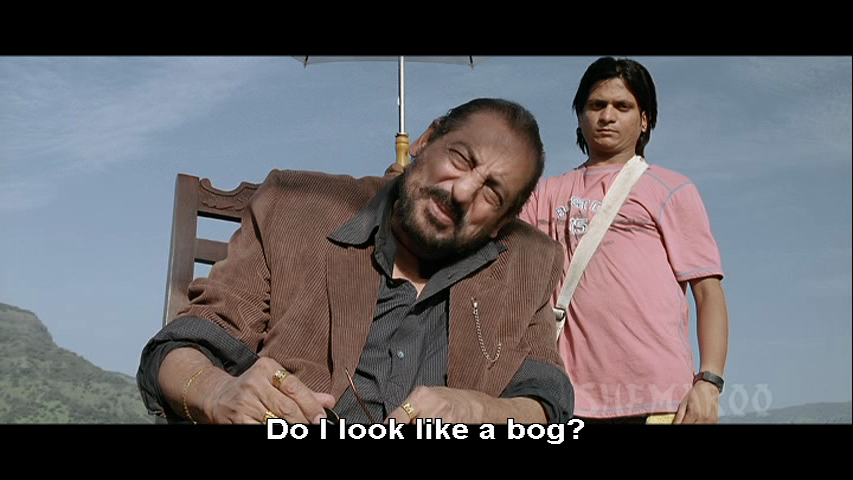
The film tells the story of two thieves, Khalujaan and Babban who are on the run after stealing from their boss Mushtaq. Khalujaan and Babban are uncle and nephew, and there is the added complication that Mushtaq is Khalujaan’s brother in law.  Khalujaan tries to rely on this connection to escape Mushtaq’s murderous plans for revenge but it seems that just being family isn’t enough – not when you’ve stolen from Mushtaq at any rate. After being caught by Mushtaq and his merry band of thugs near the start of the film, the pair manage to escape by means of some witty repartee and good team work. There is an interesting subtitle error here. I am quite sure that Mushtaq says kutta and really does mean ‘dog’, although possibly bog makes just as much sense.

Since they can’t find anyone willing to risk the wrath of Mushtaq and take them in, they end up planning an escape toNepal. When they end up at the border town of Gorakhpur, they decide to seek help from an old accomplice Vidyadhar Verma. However on arriving at Verma’s house, they find out that he has been killed in a tragic accident, and end up dealing with his widow Krishna instead. This creates an interesting dynamic as Krishna plays the two men against each other while she plots to use them for her own ends. Meanwhile Mushtaq turns up yet again, and in a final attempt to get enough money to pay for their freedom, Khalujaan and Babban join forces withKrishnato kidnap a local business tycoon. They plan to use the ransom money to pay off Mushtaq, but Krishna has other ideas and their kidnapping ends up with some unexpected results.

The film opens with Krishna and her husband at home and in bed as he teases and cajoles her while she tries to get him to surrender to the police. Although the couple have been kept apart by Verma’s kidnapping schemes they seem to be very much in love and Krishna obviously misses her husband while he is away on his various criminal activities. Abhishek Chaubey has cleverly drawn Krishna and Verma’s relationship in detail in just a few minutes in these opening scenes and this attention to detail in the characterisation is carried out throughout the film. For example, when we first meet Khalujaan and Babban they are celebrating their escape from Mushtaq with the loot, and just from the way they are dressed and the way they dance and celebrate, we have a lot of information about their respective characters.

The more sensible and level-headed of the two is Khalujaan, ably played by Naseeruddin Shah. He’s older, although not necessarily wiser, especially if he has had a bit too much to drink. Despite his criminal tendencies he is a romantic at heart and on meeting Krishna he praises her singing, helps her with the cooking and indulges in idealistic fantasies of the two of them together. After their first meeting he has a good look at himself in the mirror and realising that he looks his age, resorts to using some of Krishna’s kohl to darken his hair and beard to make himself look more attractive to her. It’s all so very human and natural and is just one of the ways that Abhishek Chaubey brings his characters to life. Khalujaan is also more focused on the goal of getting away with the loot, while Babban (Arshad Warsi) votes for killing Mushtaq and getting on with spending the money and enjoying life.

As Khalujaan romances Krishna from afar, Babban eyes her speculatively from almost their first meeting. He’s much more direct and it’s very telling that his first visit in Gorakhpur is the brothel. He is all male, hot-blooded and very ready and willing for action. Despite knowing that his uncle has fallen in love with Krishna, he makes a play for her too. However, even with his ‘love them and leave them’ attitude he ends up under her spell, and falls in love for probably the first time in his life. His betrayal by Krishna seems to cut much deeper than with his uncle, perhaps because this is his first love.

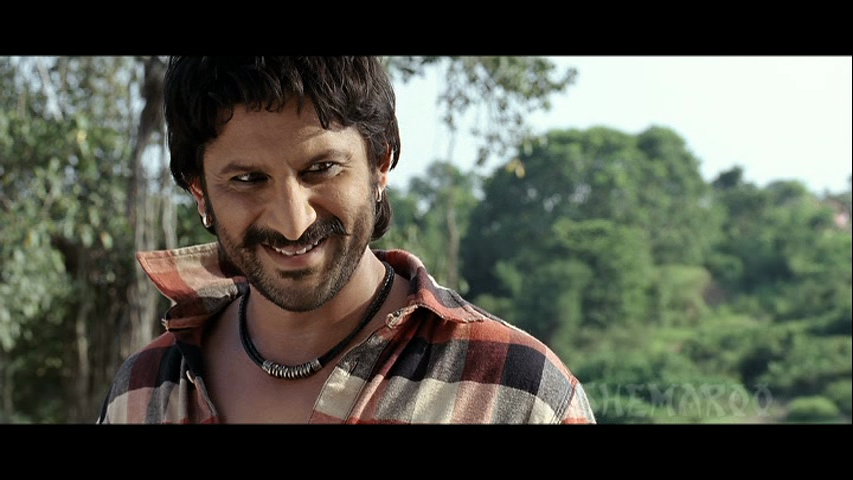
With his kohl rimmed eyes and knowing looks Arshad Warsi revels in the character of Babban. To some extent he revisits a little of his lovable rogue character of Circuit from the Munna Bhai series, but Babban is much more cynical and a harder persona. He has no qualms about accusing Krishna of stealing their money, or using violence to force her to reveal her plans later on. But at the same time his heartbreak when he realises he has been betrayed is very real and he genuinely seems to take an interest in Nandu (Alok Kumar), a local boy he meets at Krishna’s house.

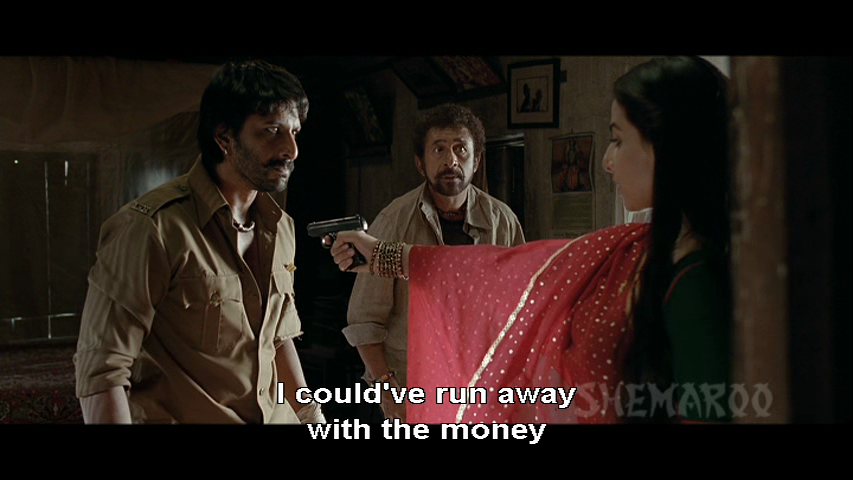
The two men are very easily seduced and led by the enigmatic Krishna. Vidya Balan does an excellent job of portraying Krishna as a woman of many faces. She starts off as the woman in love but with her husband’s death she seems to change and becomes aloof and mysterious, at least until she meets up with Khalujaan and Babban and seems to come to life again. She knows exactly what she wants and how to achieve it, and will allow nothing to stop her reaching her goal.Krishna is a very strong female character, even if she does turn a little crazy and vengeful at the end, and it’s great to see Vidya Balan in a role which suits her skills as an actress. She doesn’t have too much dialogue and in many scenes conveys most of her emotions through her expressions alone, which she does very well.

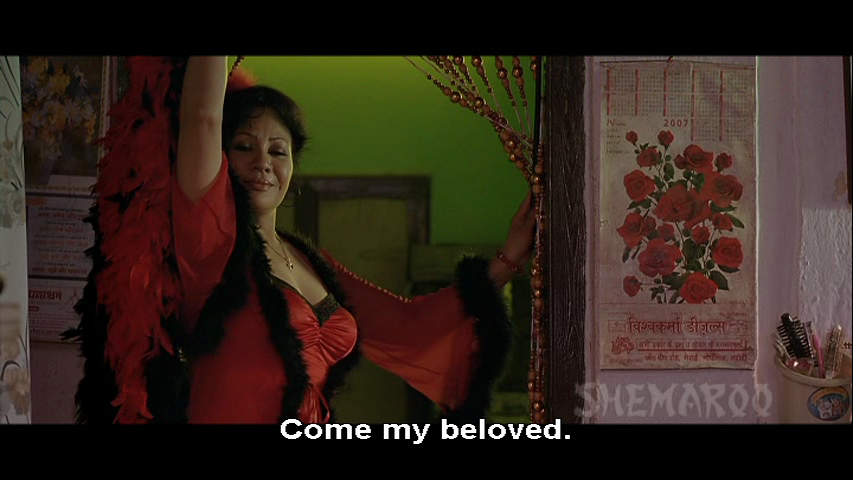
The interactions between the three leads are the crux of the film, but the other characters all have their place. Salman Shahid is coldly efficient as the omnipresent Mushtaq who has the knack of turning up at the right place every time. Rajesh Sharma as businessman Kamalkant Kakkad and Gauri Malla as his mistress Mamta have some comedic scenes together, particularly when Babban and Krishna first see them indulging in a little role playing to the wonderful Aa Jaane Jaan from Intaquam. (Another film about a woman out for revenge and Mamta nods to the Helen connection with all those feathers.)

There are some beautifully shot scenes of village life in the film and the cinematography by Mohana Krishna Agapu makes the most of the local countryside. While there aren’t any big song and dance numbers, the songs by Vishal Bhardwaj and Gulzar are excellent and fit well into the film. As well as the film soundtrack, Babban has a tendency to burst into song when he’s happy, and there are some fun renditions of songs from Chak De India and Om Shanti Om. There are so many great moments in this film, both comedic and some very good drama as well. With all the twists and turns the film never drags and Abhishek Chaubey even manages to add in a couple of explosions to add to the mayhem. A very well made film with excellent performances from the three leads – I’m definitely looking forward to the sequel. 4 ½ stars.