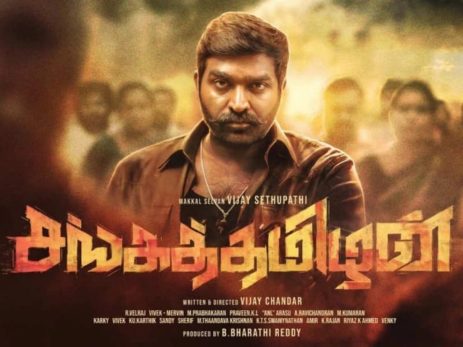
Sangathamizhan

Vijay Chandar’s latest film starts out as a spoof comedy, but ends up as a fairly run-of-the-mill mass entertainer by way of a tired romance and routine ‘villain versus the villagers’ plot. Vijay Sethupathi is always watchable, even in this clichéd action adventure, but the rest of the cast get short-changed by the screenplay, having little to do except either adore or loathe the lead character. There is plenty of action, comedy and even Vijay Sethupathi dancing, but by the end there really is little that makes Sangathamizhan stand out from the rather large pool of similar films.

The opening scene of the film typifies much of the first half. It’s a jumble of mass action and hero-centric plot with a mixed bag of comedy that generally works better than the dramatic dialogue. As aspiring actor Murugan, Vijay Sethupathi has a classic hero entrance before single-handedly reducing a gang of villains to groaning bodies on the floor, while his friend Soori (Soori) cracks a few jokes and performs the usual slapstick side-kick role. It works to some extent as neither Vijay nor Soori seem to be taking any of the dialogue seriously and there are a lot of sideways glances and self-referential jokes in the opening sequences. But the inclusion of a college girl who needs to be rescued from rape, some tasteless jokes about a group of prostitutes and rather humdrum action make this rather more cringeworthy than it needed to be, particularly for the start of the film.

The first half also includes a woeful romance with a truly terrible introduction scene for Kamalini (Raashi Khanna). Murugan crashes Kamalini’s birthday party and then proceeds to scold her for being so generous as to provide him with a free drink at the bar. Somehow this is supposed to make her intrigued by Murugan rather than acting as most women would in this situation and just calling for the bouncer to kick him out of the nightclub. At no point does the love affair between the rich industrialist’s daughter and out-of-work actor seem plausible despite the clichéd and formulaic development of the relationship. The only good thing about their romance is the inclusion of the upbeat and jaunty Kamala (which features men in colourful tutus as backing dancers), even though it doesn’t fit into the narrative at all. In fact, generally the music from Viviek-Mervin is excellent throughout, while the lyrics are beautifully translated by rekhs, who doesn’t just translate the words but makes the lyrics rhyme and scan perfectly. Why doesn’t everyone do this instead of providing literal translations that make absolutely no sense at all?

The plot begins with a courtroom scene where a group of villagers are trying to prevent a copper processing plant from opening in their area. The land appears to have been acquired illegally and for a change the judge seems to be on the villagers’ side, giving the developer just a few weeks to come up with evidence to prove that the factory won’t be a health risk to the villagers. This all becomes much clearer in the second half, which moves into flashback mode to explain the fight between the owner of the copper factory, Kamalini’s father (Ravi Kishan) and the village headman Devarajan (Nassar). Also drawn into the fight is the local politician (Ashutosh Rana) and the rest of Devraj’s family, including his son Sangathamizhan (Vijay Sethupathi).

The tone of the second half is much darker than the first, and from a frivolous romance comedy, it changes into a more dramatic action film. This disconnect between the two halves of the film is jarring as the shift happens suddenly (there is no interval given in Australia) and the mood change is relatively extreme.  Despite this, the second half is actually significantly better since it also includes Nivetha Pethuraj as Thenmozhi, Thamizhan’s romantic interest. Thenmozhi is a better realised character than Kamalini, despite her short time on-screen, with sharper dialogues and actions that actually make sense. Nivetha also has a good on-screen chemistry with Vijay in the romantic scenes between the two characters, which is a significant improvement on the lacklustre interactions he has with Raashi Khanna in the first half. The love story here is also more plausible, making me wonder why so much time was wasted earlier in the film, when the second half has a more convincing story, sharper action and generally improved performances from the entire cast. The main downside is Ravi Kishan’s rather anaemic villain who just doesn’t seem evil or ruthless enough, and Kamalini’s rather bizarre justification for accepting her father’s final fate.

The glue that manages to hold the entire film together (just) is Vijay Sethupathi and his frequent knowing nods to the camera seem to signify that he finds the entire story just as ridiculous as the audience. At times the film dips closely towards satire and throughout the first half I kept thinking that Vijay Chandar was trying to poke fun at the mass genre. But then the second half moves quickly towards more serious topics and the jokes dry up, along with Soori’s virtual disappearance from the screen as the film moves into more straight-up action territory. It doesn’t quite gel there either however as there is too much baggage hanging around from the first half that acts as a distraction. The two characters, Murugan and Thamizhan are also very similar which further undermines the dramatic ‘reveal’ of the finale. The positives are the music, Vijay Sethupathi and rekhs excellent subtitles, but otherwise this is a rather pedestrian and predictable outing that is really one only for fans.

Gods of Dharmapuri (2019)

Director/writer/actor Anish Kuruvilla’s latest, Gods of Dharmapuri (G.o.D), is a ten part series currently available with English subtitles on Zee5. (You can sign up for a free trial – just remember to cancel before the billing date). The action is set in a remote mining settlement, opening with the arrival of Pratap Reddy, his wife, and kids. But this is not a heartwarming underdog story, or a Kaala Patthar-esque industrial relations primer. Think more like Animal Farm as the new arrival starts his climb to the top of the muck heap.

A taciturn and surly man, I’d love to tell you Pratap has a heart of gold but he is driven by ego not empathy. After becoming a spokeman for the miners, he forms a political alliance with Ranga Rao (John Kottoly) and opposes D.N Reddy (L.B Sriram), the incumbent member and dictator. The men of the community accept Pratap as their leader, and D.N Reddy loses the blind obedience he had commanded. But Pratap moves further away from being a voice for workers like him and resents being a tool of the party. He asks what has the power – the hammer or the arm that wields it. Raj Deepak Shetty imposes himself on every frame, looming like a dark cloud. He may not say much but his rage and hunger are palpable. He doesn’t have relationships so much as he gathers retainers and servants.

Pratap has two sons. Venu (Satyadev Kancharana in an impressively nuanced performance) is the eldest and a clean cut good guy who likes to keep his hands clean. Other people do the dirty work and then he agonises over it. Ravi (Karthik Rathnam) is 80% penis and 20% hair. He loves movies, sex, booze, and his hairdo. Subtlety is not his thing and Rathnam goes all in to portray that. The brothers are so different and they are perpetually in disagreement over how to handle problems. But they love each other and are each other’s most reliable friends. The boys always assume they are in the right because they have the power to punish anyone who insults them.  And Venu certainly wants to win at any cost, despite preferring to manipulate rather than go full machete. He was going to get out, but Ravi caused a problem and suddenly Venu couldn’t escape. He asks Pratap how much longer they have to keep stopping him from acting on his rage and digging them into a deeper hole. You can see the dynasty shaping itself as they jostle for position.

The wives are always on the fringe of things, listening and quietly organising and sharing resources. The husbands all turn a blind eye, trading their wives bodies to sleazy managers for job security. When Saroja (Sruthi Jayan) is raped by a supervisor she suffers in silence. The rape was horrible, but that wasn’t the only sexual violence in her life. And women have to pay for men’s crimes with their own bodies time and time again. Saroja was deprived of a much wanted baby because of Pratap’s pride and entitlement. Acutely aware that one day her family will pay for their actions, she tries to shake some sense into the boys but Pratap dominates their lives. Sruthi Jayan is effortlessly expressive, and the moral burden Saroja carries is etched on her face. It’s not all gloom, and she does have a loving and warm relationship with Venu. Maybe because he was the best bet for breaking the cycle of violence and scheming.

Divya Mathews (Samyukta Hornad) is the young reporter, a professional woman sent to do a story about the family dynasty. She doesn’t wear a saree and  she has sex with Venu, her interviewee, so we know she is Modern. I understood why her character was needed but there was something a bit off, and a sizeable mismatch between her career and the scale of the stories local politics could sustain. I also felt that her taking a cheap shot at Venu’s wife Swapna (Chandini Chowdary) was a misstep by the writers. She had plenty of grievances without resorting to petty and uncharacteristic jealousy. And for a reporter, maybe a bit more fact checking and insight into motives would have helped establish her career and credibility as a character. Or finding a different boss.

Writer/director Anish Kuruvilla also stars as Rao, a slimy rural Rupert Murdoch who manipulates the news he publishes to get the political results he wants. It might be a good indicator that I hate this character with the fire of a thousand suns. Media and politics in bed together is no surprise, but Rao has no real convictions. He just wants what is advantageous to him, and presumably for the bigger shark somewhere in the shadows.

The significant supporting characters are relatively few in number, which made the story’s world feel too small for the stakes we were meant to believe in. However I really enjoyed getting to know more about the various That Guys who enabled Pratap’s rise. Chalapathi (Jagadeesh Prathap Bhandari) is a relative of some sort, and he remains steadfastly with Pratap. Chinappa and Seenaiah are the peanut gallery, freeloading when they can and passing commentary on everyone. I didn’t mind their shenanigans as they gave a cynical fly on the wall perspective. Some supporters became disenchanted with Pratap’s tactics, some like Raghu were resigned to staying with the horse they had picked, most would go wherever the wind took them. One of my favourite scenes is when a woman insists on her right to vote. Seeing her stand up to male indifference and dismissal and claim her name and her democratic right was beautiful, and it anchored the story back to the the little people who had no control over the poltical wheeling and dealing.

I liked that the episodes are not uniform in length, but seemed to stop and start where it made sense to do so. While there are some stylised visuals they mesh well with the beats of the story.  For classic mass fans, there is a significant gold tooth and a significant horseshoe. Many of the male actors looked a lot happier from episode 5 onwards when the tight fitting retro wigs were left in the past.  I was very unimpressed by the prosthetics team. A scene that should have packed a visceral punch was ridiculous due to the amateurish crafting of dismembered bits and pieces. Depicting sexual violence is often problematic with a tendency to voyeursim or sensationalising the act. I was both horrified by what was happening on screen and impressed at the restrained direction that left no doubt but also left a lot to the imagination.

The subtitles are mostly good, and the saltiness of the language is appropriate to the setting and characters. There are a couple of episodes where it felt like a different person was writing the subs and sometimes the translations were too literal. Are fish smilies a thing? I want to know. Not enough to really research it myself, but still. The original soundtrack is excellent and yet sometimes too fresh and modern, not always suited to the rural recent past.

If you like your dramas to come with a kick in the head, this is highly recommended.

Bombay

Bombay is the second of Mani Ratnam’s ‘terrorist trilogy’, and is the one that I find the most disturbing. I remember the news reports from the real-life events that happened in Bombay in 1992 which are recreated here in authentic detail, and I find the violence here more confronting and realistic, despite a rather romanticised ending. In Bombay, Mani Ratnam juxtaposes a ‘forbidden’ romance between a Hindu man and a Muslim woman with the Bombay riots to create a compelling and disturbing look at the religious divide in India. The film shows how prejudice can drive extreme acts of hatred but also includes the counter ideals of selflessness and acceptance with an almost fairy-tale spin on good and evil. It’s another stunning film from Mani Ratnam that still makes an impact to-day and along with A.R. Rahman’s soundtrack deserves all the awards and recognition that it has achieved over the years since its 1995 release.

The story starts with Shekhar (Arvind Swami) returning home to visit his family in a river-side village in Tamil Nadu. Just as Shekhar arrives he sees Shaila Banu (Manisha Koirala) and instantly he falls in love. Luckily the attraction is mutual and despite their different religions, a romance begins to grow between the two. Shekhar has been studying journalism in Bombay, which gives him a city sophistication and an intolerance for his father’s prejudiced views. Narayanan Pillai (Nassar) is a devout Hindu whose worst fear seems to be that his son will marry a bride from the North of India, since he is unable to imagine the horror of a daughter-in-law from a different religion. Shaila’s family is just as appalled by the thought of Shekhar and her father Basheer (Kitty) quickly arranges a marriage for his wayward daughter when he finds out about the affair. The clandestine nature of the romance allows for some beautiful camera work from Rajiv Menon and we also get the beautiful Kannalanae as Shaila spots Shekhar at a wedding.

I’ve read that Mani Ratnam wanted these scenes to be beautiful as a contrast to events in the second half, and I find it interesting that his idea of beauty is in the wind and rain that are a constant presence in the village. For me, accustomed to the weather in Ireland, I’d thought that this was supposed to represent the cold attitude of the two families to the romance until I read Baradwaj Rangan’s interview with Mani Ratnam. In Ireland, wind and rain is always cold and miserable, but since visiting Tamil Nadu I can appreciate why gusts of wind and showers of rain would be beautiful in a hot and often dry landscape. Despite knowing this, I still feel chilled when I see the wind whipping Shaila’s veil and skirt around, while the crashing waves and constant rain strike me as cold and gloomy even though I can appreciate the beauty of the landscape.

At the same time, coming from Northern Ireland, where it was just as taboo for a Catholic and a Protestant to start a relationship, I can really relate to the problem faced by Shekhar and Shaila; another reason why I find this film so confronting. The attitudes and expectations of society resonate closely to my own experiences growing up surrounded by religious intolerance and I am always thankful that my own family had a more progressive attitude. It does mean that I can understand their predicament here, and to some extent why their families are so worried as well. Beyond their own antipathy to the relationship there is the worry that society will condemn both Shaila and Shekhar, leading to ostracism and a continual risk to their safety.

With their families at loggerheads, Shekhar and Shaila elope to Bombay. They quickly get married and before long have two twin boys Kabir Narayan (Master Harsha) and Kamal Basheer (Master Hriday). The boys are named for their respective grandfathers but are brought up in both religions, while Shekhar and Shaila are easily accepted in their neighbourhood despite their ‘mixed’ marriage. But when the Babri Masjid is demolished and riots break out across Bombay, the boys are lost in the city alone. They are caught by a gang of men who terrorise the children, pouring petrol over them and starting to set them alight in a shocking scene full of religious intolerance and hatred. These are two young boys with no idea what religion is, let alone the differences between Hindus and Muslims, and with their brutalisation, Mani Ratnam exposes the full horror of the riots and the absolute inhumanity of the rioters.

While relations between the communities in Bombay are breaking down, Narayanan and Basheer have gradually turned their enmity into a guarded tolerance, so when both travel to Bombay in the wake of the December riots, they are able to live with Shekhar and Shaila without too much trouble. As the violence continues in the city, their relationship continues to improve as they realise the extremism and intolerance doesn’t reflect either of their own beliefs.

Some of the most powerful scenes here show Shekhar interviewing the religious and political leaders and asking them when the riots will stop, but no-one seems able or even willing to try and bring peace. As riots again grip the city and neighbourhoods are set on fire, the family is torn apart once more with Shekhar and Shaila left to tour the hospitals and mortuaries in their search for Kabir and Kamal. Meanwhile the boys find kindness from unlikely places as Bombay slowly begins to return to normal.

The film has graphic scenes of the violence and does not spare the audience any of the horror associated with the riots and the aftermath. The scene of bodies in the morgue is particularly bleak, even though Mani Ratnam doesn’t explicitly show grieving families – he doesn’t need to. The anguish and despair come through clearly as Shekhar staggers through room after room of bodies, men women and children, Hindu and Muslim, all mixed together, in a terrible reminder that this is the real cost of the riots. Although some of the scenes here do feel rather contrived, such as when Shekhar confronts two of his friends who are fighting on opposite sides, many more appear authentic, painting a picture of neighbour against neighbour with the main casualties being the innocent bystanders. When the police enter the picture (including Prakash Raj as Inspector Kumar) the level of violence seems to jump yet again, and the images of Kabir and Kamal hiding from the authorities are powerful reminders of the political aspects to these events.

The romance is beautifully told with plenty of symbolism in the images of sheets of rain separating Shekhar from his family, and Shaila losing her abaya as she runs towards Shekhar and freedom. The second half is brutally realistic but still has beautiful scenes of the family together and the developing relationship between Narayanan and Basheer. Rajiv Menon’s cinematography is excellent and A.R. Rahman’s soundtrack perfectly complements the visuals while Raju Sundaram and Prabhu Deva ensure that the dance numbers are equally spectacular.

Arvind Swami is excellent in a role that requires him to switch from a love-struck young man to a desperate and terrified one as he searches the streets for his children. His emotions are clear and easy to read, particularly in the second half when he begins to realise the political manipulations that are behind the riots. His fear and desperation as he searches for his children are frighteningly realistic while his disgust at the politicians, religious leaders and the rioters themselves also comes across well. Manisha Koirala too is wonderful in her role, and brings plenty of emotion to her character at every stage. Although she looks fragile, her character has plenty of determination and a fierce capacity to fight back when necessary. I love her performance here as she conveys so much without words, letting her expression say everything instead. The support cast are all good too, and Nassar and Kitty steal the show whenever they are on screen together. Their initial animosity and then gradual acceptance help to ground the film and stop it becoming too overly emotional as well as providing some mild comedy that also helps to lighten the atmosphere.

Overall, Bombay is a beautifully made film that takes on both a societal issue and a horrific subject to make strong and compelling political and social statements. Mani Ratnam does hammer home the manipulation message rather forcefully, and the final scenes are a little too simplistic, especially after all the drama that has come before, but despite these few issues, the film still delivers a powerful message that continues to resonate, even all these years later. It’s a disturbing film but that’s what makes it such essential viewing. Highly recommended. 4 ½ stars.