Chennai 600028

Chennai 600028

The opening moments of Venkat Prabhu’s debut film seem to be setting the scene for a retelling of West Side Story, with two rival cricket teams called the Sharks and the Rockets replacing the American street gangs. But surprisingly the rivalry between the two teams isn’t the focus of the story at all. It’s smarter than that. Yes, there is plenty of cricket and even some cross-team rivalry, but Chennai 600028 mainly follows the different players from the Sharks team for one year, with all the highs and lows you’d expect in any character drama. Essentially, it’s a story about an everyday group of friends, connected by locality and a passion for their cricket team.  None of the actors were well known at the time, and they all fit easily into the roles of regular guys, some of whom have jobs and some of who are still at college, but who all hang around together to play gully cricket. With some clever dialogue and good situational comedy, Venkat Prabhu ensures that despite a rather rambling storyline, the film has plenty of laughs and enough memorable characters to make the film an entertaining watch.

The Sharks team live in the Chennai area of the title and are introduced one by one by a narrator who describes them by their cricket skills; although generally some other identifying characteristic is also given. This is incredibly useful as there are 10 named team members and it’s very easy to lose track initially of just who is who and where they fit into the team. The film starts off with the defeat of the Sharks for the fourth time by the Rockets, mainly due to a dismal performance from supposed ‘all-rounder’ but actually terrible player and tail-ender Seenu (Premji Amaran). He’s the bumbling fumbler who cannot take a catch to save his life, but is generally loud and obnoxiously cheery despite his limited cricketing talents. Premji is a little more restrained here than in later films such as Goa, and he’s mostly funny thanks mainly to a good rapport with the other characters and some witty and well written dialogue. I didn’t know that Premji was also a musician, and he is responsible for the background score as well as one of the songs – pretty impressive!

Along with their most recent defeat, the Sharks players all have their own problems, although lack of money is the most regular feature in their discussions. The money is for their regular drinking sessions, which allows them to sit and talk about life, cricket and women, which eventually leads back to money, of course! It all fits in well with their various personalities and since the characters are all engaging and seem to fit well into their roles it comes across as a genuine look at life in the area. Plus we get this song, which perfectly captures the group of friends out drinking and having a good time. This is also a fun song.

Things change when Rocket team member Raghu (Jai) moves into the Visalatchi Thottam area with his family. Raghu feels that his world has come to an end, nicely illustrated by some excellent histrionics in the bathroom, and this does indeed seem to be possible given his initial reception by the locals. He’s looked on with suspicion and to add to his woes, his old team are too far away for Raghu to make it to regular practices, meaning he’s left out of their line-up for matches.

Raghu is one of the central characters for the story and Jai is excellent here in his first main role. His initial arrival into the new area is hilarious, and in just a few scenes he imbues Rahgu with plenty of charm and appeal, making his eventual acceptance into the rival team seem more plausible. His resemblance to Vijay is also part of the comedy, but best of all are his scenes with Karthik (Shiva Sundaram) starting from when a fight seems inevitable. Karthik is in love with Selvi (Vijayalakshmi) who is the sister of Karthik’s teammate Pazhani (Nithin Sathya) and therefore, for some obscure reason, off limits. Raghu’s father on the other hand is friendly with Selvi and Pazhani’s father, so inevitably Raghu is often seem chatting to someone who does at least acknowledge his existence. Karthik has some wonderful lovelorn expressions as he sees his rival on the field appear to become his rival in love and the interactions between the two potential adversaries are very well done.

Aravind (Aravind Akash) is also in love with a wealthy girl Swetha (Kristine Zedek) who regularly comes in to the coffee shop where he works. This is a rather more implausible romance, which is made more unlikely by the couple mainly only appearing together in song. These romantic songs also slow down the pace of the film and seem somewhat out of place in an otherwise more realistic and upbeat film.  Aravind is fine in his role as part of the cricket team and amusing as a guy in love but Kristine has very little to do and doesn’t impress in her few moments on screen.

There is a side plot involving Karthik’s brother Guna (Sampath Raj) but mainly the action revolves around the team members, their relationships with each other and their ambition to finally win the Radio Mirchi Cup.  There are no standout heroes, just a regular group of mates and that’s what appeals most about the film. Venkat Prabhu has captured plenty of camaraderie, but included discord and division to spice up the story and the blend is just about perfect. The cricket scenes are nicely placed in the film too – not too many, but enough to keep focus on the team rather than on just the individuals.  The commentary is also excellent (although that just might be my subtitles) and reflects the general standard of cricket commentary the world over!

Chennai 600028 is an excellent début and a good indication of what to expect from Venkat Prabhu as he uses most of the same ingredients (and often the same actors) in his subsequent films such as Saroja, Goa and Mankatha. Mainly Chennai 600028 is a film about people, their lives and their dreams, and only after those details are fully realised is a story superimposed on top.   It works because of the very ordinariness of the characters – these are guys that can be seen on every patch of ground, anywhere it’s possible to set up stumps and standing around on every street in Chennai. That is the charm of the movie. Recommended for excellent performances, witty dialogue and a film that  captures the intensity and ubiquitousness  of street cricket in India.  4 stars.

Bhoot Bungla (1965)

Bhoot_Bungla_poster

Adhering to the Scooby Doo school of horror, Bhoot Bungla is fun from go to whoa with great music, dodgy disguises, lukewarm romance, dancing skeletons and a dash of suspense. This was Mehmood’s debut as a director and he pulled out every trick in the book, and I suspect a few favours from the filmi fraternity, to make it a hugely entertaining romp.

Bhoot-Bungla-Moni Chatterjee

50 years ago Kundanlal was murdered and his wife and son disappeared from the family home. In the present day his three nephews live in the mansion. Ramlal (Moni Chatterjee) gets a telegram that his daughter Rekha (Tanuja) is coming home from Abroad. He prepares to collect her from the airport but brother Shyamlal (Nazir Husain) makes an excuse that he has to go to the office. Ramlal’s car explodes, leaving Rekha an orphan and heiress. Not long after, poor unhinged Ramu (Nana Palsikar) is found dead in a murder staged to look like suicide.

Shyamlal and Rekha move into a stylish apartment in town but can they escape the curse? Or is it a more corporeal threat? Worried that she is sad and afraid, Uncle calls Rekha’s friends to come and get her out of the house. They enter her in a singing competition at The Beach Club, where her rival is none other than Mohan Kumar (Mehmood) and his Youth Club, dedicated to Doing Good. The hi-tech Applause Meter gives Mohan the cup, but the audience is the real winner! Oh yes, hijinks ensue.

Tanuja is excellent as Rekha, sassy and sweet by turns. I really liked that the first thing Rekha did in the new flat was unpack her books while the servants dealt with the clothes and other belongings. She is smart but also raised to be obedient and good so when suspicion falls close to home, she tends to go with the dutiful response rather than a rational one. Tanuja matches Mehmood’s energy, throwing herself into the silliness with gusto. She also delivers a convincing portrayal of Rekha as someone weighed down by fear and losing confidence in their own judgement. I can think of no other explanation for her fleeing the apartment in a frothy nighty and huge fur coat (in Mumbai? Really?). The romance is a minor part of the story, and there are no sparks between Tanuja and Mehmood, but they do have nice rapport. Since the relationship is partly due to Mohan’s Youth Club commitment to helping people, it doesn’t matter that they seem more like friends than being crazy in love. There’s enough crazy to make up for it!

Mehmood’s grand entrance is riding a motorbike up Marine Drive and howling like a police siren. At first I actually thought it was just exceptionally dodgy sound effects and had grave fears for the rest of the film! There can be too much Mehmood, but in this case he gets it just about right and Mohan is wacky but always likeable and genuine. Maybe he was too busy worrying about tricky camera angles (of which there are many) to be The Star and settled for a happy camaraderie with the ensemble. Of course, restrained by Mehmood standards still includes doing drag, slapstick, encouraging children to gogo dance their fears away, and instigating a dance off with gyrating skeletons. But I knew Mohan truly loved Rekha when he shaved his moustache off to frock up, committing himself to having to draw it back on with pencil for at least one subsequent scene. That is commitment,

The music is fabulous and the songs are a real highlight. Mohan sees a blind beggar whose violin has been broken by drunk boys – so he does a West Side Story style dance number exhorting society to wake up and care. Pyar Karta Ja moves the hearts of all youth club boys and girls who were otherwise occupied in construction work. It’s not quite the barn raising scene in Witness but pleasing nonetheless, and Witness didn’t have Manna Dey. Everyone, including the special effects team, saved their best for the Bhoot Bungla song. Watch it now, and enjoy all manner of silliness with Mehmood and RD Burman dancing with skeletons and showing the ghosts who’s boss.

The support cast has lots of excellent performers although I am struggling to put names to all the faces despite the detailed opening credits. I will take a punt that Jerry played Jerry who was an imitation Jerry Lewis. I was particularly fond of Rekha’s exuberant girlfriends (including Lata Sinha). RD Burman is a hoot as Stocky, the cowardly foodie who accompanies Mohan on his ghost busting mission. It’s always good to know that someone has afternoon tea requirements under control. The creepy family retainers – Lakiya and the mysterious and toothy gardener – are perfectly cast with their spooky appearances adding to the sense of unease. Just the thought of Lakiya’s ruffles is enough to terrify me.

Bhoot-Bungla-Dedication

Apart from the fluffy entertainment value, the story is reasonably strong. Mehmood balances the various elements well and kept the suspense and laughs coming. There are some twists and red herrings, and things move along at a fair pace. I found the dedication to Guru Dutt quite touching – Mehmood seems to have been a thinker when it came to his own films.

See this for the excellent songs, the generally well balanced suspense and comedy, and the skeleton dance-off. Sure there are some things that go bump in the plot, and a couple of loopholes big enough to drive a Youth Club bus through, but nothing that detracted from the good natured fun. 4 stars!

Did someone say Twist?

Cannot. Resist. Urge. To. Dance!

Bhoot-Bungla-the end

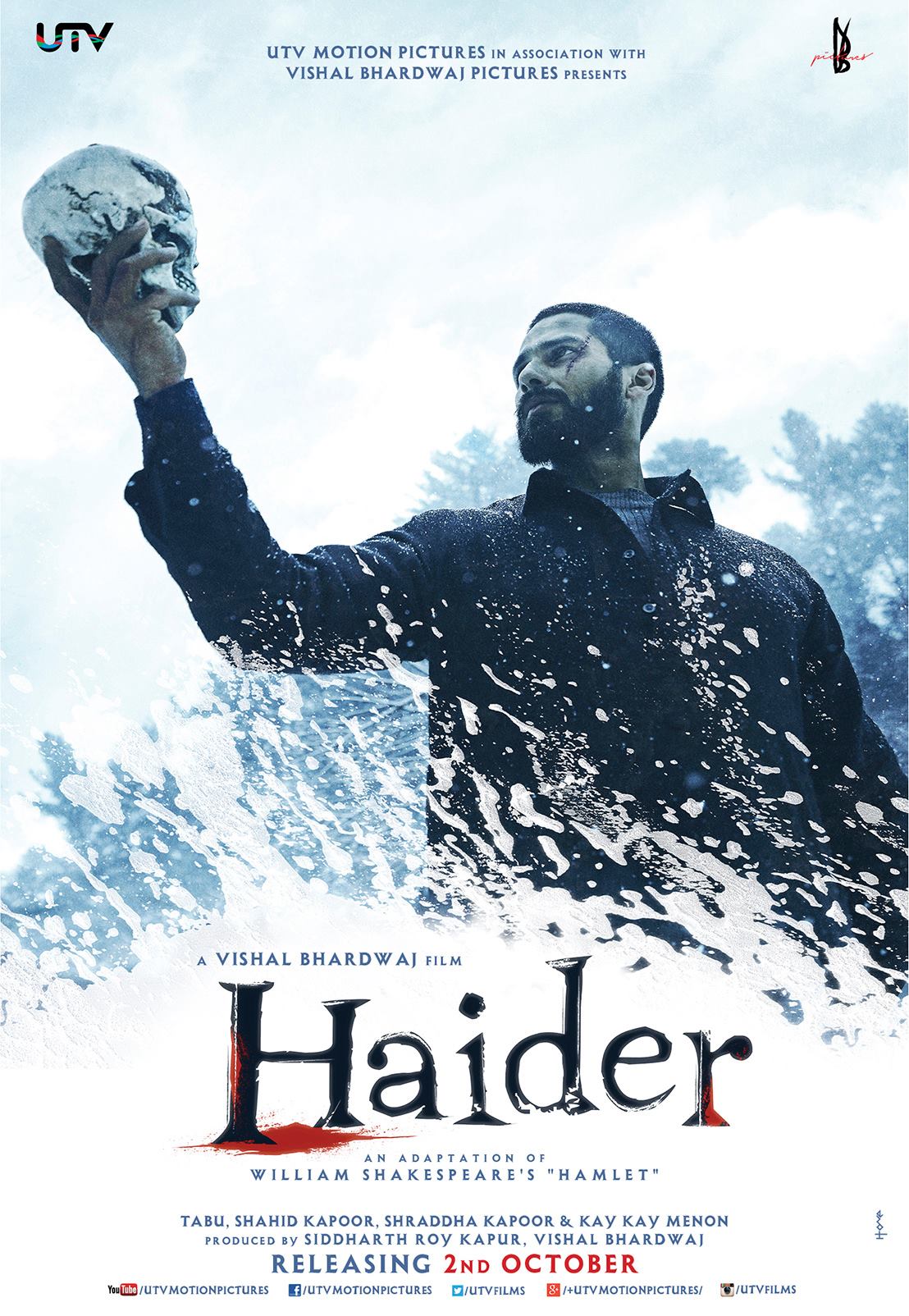
Haider

Haider

Watching Vishal Bhardwaj’s latest film Haider is a visceral and haunting experience, as the gorgeous detail of the film allows every emotion and each drop of blood to be shown in crystal clarity. The story of treachery in Denmark is transplanted to Kashmir at the height of increased militancy in the area in 1995, but still remains tragedy on a grand scale. Bhardwaj and his co-writer Basharat Peer have successfully adapted the bard’s play into more modern-day India, although the pacing is a little inconsistent in places and at times the Kashmiri issue threatens to overshadow the personal drama. The heart of the film is in the performances, and although Shahid Kapoor is excellent in probably one of the best performances of his career, the real stand-out is Tabu who is completely mesmerising in her role as a conflicted mother to Haider and disloyal wife to Dr Hilal Meer. It is compelling cinema and definitely well worth watching in the theatre to fully appreciate the stunning cinematography and spectacular beauty of Kashmir.

Haider (Shahid Kapoor) is a student, safely studying poetry in Anantnag when he learns that his father has disappeared after providing medical aid to a militant leader. Dr Hilal Meer (Narendra Jha) is taken by the army in a truly frightening scene that manages to grasp the sense of hopelessness and terror of a military raid in just a few moments. The grim method of selecting who may go and who is arrested by a balaclava-wearing man in a Jeep is chilling, as is the resignation that makes everyone line up for inspection without any word of complaint. The detail in each frame is incredible, and the performances are very natural, making the film seem almost like a news report direct from the action, rather than a fictional story.

Dr Meer’s family home is also bombed, along with the militant leader still inside, and in a few seconds his wife Ghazala (Tabu) has become a ‘half-widow’ without anywhere to live. As a result, when Haider returns he finds his mother living with his uncle Khurram (Kay Kay Menon), and he is instantly suspicious about their relationship. While rejecting his mother, Haider relies heavily on his girlfriend journalist Arshia (Ahraddha Kapoor) and two friends Salman (Sumit Kaul) and Salman (Rajat Bhagat) as he searches for his father. Since up until this point the film is unrelentingly bleak, it’s a real relief when the comedy appears, and Salman and Salman are an excellent counterpoint to the violence and despair elsewhere.

Haider’s search for his father is heart wrenchingly sad, as he is just another one of many who are searching for their own disappeared relatives. However, interspersed with his search are confrontations with his mother and uncle which fuel Haider’s anger and mistrust. The relationship between Haider and Ghazala is wonderfully nuanced and both actors capture the essence of Shakespeare’s characters and their conflicted emotions well. There is a frisson of sexual tension, heightened since Tabu looks way too young to be Shahid’s mother, but mainly the film focuses on Haider’s sense of betrayal when his mother takes up with his father’s killer. Kay Kay Menon is also effortlessly perfect, juggling Khurram’s political ambitions with his desire for Ghazala and bringing more depth to the Shakespearean character of Claudius than I seem to remember from studying the original play at school.

The romance between Haider and Arshia is also nicely developed, and Arshia has a believable character as a journalist and relatively realistic relationships with her brother Liyaqat (Aamir Bashir) and father (Lalit Parimoo). Shraddha Kapoor is good in her role, particularly in her scenes with Shahid and she’s also credible in her despair when she loses the plot after her father dies. Most of the other characters from Shakespeare’s play appear, although the role of the ghost is changed into a fellow prisoner of Dr Meer who is expertly played by Irrfan Khan.  Most impressive is the ‘play within a play’ which in is depicted as a song. The puppets are wonderful, but even just a glimpse of Tabu and Kay Kay Menon in this clip illustrates just how good they both are in conveying their characters.

Haider’s eventual descent into madness is dealt with better than the earlier scenes where Shahid sometimes appears a little too distant. But as the film progresses his emotional shifts and internal struggles are mostly well represented and he does genuinely appear to be a conflicted personality by the end. Many of the famous lines from the original Hamlet appear in Haider’s soliloquies, although they are also inserted into various conversations (and the subtitles don’t really do them justice), and there is even a brief appearance of the skull before the final, and very bloody showdown. This is passion, vengeance, despair and madness writ large and the scope of the film truly feels epic.

Haider impresses with fine attention to detail and excellent performances from the entire cast. However the shift to Kashmir means the military conflict looms large in the story and as a result the original tale of betrayal and treachery occasionally gets a little lost. The pacing is uneven, particularly in the first half, but this allows time for the complexity of the characters to fully develop so isn’t necessarily a flaw with the film. It is a bleak story and be warned that some scenes are definitely not for the squeamish as the body count piles up and cinematographer Pankaj Kumar illustrates just how well snow contrasts with blood. Overall Haider is a well crafted and novel interpretation of Shakespeare’s Hamlet and one I definitely recommend watching for excellent performances and a rather different view of Kashmir.