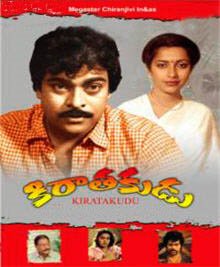
Kirathakudu (1986)

If Kirathakudu didn’t have Chiru and Suhasini in the leads I am not sure I would have persisted. The first hour or so is very trying indeed. But then I would have missed out on an unexpected reworking of John Carpenter’s 1981 classic, “Escape From New York”. If I see Chiru plus subtitles, the DVD is an automatic purchase so I didn’t read anything about the film before I watched it. There is a voiceover about criminals and the government, but the concept wasn’t well translated in the subtitles. Imagine my delighted confusion when it started to seem somewhat familiar.

Chiranjeevi is Charan, a poor rich boy who just wants his father (Kongara Jaggaiah) to show him some affection. Charan spends his time winning every possible sporting and aeronautical trophy, beating people up, carousing and brooding in his room.

I enjoyed this sporting montage greatly, although it has prompted me to make a statement critical of Chiranjeevi.

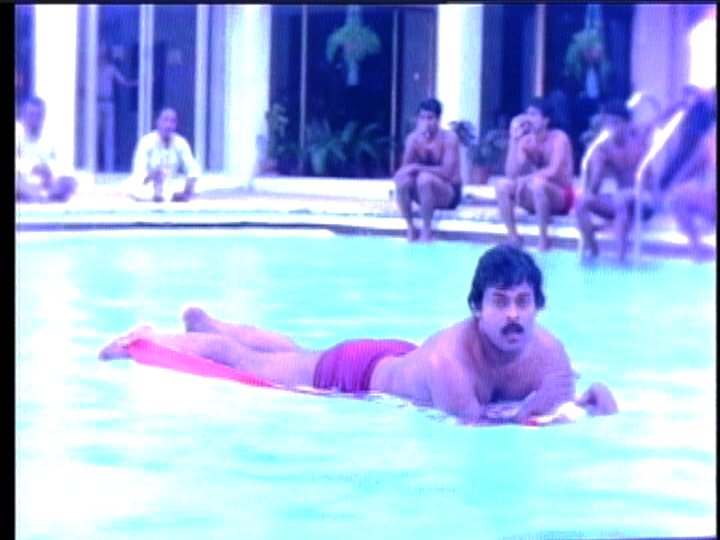
His swimming style is splashy and inefficient and he would not have won a race against the under 9s in my swimming club. There – I’ve said it.

Maybe it’s not about winning the race, but about looking stylish on a lilo.
And making bad art.

He is a renaissance man, albeit one with questionable taste, a very bad temper and poor impulse control. He drinks heavily, and I think I was supposed to find this appearance a warning – but he looks so good!
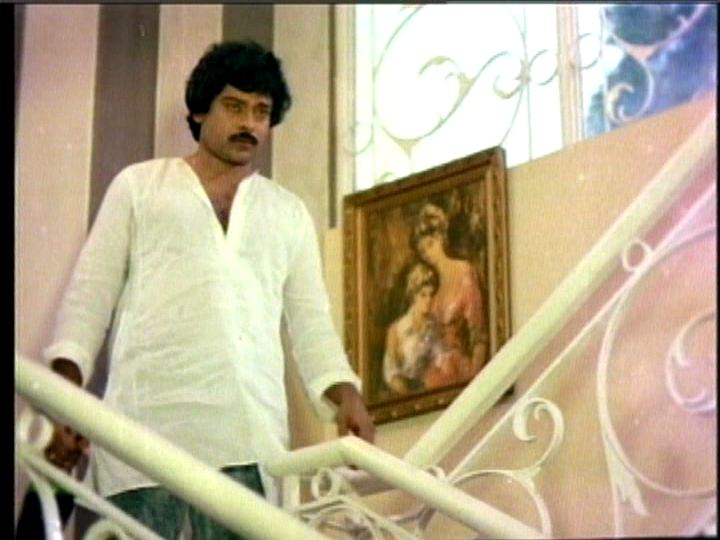
Charan sees a quite unimpressive statue in a local emporium and runs afoul of Swetha (Suhasini) who has purchased the one of a kind piece. His reaction to finding out he can’t have it is extreme.

Swetha is a psychology student, and daughter of the local police chief. She is smart, self assured and is not intimidated by Charan. She is also a raging narcissist from the looks of her house – pictures of her adorn almost every wall.
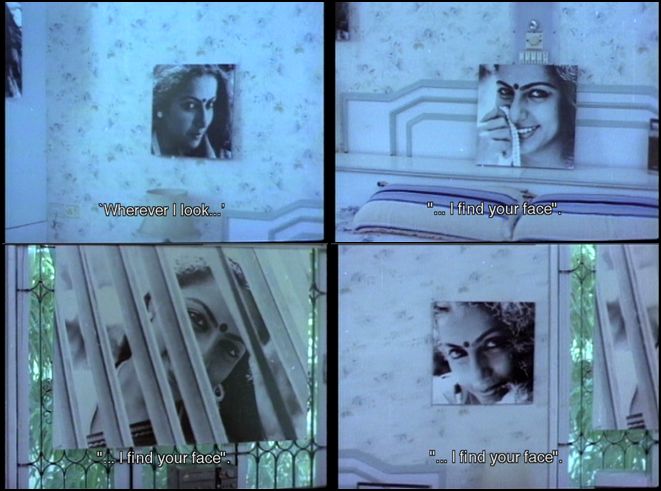
It is interesting that Swetha is given career aspirations and a brain, and yet the dialogues are often very disparaging of women. Suhasini is such a graceful and intelligent actress that I was pleased to see her in a reasonably involved role. She is drawn to Charan both as an interesting psychological study and because he is Chiru – those eyes!

Charan goes off the rails due to the influence of vampy Hamsa (Silk Smitha). Only Chiru could make Charan watchable as he broods, rants and sooks over why his daddy doesn’t love him and then commits crimes as a cry for attention.  Showing that she is smarter than most people in the film, Swetha finds Charan’s hideout and dobs him in to the police. He kidnaps her in a dramatic getaway and their forced proximity accelerates the already budding love.

Having been ruined by a tramp, he feels that the love of a good woman will let him live like a decent person. Yes. Surely it would be unreasonable to expect him to take responsibility or just grow up. She then takes on the burden of reforming Charan and settles in for a lifetime of prison visits. I found their song fantasies quite amusing – Swetha was all flowers and pretty colours, while Charan was much more, um, hands on. One thing they did have in common was their terrible taste in art.

Silk Smitha is Hamsa.

Well, Silk’s arse does most of the work thanks to the constant upskirting camera, but she sneaks the rest of herself into shot occasionally. Hamsa is a Bad Girl who entraps Charan and forces him to turn smuggler (bad) and wear pleather (not so bad). Again, I had to growl a bit at Charan crawling out of her bed the morning after and treating Hamsa like dirt for giving him what he wanted.

Mothers in the film are sacred but women who have sex are evil  – so I wondered briefly about how these idiots thought babies were made. I am not exactly sure why sleeping with Hamsa would be enough to place Charan under Snake’s control, especially given his cavalier attitude to the law and society, but it seems he was besmirched and that was it. The bad girl is usually a thankless role, but Silk gets a few pithy lines and an excellent confrontational cheerleading dance.

The second half of the film took a sharp turn towards awesome. Maybe because Chiru changed into this outfit?

The police need Charan’s help to take on Snake and rescue his dad (and the Top Secret papers) as they could not get into the badlands themselves. When Charan stole a car ferry and chuffed off about 10 seconds ahead of the cops, he managed to hide the ferry within walking distance of a sari shop and judging by the number of Swetha’s outfit changes, remain undetected for days. The man is a genius and I can see why the police appealed to him.

Armed with an array of gadgets and with deadly time release microcapsules implanted in his neck, Charan sets off to save the day. He lands a glider on top of a skyscraper in the crime quadrant, on a mission to rescue his father and protect Indian national security. He had to take a glider as there was no way in by land. In a puzzling development, Swetha and Baby (the cab driver played by Nutan Prasad) decide they have to follow him, and drive in through the front gate in a taxi, sedately avoiding the bombs planted along the route. While the residents look like a left over mob from a B grade post apocalypse horror movie, Swetha is able to glide around in her pristine sari without being spotted. The scenes in this second half are more closely aligned to the original film and the mood is both darker and more absurd.

Snake (Kannada Prabhakar) is the kingpin in the sealed off criminal zone. While John Carpenter recreated Manhattan as his prison colony, Snake has to make do with a warehouse complex a few minutes from the downtown area. He has possibly the best DIY lair and henchmen I’ve seen to date, and I enjoyed deciphering the very random graffiti.

Snake is also a psycho killer on a very short fuse.

This guy is quite fascinating.

He plays his role of chief henchman with a blend of odd chicken inspired noises and statue postures, and walks with what I can only describe as a slow-mo mince. While wearing a dress (maybe toga).Who is he?
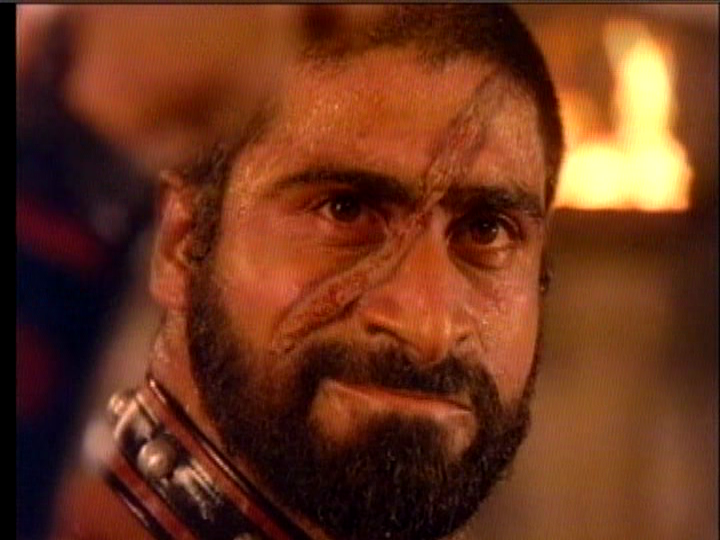
And the guy who would have been played by Bob Christo in a Hindi version of this is back! Last seen in Adavi Donga (the apple peeler Wolverine claws guy) here he is sporting a fake scar and some hideous trousers.

How does it end? Is there any doubt?

It’s a film by A Kodandarami Reddy so I expected crazy, and the second half delivers. I did have to chant the ‘it was made in 1985’ mantra a few times, but even allowing for that I was irritated by some of the dialogue relating to women and their evil powers. Grow up guys! Yandamoori Veerendranath gets a writing credit, but this is a reasonably faithful remake with the addition of loads of sentiment and a message about good family values.

Chiru and Suhasini inject a bit of class into their scenes, and the WTFery dial is set to 11. I’m totally biased due to Chiranjeevi but I’d give this a cautious 3 stars, for the curiosity value of the remake and for the dystopian second half.

Here is a snippet of Silk’s big song number – it is interspersed with the final action sequence so I won’t give away all the surprises!
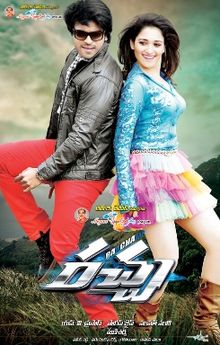
Rachcha

Rey! 3am and we were still discussing Charan’s amazing hair, his dedication to bringing the cape back and the total masala fun of Rachcha.  Another adventure without subtitles, we saw it with an appreciative audience notable for the number of women attending. Usually we hear a high pitched squeal of fandom and look around to see a dude in a suit. But Charan seems to bring the ladies out, and we can see why. There’s plenty of action, excellent choreography and at least for Charan, some superb costumes. Charan channels Chiru in his own inimitable style and with a nod to the camera that says he knows what we’re thinking, while Tamanna holds her own in both the dancing and drama stakes.

The film starts with the opening banner of Mega Supergood Films and, since any reference at all to the word ‘mega’ had the audience screaming, ensured that we were deafened right away. After a flashback involving young Raj, a significant necklace and the extremely dramatic death of his parents, we learn that present day Raj (Ram Charan) is being brought up by comedy stalwart M.S. Narayana and his wife (Sudha). ‘Betting’ Raj spends his days, well, betting and when his adopted father needs a liver transplant it’s the ‘logical’ way for him to raise money. He accepts a wager with James (Ajmal Ameer) to make the daughter of a rich businessman fall in love with him. Raj and James have a history involving a train, 2 cars and a game of chicken, so Raj is not without some reservations, but his situation is desperate.

Chaitra (Tamanna) is that rich girl. Chaitra never seems to go anywhere without her escort of 2 motorbike outriders, 4 SUVs and various bodyguards, so it’s a real challenge for Raj to approach her at all. Luckily he has accomplices (a flock of comedy uncles) so Raj is able to attend to the serious business of flirtation. In one of the many fun tributes to Chiranjeevi sprinkled through the film Raj infiltrates her medical college to the strains of Shankar Dada MBBS and all the collar popping and swagger that goes with it. Naturally it doesn’t take long for Chaitra to appreciate the well styled hair and many charms of Raj. Or does she? Tamanna is a very capable actress, and she does get a bit more to do in Rachcha than we expected. Unfortunately she does get a few scenes where she seems more like an escaped mental patient as she marvels at waterfalls, flowers, a fence painted yellow etc.


As we knew from Badrinath, Tamanna has a great imagination for song costumes and accessories. Raj appears in a couple of full length capes and with a number of scarves. At one stage we thought perhaps she had been expecting a hero more famous for his multiple layers of singlets, shirts, jackets and scarves, but Charan wore it all with aplomb. The curse of the blind stylist only seems to strike at Tamanna but does strike hard and often. The constant mini skirt and short shorts outfits were not particularly flattering, and the choreography and camera angles didn’t help.

Mani Sharma’s songs aren’t brilliant musically speaking, but the picturisations are awesomely entertaining and the choreography is excellent. The costume teams go all out (poor Tamanna) and the dancing is infectiously energetic and engaging. Charan just gets better and better. He has a good musicality and a sense of the overall appearance of a song. He doesn’t fall into the trap of substituting too many tricks and gymnastics for dancing. It’s a pleasure to watch him, and his facial expressions in the songs are highly entertaining. Tamanna is his match in energy and expression.

The two actually dance together rather than just using the heroine purely for her glamour quotient and it feels like a real partnership. There isn’t any sizzling chemistry but more of a camaraderie which works well enough to make their romance acceptable, especially considering the rather dubious origins in a bet.

Chaitra’s father Bellary (Mukesh Rishi) is not impressed by Raj and when the pair escape he sends for the big guns in the form of Dev Gill in manic villain mode. You can tell he is insane because he wears a coat inspired by Noddy and Big Ears or a high school production of Pirates of Penzance. He had a pathological attachment to this coat and he never appeared without it. This diluted his menace considerably as we giggled uncontrollably every time we saw him.

The second half explains the real reason for the  bet, and sets up the climax. The flashback episode is too long but it leads up to an excellent fight. The action scenes are brilliantly choreographed, using Charan’s physical skills to great effect. Raj was a resourceful and efficient fighter, usually going for the classic ‘kick em in the nuts’ approach rather than anything too impractical. Although he used a flaming wheel and even threw a motorbike at his atttackers in one scene so he was never dull. Sampath Nandi toyed with the audience when he put Charan, Dev Gill and a helicopter in one scene, teasing with the possibility of a Magadheera replay. Rather sensibly the director chose to leave Charan on the ground and let him deal with his problems the old-fashioned way – with a very impressive axe.

There is a pointless appearance by Ali. Brahmi, Venu Madhav and Srinivasa Reddy were moderately amusing in their roles and at least the story did have a flimsy reason for their presence. Srinivasa Rao Kota, Nasser, Raghu Babu and various others turn up and do their usual thing. Satya Krishnan makes a small appearance in a fun women vs men backyard cricket match, and there are some really enjoyable little moments with minor characters. We have to give a big shout-out to the backing dancers and the rather listless ‘dance students’ for their efforts. The comedy and subplots were all more or less tied to the main story which helped keep things moving along. The audience dissolved into hysterics when a man at a roadside restaurant knocked back his drink and then picked up a chicken and sniffed it. Granted that alone was pretty funny, but we did wonder if perhaps there was a reference there that we didn’t spot?

There were plenty of references throughout the film to Chiranjeevi movies and Charan wears a number of outfits that are pure Chiru style. White trousers, black socks and white loafers made a come back, as did loud shirts and colour blocking. He has his father’s mannerisms down pat and it added another dimension to the film to see how many of these tributes we could pick up. And we think it is a smart way for him to deal with the pressure of expectation – he is always compared to his father, so why not own those references and play them with his own style. We were a little disappointed that the significant necklace (which Chaitra could only discover late in the story) meant that Charan kept to a rather modest look, but Vaana Vaana with the dancing in the rain was some compensation.

We have now seen both the original Vaana Vaana from Gang Leader and this remix on the big screen, and the Mega Men certainly know their way around a rain song!

Rachcha is Charan’s vehicle and he delivers a full mass performance that is exciting and very watchable. Tamanna got plenty of cheers from our audience for her dancing and at her speech just before the climax. The songs and fights are so well executed that they had us cheering along too. It’s a visually pleasing film, and has a sense of fun in amongst the action and drama. The story is a familiar one, very much inspired by the type of films Chiru made back in the day, but who says that’s a bad thing? Despite a plethora of comedy uncles, Sampath Nandi delivers a fun and entertaining film that we both want to watch again.

Gulebakavali Katha

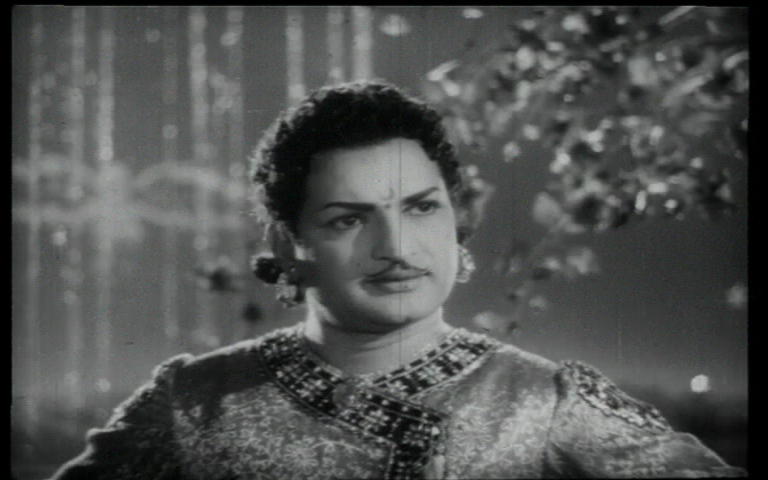
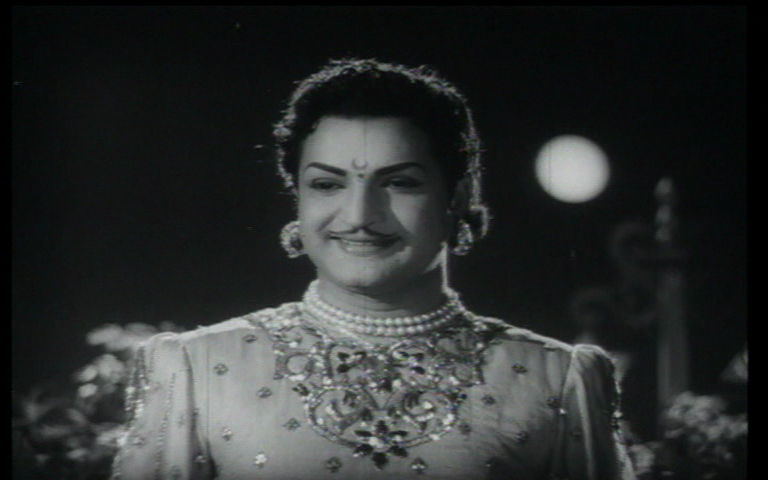
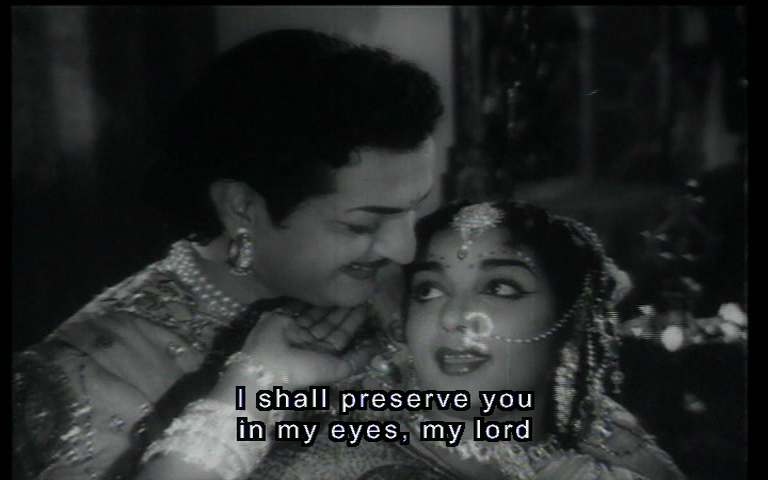
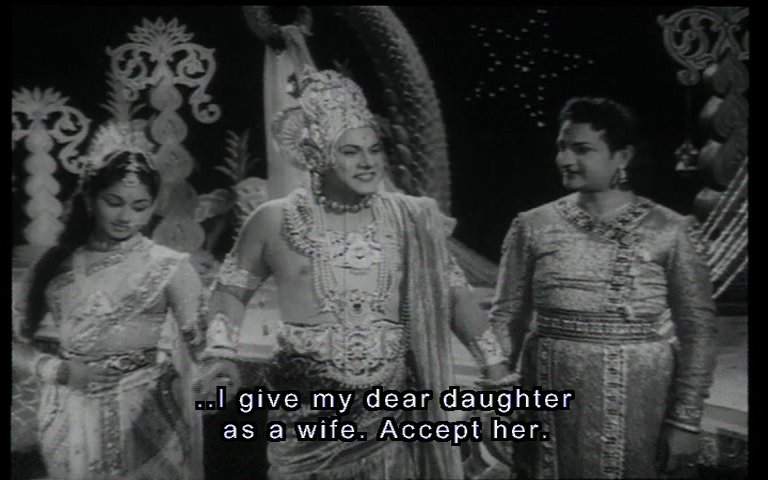
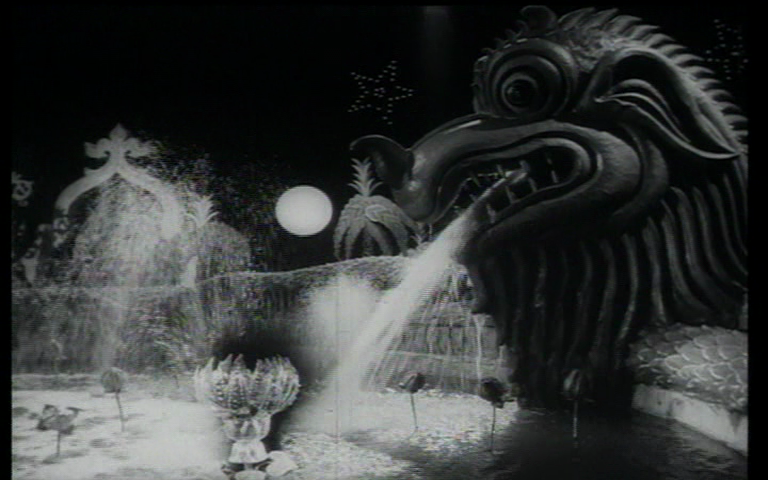
I love folk tales and fantasy in Indian cinema, and when they are combined with a theme involving eyes and blindness then that’s a combination guaranteed to make me watch. And Gulebakavali Katha doesn’t disappoint with plenty of eye references and fantastical scenes throughout. The story is reputably based on Madhira Subbanna Deekshitulu’s Kasimajili Kathalu which also provided the story line for Patala Bhairavi, although from time to time the story here reminded me of Jason’s quest in the Greek classics. It’s a fun film with the emphasis on the fantasy and NTR’s hero is dashing, suitably brave and self-sacrificing. The music is lovely and plentiful, and the sets and costumes are absolutely fabulous.  There are excellent opening titles featuring an animated skeleton, and the story opens in the best possible way with a song featuring Geetanjali and Jyothy as dancers.

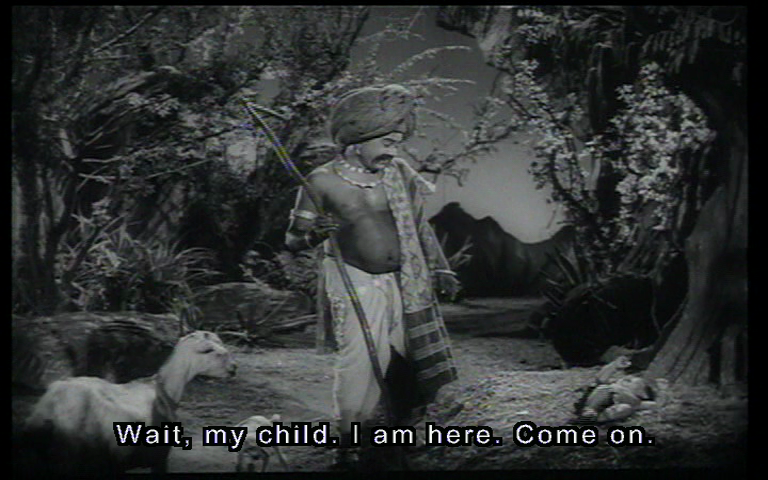
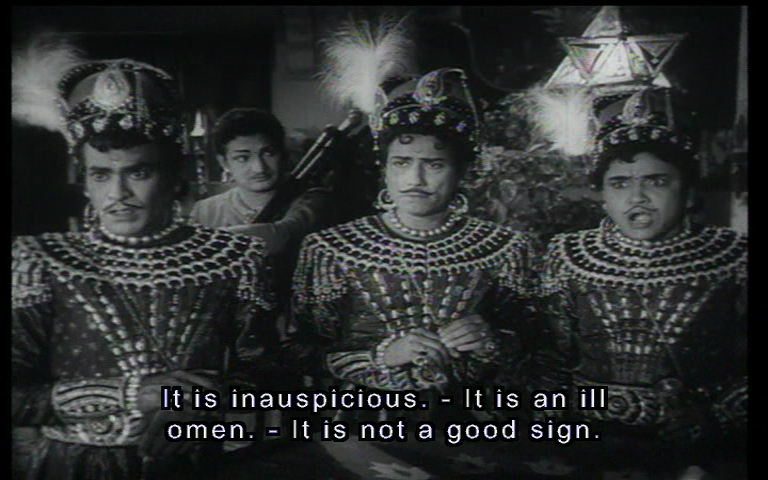
The storyteller introduces the tale of King Chandrasena (Mukkamala Krishnamurthy), his two wives and his wicked brother-in-law who is conspiring to take the throne. King Chandrasen’s first wife Gunavathi (Rushyendramani) falls pregnant after she is blessed by the goddess Parvathi. This makes his younger, second wife Rupavathi (Chayadevi) jealous even though Rupavathi already has 3 sons of her own. To make sure that her children will inherit the throne, Rupavathi plots with her brother Vakraketu (Rajanala Kaleswara Rao) to get rid of the baby and discredit her rival. With the help of the Royal astrologers, Vakraketu concocts a tale that the King will go blind if he sees his son. Not content with this form of banishment, Vakraketu then orders his soldiers to take the baby into the woods, kill him and bring back his eyes as proof of the deed. Of course it doesn’t go to plan and the baby ends up being rescued and brought up by a shepherd couple in the forest.

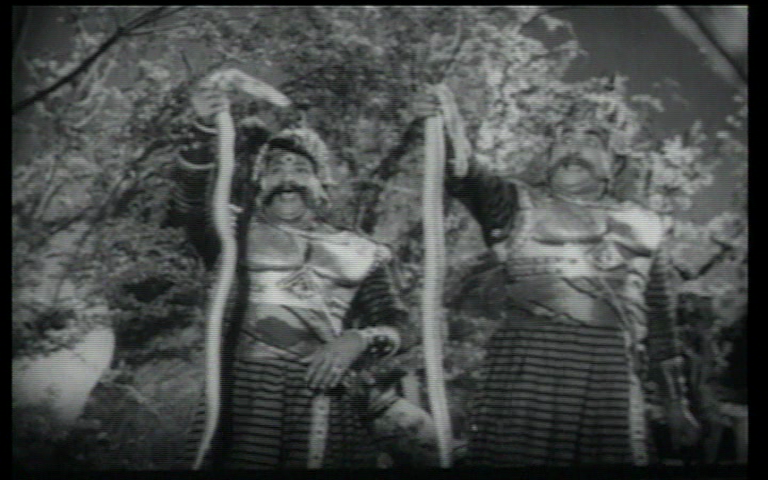
Rajanala makes an excellent villain here with his amazingly expressive eyes and appropriately evil laugh. His performance also provides a strong foundation for the story as he schemes his way towards the throne with the help of the treacherous army chief Dushtabuddi. He also has excellent moustache twirling skills!

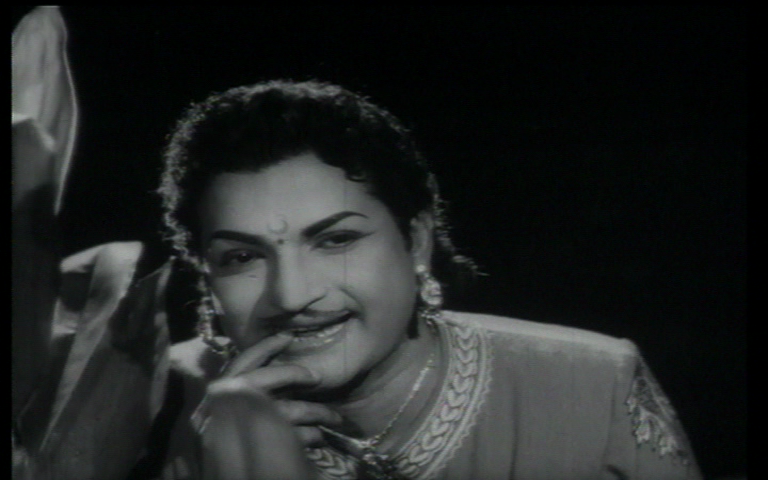
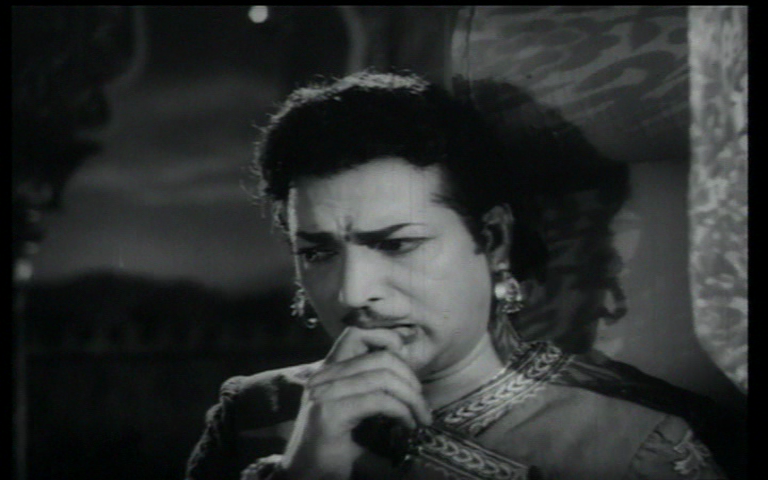
Meanwhile, as may be expected from someone who grows up as a goat-herder in the woods, Vijay (NTR) grows up to be a handsome well-spoken young man who has an amazing ability with a sword but no idea about his real parents. Despite his lowly start in life, Vijay is a man of principles and NTR gives him plenty of charm and humour to go with his bravery and spear throwing. He does look the part of the perfect fantasy prince and can look determined, puzzled, worried or intrigued as required.

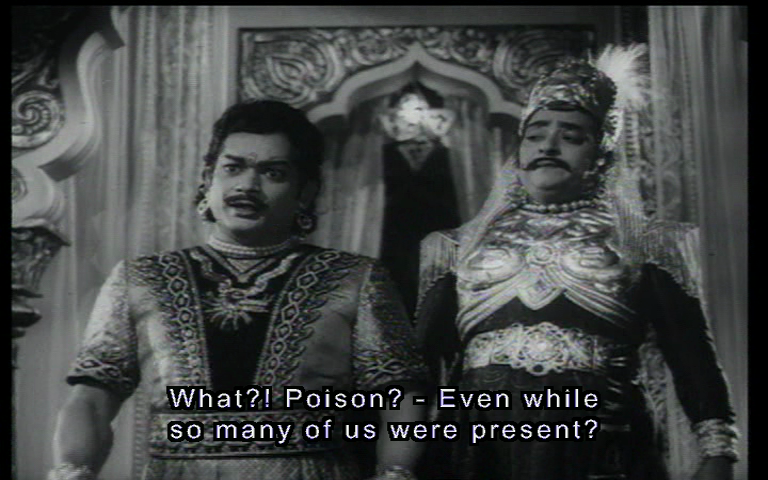
Now that Vijay is grown up and capable of thwarting his plans, Vakraketu finally decides to make his move on the throne by poisoning the King’s wine to destroy his sight. This happens to coincide with a hunting trip into the woods enabling Vijay to turn up just in time to be the last person the King sees before the poison takes effect, thus fulfilling the totally fabricated prophesy. While Vijay easily evades the soldiers sent to capture him he’s intrigued enough to climb up to the King’s lodge and discovers his heritage. After meeting his real mother, he sets out to discover the fabled Gulebakavali flower which will cure his father’s blindness.

Vijay’s three elder brothers have grown up to be complete fools under the influence of their uncle, but they also decide to search out the fabled flower and they provide much of the comedy throughout the film. Although they’re not particularly funny they aren’t too irritating despite the youngest brother’s incredibly squeaky voice, and they do have an important role to play as they cheat their younger brother later on in the film. The rest of the comedy is provided by Atitelivi (Balakrishna) who befriends Vijay and helps confound and defeat Vijay’s three brothers and by Vijay himself as he proves he has plenty of brains to go with his bravery.

On his quest for the gulebakavali flower Vijay has to overcome many challenges, and the first of these is in the form of a beautiful woman who has declared that she will marry the man who can beat her at dice. Yuktimati (Jamuna) provides plenty of glamour and looks stunning as she scams various rich men out of their wealth and takes them prisoner, although unlike Circe she doesn’t go as far as turning them into pigs.

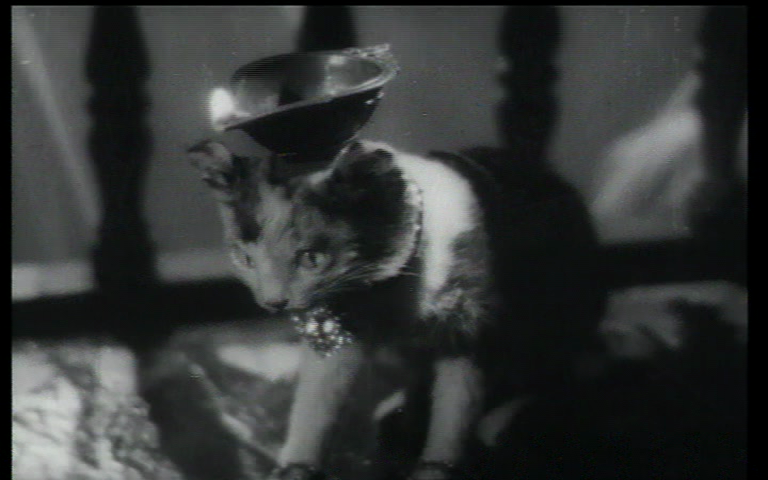
After his brothers succumb and are taken prisoner Vijay disguises himself as an old man and beats Yuktimati when he discovers her trick of using a mouse to distract her cat which serves as her lamp.It’s all rather silly and the cat and mouse are both obviously stuffed, but it’s a nice fairy-tale like idea and the song with NTR in disguise is excellent.

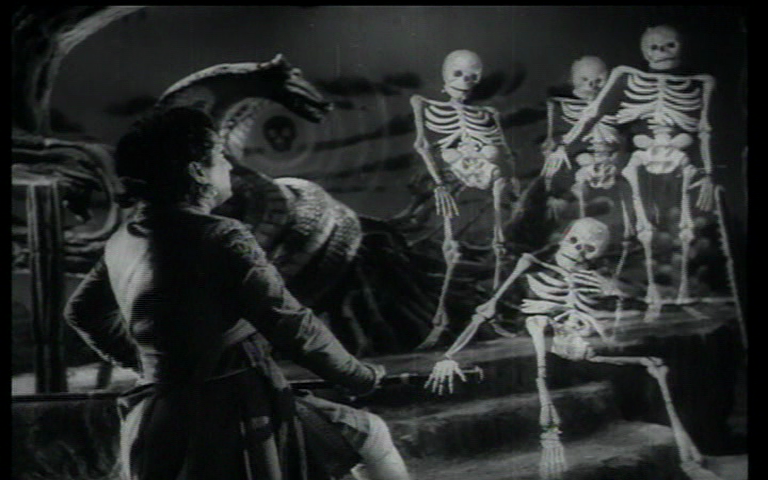
Despite beautiful women throwing themself at him, the search for the gulebakavali flower must go on and Vijay leaves his new wife to continue looking for the cure for his father’s blindness. He picks the scariest looking spot in the entire forest to go to sleep, so it’s not surprising that he is awakened by a skeleton that attacks him as the statue starts to breathe smoke, the moon sports a skull and there are bats and snakes in abundance. However it was all just a test and after proving his bravery, Shiva gives Vijay an enchanted jewel which will enable him to become invisible and reach the yakshaloka.

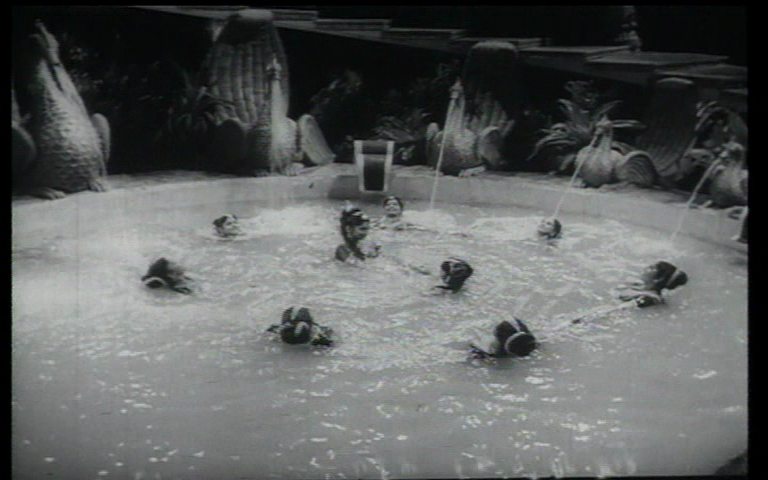
Once there he discovers the beautiful princess Bakavali and her entourage who guard the golden flower. The sets here are beautiful and as well as singing and dancing there is also synchronised swimming to enjoy. Peacock beds are obviously de rigueur for fantasy princesses and Bakavali has a rather nice example here.

Back on Earth with the flower Vijay meets treachery and betrayal and becomes progressively more unshaven and tattered which makes the resemblance between him and his grandson Tarak very obvious.

There are more damsels in distress to rescue and more fantastically gory eye scenes before Vijay adds a second wife to his collection by marrying Bakavali as well before heading home to save the day.  Here are some more pretty pictures of the various beautiful women who all are happy to see Vijay, plus the elusive gulebakavali flower.

While Gulebakavali Katha follows a fairly standard fantasy theme with a heroic prince overcoming various challenges it’s all done beautifully with stunning sets and some very sparkly jewelry.  There is enough humour in Vijay’s character that he doesn’t become too sanctimonious despite all his self-sacrifice, and he seems quite delighted at the various women who throw themselves at him. Jamuna has the best described role among the women as Yuktimati along with her chief handmaiden Asha and it’s a shame that they disappear from the story so quickly.

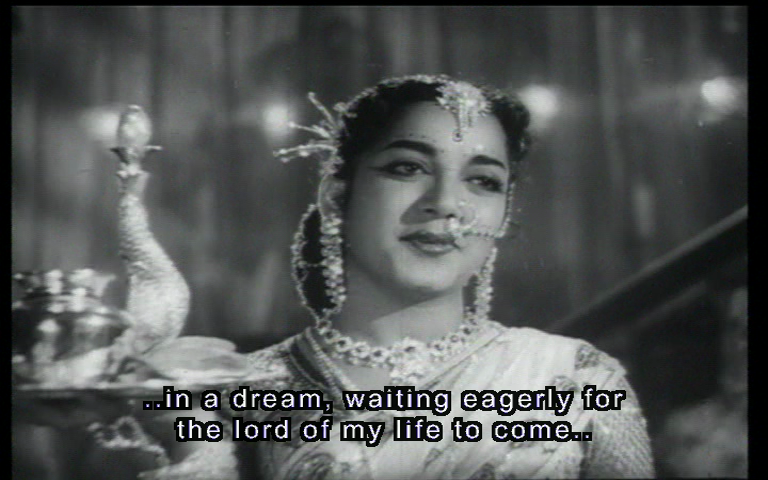
The effects are really quite innovative for the time and feature transformations, fighting skeletons and plenty of quite realistic eyes being thrown around. There is even a flying dragon as transportation although rather oddly it makes the same noise as is generally used for UFO’s. On reflection though, that perhaps does make sense! There are plenty of songs and some very beautiful duets although the mix of traditional songs and fifties ‘big band’ sound is occasionally a little strange. I really couldn’t decide which of these was my favourite, so here is a link to Nannu Dochokundavate with Vijay and Yuktimati, and below is Kalala Alalapai where Bakavali is dreaming of Vijay.

I really enjoyed this film as the simple story unfolds so smoothly and the whole film looks absolutely stunning. NTR makes a wonderful heroic prince and I love him in these roles, particularly with such excellent co-stars. The eye related theme is fantastic and so much fun without being overdone or used too heavily as a metaphor.  I thoroughly recommend watching and as an added bonus, it is available with subtitles! 5 stars.

Temple says:

I tracked this film down after reading Minai’s excellent blog post. While I enjoyed it immensely, there are a couple of things that didn’t work so well and I wouldn’t put this quite at the top of my list of vintage Telugu fantasy.

After the great start with jaunty music and skeleton, the device of a story being told within the film detracted a little from the opening sequences. There was a bit too much telling via voiceover and not enough getting on with it. I don’t particularly care for the intrusive narrator in films, unless we are talking The Princess Bride, as it can be distracting and can break the rhythm of the story. While it was intended to convey the folktale flavour, I think just showing the events happening would have been better. Heather has pretty much retold the whole plot, so I won’t go over my favourite episodes, but there are lots of obligatory folktale challenges and obstacles, all solved in a stylish and heroic manner. But while there is a lot happening, and lots of characters coming and going, this felt like it was plodding along at times where it should have had more zing.

Maybe that is because there just isn’t enough dancing for my liking. Compared to other favourites of mine like Patala Bhairavi, Bhookailas (featuring Helen!) and Jagadeka Veeruni Katha (with the peppy L Vijayalakshmi as a snake goddess), this film is a bit light on for songs and dances. The music is very pleasant, and slightly eccentric at times, but I can’t recall most of the melodies now while I can immediately think of songs from the other films. Clearly I need the sparkly dance outfits and choreography to make me remember.

NTR has a romantic melting eyed look that suits the princely characters but is physical enough to be the heroic warrior or goatherd as the case may be. I can see why he is synonymous with this genre – it is just perfect for him. I’m quite fond of Balakrishna too so I enjoyed his contribution to the comedy and confusion. And the ladies all look stunning and suitably fairytale princess inspired, which for the most part is all they need to do. The costumes and jewellery are typically lavish and beautifully filmed.

The fantasy genre is something I think Telugu film makers excelled at in the 50s and 60s. Regardless of whether the inspiration was folktale, mythology, history or religion there is an abundance of delightful films that combine beautiful visuals with a sense of wonder and whimsy. But while I like Gulebakavali Katha, I prefer the more sprightly energy and derring-do of the other films I’ve listed. (Although this film has NTR plucking his eyes out, I don’t think anything can top him cutting his own head off in Bhookailas. Terrible pun, sorry!) It is well worth a watch but there are other films in this style that appeal to me more. A small deduction for the slightly draggy start, and the missed opportunity for more dances. 4 stars.