Nannaku Prematho

Nannaku Prematho treads the line between mass action shtick and a more restrained thriller. Sukumar is attentive to foreshadowing and resolving the things he sets up so it is all very satisfying. Note: I think I’ve avoided giving away most of the surprises, but this is not completely spoiler free.

Abhiram (Tarak) is the youngest son of Subramanyam (Rajendra Prasad), a successful enough NRI businessman. But all families have secrets and when Subramanyam is diagnosed with terminal cancer, he tells his three sons about his past. He was once even the even wealthier Ramesh Chandra Prasad, but was cheated by an associate who has gone on to become filthy rich and influential on a global scale. He wants those wrongs righted, and the lost wealth back, before he dies. The two older sons humour him but have no intention of paying anything more than lip service. Abhi is more action oriented and he decides to ruin Krishnamurthy (Jagapathi Babu) so his father can die in peace. He decides to throw everything he has at this, including emptying out the family bank accounts. And his method? Making Krishnamurthy’s daughter Divya (Rakul Preet Singh) fall for him so he can worm his way in to Krishnamurthy’s good books and then steal all the things. His brothers are not supportive after losing the family fortune twice, Divya is unimpressed when she rumbles him, but Abhi is undaunted.

Despite the premise that Abhi will use Divya the relationship that develops between them, as much as any relationships in this film are developed, is quite respectful and they seem to like each other. Sukumar falls back on the hero saving heroine from a completely unnecessary and gratuitous rape scenario but this is a big budget Telugu film and it’s not like they have the inclination to actually think about having the hero talk to a woman with a brain. When Abhi tries to get over losing Divya he doesn’t want her insulted or cheapened in any way, so he focusses his anger on her father. I like that he didn’t think less of her because of either how their relationship started or who she was related to. But I am not sure he really knew her all that well either. He knew what he wanted to know of her. A lot of the tension is really about misunderstanding. And when people do understand the situation or the motivation, they deal with it and it makes sense. Mostly. The character with minimal respect for Divya is her father.

Tarak is low key and solid in his 25th film, and manages to make the shift into heroic daring and action a seamless extension of Abhi’s character. It was well judged, and helped by some thoughtful plotting. Sure there was still some near certain death, and suspension of logic and laws of physics, but overall his challenges required brain as well as brawn. Abhi tries not to let extreme emotions sway his behaviour, but he isn’t dull. He has a sense of humour to go with his overweening confidence, treats his sidekicks like valued helpers most of the time, and Tarak has a nice rapport with his co-stars. I was really interested in how Abhi was going to solve the various challenges thrown in his way and very invested in seeing him win over the slimy Krishnamurthy. The action scenes seem like a breeze for Tarak, and he gets to strut his stuff in a few songs too.

Rakul Preet Singh has some fairly thin material as Divyanka, but manages to pull a decent performance out of it. She doesn’t simper, she looks Abhi straight in the eye and demands answers. It is nice to have an unapologetic and self-assured woman as the heroine. Divya was also given a little bit of space to be angry, be sad, be scared, get drunk, hang out with friends, and be a person in her own right. It’s not a ground breaking role, but I liked the performance and the hints of being more than just an accessory for the hero. Rakul Preet just turns up in the songs, does great face, and leaves most of the work to Tarak which suited me fine. She dressed appropriately for the part, wore stylish and sensible flat shoes which made me ridiculously happy, and only suffered a few dodgy outfits. I also liked that her conflict over her father heading for a collision with Abhi was somewhat resolved, albeit in a thrifty way.

Set in the UK and Spain the film’s style is urban and the characters well to do. It all looks crisp, well composed, and orderly. Tarak’s image as Abhi was a mildly dandified hipster about town, affluent and understated. But I laughed at the matching outfits all three sons wore in one critical scene. Otherwise the wardrobe team did well. I’ve been thinking about eyebrows a lot since I rewatched this.

Also interesting – I’ve never seen a plot hinge on a car full of guinea pigs before. The poor little buggers were thrown around a bit, which I find distressing. But the stupid science thing that had me rolling my eyes turned out to be a ruse so I’m glad that was not supposed to be a thing. The songs by Devi Sri Prasad are OK and are integrated well into the action.

The supporting cast is strong, even if they don’t always seem essential. Jagapathi Babu is in his element as the urbane, narcissistic, Krishnamurthy. How cool that he gave Abhi a swipe card to get into his office anytime without breaking in, he was so confident he would win. The way the story was fleshed out around the characters made sense in this world, and there were few false notes. Hooray for quietly competent Kate (Liza van der Smissen) in amongst the sidekicks. I was honestly puzzled by why Srinivas Avasarala was even in the film because I can’t recall his character doing anything necessary. Rajeev Kanakala does high emotion well, but his character was hampered by the lack of connection between some scenes. Rajendra Prasad isn’t in the film for long but his presence permeates everything.

I have a small gripe. The opening titles are over a badly animated approximation of a Rube Goldberg machine….Why not just build one instead of faking it? But the film is fairly well constructed, has decent internal logic, throws in a few elaborate surprises, and like a Goldberg machine everything lands where it should.

See this if you like a good mass film but often wish they made more sense, and for people mostly acting like grown-ups. 4 stars! (deductions for gratuitous rapeyness and imperilled guinea pigs).

Lady James Bond (1980)

There is very little written about this film. I can’t say I’m entirely surprised nobody wants this to grace their filmography. You may be delighted with the prospect of another Silk Smitha starring film, or perhaps just glad I watched it so you don’t have to. Check out this song!

That really is amazing. The hideous styling distracts from the lewd choreo which distracts from the hideous styling. It’s ingenious.

(You know, Chiru would have rocked that outfit. Just saying.) And while everyone is distracted, cat stroking villain Supreme’s Henchman 1 launches a kidnapping attempt!

The Professor has a folder of Important Research that is always in The Briefcase. It feels like everyone in the film is after The Briefcase at some stage. Luckily the government assigns Lady James Bond (Silk Smitha) to protect him. His daughter Indu’s boyfriend Kapil (Kapil Dev but not that Kapil Dev) is blackmailed into stealing The Briefcase. Apparently this is very bad for the country. Kapil lives in the equivalent of a lighthouse with a very long spiral staircase up to his lounge room, quite challenging for poor Indu trying to make a dramatic entrance and confront her deceitful fella. He admits to the theft, she pulls a gun, they struggle and she is both shot and falls out of a window. Lady J drops by to suss out the situation but Kapil sends her away.

And then – a blackface song.

Sadly for Lady J the baddies see right through her disguise and sadly for us we have to witness this at all. A rooftop fight shows off her latest horrible outfit complete with neoprene leg warmers AND arm warmers. She is chased, beaten, then maced. And the baddies run off. These people have no idea she still has half a movie to go and they are not yet safe. She is criticised by her commanding officer for being hopeless, either at her job or at disguises, I don’t know which. Either could be valid.

Undeterred by her lousy luck with disguises, 001 Lady James Bond pretends to be a food vendor and ends up drinking with Henchman 2. Finally an explanation for the ubiquitous black socks in skimpily clad dance numbers – it’s where she hides her pills! They spike each other’s drinks and this causes another terrible song. Lady James Bond recovers first, takes a hit of her special smelling salts and ransacks the house, finding The Briefcase. H2 seems to keep a hockey playing gang on retainer, or maybe they were just opportunistic thugs who play hockey in between assaulting women. Anyway, she has another epic fight on her hands as she runs the kilometres and kilometres to get from his house to the end of the driveway.

Lots of things happen but there doesn’t seem to be much to connect them all. There is a skanky item girl waiting for Nagendra in the lighthouse but just as the horror of that starts to settle, policemen are being garrotted and the director is under attack. Lucky for him Lady J doesn’t hold a grudge. I think she might resuscitate her boss by electrocuting herself on a desk lamp and passing the current through her hand to his body. That’s commitment. But the baddies are still after The Briefcase, which now has a new file in it. And Lady J has so much more high kicking and back flipping to do.

She rescues Nagendra from the gang, only to then be captured by “tribals”. Of course they strip off her snazzy purple jumpsuit and kit her out wearing the skin of a teddy bear, just for the sake of another skanky dance number. And then they tie her to a tree and leave her. There’s a theme with not finishing things off. People just leave Lady J and expect her not to come after them.

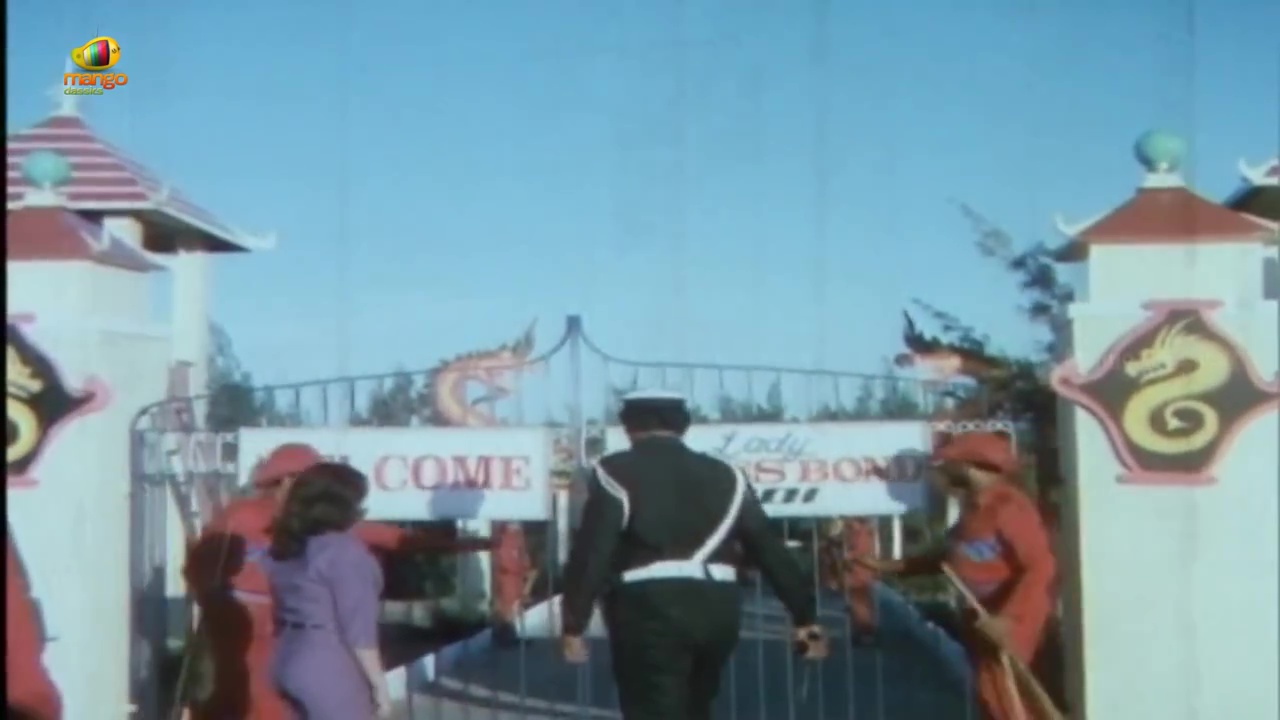
She wanders through the wilderness, again, and suddenly someone releases the hounds. She is taken to Supreme’s secret hideaway, more like a high school adventure camp or low budget theme park. Lady James Bond blows everything up, Suthivelu turns out to be both smart and useful, almost everybody else dies, and the baddies are taken away. But I still have no idea what they were up to.

So many men in this film “accidentally” kill the woman they say they love. And cry their teeny selfish hearts out about it. I’m not confident anyone in the film knows how to confirm people are actually dead either as they seem very reluctant to consider trying any form of treatment. But what goes around comes around, so…

Silk Smitha is actually pretty good. Despite the near constant gyno-cam and detour into sleaze at any and every opportunity, she is fun as the top secret agent. She is pleasant and professional with her charges, but can switch to a cold eyed rage when she is taking on the evil doers. She wears some hideous clothes, but as a skanky item specialist that wouldn’t have worried her. And the fancy agent gadgets were a triumph of imagination over budget and science. She uses her transmitter detecting boots to find a secret phone in a tree and uses another spy gadget aka a shirt button to disguise her voice. I think Silk carried on the legacy of ladies like Jyotilaxmi very well indeed. And all her snake dance appearances may have held her in good stead with Lady J’s trademark rolling away from trouble move.

My other favourite thing about the film was the prevalence of photo mural walls. Every house had at least one.

The excellent 4DK has written a much more thoughtful analysis of Lady James Bond.

Since this is, at least in English, almost undocumented I haven’t put names to many of the faces in the film. Feel free to leave a comment if you would like someone’s film legacy blighted by including their appearance in this.

It’s a film that goes beyond So Bad It’s Good and dives into Almost Endearingly Awful. I can mostly overlook the sleaze of the times and appreciate Silk doing her thing and Lady James Bond triumphing over the men, despite the men, without the men. Maybe 1 star for effort, 2 ½ stars for WTFery and entertainment. If you’d like to share your thoughts, just speak into the flowers!

Mahanati

Mahanati

Nag Ashwin’s Mahanati is a spellbinding biopic that celebrates the life of Savitri in sumptuous colour with haunting re-enactments of her most famous scenes. Keerthy Suresh invokes the magic of Savitri’s screen presence while Samantha ties it all together as a journalist researching the legendary actor’s life for a newspaper article. At just under three hours, the film still only scratches the surface of Savitri’s story, but with an impressive cast and convincing dialogue, Mahanati is a mesmerising look at one of the most successful film actors from the South.

The film opens with Savitri falling into a coma and being taken to a hospital whose bemused staff have no idea who they have just admitted. One year later, on the anniversary of her illness, journalist Madhura Vani (Samantha Akkineni) is given the task of writing about the film star for a short article in the newspaper. Vani is shy and frumpy, struggling to make her mark in the male-dominated profession of journalism and she is dismayed at what she thinks is a throw-away assignment. But once she starts speaking to the people who knew Savitri, Vani becomes intrigued by the star and her generous and compassionate personality. As she learns more, Vani draws inspiration from Savitri and becomes empowered to make changes in her own life and stand up for herself. This interweaving of Vani’s story into the life of Savitri is ingenious and allows Nag Ashwin to focus on the more positive aspects of Savitri’s legacy, although he doesn’t avoid the drama either.

The film shows Savitri’s early life after her father dies and her mother goes to live with relatives. Even as a child, Savitri was a force to be reckoned with. Her determination and will to succeed is demonstrated as she learns to dance despite the dance instructor telling her she lacks discipline and will not be able to master the skill. I loved these early scenes and the young actor playing the child Savitri who is a real find. She is full of life and totally charming with plenty of attitude – perfect for the role!

Savitri is shown taking part in theatrical shows under the supervision of her Uncle, K.V. Chowdary (Rajendra Prasad), and her abortive first trip to Chennai to become an actress is also depicted. This is beautifully done, with Savitri in full fan mode as she tries to get glimpses of her favourite actor Akkineni Nageswara Rao (Naga Chaitanya), and being almost totally oblivious to the man who takes her photo, Gemini Ganesan (Dulquer Salmaan).

Nag Ashwin doesn’t dwell too much on Savitri’s rich film history but focuses instead on the real-life drama of her marriage to Gemini Ganesan and subsequent estrangement from her uncle. Her iconic roles are shown in a montage and Keerthy Suresh does a fantastic job in re-creating these accurately, including a poignant song from Devadasu and the wonderful scene in Mayabazar where Savitri is playing Ghatotkacha impersonating Sasirekha.

I’ve been waiting for a film that showcases Keerthy’s talents as an actor, and finally she gets her moment to shine. She really is amazing here and completely nails a wide range of emotions. From the early bubbly and happily carefree girl all the way through to the devastated wife who turns to alcohol, Keerthy makes us live every moment and completely believe in her portrayal of a legendary actor. A standout is the moment when she learns Gemini Ganesan is already married and her dreams of romance turn to ashes. This, and her subsequent difficult decision to marry the man she loves despite everything are simply perfect, with none of the actors overplaying the emotion, but still managing to make the audience feel every heartache and each moment of elation.

Dulquer Salmaan is also a perfect choice for the ultimate romantic actor of the time; Gemini Ganesan. He has plenty of charm and when he sets out to woo Savitri, she doesn’t stand a chance! Their romance sparkles on screen and Dulquer is just as convincing when he portrays Gemini Ganesan’s jealousy at his wife’s success and subsequent alcoholism. The story is told from Savitri’s viewpoint, so Dulquer has less screen time after Savitri finds out about his affairs, but throughout it’s an excellent performance that makes the drama and emotion behind their relationship very real.

The secondary story of Madhura Vani and her struggle to be accepted as a serious journalist is well integrated into the main plot. Nag Ashwin uses Vani to introduce key witnesses to events in Savitri’s life that allow the film to move back into flashback. But is also emphasises the importance of Savitri as a role model and inspiration, while Samantha’s success over the other, male reporters is an important step for Telugu cinema. Here is a film that has a female lead who isn’t defined by her romance with a male character and who is allowed to have a personality and story of her own. Although there is a romance (with Vijay Devarakonda in a very bad wig), it’s very much part of Vani’s own story and important mainly as a way for her to assert her independence from her father’s plans.

There is a plethora of other actors who appear in cameo roles as various screen legends of the time. Just a few are Mohan Babu as S.V. Ranga Rao, Prakash Raj as director/producer Aluri Chakrapani and Krish appearing as K.V. Reddy. It’s a real who’s who of Telugu/Tamil cinema of the time and I was inspired to read up on some of these directors and producers whose names I recognised when I left the cinema. Mickey J. Meyer’s music fits the film perfectly too and Dani Sanchez-Lopez does an excellent job with the cinematography. The effects team have managed to recreate Chennai in the fifties and the costume department deserve special mention for the wonderful outfits worn by Keerthy and Dulquer. The end credits juxtapose shots of Savitri with those of Keerthy in the same film role and the resemblance really is astonishing.

Overall there is fantastic attention to detail for both the scenes in the early eighties and Chennai in the fifties that ensure the film feels authentic, although I did sympathise with Samantha and her selection of ruffled shirts and long skirts. Everything about the film seems to have been well researched and the sets dressed to add plenty of authentic flavour. Including the film segments in black and white also adds to the whole period feel of the film and emphasises just how much impact Savitri had at the time. I also have to comment on the excellent subtitles by Rekhs that ensured the drama of each scene was well conveyed. After the last few Telugu films I’ve watched where literal translations have made a mockery of important scenes it is such a relief to have proper idiomatic English that makes sense and doesn’t detract from the dialogue. Until I can learn Telugu (a vain hope given my lack of success with Tamil) Rekhs subtitles are the next best thing to understanding the dialogue myself and I always cheer when I see ‘Subtitles by Rekhs’ appear on screen.

Mahanati is an excellent dramatisation of the life of one of South India’s best known and well-loved actors. I don’t know enough about the details of Savitri’s history to comment on its accuracy but from all I have read, Nag Ashwin has captured the essence of Savitri’s story while Keerthy Suresh has brought her memory to vivid life. It’s ultimately a sad story but also a lovely tribute to Savitri and a reminder of what a wonderful actor she was. Mahanati is a real treat for fans of both classic and contemporary Telugu cinema – don’t miss it!