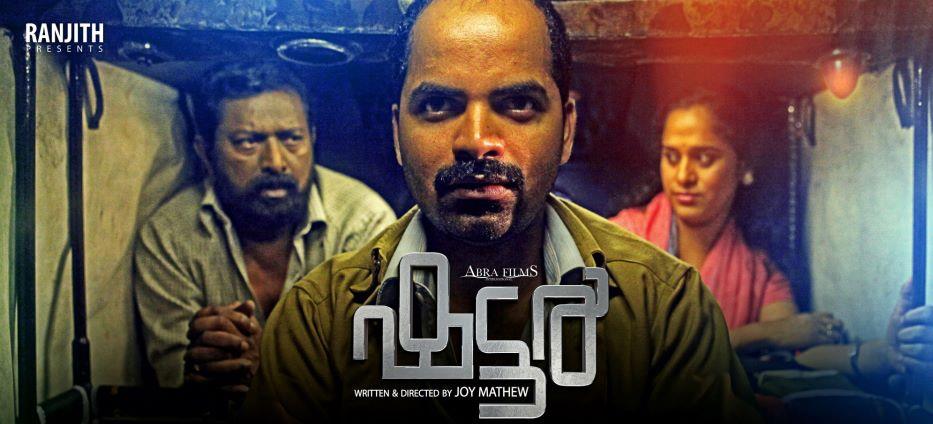
Shutter (2012)

Shutter poster

Shutter is an intriguing début film from noted theatre actor and playwright Joy Mathew. The story sounds simple; a married man ends up locked in his own empty shop with a prostitute for a night and a day, but Mathew has developed rich and detailed characters with a complex story that says much about society and the double standards applied to men and women. There is suspense and plenty of drama as Rasheed (Lal) has to face his own hypocrisy and struggles to deal with the possible consequences of his actions. Although the film starts slowly and does take some time to fully introduce the characters and eventual situation, it is well worth the extended set up as the film features excellent performances from Lal, Vinay Forrt, Sreenivasan and Sajitha Madathil along with the clever storyline. Shutter is an excellent slice of social commentary and one I highly recommend as a memorable and thought provoking film.

The story follows Rasheed as he visits his family in Kozhikode during a break from his work in the Gulf. In the short time he is home, he manages to upset his eldest daughter Nyla (Riya Saira) by insisting she stops her studies and gets married, and alienates his wife (Nisha Joseph) by snubbing her relatives. Not bad for just a few days! However his views are not extreme and seem fairly typical for a man of his generation. While his belief that studying is wasted on girls is one that I personally find outrageous, it’s one that seems common in India even to-day. So Rasheed’s bluster to his friends that Nyla will do as he says and get married, even though she is underage, sounds plausible and typical of an Indian father, while the half-hearted objections of his friends also ring true.

Rasheed also owns some shops which are just in front of his family home. He rents one out to an auto mechanic and is renovating another, while in the evenings he invites his friends into the empty shop for a night of drinking. While on a trip to a bottle shop with his friend Suran (Vinay Forrt), Rasheed spots a prostitute Thankam (Sajitha Madathil) and decides to bring her back to the shop when they cannot find a hotel room. Suran locks them in while he goes to find food but fails to return following series of unfortunate events which leave him with his own predicament to solve. The story then follows Rasheed’s moral dilemma as he quickly realises what he has done and what will happen if he is discovered in the shop with a prostitute. To make matters worse he can see his house from the small window, which serves as a constant reminder of his wife, his family and everything he might lose as a result of his rash decision.

While Rasheed goes through his moral crisis, Thankam is a brilliant contrast to his misery and despair. She has a relaxed, take life it as it comes attitude, and her constantly ringing phone and cheery attitude infuriate Rasheed. Naturally Thankam can’t see his problem as she just needs to keep in contact with her clients and her only difficulty is that she may have to cancel appointments if she can’t escape the shop. For Rasheed every call risks discovery and he desperately tries to silence her conversations any way he can. The difference in their attitudes is summed up when Thankam lies down for a short nap, while Rasheed paces around the increasingly claustrophobic room with tears and sweat dripping down his face. I like that Thankam isn’t yet another beaten down woman who has turned to prostitution in desperation, but rather is portrayed as a businesswoman for whom the night is just one more transaction, albeit one that doesn’t go quite to plan.

Parallel to the main story, a film director Manoharan (Srineevasan) is shown trying to tie down dates for his lead actor and secure financial backing for his next venture. Unfortunately Manoharan is having some difficulty with this and adds to his problems when he leaves his script behind in Suran’s auto. This pulls Manoharan into Suran and Rasheed’s world and the two stories blend together seamlessly. Vinay Forrt is just superb in his role as the anxious and somewhat naïve auto driver who doesn’t know how to get his friend out of a locked shop without letting the cat out of the bag too. Sreenivasan is perhaps a little too understated for much of the film, but he provides a more stable and rational character and another different viewpoint of the situation.

Glimpses of the outside world through the shutter heighten the stuffy closeness of the shop, while Suran’s travels in his auto and Sreenivasan’s conversations in a car with his friend provide a counterpoint. Despite the illusion of freedom and travel, neither can solve their problems, while Rasheed, stuck in his small room without freedom of movement can achieve self-realisation and come to terms with the issues he faces, even if his main problem is one he cannot resolve himself.

There is so much I like about this film. I love the characterisations and the depiction of ordinary, everyday people with their conventional concerns. I like the  way Joy Mathew takes a simple story and layers more and more complexity to each character to finish with a rich and satisfying plot. The underlying social issues are expertly brought into the forefront of the story and I hope raise plenty of questions and lead to discussions around the inequalities portrayed. The performances are all outstanding and Hari Nair’s excellent cinematography adds to the drama and tension without over shadowing the very human story. It’s wonderful and definitely not a film to miss. 4 ½ stars.

Mumbai Police (2013)

Mumbai Police

I’m a big fan of police procedural dramas and crime films in general, so naturally this 2013 film from Roshan Andrews made it onto my ‘must-watch’ list. And I’m happy to report that the film more than lived up to expectations, with a genuinely surprising ending and a good build-up of suspense along the way. It’s a difficult film to discuss without revealing crucial plot elements, particularly since those are partly what make this film so good, but I will do my best to discuss the film without getting too spoilerish.

The film starts with an accident that causes ACP Antony Moses (Prithviraj) to lose his memory. This is particularly inconvenient since he had just discovered the name of the criminal who had assassinated his friend ACP Aaryan John Jacob (Jayasurya) at an awards ceremony. Despite not remembering who he is, let alone anything of the crime, Police Commissioner Farhan Ashraf (Rahman) asks him to re-investigate the murder, presumably in an attempt to bring back Antony’s memory. Farhan is another friend and the tenuous link to the title of the film is that the three were collectively known as the Mumbai Police due to previous time spent together working in Mumabai. The friends had a reputation for drinking and carousing, particularly Antony who is now known by his nickname Rascal Moses, a label that seems to colour Antony’s reception by colleagues and suspects alike.

Antony has also been instructed not to let anyone know that he has lost his memory and as a result he makes a number of crucial errors in his first days back on the case. Not all of these relate to the investigation, such as his failure to recognise the Superintendent of Police, but he falters in his interactions with the rest of the investigating team who seem to suspect that something isn’t quite right.

Roshan Andrews uses flashbacks to the original investigation to show that pre- and post-accident Antony are two quite different people. Pre-accident Antony wasn’t a particularly nice character as he wasn’t averse to using force and various other dubious tactics to achieve his desired outcome. Post-accident Antony is quieter, more introspective, and seems to be genuinely interested in finding the actual culprit for his friend’s assassination rather than the first available scapegoat. Prithviraj does a great job of highlighting the differences by completely changing the physical mannerisms of the two Antony’s; changing his walk, stance and mannerisms to accentuate the difference. He’s helped by the physical signs of the accident but there is a distinct personality change too which makes Antony a fascinating character.  I kept waiting for a moment where he would remember his former life and revert back to mean and nasty, however post -accident Antony is quieter and more introspective, and seems constantly bemused as he struggles to come to grips with his memory loss. The reactions of Antony’s colleagues, particularly police constable Rakkhee (Aparna Nair), are used to provide more insight into his character both pre- and post-memory loss while Antony’s complete lack of emotion about his best friend’s death post-accident provides a good contrast to his passion and fire before he lost his memory. The greater objectivity should be a boon but instead seems to make Antony even more unsure of how to proceed and his colleagues find his lack of empathy odd. Antony has no recollection of his friendship with Aaryan and only knows that such a relationship existed because he has been told about it by Farhan. In fact, everything Antony currently knows about anything has come from Farhan and this leaves Antony suspicious and unsure of exactly what to believe – particularly when the evidence starts to point to a cover-up. It’s cleverly written to ensure that the audience really doesn’t know who to believe and who is covering for who, which further adds to the suspense and classic whodunnit flavour of the film.

Antony’s self-discovery proceeds in line with the police investigation and piece-by-piece the story is slowly revealed. There is an interesting side plot that involves tensions between the navy and the police force but overall writers Bobby and Sanjay keep to a fairly simple storyline focusing on the friendship between the three men and the investigation into the murder.

Just as the careful detailing of the investigation helps build tension, the sudden reveal of the killer and the reasons behind the murder make it even more surprising, even though re-watching shows that the clues were there all along. But then that’s just as they should be in any good detective story, and the smoke screen raised by the myriad other discoveries of the investigation is cleverly applied. The only thing that didn’t quite ring true for me was Antony’s reaction, which was just too overdone and rather too ingenuous to be convincing. However it’s a small quibble and the rest of the story more than makes up for Antony’s unrealistic response.

Technically the film looks fantastic and the background score by Gopi Sunder is effective in maintaining the desired atmosphere throughout. The performances are all well nuanced, as would be expected from such seasoned actors, but each has been well cast and fits their role perfectly. Mumbai Police is an engaging thriller which works mainly due to the gradual buildup of tension which flourishes due to Antony’s memory loss, and the ever present threat that the other shoe will drop and either the killer will come after Antony, or he will regain his memory and revert back to his old self.  Does either happen? You will need to watch to find out!

The film is entertaining for all the right reasons as Antony struggles to find both his past and the killer against a background of confusion and loss.  The ideal of the final revelation and the ultimate reason behind Aaryan’s death is excellent even if it is a little far-fetched, and the execution could have perhaps been a little better. It’s still a clever and honestly shocking conclusion.   I found Mumbai Police to be a slick, well-packaged and modern thriller that’s definitely well worth a watch for both the storyline and the actors who emphatically bring their roles to life. And you can’t ask for much better than that. 4½ stars.

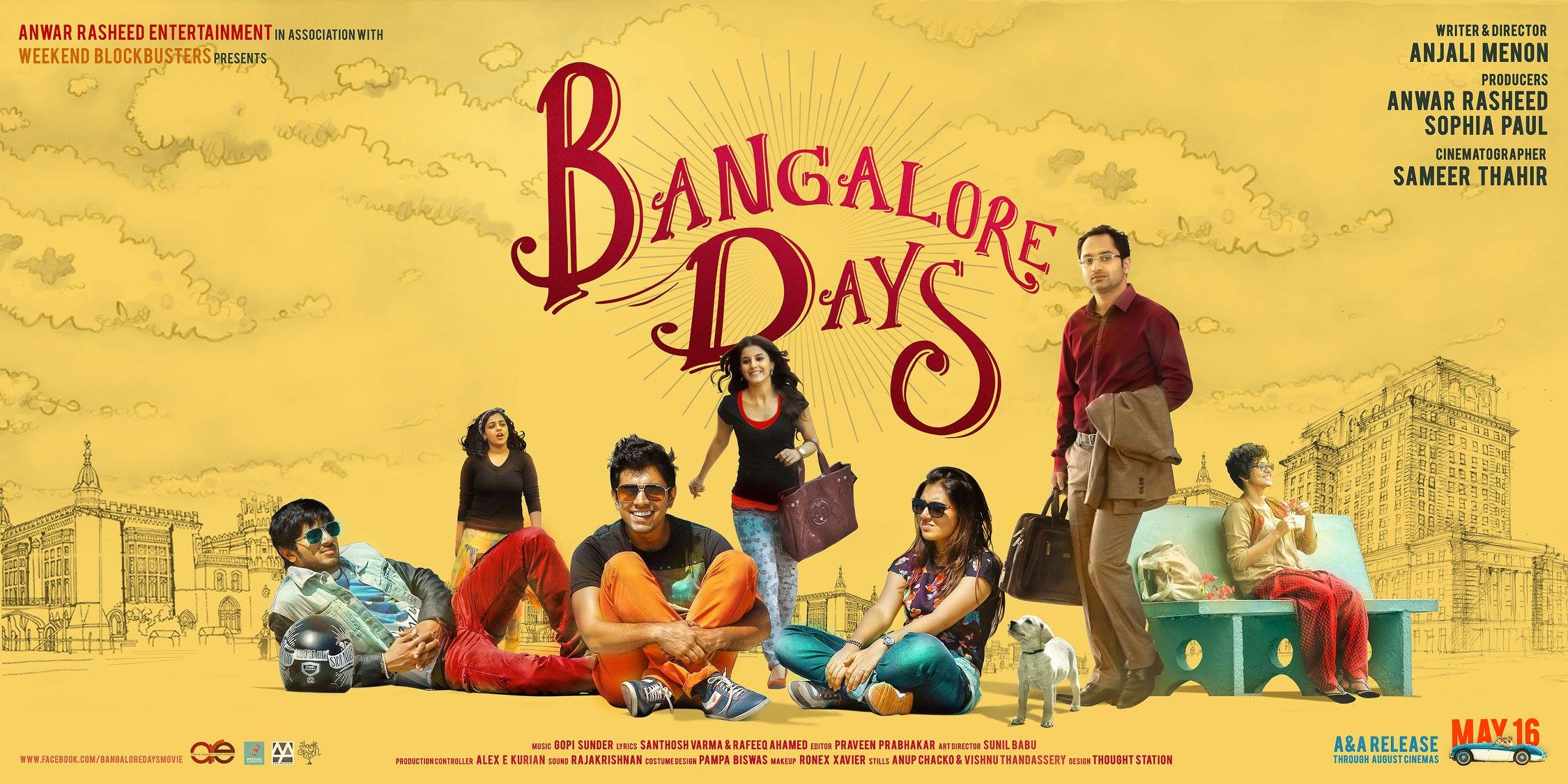
Bangalore Days

Bangalore Days

Bangalore Days is a gem of a film, written and directed by Anjali Menon, who was also responsible for the excellent Ustad Hotel. The film follows the lives of three cousins after they each move to Bangalore for different reasons and despite the almost three hour run time, it’s a completely absorbing watch. The young actors are the highlight, but the plot for each is perfectly developed and fits neatly into the overall story, so that there is a ‘fly on the wall’ feeling of watching real lives unfold. Even the slightly clichéd drama that forms the final climax is compelling, although the ending is never really in any doubt. Beautifully developed characterisations, a clever storyline and gorgeous cinematography all add up to make Bangalore Days a must watch film.

The three cousins, Krishnan PP aka Kuttan (Nivin Pauly), Divya (Nazriya Nazim and Arjun (Dulquer Salmaan) have been friends since they were children when they spent their summers together in the family’s ancestral home. Divya is a good student who has dreams of completing an MBA while Kuttan achieves his desire of escaping rural Kerala when he lands a job as a software engineer in Bangalore. Meanwhile Arjun seems content to drift, working at night as a graffiti artist and using his mechanical skills to work on motorbikes. As the film unfolds, more of Arjun’s past comes to light, including his unhappy childhood following his parents’ divorce. All of this has made him something of a rebel and disinclined to settle in any one spot or profession.

Divya’s parents decide to get her married quickly to counteract an inauspicious horoscope, firmly ending her dreams of study although the prospect of moving to Bangalore after the marriage is an enticing incentive. But things don’t appear too favourable when the prospective groom Das (Farhadh Faasil), reveals he was in a previous serious relationship and isn’t sure if he is over it. Divya’s main reason for going ahead seems to be the family dog’s acceptance of Das, and to be fair, I can completely understand her reasoning. Surely anyone who is a dog-lover cannot be a bad person? Throughout the film Anjali Menon small touches like this to successfully develop the characters and illustrate small traits that become important later. It’s simply done, but very effective and adds to the realistic feel of the characters.

The songs by Gopi Sundar are another highlight and this one sums up the different personalities and the relationship between the cousins perfectly.

Needless to say when Divya moves to Bangalore  with her new husband the situation does not improve and it’s not long before she is bored and resentful. Luckily Arjun has also moved to Bangalore to complete the confluence of cousins and is working for a Motocross bike team. With her husband’s indifference as motivation, Divya spends her days and nights out with Arjun and Kuttan, further increasing the distance between her and Das.

At the same time Kuttan has found what may be the love of his life in the form of air hostess Meenakshi (Isha Talwar). Although it’s completely baffling as to why she would be interested in the conservative Kuttan, she quickly takes him in hand, giving him a total make-over in the process. As to be expected, it doesn’t end well, but there is some lovely comedy and genuine warmth in the relationship which allows Kuttan to explore his less conservative side. Arjun is also in love, first of all with the voice of RJ Sarah (Paravathy Menon) and her positivity, but this quickly develops further once he sees her in person. There is a lovely moment where, after Sarah accuses Arjun of following her, which to be accurate is exactly what he has been doing, he eventually responds that rather than following, he would like to walk with her. It’s very sweet and the relationship between Arjun and Sarah develops into a full scale romance with plenty of sparkage between the characters.

What makes the film work so well is the excellent casting and the outstanding performances from all the actors. Nazriya Nazim is perfect in her role and even more impressive here than she was in Raja Rani. Her reactions and emotions are perfectly nuanced and her easy camaraderie with her cousins is well portrayed. Farhadh Faasil is also excellent as her distant husband with an unresolved past and his emotional delivery as his character gradually thaws is superb. Perhaps because the two actors are partners in real life, the depiction of their marriage is also very well done and the relationship is completely believable throughout.

Even better though is Dulquer Salmaan who gets his portrayal of a rather bitter but still compassionate man spot on. His relationship with his cousins is perfectly casual with plenty of chemistry that really makes them seem like a family. His expressions and body language speak more than the dialogue when he is with Sarah and he makes Arjun a more sympathetic character than I expected given his opening montage.  Dulquer’s character is well written but his performance takes it to the next level and I think this is the best I have seen him so far. Nivin Pauly has a more difficult job since Kuttan is self-restrained, almost staid and nowhere near as exciting as Arjun. However he still does a fantastic job with the character, particularly in the interactions with his father (Vijayaraghavan) and mother (Kalpana), both of whom are also excellent and perfectly cast. There are many levels to his character and to his relationship with both his cousins and the rest of his family that I don’t think I fully appreciated on my first watch, but become more apparent on repeated viewing. Kuttan’s character provides most of the comedy, but his serious nature is a perfect foil to the more impulsive Divya and rebelliousness of Arjun.

Although the film focuses on relationships, family, community and the three love stories, there is plenty more happening in the background. The film interposes the traditional values of rural India with the reality of modern city life, starting with the idea that community is lost in the city. However the complexities of this idea are further developed as Divya makes her own community wherever she goes, while Das carries his loneliness around with him as a shield. All the characters are looking for their own form of escape, some more literally than others, and all have personal challenges to overcome before reaching their goal. Anjali Menon develops the narrative through the different personalities and their attitudes, allowing the characters themselves to become the story and relegating the action to second place for much of the film.  It works beautifully well and it’s refreshing to have a film about marriage and relationships that is ultimately so optimistic and hopeful. Bangalore Days is an easy film to enjoy and I thoroughly recommend it as a modern tale of relationships. 4 ½ stars.