Pushpak

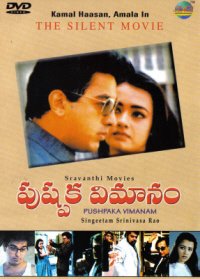
Although made in 1987, Pushpak is a silent film with no dialogue. However there is background noise and a very funky soundtrack. Presumably inspired by the early silent films from the start of the last century, director Singeetham Srinivasa Rao has included plenty of situational and physical comedy but Pushpak manages to be a compelling, if somewhat moralistic drama at the same time.

The story centres on an unemployed graduate played by Kamal Hassan. He lives in a one-roomed apartment on the roof of his building, and spends his days wandering around the streets unsuccessfully looking for work. By chance, he comes across an alcoholic millionaire (Sameer Khakhar) lying at the side of the road and recognises him from an earlier encounter near the Hotel Pushpak.
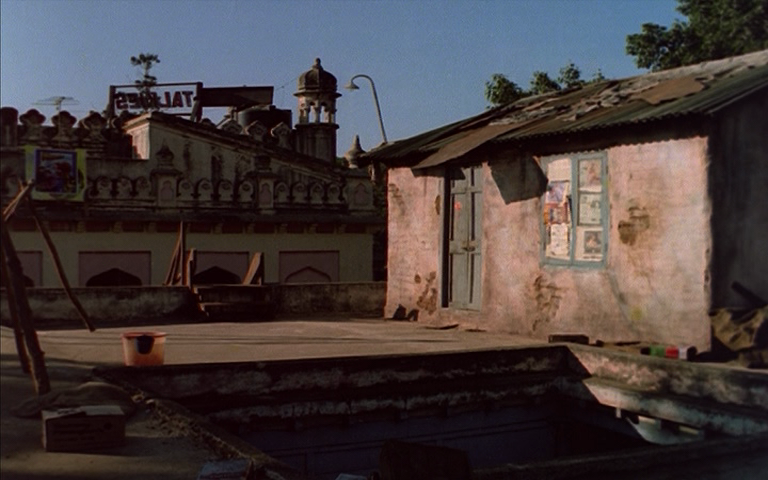
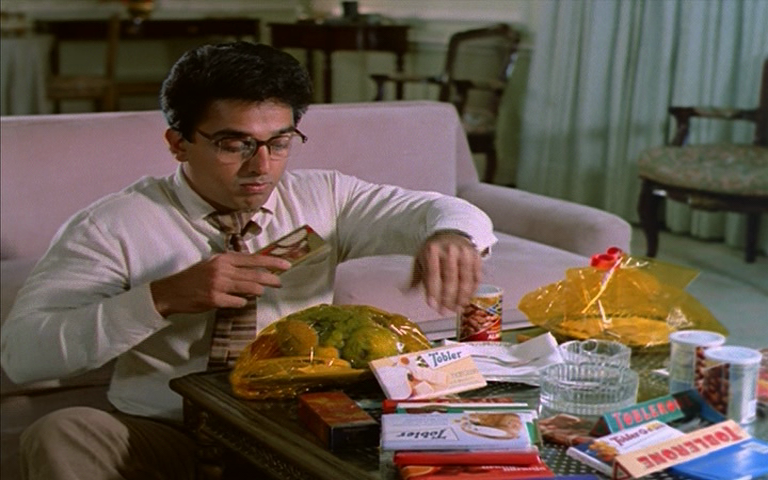
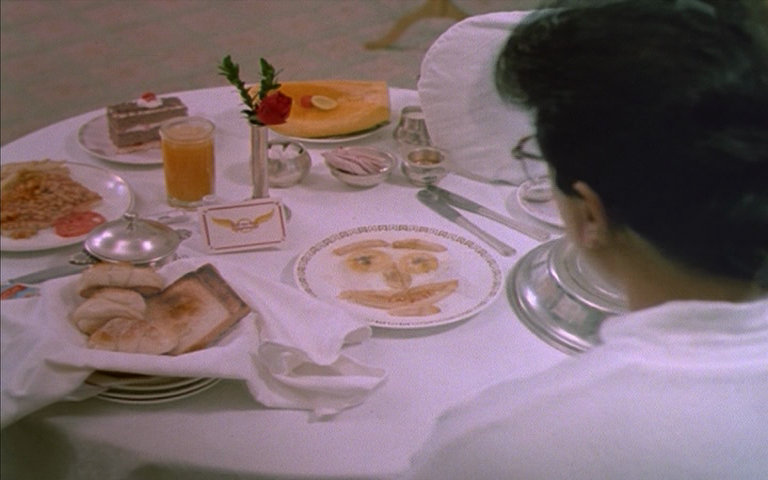
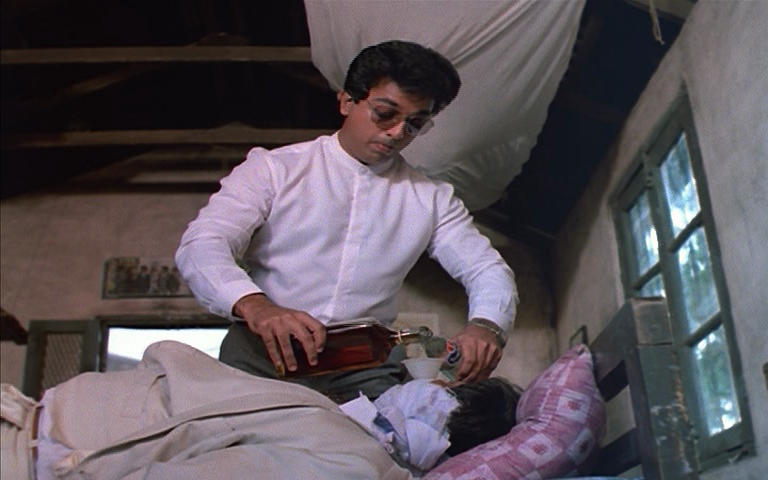
Kamal Hassan decides to kidnap the unfortunate millionaire and carries him back to his meagre apartment where he restrains and gags the unconscious man (although he does thoughtfully turn on the fan), and then heads off to Hotel Pushpak where he assumes the millionaires identity. He sleeps in the millionaire’s room, eats his food and uses his cash to buy smart new clothes. Kamal Hassan is perfect in his indecision as he tries bread sticks, then some nuts and finally cannot decide which chocolate bar to eat – too much choice for someone who has been used to no choice at all. And I love the way they serve breakfast in the hotel.
Clever shots of photographs in both the hotel room and the millionaire’s home allow us to identify the millionaire’s wife, to whom he appears devoted and the millionaire’s best friend, who appears to be devoted to the millionaire’s wife. The two are having an affair and we learn that the best friend has hired an assassin to get rid of the husband for good.

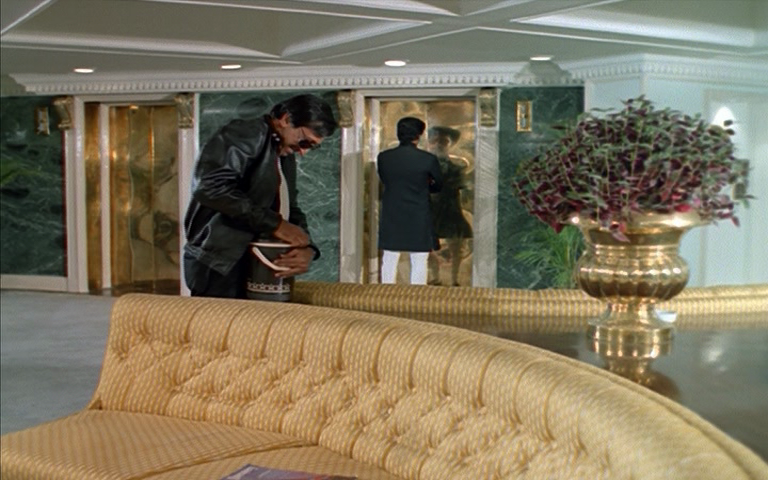
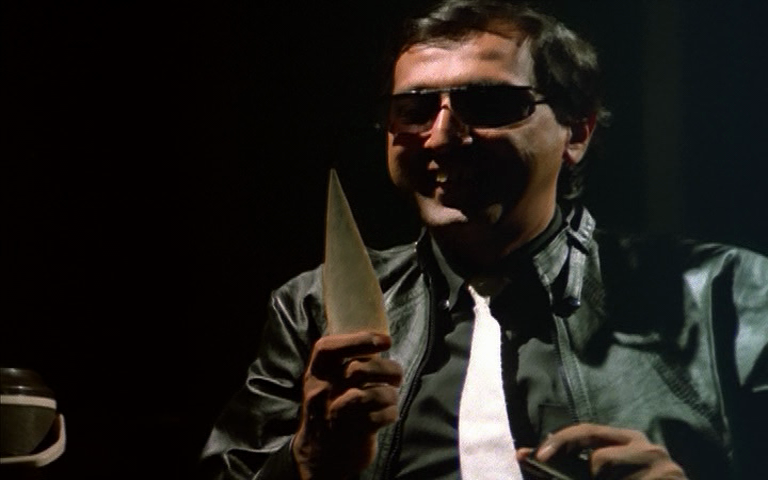
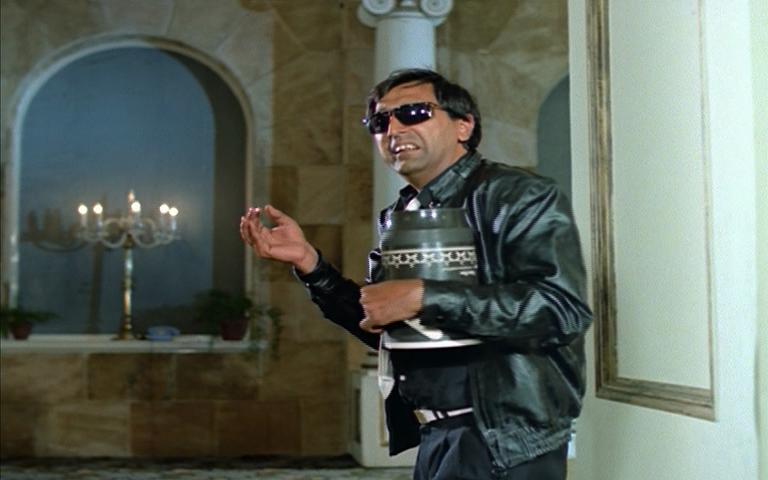
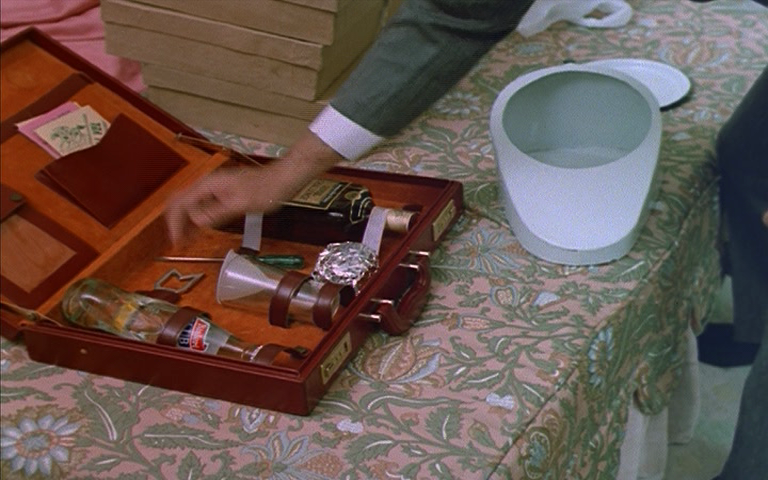
The role of the assassin is played by Tinnu Anand who throws himself into the role and seems to have a great time stalking his target. However as he has only the hotel name and room number, he clearly doesn’t know that he is attempting to kill the wrong man. His weapon of choice is a throwing dagger made of ice which he carries around in an ice bucket (of course!). His efforts to remove the lid of the ice bucket, pull the ice dagger from the mould and then throw and hit his target are wonderfully inept leaving me wondering why he didn’t just bring one of his large collection of guns along as a back-up plan. The daggers also seem rather friable although they work well enough in the dummy he has brought along to the hotel room in order to practice his technique.
Added in to all this farce, there is a rather sweet romance which develops between Kamal Hassan and the hotel magician’s daughter, beautifully played by Amala. The film builds to a moralistic but somewhat poignant ending where everyone appears to have learned that money cannot buy everything and that there is more to life than wealth.

Of necessity the acting in a silent film has to be more obvious when there is no dialogue to explain the reasons behind people’s actions. However the various characters here are explained by a few simple scenes which give a clear understanding of their personality and there isn’t really any heavy-handed overacting by the lead actors. As with many of the early silent films there is a high reliance on slap-stick humour and most of this involves the efforts by Kamal Hassan to keep his prisoner quietly hidden and the assassin’s attempts on Kamal Hassan’s life. There is a lot of toilet humour as Kamal Hassan goes to rather detailed lengths to make sure his prisoner is relatively comfortable throughout his captivity and there is perhaps a little too much detail for it to be really funny. Rather, I was impressed by the ingenuity shown in the ‘waste disposal’ plan, although perhaps this is to be expected in a college graduate.
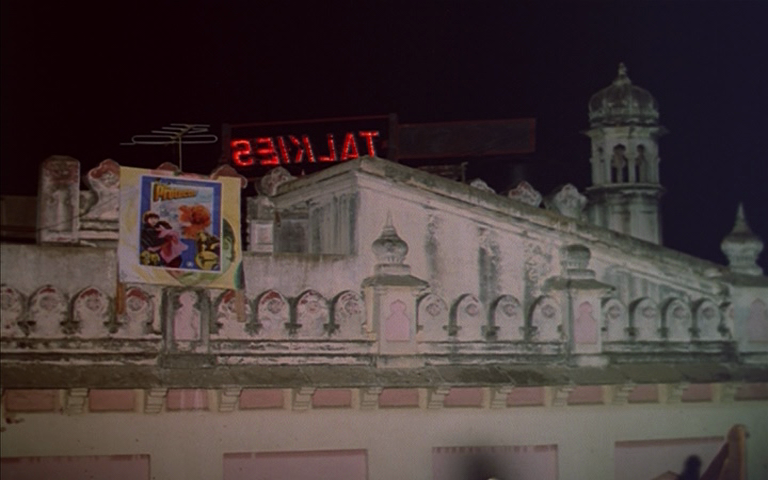
Where the film works best is in the small details. For example the large sign on top of the adjacent cinema which reads ‘Talkies’, and Kamal Hassan flexing his muscles with a Rambo poster in the background above. One of the standout moments in the film is the intricate choreography enacted as a number of building residents vie for the bathrooms in the morning.  
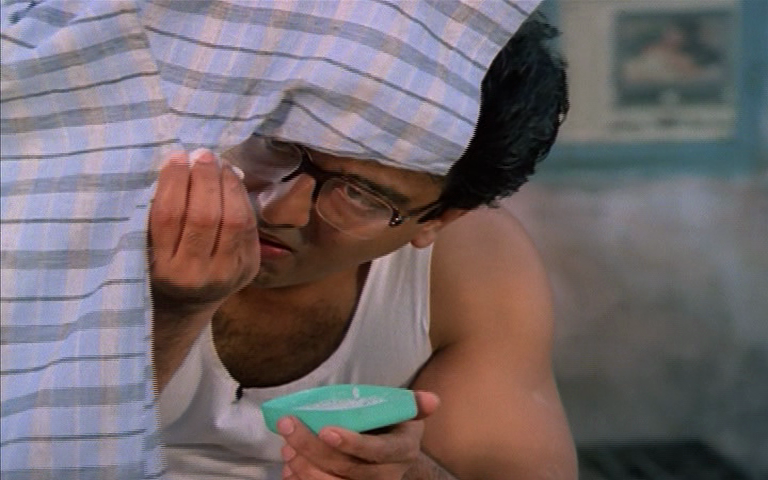
The opening scenes of the film give a snapshot view into the lives of the various residents of the building and also show the type of man Kamal Hassan is. He is not averse to spying on his neighbour as she fixes her sari, carefully washes only the underarms of the shirt he means to wear that day and tries to skip ahead in the employment lines. All these little traits allow us to build up the impression of a man who, when tempted, would possibly be amoral enough to kidnap a man and take over his life.

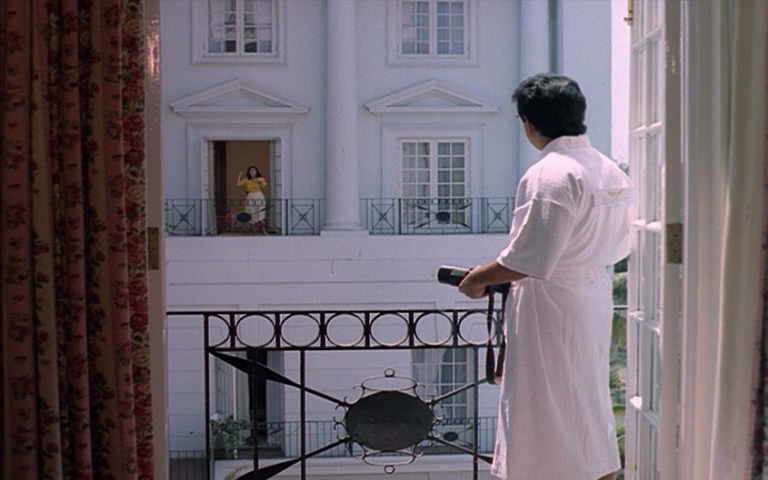
I also like that frequently there is a reason for there to be no dialogue as part of the storyline and this makes it easy to forget that it’s a silent film. The magician’s daughter and Kamal Hassan communicate by gestures across rooms and from balconies on opposite sides of the hotel as well as when she is onstage with her father, while the millionaire is both drunk and incoherent or gagged.
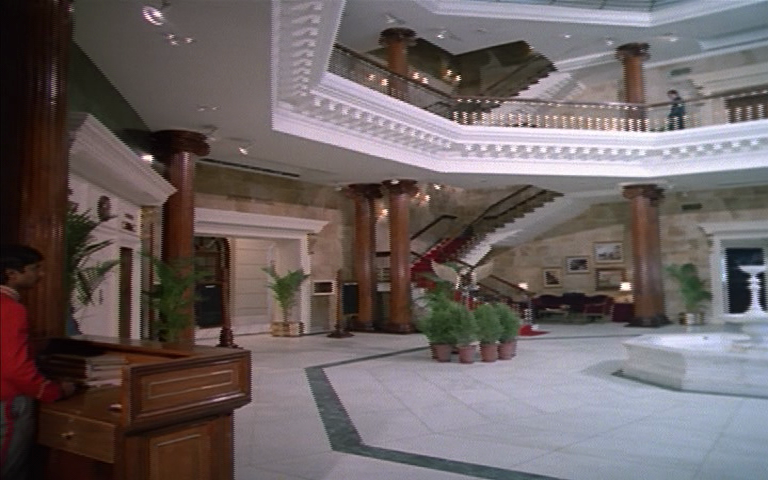
The film looks fantastic and the contrast between the two social worlds is reflected in the different lighting between the rooming house and the hotel. The hotel décor is lavish and there is plenty of attention to detail throughout. I kept wondering if the Windsor Manor Hotel in Bangalore where this was filmed still has all those huge lift lobbies and chandeliers as it looks amazing.

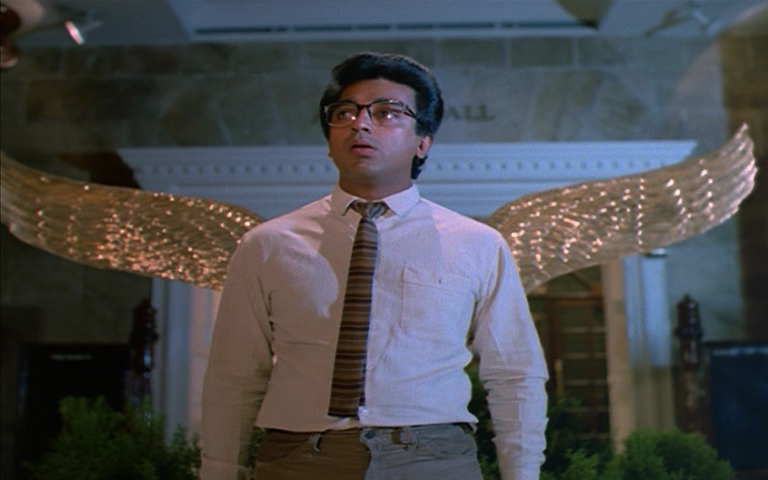
The hotel logo of a circle and wings recurs a number of times, and I agree with other opinions that it is meant to represent dreams and wishes. When an ice-cream is dropped on the ground, it’s Kamal Hassan’s shadow that we see reaching out for the treat, and again it’s fallen right in the middle of the shadow of the hotel symbol. I think that his inner feelings are very well represented in this way.
Much is also made of the death of a beggar, who actually has much more money than the unemployed Kamal Hassan, but whose corpse is unceremoniously dumped at the side of the road when his stash is revealed and everyone fights to get a share. This is also contrasted with the death of the hotel owner who has a parade of people who come to mourn him, but their grief isn’t all genuine either. Just in case Kamal Hassan was slow to get the message about money not buying happiness, Amala turns down his offers of clothes and household white goods (yes really!) when he takes her shopping, and asks for a wild flower growing on a ruined building instead.
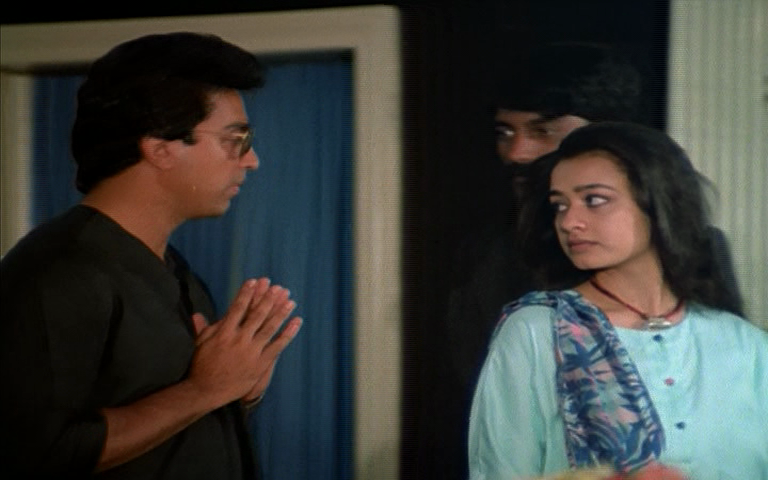
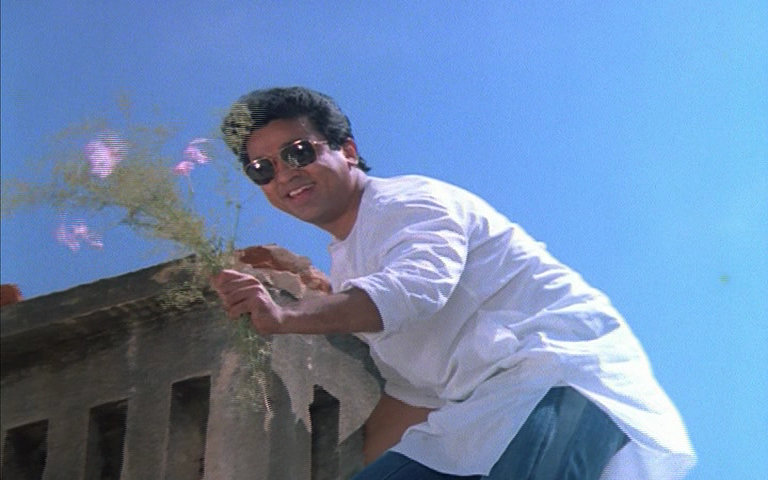
Kamal Hassan is excellent in his portrayal of the unemployed and perpetually unsuccessful graduate, as he manages to express so much very simply without words. His economies with toothpaste and washing powder initially made me a little more sympathetic towards his character and although his treatment of the millionaire was terrible, it was all made a little more believable by the amount of detail shown in the scenes where he was looking after his prisoner.  Amala was beautiful as the magician’s daughter, although as usual for a Tamil heroine, she didn’t really have much to do. She was the moral compass for Kamal Hassan and as such played her role perfectly. Both Tinnu Anand and K. S Ramesh as the magician looked to be having the time of their lives in their roles and I suspect they spent a lot of their time laughing about what they were actually getting to do on-screen.

I do have a few small issues with the film even though overall I think it’s an entertaining watch.  The story is really quite simplistic and without dialogue it occasionally feels like a collection of very good ‘moments’ all strung together with some unnecessarily long repetitive comedic scenes. These don’t really add anything to the story or to my understanding of the characters and tend to just be irritating instead. The long scene where Kamal Hasan dresses up as a hotel employee to give the magician’s daughter some earrings could very easily have been skipped for example. In contrast the inept assassin and the magician scenes are funny and well handled. I also think that keeping someone tied up and insensible with alcohol does seem very extreme and it’s very unlikely that the millionaire would just go home without contacting the police. Especially in this instance where he had evidence that the whole experience wasn’t just an alcohol induced dream. And really while money may not buy you happiness, it certainly can buy comfort which is not to be sneezed at – the overly moral tone in parts was a little overbearing. But there are so many good things about this film that I can ignore these little irritations and just appreciate the acting skills that bring this silent movie to vibrant life. It’s an interesting and quite unusual film and I think that Singeetham Srinivasa Rao and Kamal Hassan deserve praise for attempting something so very different and managing to pull it off in such style. 4 stars.

Thillana Mohanambal

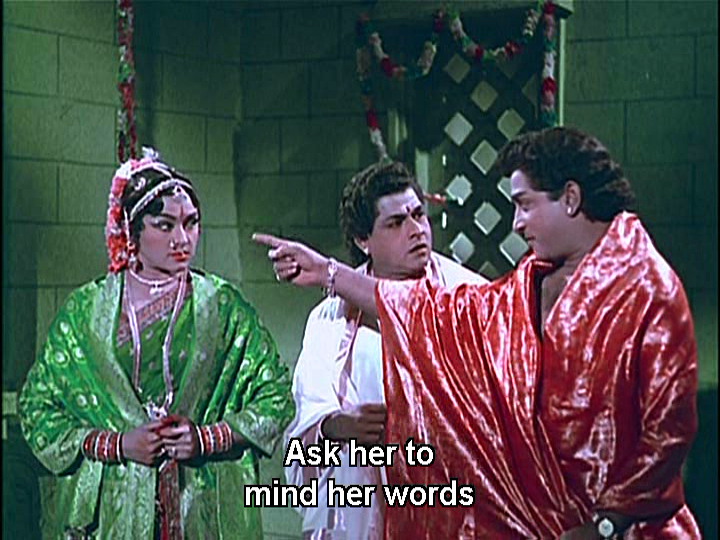
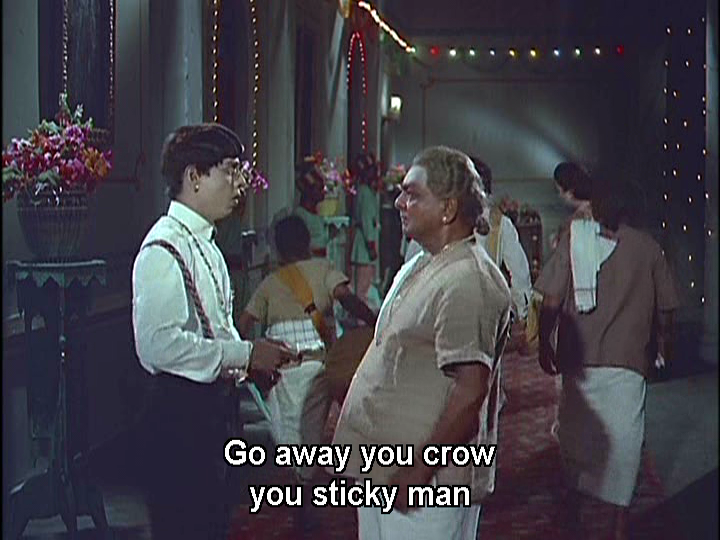
Padmini is Mohanambal, a beautiful and exceptionally talented bharatanatyam dancer. Sivaji Ganesan is the less beautiful but equally talented musician, nadaswaram player Sikkal Shanmughan. Crossing paths at a temple festival sparks fly between them but within minutes they go from this:

To this:

They challenge each other to a contest of dance versus music at some later date. So the stage is set for a fiery romance, riddled with misunderstanding, thwarted by pride and a meddling mother (Vadivambal, played by C.K. Saraswathi).

Mohana believes that dance is for everyone and for all occasions, inspired by the world around the dancer as well as a gift of god. Sikkal is more of a princess, demanding that his audience give him full attention and due reverence as he displays his gift. He believes art exists for god and for the artist. He refuses Mohana’s invitation to stay and watch her dance, but sneaks back later to see this.

There are some interesting observations on women in the performing arts and Mohana is certainly subject to some assumptions by men who desire her beauty and talent. Her mother seeks to ensure a wealthy man as her daughter’s protector or husband, but Mohana rejects all offers even before her feelings for Shanmughan are an issue. Nagalingam (K Balaji) is one thwarted suitor and a kidnapping attempt results in a comedy fight scene that I could have done without. I don’t quite get the undersized guy with stupid hair as instant hilarity, and there are two of them (double the fun?). This diversion means Mohana and her group catch the same train as Sikkal who has been waiting in the hopes they might turn up.

Padmini is gorgeous and her dance training is evident in her deportment and expressions as she uses all of her skill in conveying Mohana’s emotions. She also does an exceptionally good eyelash flutter. Sivaji is more old school theatrical, and lays it on almost as thick as his makeup. But his somewhat rubbery face is wonderfully expressive, especially his eyes, and he does have palpable chemistry with Padmini. There is a delightful scene of wordless communication and voiceover on the train journey that is funny, romantic and beautiful.

There is lots of sparring between the two and she is not the heroine to fall in love and lose her sense of self. I liked seeing a young lady who was a bit of a brat, very self-confident, and who felt no need to be apologetic. I don’t think I would enjoy her half as much in real life, but she did keep my attention in the film. And there was no suggestion that she should give up dancing to be a servant of Sikkal’s muse. She was a dancer and was valued for her gift.

There are abundant comedy elements. Manorama is Jil Jil Ramamani, a folk dancer and girl of suspect virtue. Her ‘comic’ dances are strange, and perhaps the subtitle team decided to make sure we knew this was a modern film:

In addition to being the butt of many jokes, she does play a significant role at several points in the story. Manorama made her character both a caricature and quite sympathetic. I was left thinking Jil Jil understood herself and how others saw her, and she retained some dignity despite the silliness. Nagesh as Vaithy had a role that just irritated me. He is a Jerry Lewis kind of character, so if you like the style, you may have warmer feelings towards him than I do.

His presence extends the story with pranks and frauds, and a longwinded and obtuse approach to being a go-between. The supporting characters are pretty broadly drawn and usually played for comedic effect or buffoonery. There is some excellent face throughout.

There are pointed references to the issues of art versus money, the dedication of great artists and who owns art.  Sikkal storms out of a private party rather than be ‘owned’ by the landlord and plays an impromptu concert to the locals gathered outside. I particularly enjoy this face off where the classical versus modern question is settled judging by the smug expression on Sivaji’s face (wait for the white couple to turn up at about 4 min):

Mohana is pursued with increasing vigour by the landlord and the ensuing scenes are quite farcical. I was quite annoyed that Sikkal immediately assumed Mohana was playing him, without speaking to her or investigating. He just did the heroic leap to the conclusion that she was duplicitous and decided to feel sorry for himself. I might have been more tolerant of manly brooding in a more attractive character, but really I just wanted to slap him. He then departs to sulk with Jil Jil, now calling herself Rosarani, who owns a drama company. Word of this gets back to Mohana who knows about his misunderstanding but had hoped he might still be interested. Rather than giving up, judging or moping, she decides to confront him.

Jil Jil and Mohana show themselves to be more decisive and action oriented than many a filmi heroine. I have doubts over the subtitle translation of some of the relationships as people refer to the landlord wanting Mohana to live with him, but he is also referred to as a groom, there is mention of dowry and so on and he has a wife already. In one scene, Padmini begs him not to spoil both their lives and mentions women being enslaved by money. So I am guessing she would have been his mistress but perhaps the subtitle team decided to sanitise the arrangements. Regardless, her modesty and chastity helps to persuade the landlord to be a brother rather than a suitor.

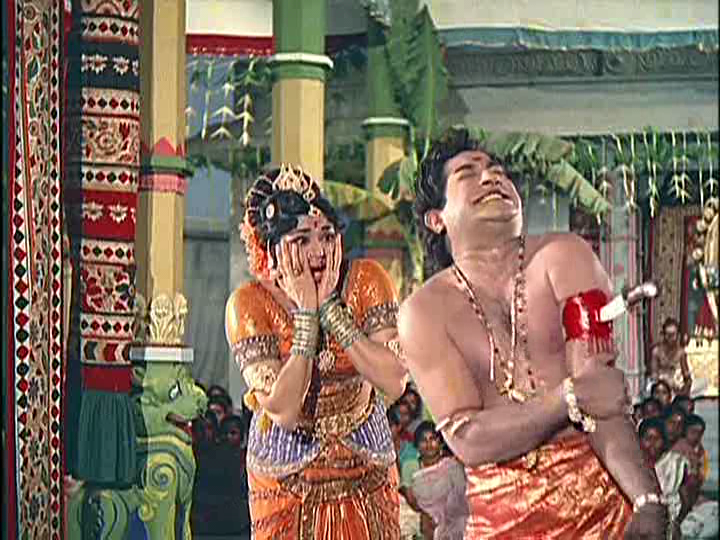
Mohana knew that the only way to keep Sikkal from leaving India with Jil Jil was to appeal to his artistic pride. The Thillana contest goes ahead. Nagalingam returns for skulduggery resulting in Sikkal taking a knife to the arm. Sivaji really milks the scene, thrashing around like a fish out of water for what seems like minutes. This injury prompts a further outbreak of overacting, and Sikkal gets another opportunity to feel sorry for himself again. Thanks to yet another smart competent woman (his nurse Mary) he begins to see that perhaps he has been a little narrow minded.

The finale is predictable but unravels over yet another complex scheme to sell Mohana, this time to a King. She defends herself, verbally and physically, and finds an ally in the very peculiarly accented Queen. Her chastity proves transformative once again, and the King decides to be a good husband.

Sikkal jumps to conclusions (yes, again!) and flings himself around chewing the scenery. This time Mohana has had enough and decides to resolve things. The climax is very filmi and over the top but the duelling diva personalities of the leads made it less unbelievable than it might have been.

This is such a pretty film. The ladies wear beautiful jewellery and costumes, there are lots of sparkly things, the temple locations and houses are lovely. It also has quite a timeless feel, with only a couple of scenes overtly placing the story in the late 1960s. The story is an overblown romantic melodrama but the theme of art and excellence gives the characters much more substance than I expected.  The female characters stand on their own feet, and have their own plans and desires. Padmini and Sivaji are exceptional and really made me care about their relationship even as their characters annoyed me sometimes. And of course, Padmini’s dancing alone makes this worth a look. Who won the contest you ask?  Art was the winner! 4 stars.

Madrasapattinam

I picked up Madrasapattinam with a little trepidation; after all Indian historical films featuring a cast heavy on English actors don’t usually bode well. But I was pleasantly surprised as, although there are tinges of Lagaan and a few cringe-worthy moments, overall Madrasapattinam fares somewhat better than expected. There is still the issue of almost uniformly ‘evil English’ and ‘good Indian’ characters, meaning most of the supporting cast are very one-dimensional. However the leads give good enough performances that apart from one notable exception, I could ignore the clichés and just enjoy how beautiful the film looks.

The film begins with the elderly Amy Wilkinson determined to return to India and find a man she last saw some 60 years previously. Ostensibly she wants to return a Thali necklace given to her as she feels it does not belong to her. As she is also quite seriously ill she travels with her increasingly whiney and irritatingly useless granddaughter Catherine who is supposed to be looking after her. To aid her search Amy has a photograph she took in 1945 but little else other than a name.

When they arrive in Chennai Amy starts to relive her time in India, when she was the young daughter of the Governor, and this is when the film really comes alive.  The young Amy is picked up at the station by the Commissioner of Police, Robert Ellis (Alexx O’Nell), and straight away he’s my biggest problem with this film. Why does every English bad guy have to be the most evil and despicable person on screen? It’s very obvious from the first time we meet him that this is a man with absolutely no redeeming features whatsoever and it’s difficult to keep watching and not just skip his scenes. In my opinion he could have been made much more interesting if he was just thoughtless and greedy rather than consistently evil, but sadly he’s just vile and repulsive and it’s very obvious from the very beginning how he is going to behave throughout the film.

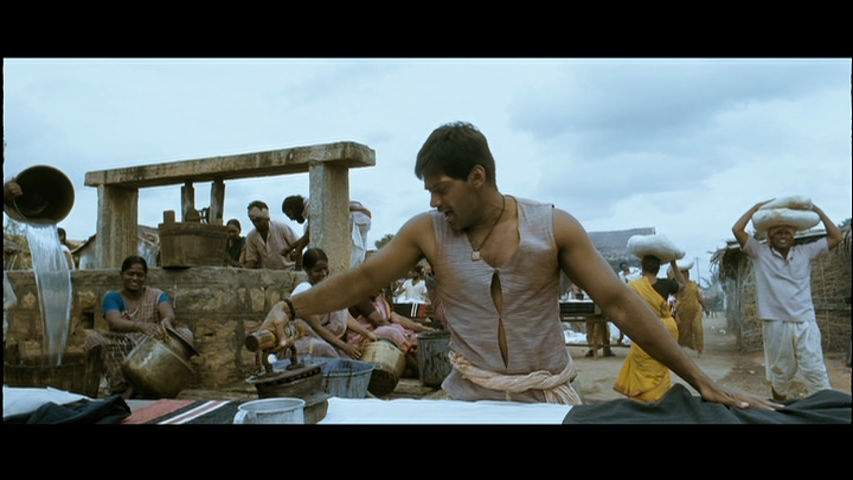
On the trip to the Governor’s residence Amy meets Parithi (Arya) in classic ‘meet the hero’ style since she sees him running to save a donkey from the path of her runaway car. Parithi works as a dhobi and in his spare time he wrestles with local trainer Ayyakanu; a man with an impressive moustache who isn’t afraid to get down and dirty in the ring himself. Added to Partithi’s ability to run, wrestle and save animals is his most perfect feature – he can iron. Naturally Amy falls in love with her ‘brave man’ as he fights against the English plans to build a golf course on the area where the villagers work and live. It becomes a personal vendetta between evil Robert and Parithi as they are both also competing for Amy’s attention and since they are playing by different rules you know that it’s not going to end well.

Amy and Parithi meet each other in secret, and there are some lovely scenes as they struggle to overcome their language barrier. They have an ingenious if somewhat laborious method of communication, as Amy draws pictures on her clothes of where and when they will meet which Parithi then has to launder off. Amy spends much of her time in the village with her camera, and the villagers seem to love her just as much as she loves them. However when Indian Independence finally arrives it means the end of her romance unless she can escape with Parithi. Their plans are naturally foiled by evil Robert who chases them through the Independence celebrations determined that if he can’t marry Amy then no-one will.

The romance between Amy and Parithi is the best part of the film. Amy Jackson is stunningly beautiful and is convincing as a young English girl in the post-war period. She is nicely restrained in her scenes with Parithi, but charmingly natural with Parithi’s sister Selvi and the village children. Arya is excellent as the strong and mostly silent Parithi who is determined not to back down in the face of the English oppression.

There are many genuinely funny scenes which are well integrated into the narrative, and these help the film from getting too bogged down in all the drama of the fight for the village and the seemingly doomed romance. Tension is well build up in the chase scenes although these could have been cut a little without losing too much of the suspense. Cochin Hanifa as the translator Nambi and Nassar as Ayyakanu are the best of the supporting actors but the story revolves around Amy and Partithi and no-one else has an awful lot to do.

The film does look beautiful with well constructed sets which seem to be representative of 1940’s Madras, particularly to someone like me who’s only ever seen the modern version from 1990 onwards. There are one or two instances of rather dodgy CGI but these are fleeting and don’t really disrupt the story so they are ignorable. The end credits feature old pictures of Madras landmarks followed by their current appearance which really was fascinating. One anachronism for me was one of the actors had an apparent artificial eye. While this was possible from the time period, I don’t really think it’s all that likely that a dhobi would have had access to this especially post WWII where prosthesis were a luxury. But that’s just my obsession and I’ll just see how many people spot him.

The modern day scenes are somewhat hampered by an incredibly wooden performance from Lisa Lazarus as Amy’s granddaughter although Carole Trungmar is rather better as the elderly Amy and her periods of abstraction fit her character well. The story is compelling and the final scenes in the present day give a satisfying conclusion. While the soundtrack by G. V. Prakash Kumar is perfectly adequate it doesn’t stand out as particularly memorable. The first song is set in the dhobi village by the river and I’m sure intentionally, is very reminiscent of Ghanana Ghanana Ghir from Lagaan, although in this case they are asking the rain not to come. The rest of the songs have less dancing than I would have preferred but we do get the opportunity to see Arya in an outfit that looks as if he has just escaped from a totally different period film as consolation.

While evil Robert and the standard ‘English opression’ storyline did annoy me in this film, the romance is quite charming and I think the two leads manage to carry the story well. The parts of this film that I like, I really do like very much but the parts that I don’t like, I really do dislike very much. Which means a lot of fast forwarding when rewatching. As far as historical romances go it’s certainly not the worst I’ve seen and I give it 3 stars, although one of those is for a hero who can iron!

Temple says: I don’t have the same issue with evil Robert that Heather does. He shouts, snarls, twitches, bullies his underlings, has a pit full of decomposing bodies in his backyard and constructs overly elaborate revenge plans. In short, he’s like almost every other filmi villain. I do have an issue with the atrocious acting by the guy who plays Amy’s father. Distractingly bad. Given to long….pauses. For no reason. And delivered other lines. Like this. Staccato. Caroline Trungmar was not impressive as the older Amy as she seemed catatonic for most of the film but her Titanic inspired role was mostly to sit and look like she was remembering so I may be a bit harsh in my judgement. The tradition of really bad acting by white extras seems to be alive and well and was embraced by many in this cast.  As they were mostly caricatures rather than fully developed characters I don’t know that a more nuanced performance would have been much help. The Indian supporting cast were all pretty good, and Cochin Hanifa is lots of fun as are Parithi’s friends.

I was more distracted by the indeterminate historical period of the costumes and dialogues. As the film starts in 1945, the European costumes are often very wrong indeed and the dialogue sounds as though some of it was lifted from Dickens rather than a comparatively modern family. And the Europeans’ manners at the dance…well.

But the film is really about Parithi and Amy and if you can enjoy their developing love story, then it is a pleasant enough timepass. Arya is excellent as the strong silent type, prone to flexing and ironing. Who could ask for more? Ok well, if you want more, he also wrestles.  Amy Jackson looked more like a footballer’s girlfriend than a 1940s heroine but I think she is one of the least embarrassing gori love interests in an Indian historical film that I have seen. Their interactions are simple and often Amy follows Parithi about as he works, allowing us to observe the villagers life and see the diverse supporting characters in play. They have a nice rapport, and the scenes with Selvi (Parithi’s sister) are genuinely touching.

The look of old Madrasapattinam is very picturesque and the olden days scenes are pretty and dominated by sepia tones that help keep the mood of past times. The modern city of Chennai is a contrast in grey and blue, cold and confusing. This feels very much like a pastiche of Lagaan and Titanic with a dash of Kisna and it is entertaining rather than informative.

I give this 3 stars – for a good looking film, with good looking stars and a positive message that men who iron are heroes.