Navarathri

Navarathri-Savitri in Navarathri

Savitri starred in both the 1964 Tamil Navrathri (dir. A.P Nagarajan) and the 1966 Telugu remake (dir. Tatineni Ramarao) and she is lovely as ever. What makes it particularly difficult to choose one over the other film is her leading men – Sivaji Ganesan (1964) and Akkineni Nageswara Rao (1966) – who each bring their own style to the proceedings. So I won’t pick.

That is so pretty with the Golu, the girls dancing and their sarees. The Telugu song is a bit more sparkly so I always pick that one.

Savitri is Nalina (Tamil) or Radha (Telugu). I’m going to just refer to her as Savitri throughout. After that lovely happy song, Savitri is told her father has fixed her marriage. She is already in love, and has no idea that her dad has unwittingly accepted a proposal from her boyfriend. Oh the drama. She runs to see the boy, only to be told he has gone to get married. She runs away, unable to face life as another man’s wife. Her character spends 9 nights wandering. She encounters different characters, all played by the leading man, who represent different aspects of human behaviour and emotion. These are named slightly differently in each film so I will just list them by night.

The film is more of an allegory than a realistic portrayal. Despite having lots of detail presented about who these men are, there is not a lot of depth to all the characters. The actors focus on the key emotion of the episode rather than trying to create nuances. Sivaji Ganesan is charismatic and is always instantly recognisable in this tour de force. ANR is generally better suited to low-key roles, but he also plays the various men as types. It is highly entertaining and stylised.

Night 1. A flamboyant widower interrupts Savitri as she contemplates suicide and drags her back to his house. Both ANR and Sivaji played this character as an eccentric, lonely man. The widower is devoted to his dead wife and little daughter (played by Kutty Padmini in both versions, I think). When compared flounce for flounce, there is little to separate the actors in this episode. I kept thinking of Snagglepuss.

Night 2. Tricked by a brothel madam, Savitri has to fend off a drunkard with a sob story. Savitri is determined, fierce and has a good throwing arm. Sivaji played this role as a wild eyed, plaid pants wearing letch with mood swings. ANR did a gorgeous self-parody as a self-pitying Devdas and for that, he wins my vote.

Night 3. Picked up by the police, Savitri is taken to a mental hospital. Both actors play the doctor as gently considerate and interested in why she was faking madness. I enjoyed ANR’s reactions to Savitri’s odd gesticulations and speeches. Sivaji is more of a generic saint in a white wig. Placed in a ward with several other women exhibiting different manias, Savitri joins in the various set pieces each inmate delivers and their song and dance medley. The Telugu patients (including Suryakantam, Chhaya Devi, Jamuna and Jayalalithaa) are funny and energetic, and I recognised most of the songs they used so I enjoyed their section a lot.  Manorama features in the Tamil film where the dancing and singing is more subdued but still fun. I’m usually averse to using the mentally ill as comedy fodder, but there was something good-natured and kind in this episode that helped me put my qualms aside.

Night 4. Frightened that the police had come for her, Savitri runs again. She meets a lurking gunman, out for revenge against the men who tortured and killed his brother. Savitri tries to persuade him to stop but he is killed by his enemies. It’s his character who has the most obvious demons to fight in this Navarathri. Both ANR and Sivaji play him with swagger and bluster. ANR had a little more vulnerability while Sivaji showed more of the wounded pride and ferocity. Both died spectacularly and both had to deal with interesting makeup and costumes. I guess it depends on whether you prefer a stripy t-shirt or a stripy lungi.

Night 5. Savitri contemplates suicide again. She is saved by a kindly villager and his sister who worry that she had been possessed by an evil spirit. A comedy conman arrives to fleece her poor but honest benefactors and Savitri decides to give him a taste of his own medicine. Nagesh originated the role in the Tamil verison while Relangi played in the Telugu film. I prefer Relangi in almost any role to Nagesh in most things! I think ANR does poor man with heart of gold so very well.  For this section, the Telugu film is the winner for me.

Night 6. Savitri sees an old man crawling along a path and goes to help. A formerly rich man, he is now a leper and shunned by all his family and associates. Savitri doesn’t let her revulsion at his physical state stop her from behaving with compassion and integrity. I really like that at around this stage in the movie, Savitri has stopped just passively absorbing help and is not only thinking about how to sort out her own life but is actively supporting other people. The makeup department were a bit more effective in 1966, and ANR does vulnerability so well. The Telugu film gets my points for this episode.

Night 7. A theatrical company is in need for an actress after theirs elopes. Savitri agrees to help them and the play goes on. I don’t think anyone can beat Sivaji Ganesan in Ye Historical Outfits and he looks like he has a ball in this turn as the rural actor/director. ANR is very good and his dancing has a higher comedy value, but the portentous dialogues flow so nicely in the Tamil film. Savitri is lovely in both films as she matches her leading man step for step.

Night 8. Whoever thought either of these men should wear short shorts should be given a severe talking to. Playing a policeman playing a hunter ANR and Sivaji both opt for a braying laugh, military bluff heartiness and those shorts. I think they used the same footage of the tiger in both films. Savitri masquerades as a man. She is not even slightly convincing, but her expressions are funny and her Telugu characterisation is enjoyably pompous. I think Sivaji’s shorts are both more terrifying (baggy, poor camera angles) and hilarious (baggy, poor camera angles). The Tamil film is a little more dramatic and better paced at this stage so I prefer that.

Night 9. In which we discover that intended groom/disappearing boyfriend Anand or Venu (Telugu) is of course Sivaji or ANR. Savitri has nice rapport with both actors and the reconciliation scenes were both funny and heartfelt by turn.  The wedding goes ahead and all the ‘other men’ turn up (except the dead gunman). Happiness prevails!

This slideshow requires JavaScript.

I slightly prefer the Telugu soundtrack by Chalapathi Rao T as it is a little more filmi and festive but the songs in the Tamil film are quite soulful so it does depend on my mood. I have the Telugu DVD with subtitles but have only seen the Tamil film without (it’s on Youtube). The stories are identical but of course, the dialogues will differ somewhat. Despite having different directors, there are only differences in a few scenes. It’s interesting to see so little of the second director in the remake – when I first saw the films I assumed AP Nagarajan did both.

I have some minor doubts. How did Savitri keep finding new sarees with impeccably tailored blouses? And she seemed to be wandering in circles yet no one could find her. But nothing detracted from enjoying her journey and her realisation that she could go home and be happy.

I really like both films, and have rewatched them a couple of times. Savitri is brilliant as Nalina/Radha and despite the focus being on the men, her performance is varied and her characterisation develops beautifully. Both Sivaji and ANR are in fine form and make the task of playing nine roles seem effortless. Choose your favourite cast, choose on language, choose the songs you like most, choose your own adventure! 4 stars!

Padayappa

Padayappa

Many thanks to regular readers Violet and KB for suggesting Padayappa (1999) when I asked for Ramya Krishnan film recommendations. I believe that director K.S. Ravikumar cast her after seeing Ammoru, and I understand why. Padayappa has an amazing cast, an often incredible story, and all the trappings of a revenge drama custom built for superstar hero Rajinikanth. It also has a strong female antagonist that was perfect for Ramya Krishnan, who won the Tamil Filmfare Best Actress for the role. The support cast includes such talented actors as Sivaji Ganesan and Soundarya, along with Manivannan, Lakshmi, Nasser and even a brief appearance by Prakash Raj.

Padayappa (Rajinikanth) comes home to attend a family wedding. He falls in love with poor but honest Vasundhara (Soundarya) however overseas educated rich girl Nilambari (Ramya Krishnan) decides she must have him for herself. Her branch of the family is riddled with self-serving weaklings and their machinations help hasten the death of Padayappa’s father, played by legendary actor Sivaji Ganesan. Padayappa stays in the village to support his mother and sister, sort out the cheating relatives, and also to try and woo Vasundhara. The conflict between Nilambari and everyone who gets in her way is the main focus, although there are the obligatory comedy tracks and lots of rousing speeches.

Padayappa-SuperstarPadayappa-Padayappa the hero

In Padayappa Rajinikanth is Superstar Rajni the Hero rather than using his considerable acting skills for a fully developed character that required any subtlety. The thing I always find admirable about Rajni is that he commits to the role and to the style of film he is in, and that conviction makes even the most preposterous shenanigans seem somehow right.

Padayappa is moral, righteous and has absolutely no self-doubt. He has all the trademark Rajni mannerisms from the snappy salute with whooshing sound effects, the cigar trick, the ability to force his enemies to attack him one by one and at a pace that allows him to win, the power to make multiple cars explode just by looking at them. There is some light and shade as Padayappa gets all silly and tongue-tied around Vasundhara, or as he grieves for his family’s losses but he is less a character and more a personification of Heroic Values.

Padayappa-against the oddsPadayappa-Flexing

Confession – I am so fond of Rajni that I really don’t care that his fight scenes are implausible or his ‘dancing’ quite terrible. But I could have done without the shirtless flexing.

I rarely take issue with the (usually considerable) age gap between Rajni and his heroines. Maybe it’s because I discovered him comparatively recently so to me he has always been an elder statesman of film. And to some extent his reputation overshadows any character he plays.  He’s Rajinikanth!

Padayappa-NilambariPadayappa-Ramya Krishnan 2

Nilambari is compelling yet totally unlikeable. A spoilt girl who never took no for an answer, Nilambari often does things more likely to be done by the hero – she stalks the hero, she grabs him and kisses him in front of everyone at a wedding then saunters off casually, she torments her rival (the lowly Vasundhara) and threatens anyone who tries to obstruct her.

Padayappa-Ramya Krishnan 3Padayappa-Nilambari and Vasundhara

Ramya Krishnan gave Nilambari a beautiful façade over a twisted and arrogant core. It is great to see an actress capable of such expression and subtlety and who is not afraid to reveal the ugliness of a character’s dark side. She took it up to Rajinikanth and more than held her own in their confrontational scenes.

Padayappa-beauty status and talentPadayappa-contrast

Nilambari’s outfits improved but her attitude never did.

There is a village tradition that couples should only marry when both want to, either through love or mutual agreement. Padayappa rebukes Nilambari saying a good woman should be well-mannered and demure, so it’s not exactly progressive but I liked seeing girls get a voice too.

Padayappa-Soundarya (2)Padayappa-awkward

Vasundhara (Soundarya) is Padayappa’s ideal woman. She is a servant in Nilambari’s household, but her family used to be wealthy. Devout and domesticated as well as very pretty, Vasundhara obviously likes Padayappa too. She and Rajni seem to have nice rapport and the courtship is more about shy conversations and sideways glances. It’s quite cute if predictable. Soundarya does well to build up a character that is only lightly sketched out by the screenplay and dialogue. I did yell at Vasundhara a couple of times to STOP TRUSTING NILAMBARI. Luckily her devotion earns her some snake assisted escapes from near certain death.

Padayappa-Soundarya

Soundarya also does an excellent job of dancing around Rajni in their songs together. She often has a cheeky smile on her face, so Vasundhara might have a colourful fantasy life to balance her dutiful side.

Padayappa-wedding wishesPadayappa-promise

The dynamic between Padayappa and Nilambari was interesting as this is an instance where the hero is quite passive. Padayappa doesn’t do anything to torment or punish Nilambari other than be happily married to the one he loves. She is insignificant to him, and that is what drives her insane.

The song picturisations have all the colour and excitement I expected. AR Rahman’s music is a good fit and his use of recurring motifs helps express the characters inner lives.

Minsara Poove sees Nilambari dancing her feelings for Padayappa as he sings for Vasundhara. It’s very pretty, apart from the bits that are happening in Nilambari’s fantasy. She really needed a better dream wardrobe designer. Suthi Suthi is colourful, with giant puppets and lots of costume changes for Soundarya and Rajni. Kikku Yerudhey is a little out of place in terms of the story and I think it was only there to get Rajni prancing about with lots of young girls (Padayappa’s daughter’s school friends) and drunk uncles. Or maybe just to let the director make his trademark cameo appearance.

Padayappa-carnage

There are fight scenes, cars stunts, a murderous cow (not a euphemisism for Nilambari) and all manner of excitement as well as the revenge and drama.

Padayappa-the dating advice committeePadayappa-advice gone wrong

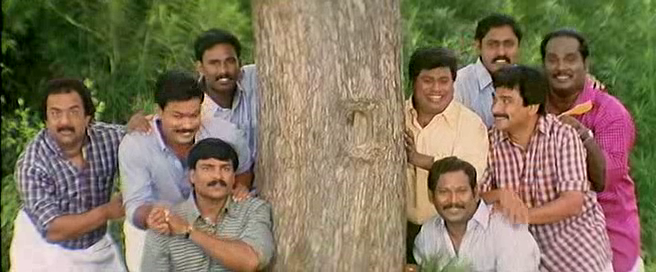
Padayappa’s friends are largely there to provide comic interruptions but they also do an excellent line in relationship advice and support (and hiding behind trees).

Padayappa-Sivaji Ganesan and Lakshmi

The legendary Sivaji Ganesan had a small but pivotal role as Padayappa’s father and was still quite magnetic. Lakshmi made the most of her big scenes as the surprisingly fierce mother. The always excellent Manivannan made his character despicable and yet pitiful while Nasser was just despicable.

Padayappa-Prakash Raj

And a quite svelte Prakash Raj was a nice bonus as a police officer. The casting budget for this film must have been enormous.

At almost 3 hours Padayappa does drag occasionally but just as I was thinking that surely things must settle down, K.S. Ravikumar would ramp up the action. See it for a classic village family revenge masala style story with a first class cast and loads of colour and movement. 4 stars!
Subramaniapuram

Subramaniapuram

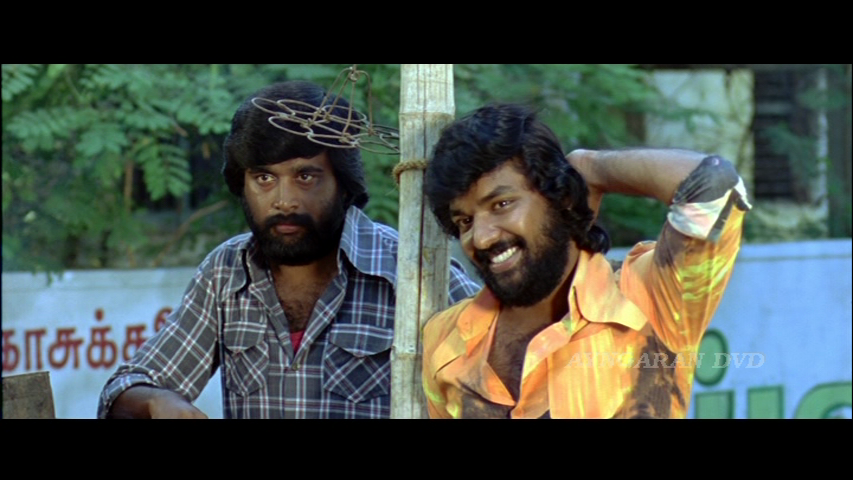
I picked up a copy of Subramaniapuram after being intrigued by the costumes, Brothers’ Gibb hairstyles and excessive facial hair I saw in the songs – which I’m worried says a little too much about how I choose which films I watch!

It all makes a little more sense when it turns out that most of the film is a flash-back to 1980, although I’m not sure that large collars and flares ever made much sense.  This is director M. Sasikumar’s first venture, but he worked with Paruthiveeran director Ameer on a few films previously and appears to have been influenced by Ameer’s true-to-life style of film-making.  The realistic approach suits the gritty storyline, although the screenplay does wander in places with the first half being essentially a long set-up for the action in the rest of the film.  However, there is enough suspense to keep the plot interesting and the attention to detail in the sets makes it an intriguing glimpse into India in the early eighties.

SubramaniapuramSubramaniapuram vlcsnap-2013-09-01-21h59m26s70Subramaniapuram


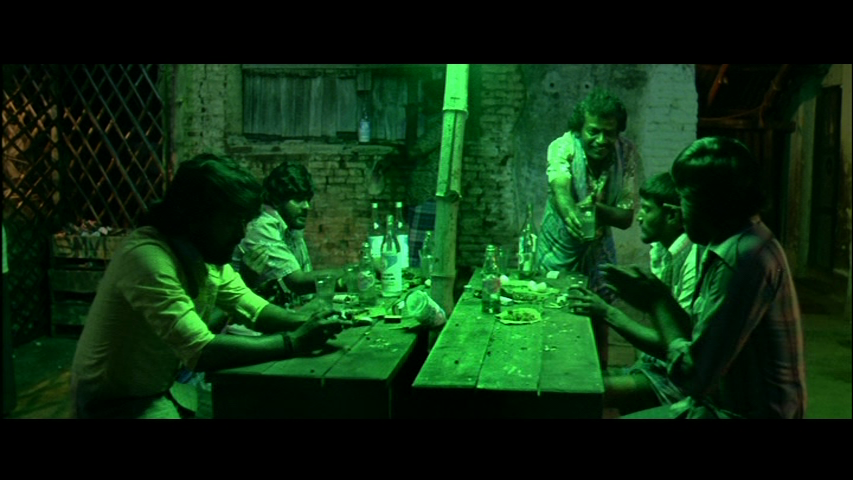
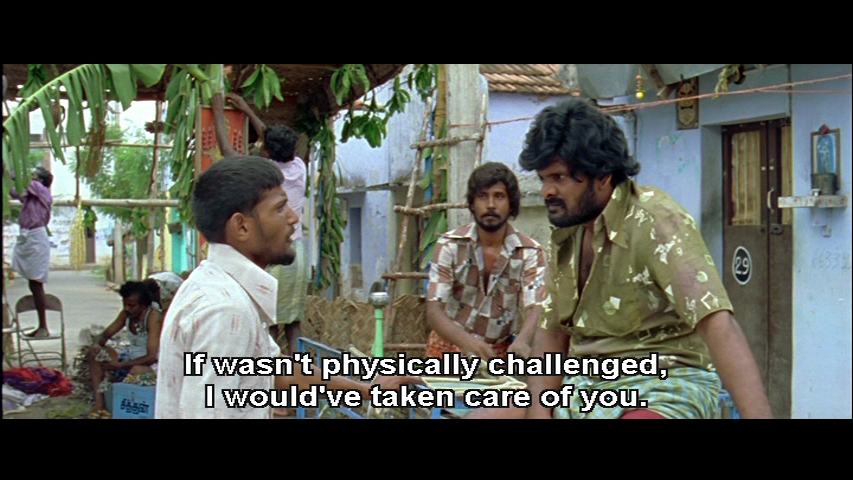
The film starts with a dramatic stabbing outside Madurai prison in 2008.  To explain who has been stabbed and why, we move back to 1980 and a group of friends who spend their days lazing around the area of Subramaniapuram.  Azhagar (Jai), who my subtitles call Alagar and Paraman (M. Sasikumar) act as security for the ex-councillor Somu and his brother Kanugu (Samuthirakani), although it’s a rather informal arrangement and Somu spends most of his time bailing the friends out of jail.  Along with Kasi, (Ganja Karuppu), Dumka and Dopa, the friends prefer to drink and fight, rather than look for any gainful employment, which is a point of contention for Azhagar’s more successful brother and his long-suffering mother.

SubramaniapuramSubramaniapuramSubramaniapuramSubramaniapuram

Some comedy is introduced with the goofy looks Azhagar gives Somu’s daughter Swathi (Thulasi), and the way he cannot keep his attention on anything else whenever she is around.  It’s cute, and Azhagar’s attempts at stalking are met with plenty of encouragement, although naturally Swathi expects her man to eventually change his ways.  Thulasi has a great shy and bashful smile which she uses well and she easily fits into the role of a school girl in the first throes of love. Later on she gets the chance to do a little more with her character and is convincing as she tries to reconcile her family’s expectations with her love for Azhagar.

SubramaniapuramSubramaniapuramSubramaniapuramSubramaniapuram

The first half is slow with considerable time spent on developing the characters of the friends and not much progress with the story.  However, there is a lot going on, but these are mainly background events which gradually combine to give an overall feel for the time and place.  A trip to the cinema at one point for example, illustrates just how much Azhagar values his relationship with Swathi above his friends, which does have implications later on in the story.  It also shows just how easily Azhagar and Paraman erupt into violence for very little provocation and that the Three Musketeers have nothing on Azhagar and his friends when it comes to the ‘all for one and one for all’ concept of fighting.

Essentially Subramanipuram is a story of betrayal.  Kanugu feels betrayed when his political party appoints someone else into the role he has been coveting, and uses the unquestioning loyalty of Azhagar and Paraman to get his revenge.  It’s also a story about the betrayal of Azhagar and Paraman who expect Kanugu to come to their rescue yet again and are spurred into action by Kanugu’s failure to get them out of jail after they remove his rival. There are many other betrayals along the way, which serve to highlight the few characters that do remain completely faithful. It’s an interesting look at how each small act of disloyalty starts another in a chain reaction that doesn’t intensify, but rather just keeps perpetuating in an endless cycle.  Whether it’s about jobs, relationships both professional and personal or friendship, the betrayals come thick and fast throughout the community.

SubramaniapuramSubramaniapuram

After the interval the story moves much faster as Azhagar and Paraman escalate their violence from petty fights to actual murder.  The friends’ initial decision to kill Kanugu’s rival seems naïve, especially when Kanugu is so very obvious about his manipulation.  However, their

subsequent actions quickly demonstrate how violence breeds yet more violence and that having killed once, it’s much easier to kill again.  One of the most realistic scenes of the film does illustrate that it takes a fair amount of determined hacking to chop off someone’s head, so be warned that this isn’t a film for the squeamish (even though most of the aforementioned chopping does take place off-screen).

While Sasikumar does well at directing, he is rather more one-dimensional as Paraman, and even though Paraman has the potential to be an interesting character, he somehow never quite gets there.  Jai has a little more material to work with as Azhagar, and does a great job of expressing every emotion from infatuation to terror and finally despair as the final betrayal hits home.  It’s an impressive performance and enough to make me have a look for some of his other films, where thankfully he appears to have shaved off most of the truly excessive beard.

SubramaniapuramSubramaniapuram

SubramaniapuramSubramaniapuram

Ganja Karuppu is suitably annoying as the perpetually drunken Kasi, and when he does get the opportunity to do something more than just mug at the camera, he proves that he is a very credible actor when given the chance.  Best of all though is the actor playing the disabled Dumka, who is wonderfully matter-of-fact and keeps the whole film grounded with his pithy observations and practical solutions. The character is well written, but the actor does justice to the role making Dumka memorable even though it’s only a small part.  I haven’t been able to find out anything about him, but I hope he gets the chance to appear in more films in the future.

The costumes are also fantastic and all those shirts did conjure up some hideous memories of the late seventies.  I have no idea how accurate this vision of 1980’s Madurai actually is, but it seems to be scarily reminiscent of 1980’s fashion in the UK (excepting the lungi’s of course).  The music by James Vasthanan seems to fit the time period well and this is probably the best song which features plenty of those goofy grins and bashful glances between Azhagar and Thulasi.

Subramaniapuram starts out like any typical Tamil film, veers off into more novel territory with some good ideas, but is a little let down by patchy pacing of the action.  Excellent performances and the dedication to recreating an early eighties feel make the most of the storyline although it’s not a film I’d recommend for the faint-hearted.  Worth a watch though if you like a more realistic style of film and don’t object to the occasional outbreak of gory violence. 3 ½ stars.