Tikli and Laxmi Bomb

Note: I was given the opportunity to see Tikli and Laxmi Bomb when one of the producers got in touch. I was free to write about the film if I wanted to, and they haven’t asked for content approval or seen the review.

The poster is regrettable, as I think it is unnecessarily salacious and makes the film look like a tacky sex comedy. Aditya Kripalani’s film is more of a study of women who want a fair go in their field of employment, which happens to be sex work. I read some articles about the movie and they seem to take a superficial view, maybe taking a cue from the poster, that this was all happy girl power shenanigans. There are moments of dark humour that provide some levity, but the women are vulnerable and the system is rigged against them. I hope that PR misdirection isn’t detrimental to the film when it is released.

Laxmi (Vibhawari Deshpande) has been around for a while and is given a new girl, Putul (Chitrangada Chakraborty), to train. Laxmi is decidedly non glamorous and businesslike, maybe more like the wives her clients have at home. Putul is younger, more confident in her looks and with a sassy personality. Putul, also known as Tikli, is outraged that while a cut of her earnings goes towards protection and police bribes, it’s all meaningless. The men she pays view her protection money as their income, not a service she is entitled to. If she pays A.T (Mayur More) for security, how is it that he can ignore her calls for help and she ends up being at fault. If the police accept bribes, why do they still raid the women and why is raping a prostitute one of the perks of their job? Tikli wants a revolution and Laxmi knows how to work the system. The women set up on their own, cutting out the useless men who lived off their labour. Will they be allowed to succeed? Can they beat the system?

This isn’t Pretty Woman.

Laxmi is struggling emotionally, and does her best to get her life back under control. She doesn’t have family and the women become that for her. Vibhawari Deshpande has a stolid, enduring strength with flashes of warmth and a bit of sarcasm. She has no expectations on anyone else and often says “our safety, our responsibility”. Tikli is impulsive and seems brash but is a damaged young woman, more lonely than she lets on. Chitrangada Chakraborty doesn’t try to make Tikli glamorous or even particularly nice, but explores the emotions driving her character. She snores like a truffle pig, which is not a great characteristic for a room mate. Laxmi initially mocks Putul’s indignation but slowly they become friends and co-conspirators, and the actors bring that to life beautifully and believably. Tikli has the daring they need to contemplate a different way, and Laxmi knows how to get shit done. Tikli’s rallying cry is “our business, our bodies, our pain, our shame”. If she has to wear the shame and the fear, she wants the benefits of her business.

Sparky Tsamchoe (Kritika Pande) welcomes Tikli, takes care of those around her, and embraces the new way of working. Her girlfriend, doll faced Sharanya (Divya Unny) is sweetly dim, and an easy target. Veteran Manda (Suchitra Pillai) is reluctant to change and sacrifice what little security she has. Her work persona is a little old school too. But the money talks and hope starts to spring. Their growing friendships and collaboration is one of the film’s strengths and the scenes have a lively and often spontaneous feel. Conversations in the small hours are full of ribald jokes about punters, wistful plans, and gossip.

These women are smart and resourceful, and I found myself getting caught up in the same hopes they had. That they would find a place in this man’s world, and live comfortably and safely. Such a small dream, but so powerful. When the women realise they need a safety plan when jumping into a car with men, they come up with a way to spin that into a value added service. When they are chased off the street and the dodgy hotel triples it’s prices they use their local knowledge to find another option. Mobile phone technology can work for them too. And their female security guards never get distracted. The gang grows as other working girls hear of how Tikli and Laxmi Bomb treat their team and how much they earn.

They all run up against men who believe that consent is not necessary. If a man pays for a quickie, can a hooker refuse his friends who suddenly turn up or decline to perform some sex acts? If you’re paying for sex, does that give you the right to be insulting or threatening? Laxmi and the ladies want to be able to earn their living without it costing their lives, but Tikli is the one who puts the wind up the local punters. The men in the film are almost entirely awful. Mhatre (Upendra Limaye) is a slimebag, and corrupt policeman More (Uday Atrolia) is worse, both using brutality and rape to assert their dominance. There is always a hint of violence surrounding the women, but also a lot of strength and warmth in their own small gang. Actually, there is one seemingly decent man in the film – the dude who runs the cigarette store and lends the girls a scooter. And sparks a nice little Sholay moment as Laxmi and Tikli drive home.

There are some clunky scenes, and I found some things a little predictable, or maybe just inevitable given the subject matter. The largely female crew has done a good job of avoiding unnecessary graphic sleaze and objectification while still revealing the brutality of this world. The male gaze is there in scenes where pimps are auditioning new girls or assessing their assets. But when the women are together they are shown as people who sell sex, not sex objects. The film is shot on location and with synch sound so it has an immediacy and a sense of life in Mumbai. The city is both huge and incredibly tiny and intimate. The girls who work their back street are a diverse bunch, often speaking a hit and miss Hinglish to communicate through regional language barriers. Mumbai is where everyone comes to chase their dreams. Laxmi sings to Mumba Devi as another woman who is constantly besieged by freeloaders and gives her all, taken for granted and treated like a possession.

I’m always interested in seeing more women represented on screen, and seeing diverse stories. The cast delivers a good ensemble performance and don’t fall into filmi clichés. Tikli and Laxmi Bomb is full of heart but not too preachy or idealised, sometimes funny, and doesn’t shy away from the harsh realities.

Lipstick Under My Burkha

Lipstick Under My Burkha

Alankrita Shrivastava’s Lipstick Under my Burka is a fascinating look at the lives and dreams of four different women living in a community in Bhopal. The film has been successful in a number of film festivals (including a sell-out show here in Melbourne) and has also recently released in India after some initial censorship problems. This is not the usual filmi view of Indian women as perfect mothers, wives or romantic partners, but rather a warts-and-all exposé of the realities of life as a woman in India today with all the restrictions, society taboos and in some cases the violence they face every day. These are real women and the film shows us their real lives. It’s the combination of that reality with powerful performances and a major dash of empathy that make the film a must-see, and one that stays with you long after the end credits roll.

The four main characters all live in the same housing block in Bhopal and although their lives connect only peripherally for most of the film, each is struggling with their own problems that eventually bring them all together by the end.

Usha (Ratna Pathak Shah), commonly known as Buaji is the widowed matriarch of a large family and has been called Aunt for so long she’s almost forgotten her real name. Her family own the building and it’s Usha’s who’s called on to deal with any problems, but despite her control over the family property, Usha has little control over her own life. This leads her to keep secret the few things she does have for herself. She secretly reads romantic novels, hidden from her family behind the pages of a magazine, and one of these books, Lipstick Dreams, becomes the background narration to the film. She also keeps her swimming lessons with the hunky instructor Jaspal (Jagat Singh Solanki) to herself, pretending that she is attending religious meetings instead, and the combination of frustrations, romantic dreams and a handy object of desire eventually leads her to racy phone sex, which she also has to keep hidden.

Rehana Abidi (Plabita Borthakur) is perhaps the most conventional character and is the owner of the burkha mentioned in the title. The film starts with Rehana stealing bright red lipstick by hiding it under her burkha. She applies this as soon as she gets to college, also shedding her traditional dress for jeans and a skimpy top, and changing her behaviour to suit. Rehana struggles to conform to the expectations dictated by her traditional family, leading her to hide her desire to become a singer, her western-style clothes and her pictures of Western popstars from her parents. The burkha is a symbol of more than just her perceived oppression too, as it’s also the shield behind which Rehana hides when she is shop-lifting and it allows her to pass almost unnoticed through the streets at night. Unfortunately, Rehana’s rebellion leads her to some dodgy choices, and she puts herself at risk when she becomes involved with an older man Dhruv (Shashank Arora), but for the most part her attitude is as expected for a young woman trying to escape her conventionally traditional family, and her motivation is relatively easy to discern.

Konkona Sen Sharma plays a more complex character and she does an excellent job with the role. Shireen is ostensibly a stay-at-home mom with three children and a slew of abortions behind her. Her husband Rahim (Sushant Singh) is based in Dubai and when he is home is only interested in asserting his ‘right’ to Shireen’s body, raping her most nights when he is home and refusing to wear a condom, despite the risk to her health. Shireen though also has a secret. She’s a very successful door-to-door saleswoman who is about to be promoted in her company, but she isn’t able to tell her husband as she knows he will not approve. Things become even more complicated when she finds out that her husband is keeping secrets too, but she seems trapped by her three children and society’s rigid belief in a woman’s place.

The final character is Leela (Aahana Kumra) who is Hindu and works as a beautician. Her mother is keen for Leela to marry well and has arranged her marriage with Manoj (Vaibbhav Tatwawdi) but Leela is in love with Arshad (Vikrant Massey) a Muslim photographer and wants to run away to Delhi with him. Leela uses sex as a bargaining tool to ensure that Arshad stays with her, but despite her modern views and her willingness to use her body to get what she wants, she’s still bound by convention and reluctant to run away without a man by her side.

The film follows these four women as they live their lives and dream their dreams, but finally their secrets are revealed with disastrous consequences.

What works well is the matter of fact manner with which Alankrita Shrivastava approaches her subject matter. The woman’s lives are shown authentically without glossing over any of the harsh realities of life in a small community. The women’s dreams and desires are mostly all relatable, as are many of their problems, making it easy to be sympathetic to their circumstances and hope that their situations improve. There are a few sex scenes but these are never voyeuristic, rather they are sensitively shot without any gratuitous nudity. Leela’s quick hurried couplings in various handy rooms and Rehana’s inexperienced fumblings are juxtaposed with Shireen’s attempts to ward off her abusive husband and Usha’s romantic fantasies in the bathroom.

While the women don’t interact much with each other there are a few moments where a couple of the characters come together, which serve to build a gradual sense of unity that becomes more apparent by the end. The actors too are all fabulous in their roles, ensuring the characters remain authentic while generating understanding and empathy. There is some excellent comedy too that stops the film from being simply a litany of abuses against the women.

The only real flaw for me in the film is in its portrayal of the male characters. These are almost uniformly one- dimensional with few redeeming features and, with one or two exceptions, only appear on-screen to abuse or threaten the women.  Rehana’s authoritarian father and Shireen’s abusive husband are the most caricatured, but even Dhruv and Rahim are mostly self-serving with little thought for their female partners. This is in stark contrast to the women who have plenty of light and shade, and it’s a pity that Alankrita Shrivastava didn’t bring this diversity into her male characters too.  The ending is also rather abrupt, and while I have no issue with leaving the final outcome hanging, the final scene had a few elements that didn’t quite fit with the rest of the film.

Regardless of the shortcomings with the male characters, the central theme is one of shame. The shame that the women are afraid of if their secret is revealed and the shame their families keep insisting the women have brought to them. When in reality all the shame here likes in the intolerant society and regressive views of the men. As far as showing the lives of the women involved goes, the film succeeds beautifully and indeed, the points raised are universal and hopefully will start conversations and increase awareness in many communities. This was simply an excellent film and one I highly recommend watching for a novel view of Indian women.

Lipstick Under My Burkha

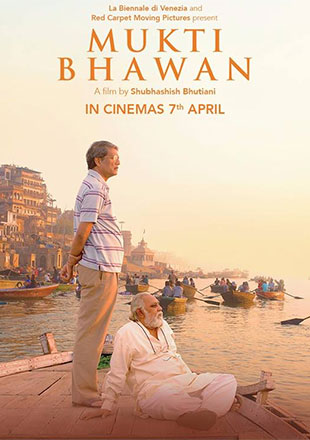
Mukti Bhawan (Hotel Salvation)

I’d be having a stern word with whoever came up with this blurb “Forget The Best Exotic Marigold Hotel; India’s new must-visit accommodation for the elderly is Hotel Salvation. Take a visit in this award-winning debut.

Shubhashish Bhutiani’s Mukti Bhawan (Hotel Salvation) is a beautifully made contemplative story of family, guilt, love, and finally death.

Dayanand (Lalit Behl) is from that blissful generation of men who don’t need to think about whether they are interrupting or are they being too demanding. Everything revolves around him. When he decides his time has come, there is no way to rationalise or compromise with him. Dayanand sulks and insists he will go to Varanasi alone because he is ready and therefore it is his time and that is where he will die. His son Rajiv (Adil Hussain) reluctantly commits to going with his father on what might be his last journey. They travel to Varanasi, and check in at the ramshackle Mukti Bhawan where people await their death by the holy Ganges. The efficient owner Mishraji (Anil K Rastogi) tells them he only allows a stay of 15 days and Dayanand is sure that will be enough. As it happens, Mishraji has a loophole whereby residents can change their names every 15 days. But he assures Rajiv the time is indeed close, although he can’t divulge any more details.

Lalit Behl is by turns childlike, childish, arrogant, demanding, apologetic and affectionate. Dayanand is not used to showing weakness in front of his family, but seems less uptight with his peers at the Hotel Salvation. Daya immediately immerses himself in the daily rituals and starts making friends with the other residents. He is there to actively prepare for his death and welcomes the process. He joins in writing obituaries and practicing yoga, and is addicted to a TV soap they watch every night. He finds community in the house. He is occasionally over the top but only when Daya is in a heightened state, and I thought every note rang true for the grumpy patriarch.

Vimlaji (Navnindra Behl) has genuinely prepared to go but can still enjoy every day she spends on earth. She says she will go when God calls, and has been waiting for 18 years. She is vivacious, the kind of lady you’d have tea and a natter with on a long train trip, but has a calm focus on her task of letting go. I liked her acceptance without finding her passively fatalistic. Vimla’s rapport with Daya is lovely, and I read somewhere the actors are married in real life which may be a factor in the warm familiarity and physical ease around each other.

Rajiv is awkward and appalled by what he sees as squalor and backward thinking, and wants his dad to either come home or go to a hospital. Rajiv is almost like a child again, hanging around on the fringes of adult conversation and not quite being able to participate. He wants to be there to do the right thing, but he doesn’t want to be there at all. He is intimidated by his father, and calls from his wife and demanding boss don’t help matters. Adil Hussain is lugubrious, tetchy, and a little fragile as Rajiv. He is in a rut at work and at home, and his father’s death plans are highly inconvenient. He doesn’t see the value in what Daya is doing, thinking of it as taking him away from work. But he starts to open up and shows that his frustration is driven by love and a maybe a bit of an inferiority complex. His scenes with Lalit Behl are emotionally complex yet very contained. There are few grand gestures or raised voices, and the acting is perfectly aligned.

Rajiv’s wife Lata (Geetanjali Kulkarni) struggles with a demanding old father-in-law and an absentee husband. Rajiv and Lata aren’t wishing for Dayanand to die but they do wish they could get some idea of how long this phase will last. When Dayanand performs the cow donation ritual, it is life and death to him, but to the family it is just an interruption. Lata wants life to be normal, unexceptional, and organised. She seems brusque but when people need her affection it is there. Her scenes with Rajiv run from shockingly direct conversation to wordless empathy and she is the bedrock of the family.

There is often a point in family crises where you’re damned if you do and damned if you don’t. Everyone has their idea on what is right and what everyone else should be doing. That tension is drawn out very well, mostly through the character of Sunita (Palomi Ghosh). She is a bright and warm girl, and has a cheeky rapport with her granddad. Daya is less strict and demanding of her and Rajiv quietly absorbs the difference in how his family interact with each other and with him. When Sunita comes to visit, Dayanand and Vimlaji sneak a bhang lassi with her because it’s Varanasi and of course they should. The three of them giggle through the day and each takes comfort in the camaraderie. When Daya hints that she might not be happy with her upcoming engagement Rajiv brushes it off. Later he confronts Dayanand about why he was made to do what was expected rather than follow his passion. Rajiv is more like his dad than he realises.

Tajdar Junaid’s soundtrack complements ambient sound of prayers and TV and kids playing. Bhutiani and his crew largely eschewed the more sensationalised Varanasi cremation clichés and instead dwell on the daily rituals, the bustle of the narrow back streets, the changing light, and the overwhelming feeling that life is a cycle. Mukti Bawan is somewhat similar in content (if not in tone) to Piku, with a dominant patriarch on a journey only he comprehends and a family who don’t quite realise they are being given precious time to say goodbye.