The Lunchbox

The Lunchbox

The story of The Lunch Box is charmingly simple – a mistake in the delivery of Ila’s carefully cooked lunch for her husband marks the beginning of a relationship with a curmudgeonly accountant on the cusp of his retirement – yet it opens up the complexities of life in Mumbai and how easy it is to be lonely in a city of millions.  As the story gently unfolds it showcases the famous Mumbai Dabbahwallahs and their phenomenal achievement of delivering thousands of tiffins across the city each day.  Watching the system in action, perhaps the hardest thing to swallow about the film is that a lunchbox repeatedly does go astray, although perhaps there is some redemption in the fact that is consistently it is misdirected to the same person every time. I’m happy to believe such an aberration is possible though, since it does make for an excellent story.

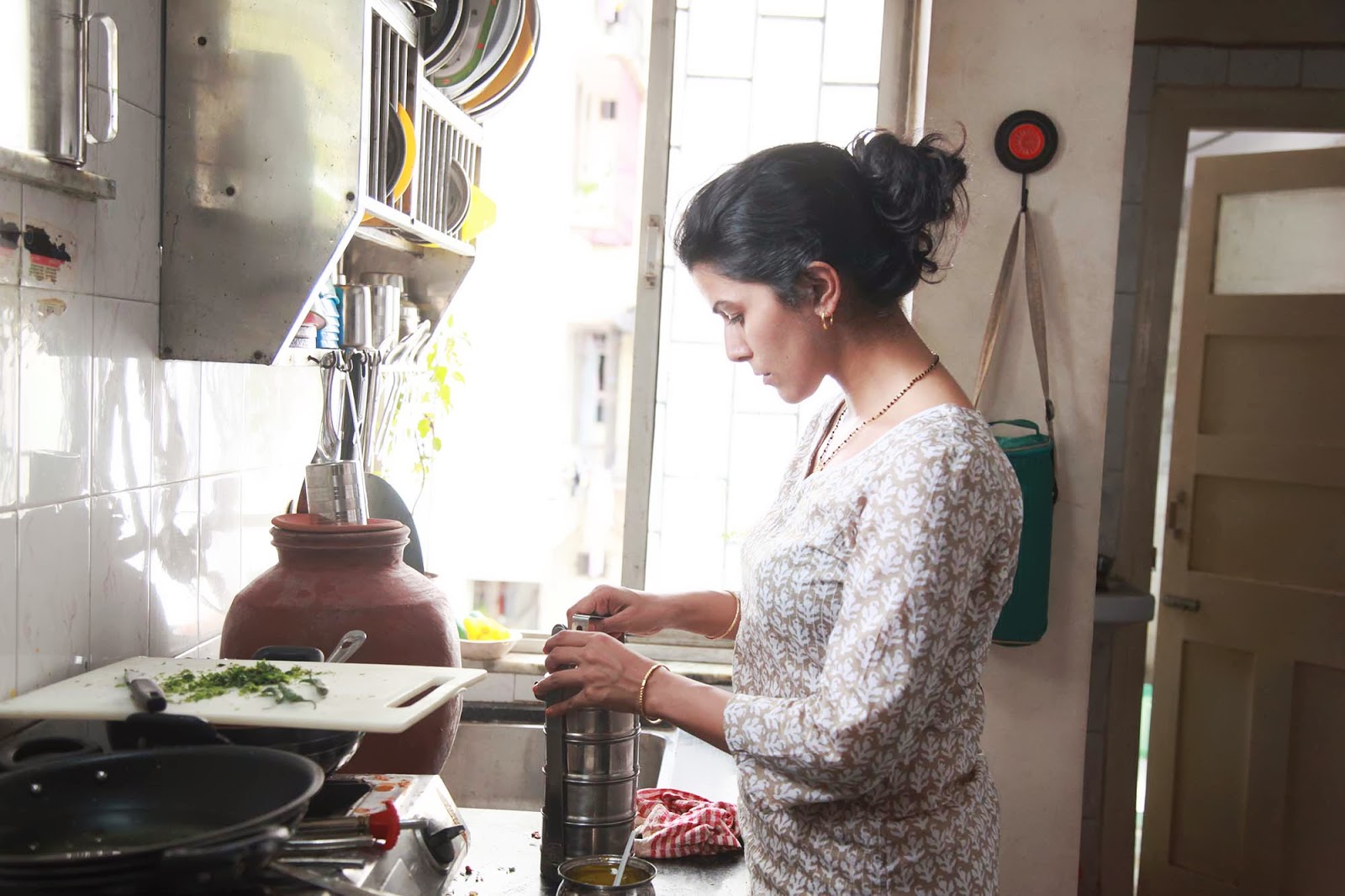
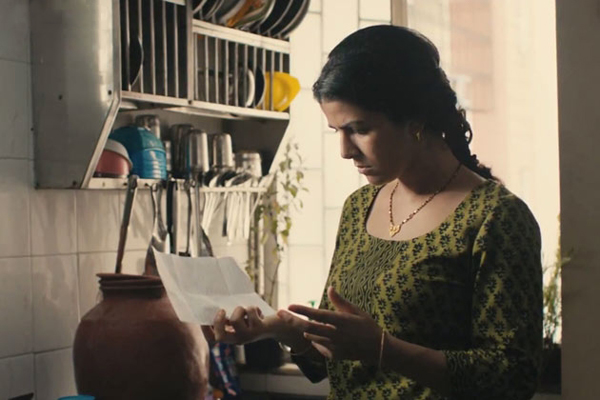
Ila (Nimrat Kaur) is trying to use the old adage that the way to a man’s heart is though his stomach as she struggles to get her workaholic husband (Nakul Vaid) to notice her.  She’s ably assisted in her endeavours by her upstairs neighbour, Mrs Despande (Bharati Achrekar) who supplies spices and recipes along with useful homely advice.  We never see Mrs Despande, but only hear her voice as she shouts down instructions or sends down a basket of supplies, although there is the added bonus of hearing her music – a selection of evergreen Bollywood tunes. As we learn later, her story is also one of isolation, but Mrs Despande seems to have come to terms with her life while her presence seamlessly adds another layer to influence Ila’s own indecision.
The Lunchbox

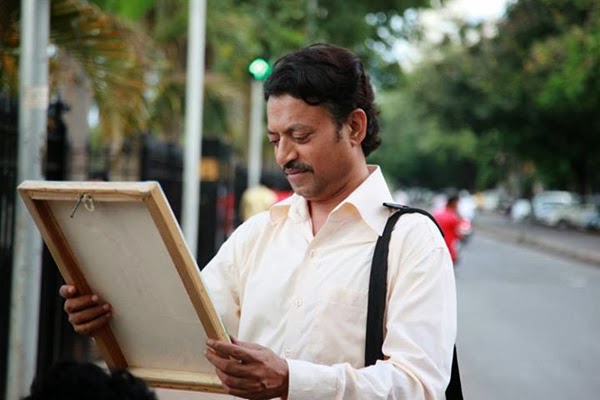
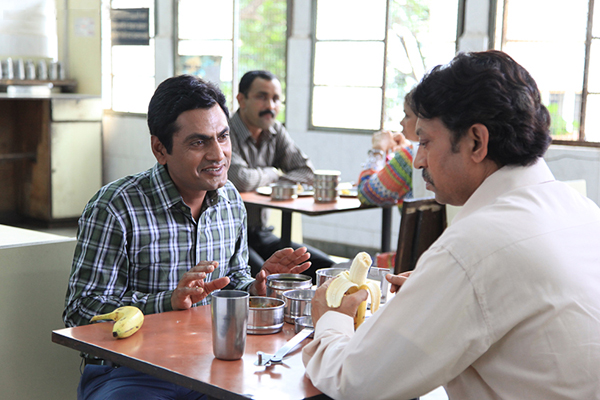
Meanwhile, Saajan Fernandez (Irrfan Khan) is just biding his time until retirement.  However in the lead-up to his departure, he’s been saddled with the younger Shaikh (Nawazuddin Siddiqui), a tiresomely happy replacement for his own efficient and silent procedures. As the story unfolds Saajan’s loneliness and Ila’s relative isolation become apparent, despite various encounters each experiences during the day.  Saajan’s nightly smokes on his balcony while he watches a family enjoy their communal dinner are the perfect example of his solitude, while Isla’s constant round of household chores perfectly show the constraints of her life.

The LunchboxThe Lunchbox

It’s not at all depressing though.  Saajan and Ila exchange notes every day along with the tiffin, and there is plenty of humour in their written exchanges.  The developing relationship between Saajan and the increasingly demanding Shaikh also provides some comedy, but as it turns out there is more to Shaikh’s character than just comedic relief and he has an important role to play.  Needless to say, Saajan’s silence at work is slowly eroded by Ila’s tasty lunches and Shaikh’s puppy-like demeanour as he clamours for attention and follows Saajan around everywhere.   Perhaps more unexpected is Ila’s realisation that she is responsible for her own happiness, beautifully understated in a scene with her mother (Lillete Dubey) after her father’s death, and gradually developed as the story progresses.

The LunchboxThe Lunchbox

It’s the small touches that make the film so enthralling.  Irrfan Khan says more with his contemplative silences and the quirk of an uplifted eyebrow, than many films manage with an entire screenplay. Although the focus is on ordinary people and their ordinary lives. Ritesh Batra captures some extraordinary moments on film.  The claustrophobia of Mumbai’s crowded trains echoes the self-imposed limitations of Ila’s small kitchen while Saajan’s neatly organised desk speaks volumes about his personality.  As their lives open up to more possibilities, so too their physical surroundings become less constrained and both start to interact more with the world around them.
The LunchboxThe Lunchbox

Irrfan Khan and Nimrat Kaur are both fantastic in their respective roles, creating depth and interest in their characters as each slowly develops throughout the film.  They both fit their characters so well that this just wouldn’t have been as compelling viewing without them. However Nawazuddin Siddiqui is just as good, particularly as his story evolves and we learn more about his background, while there is able support from the rest of the cast.  The screenplay, written by début director Ritesh Batra along with Rutvik Oza, is beautiful in its simplicity, with plenty of unexpected turns in the path and a particularly well thought out ending.
The Lunchbox

Overall it’s a very upbeat story and a breath of fresh air in an industry that is too often obsessed with Hollywood action wannabes and South Indian remakes.  The film has featured in many international film festivals, including Cannes, and I saw it here at the Indian Film Festival in Melbourne. That was a packed showing, perhaps due to Suhasini Maniratnam’s recommendation at her Masterclass and the film received a very positive reception.  The Lunchbox is scheduled for a more widespread release in Australia later this year, and I wholeheartedly recommend watching – you won’t be disappointed!

Madras Cafe

Madras Cafe

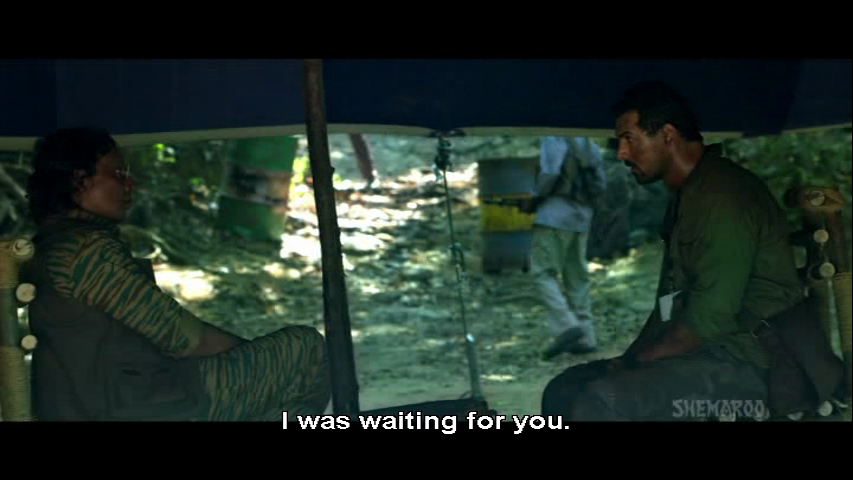
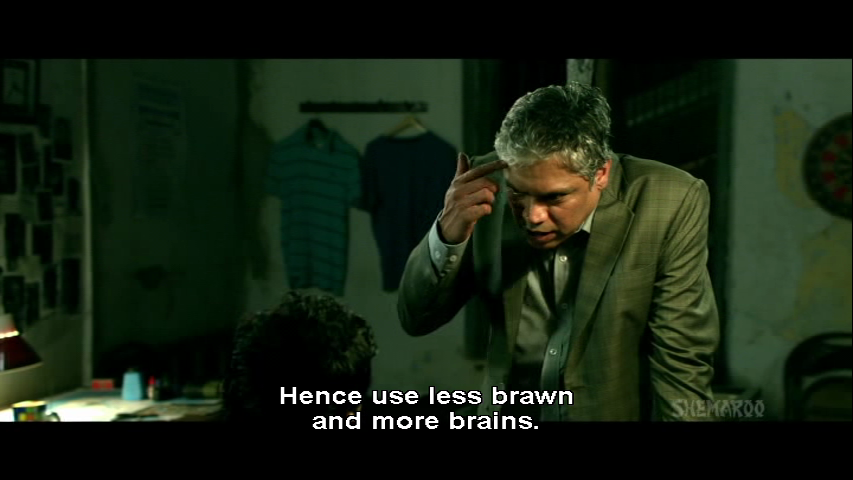
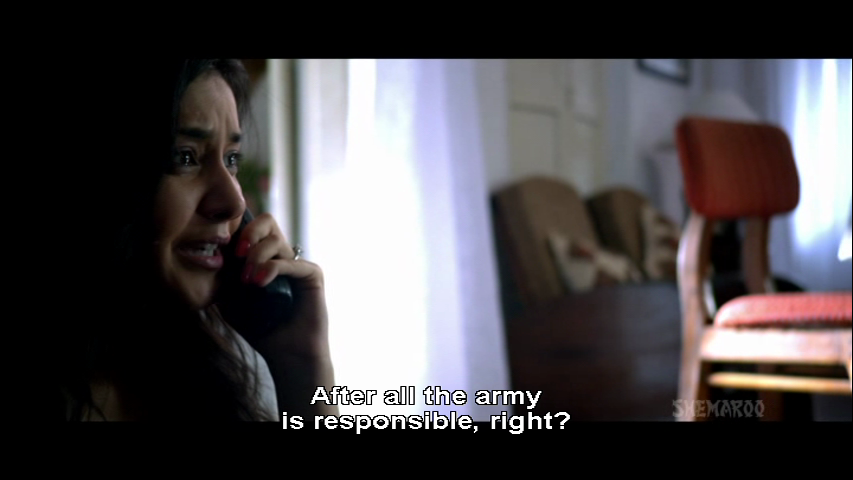
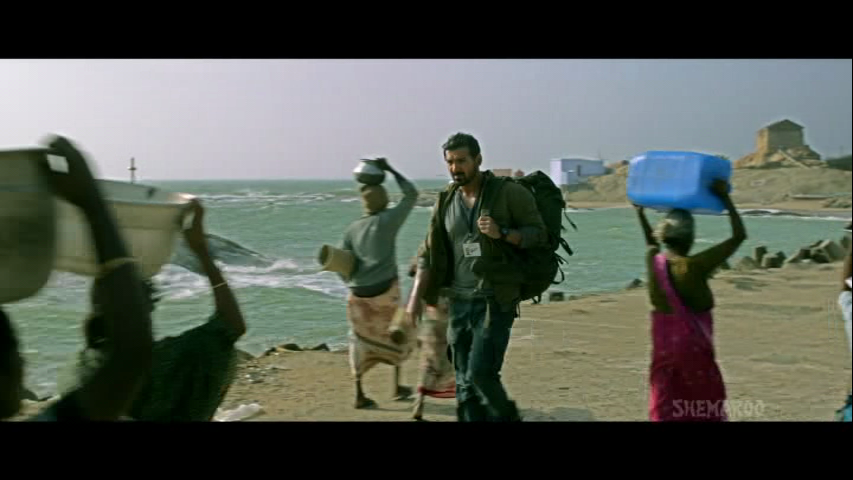
I’m not normally a fan of films that deal with the subject of war, but I found the combination of Shoojit Sircar as director and the backdrop of the conflict in Sri Lanka intriguing enough to warrant watching Madras Cafe.  The film is a world away from his last film, Vicky Donor, but Shoojit Sircar shows a similar attention to detail in this realistic and gritty political thriller.  The film begins with a disclaimer which states that Madras Cafe is a work of fiction, but even with the little I know about the Indian involvement in the Sri Lankan conflict, the story seems heavily influenced by real-life events of the time.  The story deals with the build-up to the assassination of the Indian ex-Prime Minister and owes more to Hollywood drama than the more usual Bollywood tale of an Indian army hero who single-handedly saves the day.  As a bonus, John Abraham is more convincing than expected in the lead role and his performance, along with some excellent cinematography make Madras Cafe well worth a watch.

Madras CafeMadras Cafe

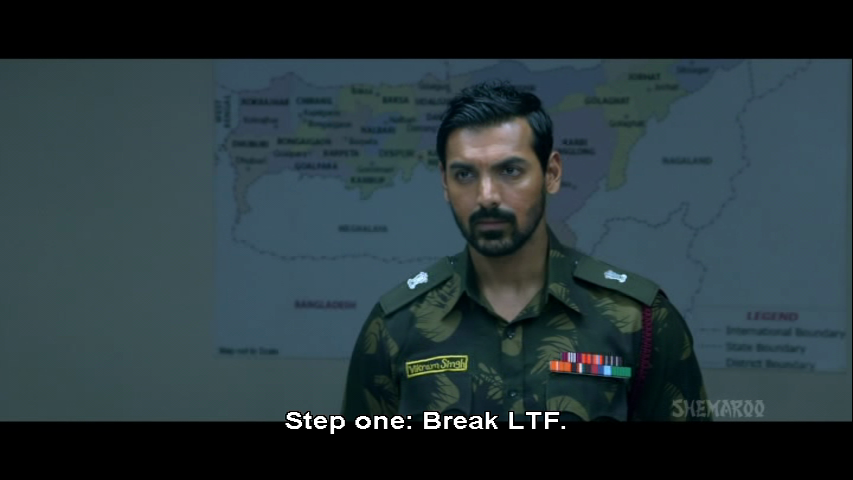
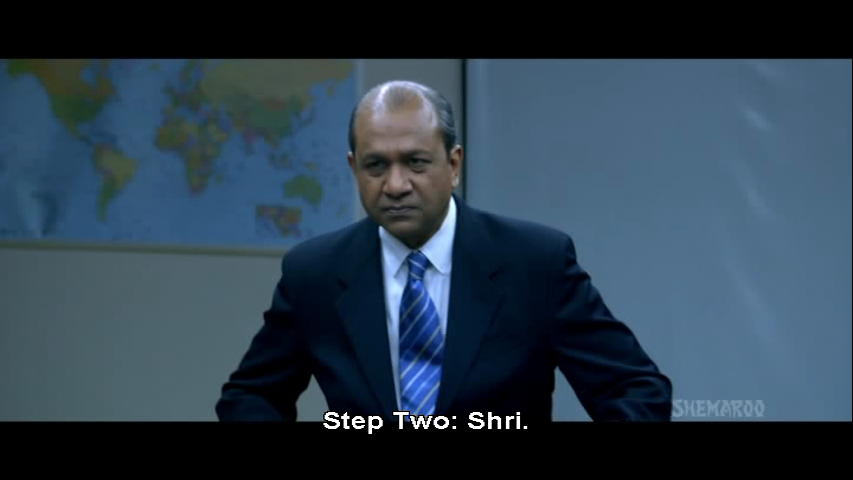
The first half of the film sets up the story, starting with a fairly graphic depiction of the atrocities committed against the Tamil people leading eventually to the development of armed resistance.  It is at times confusing as numerous characters are briefly introduced before the action moves quickly along, but once the whole cast is assembled the story settles down to describe the events leading up to the Prime Minister’s resignation and eventual death.  John Abraham plays the role of Major Vikram Singh, a RAW agent sent to Sri Lanka to ensure elections to secure the peace process go ahead.  To this end he has two aims, to move support away from the head of the Tamil Liberation Force (LTF) and instead to promote the more acceptable (to India) Shri, leader of the Tamil political party TPA.

Madras CafeMadras Cafe

Madras CafeMadras Cafe

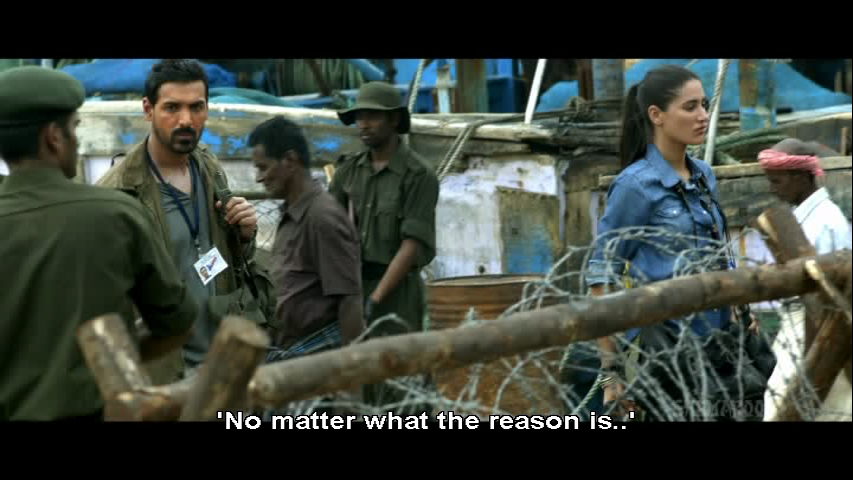
The LTF is led by the charismatic Anna Bhaskaran (Ajay Ratnam), who is ably supported by his inner cadre of Pandyan (Johnson Manjali), his Intel chief; Mallya (Arijit Dutta), deputy leader and army commander; and Rajasekharan (Dinesh Nair), spokesperson and arms dealer. Vikram manages to meet up with Shri (Kannan Arunachalam), who demands weapons for the fight against the LTF, but the mission to deliver these goes wrong and the weapons end up in the hands of the rebel force. Vikram suspects that someone in the Indian RAW group has betrayed them, and so begins a cat and mouse game to identify the traitor while attempting to keep the peace process on track.  During his mission Vikram meets Jaya (Nargis Fakhri), an American journalist based in London, who is in Jaffna to report on the plight of the refugees.  Jaya has a number of informers and sources, who later prove important contact points for Vikram, but otherwise her role seems fairly pointless and not helped by Nargis’s lacklustre performance. The initial meeting between Jaya and Vikram suggested that there may be some conflict between the two over nationalism and journalistic integrity, but this never materialised, perhaps because there is already plenty of conflict onscreen.

Madras CafeMadras Cafe


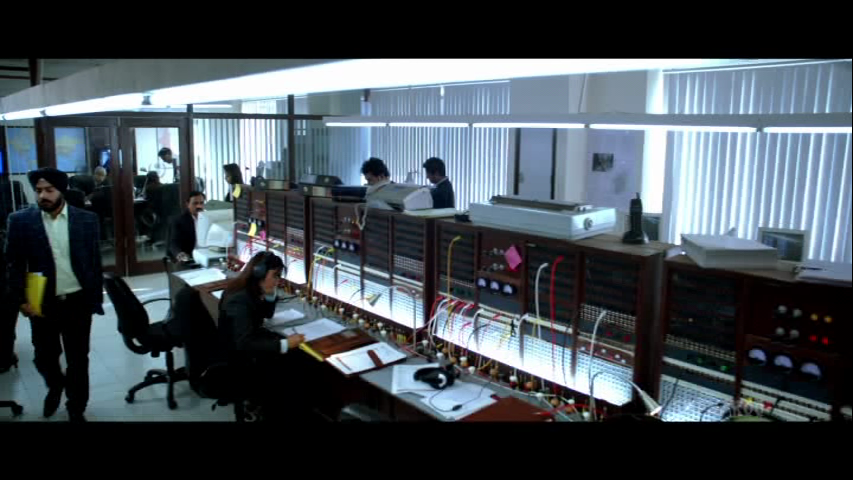
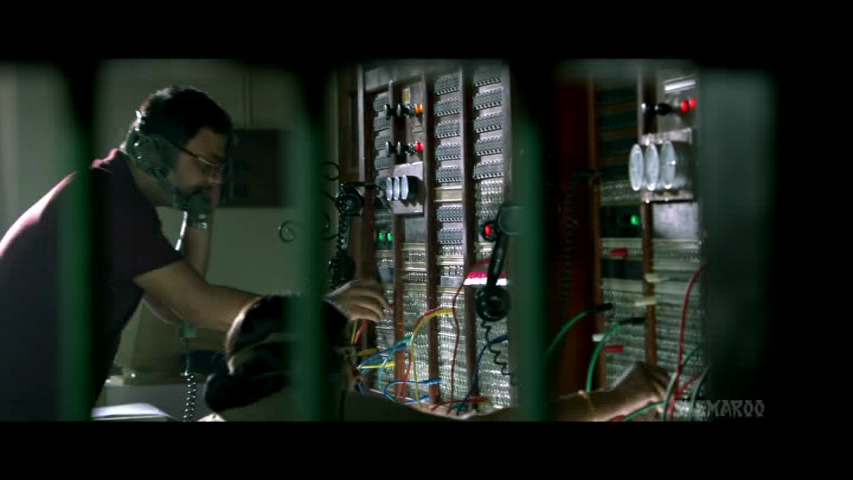
While the traitor is still providing the rebels with details about the Indian army plans, Vikram’s colleague S.P. (Rajeev K. Panday) intercepts wireless transmissions that provide details of an LTF plot to kill the former Indian Prime Minister during his campaign for re-election.  The assassination plot is developed during meetings between Anna’s representative Rajasekharan and nameless Western corporate executives who meet in the Madras Cafe.  The last half hour of the film moves into overdrive as the clock ticks down and Vikram and his boss Robin Dutt (Siddartha Basu) desperately try to put all the pieces together before their time runs out.

Madras CafeMadras CafeMadras CafeMadras Cafe


The screenplay by Somnath Dey and Shubendu Bhattacharya is realistic and gripping, even if you don’t know much about the original story – in fact it may be better if you don’t.  Excellent performances by most of the lead actors, including Prakash Belawadi as Bala, the Indian head of operations in Sri Lanka help to paint a plausible picture of the events leading up to the final assassination.  The pace does pick up in the final half hour although in general the film is kept understated, with a subdued performance from John Abraham, suiting his role as an undercover agent.  He’s perhaps a little too muscular and brawny to be 100% convincing, as I expect undercover agents to be more wiry and less memorable, but his mannerisms and emotions are much better than his previous films and seem fitting for an army officer.  At least there is none of the dreadful melodrama and over the top emoting which often seem to be required for a ‘hero’ role.

Madras CafeMadras CafeMadras CafeMadras Cafe

On the other hand Nargis Fakhri seems completely miscast and never convinces as a war reporter, while her appearance seems even more outlandish than in Rockstar. Rashi Khanna does a better job in her role as Vikram’s wife and the large supporting cast all are well suited to their roles with some excellent individual performances from the various cabinet members, Sanjay Gurbaxani as the Prime Minister and the members of the LTF cell in Madras.

Madras CafeMadras CafeMadras CafeMadras Cafe

The film looks beautiful despite the subject matter, and the cinematography by Kamaljeet Negi is superb.  There are contrasts between shots of beautiful countryside and scenes of complete devastation caused by the conflict.  The framing is excellent and often characters are shown hemmed in by their surroundings, just another way of showing there is no escape from the consequences of war. My only complaint is that the same two helicopters seem to make their way into a few too many shots, but since I always associate the sound of a helicopter with an army presence (from my childhood growing up in Northern Ireland) this just added more realism for me.

Madras CafeMadras CafeMadras CafeMadras Cafe

There are no songs as such in the film, but the background score by Shantanu Moitra is hauntingly beautiful and fits the imagery well.

Madras Cafe is not a film for everyone and at times is more of a documentary than a drama, however the subtle build-up of tension and attention to detail make for compelling viewing – even if I kept thinking that surely an undercover operative in Jaffna would speak Tamil!  A beautifully shot and well-made film, Madras Cafe is a fictional account that aptly illustrates the horror of conflict and the civilian cost. 4 stars.


Kabhi Khushi Kabhie Gham (2001)

Kabhi Khushi Kabhi Gham

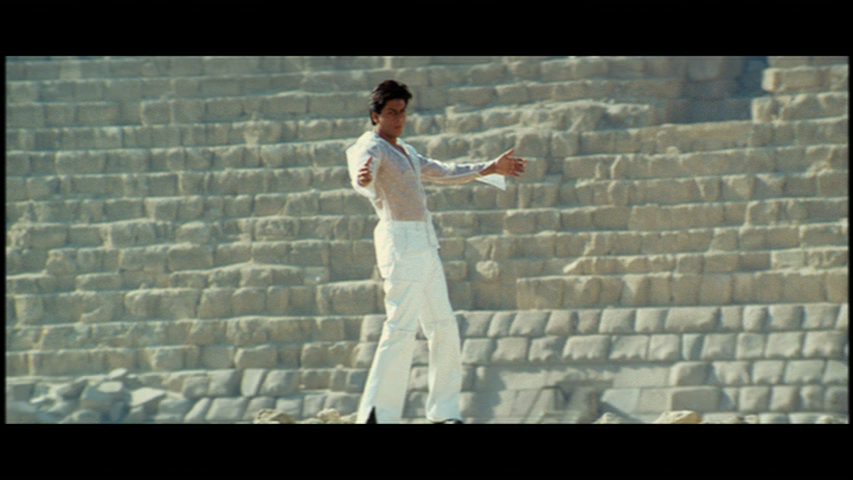
K3G is an indulgence that I only allow myself to luxuriate in occasionally.  While I love the first half of this film, despite all its flaws and typical Karan Johar extravagances, I just wish that the second half came anywhere close to the emotional appeal of the opening melodrama.  Considering the stellar cast it’s particularly disappointing that the whole doesn’t live up to the promise of its parts, but at 3 ½ hours maybe only watching the first half isn’t such an issue.  It also contains my all-time favourite Shah Rukh song with plenty of shots featuring SRK in those lacy see-through shirts, which is probably enough of an explanation for my love of this film, but K3G also brings back memories of learning Hindi and actually starting to understand dialogue without subtitles.  Special for a few reasons then, but this song is still the best part of the film.

For those who haven’t seen K3G, it’s a fairly routine story of your basic multimillionaire family and the ups and downs of their domestic relationships.  The Raichand’s live in a large ostentatious stately home which seems as far removed from India as it is possible to get despite the fact that it’s supposed to be relatively close to a lively market in Chandni Chowk.  It’s the kind of family where running late means having to hop on the helicopter to get home in time for Diwali celebrations, but despite all the lavishness of their lifestyle, it’s a family where there is a lot of love.  This is emphasised in the opening credits as Nandini Raichand (Jaya Bachchan) plays with her young adopted son, but it’s also obvious in the interactions between Rahul (naturally this can only be Shah Rukh Khan) and his father Yashvardhan Raichand (Amitabh Bachchan) as well as in the later scenes with his mother and younger brother Rohan (Kavish Majmudar).

Kabhi Khushi Kabhi GhamKabhi Khushi Kabhi GhamKabhi Khushi Kabhi GhamKabhi Khushi Kabhi Gham


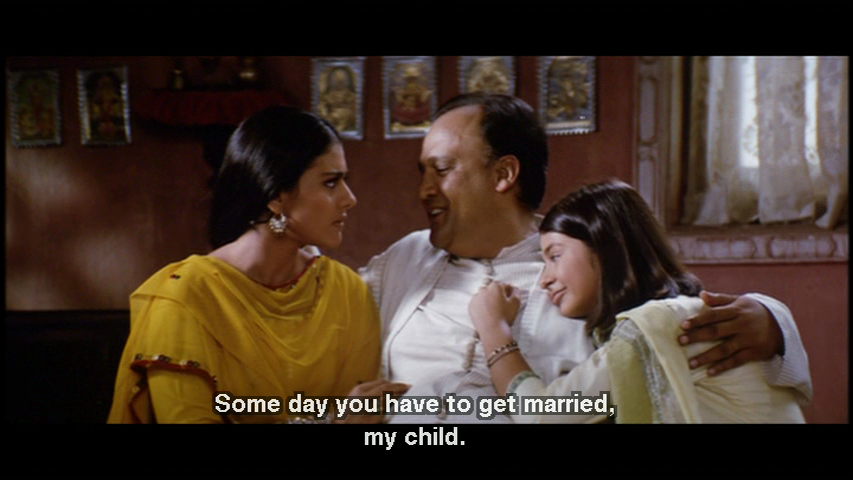
Problems arise when Yash decides that Rahul will marry Naina (Rani Mukerjee) who seems ideal for the position of rich man’s wife entrusted with carrying on the family traditions.  However Rahul has other ideas as he has fallen in love with Anjali Sharma (Kajol), the daughter of a local shopkeeper in Chandni Chowk. Just to keep things in the family, Anjali is the niece of Rohan’s nurse Daijan (Farida Jalal) and has a younger sister Pooja who is roughly the same age as Rohan.  This helps later on in the story, although initially it just seems another way of emphasising the gap between the two families.

Kabhi Khushi Kabhi GhamKabhi Khushi Kabhi GhamKabhi Khushi Kabhi GhamKabhi Khushi Kabhi Gham


The first half of the film sparkles with the romance between SRK and Kajol while the various family relationships add depth and interest to the story.  The two grandmothers, Achala Sachdev and Sushma Seth, ensure a typical Indian family feel despite the Anglicised mansion, while the glaring discrepancies between the Raichand’s home and the (somewhat sanitised) streets of Chandni Chowk are used to good effect.

Kajol is lively and boisterous as Anjali, while SRK is more retrained and less dramatically emotional which helps keep things under control.  There is a smattering of comedy in the romance too, which both SRK and Kajol handle effortlessly, and the appearance of Johnny Lever in comedy uncle mode is thankfully kept to a minimum and doesn’t disrupt the story.  The other characters all fit in too – the young Rohan is petulant and spoilt, just as a rich kid should be, while Anjali’s younger sister Pooja (Malvika Raaj) is bratty and approaching obnoxious at times, which does actually tie in reasonably well with her later persona.

Kabhi Khushi Kabhi GhamKabhi Khushi Kabhi GhamKabhi Khushi Kabhi GhamKabhi Khushi Kabhi Gham


Naturally Rahul chooses love over duty and ends up cast out of the bosom of his family, although he does have Anjali and her sister Pooja as compensation.  Of course, this is a Karan Johar film, so it’s no surprise when we reconnect with Anjali and Rahul ten years later to find that they are living in a large and opulent home somewhere in London, despite the fact that Rahul left with nothing – pretty impressive work!

Kabhi Khushi Kabhi GhamKabhi Khushi Kabhi Gham


But things start to fall to pieces once Kareena Kapoor enters the picture.  This was the first time I’d seen her in a film and it was also the last for a very long time – based solely on this dreadful performance. Hrithik Roshan as the grown up Rohan is also sufficiently unimpressive, seemingly unable to decide between the role of hot and macho student running amok in ridiculously expensive cars, or emotional wreck searching for his brother.  The two completely derail the romance and it’s hard to come up with any reason why Pooja has to dress like a call girl and act like a complete airhead.  The film also dives deep into overindulgent farce as Anjali complains about her son becoming too English (hmm, could this be because they’re living in England and he’s attending an English school?) while Rohan decides that staying with his brother while pretending to be someone else would be a good way to reconcile his father and brother.  Because that would definitely work.

If you can ignore all the self-indulgent weeping from Rohan and the insufferable unpleasantness of Pooja, the rest of the film is endurable, although unbelievably long and drawn out with a ridiculously contrived ending.  Karan Johar goes overboard trying to tug on his target NRI audience’s heartstrings with a rendition of the Indian National Anthem which seems totally out of place, and there are far too many references to ‘loving your parents’.  Even apparently when they don’t love you and repeatedly tell you so.  There are a few moments where the easy flow of the first half is almost recovered, but overall the second half is disappointing at best, particularly after such a good beginning.

Thankfully though there is still SRK, who is as charismatic as always, and the Shah Rukh and Kajol jodi works even while the story around them falls to pieces. If only the whole Kareena Kapoor and Hrithik Roshan storyline had been cut, this would have been a much more enjoyable film, although still not perfect.  Still, I do recommend watching right up until the interval – after that it’s at your own risk!   4 stars for the first half, but only 1 for the second.