Pistolwali (1972)

pistolwali

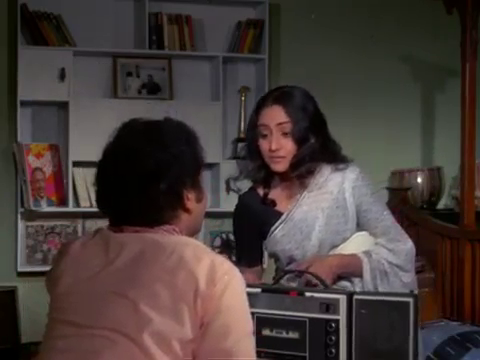
I often wonder how gangs of ne’er-do-wells get along before they reach the critical mass that attracts a hero to sort them out, and what it is that they do all day. Pistolwali doesn’t answer the first of those questions, but it does provide plenty to look at as you ponder whether what they do all day is make their own outfits and fight over the dress-up box.

K.S.R Doss’ Pilla? Piduga? was either dubbed or partially reshot in Hindi as Pistolwali. Both (unsubtitled) films are on YouTube so choose your poison. I have chosen to use the Hindi version as some actors and both Helen and Jayshree T appeared to be speaking Hindi and this film is all about the authenticity…Plus I understood more of the dialogue even if I couldn’t read the significant clue written in blood.

Like so many other Telugu cowboy themed revenge films, this one is set in a time and place that exists only in Telugu cowboy themed revenge films.The movie opens with Raaka (Satyanarayana Kaikala) and his gang attempting a train heist. A brightly clad cowboy (Ramakrishna as Amar) puts them out of business from his perch in a convenient tree. It’s cowboys vs cowboys and hat colour is not a reliable indicator of anything.

Maybe if we saw the floral sunhats being stolen from helpless old aunties it might be suitably Bad, but instead it just looked like a job lot guaranteed to brighten up every occasion. And there was that one guy who just painted his scalp silver. Reeka (Prabhakar Reddy) seems to have fewer marbles and fewer outfits than Raaka. He throws childish tantrums that quickly escalate into homicidal rampages. And that is the nicest thing I could say about him.

“South Bombshell” (according to the poster) Jyothilaxmi is Neelu. She is first seen cavorting in a daring swimsuit but later changes into equally fashion forward pantsuits. The villains go too far when they steal from the temple, and Neelu sets off in pursuit. She swaggers, shoots and curses like a hero rather than a heroine relying on womanly wiles, and generally she rescues herself. Jyotilaxmi wears some abbreviated costumes and gets a big dance number, but Neelu isn’t a girly girl. Neelu gets roughed up by her adversaries but how to say this… they don’t get rapey and creepy with her despite the allure of her midriff. She is a foe and they deal with her as a threat, not as a plaything. She is tough cookie and I suspect it would take a bit to outrage her modesty in any case. When Helen gives it her all in Hoga Sa Hoga, Neelu fills the time honoured role of hero looking like they’d rather be elsewhere. Although that may also be professional item girl rivalry.  Neelu has her own ideas and just goes and does her thing. Even if that includes falling through a trapdoor and wrestling a (sight impaired) tiger.  And she has a straightforward approach to relationships.

Pistolwali-Graceful

I am not sure it was desire for authenticity or just directorial cruelty that had her struggling to get on and off horses, but it looked like Jyotilaxmi did a lot of her own action scenes.

The viewer learns that Raaka is Neelu’s biological father long before she does.  Raaka raped Lakshmi and left her for dead before also maiming his friend and rival for Lakshmi’s love. She fell pregnant as a result and she and the baby were taken in by her now one-legged true love who seemed to think it was the right thing to do. He may have been grooming Neelu for vengeance as well, but he seemed like an affectionate and over indulgent filmi Daddy. Neelu was none the wiser about her parentage until quite late in the film. That might all sound a bit progressive so let me assure you that the way it was revealed to her made me deduct a lot of the good parenting brownie points.

Ramakrishna is technically the hero but Neelu overshadows Amar in all respects. He does an OK job and he doesn’t get in her way, but apart from some excellent outfits he achieves little of note. Although I did giggle at his inept dealings with the ladies. On the subject of costumes, it looks as though each main character was issued with one distinctive pair of boots and they pretty much wear them throughout. Raaka’s boots were particularly special and Satyanarayana Kaikala was suitably over the top to match. And the outfits did help a little with identifying characters in the many and varied fights and action scenes. K.S.Madhavan threw everything and the kitchen sink into the stunts. However I have to say that the plot is quite cohesive and to an extent, I would almost say logical.

The background music is a brilliant mish-mash of fuzzy surf rock and funky Hammond organ with classic cowboy guitar strumming and the odd slide whistle. The song set pieces are unashamedly random and the film has an embarrassment of item girls that all get a guernsey in featured numbers.

Jayshree T is always so perky, I love watching her dance. She always seems to wear more hair than clothes but I never see her as really skanky.


Helen and her creepy blue contact lenses appeared in a nightclub song and Jyotilaxmi got a dance in a fabulous Fauxgyptian inspired village set with what may be happy go lucky tribal cannibals. The camera is often at crotch level which is a bit confronting. But to be fair, the camera wasn’t just upskirting the ladies. Once seen, never unseen.

This is one of my favourite heroine-centric B movies from 1972 and Jyothilaxmi is perfect as the righteous gunslinger. See it if you have ever harboured thoughts of wearing a fur trimmed vest with fringed pants but weren’t sure how to accessorise, or if you want a primer on tiger wrestling for the modern lady. 3 stars!
Bawarchi

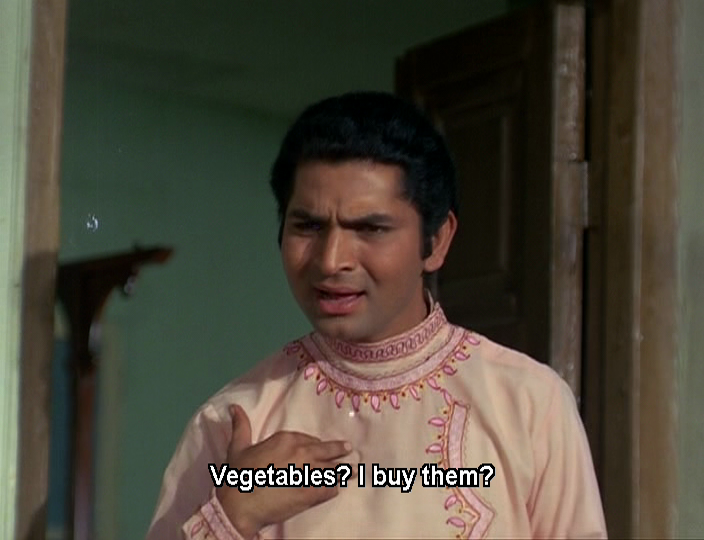
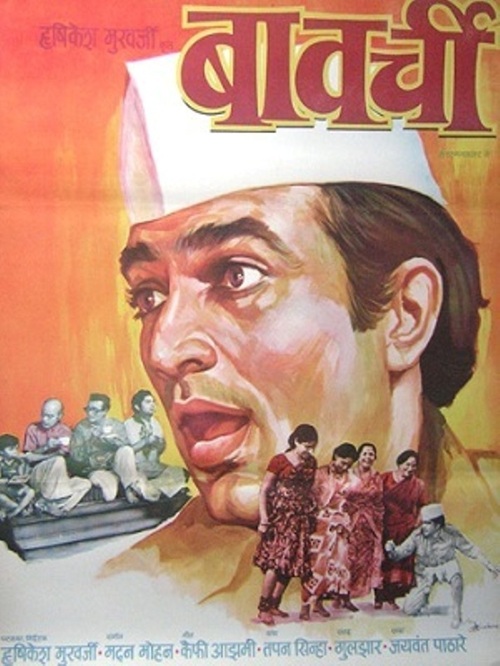
BawarchiBawarchi is simply a charming film and one that always makes me smile, even though it’s heavy on moralistic aphorisms and homely words of wisdom. Rajesh Khanna plays the cook who takes on the task of transforming a dysfunctional and argumentative family with his simple outlook on life; although there are numerous hints throughout that he may not be quite what he seems. The strengths of the film are the all-star cast who all fit into their roles perfectly and Gulzar’s well written dialogues that ensure the petty family disagreements are realistic and believable. Hrishikesh Mukherjee’s screenplay is based on Tapan Sinha’s 1966 Bengali film Galpa Holeo Satyi and Sinha is credited as the writer for Bawarchi. For anyone trying to track them down, both films are available on Youtube, although sadly the original Bengali film seems to only be available without subtitles.
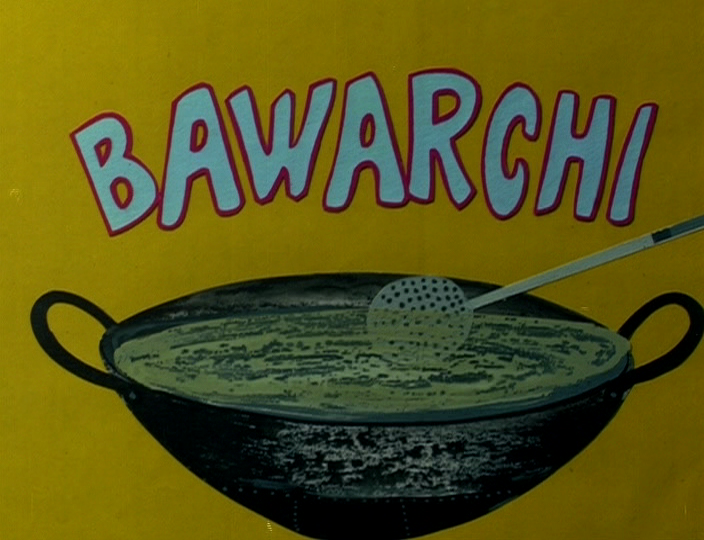
The story revolves around the household’s transformation from an unhappy and argumentative group of people to a caring and considerate family. Along the way there are songs, a dance competition and even a romance thrown in for good measure. I love the opening graphics which use the cooking theme to good effect, but there are only a few before Amitabh Bachchan takes over, announcing the credits against a rather oddly static red curtain, and carries on with a voice-over introducing the various characters in the drama. Firstly there are the fractious Sharma family members who live in the ironically named Shanti Niwas.

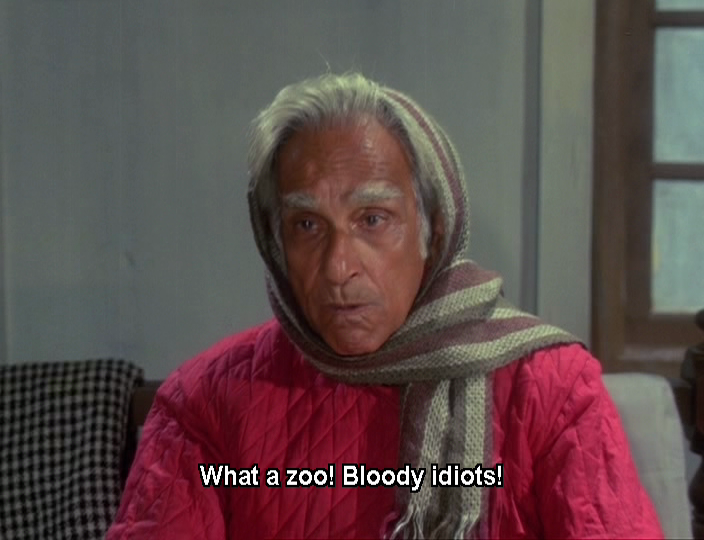
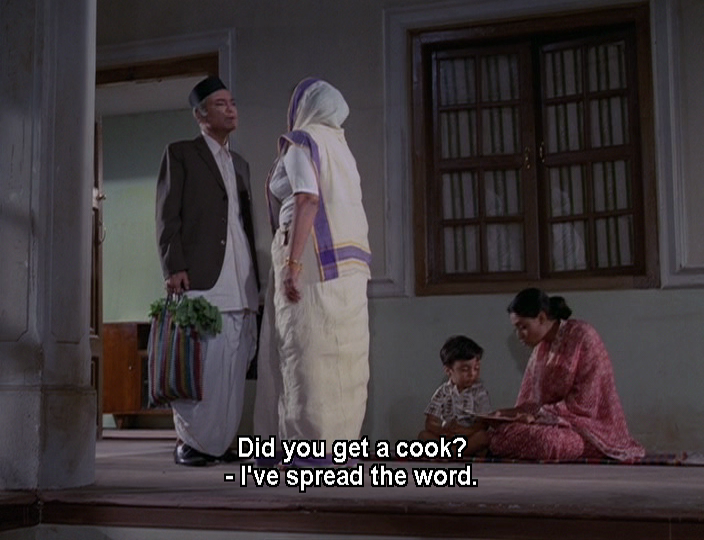
BawarchiBawarchiThe never-ending conflict in the house means that the family cannot keep their servants, which in turn leads to further discord and argument. As the story opens the family are in the process of losing their last servant – the family cook – who has decided to move on despite his new job paying less. The family is ruled by the ageing patriarch Shivnath Sharma (Harindranath Chattopadhyay) who complains about his sons, his daughters-in-law and the lack of a decent cup of tea in the morning.

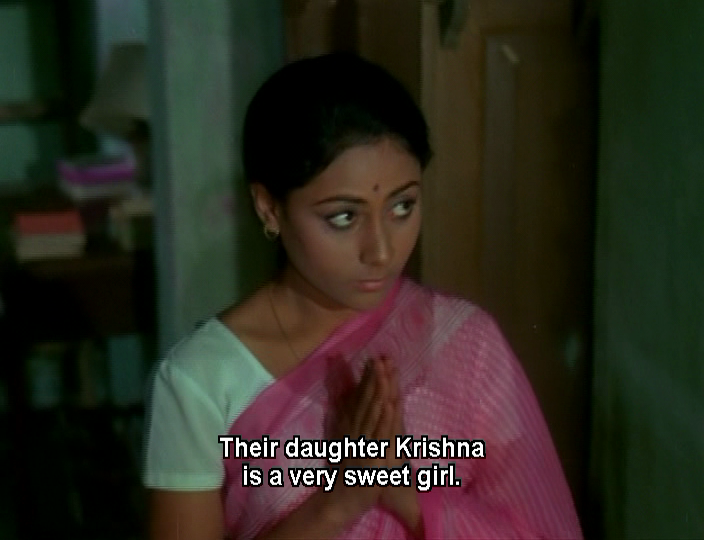
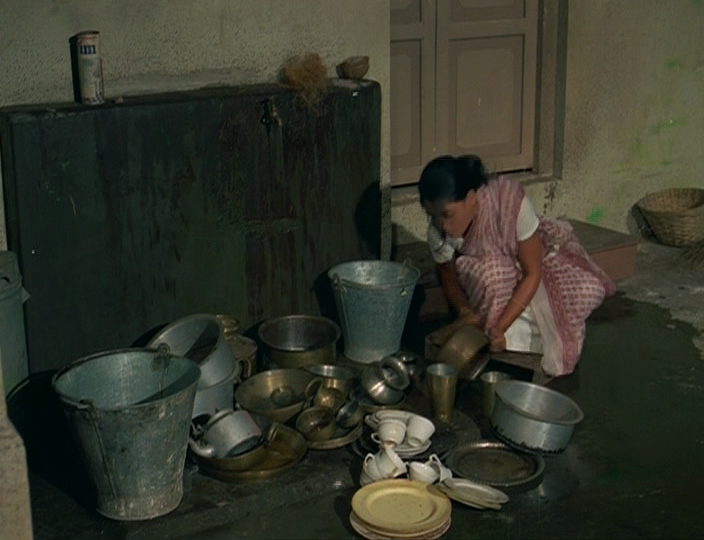
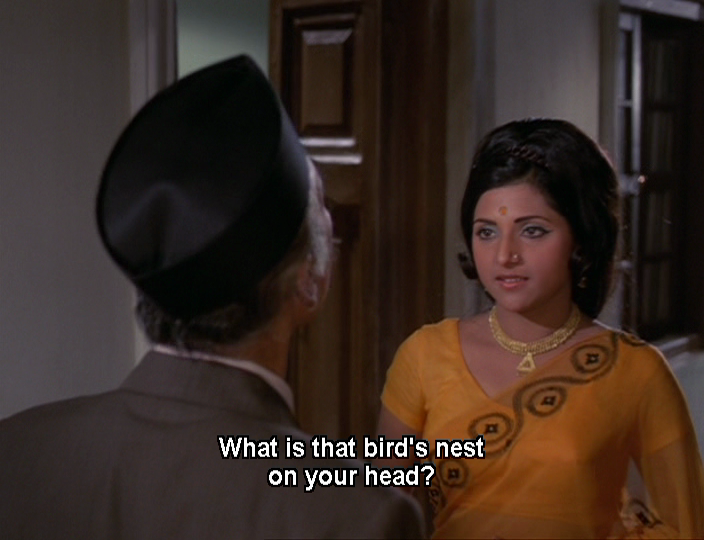
BawarchiBawarchiDespite his grumpy demeanour he is the only person in the house to think about the welfare of his late second son’s orphaned daughter Krishna (Jaya Bachchan as Jaya Badhuri). Harindranath Chattopadhyay is perfect here and his complaints are used to good effect to illustrate the trivial nature of most of the family disagreements. Krishna is at everyone’s beck and call, and yet she has a pleasant and sunny disposition which leads her to wait on everyone with a smile and not much thought of her own comfort. Just as well perhaps since no-one else thinks about her comfort at all.

BawarchiBawarchiAlso in the house are Shivnath’s eldest son Ramnath (A.K. Hangal), his wife Seeta (Durga Khote) and their daughter Meera (Mansiha). Ramnath is a harried clerk whose family life is impacting on his work. To combat his woes and possibly also to help him deal with his complaining wife and daughter he also drinks, although this actually makes him more pleasant to deal with, so perhaps it’s not entirely a bad thing. Seeta complains of her gout which makes her unable to help with the various household chores, while Meera is just plain lazy although she does get out of bed for her dance lessons.

BawarchiBawarchiShivnath’s third son Kashinath (Kali Banerjee) is a rather pompous school-teacher who lives in the house along with his wife Shobha (Usha Kiran) and their son Pintoo (Master Raju).

The last member of the family is Shivanth’s youngest son Vishwanath (Asrani) aka Babbu, a music director for films who, as Krishna so aptly puts it, copies English songs, adds Hindi lyrics and records them. It’s just one of the examples of tongue-in-cheek poking fun at the Hindi film industry which Hrishikesh uses to add some more gentle comedy, almost as if he’s letting the audience into a big filmi secret, even as he himself still sticks to type of BW conventions he mocks during the film.

BawarchiBawarchiBawarchi - ShobaBawarchiThe final two characters in the drama are Meera’s dance teacher Guruji (Paintal) and Krishna’s tutor Arun. Arun is Krishna’s love interest but their romance is only a small part of the story, although it does become more important towards the rather clunky end of the film.
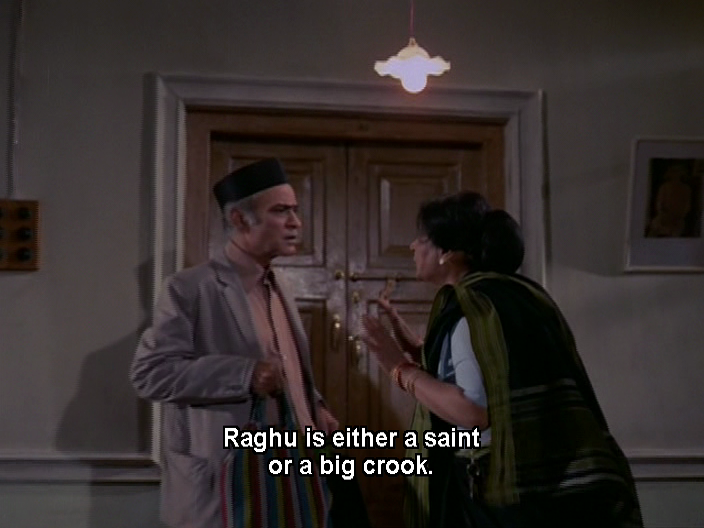
The family squabbles are based on their own selfishness, and none of them wants to take on the responsibility of looking for new servants. Into this unhappy household steps Raghu (Rajesh Khanna) who just appears on the doorstep one day volunteering to be their new cook.

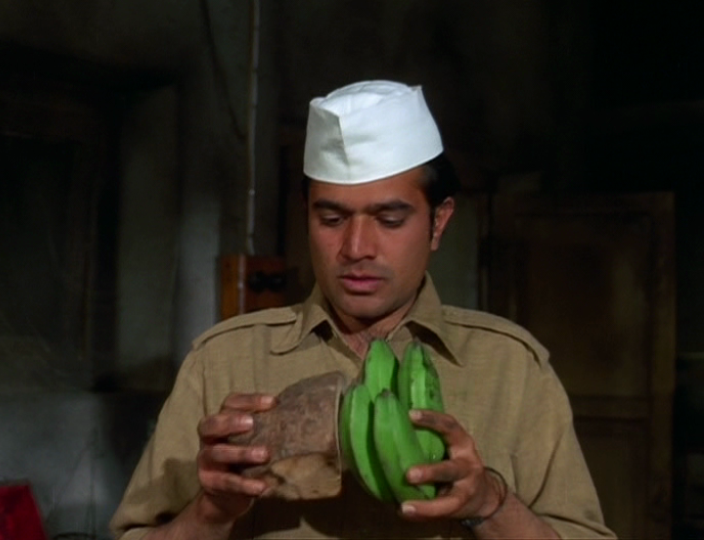
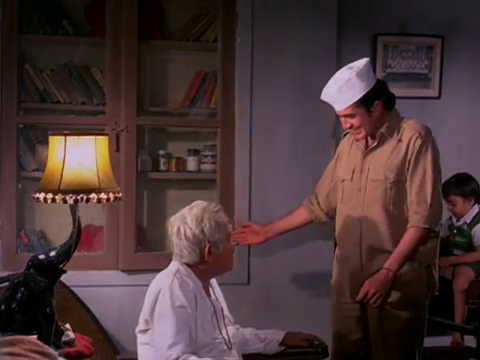
BawarchiBawarchiBawarchiBawarchiRaghu seems to be the answer to everyone’s prayers as he insists in a low salary, cooks amazing food and also has talents as a philosopher, singer, composer, and dance instructor to name but a few. Raghu seems to be a gift from the gods as his unfailing happiness and good cheer start to have an impact on the family, as does his willingness to tackle even the most demeaning of tasks.  This is a man who does the ironing – nothing else needs to be said!
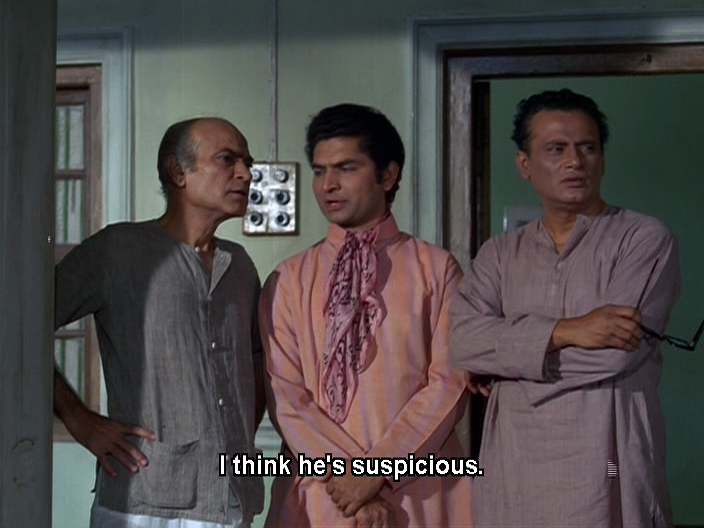
Raghu does however seem to have an unhealthy interest in the large box chained under Shivnath’s bed.This happens to contain the family jewels, and added in to reports of a thief in the area makes Raghu’s sudden arrival more than a little suspicious. However his ability to cook and his constant stream of knowledge about anything and everything soon make him indispensable to the family.

Bawarchi - happy songsBawarchiBawarchiBawarchiRajesh Khanna plays Raghu as a cheerful and somewhat bossy servant and he uses this relaxed outspokenness to stop the stream of advice from becoming too preachy. Despite his constant chirpiness Rahgu never seems too sickly sweet to be true, something which is helped by the suspicion that he may in fact be a thief and is simply putting on an act. Most of the films I’ve seen with Rajesh Khanna have been romances, but there is something very special about those few films where he doesn’t play the typical hero. Here he has an irrepressible twinkle in his eye and such a beautiful smile as he guides the family to an actual ‘peaceful abode’. It’s a wonderful performance and Rajesh Khanna is definitely a large part of why I love this film.

Just as amazing though is Jaya Bhaduri as she portrays shy innocence and naiveté with ease, and yet makes Krishna a normal down-to-earth person, trying to do her best with the lot she has been given. She’s sweet and natural with her grandfather, properly demure and respectful to her aunts but cheekily mischievous with her youngest uncle.  It’s hard to believe that this was one of the early films in her career as she definitely holds her own with the rest of the more experienced cast.

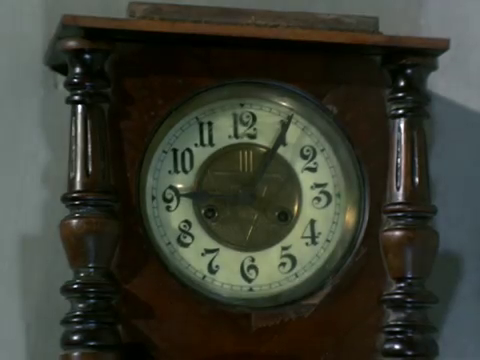
I also love the sets here which make the house look homely and lived in.  The locked case is impressive in it’s ‘look at me – I contain something valuable’ obviousness but there are also some wonderful lamps and clocks and Babbu has some very cool looking records on his shelf.

Bawarchi - the caseBawarchi - clockBawarchi - lampBawarchiThe only let-down in the film for me is the end, which seems a little too contrived as Raghu creates a rather unsophisticated solution to the final family problems. I feel it’s a little too simplistic considering some of the earlier scenes and the way Raghu’s character has evolved. However it’s a small quibble, particularly when the rest of the film is so enjoyable.  Bawarchi is definitely recommended for those times when you want to escape into a wholesome family drama that’s guaranteed to make you smile. 4 stars.


Khal Nayak

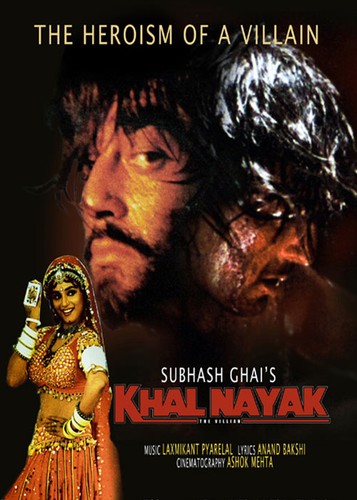
Khal Nayak poster

Subhash Ghai’s Khalnayak is a fairly predictable cops and robbers story twined with references to the Ramayana which adds depth and resonance.  There are some excellent performances, stylish visuals and excellent music. But at a shade over 3 hours, the pace is stately to the point of plodding and there is too much emphasis on the meaning, and not quite enough on the drama.

Ram (Jackie Shroff) is assigned a case to bring down a terrorist organisation. Ballu (Sanjay Dutt) is the poster boy for Roshida’s (Pramod Muthu) gang. When Ballu escapes from jail, Ram is accused of neglecting his duty to go spend time with his girlfriend Ganga (Madhuri Dixit). When what looks like every policeman in India is put on Ballus’ trail with no success, Ganga finds a way to infiltrate the gang. She sees that Ballu is not quite as bad as he seems, although he is far from being misunderstood. Eventually the police close in, and Ganga is caught between Ram, duty, and her empathy with Ballu.

Madhuri looks stunning and delivers a strong and engaging characterisation. There is nothing simpering or weak about prison officer Ganga. When she sees an opportunity to help Ram restore his reputation, she asks for his support. Then she does it anyway. When she sees Ballu needs medical help, she just goes and gets a doctor because it is the right thing to do. Madhuri does some wonderful deliberately bad acting when Ganga, having captivated Ballu, joins the gang and goes on the run.

Then in Aaja Sajan Aaja she is simply incandescent as she dances for her Ram. Madhuri was also lucky as Ganga dresses in Indian attire, not the hideous synthetic 80s gear that Ballu wears when he tries to impress.


Sanjay Dutt is so very good in some scenes that it makes me angry at how bad he is for much of the film. He adopted a range of bizarre grimaces and physical tics that I think were meant to emphasise the animal side of Ballu, but just made him look ridiculous and clumsy. When he dropped the exaggerated mannerisms and just channelled the emotions, he was compelling and raw. While asserting his ownership of Ganga, Ballu accidentally defends democracy and becomes a Nayak for those people. His awakening to being respected and enjoying that feeling was nicely done, even though there was a lot of literal flag waving to make sure the point didn’t escape unnoticed.

Jackie Shroff is perfectly competent as Ram, and only tries to tear his clothes off once so that was good. For my money Ram is the least interesting character. He knows he is right, everyone knows he is right and he is not averse to using extreme force against Ballu to prove how right he is. While there is an interesting dynamic between hero and villain, there is minimal character development for Ram. A relationship between Ganga and Ballu would be a Very Bad Idea but I thought marrying Ram could be a bit suffocating.

The Ramayana elements were more obvious to me on a recent re-watch than when I first saw it, particularly the twists on that narrative. I couldn’t help but compare this with Mani Ratnam’s Raavanan (which I greatly prefer to the Hindi Raavan). In Raavanan, Ram revealed his darker side and could become as Ravana but Khal Nayak seems to say rather that Ravana has the potential to be Rama. I liked that the question of what makes a hero or a villain was articulated and that this was more than a glorification of Rama. Ganga didn’t sway from her beliefs when she was frightened, and kept her faith in Ram. Ram wanted to believe Ganga but society and the law demanded she was still put to trial. I was annoyed that she had to have her virtue validated by a thief and murderer, a man so despicable in the eyes of the law that he had besmirched her just by his proximity but whose word was still worth more than hers. I know she is Sita and he is Ravana, but still. The film plays with some of the conventions especially around the notion of hero and villain. Ram is also helped by Ballu’s testimony, his reputation restored by the hand of a sinner.

Ghai doesn’t quite go the whole hog but he does use a range of staple masala ingredients and has a lush visual style. Ram and Ballu have bloody fights that crash through walls and take to the treetops. There are long lost childhood friends and dreary paeans to motherhood. There are coincidences, speechifying and tearful reconciliations galore. The evil mastermind Roshida has a nasty disposition and lots of cats who do a fabulous job of reacting to stuff.

Rakhee gets a lot of screen time as Arti, not all of it crying. Neena Gupta makes an impression as the striking Champa. Ramya Krishnan is charismatic as Ballu’s girlfriend Sophia, and also gets both versions of the title song. What a waste to have her in such a small role, but how great to have so many powerful actresses in one film. The female characters are strong and quite distinct, but Subhash Ghai stays firmly within the conventions of 90s masala so none of them break the mould of Ma, the friend, bad girl etc.  Oh, and Anupam Kher does his customary shtick as Pandey the prison warden.

There are interesting observations about the conventions of parenting and filial behaviour. Ganga tries to evoke Ballu’s sentimental side by talking wistfully of how much he must love his Ma and how hard it must be for him to live on the run. He calls Ganga out on trying to manipulate him through sentiment, but he rejects that as unimportant to him. Question – If a villain shouts ‘Ma!’ in his sleep and there is no one to hear it, does he have feelings?

Mind you, when Ballu is beating Ram up because why not, Arti hits Ballu for assaulting Ram, Ballu shoves her so Ram belts him for hitting a Ma, then Ballu fights back and Arti comes back at him to stop him using violence.  A move straight out of the Nirupa Roy Filmi Ma Manual.

The songs are extensions or amplifications of the narrative as well as being beautiful and usually pleasingly melodic.

I am not so fond of that title track, although it does epitomise early 90s style and Ramya Krishnan works that beaded gear for all it’s worth.

Khal Nayak-Fruitbat

I had to pity choreographer Saroj Khan. Between Dutt’s own ‘dance’ style and the outfit given to Ballu in the final song, he looked more like a demented fruitbat. Seeing Ballu and the boys try their seductive dance moves on Ganga was highly amusing. But she choreographed some beautiful dances for Madhuri. I went to see the Temptations Reloaded show up in Sydney last year, and the roof nearly came off when the opening bars of Choli Ke Peeche played.

The first hour of the film could be condensed to around 20 minutes with no great loss, but things get much more interesting once events are set in motion. While it is a visually strong and often darkly dramatic film, the pace suffers from Ghai’s concentration on symbols and stylised elements rather than closely following the emotional arcs of the characters. Very much worth watching, but some patience is required. 3 ½ stars!