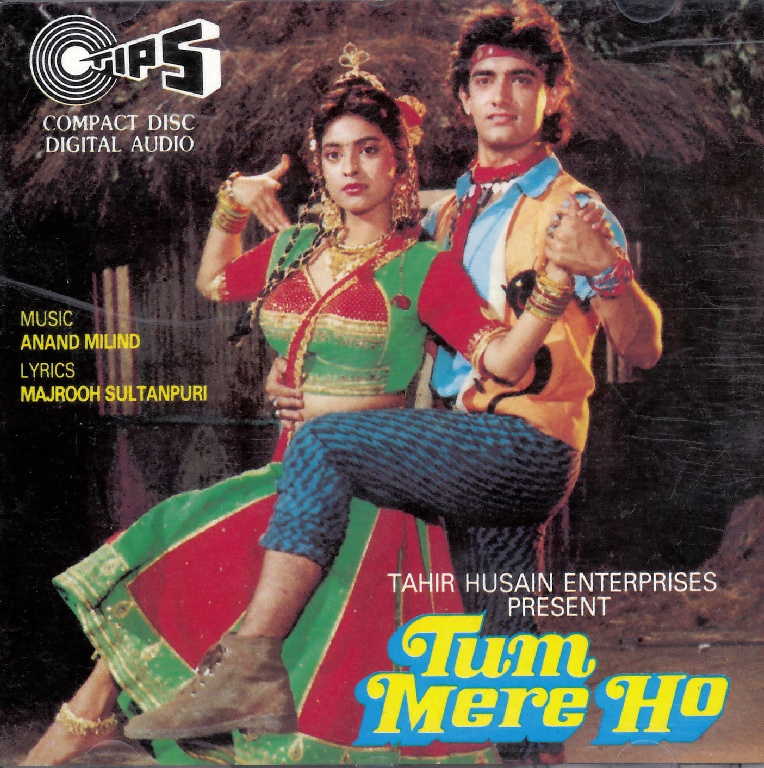
Tum Mere Ho (1990)

Aamir Khan, Juhi Chawla and snakes? Sounds like an excellent Nag Panchami Film Fesssstival subject. The film is pretty terrible, but is almost always So Bad It’s Good, and the songs are quite pleasing in both snakey choreography and energy. It may have lost something in translation due to the dodgy quality youtube version with no subs that I watched, but I doubt it.

It seems of late that Aamir has distanced himself from his pre-Lagaan career. But I say let him be known for his heroic role as Shiva the hairy-chested snake charmer who saves his lady love Paro (oh so young and pretty Juhi) from a crazed Snake Queen (Kalpana Iyer).

The film opens with Thakur Chaudhary attempting to steal a Naag Mani by using a very flawed contraption. In the process, he kills a snake and draws the ire of the Snake Queen on his own household.


She declares that as he killed her child, she will kill his. And off she goes and bites the young lad as he sleeps.
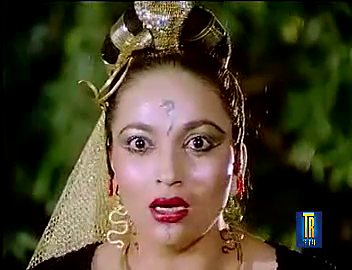
The weeping parents, with the Snake Queen laughing at their grief, put their son’s corpse on a little raft arrangement, and he is sent off on the currents of the river. Of course he washes up at the feet of the one man who can reverse a death by snake bite. The child lives and grows up to become Shiva (Aamir). He learns to use magical powers that involve him waving a bone and a skull around, and doing lots of fist clenching emoting.


He has his uncle, his snakes, a daft sidekick, and is being pursued by the village skank belle. He also has a waistcoat with a snake motif for special occasions.

Everything a boy needs!

Shiva goes into the village for some reason, possibly to deliver a snake, and sees Paro at the fair. He impresses her with his snake, and she is immediately full of dreams of love as well as thoughts of garam garam jalebis and thandi thandi kulfi.


My Hindi vocabulary is small and selective so I may not have captured all the nuances of her romantic fantasy. Paro is the daughter of local bigwig Chaudhary Charanjit Singh and is out of Shiva’s league.

No one wants these youngsters to get together and this leads into not entirely boring Romeo and Juliet territory. I was concerned the snake theme may dissipate, but Shiva uses snakes as part of his courtship ritual which was an interesting approach. Paro can’t stop thinking about him, his snake, and possibly those jalebis and so love blooms.

They’re so young! So pretty! He’s in a floral blouse!

Romance blossoms despite Paro’s father arranging attacks on Shiva using black sorcery, beatings and guns.


Of course, merely locking Shiva in his room cannot keep them apart, not while clever snake Naga Raj is there to unlock the door.

Shiva’s people want to keep him away from Paro too as they can see she is trouble for their boy.

Shiva and Paro scamper around the forest looking like the poster children for young love and carefree premarital fumbling.

Until the revelation that Paro has been married since she was 3 years old to some unseen Rajput scion. Guess who that boy was? Sigh. Shiva has to perform at her wedding (oh the tragedy!) before Paro is sent to live a widow’s (I’m guessing the widow bit as she wore white, no sindoor, and cried non-stop so it was quite funereal anyway) life at her in-laws and mopes around a lot.

Note: Re the village belle –  Despite her clothing usually erring on the correct side of the fabric to flesh ratio for a snake, she does fail other snake tests and is a Fake Snake.

Anyway Paro’s change of address propels Shiva back to his family home and into Snake Queen territory. He does a lot of pining and trying to lure Paro out with his snake music, which is just asking for trouble.
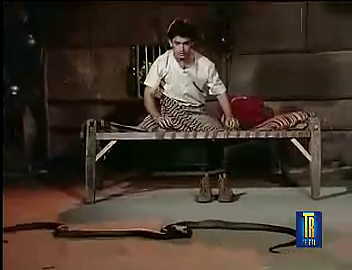
Naga Raj saves his human from the Snake Queen which made me wonder about the Snake Code and what did a snake have to do for other snakes to turn against it, and did they have to show just cause if they were opposing a more powerful creature?  And also, what were her responsibilities towards lesser snakes? Was she justified in attacking them? It raised so many questions.

I did like this song where the Snake Queen impersonates Juhi, but is caught out by her excessive accessories (compared to the pristine white of the real Paro). She misses a couple of easy bites. I really had to question this whole selective bite placement thing that filmi snakes seem to have.

https://www.youtube.com/watch?v=ZbW0xOxyy1E

It emerges that the uncle snake charmer knows Shiva’s real identity. Shiva’s father rejects the idea as some attempt at magic although I wondered if that was really to protect his son given that the vengeful snake was likely to still be around. All unaware of this peril, Shiva and Paro return to the forest and I think they sort of get married. Wedding rituals in the snake charmer village seemed quite straightforward, and there was a robust approach to courtship. Basically, if you can catch your person and subdue them, you’re as good as married.

Having set Naga Raj to wait outside (after a bit of a chat about the privacy required on one’s wedding night), Aamir and Juhi are alone. He does lots of nuzzling and she looks like she has passed out. But the Snake Queen takes the opportunity to attack.


Can Shiva’s magical powers save Paro? Will there be flying snakes? Will it involve a ritual both very silly and slightly icky? Will someone go up in a ball of flames? Will people just learn how to get along? What do you think? (If you really have to know, I can’t help you thanks to Shemaroo – who don’t care enough to release decent quality DVDs but will stop you watching this on youtube. Sigh)

This is not a good film but I was entertained enough and don’t regret the time spent. I can’t say that for every film I see! Tahir Hussain hasn’t created a masterpiece but he has made a pretty solid snake revenge romance. The soundtrack by Anand-Milind is pleasant, and there is some nicely energetic dancing. And you know, Aamir, Juhi and those snakes. 2 ½ stars!

Punnami Naagu (1980)

Punnami Naagu is almost two films in one. It’s as though someone took a deck of cards marked ‘happy animal friends’ and shuffled it with the deck marked ‘a nagin stole my soul’ and voila!  It was an excellent opportunity to apply the principles in Jenni’s Field Guide.  Apologies for the crappy screencaps – the DVD picture is really grainy. And I didn’t have subtitles so I may have made the whole story up.

A local snake charmer uses his snake coercing powers to kill a priest after he had stopped the snake charmer raping a girl. The priest seems to make some dying invocation or curse, and leaves his young son an orphan.

The priest’s son is adopted by the landlord, and I think god sends an elephant to look after him. The elephant is very maternal, making sure Raju eats and washes regularly. It’s all very family friendly and sweet. When Raju moves in with the landlord, naturally his elephant moves in to the luxurious mansion too, and they grow accustomed to the good life. I would have had seizures looking at that decor, but apparently elephants rise above such things.

Meanwhile the snake charmer is in less happy circumstances, and his son Naagulu is growing up unaware of the curse that will take over his life. The father is feeding Naagulu snake venom in his food to help him become immune to snake bites, and he is being trained to take up the family business. It is lucky he is immune as his snake handling is a bit cavalier – I’m pretty sure they could fang you through a hessian sack. Nevertheless.

Naagulu’s heavily pregnant aunt has an animal helper of her own – a very useful monkey that assists with laundry and has exceptional empathy and communication skills along with basic midwifery knowledge. When little Laxmi is born, all the main players are set for the drama which is to unfold.

It’s a standard boy woos girl story, as Raju and Laxmi flirt and fight and make up, all under the watchful and slightly exasperated gaze of their animal friends who also help to patch up fights and carry messages. There is dodgy dancing, Narasimha Raju has an exceedingly voluminous coiff, the elephant and monkey are smarter than the humans, and that storyline is all quite cutesy. Laxmi (Rati Agnihotri) is bright and confident, their courtship is energetic and they get all the upbeat songs. Raju’s costumes are entertaining even without a story to go along with – Could his collars have been any bigger, his pants any higher? It’s kind of fun, especially a song and dance involving the couple wearing each other’s clothes. Laxmi does not fit any of the clothing or eyeliner indicators, so I suspected the snake thing skipped her side of the family.

But. The dark side of the film starts to emerge.

Chiranjeevi as grown up Naagulu is unaware that he is slowly becoming more snake than human. There are some annoying comedy snake charmers on the scene, and they perform with a troupe which includes a spectacularly flexible snake dancer in a bejewelled bodysuit. Naagulu berates the performers for using the gift as entertainment. He may not know why,  but he cannot control his response to the snake music. It was easy to pick the real snake here, bedazzled Fake Snake notwithstanding.

As his hormones kick in, the lust aspect of the snake character takes over when the moon is full. So it’s a bad idea when Naagulu falls for Raju’s sister Menaka after saving her from a rampaging roaring bovine. I applaud the enthusiasm if not the ability of whoever did the voiceover for the animal – I have never heard a cow go “Grrrr-aaaaaargh” nor have I heard one oink like a pig so I was very impressed. Menaka manages to be quite saucy even when barely conscious and Naagulu was smitten.

This can’t end well, what with Naagulu being lethal and all. He lures young ladies to a lonely spot, where it is always night and swirling with mysterious mists, and the venom contained in his bodily fluids is fatal to them. They are mesmerised by his snake gaze (blue contact lenses – tick!) and don’t seem to notice his odd mannerisms that echo some snake behaviours. In his human state he has no recollection of these interludes.

Back in Raju’s storyline, Naagulu’s father repeatedly stomps on a baby snake and the local snake deity eyes him with a vengeful glare. Duelling snakes ensue as Naagulu’s dad tries to kill Raju with his snake, and the deity pursues the snake charmer with eventual success.  Naagulu’s dad delivers a deathbed monologue which seems to include telling his son that he can never marry as he will poison any woman he sleeps with. This revelation came a bit late for poor Menaka.

Naagulu inherits a book that seems to explain his condition, but now he knows what he is there is no one to help him. Naagulu is devastated by what is happening to his body. His eyes change to those blue contacts, his skin is shedding, and he seems to be in agony as he sees these familiar but totally inhuman changes. And that’s what makes this a bit more interesting than I expected. It’s a strong performance in what started out looking like a fairly silly film. There is more to Naagulu than just the killing and being venomous, and Chiranjeevi shows the transition from carefree boy falling in love to tormented soul.

A new school teacher arrives in the village, and takes a photo of Naagulu that later proves his undoing. He offers to guide her to the village but the sun sets and his cobra nature asserts itself. When Raju sees the significant photo he confronts Naagulu. There is no real outcome, just a scuffle and then everything goes back to normal. I was struck by another snake indicator – venom. During the fight, Chiru bit a chunk out of a tree, which then appeared to ooze blue ink. Both he and Narasimha Raju looked a bit taken aback by that, as was I. Another thing the book clearly neglected to mention was hunting technique. Naagulu keeps trying to bite Raju’s neck, when I suspect a nip at the fingers that were pushing at his face might have been just as lethal.

Despite the rising body count, Raju and Laxmi are still flirting madly and Raju doesn’t seem to be too concerned about all the deaths. But then Naagulu is drawn to his cousin Laxmi and it all becomes much more dangerous.

Luckily Laxmi’s monkey Anji has a reliable mongoose supply and the peril is averted.

This scene was so strange – on the one hand very silly with a mongoose being thrown at Chiru’s face repeatedly as he emoted fiercely, but also a strong defining point in the character’s transition from troubled man to snake.

Naagulu makes an unsuccessful attempt at assaulting a blind girl – she couldn’t see his mesmerising gaze so escaped. Raju and a mob of villagers with flaming torches (led by the elephant) are soon on his trail. Naagulu reveals he cannot control the snake and has become a monster even to himself. Raju cannot help but feel sorry for him and tries to help. But what monster ever gets a happy ever after? And seriously, could Raju’s collars be ANY bigger?

Rajasekhar’s film gave  a bit more food for thought than I was expecting. The Raju-Laxmi romance was sunny and a good contrast to the Naagulu story. The animals seemed fairly un-stressed, with the exception of the spring loaded mongoose and the sacrificial snake, and their antics were highly entertaining if predictable.  It’s a strange mix but overall, I really enjoyed the characters, the unusual story, and the general WTFery. The only thing missing was a Chiru snake dance. 3 stars!

Filmi Snake Spotter’s Field Guide

We are delighted to have a special guest post for Liz’s Nag Panchami Film Fesssstival by BollyWhat’s resident snake fancier, jenni.

THE ILLUSTRATED FILMI SNAKE SPOTTER’S FIELD GUIDE

If you have ever seen the film Nagin (1976) you will know what I mean.  That is, that you are really much better off if you can identify a vengeful snake, before you are…well….dead.

If only they had been able to access my handy Snake Spotter’s Field Guide.

 original photograph located at  http://www.flickr.com/photos/dramaqueennorma/122105967/

Introduction

In this guide we will illustrate only a small sample of the many hundreds of filmi snake species featured in subcontinental movies, but sufficient, we hope, to show enough of those commonly spotted varieties, and a selection of rarities, to satisfy the beginner and excite the specialist.

Habitat

We have concentrated on snakes that are hardy enough to have tolerated subtitling and You Tube exposure.  The filmi snakes in this Guide are restricted to the DVD and VCD habitats.   Those filmi snakes only found on videotape and 18mm film are extremely rare and outside the scope of this particular guide.  Indeed, VCD snakes are often difficult to glimpse and are dwindling in numbers to the extent that some may even be endangered.  This is due to years of neglect and the gradual encroachment upon, and degradation of, their natural environment.

Methodology

The following observations are based on extensive work in the field and hours of YouTube research.  Although scientific validation has been undertaken through consultation with both acknowledged experts and enthusiastic amateurs in the area, hypotheses are always subject to revision with an expanded evidence base.

Instructions:

It is a simple case of frequency.  The more of the following identifying characteristics present in any film, the more likely you are to have bagged yourself a filmi snake!


General Filmi Snake Identifying Characteristics

1. Sex

Most important filmi snakes are female.  Male filmi snakes are generally underrepresented and play a comparatively small role in the proceedings.

2.  Actors

If the actor is an item girl (or even an actor who has repeatedly appeared in item numbers), the likelihood of that person being a snake is increased.

3.  Clothing:

a.  Amount of clothing

It is particularly the case in post 70’s movies, that more of a  ‘reverse proportionate’  factor in clothing increases the likelihood of the wearer of said clothing being a snake.  i.e.  the less, and more skanky, the clothing the more likely the wearer is to be a snake.  This appears to be a rapidly developing characteristic of the filmi snake, likely a genetic evolutionary response set in motion to impede the threat of extinction.

b.  Style of clothing

(i)  Female:  Body hugging attire is generally favoured by filmi snakes, therefore traditional south Indian sari tying styles or short half saris are often seen.

In more western style garb they are not averse to a body suit.

(ii)  Male:  Fairy tale princely garb often involving some kind of tunic, puffy shirt or ruffles are often found in the male of the species in the north of the subcontinent.

Southern males appear to prefer the body hugging styles of their female counterparts.

c.  Jewellery

Snakes are, by and large, nicely accessorised.  In human form one has to forego scales which have a natural glitter and sheen, and frequent attempts are made by filmi snakes to replicate this characteristic.  This is generally achieved with either metallic fabric, or substantial amounts of jewellery.

d.  Headwear

Most snakes appear to have headwear, ranging from

(i)  Everyday Use Headdress: a more subtle form (although still often elaborate from a human perspective) often daywear, frequently features a simple cobra head, usually in gold (often a give-away this one).

(ii)  Big Night Out or Ceremonial Headgear. Most snakes appear to have elaborate and bejewelled headwear for special occasions.

(iii) Confrontational Headgear:  Even more elaborate and intimidating than ceremonial headgear. As in their reptilian form, (e.g. cobra hood), this serves to make them appear more impressive and sexually desirable, more commanding and important, or just more threatening.

4.  Eyes

a.  The more eyeliner that is worn, the more likely that the wearer of said eyeliner is in fact a snake.  Heavy application of eyeliner cannot be underestimated as a hot spot indicator for the filmi snake spotting novice.

b.  Coloured contact lenses are currently popular in the filmi snake community.  There appears to be an evolutionary factor to this characteristic, in that the widespread availability of coloured contact lenses has only occurred since the mid 1980’s.

c. The “I am a snake experiencing murderous thoughts and I mean business”  Look.  Often, The Look will be highlighted with a lurid coloured camera lens filter for extra impact.  Sadly, if you are only recognising the snake at this point, you do not have much longer to live.  However, if you can identify this look when it is directed at others you still have a chance, not only of accurate filmi snake identification, but to execute a hasty exit.

5. Habitat

a.  If the said scantily dressed woman is out late at night in an isolated and often forested place, there is an increased chance that she is a snake.

b.  If there is a snake charmer/holy man present with a bedazzled snake charmer’s pipe (been), it is likely that a filmi snake is nearby.  If said snake pipe is being played, the chance a snake is likely to be revealed soon, is high (see Sound).

c.  Actual snakes or snake houses in the frame increase the likelihood of a genuine filmi snake sighting.

d.  Likewise, an environment filled with snake statues is generally a dead giveaway.

e.  (i)  The Jeetendra Effect 1 – Jeetendra Proper:    For reasons unknown Jeteendra’s presence in any film increases the chance of an appearance by a filmi snake.

(ii) The Jeetendra Effect 2 – Munchausen’s Jeetendra:  Sometimes even a Jeetendra look alike will serve this function (e.g. Naag Muni).

6.  Snake (Been) Music

Snake music appears to serve a number of functions and consequently has a complex relationship with the snakes themselves.  Essentially, snake music can provide a state of ecstatic release and abandon for the snake while in human form, through the medium of dance, albeit only briefly  (for more on Snake Dancing see Activity, part b).  Whilst initially snake music can liberate the snake from the confines of the human form, if this state is maintained for too long, or with sufficient intensity, all vestiges of the human state will be shed and the snake will revert to their inner reptilian nature and eventually, their reptilian form.

Reaction to snake music is not always helpful in discriminating filmi snakes from filmi humans in that both snakes and humans will typically experience strong reactions.  It is the underlying reason for the reactivity, however, that is the singular determinant in accurate identification.  Snake music is often cacophonous to human hearing so they will often cover their ears as a deterrent to an adverse auditory stimulus.  Snakes however, though they might also attempt to mitigate the auditory stimulus, have an adverse reaction only because the snake music in the presence of humans renders their camouflage ineffective and therefore exposes them to increased environmental threat. This is because, as previously mentioned, prolonged exposure, particularly at the hands of a trained professional (i.e. sadhu or another snake), can force any snake in human form back to its reptilian state.

Despite the complexities of the interaction between snakes and their music, for the purpose of snake identification the following is a given: If there is snake music, there are generally snakes.

6.  Activity

a.  A snake orchestra usually indicates that filmi snakes are nearby.

b.  Snake dancing provides a reasonable likelihood of a filmi snake sighting in many instances, as long as the following provisos, contraindications, and cautions are observed:

(i) Proviso

Snake devotees rather than the snakes themselves perform a number of snake dances.  These can generally be distinguished by their comparative lack of eyeliner and relatively modest attire.

(ii)  Contra-indication

For the beginner, an oft-made mistake is the misidentification of women emerging from wicker baskets being real snakes.  Although snakes in their reptile form will often perform for human audiences in a wicker basket under contract to snake charmers, snakes in human form will generally not, and if they do, it is usually only as a ruse.  The tradition of women emerging from wicker baskets draws heavily upon both snake myth and stereotype.  These snake charlatans are generally involved in the entertainment industry and bear nothing more than a passing resemblance to the real filmi snake.  At most this is a symbolic plot device to illustrate an underlying jealous or vengeful nature on the part of the character. Otherwise known as the Snakeus Imposterus or, more commonly, Fake Snake.

Snakes love dancing. Genuine snake dancing most commonly can be categorised into five major categories (there are also minor categories beyond the scope of this guide).  An illustrative example for each category is provided.

1. Discovering Your Inner Snaky Nature dance.

When snakes have been reared with humans, they are sometimes unaware of their inner reptilian nature.  Snake music at maturity will allow these naïve snakes to touch their inner nature and sexuality, eliciting both a sense of freedom and power, sometimes conflicted with a great deal of associated confusion and fear (similar in some ways to the experience of human adolescence).

2.  Mating dance.

Can take the form of either an anticipatory mating/attracting the mate or an actual mating dance with the partner.

3.  Work dance.

Either undertaken in royal snake courts, temples, or (usually in snake form) in conjunction with snake charmers for mostly human audiences.

4. Hunting dance.

This dance has the sole purpose of attracting prey (this skilled re-enactment rather than actual footage is provided for illustrative purposes, given that the actual dance is rarely witnessed – at least by someone who lives to show the video evidence).

5.  Confrontational dance.

May occur when the snake is directly under threat and may involve transformations from human, to reptilian nature revealed but still in human form, to entirely reptilian form.

General Cautionary Afterword

The previous are general guidelines, and for every guideline there is an exception.  Snake spotting can be a dangerous activity so it is best to always maintain a state of being alert (though not alarmed).

It is hoped that this guide enhances both the accuracy and safety of your Sssnake Ssspotting experience.