100% Love

I was hoping that 100% Love would be closer to the Sukumar of Arya 2 (one of my favourite films) than of Jagadam (not a favourite). It wasn’t quite up to that high standard but I still found lots to enjoy including one of the more likeable heroine roles I’ve seen recently.

Chaitanya, son of legend Nagarjuna, is Balu. Balu is a top student, and seems to get his results by bullying the rest of his household into following a routine that works for him. He is arrogant, emotionally immature and sulky. He sneaks cigarettes, berates his fellow students (I can’t really call them his friends) and his world revolves around himself. His cousin Mahalakshmi (Tamannah) comes to stay at the family home and goes to the same college. Initially just a scatterbrained teenage girl she struggles with classes and with her new domestic routine. She has a crush on Balu and doesn’t trouble to hide it from him. Over the first half of the film, Mahalakshmi adopts a punishing study regime imposed by Balu and grows in confidence and ability. The pair become rivals for the top spot, and collude to stop Ajit (Anand) from stealing Balu’s number one ranking. The plotting and scheming means they grow closer. Their feelings are obvious – or is it just an infatuation that will pass?

The question of infatuation versus love is raised over and over, and both characters grapple with the change in their relationship. Mahalakshmi loves her cousin but she has to adjust to his demanding personality, while he seems to be taken aback by his rebellious hormones. Balu dismisses her as a little girl with a crush and doesn’t take his own feelings towards Maha seriously either. Balu cannot deal with anyone outdoing him, and needs constant reassurance that he and only he is the greatest. When Mahalakshmi fails to give him the adulation he wants, and even worse shows admiration for Ajit, he demands that she leave his family home. Post interval, the story shifts to what happens after this rift. Will they get back together or each marry a new partner? Will Balu ever grow up? Things get complicated, and the story gets a little more dramatic but this never strays very far from standard rom-com territory.

Balu is one dimensional for much of the film, but Chaitanya manages to be appealing, adding small flourishes that make Balu more human. However Balu is so self-centred and joyless that the more light hearted moments don’t always fit. Style wise he is a sharp dressed young man which at first seemed at odds with the character, but as a typical overachiever he dedicates himself to also being top ranked with the ladies. Chaitanya’s performance develops more texture as the relationship with Mahalakshmi also deepens and Balu’s emotional range broadens. When the pair have to work together to avert a crisis, Balu falls back into his childish behaviour and it is up to Mahalakshmi to shake some sense into him. Chaitanya worked hard to make foolish Balu more sympathetic in the second half of the story with flickers of facial expression, subtle reactions and changes in the way he looked at his cousin. He seems to lack the physical confidence to really dominate the dance and fight sequences so those scenes were adequate but not noteworthy. For some unknown reason there was a huge cheer in the theatre every time he lit up a cigarette. Strange!

Tamanna is excellent. She captured the energy and body language of the young girl and showed maturity and confidence as time passed and Mahalakshmi became a young woman. Unlike the boys in the theatre I was a bit tired of seeing her navel, but she did look beautiful. And the belly button scenes weren’t sleazy voyeuristic shots, but often formed part of Maha’s plan to unsettle Balu so were played quite knowingly.  Initially Maha’s mannerisms were irritating and affected but those decreased as she grew up, adapted to college and found her feet. Her portrayal of love for Balu was convincing and the dramatic scenes were high on emotion but not overdone. She was full of light hearted happiness in the beginning, so when things went off the rails there was more contrast for Tamanna to work with and she excelled. I’ve only seen her in a couple of films and was really impressed by this performance.

The comedy is mostly integral to the story and so occasionally it is even amusing. Chaitanya and Tamannah had nice timing and they bounced dialogue back and forth with great pace and energy. The audience laughed uproariously throughout some speeches. Comedy uncle (Dharmavarapu Subramanyam) is instantly recognisable by his terrible wig, and MS Narayan heads the college. There are running jokes throughout the film – if you can’t stand the sight of fried chicken this is not the film for you! Another running gag is a funny yet bittersweet Shah Rukh/Kajol joke. There are also six wisecracking kids learning to be geniuses from Balu. They aren’t terrible but I’m not a fan of the cutesy child artists for the most part. It takes an exceptional child actor, probably only Master Titoo in his purple ruffly outfit accessorised with Shashi Kapoor, to make me not long for the DVD fast forward. The supporting cast seemed fine, but I gave them minimum attention as I was concentrating on the dialogue heavy main story. The visual effects are frequently clumsy so I did find them underwhelming.

The songs range from average (Aho Balu) to quirky (A Squared) to excellent (Diyalo Diyala) and Devi Sri Prasad matches the mood and characters well. The choreography is limited for both the leads, with no long shots or protracted sequences. Chaitanya looked like he was concentrating very hard on some steps but he didn’t hold back. Maybe he should book a stint at Bunny Boot Camp before the next film? The ANR and NTR tribute song was short but fun. The execution of the dance steps could have been a little more polished, but Tamanna always looked like she was having a great time. The songs generally fit the story, apart from Diyalo Diyala which I think had the story written to fit it but that was such a good call.

I enjoyed 100% Love more than I expected to. Tamannah stole the show so if you want to see a light romantic comedy with an engaging heroine, this might be just the ticket.

Thillana Mohanambal

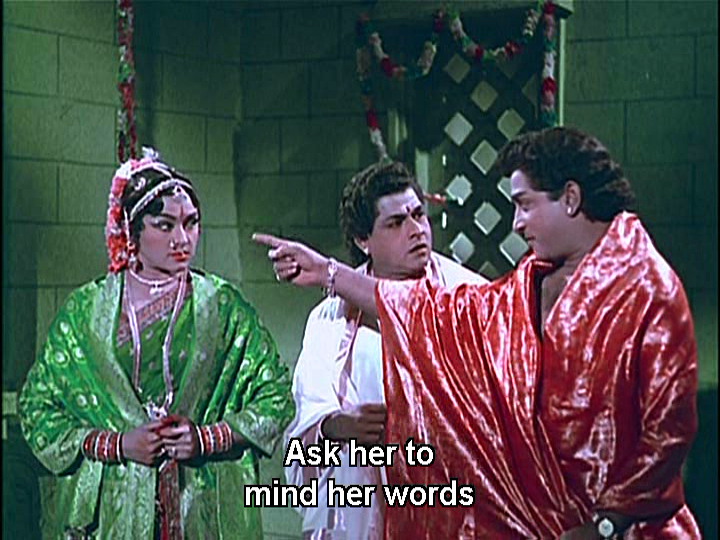
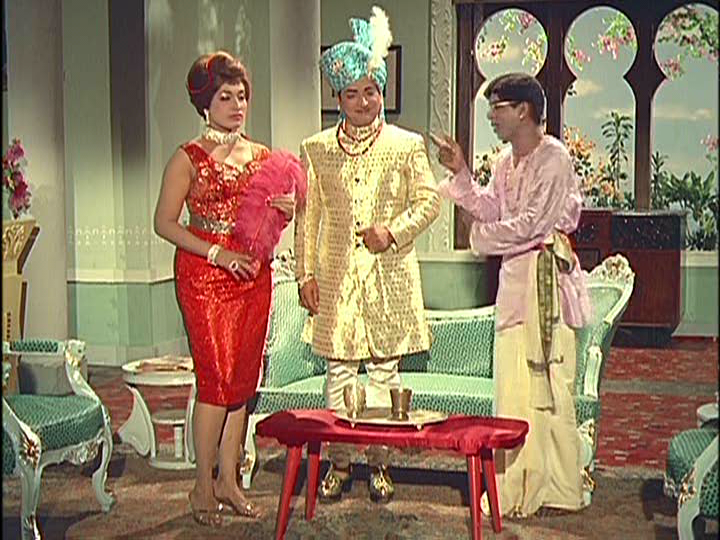
Padmini is Mohanambal, a beautiful and exceptionally talented bharatanatyam dancer. Sivaji Ganesan is the less beautiful but equally talented musician, nadaswaram player Sikkal Shanmughan. Crossing paths at a temple festival sparks fly between them but within minutes they go from this:

To this:

They challenge each other to a contest of dance versus music at some later date. So the stage is set for a fiery romance, riddled with misunderstanding, thwarted by pride and a meddling mother (Vadivambal, played by C.K. Saraswathi).

Mohana believes that dance is for everyone and for all occasions, inspired by the world around the dancer as well as a gift of god. Sikkal is more of a princess, demanding that his audience give him full attention and due reverence as he displays his gift. He believes art exists for god and for the artist. He refuses Mohana’s invitation to stay and watch her dance, but sneaks back later to see this.

There are some interesting observations on women in the performing arts and Mohana is certainly subject to some assumptions by men who desire her beauty and talent. Her mother seeks to ensure a wealthy man as her daughter’s protector or husband, but Mohana rejects all offers even before her feelings for Shanmughan are an issue. Nagalingam (K Balaji) is one thwarted suitor and a kidnapping attempt results in a comedy fight scene that I could have done without. I don’t quite get the undersized guy with stupid hair as instant hilarity, and there are two of them (double the fun?). This diversion means Mohana and her group catch the same train as Sikkal who has been waiting in the hopes they might turn up.

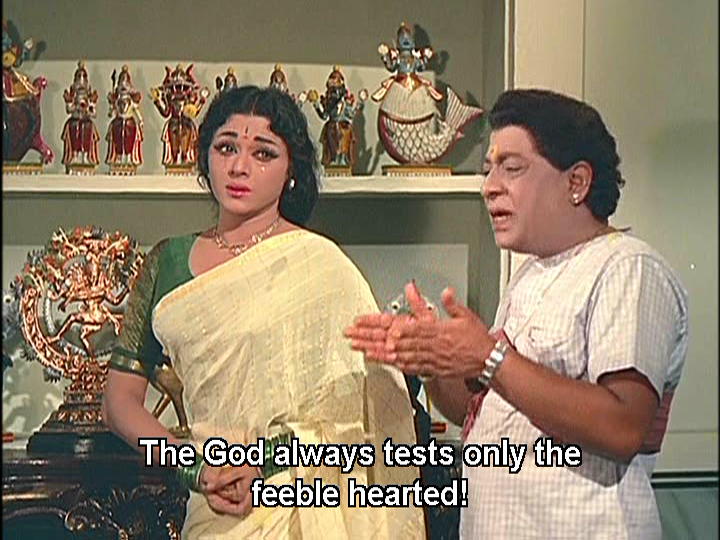
Padmini is gorgeous and her dance training is evident in her deportment and expressions as she uses all of her skill in conveying Mohana’s emotions. She also does an exceptionally good eyelash flutter. Sivaji is more old school theatrical, and lays it on almost as thick as his makeup. But his somewhat rubbery face is wonderfully expressive, especially his eyes, and he does have palpable chemistry with Padmini. There is a delightful scene of wordless communication and voiceover on the train journey that is funny, romantic and beautiful.

There is lots of sparring between the two and she is not the heroine to fall in love and lose her sense of self. I liked seeing a young lady who was a bit of a brat, very self-confident, and who felt no need to be apologetic. I don’t think I would enjoy her half as much in real life, but she did keep my attention in the film. And there was no suggestion that she should give up dancing to be a servant of Sikkal’s muse. She was a dancer and was valued for her gift.

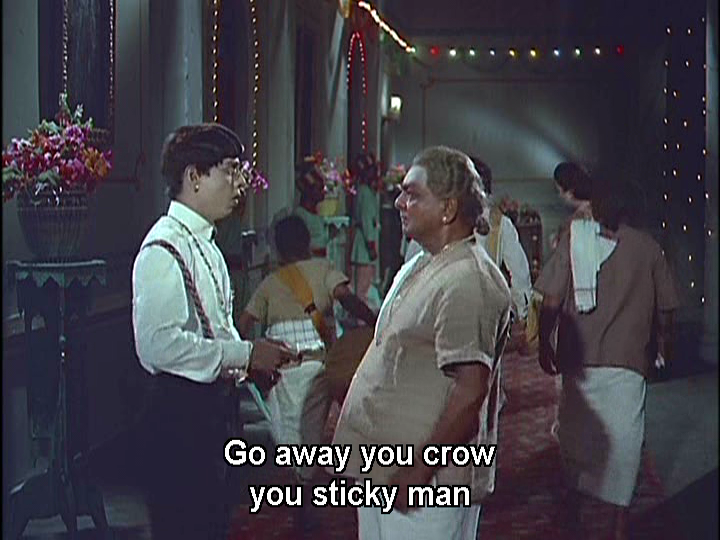
There are abundant comedy elements. Manorama is Jil Jil Ramamani, a folk dancer and girl of suspect virtue. Her ‘comic’ dances are strange, and perhaps the subtitle team decided to make sure we knew this was a modern film:

In addition to being the butt of many jokes, she does play a significant role at several points in the story. Manorama made her character both a caricature and quite sympathetic. I was left thinking Jil Jil understood herself and how others saw her, and she retained some dignity despite the silliness. Nagesh as Vaithy had a role that just irritated me. He is a Jerry Lewis kind of character, so if you like the style, you may have warmer feelings towards him than I do.

His presence extends the story with pranks and frauds, and a longwinded and obtuse approach to being a go-between. The supporting characters are pretty broadly drawn and usually played for comedic effect or buffoonery. There is some excellent face throughout.

There are pointed references to the issues of art versus money, the dedication of great artists and who owns art.  Sikkal storms out of a private party rather than be ‘owned’ by the landlord and plays an impromptu concert to the locals gathered outside. I particularly enjoy this face off where the classical versus modern question is settled judging by the smug expression on Sivaji’s face (wait for the white couple to turn up at about 4 min):

Mohana is pursued with increasing vigour by the landlord and the ensuing scenes are quite farcical. I was quite annoyed that Sikkal immediately assumed Mohana was playing him, without speaking to her or investigating. He just did the heroic leap to the conclusion that she was duplicitous and decided to feel sorry for himself. I might have been more tolerant of manly brooding in a more attractive character, but really I just wanted to slap him. He then departs to sulk with Jil Jil, now calling herself Rosarani, who owns a drama company. Word of this gets back to Mohana who knows about his misunderstanding but had hoped he might still be interested. Rather than giving up, judging or moping, she decides to confront him.

Jil Jil and Mohana show themselves to be more decisive and action oriented than many a filmi heroine. I have doubts over the subtitle translation of some of the relationships as people refer to the landlord wanting Mohana to live with him, but he is also referred to as a groom, there is mention of dowry and so on and he has a wife already. In one scene, Padmini begs him not to spoil both their lives and mentions women being enslaved by money. So I am guessing she would have been his mistress but perhaps the subtitle team decided to sanitise the arrangements. Regardless, her modesty and chastity helps to persuade the landlord to be a brother rather than a suitor.

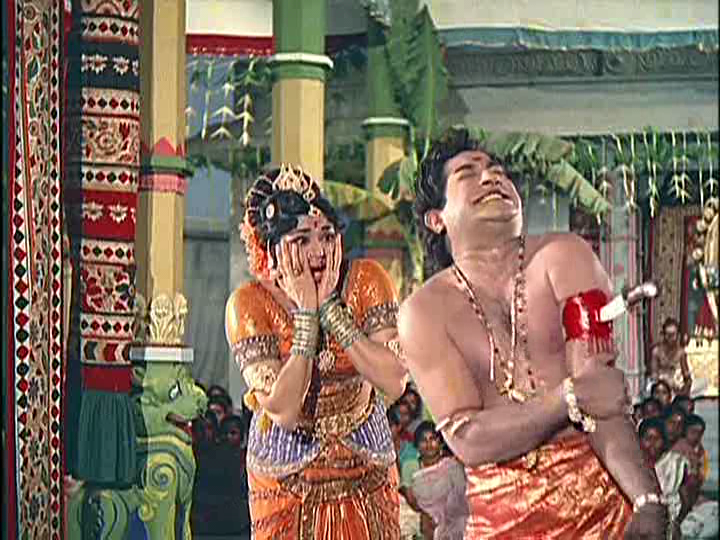
Mohana knew that the only way to keep Sikkal from leaving India with Jil Jil was to appeal to his artistic pride. The Thillana contest goes ahead. Nagalingam returns for skulduggery resulting in Sikkal taking a knife to the arm. Sivaji really milks the scene, thrashing around like a fish out of water for what seems like minutes. This injury prompts a further outbreak of overacting, and Sikkal gets another opportunity to feel sorry for himself again. Thanks to yet another smart competent woman (his nurse Mary) he begins to see that perhaps he has been a little narrow minded.

The finale is predictable but unravels over yet another complex scheme to sell Mohana, this time to a King. She defends herself, verbally and physically, and finds an ally in the very peculiarly accented Queen. Her chastity proves transformative once again, and the King decides to be a good husband.

Sikkal jumps to conclusions (yes, again!) and flings himself around chewing the scenery. This time Mohana has had enough and decides to resolve things. The climax is very filmi and over the top but the duelling diva personalities of the leads made it less unbelievable than it might have been.

This is such a pretty film. The ladies wear beautiful jewellery and costumes, there are lots of sparkly things, the temple locations and houses are lovely. It also has quite a timeless feel, with only a couple of scenes overtly placing the story in the late 1960s. The story is an overblown romantic melodrama but the theme of art and excellence gives the characters much more substance than I expected.  The female characters stand on their own feet, and have their own plans and desires. Padmini and Sivaji are exceptional and really made me care about their relationship even as their characters annoyed me sometimes. And of course, Padmini’s dancing alone makes this worth a look. Who won the contest you ask?  Art was the winner! 4 stars.

Nenu Naa Rakshasi

Did I like the film? Well, I wasn’t bored often (except for the comedy), I had plenty to think about, there are some good performances and the  first half is gripping. Puri Jagannadh has tried to frame an introspective psychological study in a mass thriller story, and ultimately fails, although he did set some interesting ideas in play. The issue of suicide is raised but left for us to make our own judgements for the most part. I appreciated the ambiguity that allowed for some viewer reflection instead of being hit over the head with one single message for the whole film. I disliked the final scenes which looked like they had been tacked on to change the overall tone of the story, but the pre-ending ending was lame too. So yes, yes I did like the film overall though there are clearly massive flaws and I am struggling to articulate why they didn’t quite outweigh the positives.

Abhi (Rana) is a hitman motivated by hospital bills for his mother. He is kind of geeky, a loner, and not at all a flawless killing machine. His story is told in an exposition to camera, giving his reasons for becoming a killer and his view of life and love. He isn’t ice cold homicidal perfection and I found this characterisation appealing.  He stresses when the police wander into a cafe, runs into trouble instead of away, acts impulsively when he could have waited for a better opportunity, that sort of thing. When the vengeance and coincidence kicks in, Abhi loses some of that humanity, increases in heroic unstoppability and becomes less believable. He sees Meenakshi (Ileana) and falls for her instantly, sparking some half-arsed stalking (in between kills) and an ‘MTV clip directed by John Woo’ fantasy.

She isn’t too bright if she can’t spot Rana following her in a crowd. Jeez!

Puri Jagannadh shows what Meenakshi does (she records video of people committing suicide and uploads it to Youtube) but doesn’t fully reveal why she does this until very late in the film (there are clear hints early). That was a miscalculation as I didn’t really connect with Meenakshi. In the psychological drama aspect this lack of character depth unbalanced the whole thing for me.

Superintendent Vikram (Subbaraju) and his young daughter move in across the hall from Abhi. I was quite alarmed by her being allowed to wander unsupervised into a stranger’s apartment, but whatever. They provide some emotional engagement for Abhi and some tension as the men become friendly, which is a bad idea for a hitman. Vikram is hunting the Youtube suicide film person as well as investigating the spate of shootings. Subbaraju plays it straight and gives a strong and energetic performance as the righteous cop and loving father. His investigations, together with a rowdy swearing revenge against Abhi, fuel the thriller aspect of the story.

Abhimanyu Singh is the batshit crazy villain who is just too insane and dysfunctional to be believed. He seemed to kill more of his own men than he did his intended victims and his twitchy and fey mannerisms were just hammy. He was so nuts he wasn’t really menacing and so it was all a bit underwhelming for me.

The first half is pretty punchy and l really enjoyed it. The second half loses that energy. For Abhi there is hope for a better tomorrow and he is looking for something to hold on to. Meenakshi on the other hand has disengaged from the world and withdrawn emotionally. They both understand the fragility of life but it motivates them in opposite directions. The Abhi/Meenakshi storyline in Venice detours into a meandering romance and the dramatic stuff happens mostly in India so it’s very uneven. By the time they reach the pretend Easter Island sculptures, the plot has been lost.

Rana is expressive but understated most of the time, and that suited Abhi’s character. His attraction to Meenakshi and his frustration with her is evident. His scenes with the kid next door are nice and the lighter moments are fun, plus his parade of silly walks in the Michael Jackson rip-off  inspired Padithnammo shows that he is prepared to make a goose of himself for our entertainment.

The actual dancing was restricted to a drunk song in Venice and in the club number with Mumaith. It’s not his strength but he isn’t completely unwatchably terrible and I would say he falls firmly into the ‘actors who try to dance’ category. He did look self conscious in a handful of scenes. Rana was very impressive in the action sequences as he is so imposing, and the fight choreography and filming was excellent. The hero entrance scene was great, and had all the visual trademarks I expect from Puri Jagannadh. Abhi supplemented his sharpshooting with some very handy knife and martial artsy skills apparently acquired during the interval so that was time well spent. The ladies in the audience all squealed when Rana said ‘I love you! Something something full package!’ I think they liked his package.

Ileana is beautiful, and certainly gave it her best in a couple of key scenes. She was far more impressive than in the recent Shakti. She plays Meenakshi as perfectly pleasant but distant for most of the film so there isn’t a lot to say about her performance. This is a spoiler–Meenakshi films someone who decides he wants to live after all, and asks her to help him get to a hospital. She refuses saying she is just there to video not to change the course of events and walks away, which was quite powerful. Later on it is revealed that she did indeed call for an ambulance so her actions were at odds with her stated beliefs and this is a problem with the character as I don’t think that was really explored or challenged. Her backstory when it eventually showed up was so clichéd and undermined what was a fairly original idea for a heroine. I also have a problem with her ninja scarf disguise which disguised nothing. Firstly, it left most of her face uncovered and secondly, how do we all recognise Ileana instantly? The hips.

Mumaith Khan appears on and off throughout the film, and really her only contribution was to make me think ‘Is she gonna?’ When she eventually danced, it was a standard club number but still fun (also notable for the silly hat team having their way with Rana). Her facial expressions are so much more lively and spontaneous when she dances than when she acts. Mind you, she was stuck in the comedy side plot with Ali and a plus sized lady of colour so she may well have been having suicidal thoughts of her own. I was.

It’s a very stylish film, lovely to look at but the team often use tricky angles and edits just because they can. There is good attention to detail in the wardrobe and set design, and the editing is excellent in the action scenes. The music is formulaic and more effective as a background score than in the songs. There is not one healthy romantic relationship in the film, and that may be deliberate but it seemed to be more an excuse for bad comedy or dubious behaviours in the name of love. Oh for a better script and more balanced direction!

I want to get this on DVD so I can see what I missed in the dialogues and to enjoy the beautifully executed action scenes. But I think I’ll stop before the end, and concentrate on the more successful crime drama aspect.