Sujata

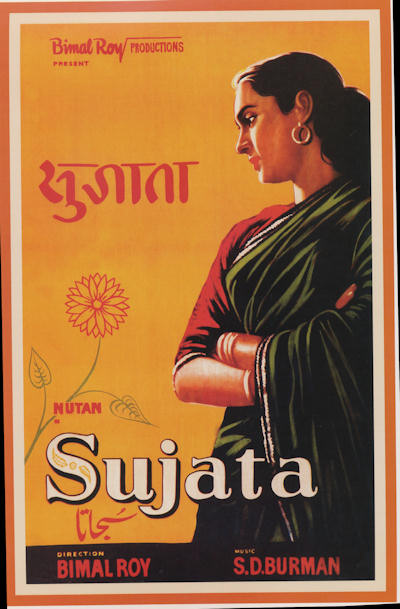
Bimal Roy’s 1959 Sujata is both a romance and a condemnation of the caste system, questioning what makes a family, and how we judge a person. Nutan and Sunil Dutt star, supported by Sulochana Latkar, Tarun Bose, Shashikala, and Lalita Pawar.
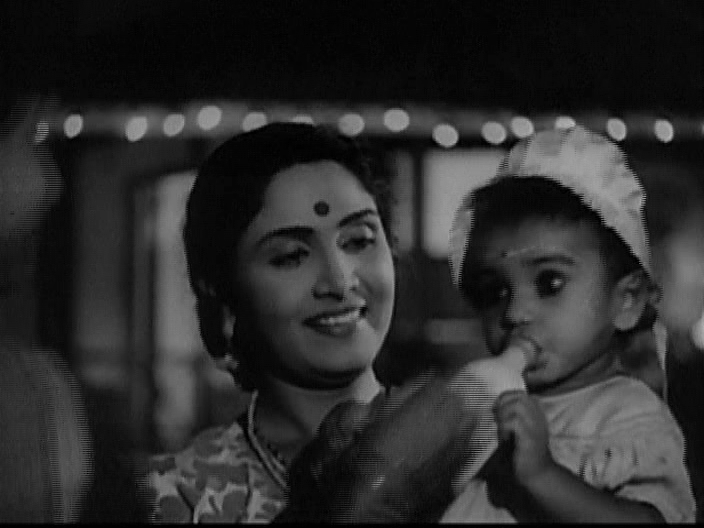
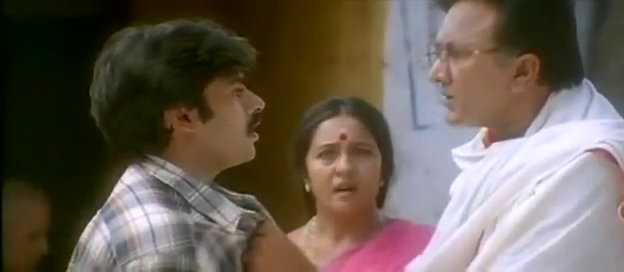
An orphaned baby girl is adopted by, or rather given to, a Brahmin couple on the same day as their baby daughter Rama’s first birthday party. The contrast could not be more marked. Rama is pampered and given the finest that her parents can afford while the baby is put in the maid’s room. The father, Upen (Tarun Bose), names the baby Sujata, a high caste name for an untouchable child. Charu (Sulochana) and Upen have their own struggles as caste rules clash with their growing affection for the little girl. They keep talking about sending her away to someone in her own community, and yet it never happens. Lalita Pawar as their Aunt Giridala is completely against keeping an untouchable in the household and demands they get rid of her.
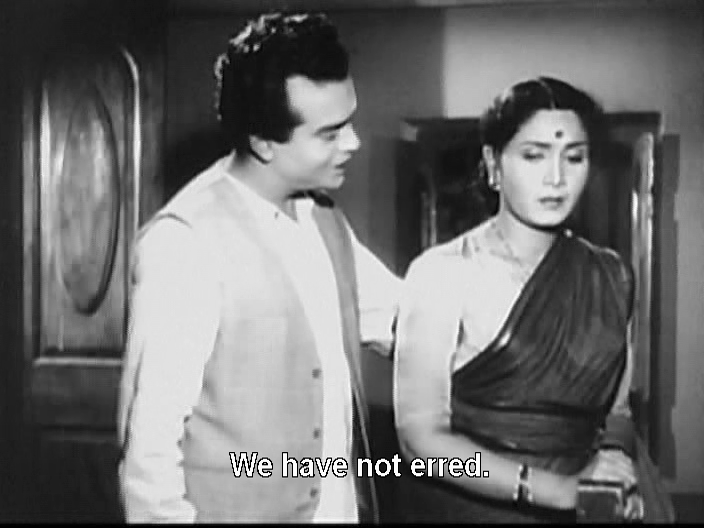
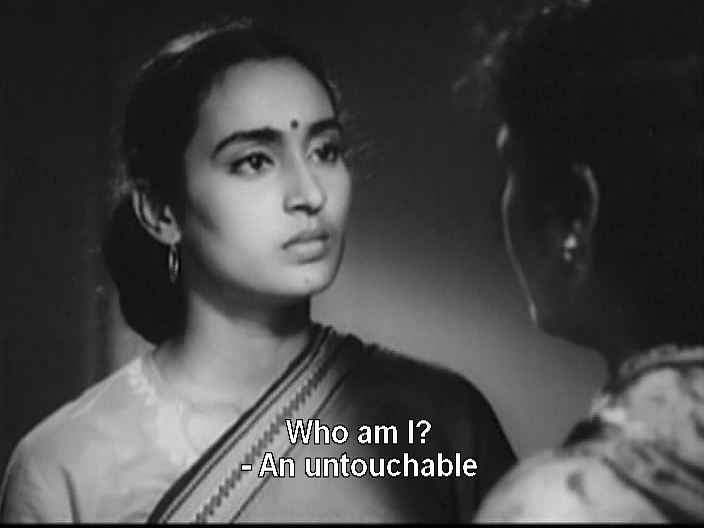
Upen and Charu relocate several times for his work, so are able to avoid the hard conversations for a while. Even so, Charu is ambivalent and often pushes Sujata away, never letting her forget that she is adopted. One day, she tells Sujata the truth – not only is she adopted, she is an untouchable. Predictably, Sujata is devastated.

While the caste issue is a focus, it is not what resonated most strongly with me. Perhaps it is that caste seems like such a backward social division to me.  Sujata’s relationship with her adoptive family was fascinating.  Regardless of the reasons for the emotional distance apparent at times, it had a strong effect on the young girl. Rama was educated and given pretty new things, had a big birthday party every year and was raised in an atmosphere of love and privilege. Sujata had to fight to learn to read and had no known birthday to celebrate, filling the role of housekeeper to be useful and a good daughter. Sujata yearns for her parents to love her but she is all too aware that she is not ‘good enough’.
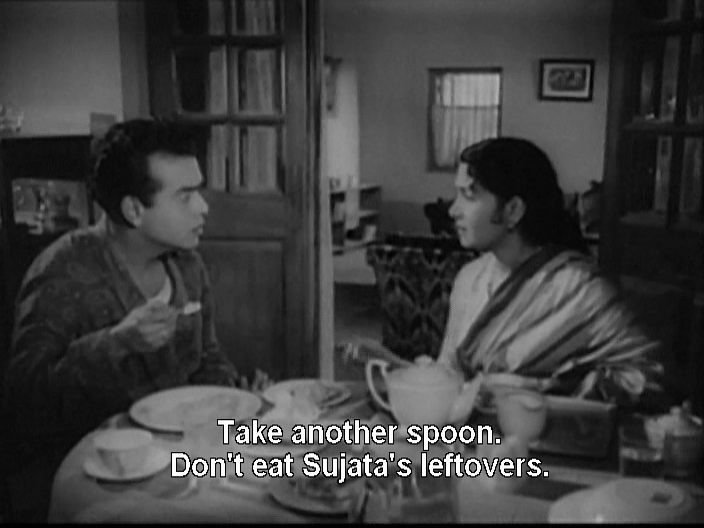
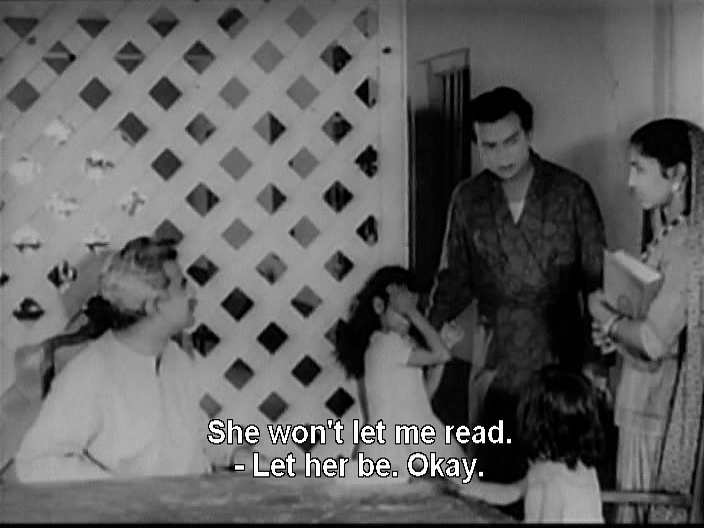
Sulochana is very good at showing the conflict Charu feels between doing what her Aunt says and following her instincts. Upen simply ignores any restrictions he doesn’t like, and little Sujata idolises him. Tarun Bose’s characterisation is sweet but Upen is a little weak or ineffectual when it counts. It tugged at my heart just a bit to see Sujata being kept at a distance and not understanding why. My parents gave short shrift to anyone who questioned whether I was really part of the family (yes, I had relatives who voiced reservations about adopting children).  Mum made it very clear I was theirs and anyone who said different was wrong. I can’t imagine growing up without that fierce maternal love as my foundation.

Meanwhile Sujata and Rama have grown up as sisters, fighting, squabbling and playing together. The little girls are played by Baby Farida as Rama and Baby Shobha as Sujata. Baby Shobha is excellent as the fiery little girl who adores her parents and can’t stand the idea of being separated from them. She keeps asking why she isn’t allowed to learn, why Charu won’t feed her with her own hands. It’s sad.  As Sujata grows up, now played by the radiant Nutan, a further complication emerges as she threatens to outshine Rama. Aunt Giridala keeps getting in Charu’s ear about how she needs to get rid of Sujata.

Grown up Rama (Shashikala) has modern attitudes and doesn’t care about Sujata’s origins. Rama sees all the good qualities in her big sister and includes her in all family events.

Rama seems to be blind to the gulf between Sujata and the rest of the family and I’m not sure whether that was naiveté or determination to ignore the discrimination. She knows her aunt wants her to marry Adhir (Sunil Dutt) but she sees he is interested in Sujata and gives their love room to develop. Shashikala is bubbly and fun, and makes Rama very likeable.
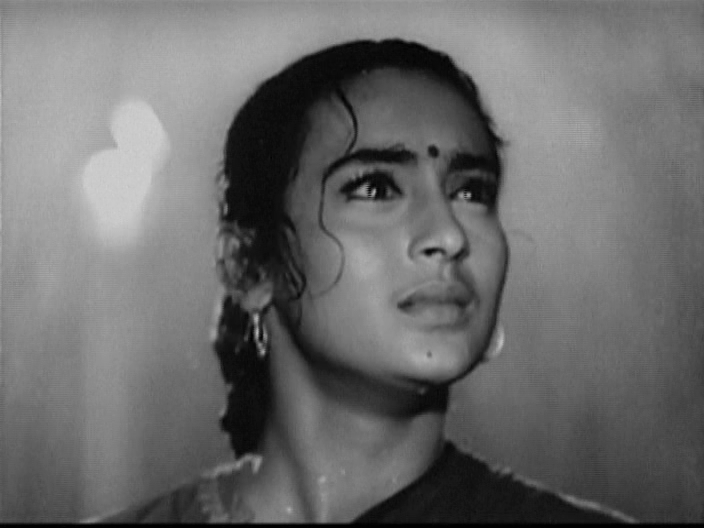
Nutan is just lovely. Because Sujata is often on the fringe of scenes, she has little dialogue and Nutan uses her beautifully expressive face and posture to show her feelings.

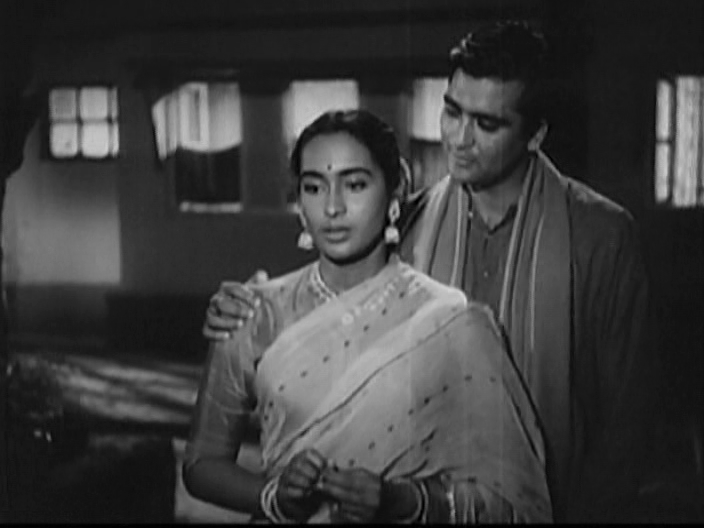
The thing Sujata wants to hear 1000 times is not Adhir saying “I love you” but Upen and Charu declaring “you are our daughter”. But having Adhir express a love that is just for her must have been amazing and intoxicating after craving acknowledgement and affection for so long. When he touches her, she shudders not in affront or with desire but with the sheer shock of being touched by another person. She does spend a huge amount of time crying, but her sadness is evident and I’d cry too if I had felt that my parents really didn’t love me and I didn’t belong. Sujata doesn’t expect anyone to fix things for her. She has some crises and chooses her next steps even as she knows her loyalty may not be rewarded.

Sunil Dutt is perfect as the charming and well bred Adhir, his clean cut good looks suited to the romantic ideal. His feelings develop slowly and he is deliberate yet not pushy. Adhir respects Sujata’s reticence although he doesn’t understand why she resists. Once he discovers her origins, he is clear that it makes no difference to him. The scenes between Sunil and Nutan have a delicate and intimate feeling, and they seem to act with each other rather than for the camera.

Adhir woos her over the phone in the lovely Jalte Hain Jiske Liye, trying to reassure Sujata that they can be together. I can see why she would be smitten!

S.D Burman’s music is used sparingly and the songs are tailored to the characters. Rama’s songs are jaunty upbeat Western infused, while Sujata tends towards the more lyrical. Often there is no background music or sound at all, sometimes just the sounds of birds or rain. Adding to that understated use of sound, emotions are mirrored in simple visual devices. When Sujata is overwhelmed, she switches off the light so she can hide herself in the shadows. When love strikes, Bimal Roy shows rain, leaves blowing in a gust – maybe showing that emotions are natural and not subject to man made rules. There are some charming visual effects when the child Sujata is told that she is going to visit a magical land (an orphanage) but by and large the characters speak for themselves.

I was moved by Sujata and found myself engrossed in the family drama. The resolution is so textbook filmi and yet profoundly satisfying as it destroys a few obstacles and hammers home the message. See it if you appreciate a melodrama with a social message and for the beautiful and restrained performance by Nutan. 4 ½ stars!

Jab Tak Hai Jaan

Jab Tak Haai Jaan is a slow, deliberate romance with lush visuals, improbable events and attractive people that persist in their beliefs long after a period of reflection and reconsideration is warranted. A typical Yash Raj film in many respects, with the notion that love is all you need, it sheds some of the YRF dated coyness when exploring a modern romantic relationship. Maybe it’s affection for the Yash Raj heyday or sadness for the recent passing of Yash Chopra, but despite some issues with the story, I found the style appealing and almost timeless.

Shah Rukh Khan is Samar Anand, an introverted bomb disposal expert who chases after death. Katrina Kaif is his first love, Meera, a rich girl caught between being dutiful and being happy. Anushka Sharma is Akira, the ambitious young journalist who stumbles across Samar and decides his story must be told. Samar’s early romance is revealed via a diary Akira finds. I really liked the way the plot was constructed initially but when the love stories intersect Aditya Chopra unleashes all the daft medical and action plot twists he could fit on what was left of the post-it note he wrote the screenplay on. But until that all started to unravel, I was caught up in wondering how it would be resolved and who would get the happily ever after ending.

In some respects Shah Rukh was more convincing as 28 year old livewire Samar than Katrina was as his 21 year old girlfriend. That is less evident in stills so I ascribe that more to his energy and performance than just makeup and styling. Samar was too good to be true as he navigated life in London and juggled multiple menial jobs, being everyone’s friend. But the floppy-haired puppy enthusiasm was punctuated with some sarcasm and smoulder that gave him more bite. Shah Rukh’s dancing in Ishq Shava exposed his weakness in current dance styles. I thought it could have been choreographed and shot better to support the illusion of his youth.

The 38 year old Samar in 2012 was a different man, and I could see why a bright young girl like Akira would be attracted to him. He was worlds away from her usual flighty boyfriends and had an intensity that matched her own drive. The stubble, rougher haircut and a more determined physicality made soldier Samar a more daunting and attractive presence. He portrayed the transition of a man in love from the first flush of hope to the cold anger of a passion denied. The romantic scenes between Meera and Samar are quite frank and acknowledge the physical relationship without being sleazy. There were many opportunities for Shah Rukh to overact and he took very few of them. Samar is a perfectly unreal hero but Shah Rukh puts the heart in his character.

Katrina was disappointing after some good performances in recent films, and lacked warmth and expression. I could understand Meera’s character but rarely felt much for her. Meera and Samar were very convincing as the newly in love who imagine they are too cute for words but are actually a bit sickening to everyone around them. They lived in a bubble of romantic fantasy. Katrina as the 10 years older Meera was more effective as her reserved demeanour and greater fabric to skin ratio gave her more substance. Her decision making was still flaky and for someone who is supposed to have such a strong religious affiliation her lying to Samar was questionable. I was raised a Catholic so the idea of giving up something to show God you meant business is quite familiar. While I don’t share the belief I could recognise it as something people I know do as a matter of course. Only not to such a filmi extreme.

Anushka was let down by some truly stupid behaviour by her character but leaving that aside, her acting was excellent. Her warmth and rapport with SRK was lovely. They had some nice scenes talking about love and what it meant to them, and a believable affection developed between Akira and Samar. She spends time following Samar about on his work – defusing bombs! as if! – and of course she falls for him. Akira was a modern city girl with a career on her mind and not a chiffon sari in sight. I did wish she would wear more appropriate clothes in some scenes as she seemed to live in micro-shorts regardless of climate or custom. Mind you, Anushka has the legs for it. As the ‘other woman’ corner of the triangle, Anushka gave Akira a real sense of possibility, of being a viable alternative to the past love in Samar’s life. She spoke up for what she wanted in life and love.

The final section of the film is loaded with so much improbable melodrama and outright WTFery that the love story is swamped. I don’t want to get too spoilery but can anyone imagine a scenario in which a suspected bomb is found in London and a brown skinned man muttering about Semtex and fuses is allowed to casually wander in and assist the police? The drama could have been heightened without all the silliness and sidetracks.

The supporting cast occupy so little of the story that if you don’t take to the Big 3, there is little respite. Rishi and Neetu play small but important roles, and Akira has a fun fanclub of soldiers in the Bomb Disposal Squad. Anupam Kher is mercifully restrained as Meera’s dad.

The scenery in Ladakh and Kashmir is superb and one of the reasons I would recommend a big screen viewing of this film. London is presented as a beautiful and slightly magical city, the perfect backdrop for a fairytale love. There are nods to YRF classics that enhance the vintage filmi mood and it’s all a bit dreamlike.

Musically this is a bit disappointing but I think that is more to do with the placement and the picturisations than the actual songs by AR Rahman. Saans is reprised several times (happy as I am to gaze at SRK in a wet t shirt, or less) and Heer was a non-event. There is little dancing, and what there is lacks good choreography (or suitable dancers). I just don’t think a ra-ra skirt or a silly hat compensates for not doing the steps justice.

I must be getting nostalgic in my old age. Despite all the faults I found much to sink into and enjoy in Jab Tak Hai Jaan. See it for a charismatic and committed performance from Shah Rukh, the bright and beautiful Anushka and the lavish visuals. Do stay for the tribute to Yash Chopra over the closing credits.

Heather says: I’m a Shahrukh fan, so of course I was going to enjoy Jab Tak Hai Jaan no matter how ridiculous the plot, but what surprised me was just how much I absolutely loved it! Sure, there were problems with the story, mainly due to the dodgy medicine and bomb defusing Temple mentioned, but Yash Chopra really did have a gift for displaying human emotions and portraying love as a grand and enduring passion without forgetting that love can also be small, petty and selfish. The classic Yash Chopra motifs are here; a love triangle of sorts, separation and sacrifice and that’s what makes it come together so well for me.  Of course it helps that Shahrukh was back on form with effortless transitions between the happy and jovial Samar during his relationship with Meera and the more silent, reflective and stoic soldier when he meets Akira. The little flashbacks to his previous character with the occasional joke work perfectly and his chemistry with Anushka was great.  Not so with Katrina who was stiff and wooden despite the promise of the earlier scenes.  I don’t think either her styling or the character helped, but she just wasn’t convincing as Meera and she’s another actress I’ve added to my ‘must not be allowed to cry in a film’ list!  Anushka on the other hand was scintillating and looked incredibly beautiful. Her life and energy was infectious and her part of the story (apart from some dodgy Discovery Channel moments) worked very well.

As Temple says, the film looks magnificent is worth watching for the scenes in Ladakh and Kashmir alone. But more than that, there are solid performances and a return to classic Bollywood romance that can’t help but enchant. Sadly it is the end of an era, but with Jab Tak Hai Jaan, Yash Chopra has proved that he really was the ‘King of Romance”.

Tholi Prema

Tholi Prema was strongly recommended by several hardcore Pawan Kalyan fans. If it gets the most enthusiastic film fans in the world hopping with excitement, I knew I had to watch it. It is not quite what I expected from a 90s romance, and mostly it’s a very nice film. Karunakaran let a couple of vaguely sensible ideas creep into all the filminess, and I really enjoyed the way some of the situations play out.

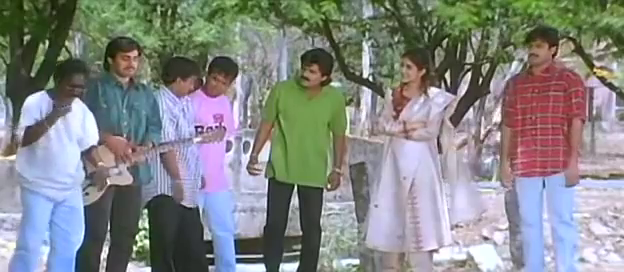
Pawan Kalyan stars as Balu, an underachiever who seems a bit adrift. He doesn’t live up to his parents’ high hopes and lacks motivation in his academic life. Balu and his father clash time and time again, and there is an unsettled and acrimonious atmosphere at his home. This forces him to spend more time with a group of friends that includes Ali and Venu Madhav. Balu has no trouble being assertive and a leader outside of his home, but he has no standing within his family. He is a decent guy, but just hasn’t quite got himself sorted and relies too much on his uncle (Nagesh) to sort things out for him.

Keerthi Reddy is Anu, the girl Balu falls instantly in love with. She is first seen hopping and clapping on the side of the road in the traditional filmi ‘escaped mental patient’ style. I liked her in Arjun and she is good here as the too perfect to be real rich girl but her role is mostly about looking fair and rather vapid. Anu has good intentions that manifest in ditzy ways. She believes ordinary people who do good should be celebrated so chases them around to get their autographs as though they were celebrities, and she also plays Santa for some homeless kids. Nice ideas but the execution makes her look flaky. Anu has big dreams for her career and study, and isn’t looking to marry any time soon. She wants to win a Nobel Prize!

Balu is looking for her because of her beauty and she is looking for him because he saved a child (in a very stupid traffic incident) and she sees him as a hero. There are near misses, a very dramatic incident and far too much advice from the comedy gang. But once Anu and Balu meet, the characters got a bit more interesting.

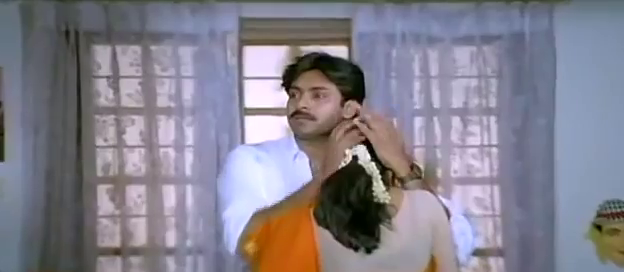
Balu is the hero so he does his share of beating up wrongdoers and righteous speechifying. But he is also a little vulnerable and I found him quite likeable. He doesn’t throw his weight around all the time, and he is easily disconcerted by quick witted cousin Priya. Pawan Kalyan looks a tad too mature for the undergrad Balu, but he is very convincing in his swings between diffidence and a more energised and confident state. He can work up a good smoulder as well as a very impressive sad puppy face. He has the Mega family eyes after all! But it’s not simply a matter of the hero claiming his ‘reward’ and he does bring a bit more nuance to Balu than I was expecting. The story plays out in both full blown melodrama and some sweetly sensible dialogues.

Priya (Vasuki) tells Balu to get to know Anu before he proposes. Radical, I know! She also points out that stalking a girl is creepy and not a good tactic as it means the girl is unaware she is in a relationship. And the sensible advice and decisions don’t stop there. When Balu writes a message in blood, another favourite of filmi heroes, Anu is as mad as all get out. She can’t understand why anyone would do that, and tells him so. The boys all fluctuate between moping listlessly and having the vapours when they so much as see their intended, so in some respects they are more like the traditional romance heroine.

Having said that, the notion that a girl is obliged to accept a guy who declares love for her is firmly in place. There are several examples of female characters succumbing to the man’s ‘honesty’ or ‘love’ regardless of whether they had ever exchanged three words in person. The biggest disappointment was in the way Priya’s story was resolved. Having seen how disturbed Balu was by his unrequited love, she couldn’t bear to reject someone who would feel the same pain. So she, giver of sensible relationship advice, married a colleague out of pity. It didn’t fit with someone who was determined enough to live away from home to complete her medical studies in a more conducive atmosphere. And while Anu and Balu were a bit more sensible, Balu showed little sign of applying himself to any form of work, study or career plan. The male characters mostly assumed that they could be useless, as the women would look after them. I think the female characters were getting a raw deal in being lumbered with these manchild types, but True Love is supposed to make everything right, isn’t it?

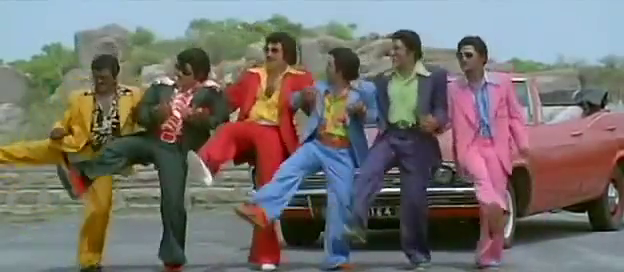
Most of Balu’s songs are picturesque montages of him wandering lost and lovelorn or behaving foolishly under the influence of daydreams. And he does all that very well. His dream sequences are really something! The opening disco sequence was hilarious and very peculiar. And there is a colourful vintage tribute. Deva’s music is pleasant, if heavily derivative at times, and matches the mood of the scenes. I enjoyed the light hearted mood in this song, mostly because he looks as though he snuck into big brother Chiru’s dress-up box to put the outfits together. And also because of the Ricky Martin ‘influence’.

Ali and Venu Madhav seem to be less irritating in films with Pawan Kalyan. I don’t know whether that is because he takes on some of the comedy himself so they are more contained, or that they often play characters with a purpose. I could still do without them, but I didn’t have my usual allergic reaction. The comedy is often broad and relies on slide whistle, poking fun at stereotypes and cheesy visual tricks. Narra Venkateswara Rao is Balu’s dad and he is a very unsympathetic character for most of the film. But he and Balu share a really soppy moment that was quite sweet, and a little unexpected. Nagesh is fun as the uncle and Sangeetha as the patient but passive mother makes up the rest of the major support roles.

I think every single character cries for most of the last 20 minutes. Luckily the resolution was left to Balu and Anu and the ending was quite satisfying (despite my reservations about Balu ever growing up).

I liked Tholi Prema for the way it took a slightly different path through the romance clichés. There are nice scenes between family members and with Anu, Balu and Priya that added real humour and emotion. I like Pawan Kalyan but if you’re not familiar with his films, this might be a good place to start for people who don’t enjoy the action genre. 3 ½ stars!