Another year, another Megabirthday just around the corner! We’ll be celebrating things Chiru related during August and of course you’re invited.
Pop over to the Facebook page *points at link on righthand side of page* and vote for one of the topics I’ll be writing about, or leave your ideas in the comments. Current suggestions (courtesy of Liz and Katherine) are:
Chiranjeevi’s cowboy years
The many hues of Chiru – a study in colour (but how to pick just one colour?)
Chiranjeevi the Serious Actor
Join in by posting on your own blog, let me know, and I’ll collate and publish the links. Or just watch for the #megabirthday2014 hashtag on Twitter and have a chat about all things Chiru. Like this.
If your eyes still work after the 2m 44s mark, check out those boots! And those moves.
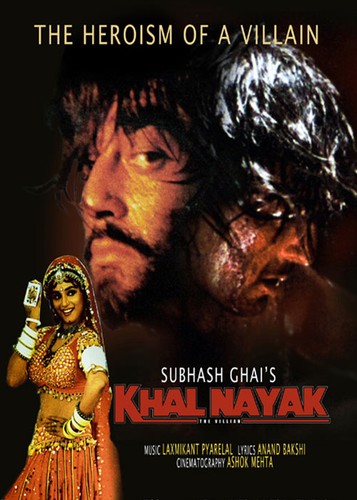
Subhash Ghai’s Khalnayak is a fairly predictable cops and robbers story twined with references to the Ramayana which adds depth and resonance. There are some excellent performances, stylish visuals and excellent music. But at a shade over 3 hours, the pace is stately to the point of plodding and there is too much emphasis on the meaning, and not quite enough on the drama.
Ram (Jackie Shroff) is assigned a case to bring down a terrorist organisation. Ballu (Sanjay Dutt) is the poster boy for Roshida’s (Pramod Muthu) gang. When Ballu escapes from jail, Ram is accused of neglecting his duty to go spend time with his girlfriend Ganga (Madhuri Dixit). When what looks like every policeman in India is put on Ballus’ trail with no success, Ganga finds a way to infiltrate the gang. She sees that Ballu is not quite as bad as he seems, although he is far from being misunderstood. Eventually the police close in, and Ganga is caught between Ram, duty, and her empathy with Ballu.
Madhuri looks stunning and delivers a strong and engaging characterisation. There is nothing simpering or weak about prison officer Ganga. When she sees an opportunity to help Ram restore his reputation, she asks for his support. Then she does it anyway. When she sees Ballu needs medical help, she just goes and gets a doctor because it is the right thing to do. Madhuri does some wonderful deliberately bad acting when Ganga, having captivated Ballu, joins the gang and goes on the run.
Then in Aaja Sajan Aaja she is simply incandescent as she dances for her Ram. Madhuri was also lucky as Ganga dresses in Indian attire, not the hideous synthetic 80s gear that Ballu wears when he tries to impress.
Sanjay Dutt is so very good in some scenes that it makes me angry at how bad he is for much of the film. He adopted a range of bizarre grimaces and physical tics that I think were meant to emphasise the animal side of Ballu, but just made him look ridiculous and clumsy. When he dropped the exaggerated mannerisms and just channelled the emotions, he was compelling and raw. While asserting his ownership of Ganga, Ballu accidentally defends democracy and becomes a Nayak for those people. His awakening to being respected and enjoying that feeling was nicely done, even though there was a lot of literal flag waving to make sure the point didn’t escape unnoticed.
Jackie Shroff is perfectly competent as Ram, and only tries to tear his clothes off once so that was good. For my money Ram is the least interesting character. He knows he is right, everyone knows he is right and he is not averse to using extreme force against Ballu to prove how right he is. While there is an interesting dynamic between hero and villain, there is minimal character development for Ram. A relationship between Ganga and Ballu would be a Very Bad Idea but I thought marrying Ram could be a bit suffocating.
The Ramayana elements were more obvious to me on a recent re-watch than when I first saw it, particularly the twists on that narrative. I couldn’t help but compare this with Mani Ratnam’s Raavanan (which I greatly prefer to the Hindi Raavan). In Raavanan, Ram revealed his darker side and could become as Ravana but Khal Nayak seems to say rather that Ravana has the potential to be Rama. I liked that the question of what makes a hero or a villain was articulated and that this was more than a glorification of Rama. Ganga didn’t sway from her beliefs when she was frightened, and kept her faith in Ram. Ram wanted to believe Ganga but society and the law demanded she was still put to trial. I was annoyed that she had to have her virtue validated by a thief and murderer, a man so despicable in the eyes of the law that he had besmirched her just by his proximity but whose word was still worth more than hers. I know she is Sita and he is Ravana, but still. The film plays with some of the conventions especially around the notion of hero and villain. Ram is also helped by Ballu’s testimony, his reputation restored by the hand of a sinner.
Ghai doesn’t quite go the whole hog but he does use a range of staple masala ingredients and has a lush visual style. Ram and Ballu have bloody fights that crash through walls and take to the treetops. There are long lost childhood friends and dreary paeans to motherhood. There are coincidences, speechifying and tearful reconciliations galore. The evil mastermind Roshida has a nasty disposition and lots of cats who do a fabulous job of reacting to stuff.
Rakhee gets a lot of screen time as Arti, not all of it crying. Neena Gupta makes an impression as the striking Champa. Ramya Krishnan is charismatic as Ballu’s girlfriend Sophia, and also gets both versions of the title song. What a waste to have her in such a small role, but how great to have so many powerful actresses in one film. The female characters are strong and quite distinct, but Subhash Ghai stays firmly within the conventions of 90s masala so none of them break the mould of Ma, the friend, bad girl etc. Oh, and Anupam Kher does his customary shtick as Pandey the prison warden.
There are interesting observations about the conventions of parenting and filial behaviour. Ganga tries to evoke Ballu’s sentimental side by talking wistfully of how much he must love his Ma and how hard it must be for him to live on the run. He calls Ganga out on trying to manipulate him through sentiment, but he rejects that as unimportant to him. Question – If a villain shouts ‘Ma!’ in his sleep and there is no one to hear it, does he have feelings?
Mind you, when Ballu is beating Ram up because why not, Arti hits Ballu for assaulting Ram, Ballu shoves her so Ram belts him for hitting a Ma, then Ballu fights back and Arti comes back at him to stop him using violence. A move straight out of the Nirupa Roy Filmi Ma Manual.
The songs are extensions or amplifications of the narrative as well as being beautiful and usually pleasingly melodic.
I am not so fond of that title track, although it does epitomise early 90s style and Ramya Krishnan works that beaded gear for all it’s worth.
I had to pity choreographer Saroj Khan. Between Dutt’s own ‘dance’ style and the outfit given to Ballu in the final song, he looked more like a demented fruitbat. Seeing Ballu and the boys try their seductive dance moves on Ganga was highly amusing. But she choreographed some beautiful dances for Madhuri. I went to see the Temptations Reloaded show up in Sydney last year, and the roof nearly came off when the opening bars of Choli Ke Peeche played.
The first hour of the film could be condensed to around 20 minutes with no great loss, but things get much more interesting once events are set in motion. While it is a visually strong and often darkly dramatic film, the pace suffers from Ghai’s concentration on symbols and stylised elements rather than closely following the emotional arcs of the characters. Very much worth watching, but some patience is required. 3 ½ stars!
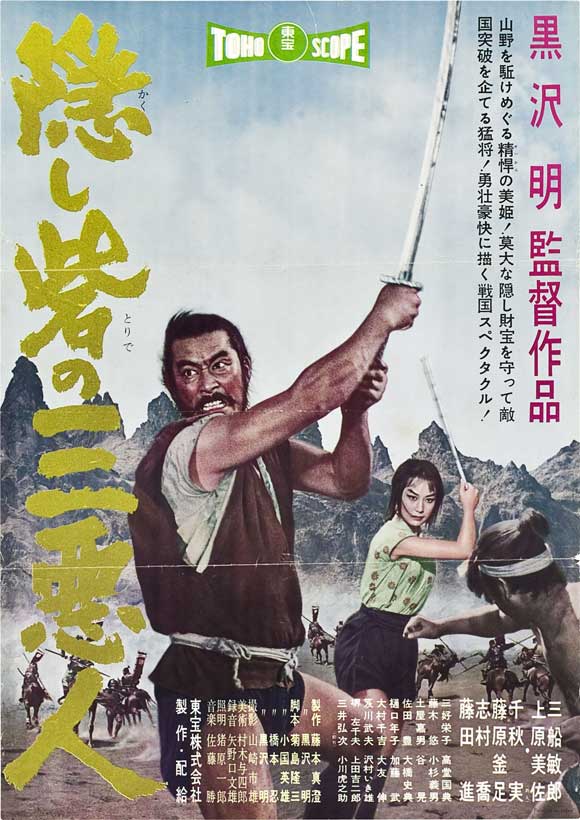
Akira Kurosawa’s story can be summed up simply. Two greedy peasants are persuaded with the promise of reward to escort a man and woman across the border and smuggle a load of gold hidden inside firewood. However, they do not realize that their companions are actually a princess and her general and that the gold is intended to help Princess Yuki rebuild her clan. There is action and humour, greed meets idealism, relationships are tested and altered, and everyone learns a little along the way.
Hidden Fortress (or Kakushi-toride no san-akunin) is cited as one of the inspirations for Star Wars, and there are numerous comparison reels and articles available online if you want to learn more. While that was one of the reasons I first saw the film some years ago, it isn’t what I remember it for. This is an action packed adventure with great characters, a ripping yarn told with a splash of verve and wit. Just my cup of tea.
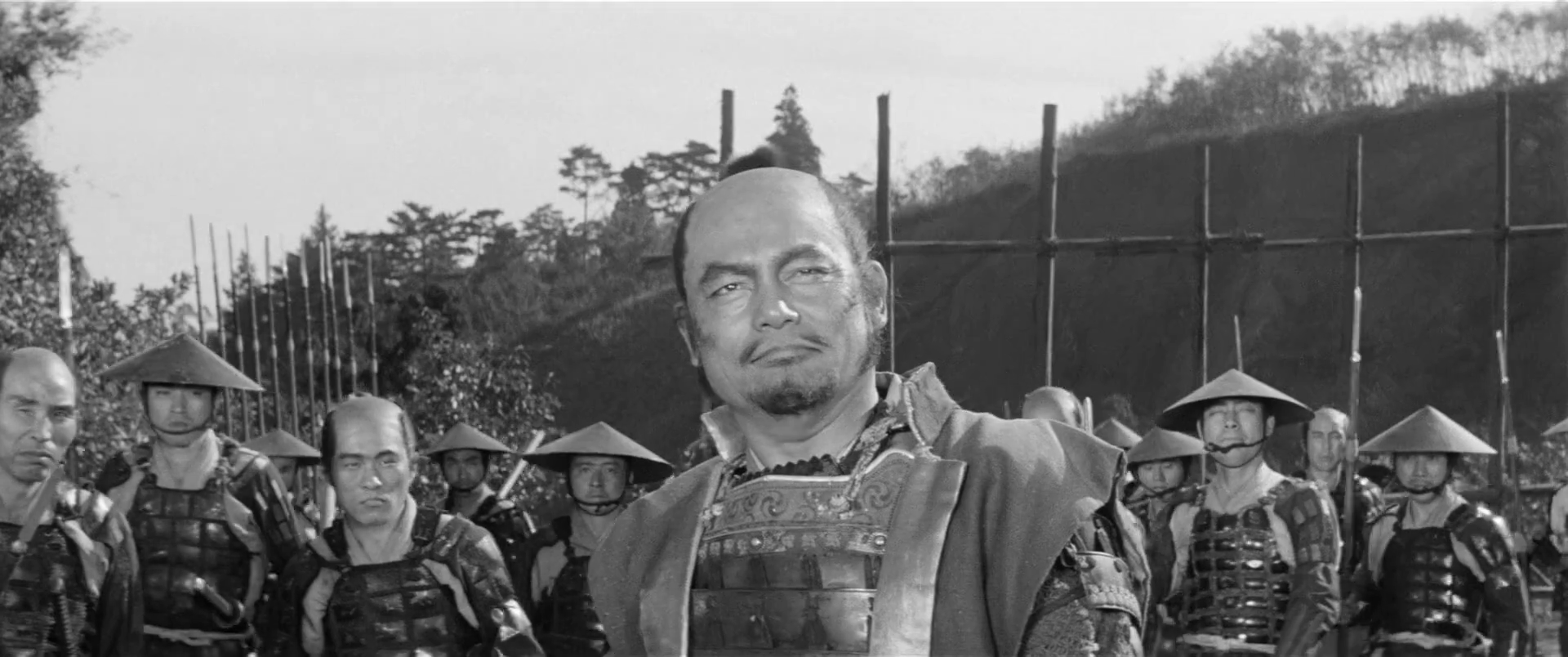
Hidden Fortress was also Kurosawa’s first film using the then new widescreen technology and he makes the most of his locations and staging. Using grand outdoor sets to bring a sense of realism to the background, plus Kurosawa’s own exceptional editing skills, this is almost an immersive viewing experience with nothing to break the sense of watching history unfolding. There is something about seeing a vast crowd of extras in a battle scene and knowing they were all real people, not CGI additions. It makes the epic seem even more so. In fact the camera shakes a little in a mass prison break scene, presumably from the vibration of hundreds of men running down the stairs. Kurosawa (and his cinemataographer Kazuo Yamasaki) can swoop from wide expanses and grandeur down to the small personal moments easily overlooked and forgotten.
On another level, the film may also be an ode to Toshiro Mifune’s thighs. Despite wearing the Edo period equivalent of shorty short shorts, General Rokuroto Makabe is an imperious leader of men. He tracks peasants who stumbled over some of the Akizuki clan gold and cons them into helping him. He torments them, seeing them as weak and venal with none of the ideology or purpose befitting a true warrior. But he comes to value their street smarts and knack for self-preservation. Mifune is a charismatic actor with a robust presence. He turns in a well judged performance in a film that provides a great showcase for his charismatic alpha male persona. His horseback chase and subsequent duel is wildly suspenseful, with the camera barely able to keep up, yet you know Rokuroto will win because he just looks invincible. And seeing the general participate in a fire festival dance with dour determination to pass for a local peasant having fun was amusing.
Misa Uehara is Princess Yuki, a feisty princess in disguise trying to survive and rebuild her family’s domain. For some reason this disguise also involves short shorts but nothing too unladylike. She appears to be unfeeling but is keenly aware of the sacrifices that her people have made and the burden that places on her. Another character says of her that she is more masculine than she is a girl, and she is certainly more competent and independent than many a movie damsel in distress was ever allowed to be. Although fleeing for her life, Yuki also gets to experience the real world for the first time in her 16 years and she finds it quite enchanting when she can put her cares aside.
She sees good and bad in people, observes poverty and other social woes. She is generally cool and decisive but doesn’t lack empathy so I found her interesting and sympathetic. I wondered whether her decisiveness was a sign of great leadership or just typically teenaged black and white thinking, but generally Yuki does the right thing. Yuki wins people’s loyalty as they believe they can trust in her integrity and not just because she has Rokuroto Makabe and his sword at her disposal. Uehara’s timing and reactions are excellent, especially in scenes where Yuki is pretending to be a mute. Apart from being limiting to an actor, that also places the character in extra jeopardy as she is limited in her ability to respond without breaking her cover. Her dancing at the festival was an expression of joy and release, an affirmation of the strength that could come if she survived the fire.
The story is largely told through the squabbling peasants Tahei (Minoru Chiaki)and Matashichi (Kamatari Fujiwara). They are repellent and a little endearing by turn. They roam through the post war landscape complaining bitterly that they didn’t get to make a profit despite all their (alleged) hard work. They seem to have no loyalty or principles beyond making a buck and will turn on each other at the drop of a hat. While these Everymen bring a lot of the comedy to the film they also provide the contrast between rarefied aristocratic living and a more dog eat dog perspective. The first time they see Yuki, they follow thinking a girl alone in the forest would be easy. Later on the journey, despite now knowing her as a travelling companion, they see Yuki asleep and draw lots for who should go for a walk and let the other one rape her first. When the chips are down, they cling to each other and eventually see the bigger picture. Given that most of their dialogue is moaning and crying, both actors do well to give their characters such vivid and distinct personalities. I didn’t mind seeing them suffer, but I would have wielded the editing scissors a little more in their direction.
Susumu Fujita has a small but significant role as Hyoe Tadokoro, an old adversary of Rokoruto Makabe. His wry expression conveys volumes as he squares up against a respected foe and tries to face down the blazing indignation of Yuki.
I was thrilled to see this included in ACMI’s recent Samurai Cinema program and to have the opportunity to see it on a big screen for the first time. It is a tale of derring-do, the grand visuals still place the human element at the forefront and the characters are easy to invest in. Well, maybe not the comedy peasants so much. 4 ½ stars!





 Cinema Chaat