Simple Agi Ondh Love Story

Simple Agi Ondh Love Story

The story of Simple Agi Ondh Love Story is one familiar from a number of Hollywood romances, but it gets a new treatment here from director Suni. He’s stuck to a minimal cast and limited shooting locations but included riddle-like dialogues and snappy comebacks to add interest to the screenplay. The film describes a romance between Kushal (Rakshit Shetty) and Kushi (Shwetha Srivatsav) with the narrative taking place one wet monsoon day when the two first meet. It’s a slow-paced film which does drag somewhat in the middle, but is redeemed by a good beginning and an excellent ending. Not a film for everyone perhaps, but worth a look as an example of new, independent cinema in Karnataka that seems to be just a little bit quirky.

The film starts with an RJ Rachna (Rachana) telling her audience a story about her brother Kushal. He is off to Kodagu area in Coorg to meet Rachna’s fiancé’s sister Ithihasini. The hope is that a romance might blossom between the two since Rachna feels she cannot go ahead and get married while her brother is still unattached. I cannot imagine that her listeners would have been in any way interested in the story, particularly since she annoyingly starts each sentence with ‘Actually…’, but as a method of introducing the actors it works well. Kushal directs advertising films and is also a keen photographer, so his interest is drawn when he sees a girl out in the monsoon rain taking photographs. Naturally when he turns up at the house to meet Ithihasini, she turns out to be the girl he has seen in the rain, and just to keep the clichés going he immediately decides then and there that he has found the girl for him. However unusually then the two are left to their own devices for most of the rest of the film. Rachna has called Ithihasini to let her know that Kushal will be there, but the rest of the family have gone to visit a temple for the weekend, leaving Ithihasini to entertain Kushal by herself.

There is a lot of fast banter between the two as Ithihasini quizzes Kushal about his reasons for wanting to meet her and Kushal tries to get past Ithihasini’s evasions when asked about herself. The dialogues often seem in the form of brain-teasers, or maybe they appear as strange questions due to the subtitling, but Suni seems to mix old-fashioned similes and sayings with modern speech giving a rather more unusual dialogue. It sometimes makes the interactions between the two difficult to understand and I found I had to pause the film to re-read some of the subtitles to get a clearer sense of what the characters were trying to say.

As a way to get to know each other, the two share their previous love stories, which are shown in the form of flashback episodes. However the same actors play the roles of each other’s previous partners in these flashbacks which backfires to some extent as the film becomes monotone and flat as a result. There is little differentiation between the characters as they are themselves and their appearance as the ‘ex’. Although there is some attempt to make them at least appear different – Jarin for example has long hair (complete with manband) and a beard compared to Kushal’s short hair and shaven chin, the personalities appear identical and the dialogue retains the riddle pattern, adding to the similarity. The love stories themselves are also rather dull, although the dialogue is often quite funny and the few songs do help lift the mood. However, by the end of the flashback sequences Kushal seems a bit of a wimp and Ithihasini appears even more immature and irritating than before.

Ithihasini’s actions seem a little odd and her responses to Kushal’s questions all avoid direct answers so it’s not really a surprise when Kushal’s sister calls to tell him that the girl he has been spending time with is not Ithihasini at all. When confronted the fake Ithihasini comes up with a number of different stories, but Kushal finds her even more intriguing as a result and declares his love for her despite not knowing who she actually is, although he does finally discover her real name is Kushi.

The final part of the film is better, adding suspense with the mystery around Kushi and the reasons for her confusing actions. The end has a surprising twist and makes up for the dreary middle section, particularly as both actors finally begin to react more to each other in a more natural way. There is genuine emotion and the overly complicated dialogue is replaced by more spontaneous sounding exchange. The different approach gives the ending more impact and made me wish there had been more of this honesty and emotion earlier in the film.

For new actors, Rakshit Shetty and Shwetha Srivatsav do a good job with their roles, particularly given that the action focuses solely on just them for most of the film. Shwetha’s Kushi is particularly irritating at times, which I think is the whole point, and does provide a good contrast to Rakshit’s more sensible Kushal. Shwetha does however come into her own into the last scene and also has some great facial expressions throughout the film. Rakshit has a little more to work with earlier in the film and is also excellent in those moments where he has to show more emotion. Although most of the film is shot in the same house with the ever-present monsoon, cinematographer Manohar Joshi captures the different moods of the rain and the subtle changes in lighting well. There is also a good contrast in the romance between Kushi and Jarin which is set on the beach in the summer and is a pleasant change from all the rain.

What I like about Simple Agi Ondh Love Story is that’s an attempt at something a bit different. The decision to use minimal locations and only a few actors may possibly have been driven by budget considerations, but it does keep the story simple and focus attention on the dialogue. A little more editing in the flashback sequences would have helped but overall I enjoyed the romance and liked the characters. Simple Agi Ondh Love Story is an unusual style of film that is definitely worth a watch provided you are a fan of the romance genre and don’t mind a minimalist approach. 3 stars.

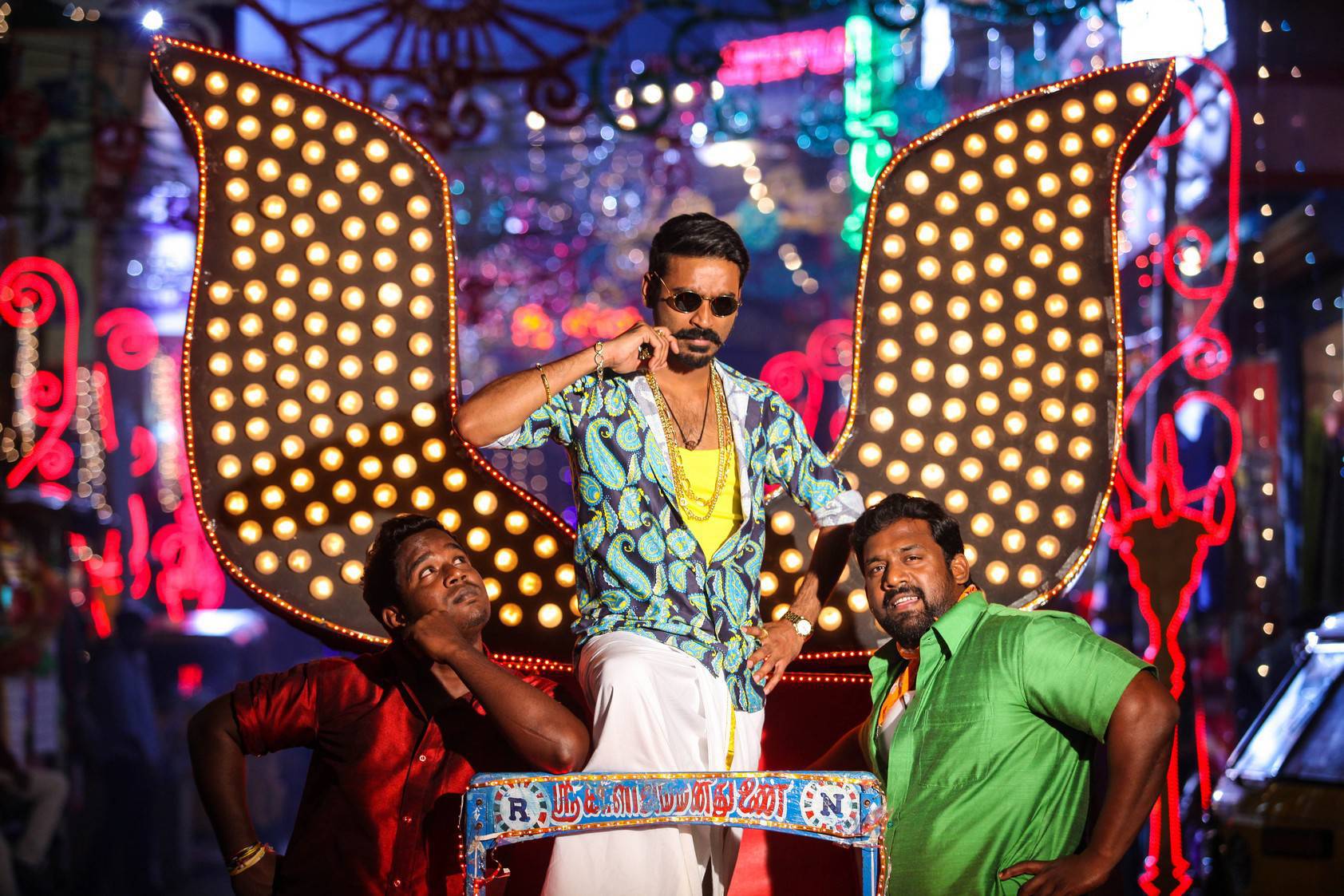
Maari (2015)

Maari

After watching the trailer for Maari I nearly give the film a miss, as apart from the obvious draw of Dhanush in a collection of garish shirts the film didn’t really look like my cup of tea. How wrong could I be! Maari may be a standard mass story at heart, but Balaji Mohan has thrown in a number of good ideas that, along with the star presence of Dhanush, deliver a film better than expected. There are a few misses, including a lacklustre heroine and a relatively uninspiring final fight scene but overall Maari is an easy and often very funny watch.

Maari

Maari (Dhanush) is a small time gangster who works for a local don based somewhere in Triplicane, Chennai. Along with his small gang of Sanikilamai (Robo Shankar) and Adithangi (Kalloori Vinoth), Maari extorts money from the shopkeepers in his area, forces people to dance for his entertainment and generally throws his rather insubstantial weight around. As a result everyone in the area hates Maari and his gang, so when a new sub-inspector (Vijay Yesudas) moves into the police station his attempts to arrest Maari seem to be the perfect solution for the area. There is a rumour that Maari was involved in the murder of another gangster some eight years previously and SI Arjun is determined to find a way to prove Maari’s guilt and lock him up for good.

But of course it’s not as simple as that, and once Maari is arrested the locals suddenly find out why they might have been better to stick with the devil they knew. It all ends up, as such things must, with much biffo and a few dodgy CGI effects, but thankfully Maari remains true to himself and is still the same unredeemed petty gangster at the end.

Dhanush plays Maari with plenty of swagger, bravado and a rather impressive moustache. In classic gangster ishtyle he mainly walks in slow-mo with his own personal wind machine for those moments when it’s essential to have a breeze wafting his perfectly styled hair around. Add to that those wonderfully loud shirts, a pristine white lungi, small round sunglasses and a truly terrible chain-smoking habit to make up the classic Tamil gangster package. Of course like every true gangster there has to be a chink in his armour somewhere and for Maari it’s pigeons – he’s a fanatical pigeon racer and the death of one of his pigeons is apparently the reason for his rumoured foray into murder a few years ago.

However there is more to Balaji Mohan’s gangster than first appears and he gives Maari a characterisation that is not particularly deep but does break away from the typical Tamil hero. The first indication occurs when Maari first sees Sridevi (Kajal Agarwal) who has just moved in to the area with her family to open a boutique. The action goes on around Maari as he stares at Sridevi while music swells in the background, and I fully expected there to be the usual ‘love at first sight’, bad guy reformed by good girl storyline. But instead the music stops and Maari threatens to slap Sridevi for her disrespect for him, moving into full extortion mode rather than anything even vaguely lover-like. There is none of the stalking as love aspect either – Maari is only interested in Sridevi as a source of income and even when she starts to help feed his pigeons in an effort to make him fall in love with her he is very reluctant to get involved. He even points out in an evening discussion with Sridevi that he is a safe guy to be around as “real men don’t rape”. It might be a blatant attempt to appeal to the female audience, but this scene got a round of applause from the packed house in Melbourne with even the fanboys in the front row adding their approval.

Sadly Sridevi is a more confused character. She hates Maari for his interference in her boutique but while her attempts at revenge are in character, her later change of heart is rather insipid. I’m not sure who dubbed for Kajal but the voice doesn’t match her appearance although that may be as I’m more used to seeing her in Telugu films. Kajal seems to almost sleep-walk through the part too and there is little energy in her performance with absolutely no chemistry between the lead pair. How is that even possible when Dhanush is at his charming best? Thankfully however the relationship between Maari and the members of his gang more than makes up for the lack of any romance. Robo Shankar is excellent as the wing-man for Dhanush and he mostly has the best comedy lines while Kalloori Vinoth makes an impression in a small role.  Kaali Venkat is good in his role as a police officer and the other actors playing Velu and ‘Bird’ Ravi are solid in these roles. Vijay Yesudas is an unusual choice of villain for a Tamil gangster film, but I found his portrayal of a corrupt and slimy personality quite appropriate and he did a good job in the role. It’s another one of those little departures away from more usual characterisations in commercial films and I appreciate Balaji Mohan’s attempt to do something a little different.

The film looks good with plenty of colour although there aren’t as many full-out dance numbers as I expected. A little disappointing since Dhanush is such a good dancer. Still Anirudh Ravichander’s songs fit well into the storyline, even if at times his background music is rather too loud and distracting.

Maari isn’t a perfect film by any means – the fight scenes aren’t particularly inspiring and the story wanders a little too much – but it’s still an entertaining blend of comedy and action that allows Dhanush full rein to express his ‘bad’ side. I fully enjoyed it and if you’re in the mood for mass masala that has the added benefit of fine performances from Dhanush and Robo Shankar, Maari is definitely well worth a watch.

Ustad Hotel

Ustad Hotel poster

After watching the excellent Bangalore Days I was on the lookout for more from writer/director Anjali Menon and director Anwar Rasheed, and luckily found their previous co-venture Ustad Hotel lurking in my pile of ‘to-be-watched’ DVD’s.  The other drawcard pushing this up the list was the appearance of Dulquer Salmaan, who has impressed so far in every performance I’ve seen and seems to have the knack of picking a good script. And once again, the combination does not disappoint. Ustad Hotel is a gem of a film and fully deserves the many accolades and awards received, including its three National Film Awards in 2012. The story is simple but beautifully executed with stunning cinematography and excellent performances from the whole cast. It’s a real feast for the senses given that most of the film revolves around food and cooking, so probably best not to watch on an empty stomach!

The film tells the story of Faizal (Dulquer Salmaan), commonly called Faizi, and the path he takes to find his true place in life. Along the way we see details of his different relationships – with his four sisters, his father and most importantly with his grandfather, the owner of the Ustad Hotel.

Faizi’s story starts before he is born when his father Abdul Razaq (Siddique) and mother Fareeda (Praveena) are expecting their first child. Abdul’s confidence that the baby will be a boy and his disappointment when this child, and the next three are all girls, sets our expectations for a typically traditional family and in the main this is what we get. By the time Faizi is finally born, his ambitious father has already planned out his son’s life, which leaves little room for what Faizi himself actually wants. Luckily Faizi has his four sisters who bring him up after their mother dies and seem to have his best interests at heart. His sisters know that he is training to be a chef in Switzerland while his father thinks he is studying for an MBA, but they aren’t impressed by his European girlfriend or by his plans to work in London. As a result they conspire to bring him back to India, but still keep his father in the dark about Faizi’s true plans.

At the same time Abdul has arranged a bride visit for Faizi as soon as he steps off the plane, but things don’t go well when Faizi tells his intended bride Shahana (Nithya Menon) of his intention to work as a chef. Faizi’s furious father confiscates his passport and in desperation Faizi turns to his grandfather Kareem (Thilakan) who runs a small beachside restaurant in Kozhikode.

Kareem acts as a mentor to Faizi and teaches him not only how to cook his famous biriyani, but also how to care for a business, including his workers, and the general community around him. The obvious respect which Kareem receives from everyone from his staff and customers, to the chef in the five-star hotel nearby, makes Faizi realise that there is more to his grandfather than he previously realised. Everyone sees him as Kareem’s grandson and that defines his place in a way that has never been so clear before.  The story is well crafted and the relationship between the two is beautifully developed as Kareem starts by making Faizi a general helper and gradually allows him to develop his cooking skills while ensuring he gains a more mature outlook on life.

Thilakan is perfect as Kareem and he is the glue that holds the story together. There is a twinkle in his eye as he describes running off with the bride from a wedding where he was employed to cook, and the wistful delight with which he describes watching rain in the desert is pitched just right. He has a number of maxims he lives by, including that every meal should feed the mind as well as the stomach and every glass of sulaimani should contain a little bit of love. With these simple words and by ensuring his workers all have extra funds should they need it, Kareem teaches Faizi how to be a good person, not just a good cook. He is a man who lives his life with no regrets and has compassion for all, which makes him the ideal mentor for Faizi.

Dulquer is also excellent, and while the role of a trendy young NRI returning to India may be straightforward, his Faizi does appear to be genuinely at a crossroads.  He imbues his character with plenty of charm but also gives Faizi an element of confusion and bewilderment that fits his indecision perfectly. Dulquer and Thilakan share wonderful chemistry and their relationship comes across as very genuine – the respected elder and the young apprentice both in the film and presumably also in real life given that this is only Dulquer’s second film. Mamukkoya also deserves special mention in his role as Ummar, Kareem’s manager and almost another member of the family. He is very natural in the role and his conversations with Kareem about Faizi are exactly what you would expect from an old and trusted employee asked to give his opinion on the wayward young member of the family.

Nithya Menon appears as the love interest for Faizi and her Shahana is an interesting character. At one moment she is wearing a burka and conforming to the demands of her rather strict family, but in the next she steals out and is singing in a rock band and wearing Western clothes. Nithya Menon is as wonderful as ever and even in her limited time onscreen she makes an impression, but I really would have liked to see a little more of her in the second half.

While Faizi deals with the repercussions of defying his father, he gets a job at the five-star hotel next door and has a chance to use his training to cook more Western style dishes, or ‘oag cosin’ as my subtitles call it! There is a plot to drive Kareem out of the hotel and close down the Ustad Hotel and finally Faizi makes a trip to Madurai to see just how cooking with love should be carried out. It all ties together perhaps a little too neatly at the end but it’s hard to complain when it’s all done so well with S Lokanathan’s stunning cinematography ensuring each scene looks perfect.

Ustad Hotel is a film that flows beautifully, blending adept characterisations, a heart-warming story and traditional Keralan cuisine into a very tasty dish indeed. There are a few quibbles; Faizi’s Western girlfriend is horribly stereotyped and the second half could have been a little shorter without losing too much of the story. The romance between Faizi and Shahana seems to go from awkwardness after her initial rejection to a friendly relationship well, but the jump to romance seems to happen off camera as the two are suddenly an item without any further development of their relationship. However these are small points in an otherwise excellent film. Well worth watching for Dulquer, Thilakan and Nithya along with all the glorious shots of food. 4 ½ stars.