Tirugu Leni Manishi (1981)

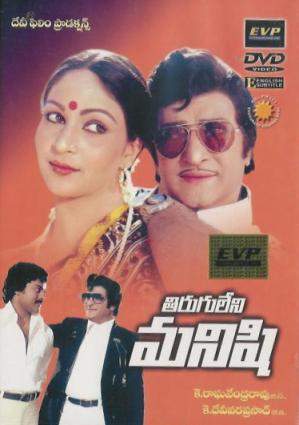
Tirugu Leni Manishi poster

The early eighties gave us so much in India cinema – psychedelic titles, crazy costumes, extreme décor and disco to name but a few – and they all turn up in Thirugu Leni Manishi! Chiranjeevi shares the limelight here with none other than N.T. Rama Rao and as far as I can find out seems to be the only film where they appeared together. Providing excellent support are Rati Agnihoti, Jayalakshmi and Jaggayya, with the unexpected pleasure of Bob Christo who pops up towards the end of the film.

Some of those amazing titles.

And almost immediately afterwards Chiru is introduced as up and coming singing sensation Kishore Kumar.

Oh yes!

Naturally Padma (Jayalakshmi) is seduced by Kishore’s smooth skills with a guitar and his excellent prancing prowess. Padma is the daughter of multimillionaire Sasibhushan Rao (Jaggayya) so it’s pretty much guaranteed that the romance is going to be an uphill battle. Raja (N.T. Rama Rao) is Sasibhushan’s son and in a nice contrast to Chiru’s tight trousers, Raja has a collection of very wide flares teamed with natty multi-coloured shirts, as befitting a successful lawyer and young man about the town. I’m not sure why they decided to portray Raja as a newly qualified young lawyer as he does look more his real age for most of the film, although no more so than watching an ageing Clint Eastwood or Jack Nicholson playing a younger hero in Hollywood, but as he has plenty of energy and dashes around saving everyone in sight his youthful on-screen age doesn’t really matter.

Sasibhushan has no intention of allowing his daughter to be married to a penniless singer and instead arranges Padma’s marriage to the son of one of his rich friends. Padma follows standard filmi heroine behaviour and decides to commit suicide as that’s much easier than standing up to her father or even running away with Kishore. Well, it is the Eighties after all, and she does make sure to call her brother and explain in precise detail exactly what she is doing.

Raja turns up in the nick of time to save Padma and decides to get her married to Kishore despite his father’s orders. At the same time, Raja keeps running into a con man (Allu Ramalingaiah) and his niece Seeta (Rati Agnihoti).To begin with Rama tries to turn Seeta over to the police, but when he realises she’s a good person struggling to makes ends meet as she looks after her dead sister’s children, he has a change of heart and gives her a job instead.

Naturally the two get to dance together so that Raja can have his love story too.

Things turn darker once Raja discovers his father was involved with a criminal gang of smugglers and even worse when he finds out that Kishore has been corrupted by the same gang. In an attempt to live up to Sasibhushan’s standards for his daughter, Kishore became involved with the gang as a way to make a lot of money quickly but soon realises the error of his ways. As Sashibhushan is murdered and Kishore’s son kidnapped things quickly come to a head leading to Raja and Kishore teaming up to overcome the gang.

N.T.Rama Rao is the man who no-one can oppose of the title. He is successful in court, in love and in rehabilitating Ramudu and Seeta so naturally it falls to him to deal with the smuggling gang once he discovers their activities. While N.T Rama Rao is the out and out hero, Chiranjeevi has a more shaded and probably the more interesting role to play. His singer is initially carefree and very much the man in love, but as he struggles to win over Padma’s father, his pride and determination to give her the life she has been used to lead to his downfall. Chiru excels as a man under pressure especially when his child is kidnapped to force him to comply with the smuggler’s orders. Although most of the film is relatively light-hearted, the scenes where Kishore struggles with his conscience are much darker and a tribute to his acting skills to be able to pull such a character off without derailing the story.

The cast are all excellent and K. Raghavendra Rao ensures that each plays to their strengths. N.T Rama Rao is charming and debonair as Raja but does get the chance to beat up the bad guys and indulge in a few disguises too, while Chiranjeevi starts off very cool and groovy but changes into a conscientious husband and father – at least until his secret dealing catch up with him and he has to fight to win back his son. Jayalakshmi doesn’t have too much to do after she falls in love with Kishore, but Seeta gets a chance to dress up and fight against the smugglers, and does a good job of it too. Chiru and N.T.Rama Rao still get the most dazzling costumes though!

The film is amazingly colourful and cinematographer K.S. Prakash goes for some interesting angles and unusual framing to keep everything looking sharp too. The decor in Sasibhushan’s house is incredibly lavish, but much more to my taste is a totally awesome lamp on Raja’s desk, and I love the Village People poster on the wall of Kishore’s living room . Naturally the smuggling gang also have style, and their hideout features a number of gigantic masks on the wall, while their criminal mastermind (Satyanarayana) has two large china cat statues on either side of his chair. The giant birdcage where they stow Kishore’s son for safe keeping is perhaps just a tad over the top though!

Thirugu Leni Manishi has a more complex storyline than I was expecting and is a lot more fun too. Chiranjeevi is in his element as a flamboyant singer and his shift to family man and gang member is beautifully done, while N. T. Rama Rao is a solid and righteous hero who knows how to make things right. It’s fantastic to see the two together and the film is definitely well worth watching for that alone although the costumes, décor and screenplay are awesome added bonuses. Drama, action, comedy, Chiru and NTR all add up to an excellent film and one that shouldn’t be missed. 4 stars.
Karvva (2016)

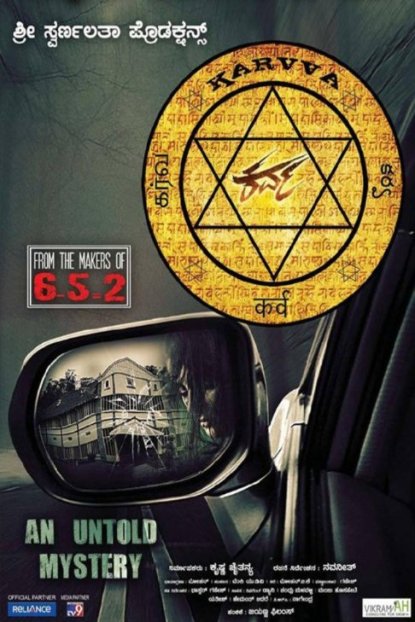
Karvva poster

Karvva released earlier this year in India, and we finally got a chance to see the film here in Melbourne last weekend. I’m not usually a fan of horror films but the blurb about Karvva suggested that it was a combination thriller/ghost story, so I ventured out to the cinema in the hope that it may be another RangiTaranga. However Karvva turned out to be a fairly formulaic and not particularly frightening (or even thrilling) film, but despite the inevitability of the storyline there are a few good features that make it worth a one-time watch.

The film is a mix of two separate but related stories, one based on a documentary film crew out to debunk a rumour about a haunted house and the other recounting the kidnap of a rich businessman’s daughter. The connection between the two is the house; is a classic ‘renovator’s delight/fixer-upper’ mansion located somewhere in the Karnataka countryside.

When an NRI attempts to sell his ancestral property he finds that it has a nasty reputation as a haunted house, and in an attempt to improve his chances of a sale he enlists the help of a documentary filmmaker specialising in investigations of supernatural events. The TV crew has some kind of spiritual advisor and a boffin with a machine that measures ghost activity so obviously they’re the right people for the job. However despite all their gadgets and scepticism, the TV crew find more than they bargained for in the abandoned house which lives up to its reputation. Naturally they have to wait for an auspicious time to go back and try to exorcise the spirit which leaves the scene set for the next reckless visitors to the mansion.

The second part of the story focuses on Thilak, a spoilt, rich kid who lives the high life but who is brought down to earth when he loses a lot of money at a casino. He tries to get some money out of his father (Devaraj) by pretending he needs cash for a business deal, but his father decides that enough is enough and refuses to bail Thilak out. Anisha Ambrose is Thilak’s sister, who tries to persuade her dad to cough up some money for her brother, but before she can achieve very much she is kidnapped and a ransom note sent to Devaraj. The kidnappers choose Thilak to deliver the ransom money and the directions he follows take him to an abandoned mansion somewhere in the Karnataka countryside. Yes – this is the same Raja bungalow that we’ve already seen is haunted by a vengeful ghost, but Thilak is only concerned about finding his sister and isn’t too concerned by his surroundings. He also approaches the house from the back which looks much less creepy and isn’t quite as festooned with cobwebs as the front of the house either.

Events conspire to leave Thilak, his sister and three friends stuck in the house overnight. As the ectoplasm starts to swirl and the friends find out the history behind Raja bungalow it’s clear that they’re not going to have a peaceful night and indeed may not even last until morning.

The basic plot is a fairly standard ghost story but there are a few twists, particularly in the second half which make the film more interesting. Unfortunately, although the visual effects are good, each even remotely spooky moment is accompanied by loud screechy music and distorted screams that quickly remove any suspense from the scene. There are numerous points where one of the characters is shown from behind with the suggestion that someone (i.e. the ghost) is creeping up behind them. It would have been so much more effective to cut out all the noise altogether, or even go for some slightly more clichéd breathing rather than the loud cacophony that occurs every time someone turns their back on the camera. More effective are the shots where a vague figure appears when the lights go out, and where there are half seen flickers in the periphery, but as the film goes on the effects get more and more obvious and subsequently less and less frightening. The inclusion of a comedy track of sorts with Vijay Chendur reduces any suspense that might have built up with the initial ghostly effects while the loud soundtrack and OTT make-up towards the end mean that the final scenes are funnier than I think they were meant to be.

The actors are occasionally overshadowed by the effects, but Thilak is fine as the sceptical and stalwart hero of the hour. Mostly he just has to ignore all the odd happenings and boldly go forward to investigate the latest black-out, noise or other unusual occurrence, but he does so with a reasonable amount of attitude and is good at the end when everything is explained. However RJ Rohith as one of Thilak’s friends is rather wooden and inexpressive although some of this may be due to his rather dour character, which doesn’t give him scope to do much else. Anisha Ambrose and Anu Poovamma are both good and escape the usual fate of female characters in a horror movie by being braver than seems plausible, while Vijay Chendur is funnier than expected and makes an impact despite only having a short time on-screen.

Navaneeth wrote and directed the film and there are some good ideas in there, even if the ghost story and horror element is somewhat formulaic. The NRI desperate to sell his house works well and there are some satisfyingly scary moments with the TV crew as they search for clues. The initial kidnap scenes are also well thought out and the events when the friends first find themselves stuck in the house are effectively written. However as the horror part of the story kicks in the film starts to lose its novelty and the final explanation can even be partly anticipated given the events of the night in Raja bungalow. Still, the cinematography by Mohan is excellent, there are a few good spooky scenes and I like that the female characters are braver than some of the men! Worth watching for the set-up in the first half, the twists in the second and a good performance from Thilak Shekar.

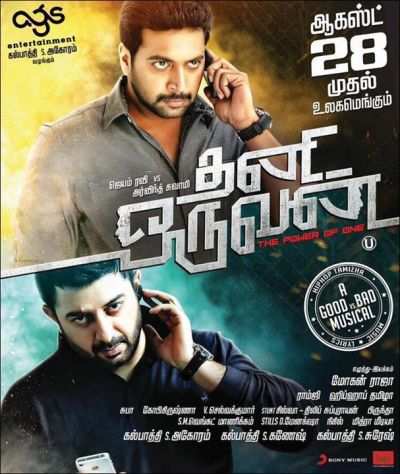
Thani Oruvan

thani-oruvan.jpg

Thani Oruvan pits a dedicated police officer against a corrupt scientist in psychological thriller that has plenty of drama and action. The writing collaboration between director Mohan Raja and Subha results in a cleverly plotted story with some unexpected twists, but the real success lies in the detailed development of the two main characters. Neither is completely black or white, although the shades of grey are relatively muted, while the cat and mouse relationship between the two provides good structure to the film. Excellent performances from the whole team but particularly Arvind Swamy as the villain of the piece ensure that Thani Oruvan is a better than average police drama and one that’s well worth a watch.

You know a film is going to be pretty epic when the story starts with a dramatic birth. Sengalvarayan (Thambi Ramaiah) is a party man through and through to the point where it’s more important to him that he ties flags for his leader’s appearance rather than take his heavily pregnant wife to hospital. The leader senses an opportunity for some good publicity and sure enough, the baby is born in the back seat of the politician’s car leading Sengalvarayan and his new son Pazhani to develop a relationship with the man who will later become Chief Minister (Nassar). The significance of these events doesn’t become apparent until later on but they provide an instantly intriguing start to the film.

After the dramatic opening, the story moves to a group of young police officers in training and their vigilante-style activities against the local criminal community. Despite the group’s best efforts, the crooks never stay in jail and Shakthi (Ganesh Venkatraman), Suraj (Harish Uthaman), Kathiresan (Sricharan) and Jana (Rahul Madhav) all look to their friend and natural leader Mithran (Jayam Ravi) for a solution. Naturally Mithran has a plan, having spent the last few years investigating all known criminal activity and discovering that all crimes are interlinked and ultimately committed by a small group of individuals. As a result he’s made it his mission in life to eliminate one of these top 15 criminals responsible for all of the crime in India, and of course his buddies want in on the action. He has a shortlist of three possible men to choose from; Ashok Pandian (Nagineedu), Perumal Swamy (Madhusudhan Rao) and Charles Chelladurai (Saiiju Kurup) who between them (according to Mithran) account for 80% of the criminal activity in the country.

Mithran’s biggest problem is which one to choose, although I’m not entirely sure why he couldn’t decide to eliminate all three given that he has his whole career ahead of him and could work on knocking off one every 10 years or so. Regardless, while he is working out which one to target, he discovers that all three actually work for a much bigger villain – highly respected scientist and Padma Shri awarded Siddharth Abimanyu (Arvind Swamy). Siddharth is known for his work in the pharmaceutical field but in reality he’s the mastermind behind all sorts of criminal activity and not a nice man at all, despite his designer suits, fashion model wife and impressive collection of University degrees.

Siddharth is of course the grown up young boy from the start of the film and his inept father is now the Health Minister in Nassar’s government, allowing Siddharth to do basically whatever he wishes. Mithran and Siddharth cross paths when an American drug company owner comes to India to open access to lifesaving medications – something that Siddharth and his associates will go to any lengths to prevent. Once Siddharth becomes aware of Mithran and his attempts to put him out of business, the contest between the two begins in earnest with each determined to eliminate the other no matter what it takes.

The characterisations are the key here and while Mithran doesn’t have all the answers he uses a methodical approach and informed reasoning to work out what Siddharth will do next. Almost too good to be true, Mithran is depicted as a dedicated and passionate police officer with a strong sense of social justice, who is almost hyper-aware of crime in his surroundings. However as he gets drawn into a battle of wits with Siddharth his obsession threatens to take over his life while his friends and allies become tools to use in his fight. His motto is that a man’s capability is defined by the quality of his enemies and by that measure he needs to be very capable indeed. Mithran’s passion for justice is what makes him get out of bed in the morning, so he has none left over for potential love interest Mahima (Nayantara) and as time goes on, little patience to deal with his friend and colleagues either. These shades of grey give Mithran more credibility and offset his tendency to indulge in pompous and long-winded speeches about truth, justice and the rights of all to obtain cheap pharmaceuticals when required. Jayam Ravi is perfectly capable as Mithran but he is very serious and it would have been good to see an occasional smile outside of the obligatory song with Mahima.

Siddharth is a more cerebral villain than usual and uses his political influence to neutralise any threat from Mithran while his quick reactions and scientific knowledge also stand him in good stead to outwit the police officer at almost every turn. He doesn’t throw tantrums, swear vengeance or send out gangs of thugs as Tamil criminal masterminds are wont to do, instead he simply adapts, moves on and changes direction.

Arvind Swamy is excellent as the criminal mastermind, with the beauty of his characterisation lying in just how very ordinary his Siddharth is. He’s rich  – designer suits, trophy wife and beautiful house all attest to how wealthy he is, but on the surface he could be any scientist working on medical breakthroughs with no indication of how cruelly callous he can be when required. Those moments when he casually orders someone’s death or explodes into controlled violence are almost totally unexpected and seem to come out of nowhere, making Siddharth a very effective and chilling villain despite his generally debonair persona.

Nayantara’s character Mahima is interesting too. On one hand she’s the typically dumb love interest who thinks that by following the hero around and declaring her love at every eventual opportunity she will eventually wear him down – and to be fair that is what happens here too. But on the other hand, she’s a forensic scientist who has some good ideas to help Mithran’s investigation, and appears coolly capable and professional in her work. If only Mohan Raja had avoided the ‘love at first sight’ cliché and given Mahima and Mithran a more plausible and realistic romance I would have liked her character more. But Nayantara does give Mahima professional competency and a no-nonsense approach most of the time that fits well with the overall tone of the film.

The rest of the cast are good with Thambi Ramaiah providing some laughs as an inept politician, but mainly giving a further insight into the character of Siddharth. Rahul Madhav is the best of Mithran’s friends, Vamsi Krishna is suitably menacing as Siddharth’s hitman, while Mugdha Godse is good in her brief but important role as Siddharth’s wife. The film looks good too, with effective use of split scenes and an effective mix of technology and good old-fashioned fight scenes. There are a few leaps of faith required but they aren’t too ridiculous and mostly the plot makes sense.

Thani Oruvan is an intelligent thriller with a good mix of action and drama and excellent characterisations. It is a little overlong, but the story keeps moving along at a good pace and like any good page-turner it’s always worth finding out what happens next. Worth watching for Arvind Swamy’s villainous scientist and the psychological cat and mouse game between Siddharth and Mithran. 4 stars.