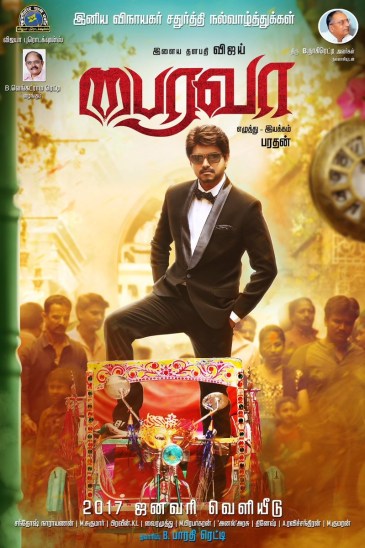
Bairavaa (2017)

bairavaa

Step into the cinema at any point during Bairavaa and you could be forgiven for mistaking it for almost any of Vijay’s previous films. The only thing that seems to vary in these masala outings is his attire, while everything else (love interest, villain, ‘comedy’ friend, evil henchmen etc) is identical. In his latest mass film Bairavaa, even the trusty masala formula fails to deliver as expected mainly due to poorly realised villains and dull, repetitive fight scenes. Not even the songs are inspiring and it’s only Vijay’s presence and on-screen charisma that makes it possible to sit through the full 169 minute run-time. There are some laughs, one or two fight scenes that work a little better than the rest and a couple of good songs but overall Bharathan’s latest release fails to impress.

Bairavaa (Vijay) is a recovery agent for a bank who don’t seem to mind that he uses rather direct methods to reclaim outstanding funds. This leads inevitably to the first fight scene as the bank manager sends Bairavaa out to collect money from a thug who likes to play cricket. The fight itself is quite cleverly choreographed with Vijay imitating cricket stars and using a cricket ball instead of his fists to flatten thugs, but despite the novelty it isn’t particularly exciting and there is absolutely no sense of suspense. It’s a given from the start that Bairavaa will be walking out of there with the money and that all of the rowdies will be writhing around on the floor. And that’s the problem with almost every other fight scene in the movie too. Even when the numbers of rent-a-thugs get upped and then upped again, there is no stopping the one-man army that is Bairavaa. The fights become an unending parade of rowdies being thrown up, down and around in slow-mo while Bairavaa barely breaks into a sweat. The exceptions mainly come in the second half when there is a little more at stake, but overall, even with a few stylish moves thrown in here and there, the fights are mostly monotonously predictable and uninspiring.

After meeting Malarvizhi (Keerthy Suresh) at a wedding and falling instantly in love, Bairavaa discovers she has a problem back home in Tirunelveli after she is attacked by a gang of thugs at Koyambedu bus station. This leads to a flashback that explains her predicament and why she is being targeted by businessman and self-styled champion of education PK (Jagapati Babu). PK is aided in his various criminal activities by Kottai Veeran (Daniel Balaji) and his merry gang of rowdies, while Malarvizhi is supported by her sister (Sija Rose), grandfather (Vittal Rao) and Uncle Narayanan (Thambi Ramaiah). Malarvizhi has taken PK to court to prove that he was responsible for the death of her friend Vaishali (Aparna Vinod) in his substandard medical college and that the college’s explanation for her death is completely untrue. PK has been warned by the judge that the upcoming final hearing should not interrupt Malarvizhi’s studies or endanger her health with the result that instead of killing Malarvizhi, PK tries every possible method of intimidation to make her break down and give up her fight. Naturally Bairavaa takes up Malarvizhi’s cause and immediately starts to oppose PK and his allies.

Sadly PK is a one-dimensional villain who does little other than sneer at the camera and order his seemingly self-replicating gangs of thugs to put an end to Bairavaa. His henchman Kottai Veeran has a little more to work with, but both men are purely obstacles to be overcome in Bairavaa’s pursuit of the girl. There is presumably some sort of message in the revelation that some private colleges are purely money making exercises and Malarvizhi does her best to promote the cause of independent women everywhere, but at the end of the day she is reliant on Bairavaa to defeat the thigs. Her methods of contacting solicitors, providing evidence and the like are casually destroyed by PK and Kottai Verran using methods that seem unlikely to work in real life. Malarvizhi is a fairly typical Tamil heroine in that she has some backbone and a promising career but still falls for the hero in less time that it takes her to find the bus home to Tirunelveli. I’ve yet to see Keerthy Suresh in a role that I think she can do justice too, and this doesn’t seem close. She looks uncomfortable in the songs and while there is some reasonable chemistry between her and Vijay it’s much like the rest of the film – pedestrian and predictable.

There are a number of other threads that seem to have been added to and appeal more to the modern market. Harish Uthaman appears as Malarvizhi’s abusive brother-in-law Prabha who has the world’s fastest rehabilitation after he gets beaten up by Bairavaa. Generally the police and judicial system are honest and the comedy is kept to a minimum with Bairavaa’s friend Shanmugam (Sathish) having only limited time onscreen. Thambi Ramaiah as Malarvizhi’s uncle Narayanan has even less time on screen, which in this instance is definitely for the best.

The songs too are disappointing and often oddly placed although Vijay’s dancing is still the highlight, but even here the energy seems subdued. At least until Papa Papa which is definitely the pick of the bunch. I can usually find something to enjoy in a Vijay film, despite the often wafer-thin plots, but I was hard pressed to find much in Bairavaa. It’s a strictly by the numbers mass film with little animation and even less ingenuity. At 169 minutes Bairavaa does feel like an endurance test and much could have been shortened (all those slow-mo fight moves and echoing repeats!) to improve the film flow. One strictly for the fans, and even then be prepared for a less than thrilling experience.

Guppy (2016)

guppy-poster

Guppy is the beautifully filmed début from writer/ director Johnpaul George featuring Chethan Lal and Tovino Thomas in the lead roles. The story is set in a small sea-side community in Kerala, and the scenery is stunning with vibrancy of colour in every frame. Cinematographer Girish Gangadharan makes the most of the beautiful location and with excellent music from Vishnu Vijay the film appears magical even before the wonderfully iridescent CGI guppies appear on-screen. The story follows the day-to-day life of Michael (Chethan Lal) aka Guppy and the problems that develop when an engineer comes to the colony, but mainly it’s the story of a young boy, his struggles to help his disabled mother and his relationships with the various people he interacts with on a routine basis.

Michael is known to everyone in his community as Guppy after the small fish he sells to supplement his income. He also works at a tea stall beside the local school where the owner Pappan (Alancier Ley) seems to be something of a father figure for Guppy as his own father is dead. His mother (Rohini) had a stroke after her husband died which left her paralysed from the waist down and Guppy looks after her as well as he can. His major goal is to buy an automated wheelchair for her so that she can get around when he is not there – and his fish sales are a vital part of that plan. The guppies are bought by local government officer Lalichan (Sudheer Karamana) as part of an initiative to help reduce the mosquito population by placing the fish in areas of standing water in the hope that they will devour the mosquito larvae. Despite knowing all about Guppy’s home situation and the plans for his earnings, Lalichan keeps half of the money for himself and only pays Guppy a small amount for each fish – a petty corruption but a common theme in his various deals with pretty much everyone throughout the film. It’s not just Lalichan either. Everyone in the community seems to inflate prices and expect bribes suggesting such corruption is normal and expected, even in such a small and remote village. Most disturbing is the acceptance of the practice as normal – shocking from my perspective that this is perceived as common practice and that no-one is even remotely bothered by it.

The first part of the film paints the picture of Guppy’s life – looking after his mother, working to raise money for her new wheelchair, breeding and selling guppies and hanging out with his friends.

There is a romantic interest in local schoolgirl Aamina (Nandhana) who wears a veil and is kept close to home by her grandfather Upooppa (Sreenivasan) which means all the local boys hang around at every available opportunity, trying to catch a glimpse of her. The other members of the community all have a role to play too and each slice of community life adds depth to the depiction of life in a small seaside village in Kerala.

Guppy’s relationship with his mother is beautifully depicted and there are some great moments, such as how he deals with his mother’s snoring, the way she prepares his fish food for him every morning, and the care Guppy takes each day in giving his mother her bath. Chethan Lal is excellent here, his emotions are perfectly displayed and the mix of joy and wonder when he feeds his fish, and excitement as he nears his goal of buying the wheelchair are superb. This is my favourite part of the film as each interaction gradually weaves the pattern of Guppy’s life, and although there are difficulties, there are also moments of happiness and camaraderie with his mother and friends.

Guppy is well liked in the community. His initiative in breeding the guppies is admired and his devotion to his mother is also appreciated by everyone who knows him, so it’s a shock when newly arrived engineer Thejus Varky seems to immediately take a dislike to Guppy. The engineer has been brought to the village by aspiring politician Onachan (Noby Marcose) and village officer Krishnan (Dileesh Pothan) to build a bridge over the railway but he doesn’t appear in time for the grand celebration prepared for his arrival. Which is a pity since it is rather special! Who could resist Michael Jackson, Amitabh Bachchan and Rajinikanth singing a Christmas song together?

Thejus is an odd character who immediately stands out from the rest of the village due to his motorcycle, his unusual dress sense and his bushy beard. Although Tovino Thomas is excellent in his portrayal of an egotistical and rather arrogant engineer, the character of Thejus doesn’t seem totally plausible – even after his full story is revealed later in the film. Thejus can be charming, as when he meets with his friend Krishnan or in his dealings with his landlord in the village, but all too often he is haughty and appears to look down on the villagers he has come to help. He is easily frustrated by the railway crossing supervisor Upoppa and rudely snubs his offers of tea and a place to sit, while his vendetta against Guppy is strangely childish and immature. Guppy’s reaction is a little more believable, given that an adolescent may be expected to act in an occasionally irrational manner, but this part of the film seems rather more contrived and filmy. However, the tension between the two is well-developed and despite a few unrealistic twists, the conflict between Thejus and Guppy becomes compelling.

What works well in the film is the story of Guppy and his mother. Guppy’s struggles to raise enough money for a wheelchair are realistically dealt with. I love that he first sees a fully automated wheelchair when watching the film Bangalore Days – up until that point he has no idea that such things existed. The love between Guppy and his mother is beautifully depicted and blends seamlessly into the general warmth of the whole community. The conflict between Guppy and the engineer is less successful but there are still some excellent scenes, particularly between Thejus Varky and Chinappa (Poojappura Ravi), the older man who runs the guest house where he has set up his tent, and his interactions with both Onachan and Krishnan. All the actors are good in their roles and their performances ensure that the occasionally convoluted storyline doesn’t get too bogged down with all the detail.

The excellent cinematography is another reason to watch the film. Even though the CGI fish are obviously not real, they are still wonderful to look at, and Johnpaul George weaves guppies into the story in many ways. The fish appear as painting on the walls, in lightbulbs in Guppy’s house and as decorations on his friend’s vehicle as well as swimming around in the drainage canal behind the school. The whole look of the film is just as colourful – whether it’s the brightly painted village, the stunning seascapes or the vibrant villagers, it all looks beautiful and instantly makes you want to move to a seaside village in Southern India!

What doesn’t work quite so well is the sheer number of characters and some of the extraneous plotlines that don’t really add anything to the main story. Each character seems to have to have their own small story and while some are quite fun, most only serve to divert attention away from Guppy and his story. However it’s hard to quibble too much, since the characters are generally fascinating and it gives even more of an opportunity to take in the beautiful scenery.

This is a lovely little film that takes a different look at adolescence, neatly giving Guppy rural innocence but enough street-smart knowledge to ensure that he can match wits with the likes of an engineer. Well worth watching for Chethan Lal and Tovino Thomas, plus the excellent support cast, and to savour yet more stunning images of Kerala. 4 stars.

Kiragoorina Gayyaligalu

kiragoorina-gayyaligalu

Kiragoorina Gayyaligalu is a beautifully filmed adaptation of a novella by acclaimed Kannada writer Poornachandra Tejaswi. Director Sumana Kittur has teamed up with screenwriter Agni Shridhar (responsible for the excellent Aa Dinagalu) to give a colourful look at village life in rural Karnataka from the recent past. Various small incidents illustrate the relationships between the different groups in the village, but the usual routine is thrown into disorder when there is a plot to con the villagers out of their land. The situation escalates until it’s up to the ‘rowdy women’ of the title to restore order and deal with the corrupt officials behind the scam. I haven’t read the original story but the film is charming with a balanced blend of drama and comedy that still manages to address a number of social issues, albeit in a light-hearted way.

The film starts by showcasing the differences between the men and women of the village. While the women are out working, the men are lounging around the village, playing dice and utilising the services of the village barber. The women from different castes all work together without any issues but it’s a different story for the men of the village who are more inclined to take notice of someone’s place in society. The higher caste Gowdas negotiate the cheapest price they can for any work done for them by the lower caste Kulavadis although the men all congregate to drink together in the village arrack shop at the end of the day. The arrack shop is a point of contention for the women as they feel that this is the reason their husbands have become lazy and argumentative. All in all, Kiragooru seems to be a typical village with the usual colourful characters, petty disputes and plenty of potential for mischief.

Daanamma (Shwetha Srivatsav) is an outsider from a different village who is married to Subbaiah (Rahul Madhav), one of the Gowdas in the village. Despite being a relative newcomer, the other women look to her for support and she’s the one they ask to break up a fight between Kaali (Sukrutha Wagle) and Rudri (Manasa Joshi) when tempers flare. She’s just as competent at home, refusing to let Subbaiah leave when everyone else runs from a police jeep in the village and ensuring the household runs to her satisfaction, although she does seem to have a genuinely happy relationship with her husband. Daanamma also provides support to Nagamma (Sonu Gowda) whose husband Kaale Gowde (Kishore) is abusing her for failing to provide him with children. Kaale is desperate to marry for a second time and has fallen for Bhagya (Karunya Ram), a vegetable seller in the local market but doesn’t tell her the truth about his marriage to Nagamma. Rounding out the village are the Kulavadi farmers who include Maara (Nikhil Manjoo), Kariya (Sampath Kumar) and their families.

Shankrappa (Achyuth Kumar) is the government welfare officer for the village, but he also runs the arrack shop and is plotting with Bhootha Swamy (Sharath Lohitashwa) to con the villagers out of their land. When Daanamma threatens the visiting Tahsildar and runs him out of the village, Shankrappa files a complaint against her with the police that also accuses the Gowdas of cheating the Kulavadis out of their rightful wages. This results in the Gowda men being taken away to the police station where they endure a humiliating experience at the hands of the drunken Inspector. They immediately turn to Bhootha Swamy for help, but he lies and tells the men that it was the Kulavadis who filed the complaint. This widens the divide between the two groups, further fuelled when Bhootha Swamy lies to the Kuavadis too and the Gowdas fan the flames by employing an outsider to chop up the tree. No reconciliation seems possible until Daanamma takes matters into her own hands and enlists the rowdy women of the village to sort out the problem once and for all.

It’s a well told story with plenty of quirky characters, but the appeal of the film lies in the excellent performances from all the actors. No matter if the character is only on screen for a few moments such as the unethical Dr Appanna (S Narayan), everyone seems to fit their role perfectly. Shwetha Srivatsav has most time onscreen and is brilliant as Daanamma with her perfect mix of compassion, bravery and common sense making compelling viewing. This is very different to her role in Simple Agi Ondh Love Story but she again makes excellent use of her facial expressions and both looks and sounds the part of a rural villager. Sukrutha Wagle is appropriately shrill and combative as one of the Kulavadi rowdy women, while Sonu Gowda provides contrast as the silent but still expressive Nagamma. The scenes between the different female characters also ring true with plausible discussions of their routine chores and complaints about their husbands with the occasional small rivalry thrown in to demonstrate how they got their reputation. Their support for each other is also realistically portrayed along with their determined reactions which are a good contrast to the men’s vacillations and indecision when faced with a problem.

The men all suit their various roles too. Rahul Madhav, Sunder and Anathavelu are all good as the overly trusting Gowda men, while Kishore is excellent as the abusive Kaale. Although the character is mainly comedic, there is a serious side in the abuse he deals out to his wife and it’s a credit to the film that this is dealt with sensibly, both highlighting the abuse itself and giving a solution that shows Kaale to be the one at fault rather than his long-suffering wife. The film also raises the issues of drunkenness and caste division and although these are used to some extent for comedy, there is a serious side as these are shown to be real issues for the community. Naturally the women are the ones to solve these issues too with their practicality and common sense winning the day.

Kiragoorina Gayyaligalu is a film where everything just comes together perfectly. Manohar Joshi’s cinematography is complemented by Saadhu Kokila’s music and Sumana Kittur evokes a village atmosphere through colourful dialogue and fantastic attention to detail. The language is often beeped out but the subtitles are hilarious with the women not afraid to air their graphic opinions publicly and loudly! Each scene is complete in itself but also serves to establish and evolve the different characters and situations. Added together they all build up to a captivating story and satisfying finale. One I highly recommend for the excellent performances, well-written screenplay and some of the best female characters I’ve seen in Indian cinema. 4 ½ stars.