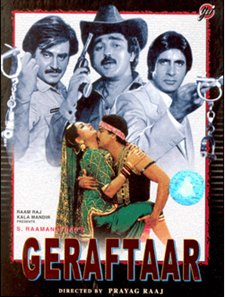
Geraftaar

Geraftaar is not just a simple tale of two brothers separated at birth as this film manages to incorporate almost every Hindi film cliché.  There is the long suffering mother, a significant song, brothers and sisters, fathers and sons, a significant necklace and to top it all off death by bulldozer. As if that wasn’t enough we have not one, not two, but three heroes.  Kamal Hassan, Amitabh Bachchan and Rajnikanth appear together although unfortunately not all on screen at the same time.

Karan Kumar Khanna is a brat of a child, but still doesn’t deserve to be framed for his father’s murder. Adding to his misery, the real killers convince him that he may have been responsible. Nirupa Roy, in true filmi Ma style, instantly believes that he did indeed kill his father.  Karan runs away and tries to kill himself.

This allows his brother Kishan to grow up free from his teasing at least.  Kishan grows up into Kamal Hassan. Working as a stuntman in the film industry he has big dreams of making it as a hero but struggles to get paid the basic rate for his work.

His personal life is no more successful. After a rather unpromising start, he finally marries the unbelievably spoilt and self-centred Anuradha.  Anu is played by Poonam Dhillon, who does a very good job of making her character initially unappealing.

Back to those clichés!  Anu’s brother is a gangster and is involved with a number of shady businessmen, who were also responsible for the death of our heroes’ father.  They devise a plot to frame Kishan for the murder of his dancer friend Lucy, (but unfortunately not before she does a really bad version of flashdance), and he ends up in jail.  Coincidence rules and thanks to that significant song he manages to find Karan, although he doesn’t know who Karan is.

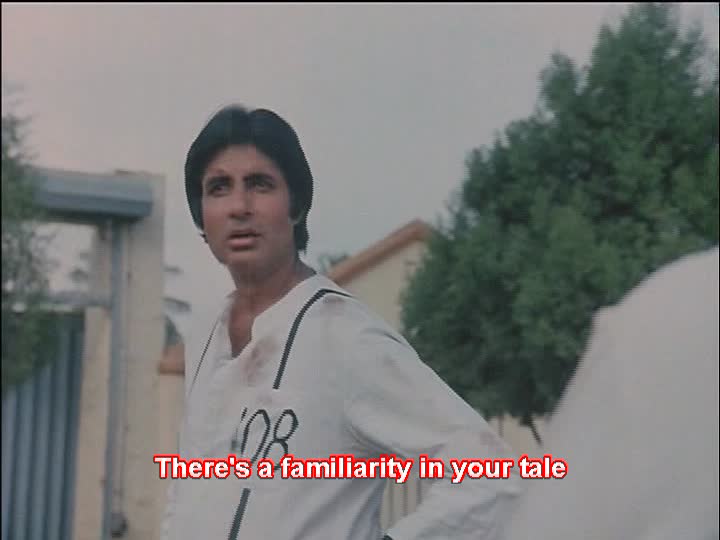
Karan (now the much taller and much more serious Amitabh Bachchan) explains why he is in prison though a series of flashbacks that pick up from his failed suicide attempt.  We learn that he was found by a Muslim boy, and taken in by him and his mother.  Both boys grew up to be police inspectors, but Hussein (Rajnikanth) was killed by Vijay, the police commissioner’s son.  Karan is in love with Vijay’s sister Geeta, played by Madhavi in a role that involves quite a bit of fisticuffs!   So we have a symmetrical arrangement of two good(ish) girls who both have evil brothers plotting against our heroes who are long-lost-brothers. There are various jail breaks, song breaks, court dramas, deaths by bulldozer (yes, more than one) and the inevitable family reunion, so that all ends well.

There are some great things about this film.  Inspector Geeta gets to join in for a lot of the fight scenes and does a really good job.  Rajnikanth is excellent as the cigarette tossing Inspector Hussein and manages a suitably dramatic and filmi ending – defiantly smoking his cigarette to the bitter end.

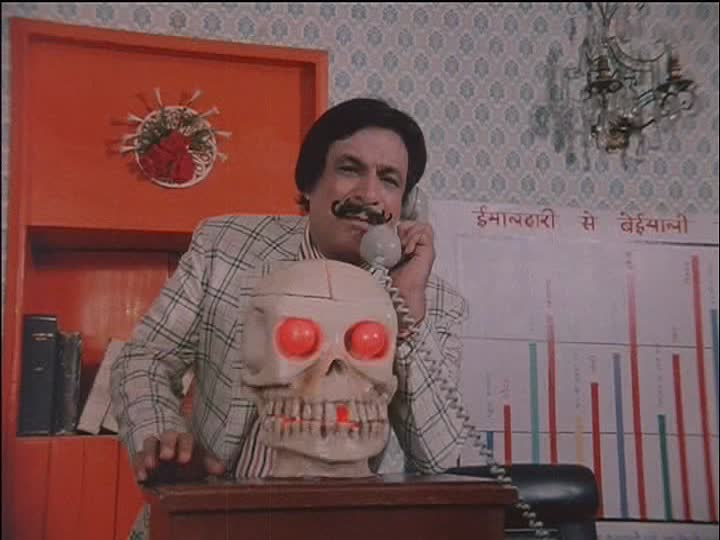
The gang are the comedy relief and manage some funny moments in their convoluted plans.  Kader Khan has a really insane moustache, and is clearly the head villain as he has a talking skull that gives him advice!
The scenes of Karan and Kishan singing and wandering around what appears to be a very nice open-plan prison are well done and the drama of their meeting is well handled.

The character of Anu is initially unlikeable and shows no empathy for anyone.  She tricks Kishan into believing she loves him (and his Ma) and then humiliates him in front of her friends — all because she couldn’t stand the idea that he wasn’t interested in her.  In revenge, he insists on marrying her before sending Anu back to her brother’s house so she can be trained to be a worthy bride. This deception on both sides leaves Kishan’s Ma in hospital as she crumbles under the weight of so much bizarre behaviour. Anu has an epiphany and  magically morphs into the perfect wife, praying to die before Kishan and wait for him in the afterlife.

Neither of the female leads show any regret about their brothers – either for the life they lead or when they both suffer the consequences for their wrong-doing.  Geeta initially tries to reason with her brother Vijay, but doesn’t seem at all happy to find that reports of his death were premature.  Anu is shown vowing to cast aside her other relationships and accept Kishan as her husband but that was part of her deception so it wasn’t clear if she decided a vow was a vow, or if some other change of heart took place. The rest of the film is dedicated to family so this lack of feeling from the sisters towards their respective brothers did seem odd.

Kamal Hassan turns in a very good performance as Kishan but is upstaged by Amitabh in the second half. The two heroines do what they do, but don’t really have much to work with although they both get to participate in the action in the final scenes. Nirupa Roy with her trademark knuckle bite is once again the dramatic filmi mother.  The music by Bappi Lahiri leans heavily towards disco – this was filmed in 1985 – but the significant song Aana Jaana Laga Rahega is lovely and sung beautifully by Shabbir Kumar and Bappi Lahiri himself. Kader Khan, Ranjeet and Shakti Kapoor play their usual stock characters and once again reap the benefit of a well funded wardrobe department. The fight scenes are very amusing.  Although sped up to a ridiculous degree they still look quite leisurely. Perhaps the fights composer, credited as Judo Rathnam, was really a tai chi expert.

Heather says: I started this film a few times before I finally managed to watch it to the end.  I find the first half drags, and the character of Anu was so annoying that I ended up shouting at the screen.  But the whole tempo of the film changed at the appearance of Amitabh and Rajnikanth, so it was well worth making it to the second half – thank-you Temple for insisting I finish it!  Rajni steals every scene he is in. Despite the fact that this is a special appearance with only a small role, he made the most of every second and I loved every single one of them!  Amitabh was overly dramatic which made him somewhat more comic  than I think was intended, but seemed to fit the general feel of the film.  I couldn’t really take death by bulldozer seriously and spent most of the film laughing at the melodrama of it all.  When I wasn’t getting annoyed by Anu at any rate.  I enjoyed the songs and thought that the comedy track was well written in, and had some very funny moments.  I have the feeling they couldn’t decide if this was meant to be a drama, a comedy or an action film, but instead of adding everything to make it full masala it just ended up switching from one style to the other and was just that little bit less satisfying.  That little bit of Rajni helped make it more palatable. This film gets 3 stars from me.

Temple says: I agree with Heather that the director couldn’t quite decide how to spread out the masala ingredients in Geraftaar—so I think they decided Kamal Hassan got the comedy (mostly), Amitabh took drama and Rajnikanth was the action man. Which made for an uneven, albeit wildly entertaining, film. Bulldozers are not a weapon for the spontaneous killer, so the build up to get to the death by moving equipment was overly complicated and really made the film drag. And how some of the victims didn’t see it coming is just beyond me. The three heroes did an excellent job, especially Amitabh and Rajni as their roles had more substance and, I can’t believe I am going to use this word in relation to this film, logic. The heroines were OK for their under-written and sketchy roles and Madhavi looked like she was right into the biffo in the final scenes. I do have to give an extra cheer for Kamal Hassan’s dancing duel in his featured song. Its worth seeing Geraftaar just for the star cast. It’s a bit of a chore to hang in there til the action kicks in, but it is worth it. I give this 3 and 1/2 stars. It gets extra for the skull with glowing eyes and for Kamal Hassan’s dancing.

Cinema Chaat & the Australian Festival of Travel Writing

Temple has been invited to take part in a panel discussion along with Shalini Akhil, Mitu Bhowmick-Lange and Roanna Gonsalves at the Australian Festival of Travel Writing at 6pm on Friday 29 October:

Bollywood Stories and Contemporary Indian Cool. Indian Film Festival Director and Producer Mitu Bhowmick-Lange, writer and comedian Shalini Akhil, and Bollywood blogger Temple Connolly discuss the influence of Bollywood on their creative projects and writing with Roanna Gonsalves.

And yes, she’s warned them she will be sneaking in more than a passing mention of the South Indian film industries. There are some fantastic writers and photographers at the festival, so it’s quite an honour for our blog to get a gig.

Follow this link to view the whole program and book tickets if you wish.  If you’re really lucky you’ll get to sit near Heather in the audience!  She has promised not to heckle (much).

Chatrapathi

There are three reasons that we ended up watching this film. It’s an S.S Rajamouli creation. It was name checked in the opening sequence of Desamuduru. The other was a throwaway remark by our good friend The Mahesh Fan: “Once you’ve seen Prabhas fight the CGI shark there’s not much else to it.” And she said that like it was a bad thing! We ordered the DVD immediately.

The film is a familiar ‘hero looking for lost mother’ tale intertwined with a search for social justice and a jealous half brother to flesh out the storyline.  Some time is spent setting up the back story for hero Shivaji (Prabhas). Separated from his doting step-mother and jealous step-brother after fleeing Sri Lanka, he and the other men who made it across the sea are working as bonded labourers to a local thug Baji Rao. By the time young Shivaji has grown all the way up into rather lanky Prabhas, apathy born of despair seems to be well entrenched into the refugees.  Inspired by his mother’s stories of the heroic Chatrapathi and traumatised by the brutality inflicted by the strong on the weak, Shivaji is truthful, defends the innocent and has never given up on finding his family. He also has a shell necklace given to him by his mother. This will become Very Significant.

But it’s the shark scene we were hanging out for! We applaud Rajamouli’s dedication to the CGI predators in his films. It really is fabulous, and this shark is a scene stealer. It growls!


This very silly episode gives Prabhas a highly memorable heroic entrance scene. It sets Shivaji up as resourceful, capable, tough, resilient and with exceptional lung capacity.

Life is cheap in this refugee settlement, and Katraj (Baji Rao’s man) rules the roost. The level of violence, both implied and actual and especially against women and children is very confronting. It does serve to illustrate the inhumanity of the thugs in charge, the general lack of support for the under classes and most importantly for a film of this type, it allows the hero to arise from the masses. The sight of a child lying near death as people watch on is not easy to view as a light entertainment.

The romantic interest, Neelu played by Shriya, works at a local government office and after some supposedly comic misunderstandings (she thought they thought she was a prostitute, puns on the words “repu” meaning tomorrow and “rape”) locates the necessary file but not the actual address of the missing mother.  Unknown to Shivaji, his mother and brother are alive and well and not far away. And his brother Ashok still doesn’t like him one little bit. Romance blooms. More rape jokes and sadism pranks ensue. And Bhardam, Shivaji’s oldest friend on the settlement and the voice of caution and moderation is killed.

Corruption and rowdyism are the bane of Shivaji’s people and the film takes a darker note when he becomes a popular leader and takes up the ruthless methods of the people he wants to displace.


The fight scenes are brutal and gory, leaving nothing to the imagination. The violence is cartoonish and unreal but still seriously dark. He takes to kidnapping, extortion, bombs and guns with no hesitation. The shocking end to a confrontation with his brother Ashok then propels the story into a final escalation of score-settling.


Neelu and Shivaji’s friends disappear into the background of the story, often appearing as silhouettes or blurry figures as the second half of the film is pure Prabhas revenge-o-drama. The machinations of Ashok continue to drive some truly bizarre behaviour and Shivaji is no closer to regaining the love of his mother. Baji Rao’s brother muscles in on the action to become the new face of evil and gives Shivaji another enemy to fight.  The final scenes include a travelogue of Hyderabad’s temples and a catalogue of lies, tears and betrayals before things go up in flames. Literally.

In the nick of time, Shivaji’s mother recognises the Very Significant shell necklace. Everyone who is still alive at the end of the film gets the life they deserve.

The fight scenes are beautifully choreographed and filmed, but may be too bloody for some tastes. The same care was given to the songs but Prabhas is not as comfortable dancing as he is in stunts and fights. The camera work in all the action sequences was excellent and really conveyed a sense of an epic struggle between heroic and villainous forces.

The support cast were effective although very much in support. Ajay played his usual sidekick role, and had a bit more range as his character was both a thug and a caring older brother. Kamal Kamaraju was another of Shivaji’s inner circle but mostly just had to stand around looking cross. Venu Madhav was the comic relief and supplied a few laughs especially in his “Anniyan” skit. Shriya was typically girly and shrill as the heroine but also displayed some good comic flair and had a few scenes allowing her to be a bit feistier. The mother (Bhanu Priya) was an irritatingly passive and trusting character for the most part, although conveyed the anguish over her sons very well. Ashok (Shafi) was a bit less successful in making his character seem at all real or memorable. He missed the mark on showing both the madness of twisted jealousy and the neediness of the overlooked son and just went for bug eyed, grimacing and grinning for comedic effect.


The soundtrack worked really well and suited both the drama and the performers. In particular, the Mumaith Khan item number was great fun and was tailor made for her. The backing cast and dancers all seemed to throw themselves into it with enthusiasm. The Chatrapathi chant that accompanied Shivaji added that element of mythical heroism, and suited the epic nature of the underlying themes.

Finally, a special shout out to whoever designed Prabhas’ outfits. We do want to know what they were on when they chose some of the shirts! It’s a bit cruel to put a tall lanky man in lolly pink and then make him dance like he means it.

Temple says: Chatrapathi is entertaining enough due to Rajamouli’s ability to make the most cliched story seem fresh and Prabhas’ likeable screen presence. The film is all his and it works most of the time. The story was secondary to the heroics and flexing, and the supporting characters were given little range. I am frequently bewildered by the White Queen style ability of a filmi mother to believe six impossible things before breakfast and this film continues that trend. Ashok’s character was a sketch rather than a fleshed out role and Shafi did what he could— but it felt like a missed opportunity as a bit more depth there would have added to the tension of the final scenes. I know Heather can’t stand Shriya but I think the heroine roles are generally written as irritating air-heads so I try to make allowances . On my personal scale of how annoying was Shriya? this is one of her least irritating roles (perhaps as there was no stupid meringue hair). I quite like the soundtrack and the songs were highlights as they were often a respite from the gore and gunshots.  Mumaith Khan is a favourite as she always looks like she is having such a great time and is totally in on the joke. I love that the South Indian heroes know that they can’t avoid dancing so regardless of their comfort levels, they just do it. I always giggle at the sight of Mahesh Babu in a lunghi (something about those long skinny pale legs) and now I can add Prabhas to the list of men who should stick to wearing trousers please!

This isn’t a film I will re-watch over and over, although the shark fight was on high rotation for a while. There was something endearingly Parvarish-like about the special effects in that scene, and I love that Rajamouli had his shark snarling, snapping and almost literally chewing the scenery. I give this 3 and 1/2 stars.

Heather says: Prabhas is a hero very much in the style of early Amitabh Bachchan in this film.  He is the ‘angry young man’ who is searching for his mother and will let no obstacle stand in his way.  Unlike Amitabh though, he makes a fair attempt at dancing!   In the first half of the film Shivaji is truly the hero with his drive to always do the right thing, and of course his constant search for his step-mother.  His switch from the hero of the docks to violent thug is quite abrupt and rather confronting, and he seems to be almost a  different character.  I did enjoy Ajay’s slightly more sensitive role here, and I like the way that both young Shivaji and the grown up version had the same mannerisms.  There really should have been no need for an identifying significant necklace!  This film also has one of my favourite lines, at least according to the subtitles: ‘trust your whiskers’!

Shriya is still not my preferred actress – there is just something about her that irritates, and I was quite relieved when her character was sidelined in the second half of the film. On the other hand, I thoroughly enjoyed Shafi’s characterisation of the jealous step-brother Ashok.  Especially when he has some money and can indulge his terrible taste in clothes and become as obnoxious as he has clearly always wanted to be.  Overall I felt the story works well, providing there is some major suspension of disbelief that Shivaji couldn’t find his step-mother even though she lives close by! Plus there is that shark scene, which really is fantastic! 3 1/2 stars from me.