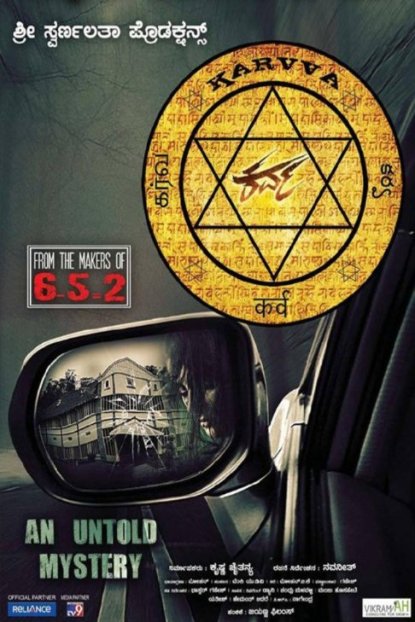
Karvva (2016)

Karvva poster

Karvva released earlier this year in India, and we finally got a chance to see the film here in Melbourne last weekend. I’m not usually a fan of horror films but the blurb about Karvva suggested that it was a combination thriller/ghost story, so I ventured out to the cinema in the hope that it may be another RangiTaranga. However Karvva turned out to be a fairly formulaic and not particularly frightening (or even thrilling) film, but despite the inevitability of the storyline there are a few good features that make it worth a one-time watch.

The film is a mix of two separate but related stories, one based on a documentary film crew out to debunk a rumour about a haunted house and the other recounting the kidnap of a rich businessman’s daughter. The connection between the two is the house; is a classic ‘renovator’s delight/fixer-upper’ mansion located somewhere in the Karnataka countryside.

When an NRI attempts to sell his ancestral property he finds that it has a nasty reputation as a haunted house, and in an attempt to improve his chances of a sale he enlists the help of a documentary filmmaker specialising in investigations of supernatural events. The TV crew has some kind of spiritual advisor and a boffin with a machine that measures ghost activity so obviously they’re the right people for the job. However despite all their gadgets and scepticism, the TV crew find more than they bargained for in the abandoned house which lives up to its reputation. Naturally they have to wait for an auspicious time to go back and try to exorcise the spirit which leaves the scene set for the next reckless visitors to the mansion.

The second part of the story focuses on Thilak, a spoilt, rich kid who lives the high life but who is brought down to earth when he loses a lot of money at a casino. He tries to get some money out of his father (Devaraj) by pretending he needs cash for a business deal, but his father decides that enough is enough and refuses to bail Thilak out. Anisha Ambrose is Thilak’s sister, who tries to persuade her dad to cough up some money for her brother, but before she can achieve very much she is kidnapped and a ransom note sent to Devaraj. The kidnappers choose Thilak to deliver the ransom money and the directions he follows take him to an abandoned mansion somewhere in the Karnataka countryside. Yes – this is the same Raja bungalow that we’ve already seen is haunted by a vengeful ghost, but Thilak is only concerned about finding his sister and isn’t too concerned by his surroundings. He also approaches the house from the back which looks much less creepy and isn’t quite as festooned with cobwebs as the front of the house either.

Events conspire to leave Thilak, his sister and three friends stuck in the house overnight. As the ectoplasm starts to swirl and the friends find out the history behind Raja bungalow it’s clear that they’re not going to have a peaceful night and indeed may not even last until morning.

The basic plot is a fairly standard ghost story but there are a few twists, particularly in the second half which make the film more interesting. Unfortunately, although the visual effects are good, each even remotely spooky moment is accompanied by loud screechy music and distorted screams that quickly remove any suspense from the scene. There are numerous points where one of the characters is shown from behind with the suggestion that someone (i.e. the ghost) is creeping up behind them. It would have been so much more effective to cut out all the noise altogether, or even go for some slightly more clichéd breathing rather than the loud cacophony that occurs every time someone turns their back on the camera. More effective are the shots where a vague figure appears when the lights go out, and where there are half seen flickers in the periphery, but as the film goes on the effects get more and more obvious and subsequently less and less frightening. The inclusion of a comedy track of sorts with Vijay Chendur reduces any suspense that might have built up with the initial ghostly effects while the loud soundtrack and OTT make-up towards the end mean that the final scenes are funnier than I think they were meant to be.

The actors are occasionally overshadowed by the effects, but Thilak is fine as the sceptical and stalwart hero of the hour. Mostly he just has to ignore all the odd happenings and boldly go forward to investigate the latest black-out, noise or other unusual occurrence, but he does so with a reasonable amount of attitude and is good at the end when everything is explained. However RJ Rohith as one of Thilak’s friends is rather wooden and inexpressive although some of this may be due to his rather dour character, which doesn’t give him scope to do much else. Anisha Ambrose and Anu Poovamma are both good and escape the usual fate of female characters in a horror movie by being braver than seems plausible, while Vijay Chendur is funnier than expected and makes an impact despite only having a short time on-screen.

Navaneeth wrote and directed the film and there are some good ideas in there, even if the ghost story and horror element is somewhat formulaic. The NRI desperate to sell his house works well and there are some satisfyingly scary moments with the TV crew as they search for clues. The initial kidnap scenes are also well thought out and the events when the friends first find themselves stuck in the house are effectively written. However as the horror part of the story kicks in the film starts to lose its novelty and the final explanation can even be partly anticipated given the events of the night in Raja bungalow. Still, the cinematography by Mohan is excellent, there are a few good spooky scenes and I like that the female characters are braver than some of the men! Worth watching for the set-up in the first half, the twists in the second and a good performance from Thilak Shekar.
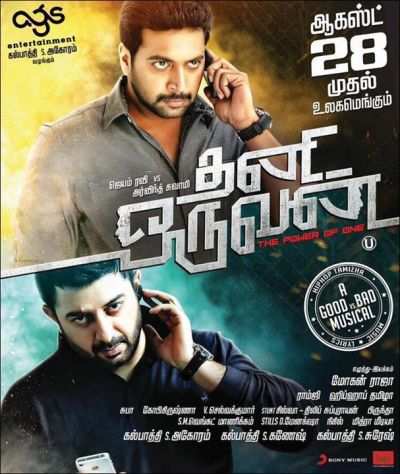
Thani Oruvan

thani-oruvan.jpg

Thani Oruvan pits a dedicated police officer against a corrupt scientist in psychological thriller that has plenty of drama and action. The writing collaboration between director Mohan Raja and Subha results in a cleverly plotted story with some unexpected twists, but the real success lies in the detailed development of the two main characters. Neither is completely black or white, although the shades of grey are relatively muted, while the cat and mouse relationship between the two provides good structure to the film. Excellent performances from the whole team but particularly Arvind Swamy as the villain of the piece ensure that Thani Oruvan is a better than average police drama and one that’s well worth a watch.

You know a film is going to be pretty epic when the story starts with a dramatic birth. Sengalvarayan (Thambi Ramaiah) is a party man through and through to the point where it’s more important to him that he ties flags for his leader’s appearance rather than take his heavily pregnant wife to hospital. The leader senses an opportunity for some good publicity and sure enough, the baby is born in the back seat of the politician’s car leading Sengalvarayan and his new son Pazhani to develop a relationship with the man who will later become Chief Minister (Nassar). The significance of these events doesn’t become apparent until later on but they provide an instantly intriguing start to the film.

After the dramatic opening, the story moves to a group of young police officers in training and their vigilante-style activities against the local criminal community. Despite the group’s best efforts, the crooks never stay in jail and Shakthi (Ganesh Venkatraman), Suraj (Harish Uthaman), Kathiresan (Sricharan) and Jana (Rahul Madhav) all look to their friend and natural leader Mithran (Jayam Ravi) for a solution. Naturally Mithran has a plan, having spent the last few years investigating all known criminal activity and discovering that all crimes are interlinked and ultimately committed by a small group of individuals. As a result he’s made it his mission in life to eliminate one of these top 15 criminals responsible for all of the crime in India, and of course his buddies want in on the action. He has a shortlist of three possible men to choose from; Ashok Pandian (Nagineedu), Perumal Swamy (Madhusudhan Rao) and Charles Chelladurai (Saiiju Kurup) who between them (according to Mithran) account for 80% of the criminal activity in the country.

Mithran’s biggest problem is which one to choose, although I’m not entirely sure why he couldn’t decide to eliminate all three given that he has his whole career ahead of him and could work on knocking off one every 10 years or so. Regardless, while he is working out which one to target, he discovers that all three actually work for a much bigger villain – highly respected scientist and Padma Shri awarded Siddharth Abimanyu (Arvind Swamy). Siddharth is known for his work in the pharmaceutical field but in reality he’s the mastermind behind all sorts of criminal activity and not a nice man at all, despite his designer suits, fashion model wife and impressive collection of University degrees.

Siddharth is of course the grown up young boy from the start of the film and his inept father is now the Health Minister in Nassar’s government, allowing Siddharth to do basically whatever he wishes. Mithran and Siddharth cross paths when an American drug company owner comes to India to open access to lifesaving medications – something that Siddharth and his associates will go to any lengths to prevent. Once Siddharth becomes aware of Mithran and his attempts to put him out of business, the contest between the two begins in earnest with each determined to eliminate the other no matter what it takes.

The characterisations are the key here and while Mithran doesn’t have all the answers he uses a methodical approach and informed reasoning to work out what Siddharth will do next. Almost too good to be true, Mithran is depicted as a dedicated and passionate police officer with a strong sense of social justice, who is almost hyper-aware of crime in his surroundings. However as he gets drawn into a battle of wits with Siddharth his obsession threatens to take over his life while his friends and allies become tools to use in his fight. His motto is that a man’s capability is defined by the quality of his enemies and by that measure he needs to be very capable indeed. Mithran’s passion for justice is what makes him get out of bed in the morning, so he has none left over for potential love interest Mahima (Nayantara) and as time goes on, little patience to deal with his friend and colleagues either. These shades of grey give Mithran more credibility and offset his tendency to indulge in pompous and long-winded speeches about truth, justice and the rights of all to obtain cheap pharmaceuticals when required. Jayam Ravi is perfectly capable as Mithran but he is very serious and it would have been good to see an occasional smile outside of the obligatory song with Mahima.
Siddharth is a more cerebral villain than usual and uses his political influence to neutralise any threat from Mithran while his quick reactions and scientific knowledge also stand him in good stead to outwit the police officer at almost every turn. He doesn’t throw tantrums, swear vengeance or send out gangs of thugs as Tamil criminal masterminds are wont to do, instead he simply adapts, moves on and changes direction.

Arvind Swamy is excellent as the criminal mastermind, with the beauty of his characterisation lying in just how very ordinary his Siddharth is. He’s rich  – designer suits, trophy wife and beautiful house all attest to how wealthy he is, but on the surface he could be any scientist working on medical breakthroughs with no indication of how cruelly callous he can be when required. Those moments when he casually orders someone’s death or explodes into controlled violence are almost totally unexpected and seem to come out of nowhere, making Siddharth a very effective and chilling villain despite his generally debonair persona.

Nayantara’s character Mahima is interesting too. On one hand she’s the typically dumb love interest who thinks that by following the hero around and declaring her love at every eventual opportunity she will eventually wear him down – and to be fair that is what happens here too. But on the other hand, she’s a forensic scientist who has some good ideas to help Mithran’s investigation, and appears coolly capable and professional in her work. If only Mohan Raja had avoided the ‘love at first sight’ cliché and given Mahima and Mithran a more plausible and realistic romance I would have liked her character more. But Nayantara does give Mahima professional competency and a no-nonsense approach most of the time that fits well with the overall tone of the film.

The rest of the cast are good with Thambi Ramaiah providing some laughs as an inept politician, but mainly giving a further insight into the character of Siddharth. Rahul Madhav is the best of Mithran’s friends, Vamsi Krishna is suitably menacing as Siddharth’s hitman, while Mugdha Godse is good in her brief but important role as Siddharth’s wife. The film looks good too, with effective use of split scenes and an effective mix of technology and good old-fashioned fight scenes. There are a few leaps of faith required but they aren’t too ridiculous and mostly the plot makes sense.

Thani Oruvan is an intelligent thriller with a good mix of action and drama and excellent characterisations. It is a little overlong, but the story keeps moving along at a good pace and like any good page-turner it’s always worth finding out what happens next. Worth watching for Arvind Swamy’s villainous scientist and the psychological cat and mouse game between Siddharth and Mithran. 4 stars.


Lankeswarudu

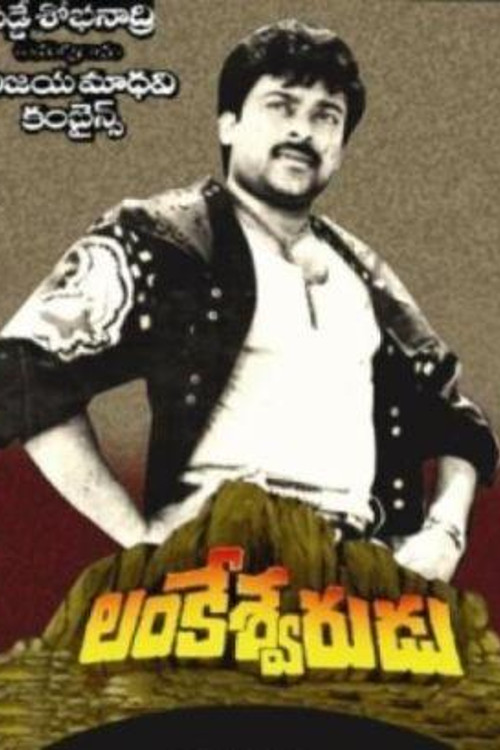
Lankeswarudu Poster

Who could resist a film synopsis that says “Apart from crime Shankar is also a good dancer and he teaches dancing too”? Certainly not me and especially not when it stars Chiranjeevi. But Dasari Narayana Rao delivers little except for a solid performance from the Megastar and some diverting song picturisations in this lethargic stagger through a bunch of Hollywood “inspired” set pieces.

Siva and his sister Swapna are washed up on a beach. Alone in the world, the boy tries to make a living through odd jobbing and petty theft, eventually falling in with a gang. The siblings acquire a new brother, Kalyan, when his mother is killed saving the little girl. Ma put his hand in Siva’s hand and there you go. Adoption formalities completed. The kid who plays little orphan Kalyan is quite terrible at crying.

Thankfully we leap forward in time. Chiranjeevi enters casually taking his leopard for a stroll. After a recruitment process featuring Bob Christo and a pack of goondas he becomes Shankar, the right hand man of crimelord Dada (Satyanarana Kaikala). Dada already has two left hands in flashy dresser Mohan Babu and snake venom imbibing Raghuvaran.

When not preoccupied with his criminal activities, Shankar is also Siva and he is a dance god. Radha plays his love interest with a lot of “I just escaped from a high security psychiatric facility. Don’t you love ruffles?!?” She fantasises her way onto the stage by way of introduction and wears a spectacular array of fug. I think she either has a speech impediment or doesn’t speak Telugu, but all that ‘comedy’ went over my head, especially on fast forward. He signs an autograph on her arm because that’s not unhinged at all. And thus are their formalities completed and she will be his one true love whenever he gets around to it.

Kalyan has grown up to be a droopy looking guy (Kalyan Chakravarthy Nandamuri). Siva pays for him to take an exam or do something and next thing you know, Kali is a wilted figure in khaki. He’s joined the police, all funded by his brother’s secret criminal life. I just can’t warm to either the character or the actor so found my eye-rolling muscles got a workout during his scenes. Siva finally notices that his sister Swapna (Revathy) and Kalyan are quite handsy, and after a few tantrums on all sides he gets them married.

Things seem to be going well until Kali interrupts Siva’s dance class to tell him he is onto a big gang. I love how unconvinced the other guys seem by all the lycra. Then ensues some cat and mouse with the sidekicks setting Siva up and Kali trying to catch him. Siva is stuck in the middle trying to set things right by the victims and keep himself out of his brother’s way and both boys try and hide their dissent from the sister.

Kali confronts Siva with one of the best worst lines “Mr Siva you can break dance but you can’t break my sense”. Swapna and Kali move out, breaking Siva’s brotherly heart. Raghuvaran and Mohan Babu attack villagers who worship Shankar as a god, enraging him and upping the stakes.

Kali has a genius idea – get Swapna to fake her death and Siva will surely return for the funeral. Siva sees through this ruse but unfortunately for all concerned Kali is rubbish at working out drug dosage. Swapna dies just so her brother and husband can have one more big speech moment.

There are two distinct images for Chiranjeevi – the good big bro Siva and the metal studded baddie with leopard. He doesn’t have to do much more than swagger but as always Chiru just lends a little more authenticity to his dialogues than the film may demand. One thing I did see in this film that is usually glossed over was the Megasock. Admittedly they looked more like circulation stockings but it was good to see them out from the shadows of the Megaboots. And when most heroes would hit the bottle and settle for a pity party, Chiru gets his West Side Story on and manages to make it quite something.

And I have a theory about the costumes for this film. I think they drew lots and the actors took it in turns to raid the dress up box.

Chiru looks positively sedate except for the plunging necklines to indicate his Badness, Mahesh looks more like a porn star or maybe they just ran out of shirts, Mohan Babu looks like he is off to guest star in Miami Vice The Musical, and Radha seems to have stolen some of Chiru’s old dance outfits, especially in this song.

Radha’s character has very little to do in terms of the plot, but she sneaks her way into the film through the songs and her character’s robust fantasy life.

This does leave her at the mercy of the wardrobe department but she’s a trooper and doesn’t bat a false eyelash at any of the excesses. Revathy is also short changed and does little but gaze adoringly at her brother and sigh at her husband’s rhetoric.

I spotted the dragon wall decoration again, and suspect someone’s teenage daughter might be missing some kitten posters which turned up in the gang lair.

The action scenes are entertaining and explosive but most lack the manic energy they need to be more than run of the mill. Having said that, Chiru spin kicks and hee-yahs like there is no tomorrow so that was pleasing. I was also impressed by Raghuvaran’s venom based strategy, especially when he licked a horse and it dropped dead. Obviously not a good outcome for the horse, but so much more effective than the usual finicky filmi snake “could bite won’t bite” dithering. I have mild concerns for the leopard but admired her resourcefulness and loyalty. Nagendra Babu features in the build up to the climax confrontation. There are double crosses and gore galore. And the finale is very Die Hard, right down to Chiru’s white singlet.

Lankeswarudu does enough to be worth a watch, but doesn’t rate high on my list of Mega Favourites. See it for fun of spotting references to other films, the unintentional hilarity of the songs picturisations, and of course for Chiru. 3 stars!