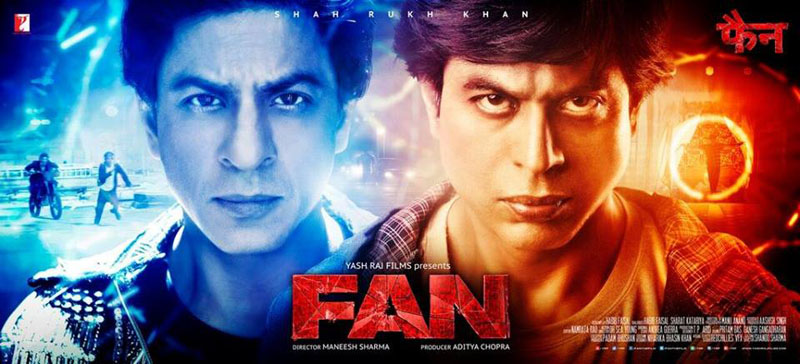
Fan (2016)

Fan- Movie Poster

Aryan Khanna (Shah Rukh Khan) is the reigning King of Bollywood. Gaurav Chandna (Shah Rukh Khan) is 25 years younger and is known in his colony as Junior Aryan Khanna. The resemblance is demonstrated in one awesome, heartfelt, funny talent show turn. He is a superfan, rational in all areas of his life except where Aryan Khanna is concerned. Junior’s passion becomes as destructive as it was once supportive. Aryan says he owes his success to his fans, but he doesn’t want them in his life. Gaurav doesn’t see a distinction between the public persona and the man – he made Aryan Khanna a king, and he can unmake him. Do stars owe their fans anything more than being a star? And why do we care so much about professional liars and dresser-uppers?

Maneesh Sharma gets a great performance from Shah Rukh, a veteran of the twofer deal. Aryan is the big star who lives in in a marble and crystal bubble. All the trademark SRK mannerisms are there – the sarcasm, the dimples, the charm. He lives in Mannat, his wife is called Gauri, he has kids, he gets paid to dance at big society weddings, gets into fights with other stars, is always late, has bad art, owns props and costumes from SRK films. But is he reeeeally SRK? That’s one layer of the game Shah Rukh and Maneesh Sharma play with the audience in this most meta masala. Gaurav is a youthful puppy faced Aryan lookalike. His characterisation goes beyond the fancy visual effects and body doubles to look like a young version of himself. Gaurav has a jaunty walk and several of his hero’s mannerisms too, but just a little bit off beat or jerky looking so it’s close but not perfect. When Gaurav is “doing” Aryan, his expressions change and his voice lowers in pitch to heighten the resemblance.

There is of course a supporting cast, but this is so much about the herocentric world of star and fan that Shah Rukh is in almost every shot. I liked Shriya Pilgaonkar as Gaurav’s crush, Neha. She is a pretty girl next door type and has a good rapport with the nervous and jumpy Gaurav. Yogendra Tiku and Deepika Amin are excellent and very believable as loving parents with a blind spot to their son’s weirdness.

Manu Anand’s cinematography makes Fan look amazing. Bombay is the contrast of Aryan’s cool world with the grimy, seedy, well-worn and fabulous city, Delhi is the intimate and homely neighbourhood, and the Dubrovnik sequence has echoes of Bond. Gaurav has a great chase scene with the police in Mumbai where he leaps from window to window, hanging from canopies and AC units, eventually wrecking the tiffinwallahs delivery success rate by sending dhabbas flying.  But guts and adrenalin can only take him so far, he stills gets nabbed. When Aryan chases Gaurav through Dubrovnik, it is beautiful as well as a pumping action scene. And Aryan has 25 years of being an invincible hero under his belt.

Fan-Gaurav meets Aryan

There is a moment where had Aryan behaved differently, Gaurav would probably have gone home and calmed his farm. But Fan uses old SRK interviews to tell us that Aryan won’t step back from putting himself first, or he wouldn’t have been driven enough to make himself into a huge star. Aryan takes a swing at the press for missing the point and talking about his image when the real story was overlooked. Some confrontations with British police felt OTT to me in terms of the acting (is it just lame white extra acting?), but my experience arriving in London probably doesn’t compare to, say, SRK landing at an American airport. Sharma also blends in footage taken outside Mannat and from the recent Temptations Reloaded tour. So Aryan is shaped by incidents that echo Shah Rukh’s past. It’s a smart way to both add cred and amp up the meta to stir up more questions.

The visuals also convey both the inner worlds and the tension between Aryan and Gaurav. Gaurav’s room shows that Aryan occupies all the space in his life. When the crowds outside Mannat disperse, they leave detritus in their wake – thongs (I’m Australian, that is not as dirty as it sounds), paper, stuff – as the only sign they exist. When Gaurav waits outside to see Aryan on his birthday, the only thing he hears is his own voice. When the POV switches to Aryan, we get a wall of noise and a sea of faces. In one fight scene, the hate is palpable. Aryan really wants to hurt Gaurav, and Gaurav is too far gone to stop himself. As blows are traded their posture starts to mirror each other, almost as though one man was fighting himself.

It’s not perfect. The movie would have ended really quickly had any law enforcement agencies thought to look for fingerprints, DNA, reliable witnesses, or just done their job. But why use science when you can play cat and mouse with your characters and with the audience? Viewing companion The Mahesh Fan felt the second half got a bit unrealistic in the context of the rest of the film being underplayed by Bollywood standards. I didn’t mind the action scenes at all, as I thought it showed in a very filmi way what Aryan was – a movie hero. Of course he could handle a motorcycle chase, a rooftop fight, a long emotional speech, all without batting a stunning eyelash. That is what made him Aryan Khanna. (Sidenote – The Mahesh Fan was an extra in Chak De India and says SRK was given the nickname No-Show Shah Rukh because of his perpetual tardiness. We laughed a lot when Aryan rocked up hours late to an event.)

This is a smart film about the industry, about fan culture, and stardom. There is even a little thread about aging gracefully in the public eye (or not – maybe as one waxwork attests). There is temptation to read into every line and interrogate every symbol, but Fan is also a well-executed ripping yarn and entertainment. All the working bits of your brain can be happily occupied watching it. The Mahesh Fan’s verdict was it needed more songs, more dancing, and about twenty minutes less in run time. I can see her point, but that didn’t detract from my enjoyment. I am so happy I love, and am a bit disturbed by, this film. Nice one No-Show!

Sardaar Gabbar Singh (2016)

poster

I didn’t expect great things from Sardaar Gabbar Singh, so wasn’t surprised when it turned out to be a formulaic action flick that’s overly reliant on Pawan Kalyan’s star power.  What the makers of Sardaar Gabbar Singh seem to have missed is that Dabangg and its Telugu remake Gabbar Singh were successful because they poked fun at the traditional herocentric films of the seventies and eighties. Here was a hero who wasn’t pure and honourable but instead was a bit crooked himself and out to look after No 1 above all else. If other people happened to benefit from that self-interest, well and good, but that wasn’t the main motivation behind Officer Chulbul Pandey’s vendetta against Chedi Singh. And therein lies the problem with Sardaar Gabbar Singh. While the first half gets off to a good start, by the time the story is starting to take shape Gabbar Singh (Pawan Kalyan) turns out to be just too, well, good. He’s not selfish enough, not corrupt enough and not greedy enough to win our hearts the way Chulbul Pandey did in Dabangg. For all it’s faults though the film does have an entertaining first half and the big budget ensures top-notch fight scenes and well constructed sets. It’s just a pity the rest is so pedestrian and clichéd.

The story is threadbare thin and follows a by-the-numbers good cop vs. evil landlord format with a beautiful and hapless princess thrown in to add a little glamour. After a cute opening scene to prove that Gabbar Singh has always stood up for himself (even as a child when sleeping under a Sholay film poster on the streets), he next appears as a rough and tough cop determined to bring his own form of justice to bad guys everywhere. Luckily for Gabbar Singh the crooks haven’t learnt that they need to attack en masse rather than one at a time if they want to have any chance of winning, so right from the first fight, he has little difficulty in overcoming an entire gang all by himself. At least the fight is well choreographed and Pawan Kalyan is funny as well as competent while taking down the latest collection of inept gangsters. His success means that Gabbar Singh is shipped off to a town in dire need of some law and order, with his best mate since childhood Samba (Ali) dragged along too.

The villain of the story is cartoonishly over-the-top evil and sadistic, while his crimes are varied and myriad. Bhairao Singh (Sharad Kelkar) has destroyed the local farmland by mining after viciously disposing of the villagers who happened to be living there. He’s also taken over the roads for his own use, intimidated the locals by killing anyone who opposes his rule and maintained a triad of lieutenants who commit various other crimes in his name. In Bhairao Singh’s sights is the land owned by Princess Arshi Devi (Kajal Aggarwal), as another potential site for a mine – although the concept of prospecting to discover if there is anything worth mining never seems to cross his mind. In the meantime, Gabbar Singh has the princess herself in his sights while simultaneously attempting to win control of the town back from Bhairao Singh. Adding to the impressive cast line-up but not necessarily to the plot, Mukesh Rishi plays the role of General Hari Narayana, guardian to the princess who is trying to secure a deal with hotelier Ramesh Talwar (Rao Ramesh) to save Arshi’s palace and secure her future.

Gabbar Singh is a one-man army capable of overcoming a seemingly never-ending parade of thugs while dodging bullets, speeding trucks, horses and everything else that comes his way. He wins back the local school for the children, fights against oppression and is prepared to give up the girl of his dreams because of her higher station in life. In short he’s a paragon of everything that is right and good, and that really just makes him rather dull and uninteresting. Thankfully Pawan Kalyan has the charisma and screen presence to make something more of his character, but even he can’t save the overlong and drearily predictable second half. Even the fight scenes start to become dull as Pawan Kalyan shows off his martial arts skills (impressive) and the thugs repeat the same mistakes over and over again.

Another problem is the character of Bhairao Singh who is basically a caricature of an ‘evil overlord’ and is only required to curl his lip autocratically and look down his nose at everyone else to play his part. Although Sharad Kelkar has an impressive sneer and can flare his nostrils when required, it’s not a demanding role and he’s too cartoonish to be a properly intimidating villain. The usual suspects who appear as his multitude of henchmen and assistants are not on screen for long enough to make an impression, while Brahmaji appears as police officer who seems to suddenly back Bhairao Singh for no apparent reason. Surprisingly, although Ali and Brahmi provide much of the comedy they are both fairly subdued and practically disappear in the second half leaving Pawan Kalyan to supply the humour as well as the action. For me the most interesting character is Gayathri, Bhairao’s wife. It’s a small role but Sanjjanaa makes the most of her time on screen and conveys a lot of meaning though her body language and eyes, making more of an impact than many of the other seasoned actors around her.

Devi Dri Prasad’s songs work well in the first half, especially the title track and Tauba Tauba which has the best picturisation and is fun to watch.

However the romantic songs in the second half are poorly placed and slow the pace considerably. They’re also very unimaginatively shot in the snow-covered peaks of Switzerland which for me is just a cliché too far.  Otherwise the film looks beautiful with Arshi Devi’s palace looking stunning and Kajal dressed in amazingly beautiful costumes and jewelry. The village does look as if it’s somewhere in the Wild West instead of India, but there are plenty of doors, boxes, miscellaneous carts and glass windows for the thugs to be thrown against, so it serves its purpose well.

Sadly Sardaar Gabbar Singh fails as a follow-up to Gabbar Singh, with the only link being the lead character’s name and occupation. The industry self-referential comedy that made Dabangg such a success is missing and there is little to recommend it other than Pawan Kalyan and a couple of good songs. While the first half is entertaining, the film badly loses its way after the interval and becomes yet another overlong and repetitive action film. It’s not terrible but given the team behind the film it’s disappointing that this is the result. One only for fans.

Kali (2016)

Kali

I’ve been looking forward to the combination of Dulquer Salmaan and Sai Pallavi onscreen in Sameer Thahir’s Kali, and thankfully they don’t disappoint. It’s an interesting film too, with a simple but effective screenplay from Rajesh Gopinadhan, following the story of a young man who cannot control his temper and the unexpected consequences of one of his episodes of rage. The first half sets the scene for a compelling thriller in the second half and with excellent performances from all the actors, Kali is definitely well worth a watch.

The film starts with a violent fight at a roadside restaurant. It’s beautifully choreographed and includes the displeasure of the restaurant’s resident cat whose meal is disrupted by the conflict. The snarling cat adds a touch of wildness and lawlessness to the fight that’s echoed later on in the film when the action returns to the restaurant. The short but vicious opening also sets the scene for another fight, although this one is less physical but equally damaging in its own way.

Siddharth (Dulquer Salmaan) is a man with a very short fuse and the simplest of things makes him lose his temper. After the fight at the restaurant, the next round is between Siddharth and his wife Anjali (Sai Pallavi). Anjali is seen leaving their house in tears and carrying a suitcase, while inside Siddharth is angrily throwing objects at the wall. It’s a scene of domestic life that rings true, particularly since Anjali isn’t staying around to accept any abuse and sensibly heads for the door. However it’s late at night and Siddharth at least doesn’t leave his wife walking down the road by herself, managing to pick her up in their car even though he’s still clearly very angry indeed.

The film moves into flashback to show how Siddharth has always been quick to lose his temper, even as a child, and how the years haven’t mellowed his reactions at all. Throughout his time as a student and even during job interviews, Siddharth shows no patience and absolutely no control over his angry reactions. He’s a man who reacts first and rarely thinks about the consequences of his behaviour. It seems strange that Anjali does stick with him and it’s hard to believe that Siddhartha hasn’t had any previous problems as a result of his behaviour. No-one ever seems to react badly to his outbursts for example. What’s good about the flashback though is that there is little about the love story between Siddharth and Anjali. Their romance is simply a fact, and the film instead shows Anjali’s struggle to cope with Siddharth’s temper outbursts and her attempts to keep him on an even keel. Many of the situations are drawn from routine day-to-day hassles and while Siddharth’s irritation is understandable it’s his inability to control his reactions that make him such a difficult person to deal with.

There is a kinder side to Siddharth too though, and he’s not all rage and temper. He does make some attempt to keep his temper and tries to control his frustration with his bank customers using a stress ball Anjali gives him, with at least some partial success. However he has an incredibly irritating colleague in Prakashan (Soubin Shahir) who is deliberately provocative and obnoxious, although Siddharth does his best to ignore him as much as possible. Dulquer Salmaan and Sai Pallavi have excellent chemistry in their scenes together which makes their relationship believable. It’s easy to see why Anjali stays with Siddharth despite his anger management issues – the two are clearly in love and outside of his temper tantrums Siddharth is a caring and attentive husband. I love the end of this song where Anjali dances with Siddharth in their living room. It seems very natural and spontaneous, plus Sai Pallavi is simply gorgeous in that red sari!

The film steps up the pace in the second half when Siddharth and Anjali find themselves in a frightening situation as a result of Siddharth losing his temper with truck driver Chakkara (Chemban Vinod Jose) on the road. The couple end up at the restaurant seen in the opening scene of the film where Siddharth’s anger puts him and Anjali in real danger and Siddharth has to curb his natural aggression to try to ensure their safety. The tension rises steadily as the situation escalates further out of control and both Gireesh Gangadharan’s cinematography and Gopi Sundar’s music work well to add further pressure.

Dulquer Salmaan does a fantastic job of conveying his rage without going too far and over dramatising his outbursts of temper. Despite his ever-present anger he manages to make Siddhartha at least a partially appealing character  and I even found myself in sympathy with him as I was just annoyed by Prakashan and the bratty child that visited Siddharth’s house! Dulquer also is excellent in the latter half of the film and allows his inner struggle to show clearly on his face as he deals with the staff and clientele at the restaurant. It’s another brilliant performance and despite the negative tones I thoroughly enjoyed his characterisation here.

After her critically acclaimed début in Premam, I wasn’t sure what to expect from Sai Pallavai but she puts in another fantastic performance in Kali.  Her frustration and disappointment with her husband come across beautifully and she gets the level of embarrassment and distress just right when Siddharth loses his temper in public.  On top of all that she still manages to have great chemistry with her co-star and makes their relationship believable too. She’s just as good in the second half and her terror and helplessness are a major factor in maintaining the tension in the latter part of the film.

The support cast are also uniformly good with Vinayakan and Chemban Vinod Jose perfectly cast as the main villains of the story. They effortlessly exude menace and both have great evil grins and good use of their expressions to help increase the tension every time they appear onscreen. Soubin Shahir is incredibly annoying as fellow bank employee Prakashan and as such manages to win Siddharth some sympathy for having to deal with such an idiot on a day-to-day basis! However thankfully Prakashan is never too over the top and Soubin Shahir doesn’t just play his character for laughs but actually makes him a more plausible character than expected.

Kali is a film of two halves. The first sets up the situation for the rest of the movie, and concentrates on the personality of Siddharth and his relationship with Anjali. It’s a well constructed observation of human interactions and the painful cost of unreasoning rage and unsociable behaviour. The second half on the other hand is an out-and-out thriller where the characters are more broadly drawn and the action tense and frightening. And yet, despite the different pace in the first and second halves the film works well as a whole story and makes for an enthralling two hours of cinema. Highly recommended.