Kiragoorina Gayyaligalu

kiragoorina-gayyaligalu

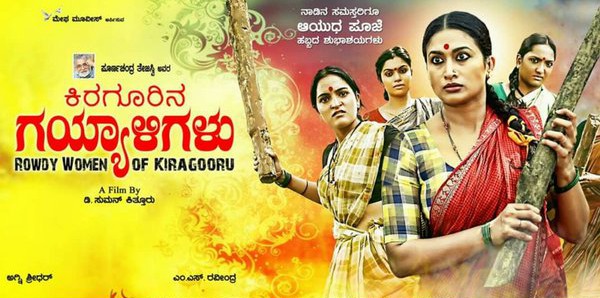
Kiragoorina Gayyaligalu is a beautifully filmed adaptation of a novella by acclaimed Kannada writer Poornachandra Tejaswi. Director Sumana Kittur has teamed up with screenwriter Agni Shridhar (responsible for the excellent Aa Dinagalu) to give a colourful look at village life in rural Karnataka from the recent past. Various small incidents illustrate the relationships between the different groups in the village, but the usual routine is thrown into disorder when there is a plot to con the villagers out of their land. The situation escalates until it’s up to the ‘rowdy women’ of the title to restore order and deal with the corrupt officials behind the scam. I haven’t read the original story but the film is charming with a balanced blend of drama and comedy that still manages to address a number of social issues, albeit in a light-hearted way.

The film starts by showcasing the differences between the men and women of the village. While the women are out working, the men are lounging around the village, playing dice and utilising the services of the village barber. The women from different castes all work together without any issues but it’s a different story for the men of the village who are more inclined to take notice of someone’s place in society. The higher caste Gowdas negotiate the cheapest price they can for any work done for them by the lower caste Kulavadis although the men all congregate to drink together in the village arrack shop at the end of the day. The arrack shop is a point of contention for the women as they feel that this is the reason their husbands have become lazy and argumentative. All in all, Kiragooru seems to be a typical village with the usual colourful characters, petty disputes and plenty of potential for mischief.

Daanamma (Shwetha Srivatsav) is an outsider from a different village who is married to Subbaiah (Rahul Madhav), one of the Gowdas in the village. Despite being a relative newcomer, the other women look to her for support and she’s the one they ask to break up a fight between Kaali (Sukrutha Wagle) and Rudri (Manasa Joshi) when tempers flare. She’s just as competent at home, refusing to let Subbaiah leave when everyone else runs from a police jeep in the village and ensuring the household runs to her satisfaction, although she does seem to have a genuinely happy relationship with her husband. Daanamma also provides support to Nagamma (Sonu Gowda) whose husband Kaale Gowde (Kishore) is abusing her for failing to provide him with children. Kaale is desperate to marry for a second time and has fallen for Bhagya (Karunya Ram), a vegetable seller in the local market but doesn’t tell her the truth about his marriage to Nagamma. Rounding out the village are the Kulavadi farmers who include Maara (Nikhil Manjoo), Kariya (Sampath Kumar) and their families.

Shankrappa (Achyuth Kumar) is the government welfare officer for the village, but he also runs the arrack shop and is plotting with Bhootha Swamy (Sharath Lohitashwa) to con the villagers out of their land. When Daanamma threatens the visiting Tahsildar and runs him out of the village, Shankrappa files a complaint against her with the police that also accuses the Gowdas of cheating the Kulavadis out of their rightful wages. This results in the Gowda men being taken away to the police station where they endure a humiliating experience at the hands of the drunken Inspector. They immediately turn to Bhootha Swamy for help, but he lies and tells the men that it was the Kulavadis who filed the complaint. This widens the divide between the two groups, further fuelled when Bhootha Swamy lies to the Kuavadis too and the Gowdas fan the flames by employing an outsider to chop up the tree. No reconciliation seems possible until Daanamma takes matters into her own hands and enlists the rowdy women of the village to sort out the problem once and for all.

It’s a well told story with plenty of quirky characters, but the appeal of the film lies in the excellent performances from all the actors. No matter if the character is only on screen for a few moments such as the unethical Dr Appanna (S Narayan), everyone seems to fit their role perfectly. Shwetha Srivatsav has most time onscreen and is brilliant as Daanamma with her perfect mix of compassion, bravery and common sense making compelling viewing. This is very different to her role in Simple Agi Ondh Love Story but she again makes excellent use of her facial expressions and both looks and sounds the part of a rural villager. Sukrutha Wagle is appropriately shrill and combative as one of the Kulavadi rowdy women, while Sonu Gowda provides contrast as the silent but still expressive Nagamma. The scenes between the different female characters also ring true with plausible discussions of their routine chores and complaints about their husbands with the occasional small rivalry thrown in to demonstrate how they got their reputation. Their support for each other is also realistically portrayed along with their determined reactions which are a good contrast to the men’s vacillations and indecision when faced with a problem.

The men all suit their various roles too. Rahul Madhav, Sunder and Anathavelu are all good as the overly trusting Gowda men, while Kishore is excellent as the abusive Kaale. Although the character is mainly comedic, there is a serious side in the abuse he deals out to his wife and it’s a credit to the film that this is dealt with sensibly, both highlighting the abuse itself and giving a solution that shows Kaale to be the one at fault rather than his long-suffering wife. The film also raises the issues of drunkenness and caste division and although these are used to some extent for comedy, there is a serious side as these are shown to be real issues for the community. Naturally the women are the ones to solve these issues too with their practicality and common sense winning the day.

Kiragoorina Gayyaligalu is a film where everything just comes together perfectly. Manohar Joshi’s cinematography is complemented by Saadhu Kokila’s music and Sumana Kittur evokes a village atmosphere through colourful dialogue and fantastic attention to detail. The language is often beeped out but the subtitles are hilarious with the women not afraid to air their graphic opinions publicly and loudly! Each scene is complete in itself but also serves to establish and evolve the different characters and situations. Added together they all build up to a captivating story and satisfying finale. One I highly recommend for the excellent performances, well-written screenplay and some of the best female characters I’ve seen in Indian cinema. 4 ½ stars.
Befikre (2016)

befikre

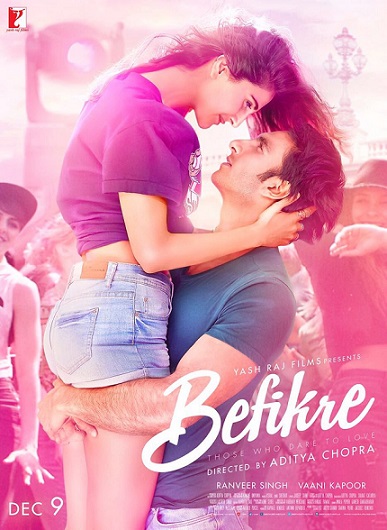
Easily the best thing about Aditya Chopra’s Befikre is Paris, and thankfully the characters spend plenty of time wandering past significant landmarks and meandering through lane ways full of beautiful buildings giving the city ample opportunity to shine. It’s not that the rest of the film is that bad – it’s just not that good. At its best, Befikre is funny and both Ranveer and Vaani are full of life and energy, but the plot is nonsensical, the dares that are used to further the love story ridiculous and there are so many WTF moments that the farcical ending is no surprise. And to cap it all off, it’s such a shame that a film set in the ‘city of love’ contains so little actual romance.

The opening sequence shows numerous couples kissing over the credits but what starts as possibly sweet and romantic moves to voyeuristic and just a little bit creepy as it goes on for that little too long. Any thought of love is also quickly dashed when we first meet Dharam (Ranveer Singh) and Shyra (Vaani Kapoor) as they’re in the process of breaking up. Neither one appears as an attractive character during the ensuing slanging match, while Dharam in particular seems to be typical of the chauvinistic man-child so often portrayed in Hindi cinema. Despite all the drama, the break-up is actually quite funny, at least until Dharam does the unforgivable and calls Shyra a slut (more of that later) before she finally leaves.

The film quickly moves back a year to when Dharam and Shyra first meet and their ’love’ story starts.  Dharam is a stand-up comedian who has moved to Paris to appear at a club run by his friend Mehra (Aru Krishansh Verma). Sadly Dharam isn’t funny at all as a comedian but he is quite amusing when he’s hanging out with Shyra. Initially Shyra doesn’t want a bar of him and is quite happy with a one-night stand, but a silly game of dare results in the two heading out together on a date and the relationship develops from there.  Both Shyra and Dharam resolve never to say “I love you’ and to keep things light and carefree with no commitment, but despite this agreement, Shyra ends up moving in with Dharam. The relationship moves forward through a series of ever more ridiculous dares, all of which would have resulted in arrest and possible jail time if, for example, anyone really did hit a policeman or perform a striptease in a library. Of course Dharam and Shyra are never seen to have to deal with any repercussions from their actions, some of which are a little too risqué to be easy viewing and despite all their antics there is never any sense that the two are anything other than friends-with-benefits. It’s Paris for goodness sake – where’s the wining and dining, the romantic walks through parks and along the Seine? Sadly for Dharam and Shyra it’s all night clubs and bedrooms with little else between – no wonder their relationship eventually breaks down so spectacularly.

The film moves back to the present day where Dharam and Shyra meet up again by chance and renew their friendship. And this time they are strictly friends as Dharam is happily working his way through a number of French women and Shyra is content with her single life. But then she meets Anay (Armaan Ralhan) and everything changes. Shyra embarks on a mature and adult relationship which seems to be happily heading towards commitment, but even here there are cracks in the screenplay. Who leaves their possible fiancé at the top of the Eiffel tower and runs off to ask their friend for advice? Would anyone seriously still be waiting for an answer after that? And while the easy camaraderie and friendship between Dharam and Shyra suits them much better than any romance, how can two people who parted on such bad terms ever develop the easy relationship shown here? At least Dharma apologises for his slut comment, accepting that it was inexcusable and less about Shyra and her previous lovers and more about him and his immaturity. Finally a small step (OK, maybe less of a step and more of a toe-dip) in the right direction, and rightly applauded by the audience too.

What keeps the film going are the performances from Ranveer Singh and Vaani Kapoor. No matter that there is zero sparkage between the two of them, they are both so energetic that it’s just possible to overlook the idiotic dares and juvenile behaviour and enjoy the craziness of two OTT people rampaging their way through Paris. This works better when they are friends rather than lovers, but for the most part their scenes together are funny and full of joie de vivre once they move past the bedroom antics. I love Ranveer Singh when he hams it up and exaggerates every possible expression and gesture as he does here. Similar to his roles in Kill Dil and Gunday, here he’s loud, brash and looks to be totally enjoying every minute as his enthusiasm colours every frame. He has great comic timing throughout and his one-liners had the entire cinema in stitches, while once again he sparkles through the songs.

Not to be outdone, Vaani Kapoor is equally buoyant during the flashback sequences while the evolution of her character allows her to be more reserved and restrained in the second half of the film. Vaani expresses a range of emotions well and her wavering and indecision about commitment is very well done in the latter half of the film. She also fits well into the European-Indian styling she is given and at least in the second half of the film does deliver some French-style sophistication during her romance with Anay.

Despite the ridiculous storyline I did enjoy most of Befikre – although nothing could make me enjoy the ending, not even Ranveer. It was a real pleasure to see Paris as the backdrop for the film even if more could have been made of its reputation as a city for lovers. While both Dharam and Shyra are irritating during the flashback sequences, for the most part their friendship is more accessible and I did find a lot of the humour very funny. Most of the audience were laughing too and the general atmosphere was pretty upbeat in the cinema. The songs from Vishal-Shekhar are great and suit the overall mood of the film and of course the whole film looks stylish, but Befikre really needed a much better story-line and more depth to the characters. The end result is a romantic comedy that basically has no romance despite the best efforts of Ranveer and Vaani. Worth watching for the beautiful views of Paris and the exuberant Ranveer Singh who really can make anything engaging!

Dhruva (2016)

dhruva

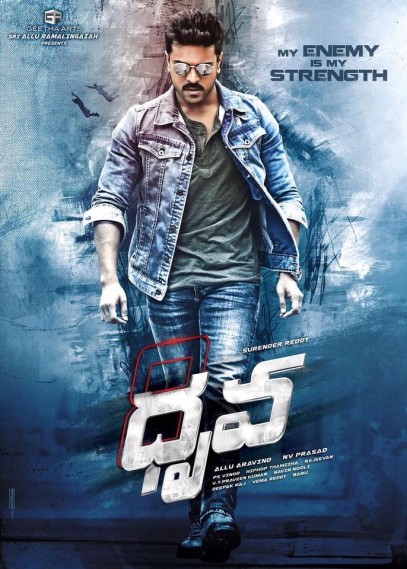
Dhruva is a reasonably faithful remake of 2015 Tamil film Thani Oruvan that benefits from Arvind Swamy reprising his role as the villain of the story. Dhruva is definitely slicker and glossier than the original, but the story is essentially the same although the emphasis is even more on the two main characters than in Thani Oruvan. Thankfully both Ram Charan and Arvind Swamy are excellent and the cat and mouse game between the two makes Dhruva an entertaining and worthwhile watch.

The film is a thriller that follows the attempts of a young and righteous police officer, to track down and catch one of three über criminals. Dhruva (Ram Charan) believes that if he locks up the kingpin of any criminal organisation this will immediately impact on 100 petty criminals and be more effective than tackling each street thug individually. It doesn’t take long before he discovers that his three possible targets each themselves are controlled by an even bigger villain – Siddharth Abhimanyu (Arvind Swamy). Siddharth is a respected scientist, recipient of a Padma Shri award and all round respected businessman so Dhruva has to somehow find convincing enough evidence to send Siddharth to jail for his crimes.

In the original film Dhruva was helped by his close friends who all formed a posse to fight crime together while they were in training college. However their role in the story here has been reduced and although the friends are still there, they have less to do in the hunt for Siddharth.  Goutham (Navdeep) is the only one who has been kept fairly true to the original, but without the detail of their friendship as background, his character is less effective. This also has an impact on the characterisation of Dhruva who appears more isolated and less of a leader as a result, making his assumption of control of a crime task force immediately after his graduation rather less credible.

Another casualty of the re-write is Ishika (Rakul Preet Singh) whose character has even less to do than Nayantara in the Tamil version. Ishika is a victim of love at first sight when she sees Dhruva, and she pursues him relentlessly, knowing that in a Telugu film eventually her persistence will be paid off by Dhruva finally accepting her love – rather than arrest for stalking, which would be the most probable outcome in real life. Although she is a forensic specialist, this is barely mentioned in the film, and Ishika has little involvement in the search for evidence against Siddharth. Where Nayantara’s Mahima had useful ideas and forced her way into the investigation, Ishika is limited to appearing only as the romantic interest. However Rakul Preet Singh does a good enough job in this role and has reasonable chemistry with Ram Charan, which at least makes the scene where Dhruva finally does admit his feelings one of the better moments in the film.

The film is all about Dhruva and his developing relationship with Siddharth and Ram Charan is excellent as the obsessed police officer, determined to track down Siddharth no matter what it takes. He certainly looks the part, easily demonstrated since Surender Reddy is an equal opportunity director who ensures that for every shot where Rakul Preet Singh appears in a bikini there is a shot of Charan without his shirt. No complaints here!  While Ram Charan expertly channels his inner Salman Khan, he also does a good job of portraying the more cerebral side to his character and his monologues where he describes his theories about the local criminals are well delivered. He’s even better when Siddharth’s tactics begin to hit home and Dhruva begins to doubt himself as he loses Goutham and his every move is known by Siddharth even before he makes it. This gradual erosion of his self-confidence is well depicted and Charan gets the emotions across effectively while still maintaining his tough cop persona.

However, as in Thani Oruvan the real star of the film is Aravind Swamy, who is perfectly evil as the amoral and unscrupulous Siddharth. His callously dismissive way of ordering the execution of anyone from mere bystanders to major players in his plots is wonderfully chilling and his appreciation of a worthwhile enemy in Dhruva just adds more menace to his character. I think he is even better here than in Thani Oruvan, or perhaps it’s because there is less focus on the other criminals and his added screen time lets him play nasty more effectively. Posani Krishna Murali does well as Siddharth’s bumbling politician father and the contrast between the clever but absolutely evil son and his unaware and totally inept father is simply brilliant and works just as well here as in the original.

The story stands up well to the remake in Telugu, even if shifting the focus even more onto the two lead characters does make for a less believable plot. Ram Charan is suitably heroic and the only disappointment is that there is little opportunity for him to show off his dancing skills. The music from Hiphop Tamizha is fine but not as memorable as his Tamil soundtrack, and the songs occasionally seem rather oddly placed, particularly in the second half. Still, the picturisations are good, and the scenery for Choosa Choosa stunning. Neethoney has the best dance moves though.

Dhruva is a good remake of an excellent film and definitely well worth a watch. Ram Charan takes on the role of a dedicated police officer, but one with more flaws than a usual Telugu hero and performs his part admirably. Arvind Swamy is perfect as his nemesis while the psychological cat and mouse game between the two is beautifully played out. Mohan Raja is credited with the original storyline and Surender Reddy has aptly modified the plot to give a slick and entertaining thriller. One to catch in the cinema if you can.