Ethir Neechal (2013)

Ethir Neechal

Ethir Neechal is one of those films I’ve been meaning to watch for ages, mainly because I loved the soundtrack when it first came out, but also because I’d seen the video for Local Boys and thought it looked fantastic.  It also sounded unusual, with a story combining an attempt to run the Chennai marathon with a romance and some comedy, plus a reference to real-life track athlete Santhi Soundarajan added in to the mix.  Unfortunately though, despite a good beginning, the film loses its way in the second half where the light and breezy romance is suddenly pushed to one side by the trials and tribulations of a serious sports story and it never quite recovers.  Still, Siva Karthikeyan is a likeable hero and there is that excellent soundtrack which makes Ethir Neechal worth at least a one-time watch.

The film starts with the woes of a young man with an unfortunate name. Kunjithapatham (Siva Karthikeyan) has endured sniggers and laughter for years as the short form of his name is apparently a rude word in Tamil. His one childhood rebellion to try to change his name resulted in his mother falling ill, so he decides to put up with his name and just get on with life. He’s fairly successful too, but the combination of an insensitive boss and a romance that falls through when the girl hears his name means that finally Kunjithapatham decides to takes his friend Peter’s (Sathish) advice and change his name. Naturally this can’t be a simple decision and requires a visit to numerologist Gunasekara Raja (Manobala) to finally come up with the new name of Harish.

No sooner has he changed his name than good things start to happen for Harish. He meets up with teacher Geetha (Priya Anand) and falls in love straight away when she compliments him on his name. Harish also gets a new job and makes a clean break with his old name and old life. Everything seems to be going along fantastically well until Geetha finds out that he lied to her to hide his old name. She’s unimpressed and Harish resolves to achieve something that will allow him to make a name for himself and make Geetha proud of him.

Harish decides to run the Chennai marathon, and not just in an attempt to finish. Oh no – nothing that basic. Harish wants to win the race, despite only starting to train when he signs up a few months out from the event. This is where Valli (Nandita) enters the story as a trainer for Harish and the story suddenly turns serious.

After a run in with corrupt coach Raja Singh (Ravi Prakash), Valli was stripped of her medal at the Asian games when she failed a gender test. Harish learns of her story and this gives him another reason to win the marathon and beat Raja Singh’s current top runner. The problem is that there is an extended flashback showing Valli’s struggles as a young athlete and the issues she faced in trying to compete. While I appreciate R. S. Durai Senthilkumar’s attempt to raise awareness of the difficulties athletes in India face, Valli’s story acts as a road block and completely changes the mood of the film.

Valli is based on the athlete Santhi Soundarajan, whose real-life story is compelling enough to be a film in its own right rather than just as a brief add-on as seen here. It’s not just that Valli’s struggles don’t fit well with the rest of the film but her story doesn’t add anything to Harish’s attempts to be accepted – despite both characters having an ‘invisible handicap’ to overcome. Valli is also fairly unlikeable as portrayed here and with her prickly and antagonistic nature it’s difficult to warm to the character. Nandita seems dull and lifeless in the role, although she is better in the flashback in the scenes with her father (Sharath Lohitashwa), so I presume her grumpy attitude was due to the director. The happy romance of the earlier scenes is completely overshadowed by her serious and dour attitude, so it’s a relief when the film does move on to the actual race and the mental and physical struggle faced by Harish. Even though the film stays serious, Siva Karthikeyan is a personable hero and the marathon is well filmed with just enough tension in the race to keep it entertaining right to the end.

Siva Karthikeyan does a good job with his role and fits well into the boy-next-door type of romantic hero. He’s in his element in the comedy scenes and has a good partnership with Sathish as the two play off each other perfectly. There are some very good moments in the early scenes with Geetha too and Priya Anand is perfectly suited to her role as a primary school teacher. She has a wonderfully expressive face and makes a good partner for Siva Karthikeyan as the two slowly develop their relationship with a few misunderstandings along the way. They make a realistic couple and it would have been good to see more of their relationship and the effect of Harish’s new determination as he  started training rather than the shift in focus to a different story with Valli.

The best part of the film is undoubtedly the upbeat soundtrack from Anirudh, and thankfully the song picturisations are complementary to the music. In addition to producing the film and his guest appearance in the movie, Dhanush has collaborated in writing lyrics and by singing a few of the songs, while Anirudh also makes a brief appearance as a bar owner. Most of the early songs have a classic flash-mob feel as various apparently random members of the public join in, and the backing dancers range from obviously fit professionals to chubby lunghi-clad uncles in Local Boys.  Boomi Enna Suthudhe  has a particularly random and accident prone start that seems to perfectly fit Harish’s character.

R. S. Durai Senthilkumar seems unsure if he wants to make a romantic comedy or a serious sports film, and really should have picked one and stuck to it. The first half of the film works much better for me and I’d give it 4 stars, but the slow pace and sharp change in mood means that overall I give the film 3 stars. Worth a watch for Priya Anand, Siva Karthikeyan and for a chance to sing along to the songs!

Badlapur & Theevram

As I was watching Sriram Raghavan’s Badlapur I was struck by a number of similarities to Theevram, a Malayalam film I’d watched just a few weeks before, so it seemed appropriate to write about them together. Both are films based on a story of revenge where the hero is forced into action by his perceived lack of justice, and both star an up-and-coming young actor surrounded by an experienced and proficient support cast. While Badlapur focuses on the obsession of revenge and the destructive consequence to Raghu (Varun Dhawan), Theevram is a more straight forward drama with Harsha (Dulquher Salmaan) playing a game of cat and mouse with Police Inspector Alexander (Sreenivasan) as he exacts his revenge. Both are good films in their own right but while I prefer Badlapur’s more ambiguous storyline, Dulquher Salmaan just pips Varun Dhawan in his portrayal of a man driven to the absolute extreme for revenge.

The story of Theevram is told in a non-linear fashion, and is actually based on a couple of real life murder cases. Sreenivasan plays a respected police officer who has an unfortunate dislike of autopsy although there is nothing lacking in his detective skills. He’s paired with a younger officer, the more impetuous Ramachandran (Vinay Forrt) and the two make a good team. The film begins with Harsha’s revenge and it’s not until later that we discover why he has been driven to this extreme. At the start we don’t know if he is a good guy or a serial killer, as without any explanation he systematically tortures and kills a man in his plastic coated cellar. His actions seem to be at odds with his day-to-day life as a piano teacher, however once Inspector Alexander comes to call it becomes clear Harsha was the victim of a crime. Most of the film is shot with dull and muted colours, but once a flashback sequence starts, explaining what has happened to Harsha to turn him into this cold and methodical man, suddenly the colours are full and rich. A rather obvious metaphor but one which is very effective.

Harsha’s wife Maya (Shikha Nair) was murdered by a company driver Raghavan (Anu Mohan) for her complaints about his speeding with her in the car. Her murder is pre-meditated and brutal, with Raghavan severing her head from the body to attempt to delay identification. He’s quickly arrested and sentenced to life imprisonment for his crime while Harsha struggles to cope with life without Maya. However, just as Harsha is starting to get on with his life, the circumstances of Raghavan’s family life allow the murderer to obtain an early release from jail. Very early. In fact he only spends 4 years behind bars before being allowed his freedom. Harsha and his friends Dr Roy (Vishnu Raghav) and Nimmy (Riya Saira) decide that Raghavan must die for his crime and set about planning the perfect murder.

Theevram rather controversially takes the view that murder for revenge is perfectly justified if the legal system has failed to properly punish the offender for his crime. Writer and director Roopesh Peethambaran delivers a story of vigilantism where the cold-blooded murder of a criminal is depicted as a good solution, and even acknowledged as such by the police. I can’t say that I agree with this view or with portraying Harsha as a hero for what he does, but the story is gripping and the plot cleverly developed. The contentious treatment of Raghavan is perhaps a way to start a discussion about such issues, and it’s interesting that he isn’t a completely black character. Raghavan does appear to try to look after his disabled wife and seems to be trying to turn over a new leaf after his release from jail. However his behaviour towards Nimmy suggests that the change may only be surface deep and he still has a poor attitude towards women.

Badlapur is a darker film where the lines between right and wrong are blurred and revenge is shown to be a weight dragging Raghu down. The first few minutes are brilliantly filmed, with a shot of a street, with people going their everyday business and the only sounds heard the traffic going past and snatches of conversations as vegetables are bought and gossip exchanged. However in the background there is a robbery, and as the two criminals leave the bank they force their way into a car parked outside where Misha (Yami Gautam) is just loading in her young son and her groceries. During the subsequent chase Robin falls out of the car, while Misha is shot and killed. While one of the robbers manages to escape, Liak (Nawazuddin Siddiqui) is left to face the music. After his wife’s murder, Raghu becomes a haunted and driven man, obsessed with finding Liak’s partner whom he believes fired the fatal bullet. However in reality the opposite is true. Liak was the man who, in the heat of the moment shot and killed Misha, although he never confesses, insisting that he was just the driver.

15 years later when Liak is diagnosed with terminal cancer Raghu is persuaded to plead for Liak’s early release in the hope that he will run to his old partner in crime. Raghu’s bereavement turns him into a cold, hard man who rapes and abuses Liak’s girlfriend Jhimli (Huma Qureshi) as part of his revenge. He’s so obsessed with the idea of finding the man behind his wife’s death that he lives a miserable life, alone and in fairly dismal circumstances. The tragedy has become what has defined the man and it seems as if only his plans for revenge keep him going.

Here, revenge is shown as something that corrupts. Raghu becomes more despicable than his enemy, killing Liak’s partner Harman (Vinay Pathak) and wife Kanchan (Radhika Apte) in cold blood. Liak himself is shown as a rather grey character, who seems to have more of a life than Raghu, despite spending most of it behind bars.

Dulquher Salmaan and Varun Dhawan both do an excellent job as young men devastated by their loss. The problem I have with Varun’s character is that it takes 15 years before he manages to achieve his revenge, and it seems unlikely that he could have maintained his rage so long. Varun tries hard but doesn’t quite manage to pull off playing a man in his forties although he does convey his preoccupation with finding Liak’s partner and his disconnection from normal life very well. Dulquher has an easier time of it, as his character only has to wait 4 years to exact revenge, and his protagonist is easier to dislike. Dulquher is also a man who has managed to move on with his life and although his world is duller without Maya, he would have been content to let Raghavan rot in jail if he’d just stayed there. His revenge is coldly plotted with great attention to detail but there seems to be little rage left – in fact little emotion at all.

Both films are made even better by their excellent support cast. Badlapur would have been less substantial and the revenge less ambiguous without the excellent Nawazuddin Siddiqui and his nuanced performance as the main antagonist. Sreenivasan doesn’t have such a consequential role, but his support and that of Vinay Forrt rounds out the story and ensures a satisfying plot. The films are brutal, both in the violence they depict and in the exposure of such deep despair but there are lighter hearted moments in both and it’s not all doom and gloom. There is just enough light to allow the shade space to deepen and both directors have paced their films well. The strength of both Badlapur and Theevram is in the portrayal of emotions and it’s heartening to see two young actors bring so much depth to their roles. I enjoyed both these films and recommend them for a combination of fine performances, strongly written characters and good storytelling. 4 for both.


RangiTaranga (2015)

RangiTaranga

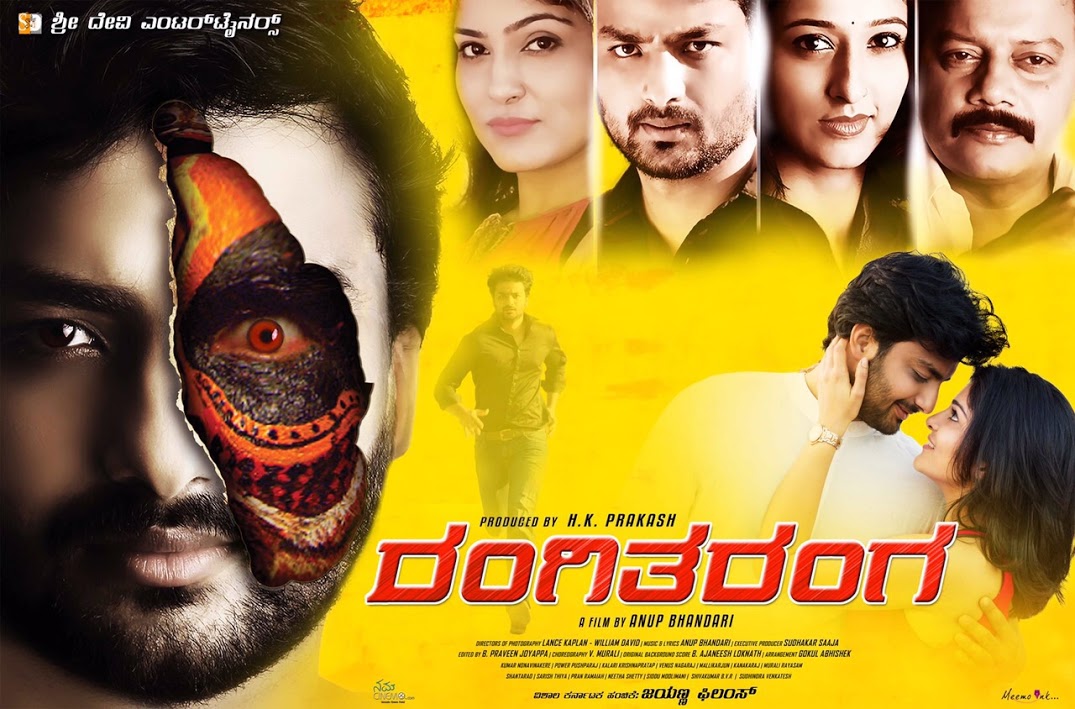
Luckily RangiTaranga was so popular in Melbourne last weekend that they ran some extra screenings this Saturday, giving me the chance to see Anup Bhandari’s début film on the big screen. As an added benefit the film released with grammatically correct English subtitles (yay!), and with yet another full house and the option of samosas and tea at the interval, it was definitely well worth the trip out to Monash.  And it’s a good film too. RangiTaranga is a clever blend of horror and suspense with plenty of twists and unexpected plot turns that keep the film entertaining until the very last minute. It’s an excellent effort from a new director and mainly inexperienced lead cast, although they receive plenty of assistance from the very capable veteran support actors.

The film starts out similar to any classic horror story with a deserted road, driving rain and a lone pregnant woman in a car. Something half seen on the road causes an accident and as the eerie music starts it’s pretty much guaranteed that the lady in the car isn’t going to make it home to her frantic husband. Nothing grotesque is actually shown on camera but right away the atmosphere is set to creepily scary even after the film shifts to the present day and blue skies instead of a dark night.

Gautam (Nirup Bhandari) and Indu (Radhika Chetan) are expecting their first child, but Indu wants to go back to her ancestral village before the baby is born to fulfil a superstitious belief that this will stop the spirits ill-wishing her baby. Gautam rashly agrees to take her, even though Indu is 8 months pregnant and has previously suffered a miscarriage.  After all what can possibly go wrong? At the same time journalist Sandhya (Avantika Shetty) is trying to track down reclusive novelist Anashku and manages to discover his post office box address, which sets her off on his trail. Of course Gautam is Anashku which means eventually Sandhya follows Gautam and Indu along the same rain soaked lonely roads from the beginning of the film to reach the village of Kamarottu.

There are many strange incidents once Gautam and Indu reach the village and the reputedly haunted house that belonged to her family. The ‘ghost of the hills’ seems determined to terrify Indu and her reluctance to leave the house means few of the villagers have even seen her. This becomes a problem later on when Indu disappears and the police refuse to believe that she ever existed. Sandhya becomes involved in Gautam’s search for his missing wife but there are more mysteries than just Indu’s disappearance and not every clue ends up being relevant.  Gautam has the assistance of local postmaster Kalinga (Saikumar) and teacher Shankar (Ananth Velu) while Inspector Haadimani (Arvind Rao) does his best to discredit Gautam at every turn.

RangiTaranga succeeds because it has a well written story with many unexpected twists. I would have been lost a few times without the subtitles as the story gets ever more convoluted with every new revelation. And yet it all makes sense with all the subplots cleverly interlocking to form a complete whole by the end of the movie.

Despite their relative inexperience, or maybe because of it, the cast are all great too.  Nirup Bhandari is excellent as the ever more desperate husband while Avantika Shetty is nicely eccentric as the journalist who gets roped into the search for Indu. Gautam isn’t particularly heroic and never has to do anything too impossible which makes his actions plausible and relatively realistic, despite the supernatural theme. Like any good hero he doesn’t believe in the ghost but the very real fear for his wife and the increasing tension he experiences as his world falls apart is very well expressed. Thankfully Radhika Chetan’s Indu isn’t as terminally dumb as most horror heroines – she doesn’t go tearing off by herself or take ridiculous risks, which makes her terror more frightening and Radhika effectively portrays Indu’s distress and fear. There were times when I wished she would be just a little less brave, and I did jump quite a few times when Indu went hunting whatever it was that was making the odd noises rather than sensibly running for cover and waiting for Gautam to get home!

Saikumar has an important role as the postmaster of the village and his character is well written to take advantage of his support for Gautam and Indu, although there again, things may not be quite what they seem. It’s a perfect role for Saikumar and he is excellent, particularly later in the film, while the rest of the support cast are just as good in their various roles.

The film looks fantastic with the amazing colours in the Nee Kele Vaaduve song perfectly bringing to life the colour wave of Rangi Taranga. All the songs are excellent, although they do occur in quick succession in the second half and could have been a little better placed. B. Ajaneesh Loknath’s background score is very effective and maintains the mood of the film without ever getting too loud and intrusive. Another plus is the stunning cinematography from Lance Kaplan and William David with traditional costumes blending well with shots of beautiful countryside to provide an excellent contrast to the spooky shots inside the building or in the forest at night.  Basically it’s a complete package where everything works together to make RangiTaranga one of the best films I’ve seen this year. Definitely one to catch on the big screen if you can.