Thiruda Thiruda

thiruda thiruda poster

Thiruda Thiruda is a 1993 action film from Mani Ratnam that follows the exploits of two thieves when they inadvertently become involved in a major bank robbery. It’s a real ‘action’ film as almost every scene involves either a fight or a chase of some kind (using nearly every single kind of transport you can imagine), and the heroes are always on the move. At almost 3 hours, the film is rather long, but there is so much happening on screen that it’s an entertaining if not completely edge-of-your-seat watch. However the real reason to watch the film is the excellent music from A.R. Rahman which mixes opera, disco and electronic music with more traditional themes to give one of his best and most interesting movie soundtracks.

The film starts with the printing of new bank notes, destined to be sent all over India in specialised containers that require a computer card to gain access. For added security the containers also require a password, but since this is printed on the computer card, there may not be quite the level of protection the Finance Department think they’ve achieved. The card looks more like a plastic credit card than the key to a sophisticated locking system, but maybe it looked like modern technology back in 1993 and does mean it’s easily transferred between the various thieves. The card is also amazingly impervious to damage and works even after prolonged submersion in water – that does also apply to the truck carrying the money and the container full of money too though so perhaps it’s the water that has the special properties!

Criminal mastermind T. T. Vikram (Salim Ghouse) has various lackeys in India who steal the money for him, but his chief accomplice Ashok (Ajay Ratnam) is quickly apprehended and arrested by CBI chief Laxminarayana (S. P. Balasubramaniam), prompting a rather juvenile temper tantrum from the boss. However after an unpromising start, Salim Ghouse settles into the role of evil mastermind and enjoys himself immensely as he executes people who displease him after he heads to India to find his money. I like that his gang mange to arrange themselves artistically before starting to menace their targets and even the initial robbery is carried off with precise timing and a pleasing display of acrobatic moves on a moving train.

Before his arrest, Ashok manages to send the vital computer card and a cryptic message to singer Chandralekha (Anu Agarwal) who skips out before the CBI manage to arrest her too. Meanwhile petty crooks Kathir (Anand) and Azhagu(Prashanth) are on the run from the police after looting a safe belonging to one of the rich men in their village. During the robbery they stop Rasathi (Heera Rajagopal) from committing suicide, but rather than being grateful she decides to go with them to reclaim her share of the jewellery they have stolen.  Kathir and Azhagu don’t want to be burdened with a village girl so they unsuccessfully try to dump Rasathi, until they learn that she is escaping from an unwanted marriage with her uncle and become sympathetic to her plight.

The unlikely trio cross paths with Chandralekha and get drawn into the race to find the money while trying to stay one step ahead of the law and simultaneously avoid T.T. Vikram and his merry band of thugs. Things move along quickly with a little romance and some attempt at comedy, but mainly there are chase sequences (many, many chase sequences), as Kathir, Azhagu and Rasathi escape from the police, Rasathi’s uncle and his henchmen, the CBI and Vikram and his gang, although not all at the same time. Mostly these are well choreographed with bicycles, motorbikes, cars, horses, buses, trucks, trains and even elephants being used at some point or another, while the art of disguise and misdirection are also used to good effect.

The action sequences ensure that the film keeps moving along at a fast pace, which may be why the various characters are relatively under developed and the script somewhat lacking at times. Kathir and Azhagu should have had an easy camaraderie given that they are two thieves who have been working together since childhood, but here their relationship is clunky. This is particularly noticeable when a love triangle develops between the two thieves and Rasathi and there is little rapport or emotion during their scenes together. It may be the fault of the subtitles but the dialogue between the two is also awkward and fails to deliver the idea of two great buddies out to con the world together.

Heera Rajagopal is much better as Rasathi and even manages a bonding session with the sophisticated Chandralekha which gives Anu Agarwal the chance to make her character more sympathetic than she first appears. Despite her overdone entry scene, I really liked Heera and her portrayal of Rasathi. Every time I felt she was in danger of becoming a typical heroine, moping around and waiting for someone else to save the day, she actually got up and did something about her situation instead. Anu’s Chandraleka was also a much stronger character than anticipated and although the two female leads have less to do than the men, they give the film some much needed shading and depth. S.P Balasubramaniam is in fine form as the CBI officer chasing after the thieves, and fares better than the leads as far as characterisation goes. He has more of a back story and shows good rapport with his co-workers while showing off his excellent interviewing skills. His Laxminarayanan is one of the more interesting characters along with Malaysia Vasudevan as the police inspector, while Ajay Ratnam, Madan Bob and the rest all provide good solid support throughout.

The music really is the stand out performer in Thiruda Thiruda and A.R. Rahman changes from full chorus and orchestral score for the big production numbers to the evocative and very effective a capella song Rasathi, and pretty much everything in between. The mixture of Western and Indian music works well here and it’s probably my favourite Rahman soundtrack just because it is so varied. The accompanying cinematography from P.C. Sreeram is also excellent and the staging of the songs ensures each fits fluidly into the storyline. This is probably my favourite though – a lovely song, beautifully sung by Shahul Hameed with simple but powerful picturisation.

While there are a many Indian films that feature bank robberies, I haven’t seen many that follow this style of heist caper more typical of Hollywood films. It doesn’t work as well as it should due to the lack of rapport between the two male leads, but the various chase sequences are fun to watch and the storyline does have a few reasonable plot twists. For a film that does have so much action, there isn’t much suspense but the characters are likeable, the songs enjoyable and overall the film does entertain. Worth watching for the songs, Heera Rajagopal and S.P Balasubramaniam. 3 ½ stars.

Thiruda Thiruda

Billu (2009)

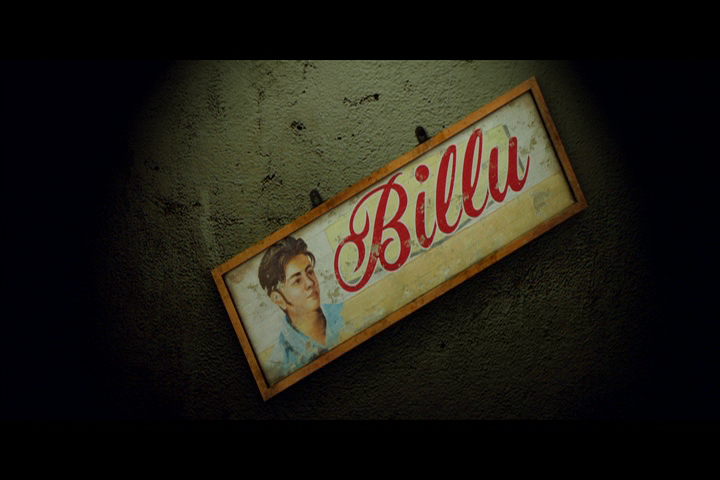
Billu-title

So. If you are considering a leap onto the “original is best” Malayalam bandwagon and insist that I must see Kadha Parayumbol, please take a moment, breathe, perhaps go make a cup of tea instead. I’m perfectly happy with this film! What makes Billu work so well for me is that I have a high degree of awareness and appreciation of Shah Rukh’s career so the references and sly jabs at and by SRK really resonate. I wouldn’t have that to the same extent with a different regional cast, even if it is Mammootty in the big star role.

Priyadarshan directs a deceptively simple slice of life drama. Billu (Irrfan, in no surname mode) is a barber in picturesque Budbuda. Sahir Khan (Shah Rukh Khan in King Khan mode) is a massive movie star. Sahir suggests Budbuda as the location for the village scenes in his current project. Filming in the village was essential to the story as otherwise how would the Martian brother find his long lost sibling who was wearing a matching locket that beeped. I liked the interplay of real life and filmidom, in scenes when Sahir was enduring the plot narration, or when the villagers watched the shooting as though they were seeing life on Mars.

Mayhem erupts in Budbuda once the villagers find out that Billu and Sahir were childhood friends. Everyone wants to get an autograph, to get their brush with fame, and all the bigwigs demand that Billu introduce them to Sahir. But Billu repeatedly dodges the issue, even when his wife Bindiya (Lara Dutta) and annoying kids keep asking. Eventually the villagers start to believe he lied and accuse him of defrauding them of the gifts they had willingly pressed upon him.

Irrfan relies on his slightly oddball, rumpled, everyman persona for Billu and it works a treat. He comes across as good hearted but a little cynical, proud in himself but overwhelmed by the difference in status between himself and Sahir. Billu has told his family of a childhood friendship with Sahir, but is totally unprepared for how his village reacts when they find out. He is reluctant to contact Sahir, citing bygone time and the difference in their positions. But Billu’s inarticulate objections fall on fallow ground. It’s interesting that when Billu was negotiating with the school or others he could be quite glib, if apparently simple. Billu did go to the shooting and marvelled at the spectacle of Kareena’s duckface in Marjaani along with everyone else, but he flubbed all opportunities to speak to Sahir. I think he just wanted fate to intervene and take care of the logistics so he could see his mate without forcing himself upon Sahir.

Lara Dutta is beautiful but not too filmi glam as Bindiya. I could feel her frustration, not at being poor, but at having to be subservient and cop all the crap that comes with being seen as a beggar. Bindiya dreams of meeting Sahir and of the benefits that knowing a big star could give her family, but isn’t greedy. She just knows how things are when you’re the outsiders, and wants to take opportunities where they arise. Bindiya obviously thinks the world of Billu and it took a lot for her to actually ask him if his friendship was real. I thought it said a lot that there was no rancour in the conversation, and Billu still walked her to the school to hear Sahir speak. They had a solid relationship and as more of their backstory was revealed I had more appreciation for her.

Sahir is often absent from the action, but his presence permeates everything. I like SRK as a bad guy, and as a hero, but I especially like him as a hero who still has a healthy reservoir of cynicism alongside the cheesy entertainer reflexes (I also loved OSO). I enjoyed his character’s observations on controversy, and expectations audiences have, and his little encounters with Chaubey the guesthouse manager. Some dialogue sounded very similar to things Shah Rukh has said himself so I found the added element which may or may not be a reflection of his own views very appealing. Apart from That Speech he keeps Sahil quite sensible and vaguely amused by all the shenanigans unfolding around him, with occasional flashes of crankiness that may be caused by chafing from all the bedazzled outfits.

Sahir’s moment with Billu is quite beautiful, and so much better than the big build up that preceded it. It’s a performance I enjoy both for the overt manifestation of star power and the glimpse under the glossy veneer, and the expert manipulation by a master of crowd pleasing.

Shah Rukh’s own career is referenced extensively in posters on village walls, old movie stills and promo pictures, a montage celebrating Sahir’s stardom. The film within a film device also allowed some spectacularly silly and blinged out song concepts as they didn’t have to fit in with the plot as such, and could also use a parade of Shah Rukh’s recent-ish heroines. In every song there is a moment when he gets a goofy grin and he can’t help uncle dancing a bit despite the choreographers’ best efforts. I love it. Plus I think Evil Anthony makes an appearance.

Each shot serves to express the focal character’s universe, from set design to lighting to the framing. It’s a pleasure just to look at this film. Pritam made Billu’s songs and background music more organic than the filmi stuff, and they were accompanied by lush “real world” visuals lovingly captured by V Manikandan.

“Jaaun Kahan” is a bewildered meditation, while “Khudaya Khair” is a sweetly romantic dream that could star either your husband or Sahir Khan, mood depending. The village setting was glorious and while I’m pretty sure it was in Tamil Nadu I chose not to overthink the geography/language mash up.

The standouts in the support cast were Asrani as Naubat Chacha, a rare voice of moderation and always seeing Billu’s side, and both Om Puri and Manoj Joshi throwing their weight around as self-important and self-proclaimed VIPs. I also liked Rasika Joshi as the long suffering principal who turned out to be not such a bad old stick.

Would this film make you a Shah Rukh fan if you weren’t one already? Maybe not. But it is a departure from his Rahul shtick and there is enough of a gleam in his eye and a quirk to those famous eyebrows to make me think he had a bit of fun playing with his own image. And I’m a sucker for both sublime and ridiculous visuals. 4 stars!

Mardaani

Mardaani

Mardaani is a crime drama from director Pradeep Sarkar and writer Gopi Puthran based around the investigation of a drug smuggling business and child trafficking ring in India. What makes it rather more unusual is that the cop chasing after the bad guys isn’t the usual rough, tough and unbeatable hero, but instead is the equally rough and tough but rather more pragmatically sensible Rani Mukerjee. As Senior Inspector Shivani Shivaji Roy, Rani takes on a crime boss and his gang when a young street vendor she has previously rescued goes missing. It’s a straight police procedural drama for most of the film but does veer off into overly melodramatic action for the last 15 minutes or so, presumably to add more commercial appeal. However Rani is superb, Tahir Raj Bhasin is excellent as the villain of the piece and overall the film works as an action thriller that is more realistic than most.

The film opens with the apprehension of a criminal by Mumbai’s Crime Branch, and the raid and subsequent capture nicely illustrate the rapport Inspector Shivani has with her team and the respect they have for her. They all joke together on the way to the raid but police officers Jafar and Morey still obey every order without question once the action begins. Dressed in a sari and noticeably understated make-up, Shivani is a cop who follows the rules when necessary, but also knows just how far rules can be bent without causing any visible stretch marks. She’s equally capable whether she’s on duty as a police officer, or at home looking after her family and is smart enough to reason her way through a case rather than bludgeoning her way to a result. The end product is a more realistic police officer and a more probable investigative team, at least as far as the world of cinema is concerned.

Shivani is married to Dr Bikram Roy (Jisshu Sengupta) and the couple look after her orphaned niece Meera (Avneet Kaur), giving Shivani a realistic and stable home life as well as illustrating that she is more than just a kick-arse cop with excellent multi-tasking skills. The person Shivani seems to care about most though is Pyaari (Priyanka Sharma), a girl Shivani rescued and placed in an orphanage and school after Pyaari’s uncle tried to sell her on the streets. When Pyaari disappears, Shivani accepts Meera’s assertion than Pyaari has been kidnapped, and given the truly frightening statistics given at the end of the film it does seem the most likely scenario. Shivani quickly establishes that one of the men associated with the orphanage is implicated in Pyaari’s disappearance and her subsequent investigations lead her to a drug dealer who is also part of the gang. From here it’s a short step to Vakil (Anil George), and the realisation that she has stumbled upon a large and well organised drug smuggling and human trafficking ring. Vakil is the face of the organisation and the man the drug dealers think is in charge, but standing in the shadows behind Vakil is the real boss, Karan (Tahir Raj Bhasin).

One of the reasons why the film works so well is the developing relationship between Shivani and Karan and the careful steps they take to outwit each other. Karan calls Shivani when her investigation begins to impinge on his organisation, and their subsequent phone conversations become an integral part of the story. At one point Karan introduces himself as Walter White, a nod to the Breaking Bad character, and a clear indication that he considers himself a criminal mastermind. Generally Bhasin plays Karan with an aura of cool authority mixed with genuine menace as he orders his various lackeys around and keeps track of his business empire. In scenes where the kidnapped girls are stripped, showered and basically dehumanised, it’s obvious Karan sees them purely as merchandise to be sold, a tactic that moves the film away from tacky voyeurism into a sinister and shockingly more realistic place. However when he calls Shivani, she refers to him as ‘the kid’ and remains cool and calm, refusing to rise to his threats or attempts at intimidation and it’s Karan who struggles to keep his composure. Shivani remains professional when dealing with Karan despite her fears for Pyaari, and it’s only towards the end that her self-control slides and she embarks on a more vigilante style of action.

While the film didn’t need quite so much focus on the plight of the girls, their abuse and degradation is effective in building outrage that is later used as a justification for Shivani’s unconventional method to bring Karan to justice. The film also loses some credibility when Rani morphs into a more typical filmi-hero and channels her inner Salman Khan for the last few scenes, taking the law into her own hands. It dulls the effect of the rest of the film, although there is some satisfaction is seeing the abused get their own back on their abusers. There is also a tendency for the film to become rather preachy towards the end with Shivani lecturing the police chief in Delhi when he is reluctant to pursue the human traffickers, but the statistics that play over the end credits are likely an indication of the point Pradeep Sarkar was trying to make. The details about the massive numbers of children who go missing and the extent of the child sex-trade are chilling and anything that raises awareness, and hopefully subsequent prosecutions and a downward change in these figures is welcome. It’s not all about ‘the message’ though, and for the most part the film is an action thriller with an engaging storyline.

Mardaani keeps to a standard storyline, but the plot is well structured with realistic characters and feasible action that keeps the film believable. Rani and Bhasin are the standouts but the support cast are all good, although the young actresses playing the girls do become overly dramatic at times. It suits the situation though and at least none of the scenes with the girls are remotely suggestive but rather reflect the brutality of the kidnappers instead. The film is a different approach to a police drama and while it’s not an overtly feminist film it is good to have a strong female character as the lead, particularly when she takes on a more traditionally masculine role so successfully. Worth watching for Rani, a more realistic storyline (at least until near the end) and Tahir Raj Bhasin, who will hopefully live up to the promise he shows here. 3 ½ stars.