Aagadu (2014)

Aagadu

After the major disappointment of missing 1-Nenokkadine, it felt as if it had been a very long time since I’d been able to indulge in the wonders of Mahesh on the big screen. As an added bonus Aagadu was being shown in my local cinema, the wonderful single-screened art deco Astor, which has the luxury of a dress circle and velveteen-couches for lounging while waiting to get into the auditorium. Plus the bonus of subtitles!

Going to the Astor is always an ‘experience’ and even more so for Mahesh.  There were massive posters with accompanying garlands, samosas for sale in the foyer, and even that rarest of things – allocated seating! Regular visitors to Telugu film nights in Melbourne will understand what revelation this was – no pushing and shoving to get in and try to find a seat that hasn’t been ‘saved’ by the first twenty people through the doors? Not this time! First night, first show and there was an orderly ticket collection queue, a leisurely stroll to your seat (with ushers!) and plenty of time to soak up the atmosphere with the sell-out crowd.

Aagadu

Aagadu sees Mahesh reunited with Dookudu director Srinu Vaitla, although the partnership doesn’t deliver such an entertaining film this time round.  Along with a number of familiar faces in similar roles, the usual mass themes pop up time and time again, so the plot feels tired even before it gets past the first half hour.  Still, it starts off well enough. Young Shankar is rescued from the streets by Police Inspector Raja Ram (Rajendra Prasad) who adopts him into his household based on Shankar’s non-tolerance approach to crime. Naturally this family relationship doesn’t last long, and Shankar is cast off by Raja Ram in suitably dramatic fashion after taking the blame for something he didn’t do.
Aagadu

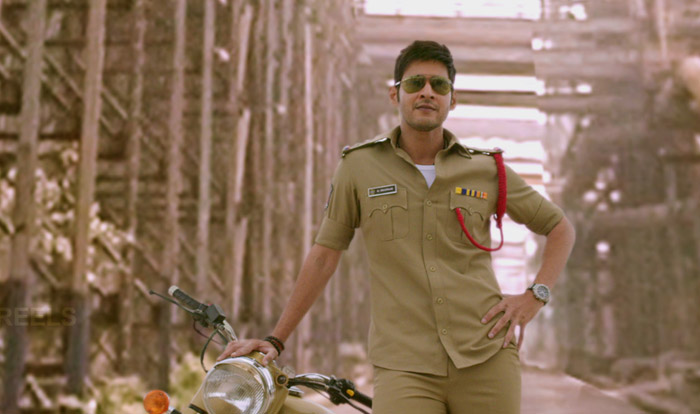
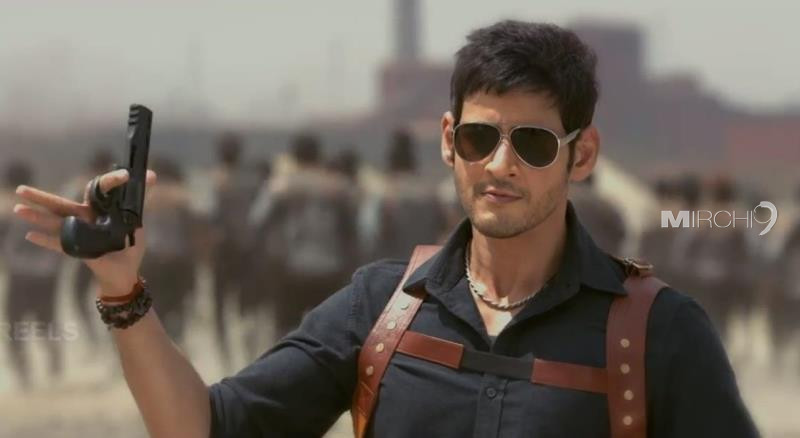
Despite these early troubles Shankar follows in his adopted father’s footsteps and grows up to be ‘Encounter Shankar’; a man so feared that the mere mention of his name is enough to turn big, bad gangsters into quivering cowards.  As expected once he appears on-screen, Mahesh Babu throws villainous thugs around with gay abandon while indulging in snappy dialogues and keeping his uniform creases sharp. Mahesh is in his element here and it shows. He looks even more baby-faced than ever as he single-handedly beats various thugs into submission and revels in his indestructible super-cop persona.  Pretty similar to the way he did in Dookudu really.  The opposing gangsters have learnt nothing and still tend to attack one at a time (they can’t ever watch any movies or they would know better), and there are plenty of barrels, containers, and various other items for them to crash into. The outcome is always a forgone conclusion but it is the getting there that counts, and the action scenes are excellent.
Aagadu

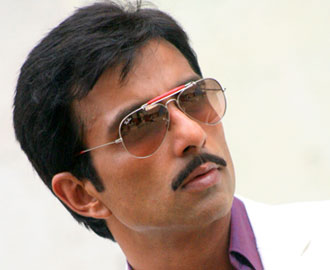
Encounter Shankar is sent to Bokkapatnam, where crime lord Damodar (Sonu Sood) is terrorising the locals and keeping the police firmly under his own control. Sonu Sood seems a little off his game here and is never quite menacing enough to be the big bad movie villain needed to offset Mahesh’s heroic cop. An early attempt to give him a ‘quirk’ falls flat and apart from one or two moments of sneering he’s a bland and relatively innocuous character.  Srinu Vaitla seems determined to include as much humour as possible, but his inclusion of the gangsters into the comedy motif works against any possible build-up of menace and just isn’t particularly funny.  Even Damodar’s gangster lieutenants are roped in with Raghu Babu, Posani Krishna Murali and Prabhas Seenu dropping their initial villainous personae for dumb comedy routines that do nothing to help the story.
AagaduAagadu

There is more comedy in the form of M.S. Narayana who is reasonably amusing as a data broker, although the best comedy moments go to Mahesh as he befuddles the villains with reprises of his own movies.  These gangsters really don’t seem to get out to the cinema much!  The usual suspects turn up in the support cast including Nasser who seems wasted in a role as a mildly corrupt cop, while CinemaChaat favourite Ajay fares a little better in a more serious than usual role and Vennela Kishore has a reasonable role as Encounter Shankar’s main assistant.  Brahmi turns up late in the film and it says a lot that he is sorely needed to bring some relief into an otherwise dull and predictable second half.  He plays a broker who ends up as the fall guy for the police operation, but it’s really just the usual slapstick with the addition of a reasonably funny dance mix from recent films, although even that seems a copy of a similar scene from Dookudu.

Aagadu

Tamanna plays the love interest and starts off as a relatively feisty character that seems to have potential. Unfortunately it doesn’t last, and after she succumbs to Shankar’s trite dialogue she is rewarded by relegation to appearing only in the songs.  There is absolutely zero chemistry between Tamanna and Mahesh but she does get to wear some pretty skirts and twirl around mountains and deserts while Mahesh does some enigmatic walking, so it all works out OK in the end.  I liked the soundtrack and the catchy songs are all well-choreographed and pictured, often with some very enthusiastic backing dancers.  Shruti Haasan makes an appearance in a rather athletic item number which got just as many cheers as Mahesh’s entrance, but Bhel Puri has some of the best costumes.  The backing dancers get to morph from Marvin the Martian to Jack Sparrow while Mahesh sports his classic shirt and jacket combination, although I’m not so sure about his red number with go-faster white stripes.

Overall Aagadu is disappointing, as Srinu Vaitla rehashes ideas from his previous movies and includes too much comedy and an excessive amount of punch dialogue in his formulaic screenplay.  The first half is entertaining enough, but the second half drags until the fast, final showdown which is over almost before it begins.  Mahesh is very watchable and almost manages to carry the entire film with his charismatic screen presence, but even his excellent performance and the best attempts of the rest of the cast aren’t enough to lift Aagadu above average. Best watched in a packed cinema with a large group of Mahesh fans, but in their absence, still worth watching for Mahesh, good action scenes at the start and the songs.


Temple says:

Aagadu is similar to other Mahesh films, particularly Dookudu, only longer and much less entertaining.

I found the first half quite dull as the slapstick and comedy uncles piled up and yet the plot never shifted gears.  The ‘comedy’ is broad and overstated – not Mahesh’s finest work. He can be very funny but Aagadu plods along, reusing the same shtick too many times, and Sankar lacks the sarcastic spark Mahesh has brought to other films (like Khaleja or The Businessman). The excessive punch dialogues were meant to be a running gag, but instead seemed a gratuitous reminder of how many other good films I could have been watching instead.  And it’s not an easy film for a new fan as the jokes are very Mahesh-centric, including a nice tribute to his dad, and would largely go over the head of anyone who wasn’t familiar with the oeuvre. The second half is more successful as Sankar FINALLY starts enacting his plans for revenge. Plus I quite enjoyed seeing Brahmi get slapped around. If I had to watch his tedious antics, I was glad to have the vicarious satisfaction of the tight slap.

Despite high production values the CGI work is often poor, both in execution and judgement, and breaks the effect of otherwise excellent action choreography. There is one scene where suddenly Sankar is CGI’d onto a tabletop during a fight and he may as well have been surrounded by a dotted line with a legend saying ‘cut here’. And the subtitles, much as I appreciate the effort, were a bit dodgy. ‘Frightended’ was a highlight, and anarchy had clearly swept through the personal pronoun department. Although I liked the description “Pant. Shirt. Shirt. Shirt.”as I think that is indeed how Mahesh dresses.

Well, at least the Astor has excellent choc-tops. And I hope that nice man The Mahesh Fan and I were talking to after the movie found his way to Doncaster.


Soodhu Kavvum (2013)

Soodhu Kavvum

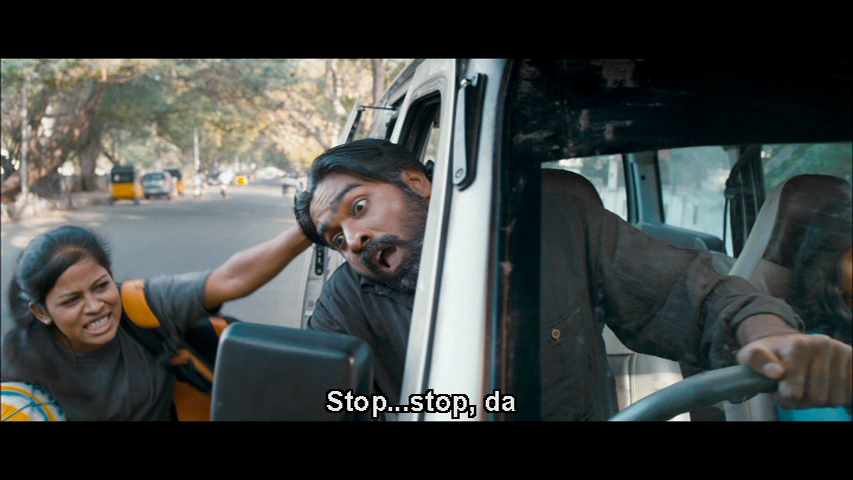
I love this film!  Nalan Kumarasmy’s début calls to mind shades of  Lock, Stock and Two Smoking Barrels or Shallow Grave, and manages to pack in plenty of comedy, action and general all round craziness in a run time of just over 2 hours.  The film centres on a kidnapping caper but there are so many different ideas tossed in, and the plot development initially seems so haphazard that perhaps the most astonishing thing is how well everything does make perfect sense at the end.  Soodhu Kavvum is essentially a dark comedy where a number of seemingly unrelated people and random happenings are thrown together into what turns out to be a funny and intelligently written storyline. Not all of Kumarasamy’s unconventional ideas hit the mark, but with inspired performances from a great cast, Soodhu Kavvum is one of my favourite films from last year and a definite must watch.

The story follows the exploits of Das (Vijay Sethupathi), his imaginary girlfriend Shalu (Sanshita Shetty) and three friends who become involved in the kidnapping caper.  There is also an ‘honest politician’, his lazy son and a psychotic police officer who never speaks, along with many other slightly off-the-wall characters who each have their own reason to be in the mix.  Each character has a number of strengths and flaws that makes them more interesting to watch, but also to some extent explains their various motivations and why they react as they do to each new crisis. Everyone is introduced in a way to showcase their personality and then slowly Kumarasamy draws all the threads together to make a coherent whole.  It’s cleverly done to keep interest in the main protagonists even when all of them seem quite typically normal, everyday people and none are particularly likeable.

Soodhu KavvumSoodhu KavvumSoodhu KavvumSoodhu Kavvum

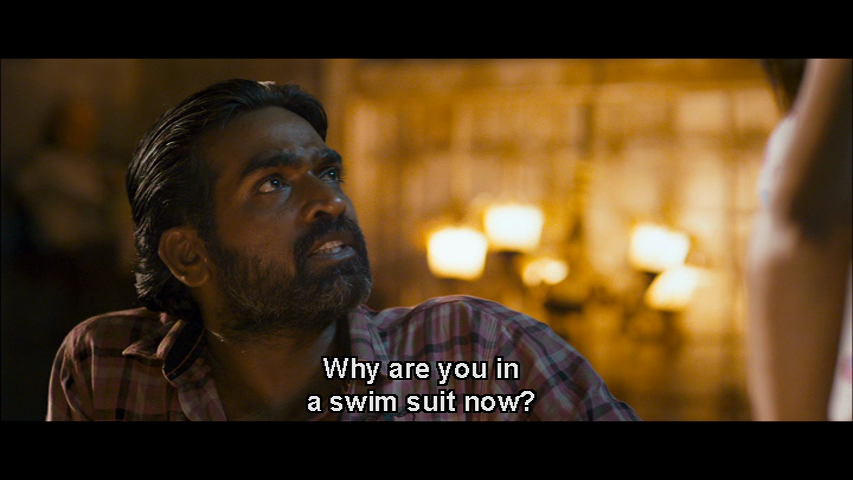
Vijay Sethupathi is the absolute star of the show here and is completely unrecognisable as Das, a more middle-aged and careful character than I’ve seen him play before.  Das is considered and thoughtful, almost gentle despite his criminal tendencies although he still appears quite manic when required.  Vijay really does appear much older here, it’s his mannerisms and stance rather than just make-up, and he perfectly blends a rational approach to his criminal activities with just a hint of mania as he argues with his non-existent girlfriend – or is she? That’s one of the delights of Soodhu Kavvum – just as you think you have a handle on what is happening and where the story is going, Nalan Kumarasamy sends it off in a completely different direction and introduces new characters seemingly out of nowhere. Except if you were paying attention (or watch it again!), they are there in the background all along.

Soodhu KavvumSoodhu KavvumSoodhu KavvumSoodhum Kavvum


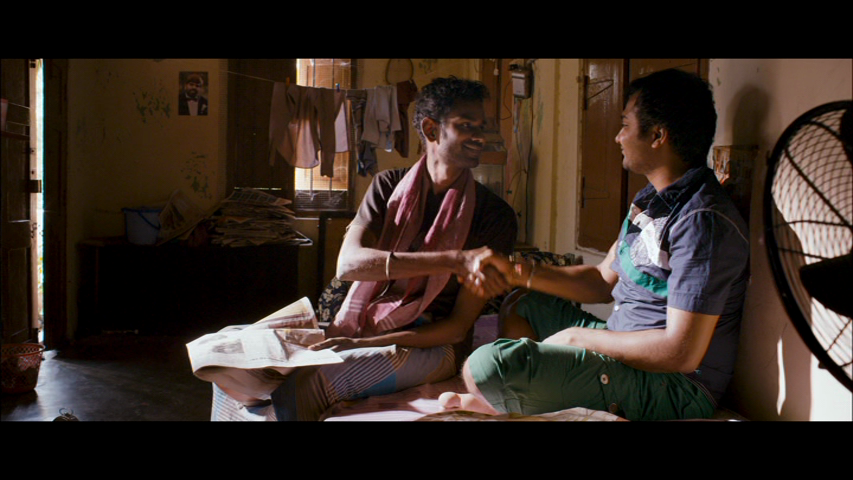
Das has developed a strict set of rules for his ‘kednapping’ business but a lack of manpower has caused him to rethink his tactic.  After a chance meeting with three friends in a bar, he offers them the opportunity to join his kidnapping team.  The three friends have their own problems; each is out of work and looking for a way to earn some easy cash.  Pagalavan (Bobby Simha) has moved to Chennai to stay with his friend Kesavan (Ashok Selvan) when he ran into a spot of bother in his native Trichy.  This involved building a temple to actress Nayanthara and the reactions of first Kesavan and then his friend Sekhar to this news speak volumes for their respective characters.  Sekhar (Ramesh Thilak) is an out of work hotel car park attendant who gets up early and gets ready for work every day, but then sits and drinks his way through a bottle of whiskey.   There is a quick blink and you’ll miss him appearance of fellow director Karthik Subbaraj in the scenes that describe how Sekhar lost his job which is pretty cool. Bobby Simha is also excellent and completely unrecognisable from his recent appearance in Jigarthanda, although his performance here is just as impressive.

Soodhu KavvumSoodhu KavvumSoodhu KavvumSoodhu Kavvum

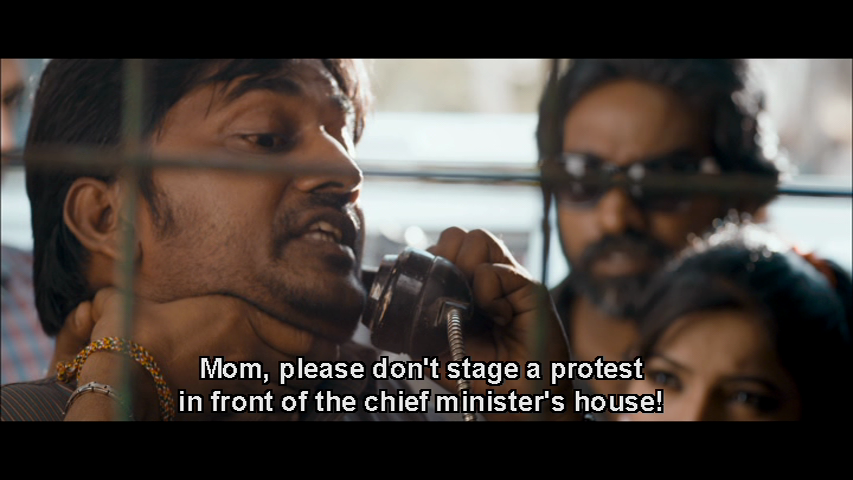
Everything goes pear-shaped when Das accepts a commission to kidnap Arumai Pragasam (Karunakaran), the son of inconveniently honest politician Gnanodayam (M.S. Bhaskar). For all of his lauded refusal to take bribes and capitulate to corruption, Gnanodayam is a very grey character as he entraps industrialists hoping to bribe him in the usual fashion, and is also abusive to his wife and son.  Karunakaran is superb in his role as the lazy and dishonest son, and his laconic delivery of his lines is excellent. Just look too at his excellent ‘uncle-dancing’ skills in this song where he celebrates the joys of money.

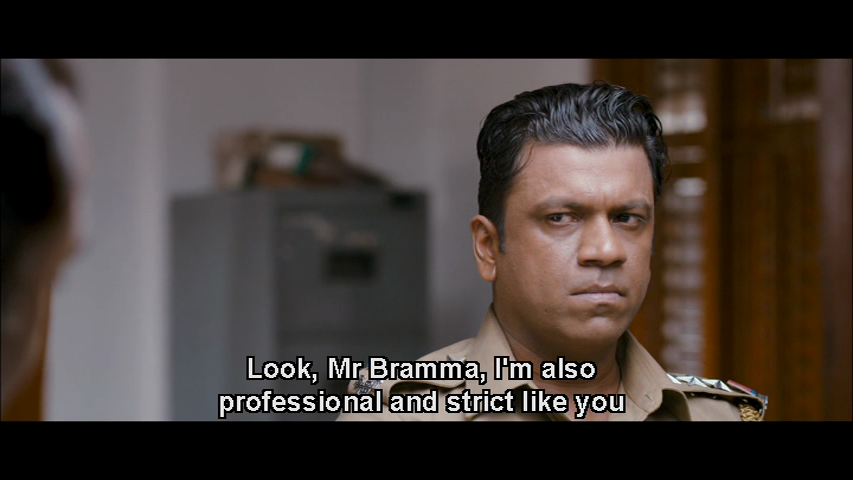
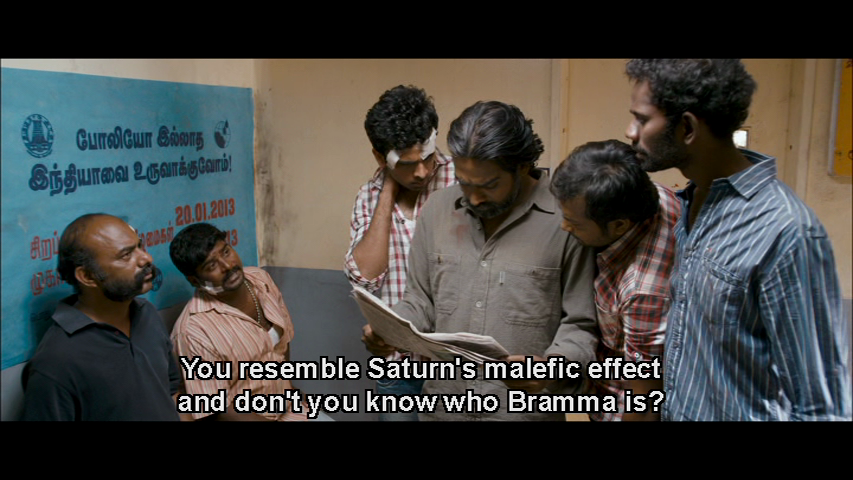
Yog Japee turns up in the second half as slightly unhinged police officer K. Bramma. There is an excellent montage of fights to show how he drags information out of the Chennai underworld as he tries to track down the kidnappers. Rather than the usual biffo in more conventional films, this is fast, mean and ugly and fits perfectly into Bramma’s persona. Truly he is the malefic effect of Saturn personified!

Soodhu KavvumSoodhu KavvumSoodhu KavvumSoodhu Kavvum

Soodhu Kavvum does have a few moments that don’t succeed, and the sheer number of twists means that it doesn’t work quite as well on a second viewing – although I did get almost as much enjoyment out of spotting the different characters in the background before they appeared in the main narrative. What I do love about this film is that the story is just as important as any individual character, and almost every moment is spent moving the narrative forward.  Each character has a role to play and at that point, they are the most important person in the scene.  I really like that there is no over-blown romance, no idealistically perfect hero and no mass fight scenes. It’s just a good story, well told with excellent actors delivering great performances.  4½ stars.


Hyderabad Blues (1998)

Hyderabad-Blues-title

Hyderabad Blues opens with a montage of Hyderabad landmarks and the usual sights of men pissing and spitting, cows wandering the streets – the stuff any first time visitor to India would notice. Varun narrates, his American accented English sounding slightly Zoolander-ish; ‘As scared as anyone would be in a foreign land – but wait a minute, this is my home’. He has to be coached on meeting relatives, what to say to a servant, who everyone is, and he feels caught betwixt and between.

Varun (Nagesh Kukunoor) is health conscious and snooty – his mum is determined to feed him up but he can’t stand the high fat high carb meals. He droops around the house looking disgruntled and superior. His mates rib him about his bad attitude and encourage him to remember how things are in India. Harish (Anoop Ratnaker Rao) is married and Sanjeev (Vikram Inamdar) will be soon. Most of his time with friends consists of happy reminiscing over the past but when they talk of current times the differences are apparent and there is lots of “Fuck you man!” Kukunoor produced, wrote, and directed the film on a shoestring, and cast himself in the lead. He sounds like he is just reading the script with little modulation in his voice. His performance is among the weakest and the character is self-centred and often obnoxious, so the sympathy I had for Varun evaporated quite quickly. (I thought that about his appearance in Dor as well.)

Sanjeev says arranged marriage makes him the king as he can chose whoever he wants and since Varun views his marriage as solely his choice I don’t think they are really so different. Varun fancies a friend of Sanjeev’s selected bride Seema (the ebullient Elahe Hiptoola), and asks for an introduction.

Ashwini (Rajshri Nair) is a doctor. Despite his progressive foreign ideas Varun is both surprised at a woman being a doctor and dismissive of her ability since she got in on a seat reserved for women. They celebrate Holi with friends and Ashwini takes bhang to be rebellious. While she is off her nut, Varun takes advantage to ask the most important question in his life – why doesn’t she like him as much as she should? She calls him out on his contempt for Indians and his put on foreign airs and stupid accent, calling him a pseud. She believes he expects all dates to end in sex, and she is not interested in being a notch on his belt. But they make a date to see Hum Apke Hain Kaun (13 songs! He must fancy her!). Rajshri Nair is generally quite good and her girl next door look suits Ashwini. There are abrupt shifts in tone required by the dialogue and she is shrill and over the top in some of the more explosive moments. She is much more effective in the scenes when Ashwini is joking around with her friend Seema or in the conversational interludes between arguments with Varun.

I liked the setting for the story. People are ordinary middle class, and live normal relatable lives. They play out the large and small rituals of life; weddings, funerals, cleaning, preparing food, and conversations that sound like duets of well rehearsed lines. I liked the mix of languages as people would start a conversation in Telugu, wander into Hindi and end with English. It’s a familiar sound to me and also helped define the characters as on more serious topics people reverted to their preferred language and cadence. Some of the one-liners are quite witty and the family rivalries and bragging about whose son was better added some levity. There are nice touches as Varun starts to soften or reconnect with his culture, like when he deigns to offer money at a shrine and then dashes back to make sure he left an odd amount just like his mother told him. I liked seeing the little bit of playfulness as Seema and Sanjeev completed their wedding formalities and the way these details added depth to the characters and relationships. The clash of generations and of different cultural influences is interesting and I know so many of my friends have gone through similar experiences so I expected to love the film. But between some dodgy plot development, Varun’s endless whining, and Kukunoor’s suboptimal acting, too many things tried my patience.

I really liked that the relationship is not plain sailing and Varun has to work to win Ashwini over. His parents object as Ashwini is a different caste and they had several someone elses in mind. Ashwini and Varun meet daily at the hospital and she says they will be the subject of gossip and that she does worry to an extent as she needs to live her life once he has returned to the US. She also tells him he is probably just another NRI coming to find a maid/slave/wife. He says he is different but he is confused about what he wants and where they would make their home. Ashwini scolds him for assuming she would want to marry him (and that he hasn’t asked) and for also assuming she would just leave everything she has in India and follow him. It’s fair enough that he doesn’t want to throw away 12 years of hard work, but he doesn’t extend the same courtesy to her.

But while Ashwini opens up about her fears and hopes and how she thinks the cultural gap is just too big to bridge, Varun strikes a more adolescent note. He and Sanjeev have a lame running gag about wanking and they constantly leer at Shashi Aunty and her precariously draped pallu. Varun has a track record that inspires scorn and envy from his mates. But then Varun likens Sanjeev’s wedding night to a drunken one nighter as he has only just met his partner, and Sanju is (understandably) pissed off. Harish and Sanju don’t seem to think sex outside of marriage is an option and caution Varun about treating Ashwini lightly. When she pushes Varun away mid-kiss he cracks it as that must be a sign of backwards values, not her preference or a reflection on his kissing. It was interesting that Varun could be disparaging of custom and society, but when Ashwini’s criticism of culture was directed at her father, Varun came to his defence saying you couldn’t ignore 5000 years of tradition and that her dad did his best. Hmmm. Sounds like a typical manchild to me!

The resolution to the on again off again romance is totally filmi and not really in a good way. I was disappointed after the relatively realistic build up that too many people acted in a way that was inconsistent with their previous behaviour. I appreciate the challenge of making an indie film, especially in an industry that is geared towards formulaic blockbusters, so Nagesh Kukunoor deserves credit for getting his film out there (even if I don’t think he deserves any for his acting). But for me there are some substantial negatives in the acting and the story that are detrimental to the overall quality. The movie is on YouTube with subs. 3 stars.