Bhoot Bungla (1965)

Bhoot_Bungla_poster

Adhering to the Scooby Doo school of horror, Bhoot Bungla is fun from go to whoa with great music, dodgy disguises, lukewarm romance, dancing skeletons and a dash of suspense. This was Mehmood’s debut as a director and he pulled out every trick in the book, and I suspect a few favours from the filmi fraternity, to make it a hugely entertaining romp.

Bhoot-Bungla-Moni Chatterjee

50 years ago Kundanlal was murdered and his wife and son disappeared from the family home. In the present day his three nephews live in the mansion. Ramlal (Moni Chatterjee) gets a telegram that his daughter Rekha (Tanuja) is coming home from Abroad. He prepares to collect her from the airport but brother Shyamlal (Nazir Husain) makes an excuse that he has to go to the office. Ramlal’s car explodes, leaving Rekha an orphan and heiress. Not long after, poor unhinged Ramu (Nana Palsikar) is found dead in a murder staged to look like suicide.

Shyamlal and Rekha move into a stylish apartment in town but can they escape the curse? Or is it a more corporeal threat? Worried that she is sad and afraid, Uncle calls Rekha’s friends to come and get her out of the house. They enter her in a singing competition at The Beach Club, where her rival is none other than Mohan Kumar (Mehmood) and his Youth Club, dedicated to Doing Good. The hi-tech Applause Meter gives Mohan the cup, but the audience is the real winner! Oh yes, hijinks ensue.

Tanuja is excellent as Rekha, sassy and sweet by turns. I really liked that the first thing Rekha did in the new flat was unpack her books while the servants dealt with the clothes and other belongings. She is smart but also raised to be obedient and good so when suspicion falls close to home, she tends to go with the dutiful response rather than a rational one. Tanuja matches Mehmood’s energy, throwing herself into the silliness with gusto. She also delivers a convincing portrayal of Rekha as someone weighed down by fear and losing confidence in their own judgement. I can think of no other explanation for her fleeing the apartment in a frothy nighty and huge fur coat (in Mumbai? Really?). The romance is a minor part of the story, and there are no sparks between Tanuja and Mehmood, but they do have nice rapport. Since the relationship is partly due to Mohan’s Youth Club commitment to helping people, it doesn’t matter that they seem more like friends than being crazy in love. There’s enough crazy to make up for it!

Mehmood’s grand entrance is riding a motorbike up Marine Drive and howling like a police siren. At first I actually thought it was just exceptionally dodgy sound effects and had grave fears for the rest of the film! There can be too much Mehmood, but in this case he gets it just about right and Mohan is wacky but always likeable and genuine. Maybe he was too busy worrying about tricky camera angles (of which there are many) to be The Star and settled for a happy camaraderie with the ensemble. Of course, restrained by Mehmood standards still includes doing drag, slapstick, encouraging children to gogo dance their fears away, and instigating a dance off with gyrating skeletons. But I knew Mohan truly loved Rekha when he shaved his moustache off to frock up, committing himself to having to draw it back on with pencil for at least one subsequent scene. That is commitment,

The music is fabulous and the songs are a real highlight. Mohan sees a blind beggar whose violin has been broken by drunk boys – so he does a West Side Story style dance number exhorting society to wake up and care. Pyar Karta Ja moves the hearts of all youth club boys and girls who were otherwise occupied in construction work. It’s not quite the barn raising scene in Witness but pleasing nonetheless, and Witness didn’t have Manna Dey. Everyone, including the special effects team, saved their best for the Bhoot Bungla song. Watch it now, and enjoy all manner of silliness with Mehmood and RD Burman dancing with skeletons and showing the ghosts who’s boss.

The support cast has lots of excellent performers although I am struggling to put names to all the faces despite the detailed opening credits. I will take a punt that Jerry played Jerry who was an imitation Jerry Lewis. I was particularly fond of Rekha’s exuberant girlfriends (including Lata Sinha). RD Burman is a hoot as Stocky, the cowardly foodie who accompanies Mohan on his ghost busting mission. It’s always good to know that someone has afternoon tea requirements under control. The creepy family retainers – Lakiya and the mysterious and toothy gardener – are perfectly cast with their spooky appearances adding to the sense of unease. Just the thought of Lakiya’s ruffles is enough to terrify me.

Bhoot-Bungla-Dedication

Apart from the fluffy entertainment value, the story is reasonably strong. Mehmood balances the various elements well and kept the suspense and laughs coming. There are some twists and red herrings, and things move along at a fair pace. I found the dedication to Guru Dutt quite touching – Mehmood seems to have been a thinker when it came to his own films.

See this for the excellent songs, the generally well balanced suspense and comedy, and the skeleton dance-off. Sure there are some things that go bump in the plot, and a couple of loopholes big enough to drive a Youth Club bus through, but nothing that detracted from the good natured fun. 4 stars!

Did someone say Twist?

Cannot. Resist. Urge. To. Dance!

Bhoot-Bungla-the end

Haider

Haider

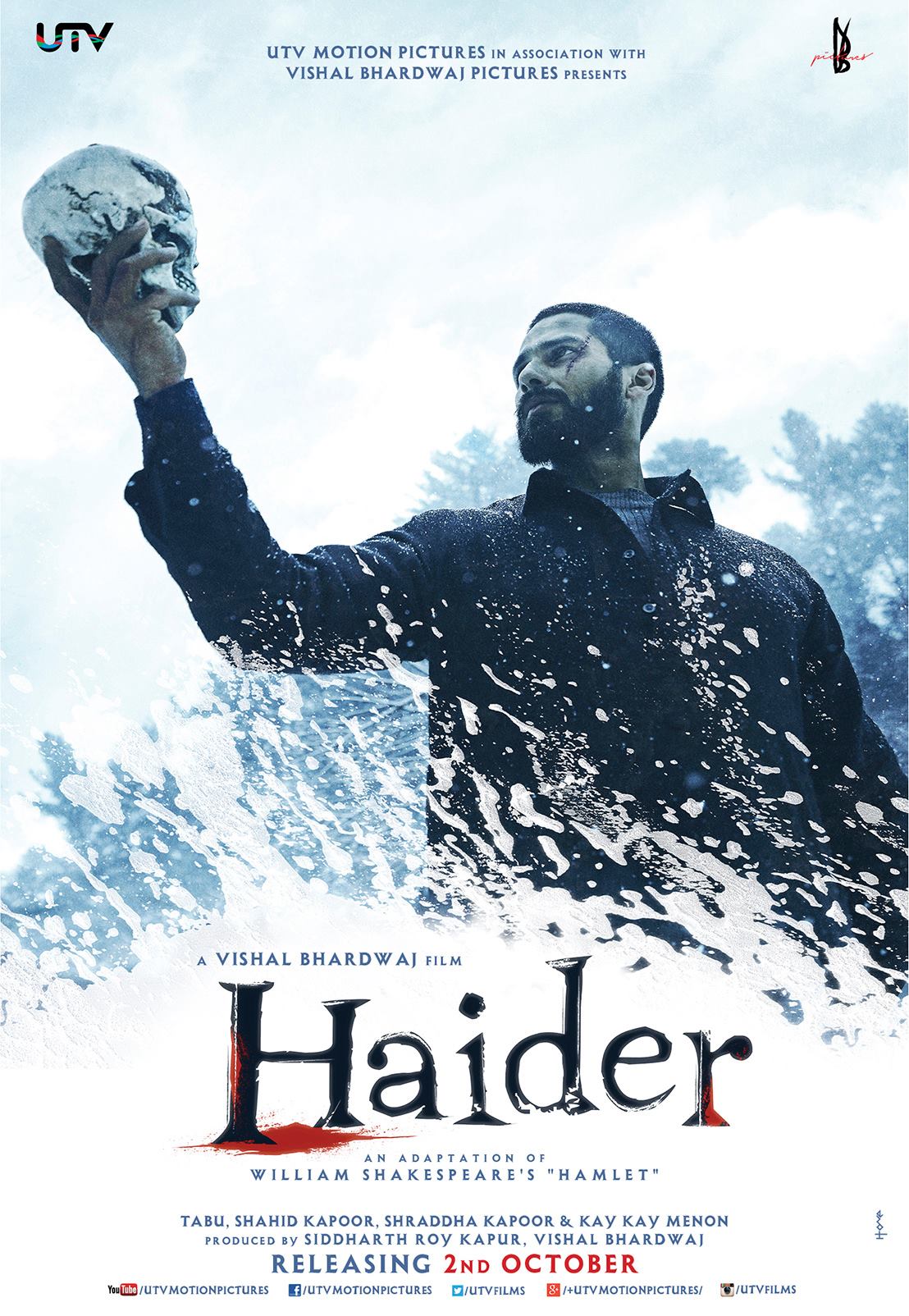
Watching Vishal Bhardwaj’s latest film Haider is a visceral and haunting experience, as the gorgeous detail of the film allows every emotion and each drop of blood to be shown in crystal clarity. The story of treachery in Denmark is transplanted to Kashmir at the height of increased militancy in the area in 1995, but still remains tragedy on a grand scale. Bhardwaj and his co-writer Basharat Peer have successfully adapted the bard’s play into more modern-day India, although the pacing is a little inconsistent in places and at times the Kashmiri issue threatens to overshadow the personal drama. The heart of the film is in the performances, and although Shahid Kapoor is excellent in probably one of the best performances of his career, the real stand-out is Tabu who is completely mesmerising in her role as a conflicted mother to Haider and disloyal wife to Dr Hilal Meer. It is compelling cinema and definitely well worth watching in the theatre to fully appreciate the stunning cinematography and spectacular beauty of Kashmir.

Haider (Shahid Kapoor) is a student, safely studying poetry in Anantnag when he learns that his father has disappeared after providing medical aid to a militant leader. Dr Hilal Meer (Narendra Jha) is taken by the army in a truly frightening scene that manages to grasp the sense of hopelessness and terror of a military raid in just a few moments. The grim method of selecting who may go and who is arrested by a balaclava-wearing man in a Jeep is chilling, as is the resignation that makes everyone line up for inspection without any word of complaint. The detail in each frame is incredible, and the performances are very natural, making the film seem almost like a news report direct from the action, rather than a fictional story.

Dr Meer’s family home is also bombed, along with the militant leader still inside, and in a few seconds his wife Ghazala (Tabu) has become a ‘half-widow’ without anywhere to live. As a result, when Haider returns he finds his mother living with his uncle Khurram (Kay Kay Menon), and he is instantly suspicious about their relationship. While rejecting his mother, Haider relies heavily on his girlfriend journalist Arshia (Ahraddha Kapoor) and two friends Salman (Sumit Kaul) and Salman (Rajat Bhagat) as he searches for his father. Since up until this point the film is unrelentingly bleak, it’s a real relief when the comedy appears, and Salman and Salman are an excellent counterpoint to the violence and despair elsewhere.

Haider’s search for his father is heart wrenchingly sad, as he is just another one of many who are searching for their own disappeared relatives. However, interspersed with his search are confrontations with his mother and uncle which fuel Haider’s anger and mistrust. The relationship between Haider and Ghazala is wonderfully nuanced and both actors capture the essence of Shakespeare’s characters and their conflicted emotions well. There is a frisson of sexual tension, heightened since Tabu looks way too young to be Shahid’s mother, but mainly the film focuses on Haider’s sense of betrayal when his mother takes up with his father’s killer. Kay Kay Menon is also effortlessly perfect, juggling Khurram’s political ambitions with his desire for Ghazala and bringing more depth to the Shakespearean character of Claudius than I seem to remember from studying the original play at school.

The romance between Haider and Arshia is also nicely developed, and Arshia has a believable character as a journalist and relatively realistic relationships with her brother Liyaqat (Aamir Bashir) and father (Lalit Parimoo). Shraddha Kapoor is good in her role, particularly in her scenes with Shahid and she’s also credible in her despair when she loses the plot after her father dies. Most of the other characters from Shakespeare’s play appear, although the role of the ghost is changed into a fellow prisoner of Dr Meer who is expertly played by Irrfan Khan.  Most impressive is the ‘play within a play’ which in is depicted as a song. The puppets are wonderful, but even just a glimpse of Tabu and Kay Kay Menon in this clip illustrates just how good they both are in conveying their characters.

Haider’s eventual descent into madness is dealt with better than the earlier scenes where Shahid sometimes appears a little too distant. But as the film progresses his emotional shifts and internal struggles are mostly well represented and he does genuinely appear to be a conflicted personality by the end. Many of the famous lines from the original Hamlet appear in Haider’s soliloquies, although they are also inserted into various conversations (and the subtitles don’t really do them justice), and there is even a brief appearance of the skull before the final, and very bloody showdown. This is passion, vengeance, despair and madness writ large and the scope of the film truly feels epic.

Haider impresses with fine attention to detail and excellent performances from the entire cast. However the shift to Kashmir means the military conflict looms large in the story and as a result the original tale of betrayal and treachery occasionally gets a little lost. The pacing is uneven, particularly in the first half, but this allows time for the complexity of the characters to fully develop so isn’t necessarily a flaw with the film. It is a bleak story and be warned that some scenes are definitely not for the squeamish as the body count piles up and cinematographer Pankaj Kumar illustrates just how well snow contrasts with blood. Overall Haider is a well crafted and novel interpretation of Shakespeare’s Hamlet and one I definitely recommend watching for excellent performances and a rather different view of Kashmir.

Govindudu Andarivadele

Govindudu Andarivadele

Soaring melodrama, fantastically colourful sets and Prakash Raj are the stand-outs from GAV. Add in Charan, who has definitely improved on his emoting, and you have the bones of Krishna Vamshi’s family drama that mostly delivers what it promises. There are plenty of emotional scenes as Abhiram (Charan) attempts to reunite his family in England with the rest of his estranged relations in India, and of course there’s some local trouble and a romance thrown in for good measure. While most of the film seemed to live up to Krishna Vamshi’s preoccupation with family values, there are a few scenes here that seem to be a hold-over from a less pc era, and stand out as glaringly sexist and just plain wrong. However the rest of the film is entertaining enough despite a storyline so overused that the lack of subtitles was really never an issue!

The story opens with a déjà vu from K3G as Abhiram demonstrates just how well he can play rugby when the opposing team fail to follow the rules of the game and actually attempt to tackle. Real rugby players end up covered in mud and crushed under a few tons of Welsh full-back in my experience, but apparently not in Vamshi’s world. Abhiram lives in a very nice pad in London with his father Chandrasekhar (Rehman) and his little sister whose name I didn’t catch. Unfortunately Chandrasekhar misses out on an appointment to be Dean of Medicine at a London University and interprets this as karma due to an old rift from his own father.  No academic politics in Vamshi’s world either then, I presume!

Overnight Abhiram decides that he will be the one to make all right for his father, and heads off to India to do what he can to bring the families back together. Sadly though, he doesn’t take time to remove his rather odd pony-tail which I can only assume must have been an attempt to look ultra-hip and cool – London-ishtyle. Not my favourite look for Charan, but it did grow on me as the movie went on.

GAV - Charan

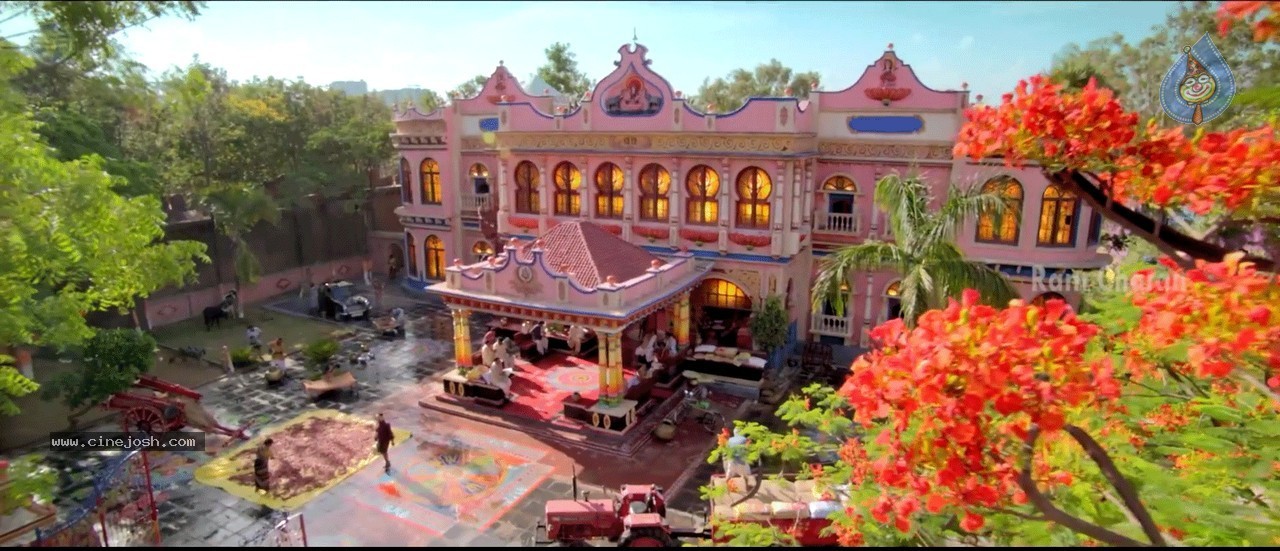
Things definitely look up once Abhiram makes it to India, does all the usual touristy things, and then heads off to his grandfather’s village. Following the standard family reconciliation template, Abhiram makes contact with the rest of his family anonymously by pretending to be a visiting agricultural student who wants to learn from family patriarch Balaraju (Prakash Raj). Balaraju runs his family and the village with a benevolent but very traditional hand while stopping his brother (Kota Srinivasa Rao) from clearing and developing the area. Living in the wonderfully pink and majorly over-decorated mansion is also Chandrasekhar’s wastrel brother Bangari (Srikanth): a man with an unfortunate propensity for mesh singlets and garish shirts. Oh, and he drinks, gambles and tries to kidnap and rape his potential bride, Chitra (Kamalinee Mukherjee). This is one of those scenes that really should never have made it in to a film in this day and age, and it does feel completely anachronistic with the rest of the story. Equally disturbing is Abhiram’s use of some photographs he has taken of his cousin Satya (Kajal Agarwal) dancing in Western clothes as a way to blackmail her. This is straight out bullying and sexual abuse, and I find it hard to believe this got past the censors in an otherwise ‘family-friendly’ film. Thankfully Satya does manage to effectively deal with Abhiram’s harassment, but it makes their subsequent romance initially less believable and Abhiram appear as a bit of a prat.

The rest of the film is much better, and that’s mainly due to excellent performances from Prakash Raj and Charan. Prakash Raj is perfect as Balaraju and he knows exactly how to play the strict but compassionate head of a large family. He never puts a foot wrong and wrings every possible drop of emotion out of his time on screen. He even manages to make stick fighting and motorbike riding emotional events, as he unknowingly bonds with his grandson. Jayasudha is just as good as Abhiram’s grandmother, and again she manages to take her overly emotional scenes and tame them down to something more realistic and believable.

Charan gets a chance to show that he can play more than just an action hero and he definitely rises to the challenge. His Abhiram has more shading than other characters I’ve seen Charan play, and he conveys plenty of emotion and feeling in his speeches, even though I couldn’t understand a word! Despite the initially rocky start, there is plenty of chemistry and some major sparkage in the romance between Abhiram and Satya. Charan is one of the few actors that interacts well with Kajal in this respect and their romance really does light up the screen. Charan does manage to stick close to his real love though, as seen in this song mainly set in and around Petra. I wonder if it’s written into every contract that he must get at least one scene with horses? Kajal gets rather short-changed in the choreography here, although Charan doesn’t actually get to dance much either and sadly most of the songs have more emoting than dancing.

The rest of the cast are all capable and fit well into their roles. Rao Ramesh, Posani Krishna Murali and Adarsh Balakrishna are part of Kota Srinivasa Rao’s opposing family but never feel terribly menacing. Adarsh’s character is mainly just very shouty and aggressive, and the various fight scenes, which appear to have been structured around rugby tactics, aren’t up to Peter Hein’s usual high standard. The film looks gorgeous though. The pink palace is amazing – Satya has a stunning peacock painting on her wall, and most of the other rooms are similarly adorned with fantastical artwork and gorgeous furniture. I would live there!

GAV - the pink palace

The emotional quotient does head into overload at times and the ending is particularly excessive, but that doesn’t really seem to matter since the whole point of the story is overblown sentiment. As a straightforward family drama GAV works well enough despite the cliché-ridden storyline and the strong performances help push it over the line. Well worth watching for Prakash Raj and Charan, particularly when you can marvel at the wonders of the pink palace as a bonus.