Kanchivaram

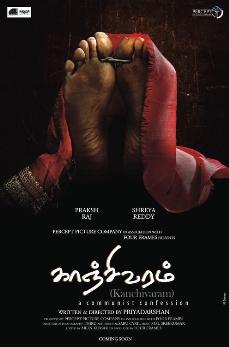
Kanchivaram (2008)

Kanchivaram is a slice of life social drama that largely rests on an excellent performance by Prakash Raj. Priyadarshan eschews the broad almost hyper style more common in his Hindi comedies and delivers a thoughtful and subdued film.

The film opens with a prelude explaining the significance of wearing silk at marriage and on death, and that the weavers were never in a financial position that would allow them to wear the fabric they wove. Vengadam (Prakash Raj) is an exceptional weaver and a natural leader in his community. A visiting writer (Sreekumar) introduces the village men to communism. Vengadam initiates collective bargaining for the weavers, which leads to a lengthy strike. But he had also promised that his daughter would be married in a silk sari, impossible to manage when he is not working. He steals silk, a hank at a time, and secretly weaves the sari he promised her. The conflict between his political and personal ideals and his love for his family is the root of the story.

The story is presented as a series of flashbacks. Vengadam is paroled from jail and travels back to the village by bus, with sounds and incidents on the journey triggering his memories of earlier times. This structure allowed me to concentrate on what was happening now, and to absorb the emotion of the story rather than wondering what would happen. His story unfolds from his marriage, birth of his daughter, the death of his wife and eventually the reason for his incarceration. The breaks in the flow as Vengadam was recalled to himself on the journey just sharpened the contrast between the bluff confident weaver and the broken man on the bus.

Priyadarshan frames the story in the political context of the rise of Communism before party membership was legalised. He efficently sets the scene of the industrial arrangements, the workers dependency on the factory, the clandestine political activism, in just in a few scenes. There are visual cues as to how things stand. The factory owner usually appears sitting or standing on a dais at a higher level than the workers. The communist writer who raises the political awareness of Vengadam and Sarathy skulks around in the dark, fearful of the police.

I’m always interested in industrial relations and the evolution of employee rights and the law so that aspect was appealing. And I particularly liked the villagers reaction to some social theatre – initially passive but on their feet and cheering like any mass movie audience when the ‘blood’ spatter started.

Prakash Raj is wonderful as Vengadam. Whether playing the younger carefree newlywed or the damaged man released on parole he is completely convincing. Vengadam has most of the dialogue in the film but many scenes rely purely on reactions and body language and Prakash Raj nails it. Often political leaders are depicted as single minded zealots, but Vengadam is more human. He understands his why wife is upset by the promise to see his daughter married in silk. He realises his daughter is in love with Ranga and goes to ask for the marriage to be arranged. He knows that when he takes a stand and strikes there will be consequences. And he knows what he is doing when he breaks the strike. Prakash Raj shows these internal struggles and questions and Vengadam’s eyes reflect his turmoil. I’m often intolerant of those who throw their families or friendships under the bus of ambition but this is more complex as Vengadam is not motivated by pure selfishness. He stole silk to weave something beautiful for his daughter, to break the cycle of not having. I could like him even as I rolled my eyes at his obsession with the sari.

Shriya Reddy is excellent  as Annam, Vengadam’s wife. Priyadarshan seems to have a knack for persuading actresses to tone down the glamour (as with Lara Dutta in Billu). Annam is smart, has opinions and politely challenges her husband in private when she thinks he has gone too far. From the initially awkward moments when Annam first comes to her new home, Shriya shows the growing affection and the playfulness in the marriage. Annam doesn’t have much dialogue so much of their closeness and the tensions in the relationship had to be conveyed through glances, the tilt of a head, the set of her shoulders.

She dies after being trampled in a crowd out to see the landlord’s new car, another symbol of the gulf between the workers and owners. Her final anguish is over whether Vengadam will be able to raise their daughter and he does his best to reassure her in his own way.

Family and village ties are revealed in many small interactions so the supporting cast are important and most are very good. I particularly like Jayakumar as Sarathy, Vengadam’s friend and one-time political ally. His rapport with Prakash Raj was excellent, and their friendship felt believably warm. I liked their stilted meeting to discuss getting their children married to each other that ended in affectionate hugs and relieved laughter. The deterioration of their relationship was shown simply but the pain on both sides and the definitive nature of the break was clear. Shammu is engaging and likeable as Vengadam’s daughter Thamarai. I do a certain amount of teeth gritting when I see little daughters made to replace their dead mothers in the home, but Thamarai was a distinct person and not just a household slave. She went to school for a while, then took sewing lessons, and her dad wanted her to be happy. So for a filmi girl in 1948 with no Ma, I thought she had it pretty good. Until things went wrong.
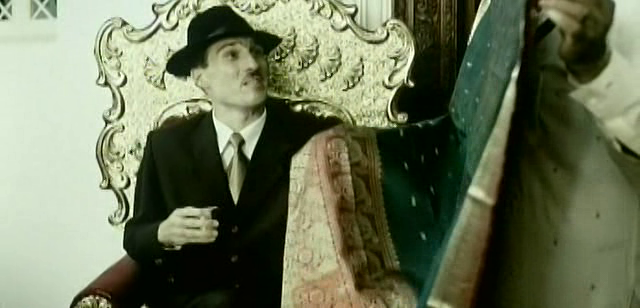
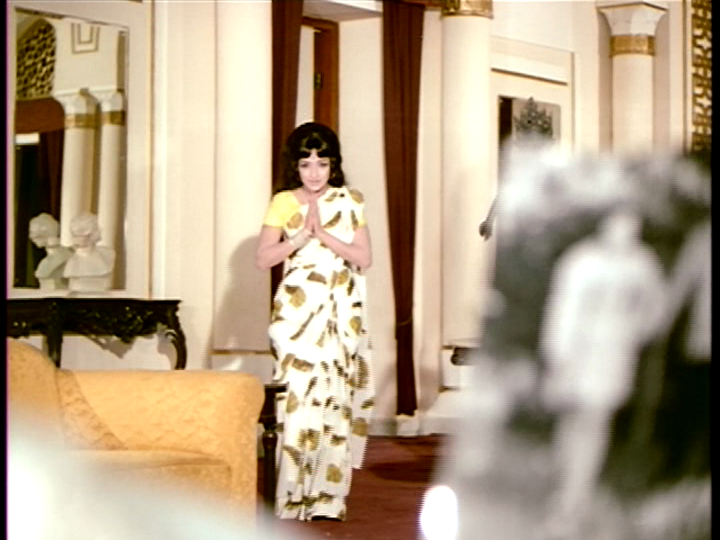
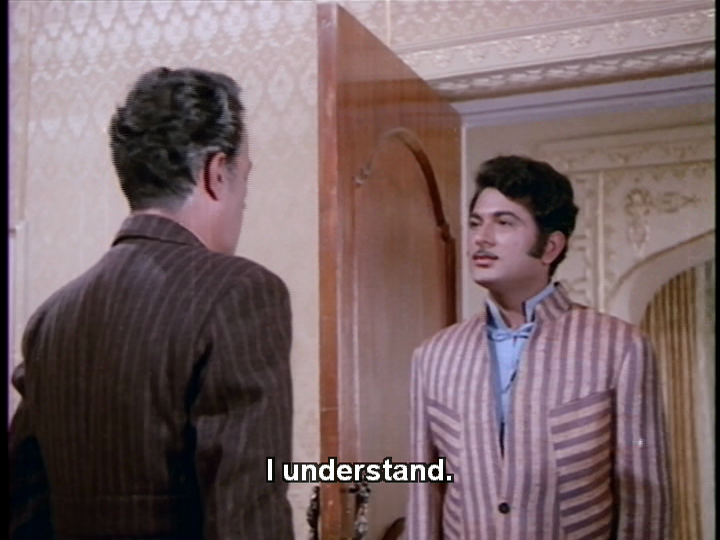
Kanchivaram-Bad actor lovely sariThere is an English character played by a truly bad actor. Well, I am not sure if the brightly over-enunciated yet almost expressionless dialogue delivery is his own style or was required by the director. There are so many good actors working across many Indian film industries yet the ‘English’ are almost uniformly laughable and seem to be reading at a pre-school level.  Who is casting these people?

The colour palette is simple and very effective throughout. The day to day scenes are muted and mostly use neutral and earth tones. The bus trip is drenched in the pale blues and grey of rain and twilight. Scenes at night are touched with the golden flicker of lantern flames. The flash of opulent silks highlights the gulf between the weavers and the eventual owners of those stunning garments, and punctuates the drama with bursts of saturated jewel tones. There are recurring motifs like the sickle, used as an emblem of communism and as a blade. Thiru’s camerawork uses lots of tight close ups of the actors and despite the dark interiors and low lighting in some scenes he catches every expression and gesture.

Despite the period and politics of the setting, Kanchivaram can be watched as a personal and intimate story rather than a didactic message film so I was impressed by his handling of those elements. But I’m not completely sold on the ending. The sensitivity of the characterisation and performances is what stands out for me. The film is available on YouTube with subtitles. 3 ½ stars!

Nache Nagin Gali Gali

nache nagin gali gali VCD cover

I’m surprised there isn’t more written about Mohanji Prasad’s Nache Nagin Gali Gali. It’s a late 80s B movie, sure, but it stars Meenakshi Seshadri  and is full of dancing and snakey masala plot twists. I was lucky enough to watch this with the virtual company of two most excellent friendly bloggers and snake film fanciers, Beth and Liz and with access to the helpful Filmi Snake Spotter’s Field Guide.

Nache-Nagin-Gali-Gali-Meenakshi

Mohini (Meenakshi) and Nagesh (Nitish Bharadwaj) are Icchadhaari Nagin; snakes who can transform into human shape. A magician (Sadashiv Amrapurkar) wants to steal Nagesh’s naag mani so he can enter a magical realm and find a cure for his leprosy.

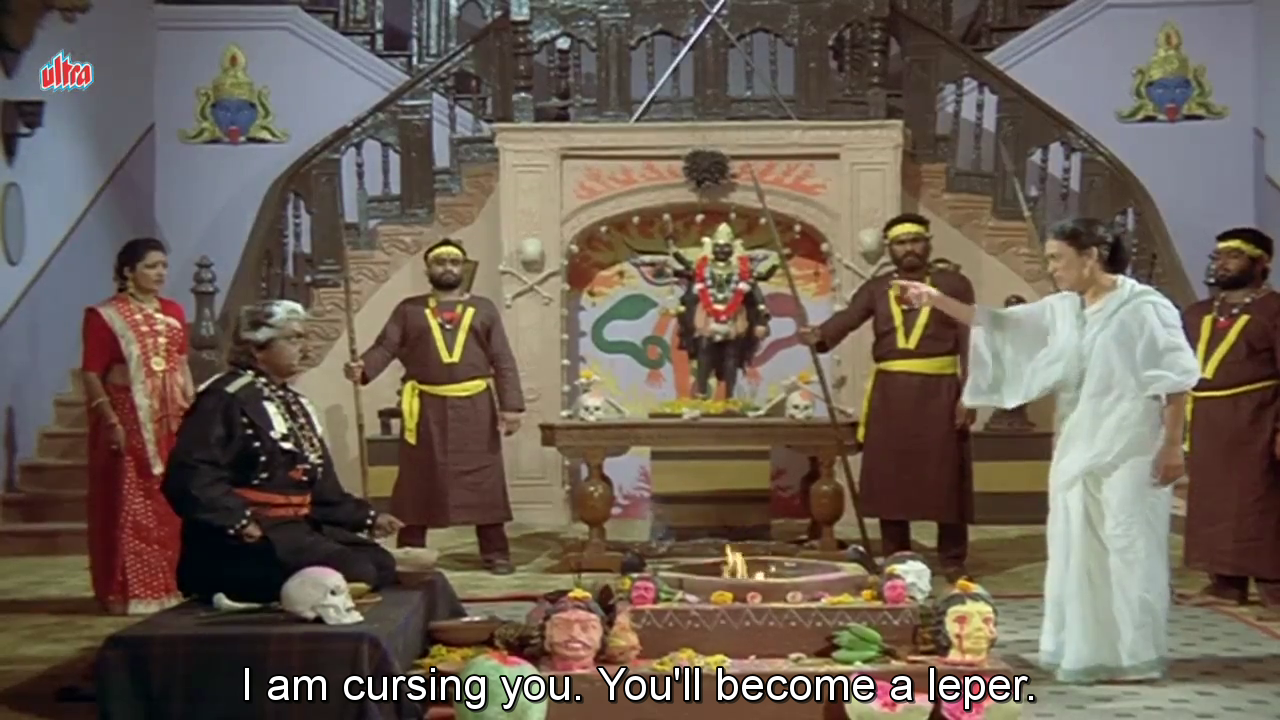
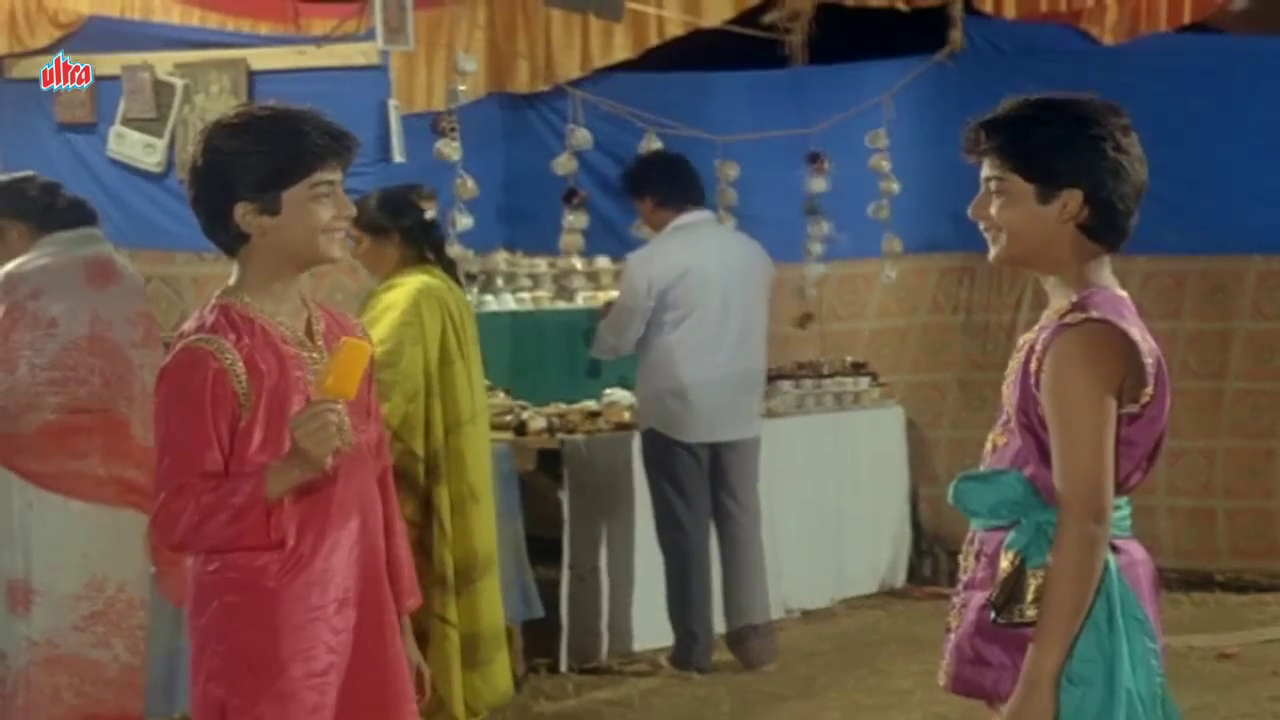
Nache-Nagin-Gali-Gali-cursed(He has a curse laid upon him by a grieving mother, the fiery Suhas Joshi, as payback for killing her son.) He could have asked his guru (Satyendra Kapoor) for help except he had him trapped in a giant bird cage and stole his power. He interrupts Mohini and Nagesh on their full moon night of love and they transform into children, hoping to hide in the crowd at a nearby fair.

Nache-Nagin-Gali-Gali-little MohiniNache-Nagin-Gali-Gali-Duplicates

In all the confusion the children are separated. Nagesh is mistaken for Kamal, a landlord’s son who he saved from being sacrificed by ‘tribal’ people, and taken home despite his denials. Kamal is taken by the sorcerer who thinks he has captured the snake. His wife Subhadra pleads to keep the boy and raise him as their son, which Kamal takes to easily thanks to some filmi amnesia. And poor distraught Mohini is rescued by kindly gypsies and raised as their own. Time passes, and the magician is running out of time to find a cure. Kamal/Nagesh takes a vow not to leave Kamal’s ma as she becomes dangerously ill when stressed so he is stuck, waiting for a solution but not doing much to find one. Nagesh and Mohini find each other, Kamal and the baddies find them, and things rattle along to the exciting final confrontation.

I really like Meenakshi as Mohini, but was even more impressed that this is a film where the entire climax sequence happens without the purported hero. Mohini and the good guru take on the evil tantric to try and prevent him from gaining more power and overcoming his creeping rot.

There are loads of special effects and there is a fairytale feel to the battle between good and evil that contrasts nicely with a quite earthy romance. I was saddened by the use of animals in some scenes, but there is only one incident where I thought there was a genuine prospect of injury or death (a snake versus mongoose battle). For the most the death and destruction is stylised so the drama plays out as engaging and a bit exciting without being at all realistic.

Meenakshi is lovely despite the hair and wardrobe choices in most scenes.

My only explanation for the backward bustle or peplum on the white dress was that perhaps it was really an egg pouch. I know if I was a self willed married lady snake I would not want to be bothering with 40 weeks of gestation plus labour. Her Mohini is heartbroken and wants to find Nagesh more than anything. But she also forms a strong loving relationship with her adopted family, and retains her sense of self-worth.

Nache-Nagin-Gali-Gali-RomeoNache-Nagin-Gali-Gali-never mess with a snakeThere are some unfortunate comedy incidents, but I quite liked seeing a creepy Romeo terrorised by the pretty snake lady.

Nache-Nagin-Gali-Gali-The Look stage 2 with lensesNache-Nagin-Gali-Gali-Mohini attacksMohini dance-fights her way through the final encounter and Meenakshi shows both the disadvantage of a small woman trying to beat a man in a physical fight and the power of her will and determination to be victorious. Her posture and energy changes to show the gradual loss of strength and the corresponding increase in desperation.

Nitish Bharadwaj plays adult Nagesh and Kamal. I have to say, apart from his mullet and some interesting outfits in songs, he made little impression. The highlight of his performance is probably his comic aversion to Roop, the girl his parents want him to marry. There is a brilliant meta moment when Roop makes Nagesh/Kamal watch her dance against the background of Sri Devi in Nagin. Roop does a terribly cheesy and not at all alluring ‘snake dance’ as Nagesh is captivated by the music, leading to his, ahem, premature transformation. I love that even in that silly scene, there is room for more plot development and film references. Nitish is adequate without being particularly good or bad.  Since his characters main contribution to the plot is just to be who they are, it all works out.

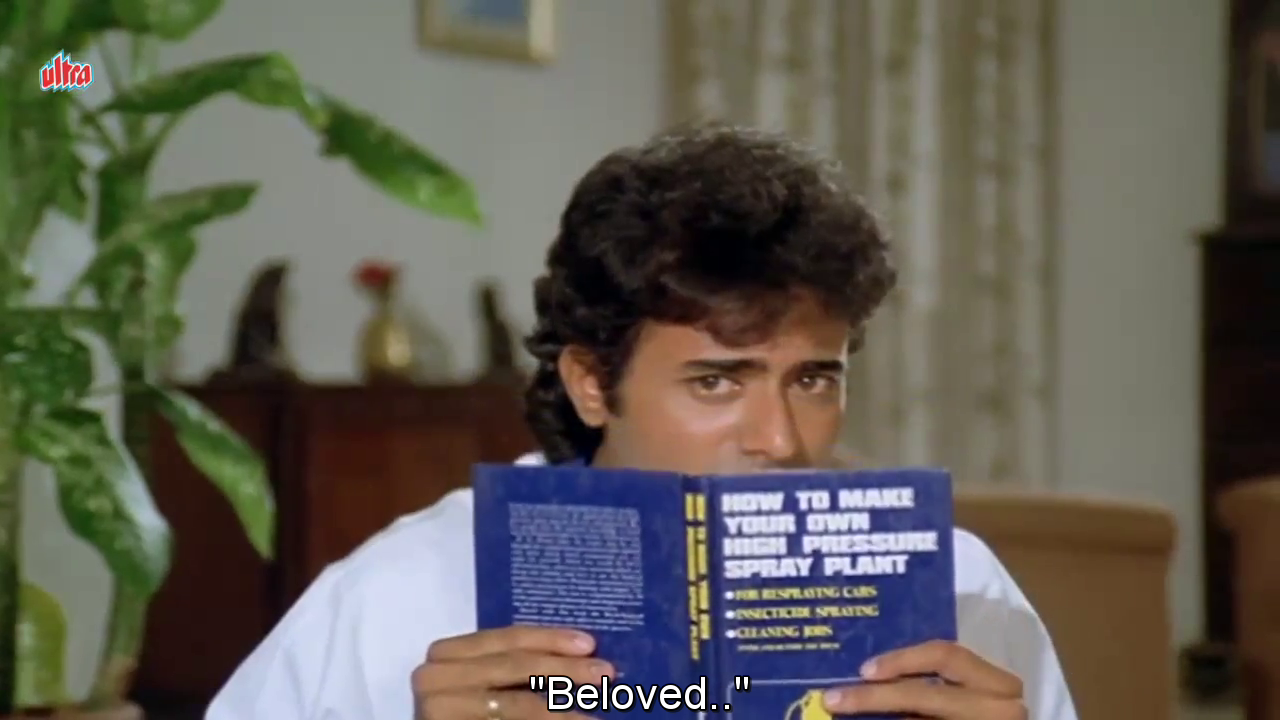
Nache-Nagin-Gali-Gali-romantic readingNache-Nagin-Gali-Gali-the chase


Was that book some kind of compulsory family reading? There are stacks of copies in the house. Perplexing.

Nache-Nagin-Gali-Gali-in chargeNache-Nagin-Gali-Gali-new interior designSadashiv Amrapurkar throws himself into the villainous role with gusto. He goes from ashram to megalomaniacal dictator décor in a heartbeat and seems content with being bad. If only he could get rid of that pesky leprosy! He spends much of the film trudging up hill and down dale, looking for the snake with the naag mani.

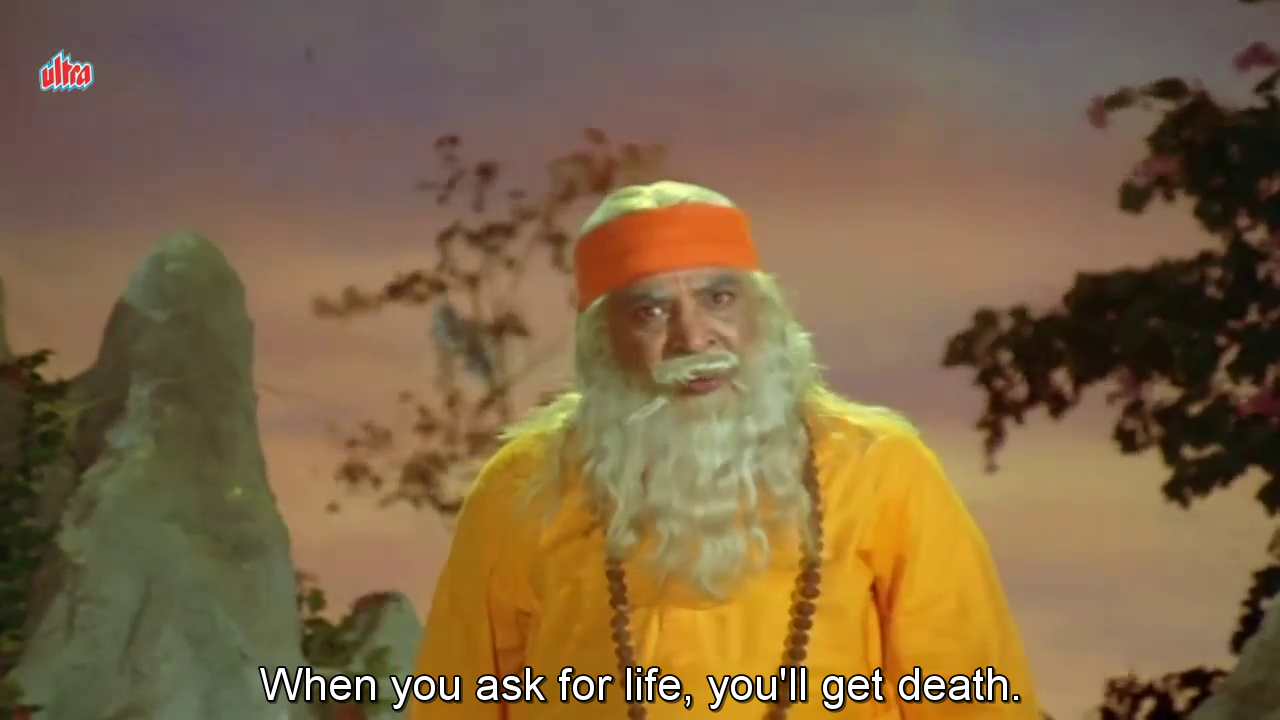
Nache-Nagin-Gali-Gali-Satyendra KapoorSatyendra Kapoor is stately and saintly in his flowing wig. He is like the voice of your conscience that never quiet goes silent. A lot of his role is done by voice over as the parrot got the most screen time. The final duel between guru and wayward disciple is something else as they transform into a series of animals with rich inner monologues.

Nache-Nagin-Gali-Gali-sporty bridal wearNache-Nagin-Gali-Gali-Sahila ChaddhaSahila Chaddha is Roop, but you could also call her Sporty Bridal Wear Lady or WTF Is She Wearing Lady. She is bubbly and determined to get her man.

I enjoyed her antics as she tried to anticipate his objections and overcome them, usually through multiple costume changes and a dance. Kamal’s mother enjoyed watching her son’s discomfort and encouraged Roop too. I never felt sorry for Roop as Kamal/Nagesh was so obviously not keen and yet she persisted. Plus she was needlessly vindictive and nearly got Mohini killed. Not cool Roop.

The songs (by Kalyanji-Anandji) are colourful and mostly uptempo. They didn’t have a huge budget for sets but they did get a good bulk deal on sequins so there is lots of sparkle.

Meenakshi does most of the dancing as Nitish Jeetendras his way around the set. He did do some slithering which was kind of interesting if not strictly speaking good. Or to quote Beth “Kya slither hai!” Both the hero and heroine were submerged in the water feature so were each subjected to the lingering clingy clothing shots. Considering snake attire, the subject matter, and the era, this film largely eschews sleaze.

Nache-Nagin-Gali-Gali-Reunited

There was some conversation about a certain “pajamas – now you see them now you don’t” scene, but these are married snakes of legal age so it is really no one business but their own.

If you want an entertaining film tinged with fantasy and magic, with baddies you can really dislike and goodies that are mostly likeable and right, packed with songs and visual effects, this would be an excellent choice. It is now available on YouTube with subtitles so why wait? 4 stars!

Jal Bin Machhli Nritya Bin Bijli

jal bin machhli

Back at the beginning of my Bollywood obsession, Temple lent me a double DVD of V. Shantaram films.  The first was the classic Jhanak Jhanak Payal Baaje which is still one of my favourite dance-based films and definitely well worth watching.  However the second film on the DVD was even more special – Jal Bin Machhli, Nritya Bin Bijli – a mix of interpretative dance, groovy sixties fabrics and more melodrama than I ever thought possible, even in Bollywood!  It’s one to watch for the dancing, décor and drama, rather than dwell too much on the rather ridiculous plot which allows almost everyone to declare their willingness to sacrifice themselves for love, or for dance, or for the love of dance.  In fact it’s amazing we get to the end without losing anyone, given how prone everyone is to explanatory declarations of their imminent demise.  But eventually, after dealing with treachery, betrayal, sacrifice and Hammond organ music, there is indeed a happy ending – or (and probably a better idea) just watch it for the songs!

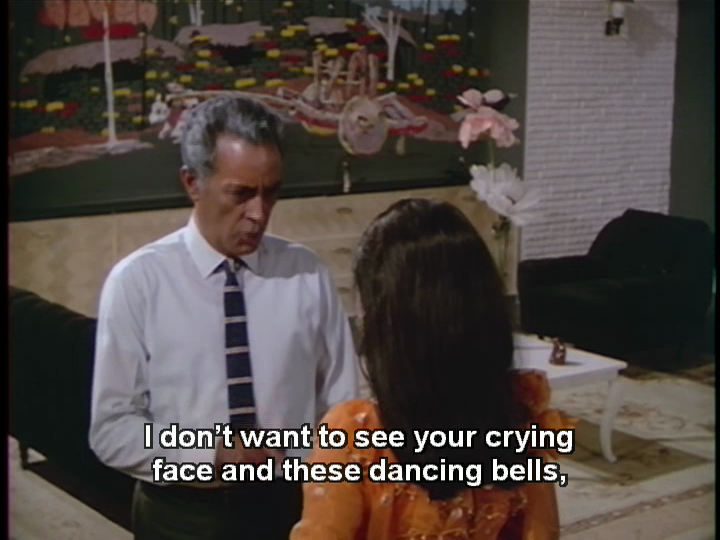
The film opens with Alaknanda (Sandhya) attempting to follow in her dead mother’s footsteps and learn how to dance.  However her autocratic father Dr Verma (Iftekhar) has no time for such frivolous nonsense and bans her from dancing until she marries, presumably because it then will be her husband who has to listen to the incessant jangling of bells rather than him.

Jal Bin MachhliJal bin machhli


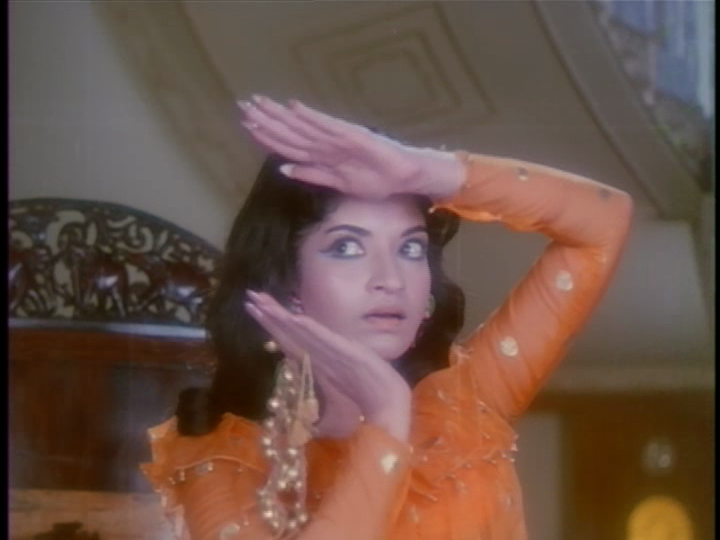
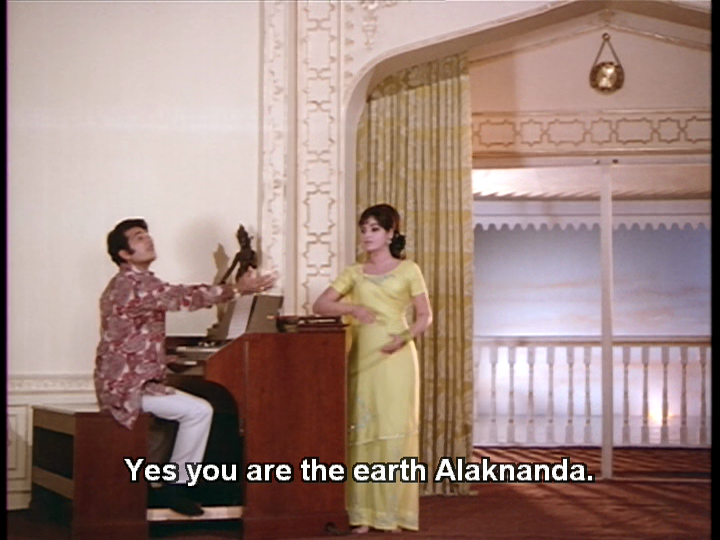
Unfortunately for her father, the family lives right next door to a huge mansion where Prince Kailash (Abhijeet) spends his days playing his Hammond organ and composing music for his resident dance troupe.  Despite an initial chilly reception, Alaknanda gets Kailash on her side by impersonating a dying fish she has rather callously flipped out of the water.  This song is an absolute must-watch as the spectacle of Alaknanda impersonating the fish out of water from the title really does have to be seen to be believed.  I could have done without all the shots of a fish in distress (or more likely a number of fish, as it’s rather a long song), so avoid if you prefer to see fish in their natural habitat.

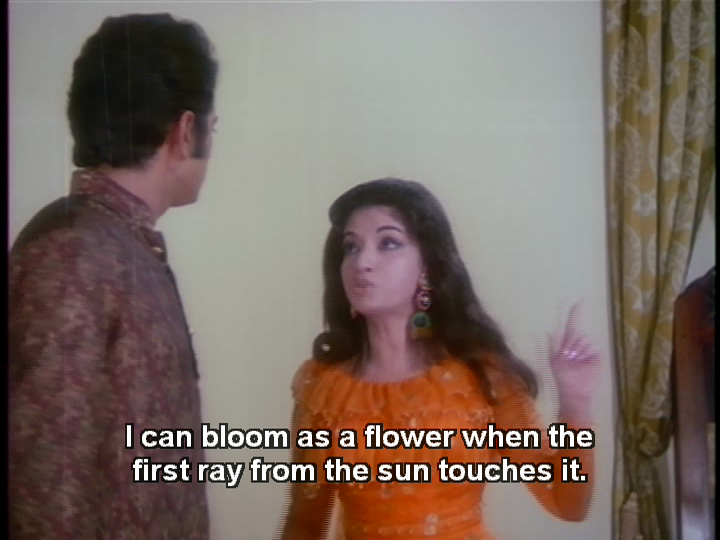
After such a performance, the prince is completely won over and his sceptical dancers welcome Alaknanda with open arms.  I suspect because she seems just as crazy as Kailash and lets them all off the hook by possibly understanding what he is trying to convey in his choreography sessions.  At least she has no compunction in throwing her arms and lashing her hair around to a number of his compositions, immediately endearing her to the prince who realises that he has just found his latest muse.  Lord help us all!

jal bin machhliJal bin machhliJal Bin MachhliJal bin machhli


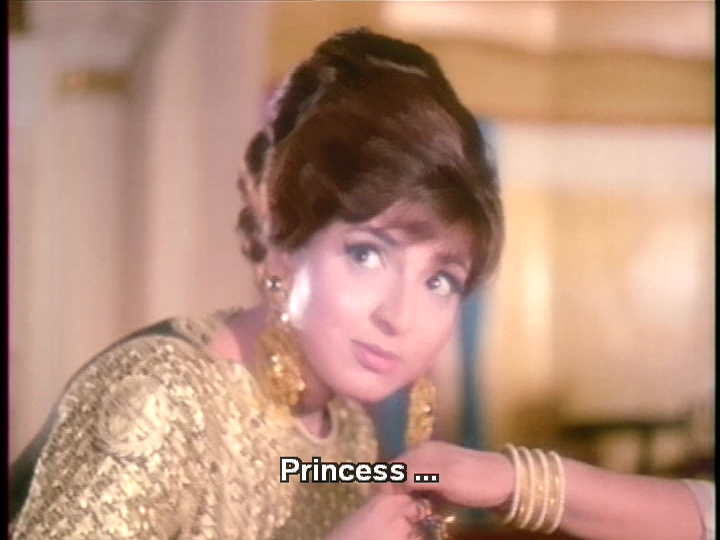
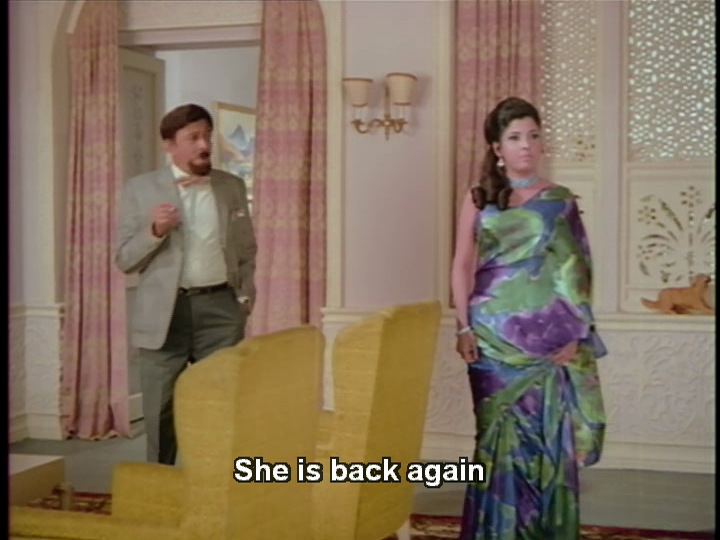
There are added complications when Dr Verma tries to arrange Alaknanda’s marriage, and Kailash’s mother Rajmata (Dina Pathak) attempts to match make between her son and Princess Roopmati (Minal).  The latter is a bigger problem since Roopmati and her uncle Chaman Rai  (Raja Paranjpe) are staying in the palace, giving Rajmata plenty of opportunity to throw the two together.  I really liked Minal as the scheming ‘other woman’ and I wonder why she doesn’t seem to have made any other films.  She’s truculent, bratty and petulant – all some of my favourite qualities in Hindi villainess and not at all reluctant to mow down everyone else in her path.

Jal bin machhliJal bin machhli


As Roopmati, Minal gets to wear some very groovy saris while pandering to Rajmata’s traditional ideas by wearing transparent robes over her trendy Parisian outfits.  She also has a tendency to break out into petulant dance moves when crossed, although her rocking out to records is definitely not the type of dance the prince admires. Naturally she doesn’t understand Kailash’s obsession with his music and is even less enamoured of his obsession with his Alaknanda. Her initial attempts to separate the two however backfire when she proposes a trip tiger hunting.  I can think of no rational explanation for this in a movie all about dance but then again there is no explanation, rational or otherwise for the rest of the story either!  The point of the trip is for Alaknanda to save Kailash from a tiger, upstaging Roopmati in the process and therefore setting the stage for Roopmati’s revenge.

After such excitement, naturally Alaknanda turns to dance and performs a wonderful snake vs. peacock number in a glitzy snake costume with authentic snake coloured hair.

The drama gets more intense as Roopmati and Chaman Rai sabotage Alaknanda’s performance leaving her crippled and unable to dance.  There are more complications as Kailash proposes, Alaknanda refuses him and our heroine escapes to live in a bandit camp and ponder her future.  Indeed, Alaknanda has to face more challenges than usual for a filmi heroine and she meets them all with a distinct lack of composure and plenty of head tossing and brow beating. Sandhya’s histrionics make it difficult to feel any sympathy at all for Alaknanda’s ever worsening plight and her petulant cries of preferring to die rather than live without dance are wearying.  Luckily there are plenty more songs thrown in to provide relief from the exaggerated and theatrical affliction, and the various misfortunes are all brightened up by some inspired costuming.

Jal bin machhliJal bin machhlijal bin machhliJal bin machhliJal bin machhliJal bin machhli


While Sandhya’s Alaknanda is irritatingly anguished, Abhijeet is fairly wimpy as Kailash and seems to deserve everything he gets with Alaknanda, although he does partially redeem himself with his bedside proposal of marriage.  His response to rejection is to shoot the heads off statues in his rehearsal room and then sob at the feet of a picture of his mother which seems to sum him up pretty well.  At least Dina Pathak and Iftekhar provide some much-needed class into the proceedings, but even they have a tendency to indulge in scenery chewing as the drama unfolds.

jal bin machhli

Jal bin machhli


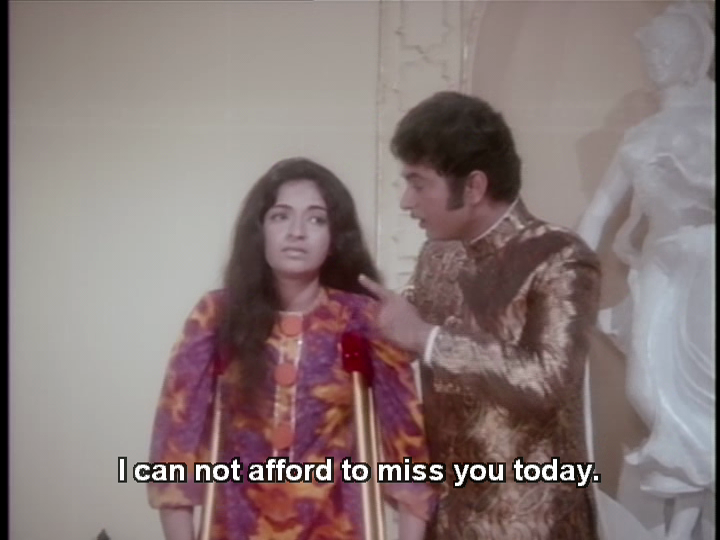
V Shantaram seems to want to explore the passion of dance, but in Jal Bin Machhli he never gets beyond overblown and theatrical drama.  Alaknanda’s obsession for her mother’s dancing bells doesn’t translate into a believable hunger for the art itself, and seems to be derived more from an urge to flout her father.  Without that fervour, the focus is on the melodrama and while that is entertaining it’s not quite the film I wanted.  However there is still plenty to enjoy in the outlandish choreography by Praveen Kumar, including such delights as Sandhya dancing frenetically on a plate while balancing her way up a steep incline and demonstrating just how to dance while on crutches.  Just as good are the songs by Laxmikant Pyarelal who manage to incorporate the theme music from the Good the Bad and the Ugly into the stunning Taron Mein Sajkeh Apneh.  Despite all the drama and the totally bizarre plot, I still love this film for all the posturing and sheer silliness of the two lead characters and the sometimes bewildered support cast.  Worth a watch for the amazing songs and to really appreciate the Bollywood definition of melodrama, even if nothing else! 3 ½ stars.

Jal bin machhli