Raanjhanaa (2013)

Raanjhanaa

Raanjhanaa is not a conventional love story, and its two protagonists are not particularly likeable people, but their very human failings do make it possible to understand their mistakes.  Despite their flaws I wanted their love story to succeed even as it seemed destined to fail. Dhanush never fails to impress with his acting but I was apprehensive about his co-star Sonam Kapoor since I’ve yet to see a convincing performance from her – and I still haven’t.  But to be fair, Zoya’s self-absorption is integral to her character, so Sonam’s wooden and lifeless performance actually suits her character for a large part of the film. However Dhanush more than makes up for Sonam’s rather laboured performance and the support cast are all excellent, making Raanjhanaa a better film than reading Himanshu Sharma’s screenplay would suggest.

Young KundanTeenage Kundan


The film opens with a group of child artists playing the roles of Kundan and his friends.  The kids are charming and in a few short moments they define their characters perfectly, so that each further development makes sense given these childhood traits.  Kundan falls in love with Zoya the very first time he sees her, despite the fact that she is Muslim, he is Hindu, and he’s only about 8 years old. His adoration at first sight develops into a full blown obsession by the time Kundan reaches his teens and his first stumbling attempts to tell the object of his affection how he feels are cringe-worthily appropriate for the ‘stalking = love’ concept that Indian cinema seems to prefer.
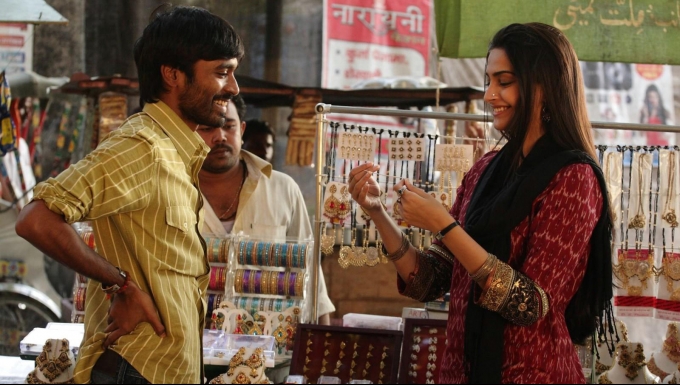
Kundan and Zoya

I’m always amazed at how Dhanush manages to transform himself into a young teenager so effortlessly, appearing suitably gauche and naïve against Sonam Kapoor’s rather clunky attempt at adolescence.  She lacks the vitality that made Shruti Hasan more believable as a teenager in 3, but there is some chemistry between the two actors which helps make the budding romance more credible.  Unfortunately at this point there is the first of too many scenes which involve slashing wrists as a way to prove true love.  It’s one of the things I particularly dislike since suicide as a plot device seems dangerous and irresponsible,  especially considering the statistics on youth suicide in almost every country in the world.  I can cope with the stalking, since Zoya definitely encourages Kundan (and I’ve been through the South Indian Cinema Induction Program) but I feel the wrist slashing is just inappropriate.

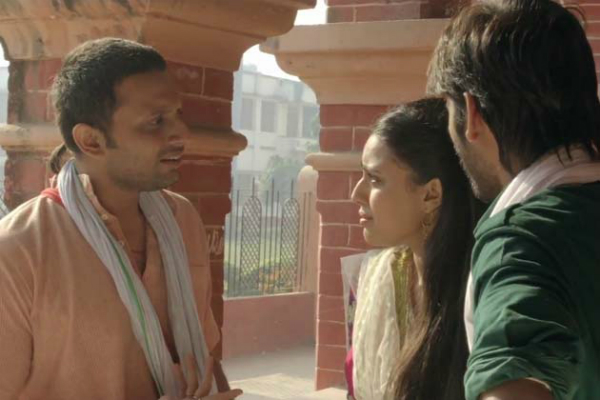
Kundan and MurariRaanjhanaa


The separation of the young lovers follows along fairly predictable lines, but what adds interest is the rival obsession shown by Bindiya (Swara Bhaskar) for Kundan.  Swara Bhaskar is excellent as the girl so obsessed with marrying Kundan that she will do absolutely anything to get his attention. She really deserves to win the guy just for her devotion and ability to put up with Kundan and his best friend Murari (Mohammed Zeeshan Ayyub), but at the same time it’s obvious that Kundan would be a horribly abusive husband.  Swara Bhaskar is full of vitality and energy and lights up the screen whenever she appears which is in stark contrast to Sonam Kapoor’s rather bland Zoya. Mohammed Ayyub is also well cast and does a good job as Kundan’s friend alternating between egging him on, and trying (usually unsuccessfully) to restrain his more dramatic impulses.

Abhay Deol plays Akram, a student activist angling for election to government and the third member of the love triangle.   While Abhay plays his part well he seems too old to be a convincing student leader, even one who is seriously considering a political career. Still, he does seem to have more to offer than Kundan, as demonstrated by the difference in their respective modes of transport.
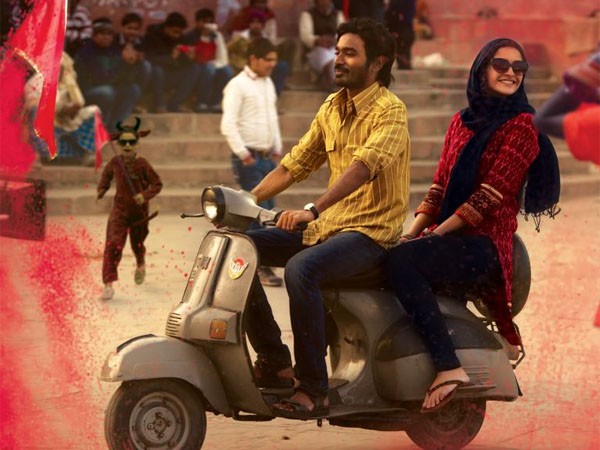
Kundan and Zoya scooterZoya and Abhay motorbike


The story seems to lose its way in the second half as the love story gives way to the political campaign and there are a few too many contrived filmi coincidences as Kundan moves out of Benares and into Zoya’s world.  But the changes in both Zoya and Kundan as their circumstances alter are well depicted and the consequences of their actions are shown to be greater than they could ever have imagined. As a teenager, Kundan’s every emotion is clearly visible on his face and his body language also transmits his feelings at every turn.  With the transition to adulthood he becomes more restrained until by the end of the film Kundan is expert at concealing his true feelings and doesn’t allow any of his emotions to colour his conversation with Zoya.  It’s a fantastic performance from Dhanush and director Anand Rai has drawn out every nuance in his character’s behaviour.

Raanjhanaa

After the first few scenes in childhood Sonam Kapoor keeps her stunned indifference expression throughout, but it is apt for Zoya’s personality so it does tend to work. She looks beautiful, but there is too much style and not enough substance in Zoya, particularly compared with Bindiya and even Akam’s sister Rashmi (Shilpi Marwaha).
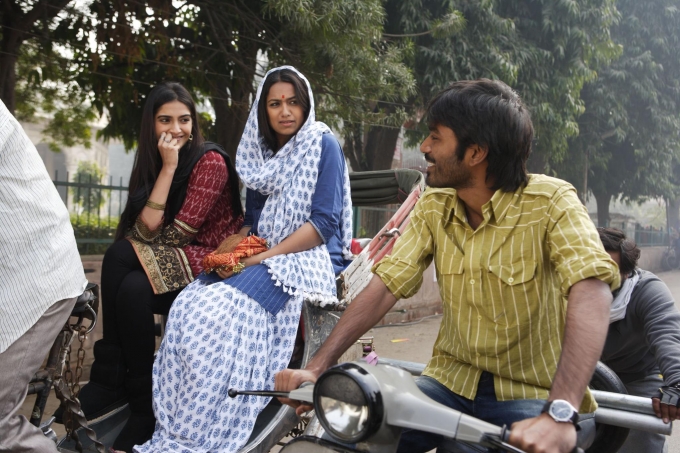
RaanjhanaaZoya


The music by A. R. Rahman fits perfectly and the dance sequences are well placed in the narrative and generally help to carry the story forward.  Benares looks like almost any other city in North India until there are shots of the river, and then it’s suddenly magical as Natarajan Subramaniam and Vishal Sinha bring the city to life with their cinematography. It’s an impressive debut for Dhanush in Hindi cinema, and he does well with the language too (at least as far as my inexpert ear can tell).  Worth watching for a role that seems to have been made for Sonam Kapoor, an excellent performance from Dhanush and from the rest of the cast and a rather different view of “love”.

Theeya Velai Seiyyanum Kumaru

Theeya Velai Seiyyanum Kumaru

I’m really not a Hansika fan and tend to avoid her in movies as much as possible, but with nothing else releasing here this weekend I decided to risk it and headed out to watch the latest Sundar C. romantic comedy Theeya Velai Seiyyanum Kumaru.  Rather surprisingly I enjoyed it! Haniska wasn’t too annoying mainly due to limited time onscreen, the film made me laugh even without subtitles and judging by the audience reaction it was even funnier if you did understand the dialogue.  Siddharth and Santhanam make a good comedy team and with the help of a good support cast, the film turned out to be well worth the drive out to the bijou cinema at Monash.

Theeya Velai Seiyyanum Kumaru

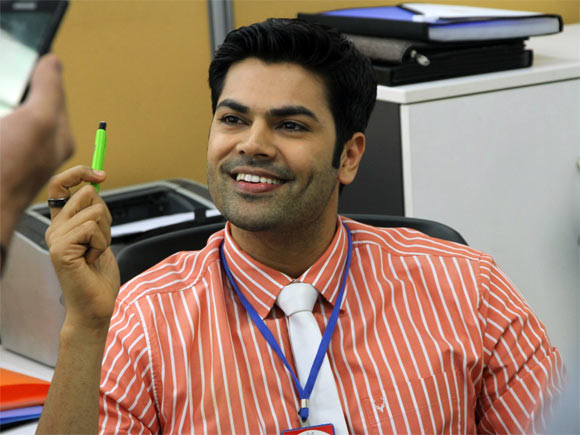
The story is fairly straight-forward, easy to follow and doesn’t break any new ground.  Siddharth is Kumar, a bit of a nerd who works in an IT company where he’s essentially just another anonymous worker. At home he has a loving family who have a history of romantic marriages and seem to care for Kumar despite his generally apathetic attitude towards life. Although he works in an office full of women, Kumar doesn’t seem to have much interest in romance, but then the beautiful Sanjana (Hansika Motwani) starts working at the same company and suddenly Kumar falls in love.  Sanjana has to put up with the masses of frustrated IT workers falling at her feet, but seems to show a preference for office hero and all-round overachiever George (Ganesh Venkatraman). This could be the influence of a string ensemble and massive bouquet of flowers, but to be fair with his looks, success at work and dedication to romance, George really has a lot going for him.

Theeya Velai Seiyyanum KumaruTheeya Velai Seiyyanum Kumaru

Seeing that his affair is destined to fail unless he takes some kind of action, Kumar consults love guru Mokia (Santhanam) to try and help him win the girl of his dreams.  With Mokia’s help, Kumar learns how to ditch the glasses and nerdy attitude but also discovers that devious deception is the way to win a girl’s heart.  Having used Mokia’s often dodgy advice, Kumar gets the girl but discovers that using unscrupulous means doesn’t mean that he will be able to keep the girl, especially when Mokia discovers exactly who it is that Kumar has been chasing.

Santhanam and Siddharth

The real star of the film is Santhanam who keeps the laughs coming and makes an effective partnership with Siddharth.  This is a role that Siddharth has played before but he is less hyperactive than usual and his geeky Kumar is just realistic enough to garner some sympathy for his ineptness. Santhanam suits this type of comedy where his character doesn’t just rely on one-liners but rather uses some physical comedy and his facial expressions to good effect.  Although his love guru is strictly in it for the money he does still manage to make Kumar more presentable and increases his confidence levels despite his rather dubious methodology.  Quite an impressive effort given what he had to work with and his own style choices.

Theeya Velai Seiyyanum Kumaru

The support cast also add to the comedy and include a number of faces from TV including RJ Balaji and Bosskey who are both effective in their roles.  I don’t know the names of the actresses who played Sanjana’s friends at her lodgings, but they are good value and make the scenes with Hansika less excruciating to watch as well as having some genuinely funny moments of their own.  Manobala pops up as a brothel owner rather appropriately attired in red silk while Samantha and Vishal Krishna also make brief guest appearances.

Hansika doesn’t have a lot to do except look pretty and she actually does look much better than her last few films.  I’m not sure if she dubbed for herself in this film but her voice is rather screechy and irritating, although at least she doesn’t get a lot of dialogue.  Sundar C. has kept her role to a minimum and she is fine as the love interest, although there is minimal chemistry between her and Siddharth.

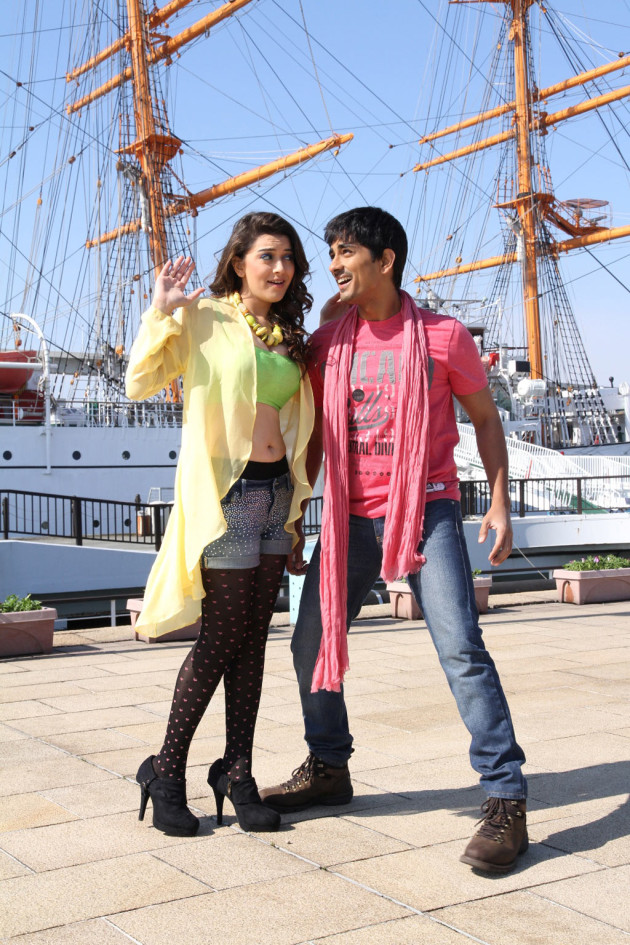
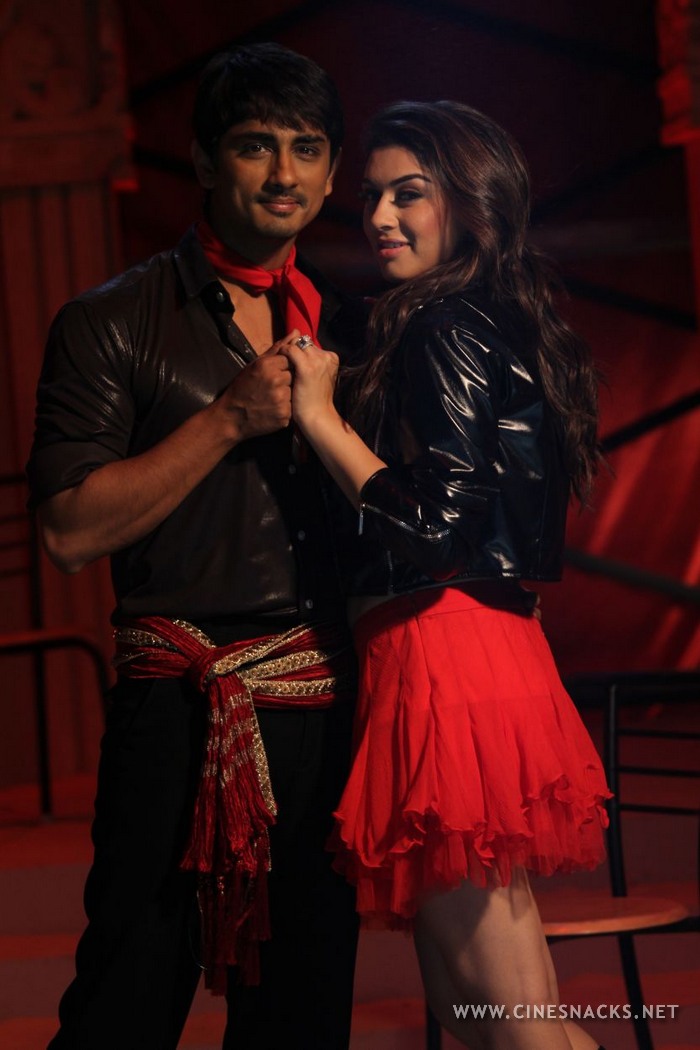
What doesn’t work so well though are the songs – the one above is probably the best of the bunch. All are pictured on Siddharth and Hansika and between Siddarth’s dreadful clothes and Hansika’s woeful dancing they really drag despite some pleasant locations. Hansika really can’t dance and to make her try to move in high heeled shoes and boots is just cruel, but somehow also quite amusing. In the pictures below you can see the high heels that she tries to dance in which perhaps goes some way to explain why she looks so stiff and inhibited.  There are times where it’s obvious she’s concentrating really hard on the steps, but that doesn’t seem to help and she looks very restrained compared to Siddharth.  Overall the choreography isn’t impressive and the backing dancers in Japan are particularly odd which adds to the overall disappointment.

Theeya Velai Seiyyanum KumaruTheeya Velai Seiyyanum KumaruTheeya Velai Seiyyanum Kumaru

If the songs are disappointing, at least the comedy is of a much higher quality and the cast do an excellent job of keeping the film from dragging.  Of course I noticed that Siddharth gets to wear some trendy glasses (as do quite a few of the cast) and there is a brief contact lens interlude which I appreciated. The humour is genuinely funny throughout and both Santhanam and Siddharth are engaging and work well to compliment each other.  Although the rest of the cast add to the comedy it’s all reasonably subtle (for Tamil comedy!) and best of all there are no terrible comedy uncles.   Overall Theeya Velai Seiyyanum Kumaru is a non-taxing and amusing watch which may not tread any new ground but does manage to entertain successfully.  And after all, that’s a lot more than I was expecting.

Ammoru

Ammoru_Poster

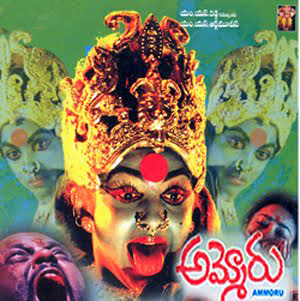
Ammoru is a 1995 film combining mythology and religion with a family drama. Directed by Kodi Ramakrishna, strong performances, a well plotted story and well modulated pace ensure this never gets dull. I like the socio-fantasy and mythological genres and Ammoru has plenty of the elements I find interesting and entertaining.

Ammoru-Ramya Krishna 1Ammoru-Ramya Krishna 2

An entire village is praying to be saved from an illness when a mysterious lady approaches. A kindly woman offers her a meal and shelter after the stranger had been turned away from food dedicated to the deity. In return, the mystery woman makes an infusion of neem leaves and directs the village lady to sprinkle it in front of every house but, whatever she does, not to look back. The stranger will watch over the lady’s house until she returns. Of course she looks, and sees Ammoru in her full glory. Knowing that the goddess would leave the village at the conclusion of the task, the lady kills herself to avoid returning and Ammoru stays and becomes the resident deity. Some years later, the orphan Bhavani is in danger from rapacious Leelamma and her black magic practitioner son Gorakh. Bhavani stopped Gorakh from burying a young girl alive in a ritual to gain his wish so he was not a fan. Leelamma wanted to marry her own daughter off to wealthy Surya, but he married Bhavani to rescue her from Leelamma instigated humiliation. A lifelong devotee of Ammoru, Bhavani is protected time and time again by the goddess. But just when things are at their darkest, Bhavani sends her protector away and compels her not to return unless certain conditions are met.

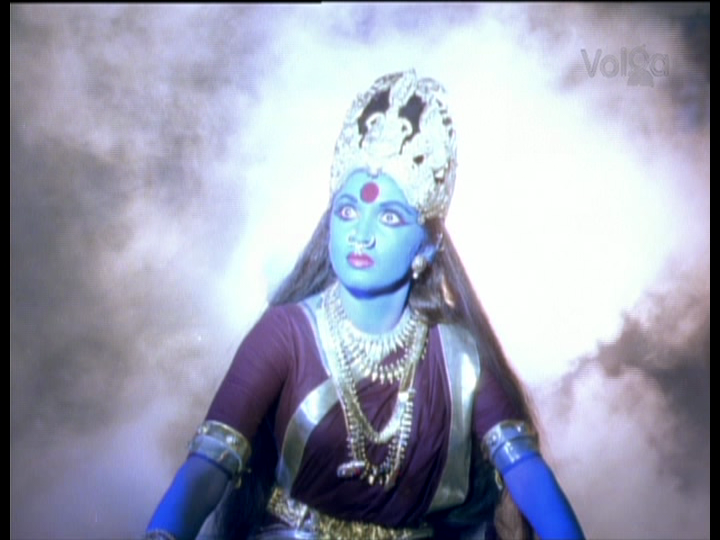
Ramya Krishna dominates as Ammoru although her screen time is limited. Her appearance as the goddess is stunning. The make-up and special effects teams do a great job of making her beautiful yet terrifying, especially when her vengeful nature is stirred.

Also playing an aspect of Ammoru is Baby Sunayana – a preternaturally wise child with a high pitched creepy giggle. I did wonder why no one remarked upon the smoke, coloured lights and echoey vocal effects that often accompanied her, but that is a mere detail. She happily torments Bhavani’s enemies, rarely confronting them directly but making sure their plans go awry. As the little maid, Sunayana is playful but intense with expressive eyes. She conveys maturity and substance despite an unfortunately shrill voice and holds her own in some dramatic scenes with Soundarya.

Ammoru-blessings 1Ammoru-blessings 2

One scene I particularly like is when Ammoru invites her sister deities to attend a ceremonial lunch after Leelamma turned away the intended mortal guests. The goddesses looked matronly and regal and the interplay of everyday and supernatural was striking but not overemphasised. The film often points to a gulf between religious belief and day to day practice. Ammoru is a mother figure, but she is all for tough love. She rewards those who do right and who try to help themselves.

Ammoru-Soundarya as BhavaniAmmoru-wedding night

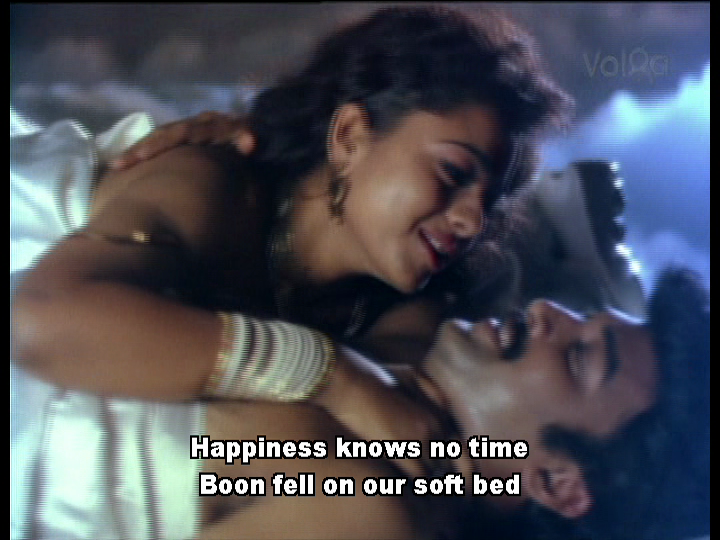
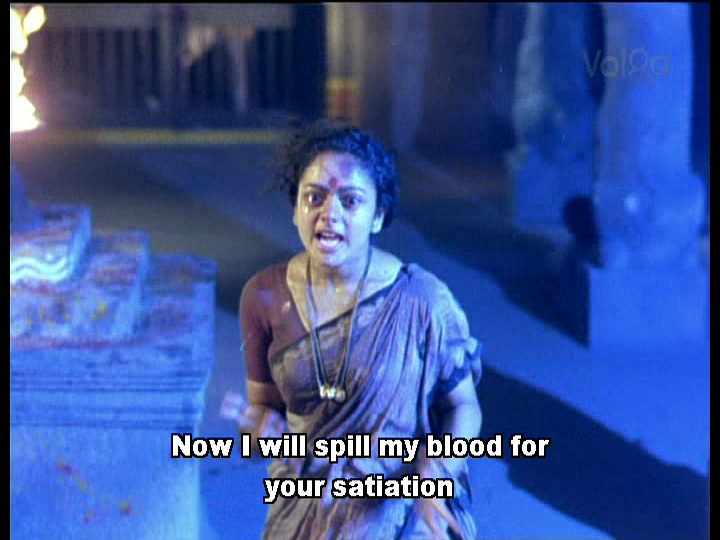
Soundarya delivers an accomplished performance as Bhavani. While the character is a bit dim at times, she has a backbone so there is ample range for the actress to do more than look winsome. She grows from a shy girl to a happy confident new bride who enjoys married life, but when Surya leaves for the USA her in-laws go on the attack. Her baby is targeted and her reputation is in tatters. Undermined and made to doubt her own sanity, Bhavani grows progressively weaker. But when Surya’s life is under direct threat Bhavani throws manners aside and demands Ammoru repay some of the devotion she has been given over the years.

Ammoru-Bhavani is tormentedAmmoru-Soundarya 2

Soundarya transforms from meek to angry and demanding without seeming a caricature. It is a pity that Soundarya died young as she had the ability to play such a range of characters and emotions that her career should have been long and interesting.

But this is by no means a feminist film. Men still rule the roost, with Surya (Suresh) casually disregarding Bhavani’s preferences and generally ordering people about regardless of whether he knew what was going on. He also demands proof before offering obeisance to heaven, which is unwise I think when dealing with a goddess who claims Durga and Yellamma among her names. A girl who is almost raped is told she has to marry the rapist as that is the only way to preserve her honour.

Ammoru-Creepy manAmmoru-what is she doing

The fact that her own mother set the attempt up but intended Bhavani to be the victim did quell a little of my outrage. As did the bizarre sight of the near victim mopping sweat off her attacker with her chunni. And his complaint that he had already raped two women that day so he was a bit tired. As she is a low caste orphan, no one except the old priest takes Bhavani’s situation seriously.

Ammoru-the bad guysAmmoru-evil schemes

Rami Reddy plays the vile Gorakh with uninhibited nastiness. He is driven by overwhelming greed for wealth and power, and uses black magic as a means to that end. He is protected by an evil spirit and believes he is invincible. He was certainly hard to get rid of, surviving many a setback including having his head set alight. His mother Leelamma (Vadivukkarasi), despite having no paranormal tendencies, is even worse. She knows exactly what she is doing and feels no compunction at belittling and torturing Bhavani in an elaborate scheme to separate her from Suresh. While the baddies planning skills are a bit suspect there is no doubt about their commitment. Kallu Chidambaram is a hapless and occasionally demonically possessed servant and Babu Mohan rounds out the family.

The soundtrack is also very effective (despite that child’s playback singer’s voice). This isn’t a big song and dance film, the music is used mostly to create or enhance the atmosphere.

Ammoru-effects

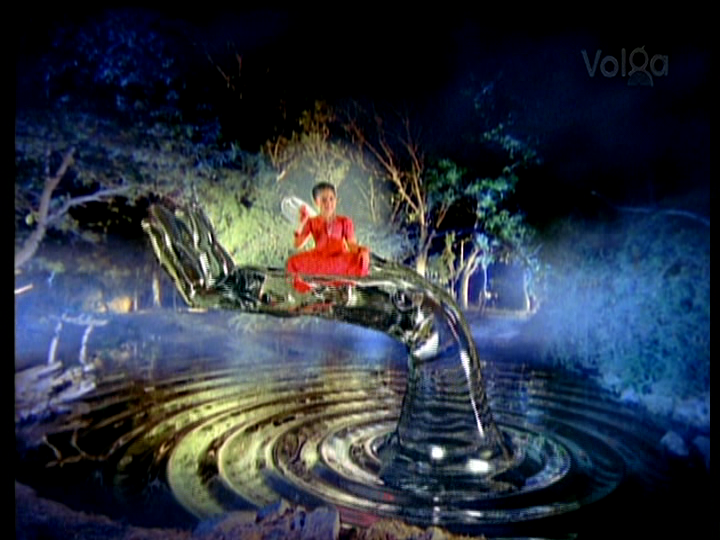
The production design is great and the village scenes are pretty but not too sanitised. The effects used for Ammoru’s interventions and her manifestations are surprisingly good for 1995. Some scenes look a bit cut and paste but the effects budget was used wisely for the big impact moments. I think it helps that the things depicted are not just everyday objects and incidents, so artistic leeway is available for how power is illustrated.

While I don’t like some of the plot points, Ammoru compensates with excellent actresses given room to shine, and strong visuals that help tell the story. The story is gripping at times and while I could guess at the ending, I didn’t see all the twists and turns coming. Highly recommended. 4 ½ stars!