7 Aum Arivu

After reading all about the buzz with 7 Aum Arivu, this was the film I was most looking forward to watch this Diwali. Especially since we had the promise of English subtitles for the first time for a Tamil film in a mainstream cinema release here in Melbourne. However there was so much hype in the build-up to its release that it was almost inevitable that it would fail to meet my high expectations. Despite an interesting concept and a generally good cast, the film pacing is slow with too many gaping plot holes to be anything more than just an OK watch. But there are some good points along the way and finally seeing a Tamil film in the cinema (with subtitles) is a definite plus. This is the first time I’ve seen Surya on the big screen and he certainly makes a good impression. The action scenes are well shot and I’m always happy to see a heroine who is capable of more than hand wringing, sobbing and looking helpless. I just wish they had spent more time on the actual plot and less on the set-up which takes up most of the film.

The film starts with an almost documentary style depiction of the life of Bodhidharma – the 5th century Tamilian monk who reputedly was the founder of the Shaolin temple in China. The documentary feel comes mainly from the interview style used and the lecturing voice-over as 150 years is neatly compressed into 20 minutes. The entire story is treated as factual although a quick internet search shows there appear to be a number of different versions around and no clear agreement on Bodhidharma’s lineage. But that really doesn’t matter here as the point is to illustrate Dharma’s expertise in war craft, medicine and hypnotic techniques, which these opening scenes do very well. Surya is perfect as the Pallava prince who journeys to China to become the ‘blue-eyed barbarian’. Yes, I did notice the blue contact lenses. Much is also made of the fact that people in China know exactly who Bodhidharma was while the Indians interviewed had never heard of him. This lack of knowledge of Tamilian heritage and history by people in India is pointed out a few times throughout the film and does become a tad wearing after a while.

Once the story of Bodhidharma has been established, we are transported back to the present day where an assassin has, rather improbably, been sent from the Chinese government to deal with a troublesome scientist and to initiate something called Project Red. The assassin Dong Lee (Johnny Tri Nguyen) is the top student of Kung Fu from the Shaolin temple and apparently an expert in all forms but seems to prefer the use of hypnosis where possible.

The scientist in question is Subha Srinivasan (Shruti Hassan), a researcher in the field of genetics whose work involves manipulating genes to resurrect DNA encoded attributes such as the fighting techniques and medical prowess displayed by Damo. Subha has tracked down the descendent of Damo who is most likely to be suitable for a little gene manipulation and he just happens to be the circus performer and general layabout Aravind (Surya). While Aravind thinks he has managed to trick Subha into meeting him to further their relationship, in fact she has been stalking him for over a year and has a scary collection of his discards including a tooth brush to show for it. It makes a change for the hero to be the victim of some determined stalking and I liked this deviation from the norm. Strangely Aravind is not as upset by the stalking as he is by the realisation that Subha doesn’t love him but just wants to get at his genes. Although from my SI filmi education so far I thought that stalking was supposed to prove true love but maybe I’ve just got it all wrong?
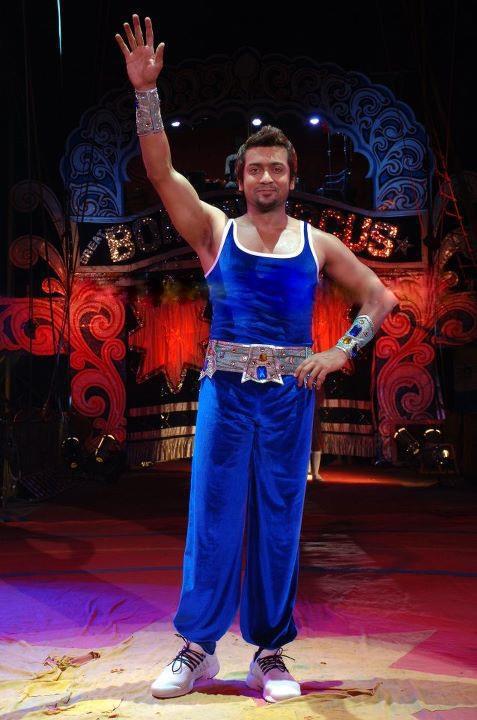
Not only has Subha been collecting Aravind’s DNA, but has compounded her dishonesty by stealing  a book from the local museum to further her research. It’s no surprise then to discover that her project doesn’t get past the local ethics committee although their reasons for rejecting her are more based on her youth and lack of kow-towing to their authority rather than her actual unethical approach to research. I found a lot of the science very funny since I do actually work as a medical researcher, often alongside geneticists, so have more than a passing knowledge about the subject. So while a lot of the science is very dodgy and eventually becomes implausible, it does have some basis in fact and it’s a relief not to have too much dumbing down of the subject matter. However the most unrealistic part of the film for me is Shuba’s apparently unlimited source of funds for her research – now that really was unbelievable!

Having learnt that Subha was only interested in him as a human lab rat, Aravind is devastated and mopes around theatrically (well he is a circus performer) until he finds out about the threat from Project Red. Dong Lee is also trying to assassinate Subha and decides Aravind needs to be removed too in order to guarantee the success of his mission. In between saving Subha and trying to save the world, Aravind barely has time for Subha to genetically transform him into Bodhidharma.

The first section of the film detailing Bodhidharma’s exploits in China is definitely the best part of the film. There is very little dialogue and Surya makes the most of his very expressive eyes to convey the various trials Bodhidharma has to undergo. While copious amounts of research appear to have gone into the making of the film, in this section it has paid off and it makes for a strong opening. Sadly though this isn’t maintained. The story has a lot of potential as it mixes science fiction with a disaster movie theme and a dash of Indian masala romance but it doesn’t quite gel. The plot rambles over the first half and it takes far too long to find out exactly what Project Red is and why Subha is a threat to the Chinese. The romance doesn’t work very well as a plot point and there is very little chemistry between the two leads. However I think this is intentional as Subha tries to keep her distance from someone she essentially sees as a walking experiment but there was a lot of time spent developing this non-relationship which slowed the story. There also doesn’t seem to have been any need to make Aravind a circus performer other than to make Surya learn a few new tricks since the whole circus background is totally abandoned in the second half.

Shruti Hassan is fine as the researcher and committed geneticist. She has plenty of passion and is able to convey the obsession necessary for Subha’s research although this does make her lack of enthusiasm in her romance with Aravind more obvious. She is particularly good in the confrontation scenes – those with the research committee and also with Dong Lee. Her character is strong, decisive and capable all of which she handles with ease.

Johnny Tri Ngyugen has excellent presence as the villain and exudes chilly menace. However there is a little too much reliance on his super hypnosis and not enough good old fashioned kick-ass kung fu for my liking , and this  slows down the action sequences. In one scene, where he hypnotises a large number of innocent bystanders and sends them after Aravind and Subha like destructo-robots, he keeps attacking for much longer than any respectable villain should allow before realising that the technique isn’t working and a change of tactics is in order. Perhaps it’s my over exposure to Southern Indian cinema but Peter Hein is an excellent action choreographer and I wanted to see more actual fighting between Dong Lee and Aravind. The few fights they had were worth waiting for though and I did enjoy the final sequence despite the overtones of Crouching Tiger, Hidden Dragon.

The soundtrack by Harris Jayaraj is great and I do love the songs, but while they are generally well pictured they don’t fit easily into the narrative and only serve to further disrupt the story. The exception to this is the first song ‘ Oh Ringa Ring’ which is fun and a good introduction to the character of Aravind. The songs are however the only time Aravind and Subha have any chemistry together so perhaps that’s one reason for leaving them in.
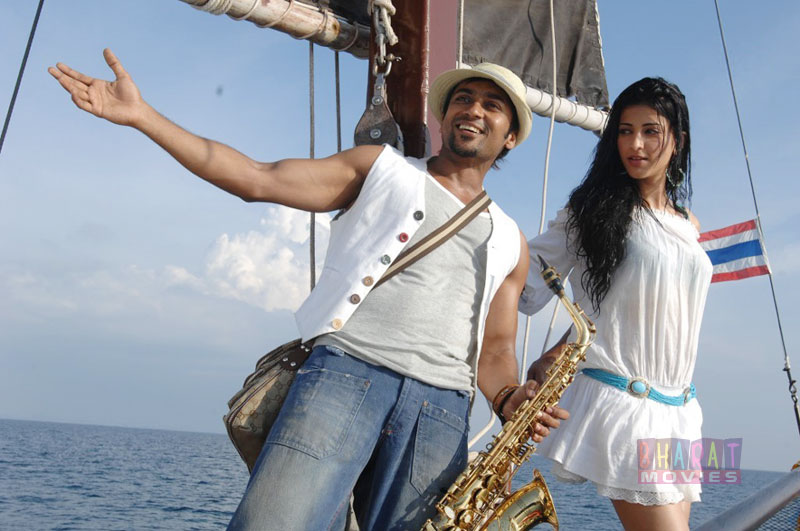
The screenplay by director A. R. Murugadoss is the main problem with 7 Aum Arivu as the film takes so long to get going once it moves to the modern era, and then is full of plot holes and unlikely scenarios. The last few minutes are dedicated to moralising about history and having pride and belief in your ancestry referring back to the lack of knowledge in India about the life of Bodhidharma. It seems very ‘Hollywood’, which seems to feel the need to deliver a sermon along with a happy ending, and didn’t seem to fit into a film which ends up being more masala than perhaps is intended. It’s still worth watching for the opening scenes and good performances from the leads, but just don’t expect too much from the actual story.

Varsham

I do really like Prabhas. He always seems to be a little surprised to be the hero of any film and with his height and general gangliness he has a ‘St Bernard puppy’ type of cuteness that is very endearing. Even though his films seem to follow a similar pattern, he brings enough personality to each character that I’m usually happy to watch no matter how many plot holes or illogical scenes there seem to be and this film does have a few of those.

Varsham is a typical Prabhas action/romance movie. The story involves two guys fighting over the heroine like dogs over a bone, with each one growling ‘she’s mine’ at appropriate intervals. But when one of those two is Prabhas and the other is Gopichand it’s suddenly a lot more fun. Add in Prakash Raj as ‘Prakash Bad Dad’ and it’s much more entertaining than it first sounds.

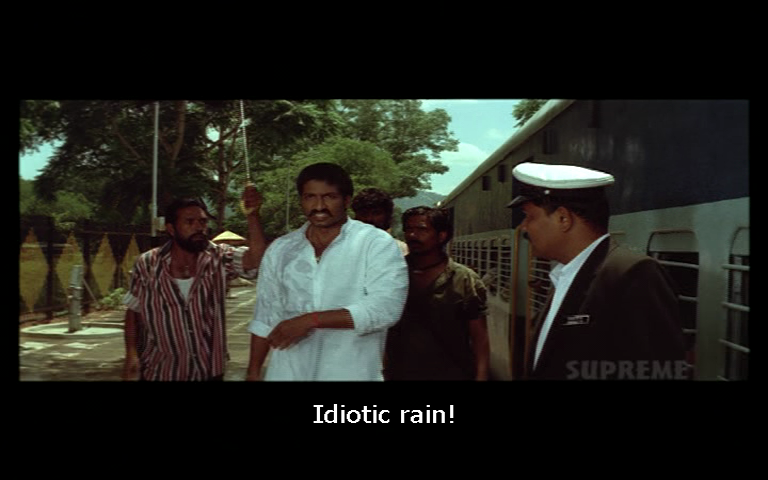
Trisha plays Sailaja, the girl who both Venkat (Prabhas) and Bhadranna (Gopichand) lay claim to. Sailaja is a fun-loving girl who adores the rain, and I fully understand and endorse her compulsion to dance in it at every possible opportunity. Venkat and Bhadranna first both see her at a train station where their train has been delayed. Once the rain starts Sailaja leaps out onto the platform to dance with total child-like abandon. She follows the ‘dance as if no-one is watching’ creed, despite the fact that everyone is actually watching her and this is a very fun song with plenty of dorky moves by Trisha. There’s a great pigeon move in here too and I’m very impressed by Trisha’s grasp of the bird-impression genre of dance step.

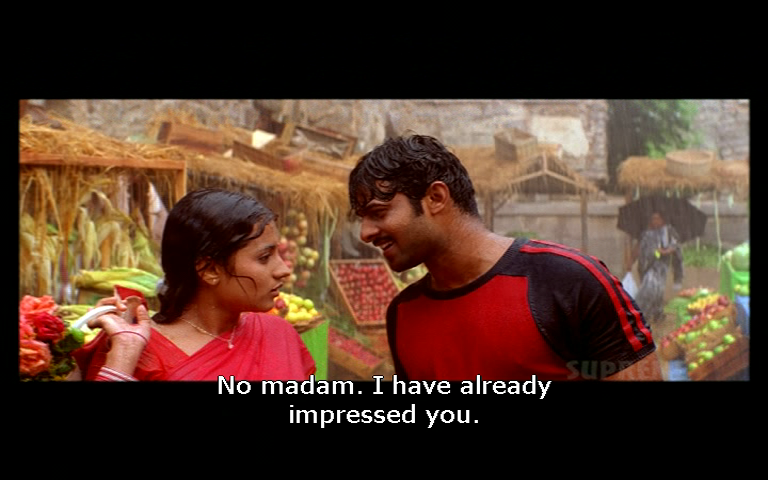
Venkat and Sailaja are separated as the train moves off, but find each other the next time precipitation hits their local market in Warangal. Since the rain seems to bring them together they make a pact to meet again when it next pours. However, just as the rain clouds form again there is the small problem of Bhadranna who has come to Sailja’s house to arrange marriage with her.

Sailaja’s father Ranga Rao (Prakash Raj) is a drunken gambler who wants to make the best use possible of his daughter to fund his chosen life style. But while Bhadranna has schemed to put Rango Rao in his debt, trying to use his weakness for gambling to force Sailaja into marriage, Rango Rao is one step ahead.  Luckily, a film producer has seen Sailaja and is desperate for her to act as his latest heroine. This will naturally pay extremely well, plus hopefully be a source of revenue for years to come, so Ranga Rao is in no hurry to marry his daughter off. And despite appearances, Ranga Rao is wilier than Bhadranna gives him credit for.

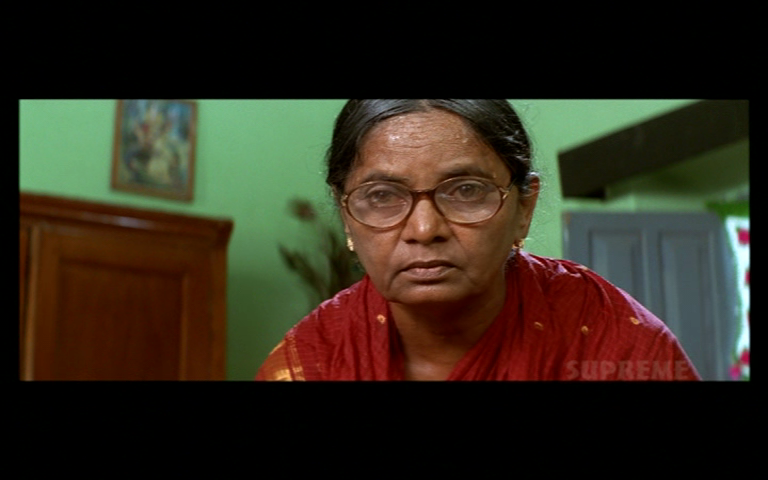
He plays Venkat and Bhandranna off against each other, reasoning that he can use Venkat to get rid of Bhandranna and therefore his debt, and then separate Sailaja and Venkat. This is exactly the path he follows and even when his daughter is later kidnapped by Bhadranna he’s still tries to make the situation turn out to his advantage. Luckily for Sailaja she has the support of her feisty and opinionated grandmother who has a very low opinion of her son-in-law. It’s also a pretty accurate one. Sailaja’s mother is a bit of a wet blanket and unable to take a stand against her scheming husband, whereas her grandmother actively supports her relationship with Venkat and obstructs  Bhandranna as much as she can.

Bhandranna doesn’t stand a chance though – he has entirely the wrong opinion about the rain. Unlike Venkat who has a much better appreciation of the things that matter to Sailaja.

Although the story itself is nothing new, the appeal here lies in the performances of Prabhas and Trisha who really do bring their romance to life. They have great chemistry, especially in the songs and the love story comes across as natural and unforced. After all as Sailaja puts it, Venkat is tall and handsome – what more does a girl need? Their first meetings in the rain are beautifully captured and make good use of the hazy lighting. In the later scenes Prabhas is all action, which he does so well, especially with the great fight scenes choreographed by Peter Hein. But Sailaja fights back too and isn’t at all a typical sobbing heroine. I really like her characters attitude even if she is a little too gullible when it came to her father and too ready to believe the worst of Venkat. I also appreciate the references to the Ramayana throughout the story. The kidnap theme is a straight take from the Aranya Kanda, but there are plenty of other references. These range from Bhandranna trying to change the outcome of the story in a re-enactment at his mansion, to the final showdown involving a large Ravana cutout, which all add yet more layers to the story. I love the songs by Devi Sri Prasad and they are generally well placed in the movie. The best are those with Venkat and Sailaja in the rain, although I do like the multi coloured chicks in this song, and both Prabhas and Trisha look to be having fun.

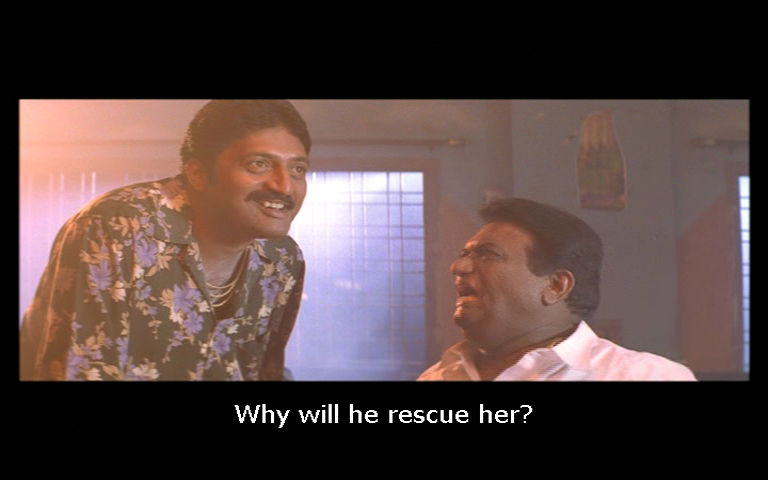
But despite my love of Prabhas, Prakash Raj is the scene stealer as the selfish and greedy father. He has a habit of running his tongue over his crooked canine tooth while he is scheming and it becomes quite mesmerising after a while, acting as a gauge of just how manipulative he is planning to be . Ranga Rao also has a collection of very loud shirts and the combination is enough to put him into the ‘bad dad’ faction even before he starts his fake suicide attempts and general bribery of his daughter. Jayaprakash Reddy as the producer aids and abets Ranga Rao’s plans in order to get his film made and the two have some of the funniest scenes in the film.

There is a small separate comedy track involving Sunil as Venkat’s friend Jagan and his quest for romance. Since Sunil is another favourite and the comedy is inoffensive and not too intrusive it doesn’t detract from the rest of the film for me. Ajay also turns up as one of Prabhas friends which is another point in this films favour although his character is of the blink and you’ll miss him variety.

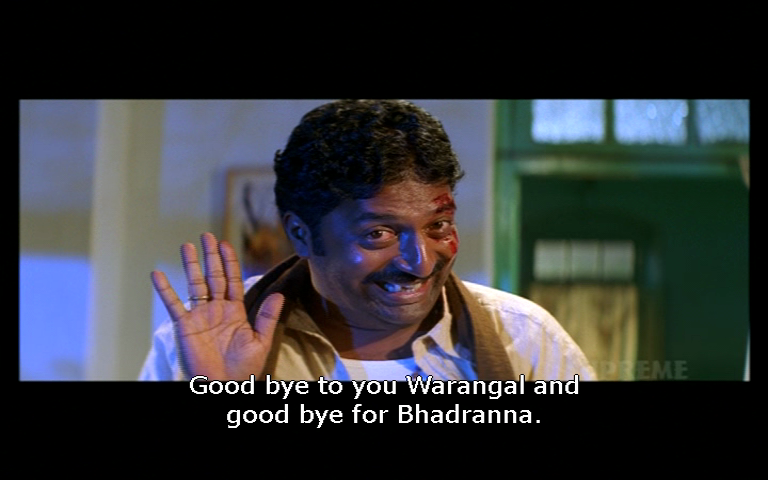
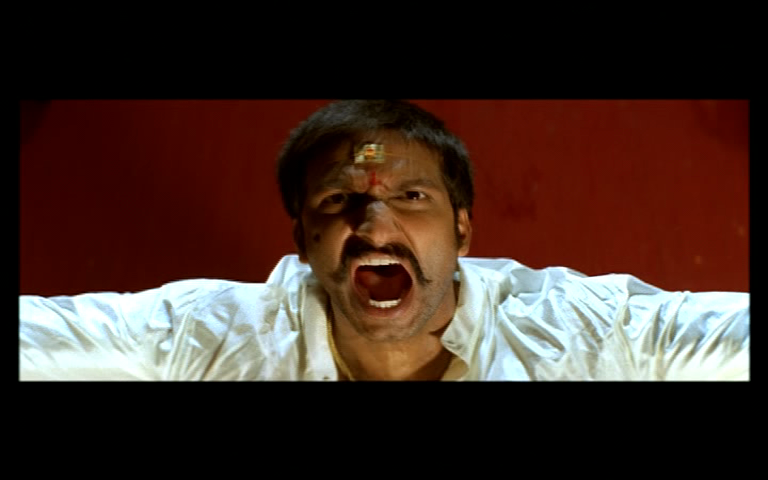
Varsham is the first time I’ve seen Gopichand act, and I think he’s excellent as the villainous Bhadranna. He’s not overtly evil, but you just know he’s the sort of person who pulled wings off flies as a child. OK, killing his father was the first clue, but most of the time he’s rational and normal until you look at his eyes, or he suddenly snaps and casually kills someone. Bhadranna is the centre of his world and the sooner everyone around him realises that and falls into line, the easier it will be for them.  Shafi has a small but important role here as Bhandranna’s step-brother Kasi, and he’s sleazy  and fanatical enough to make his initially pitiful character quite obnoxious by the end. It seems to be his special talent.

Great songs, crazy fight scenes (Venkat has amazing bullets that manage to flip jeeps), Prakash-Raj-bad-dad and a very sweet romance make this one of my favourite Prabhas movies. It’s worth watching for the beautiful rain shots alone but Trisha and Prabhas are excellent together in this film.  4 stars.

Temple says:

The structure of the simple story was quite good, and I like the overt Ramayana references. Bhadranna demanding that the local actors change the script to allow Ravana to tie the nuptial thread around Sita’s neck was just one of many signals that he was the real deal when it came to insane villainy. But the heroic Prabhas was just as demanding. Venkat was the type of hero who expects to be worshipped and he had no tolerance for people questioning him. In many respects there isn’t that much difference between hero and villain as they are both self centred and moody. Prabhas has a very likeable presence when he isn’t sulking or killing people, while Gopichand has a harder edged energy. It was the actors who made that dynamic work as apart from flagging Venkat as ‘poor but honest’ and Bhadri as ‘eeeeevil but artistic’, there was little else in the script to develop the characters. The small scale of the drama and the characters’ dreams made the film a little more engaging and plausible. The character actors were pretty good and helped paper over some of the plot holes just by being believable in their supporting roles. Prakash Raj was good but not great. I found his characterisation fluctuated between extremes of buffoonery and cunning and it didn’t feel cohesive. If he had dialled it down a little in some scenes, the sly con artist and schemer aspects of Ranga Rao would have been more convincing. My first thoughts on seeing Trisha cavorting around in the rain went along the lines of  ‘Hello..an escaped mental patient.’ Why do Indian film directors seem to associate carefree innocence with behaviour that is borderline crazy? And that is pretty much the last thought I gave to Trisha. She was adequate but I think almost any actress could have delivered that performance. There is rather a lot of kissing (seen and implied) although there is minimal chemistry between the stars, even with Trisha licking melon pulp off Prabhas’ face.

The songs are colourful, and Prabhas and Trisha incurred the wrath of the wardrobe team in some of the picturisations which made them extra entertaining. Prabhas’ signature dance steps seem to be stomping or undulating and he often got to do both. Sometimes while wringing wet. There are some nice little details in the design, and I liked seeing Bhadranna still using a gramophone – so stylish and retro. The action scenes were good, and I appreciated Venkat’s dedication to leaving no car unturned in one encounter. Prabhas is very comfortable as an action man, and tackles the fight scenes with gusto.

This is a pretty run of the mill romantic drama and while it was a perfectly acceptable timepass, there is little to set Varsham apart. 3 stars.

Ra.One

Ra.One seems predominantly aimed at older kids, so I fall well outside the target demographic. But it was interesting to contemplate Shah Rukh, the father, as I watched him play a nerdy dad who wanted to do something his son would find really cool. And I think perhaps, Ra One is the thing he made for his own kids. As with almost all things parents do to try and impress their kids, it doesn’t entirely succeed and despite being well intended, can be cheesy and embarrassing. There are daft antics, crotch kicking jokes, bad hair and the occasional detour into gross humour or sleaze that – I know this will shock you – didn’t always entertain me. But a few things were just delightful and hit the spot.  

I avoided most of the pre-film promotion as I thought low expectations would be the key to enjoying it. Those expectations were raised almost immediately by the opening sequence – a very amusing filmi pastiche set inside a computer game. Priyanka Chopra (as Desi Girl) and Sanjay Dutt (as Khalnayak) were excellent at what I hope was intentionally bad acting, and SRK was very funny as a kind of Goth styled sword wielding Fabio. It was tongue-in-cheek, with lots of action and stunts, plus silly puns and recycled film dialogue. Sadly my hopes were dashed almost as quickly when the comedy began.

Shekhar Subramanium (SRK) is a Mr Bean type fool in a dodgy wig who creates havoc everywhere he goes. His son Prateek (Armaan Verma) – a child in desperate need of a decent haircut and a swift boot up the backside – is embarrassed by his loser dad. Shekhar is a successful (based on real estate as the family home is lovely) game designer and tries to make a game that his son will like. This section draaaaaaaaags on. It is clear that the son is a brat and the dad is sweet but misses the point. Kareena Kapoor as wife Sonia tries to keep the peace but the first half is more about the father son dynamic.

Prateek tells his dad to make a game where the villain can never lose, because villains are cooler than heroes. And so we come to the action at last. The science behind how the villain Ra One can escape his game is explained by a bit of hand waving and muttering of ‘digital rays’. That didn’t bother me as I think had there been a more rigorous scientific basis for the story it would have been even longer and even more plot holes would have emerged. Once Ra One emerges in the real world, the film becomes an action superhero flick and I was much happier.

Ra One is an evil entity and determined to finish off his first opponent from the game – Prateek – for good. Shekhar sacrifices himself to save his son, but he doesn’t exactly disappear from the film. Every villain needs a hero in opposition and G One represents the life force in the game. Shekhar programmed G One with his own values and equipped him with some favourite proverbs, part of his gift to Prateek. G One bears a physical resemblance to his creator but has much sleeker hair, blue contact lenses and a flash rubbery suit.

Ra One eventually settles into the form of a bare chested Arjun Rampal and the final showdown is inevitable. Arjun Rampal just has to posture and flex, which he does well, and he was certainly menacing. Ra One’s arrival in India was brilliant and loaded with symbolism, but that wasn’t carried through.

Evil versus good, death or life, emptiness versus selflessness. As with the science, Anubhav Sinha shies away from delving into those concepts. I’m not sure that would have made this a much better film, but I do think there was room to expand on some of the ideas and give a heightened sense of consequence when Ra One faced G One.

G One’s relationship with Sonia and Prateek is mostly played for laughs but there are some moments of ‘what if’ as the grieving family look for Shekhar in his creation. The film effectively navigated the relationship between the boy and his father/hero and wasn’t too syrupy. Shekhar’s death was discussed in plain terms, and while G One was comfortingly familiar (and kind of cool) he wasn’t just a vessel for the return of Shekhar.

Kareena was most effective in he second half, especially in her scenes with Shah Rukh and seemed more real when relating to him rather than the child. It says something that a scene involving nasal contents and ending with SRK saying ‘Like it? Keep it!’ could also have some underlying sexual tension. And be funny. The role was a mix of filmi Ma and minx that let her look glam and show some dramatic range. This was a solid performance that showed her off to good advantage.

Shah Rukh is more effective as the slightly robotic G One than as the exuberant Shekhar but that may just be my prejudice against the comedy wig talking. His acting was sometimes surprisingly restrained for a broad action entertainment like this. The scene where Shekhar sacrifices himself was quite moving, and all due to the change of expression in Shah Rukh’s eyes. He covers the gamut from slapstick to deadpan comedy and gave G One a slightly off tempo rhythm to his speech and movements. SRK seems to delight in uncle dancing or cheesy retro dance moves, and there are some excellent bad dance moments, including a Michael Jackson tribute. The pleather pants in that scene made me wish that he would get back on the carbs – he’s looking very thin, maybe as a result of wearing the rubber G One suit for months.

The Vishal-Shekhar music is pretty forgettable, although the picturisations looked OK. The choreography tended towards the inappropriate but I guess if you’re a 13 year old boy it would be just dandy. And I appreciated the shiny underpants on the girls in Chammak Challo as attention to detail is always a good thing, especially when there is so little fabric to go round.

While I found the choreography for ‘Criminal’ skanky (although par for the MTV course), there was something endearing about SRK trying to pop his non-existent booty. I was a bit distracted by the triangular slit cut into Kareena’s miniscule skirt that made me hope she had also been allocated appropriate underwear.

Tom Wu was a stand out in the supporting cast. I am not sure why a Chinese character had a Japanese name (Akashi) but whatever. Just don’t call him Jackie Chan! I loved his flubbed lip synch in ‘Criminal’, and he got to show off a bit more than just being a sidekick. Satish Shah was his usual ebullient comedy uncle type. The special appearance that got the biggest cheer was of course Rajnikanth! He did look a little frail and I hope he is resting up and getting ready for his next film.

The VFX are good and are well integrated into the action.  The gaming style is maintained in the way the characters move, their fights and the fast edits. It’s certainly a quality film in terms of production values. The fight scenes are excellent, my favourite being the South style showdown with machete wielding rowdies. The script could have used some work, and the first half could easily lose 30 minutes. The wardrobe department were clearly in control of a reasonable budget, but sometimes had no idea how to use it other than by throwing more stuff into the mix. This will give you a  sample of the visual delights that await.

Expect a mass entertainment aimed at adolescent boys and you’ll be in the right frame of mind to enjoy this for what it is. Yes it takes the shallow option on many questions, but it’s a superhero genre film. Would I really take life advice from men in rubber suits? 3 stars!