Rowdy Alludu

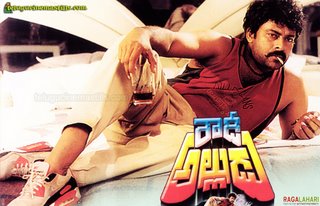
There are few things we like more than a Chiru movie, unless of course it’s a double role Chiru movie! Rowdy Alludu features Chiranjeevi taking on two classic characters; the smooth and suave businessman Kalyan and the strong, streetwise auto driver Johnny.  Add to this a dash of romance, intrigue, dastardly deeds and plenty of action and you have the perfect masala mix.
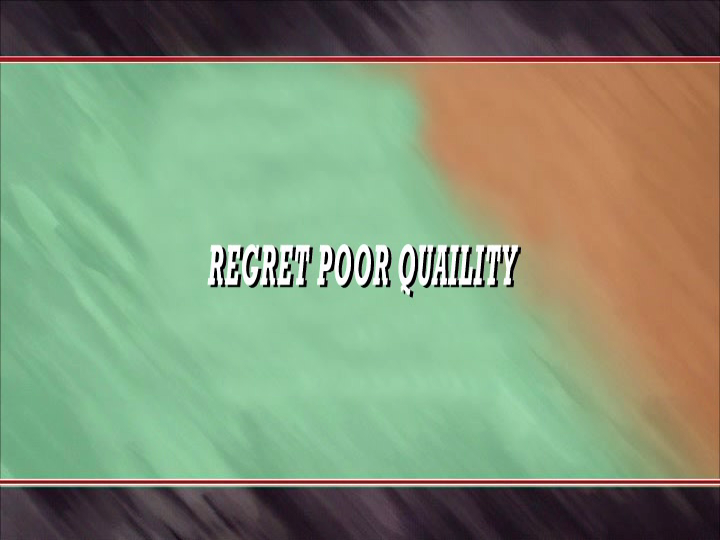
The movie starts with the above statement (which we took as A Sign) and there are a number of sections where there seem to be missing scenes as the action appears to skip. We really hope that there is someone in Hyderabad collecting and restoring, or at least preserving, all of these older films as quite a few we have watched recently have a similar problem.

Kalyan arrives back from the USA to take over the family hotel business from his ailing father and naive brother-in-law. With the help of his father’s trusted employee Mr Madhavayya (Raogopalrao) he discovers irregularities in the accounts and it’s not long before he has a few suspects in mind.
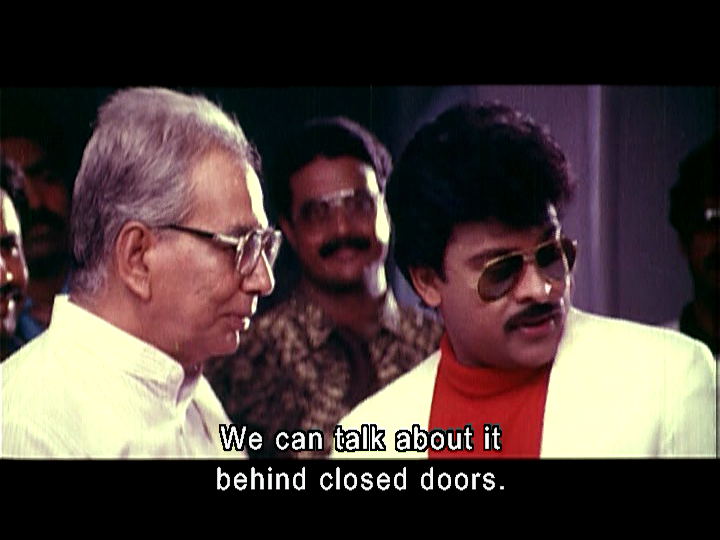
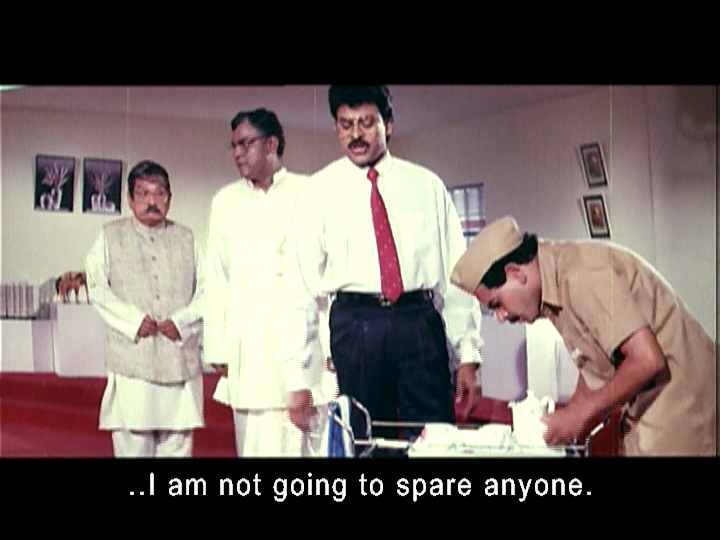
However, before he can investigate further, the whole family heads off to Ooty for a holiday. This seems to be an excuse for the wardrobe department to go mad buying a natty selection of sweaters for Chiru. Meanwhile, the fraudsters make efforts to cover their tracks and enlist the help of their partner in crime, the cat owning axe-murderer and construction contractor, Ranjit Kumar.
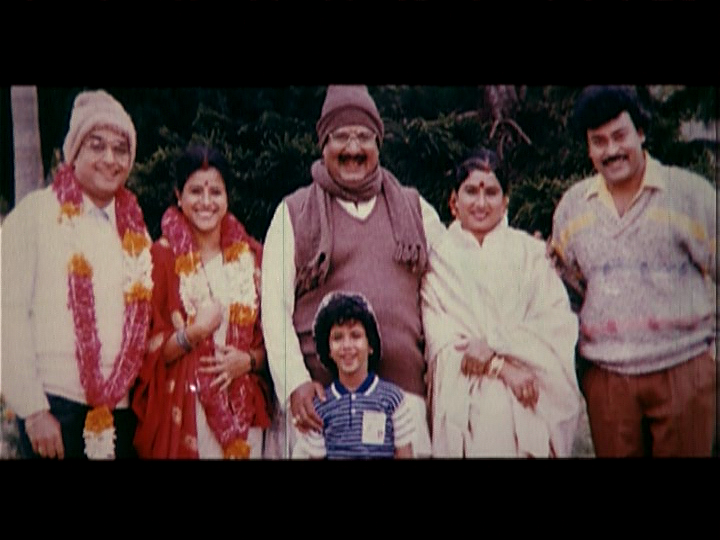
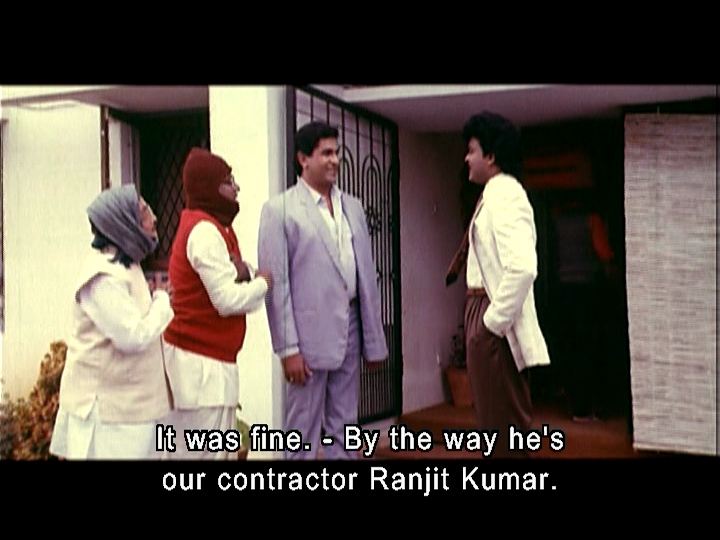
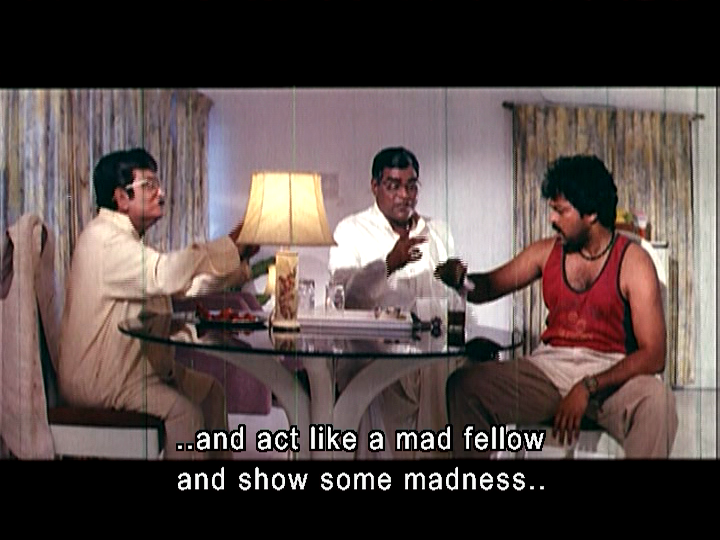
On a trip to Bombay, Venkat Raidu (Kota Srinivasa Rao) and Papi Kundalu (Allu Ramalingaiah) find Johnny, an auto driver who is the exact duplicate of Kalyan. They hatch a plot to get rid of their boss, put Johnny in his place and then take over the company.
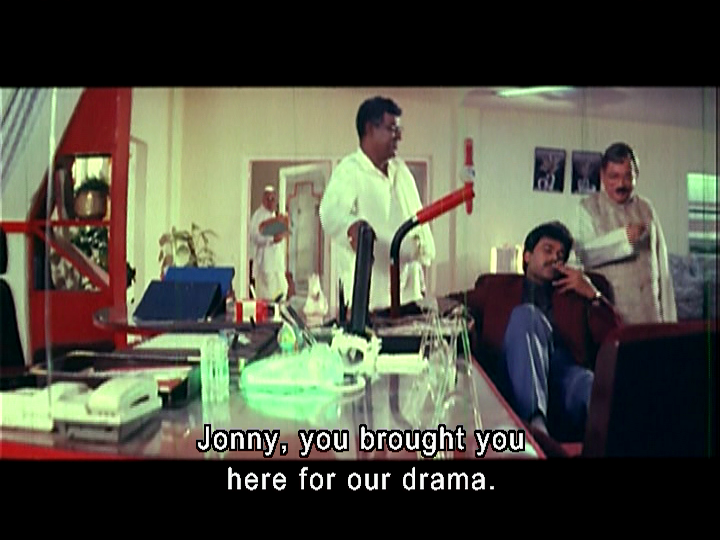
Never one to resist a beautiful woman, Johnny dances up a storm to a bonus Bappi Lahiri song with the amazing Disco Shanti. Despite the fact that this was a film released in 1991, Disco Shanti’s outfit looks to have been stolen from Sam Fox circa the mid eighties. Luckily they are in fine form, and more than ready to take on the dubious choreography and make it their own. This may be the song that taught young Charan how to handle a fire hose.

Kalyan is in love with Madhavayya’s daughter Sita (Shobana) who has the good sense to be a lawyer. This comes in very handy later on when the hapless Kalyan is accused of murder and thrown into jail. Rekha (Divya Bharti), the daughter of Venkat Raidu, hatches a scheme to marry Kalyan. Rekha does genuinely seem to love Kalyan but her father just sees the marriage as a way to control his nephew and the company. Naturally when she throws herself at Johnny thinking he is Kalyan, Johnny is delighted while Venkat Raidu desperately tries to separate the two.
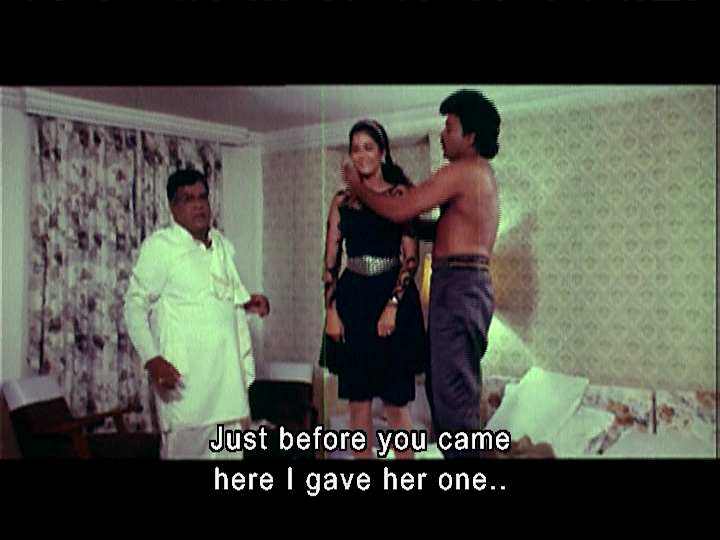
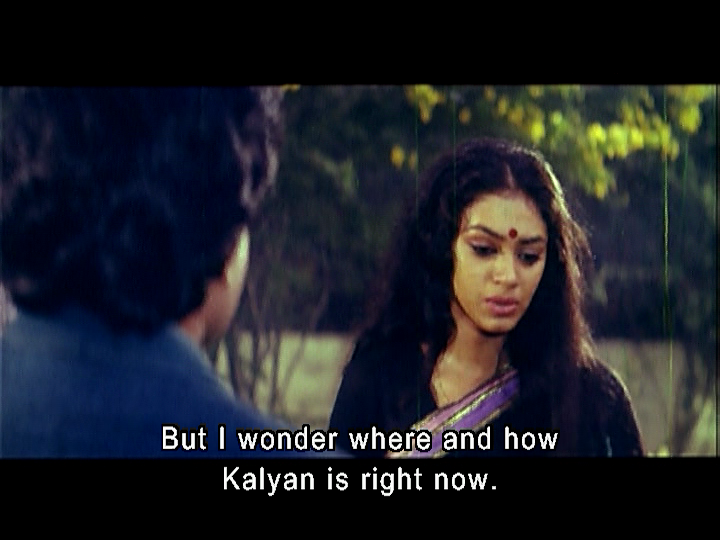
Shobana doesn’t get much screen time at all, although she does make a lovely pairing with Chiru. Most of the romance is provided by the interactions of Johnny and Rekha, relying heavily on comedy, mistaken identity and innuendo. Divya Bharti throws herself at Chiru with wild enthusiasm  and really, who can blame her.

The success of the film rests on the portrayal of the two characters by Chiru. He exudes class and style as Kalyan and is also convincingly vulnerable when his family is attacked.  Johnny is as rough and tough as they come and Chiru makes him a different character in every respect. Kalyan has a blow-waved mullet and neatly pressed trousers, Johnny has a more exuberant moustache and prefers the timeless plaid and denim combo. Johnny’s attempts to impersonate Kalyan are laughable, but since he is supposed to convince everyone that Kalyan has become crazy that works perfectly. A very youthful and bald-spot free Brahmi makes an appearance as the psychiatrist enlisted to pronounce Kalyan insane, but most of the comedy falls to Chiru as Johnny and he does an excellent job.  The two fraudulent employees also ham it up with their inept schemes and it’s left to Ranjit Kumar and his henchman to provide the real menace.

The songs are mainly featured on Chiru and Divya Bharti and are upbeat as expected from Bappi Lahiri, with some interesting choreography by Prabhu Deva among others. There is one romantic song with Shobana in Switzerland which is quite subdued choreographically, but still contains potentially scarring images of mouth to mouth grape transfer technique. Chiru and Divya have an interesting encounter with some rather obvious symbolism of melting candles, dripping wax and a lot more besides. And we would love to know what the meaning was behind poor Divya getting hit in the face with suspended fruit.  More fruit! There was a theme here, but we just don’t know why. The costume designers also seem to have gone crazy in the local DIY store for some of the outfits and must be applauded for their belief that almost anything can be used as a headdress.

We enjoyed the scene in the hospital when Kalyan’s father’s heart beats in Morse code. There doesn’t appear to be any reason for this but is one really needed? Did it say anything significant? Are there any Telugu Morse Code experts out there? Johnny is obviously a man of steel as he is able to emerge from a coma and go straight into a major fight without so much as needing a bandage change.

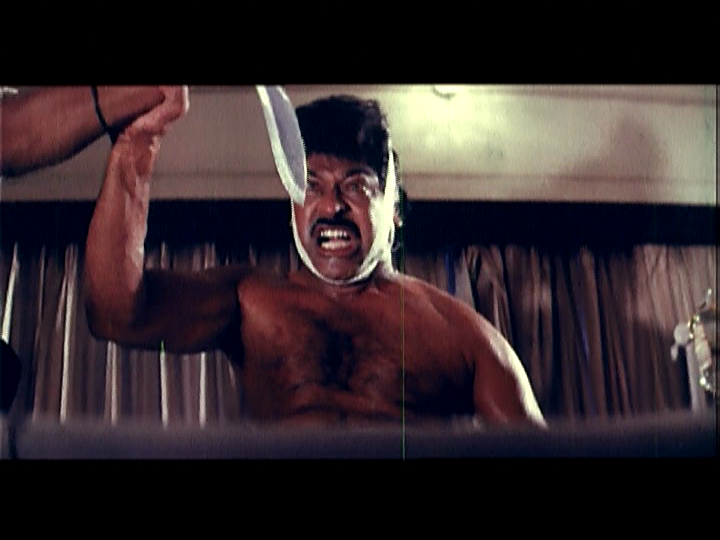
We know that the story doesn’t have to make sense, but the police do seem to be particularly inept On learning that Kalyan has been arrested and  subsequently escaped, Johnny promptly flies back to Hyderabad. Surely the police would have been deployed at the airport looking for the escaped felon Kalyan? And since Kalyan and Johnny were identical it seems likely that the police might just have spotted Johnny returning to the city of his crimes. Perhaps they were looking for someone escaping from Hyderabad rather than entering the city so he was able to sneak in while their backs were turned.  Or are we over-thinking this?

Chiranjeevi is in his element and much of the film’s appeal lies with him, but his co-stars all turn in excellent performances to make this very entertaining. There is so much packed into this film with plenty of twists, plots and counter plots making it chock-full of masala goodness.
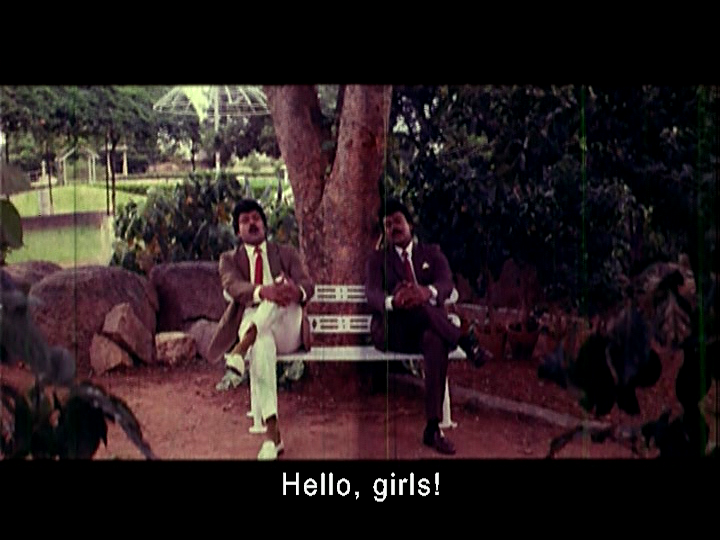
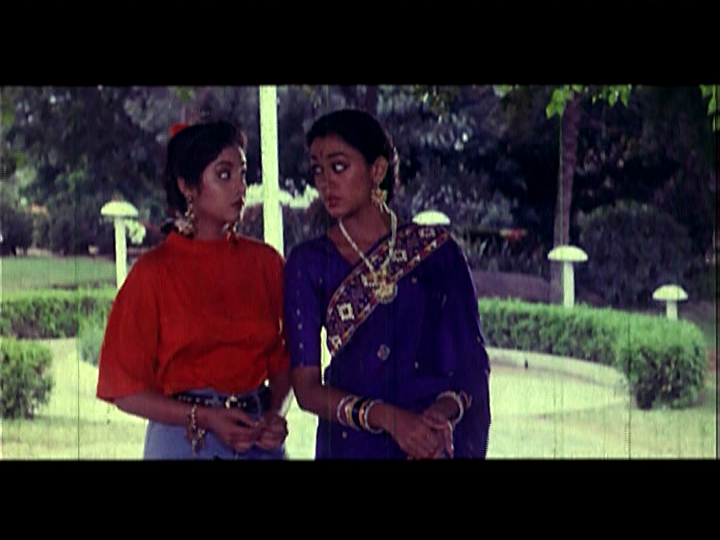
Temple says: This is not my favourite Chiru film, but it is very entertaining. All the requisite elements are there – fighting, flirting, bad denim, a sobbing mother, songs and multiple double-crosses. The comedy track is well integrated into the main story, and both Allu Ramalingaiah and Kota Srinivasa Rao make the most of their characters. Brahmi’s appearance is forgettable as he really doesn’t do much apart from fulfill what seems to be a law that he must appear. Divya Bharti plays an airhead and manages to be likeable enough but between her squeals and the wardrobe excesses, I was a bit over her character in a very short time. Shobana has less screen time but makes a stronger impression for me, as she down played a lot of her scenes and gave Sita a bit of presence. She might not have gotten a big dance number, but seeing what the costume team did to Divya, that may not be something she regrets. Chiru manages the characterisations of Johnny and Kalyan very well, and aside from obvious styling changes, his facial expressions and enunciation help keep the two roles quite distinct. It’s a fun film, if not a great one, and the songs are certainly memorable! I give this 3 and 1/2 stars.

Heather says: Perhaps it was the return to Telugu Masala after a month of watching only Tamil movies, or maybe just because it’s twice as much Chiru, but I really enjoyed this film. The songs were particularly entertaining although I’m not sure if I can say that’s because of the dancing or just due to the unbridled enthusiasm of the wardrobe department! This was one of the films that made Divya Bharti a star in the south but I found her a little too loud and over-excitable. I thought Shobana’s performance was superior and it’s a shame she didn’t have more screen time. The film however belongs to Chiru and he separated his two characters very well, with differences in speech, posture and attitude clearly defining Kalyan and Johnny. I did appreciate the tasteful sweater collection used by Kalyan compared to the more garish choices often seen in Hindi films of the same period. The bumbling conspirators Venkat Raidu and Papi Kundalu are inept and amusing, while their partner in crime Ranjit Kumar seems to be an amalgamation of a number of classic James Bond baddies. Overall the story works well and the various twists and turns are satisfactorily dealt with to make this a fun watch. 4 stars from me!

HELP!

Our good friend Memsaab is trying to identify a particular function room and hotel swimming pool that feature in a lot of Hindi films. So imagine my delight when I saw The Pool in this film!
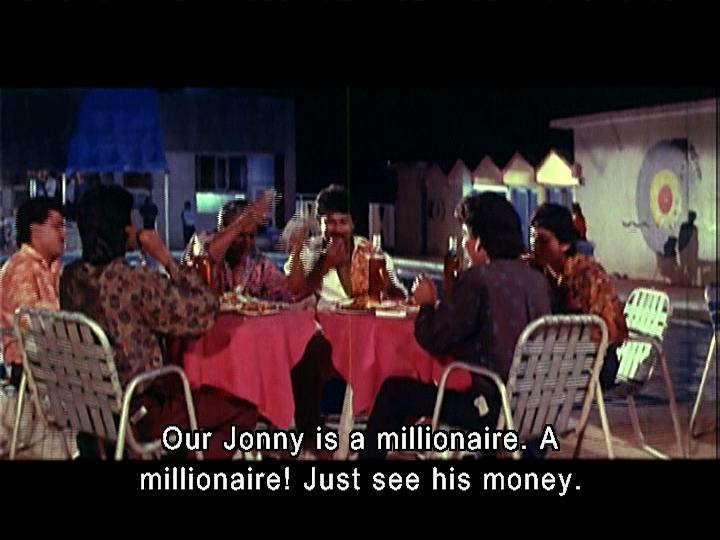
But I still have no idea which hotel it was at. Do you? Surely that distinctive wall decoration (on the right of the picture) has to ring a bell with someone. Please let us know! Temple
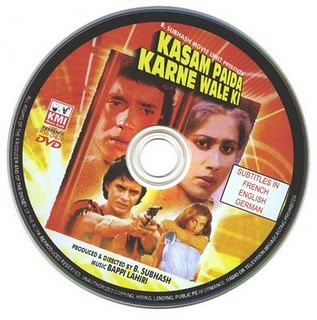

Kasam Paida Karne Wale Ki

I was meant to review another film this week, but I misplaced the DVD before I completely finished my post and it all just got too hard. As a result, you’ll have to wait for a sensible review. And it might be a very long wait. Looking for a substitute film, I decided I wanted something I wouldn’t feel obliged to think hard about, something with some sparkle and a lot of dancing. But I watched this instead.

The super groovy psychedelic titles seemed quite promising! Also, Amrish Puri.

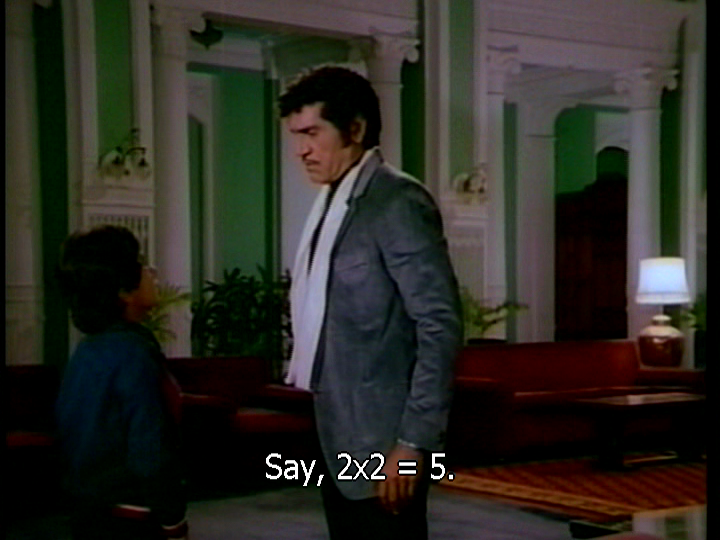
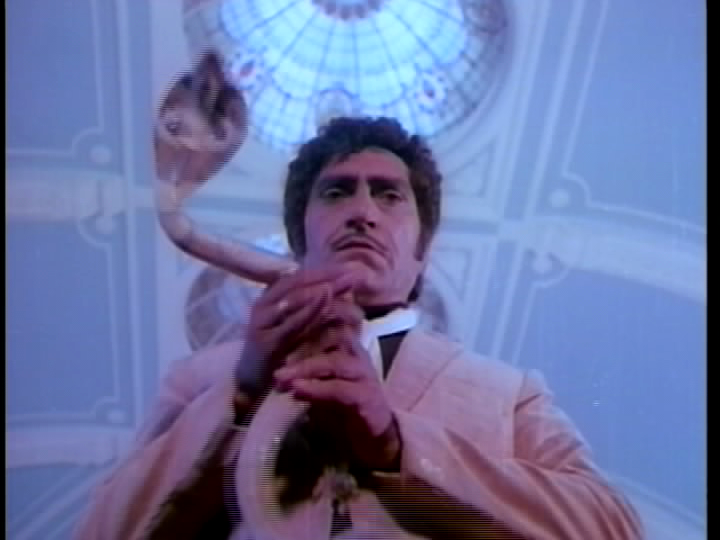
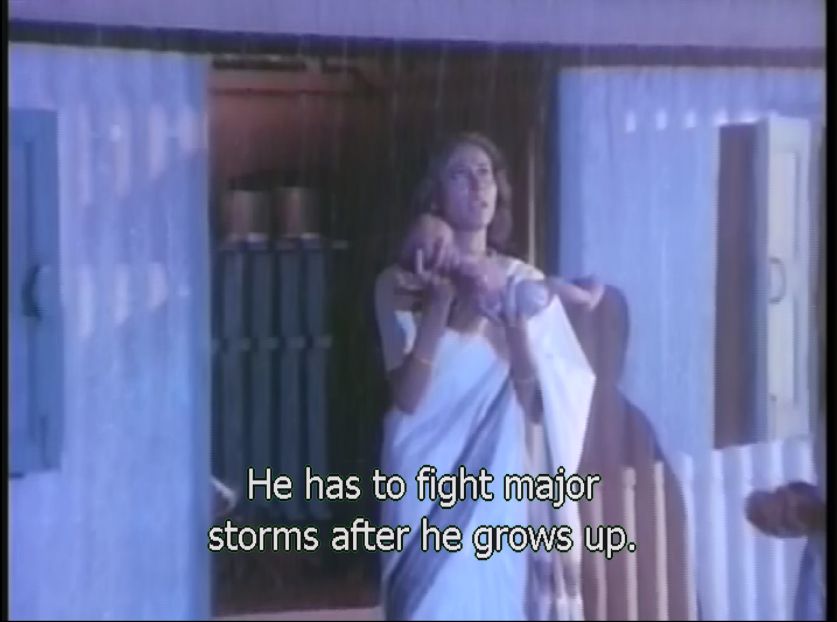
The story opens with a child, the orphaned Prince Satish, being bullied by his uncle. The kid is the heir to an estate held in trust until he turns 20, but guess who has other plans? Evil Uncle Amrish Puri in some jaunty neckwear! I have to say the water torture was mild in comparison to any day at the pool for me and my brothers so I didn’t have immediate sympathy for the young fellow. Then the use of snakes as training aids turned the tide.

Satish is reduced to a snivelling wreck under all this duress, and is not improved by turning into Mithun Chakraborty. Years have gone by but still Uday Bhan Singh is terrorising his nephew. I really would have expected more efficient villainy from Amrish, but then the whole film would have been mercifully brief. Still, Satish is widely regarded as a drunken, insane rapist by the time he is in his teens.

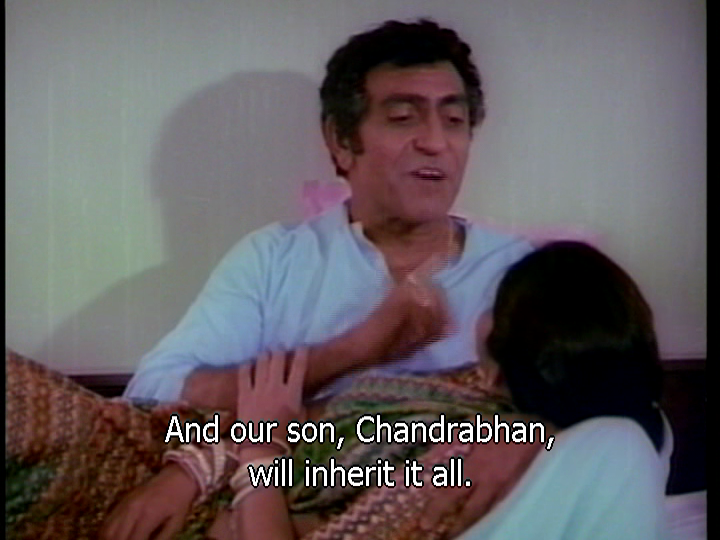
I found the Uday Bhan family conferences of evil quite amusing:

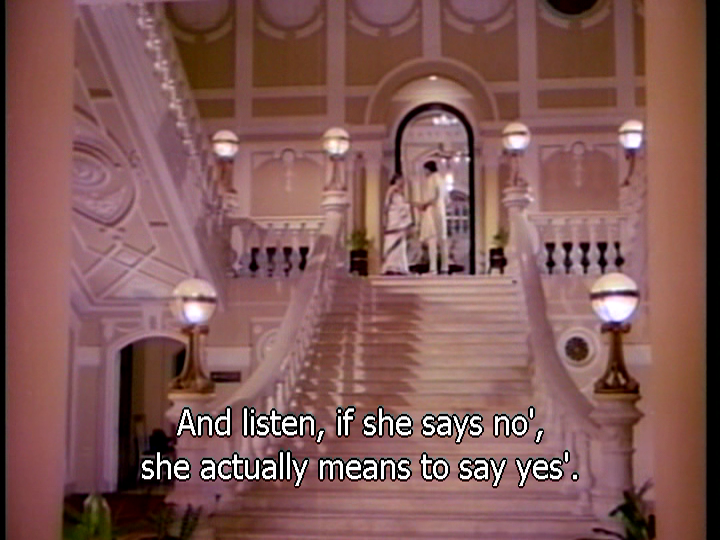
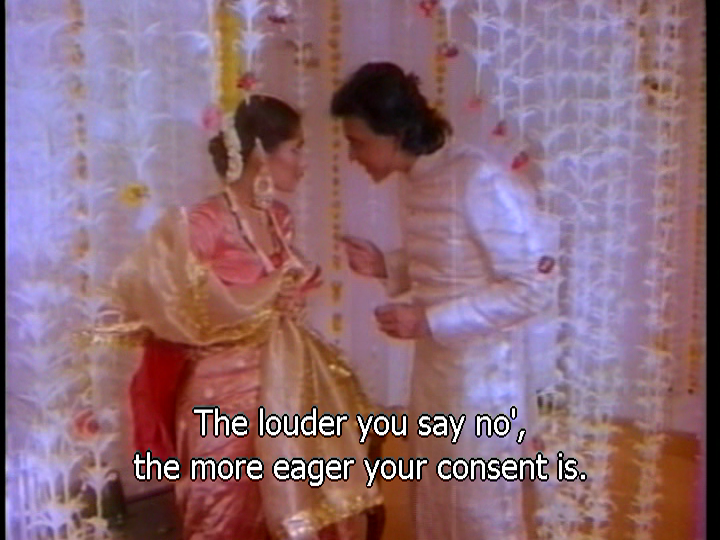
Knowing that no good girl is likely to marry her Prince, his faithful maid tees up a wedding with the first likely orphan they meet. Sadly, the orphaned Aarti (Smita Patil) is a thief and intends to steal away before the wedding is consummated and take all the cash and jewels she can carry. This is not such a bad thing considering the helpful advice Satish receives about women:

WTF?

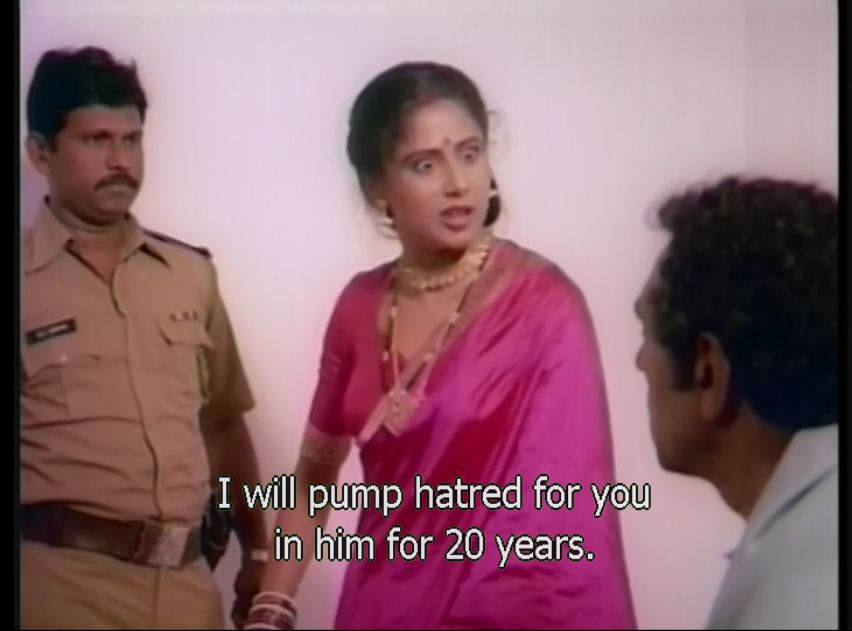
It’s obvious that we are supposed to believe Satish is such a halfwit that he has no idea his wife really might not want him pouncing on her, but it’s just so badly acted and written that I felt a bit queasy. She….well , I suggest you fast forward past the ‘rape or is it romance?’ montage, bypass blossoming True Love,  continue past the revelations and betrayal and rejoin the film when Satish is long dead (Amrish Puri has knife skills), leaving Aarti with a son who looks eerily as though he will soon be played by Mithun.  Although, you would then miss an excellent attempt by Smita to use her own Eyeballs of Hate (TM PPCC) against Amrish Puri – go girl!

Aarti is not a soft mother figure – she is a tigress. She tells Avinash that if he ever loses a fight, he won’t be able to call her Ma. She really is a vengeful woman. Aarti is struggling financially so Avinash takes a job as a drummer (it is never really explained) to start earning. It is a bizarre career move but it is lucky in one way as it means lots of dodgy songs.

It’s at this point my DVD seemed to be possessed. You might remember that it took multiple DVDs and wily tactics when Heather and I watched Surakksha and it really seems that the universe is determined to protect me from Mithun. I eventually got to see the rest but couldn’t screencap, and the picture quality was woeful. However – the disco part of the revenge psychodrama kicks in from here so you can have some lurid songs to keep up the pictorial content.

Naina (Salma Agha) is your part time Disco Diva and full time student. She and Avinash bond after he saves her from a gang of drunken would-be rapists. Perhaps he is repaying the universe for his father’s misdeed? I doubt it’s anything that meaningful.

Mithun’s dancing highlights just how talented Michael Jackson was!

Avinash and Naina fall in love, of course, perhaps because they both have hideous fashion sense and share a love of white pants. Aarti hasn’t raised her son to be a loverboy and opposes the match until such time as Avinash settles the score with evil uncle Amrish, although she hasn’t told him about his family yet. But the past can never remain buried, and the truth comes out and then of course vengeance is sworn.

I’ve mentioned before that I like it when screeds of argy-bargy can be condensed into a song, and apart from the threats this also has scary outfits. I get the impression that there were different people directing sections of the extras who were supposed to be party guests. Some are having a toe tapping good time while others maintain the traditional glaze of boredom. And what better way to alert Uday Bhan Singh of his imminent doom than this?

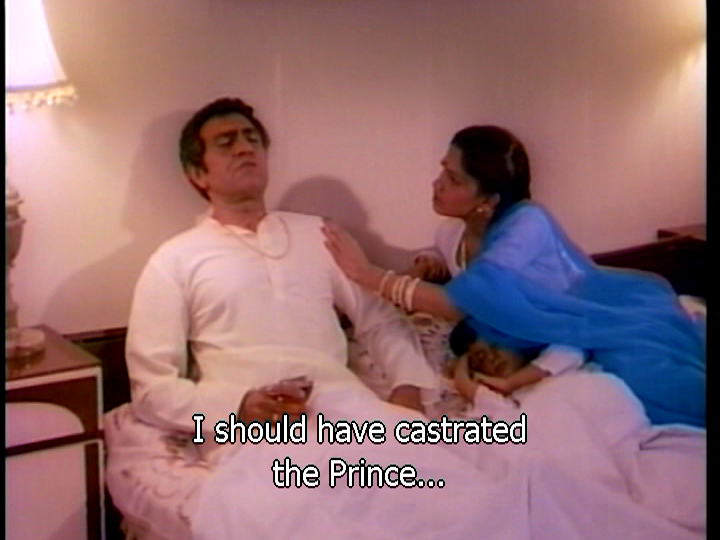
After a court scene full of shouting, staring and more swearing of vengeance, Uday Bhan and his horrible son, Chandra Bhan get horribly drunk and sing. Then junior rapes a local girl as his father shoots the girl’s brother. It’s perfectly obvious they are vile people, and I don’t think all this was needed. I do feel B Subhash thought he was making a much more worthy film than this turned out to be, but struggled to interpret the story into an original film format and fell back on badly used clichés.

By this time, my DVD had only sparse subtitles and Naina’s name changed to Neena. She has been hanging around, adoring Avinash from afar, and goes undercover to get the information he needs (whatever that is) to crush the enemy. I‘m not recommending the sailor suit for potential Bond girls among you – it’s a hard look to carry off. She also has a ridiculously flat clutch purse that somehow contains a gun and a tape recorder and some kind of truth drug.

Chandra Bhan is a stupid as he is horrible, and falls for her tricks. The women then get together to map out the final revenge. All of a sudden Aarti seems to like her prospective daughter in law!

The evil Singhs get their come-uppance starting in a neat replay of the fake rape stunt that ruined Satish’s name. The film is effectively over now despite all attempts to add more drama, but it drags on for another 30 minutes and two more songs and a few explosions.  The final scenes are are most notable for the wardrobe, the Michael Jackson inspiration, the crappy effects and a chance to take one last look at some of the fab sets. Salma Agha is supposed to turn into a kickarse heroine but looks disoriented and more concerned about her lipgloss most of the time. Smita Patil gives this film a lot more than it deserves, and maintains her rage right til the end.

There was lots of significant symbolism, more injustices that had to be avenged, recurring motifs, but I stopped caring as soon as Mithun tried to ‘Thriller’ Chandra Bhan into madness. I can understand why the undead backing dancers were a bit messy, but really the choreography is terrible!

See this film if you really have to see every Mithun film ever made, have a penchant for horrible 70s/80s fashion, can tolerate Bappi Lahiri’s misuse of Billy Jean, or want to see Amrish Puri in a bowtie. Can I even give this a star rating? I don’t want to mislead anyone into seeing this film because it really is dire, and not So Bad It’s Good; it’s just Bad. And not in a Michael Jackson Bad way. There are too many men in tight white pants. Maybe 2 stars –for Smita Patil, Amrish Puri, and their duelling Eyeballs of Hate.

Athu Oru Kanakalam

Athu Oru Kanakalam has all the right ingredients to be a good film, but despite an acclaimed director, an interesting storyline and impressive performances from the cast it doesn’t all come together as it should. The film begins by exploring the issues of class and the pressure of social expectation which is interesting and engaging, but then it loses direction after the interval and the end is basically a disappointment.

Srinivasan (Dhanush), nicknamed Cheenu, is the only child of middle class parents and spends his days lazing around with his friends after finishing his degree. He is lazy, spoilt and petulant seemingly as a result of his mother’s indulgence. His father Ganeshan (Delhi Ganesh) is a strict disciplinarian with a tendency to violent outbursts as he berates Cheenu for his apathy and lack of enthusiasm with job hunting. Cheenu insists that he is nothing like his father and is obviously afraid of him, but as we see when he is out with his friends, he has exactly the same violent temper and tendency to strike out when he is angry. Cheenu’s mother is sidelined throughout the film and rarely gets a chance to speak. Mostly she is helpless and unwilling to intervene between father and son.

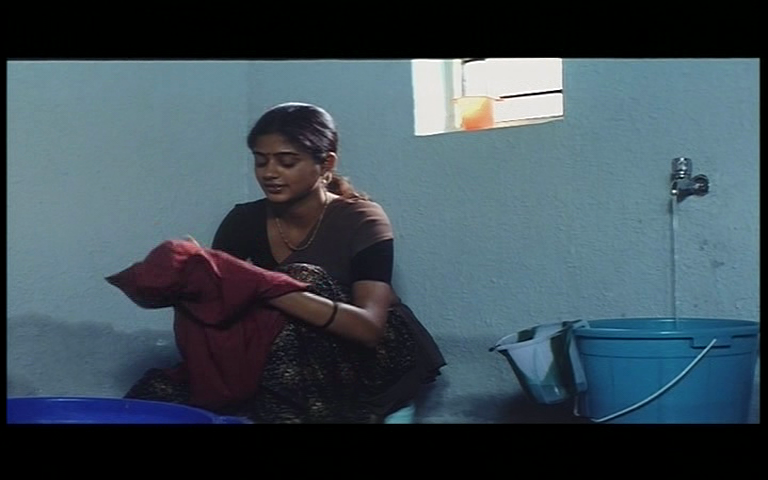
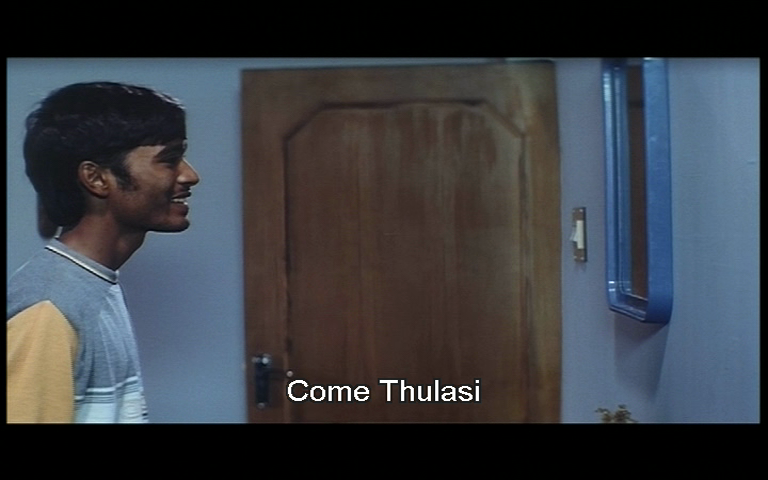
When his parents go away for a few weeks, the family maid Satya (Kalai Rani) is unwell and sends her daughter Thulasi (Priyamani) in her stead. Cheenu and Thulasi were friends as children and while Thulasi is obviously still attracted to Cheenu, he initially doesn’t recognise her. Although younger, Thulasi is more mature than Cheenu. She is also very aware of her social status and despite her attraction to him acts like any proper young servant girl should. On the other hand, he behaves like any typical young man when faced with a pretty girl, and his gauche reactions seem very natural.

In the space of the few days they have, they end up falling in love and into a committed relationship –this is the dream period of the film title. Balu Mahendra shows their romance developing in a song and doesn’t spend much time on it. It’s obvious they are in love and Cheenu is determined to marry Thulasi, we don’t need to know any more about it than that. This is a lovely song, and I’m sorry I can’t find a better quality version.

Cheenu tells his friends a little about his romance, but doesn’t introduce them to Thulasi and actually hides her in the bathroom when one of his friends visits. He seems ashamed of his relationship with a girl from a lower class. It’s hard to decide if this is also partly because he is trying to hide the relationship from his father as Cheenu is very well aware that he will not approve. The difficulties of an inter-class relationship are well explored and developed despite the initial romance not being given the same treatment, and the pair’s behaviour is realistic in this context. The development of Cheenu’s character here is convincing and Dhanush is believable as the young man realising that he will have to change his ways and actually get a job if he wants to marry against his family’s wishes. Priyamani is exuberant in her role as Cheenu’s lover and the change in her outlook as she realises the obstacles they have to face appears genuine and natural.

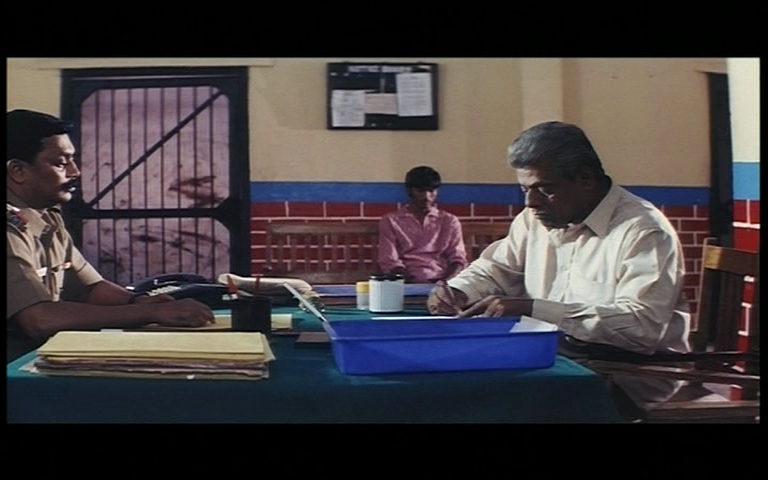
When Cheenu’s father does discover the relationship his reaction is predictable and dramatic, and Cheenu responds in kind. He vows to marry Thulasi despite the opposition from their respective families and the disapproval of his friends. It looks as if the romance may be the making of Cheenu but before he can follow through with his plans, he ends up in jail after a night out drinking with his friends.

When Ganeshan decides to teach his son a lesson and leave him in jail overnight his plans go badly wrong as Cheenu kills another prisoner and consequently receives a prison sentence for murder. I like the fact that although the prison term is obviously a plot point to keep the lovers separated, there is a strong emphasis on the consequence of violent behaviour. Despite the death being an accident, Cheenu has to acknowledge the result of his action and although unapologetic, he accepts that he has to pay for his mistake.

From such a promising beginning, the second half of the film loses the realism that kept the story interesting. The director starts to rely on prison clichés with brutal film guards, sympathetic fellow prisoners and a fairly ridiculous fight scene. Naturally there is an opportunity for Cheenu to escape just when he has found out that Thulasi is in dire straits and he absolutely has to go to her. Another problem is that Thulasi’s role is greatly reduced and she only appears on screen to cry and plead with various policemen and prison guards. Priyamani is wasted in these scenes and although she does her best there is very little she can do to make her character less of a caricature. The end is particularly disappointing as the film seems to be building up to a dramatic conclusion that never actually happens.

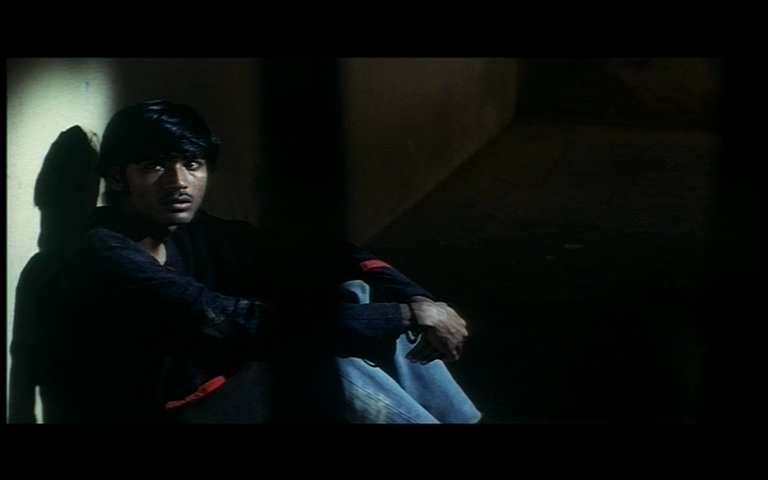
Despite the issues I have with the second half of the film, there are some good points. Dhanush does an excellent job of conveying the fear and trepidation of a young naïve man sent to prison. Cheenu’s interactions with the other prisoners are an interesting contrast to his relationship with his father and despite the clichés the prison scenes never descend into farce. There are quite a few jokes referring to the skinniness of Dhanush throughout the film, and most of the humour has a light touch. It is also good to see intelligent police officers who don’t search aimlessly for an escaped prisoner but actually investigate and have a reasonable plan to capture Cheenu.

The music by Ilayaraja is beautiful and haunting but is used mainly as a way to show some of the story: the childhood friendship between Thulasi and Cheenu, their romance and Cheenu’s relationship with his mother. One exception is the first song which is a bizarre item number with nothing to do with the story. It is purely an excuse for a skin show from Tejashree with some rather lewd lyrics (even in subtitles) and the film would have been improved by its absence.

I was disappointed in this film. While it kept my interest and was perfectly watchable, mainly due to the lead actors performances, it should have been so much better. I enjoyed seeing two of my favourite actors together and they did have an onscreen chemistry which helped make the romance more believable. While the film succeeds in the most part to be realistic it would have benefitted from a tighter second half and a more exciting climax – but perhaps that wouldn’t have been as true to life. Then again, it may just be that I’m not used to a Tamil drama actually having a (nearly) happy ending!  3 ½ stars