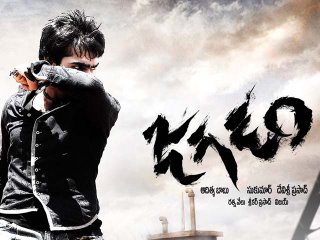
Jagadam

Ram’s second film, Jagadam, is a dark and violent gangster film and is certainly very different from his debut role in Devadasu. Supposedly loosely based on the Brazilian film City of God, it’s less an exposé of gangland life but purports to be a moralistic tale of the consequences of violence.

Ram plays Seenu, a wannabe rowdy who becomes fascinated by violence as a child.  Perhaps this is because the area around him is rife with thugs and petty crime, or maybe just because he is a rather warped child. The local community, including the corrupt police, both fear and revere the rowdies who control the area. Seenu dreams of becoming like his hero, the local Don, Manikyam (Pradeep Rawat).
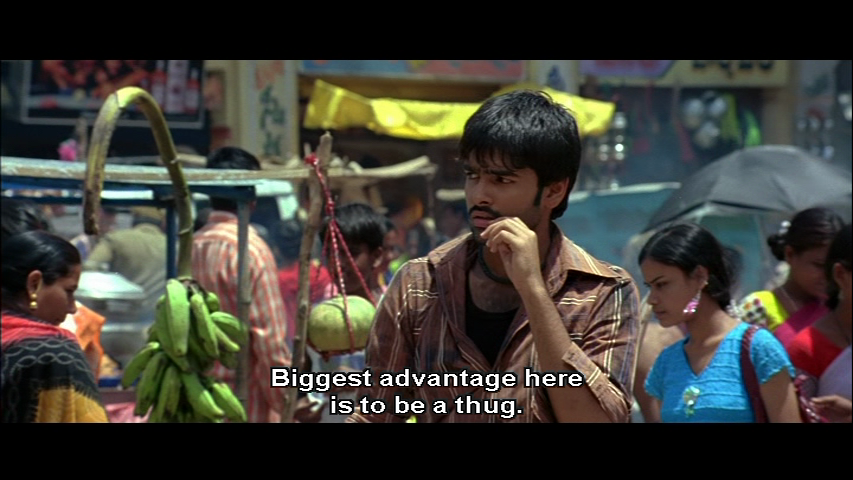
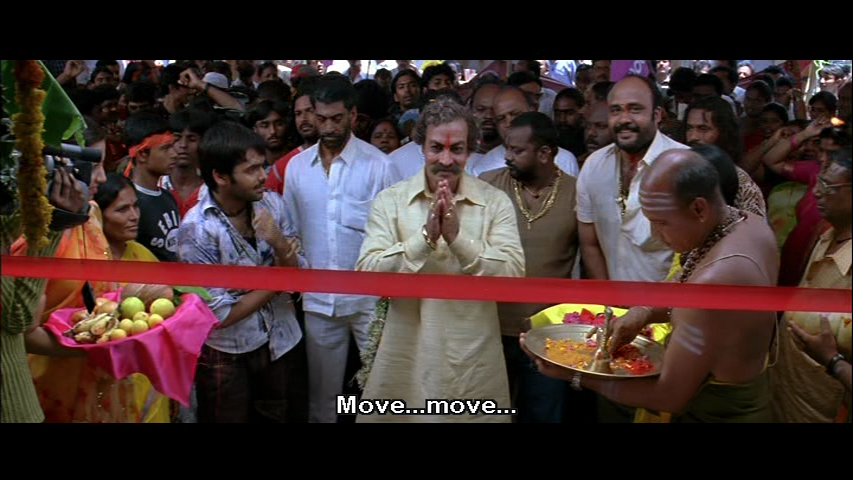
Seenu has a talent for fighting which comes in handy as he works his way up the ranks from small time thugto head his own group of initially ineffectual youths.  His recklessness and lack of anything approaching common sense is amply demonstrated in one of the early scenes when his gang is outnumbered by a knife-wielding mob. Seenu is the only one who doesn’t retreat and ends up at the front of the group – the position that, in his eyes, makes him the leader. As such he is prepared to fight and of course, since he is the hero, wins against such impossible odds.

All of this is fairly normal gangster fare, but the film introduces some more interest in the character of Seenu’s younger brother Chinna. He idolises his brother and is fascinated by his knives and guns. The way in which this adulation is used to develop the story line in the later scenes is one of the strengths of the film, which otherwise is yet another blood soaked gangland war saga.

In the middle of Seenu’s rise to notoriety, he falls in love with Subbalakshmi (Isha Sahni). Subbalakshmi appears to be an intelligent girl; after all she is a Mahesh fan, albeit an obsessed one. Unfortunately director and writer Sukumar has given her every single characteristic we deplore in a filmi heroine. She is whiney, irritating and not just totally useless but an actual liability in a fight. She wears skimpy clothes when wandering round unsavoury areas at night. And as the final insult, Subbalakshmi tells Seenu that when a girl says no, she doesn’t actually mean it. At this point we were ready to slap her ourselves.

Why she falls in love with Seenu is a mystery as well, since he is totally inept in wooing her. He follows the usual stalker method and just assumes that since he likes her she will automatically love him back. Sadly, this does seem to be her only motivation, although perhaps his willingness to dress up in the latest Mahesh costume she bought for him was a factor. She also has an interesting, if not recommended technique for removing a foreign body from Seenu’s eye – hm!

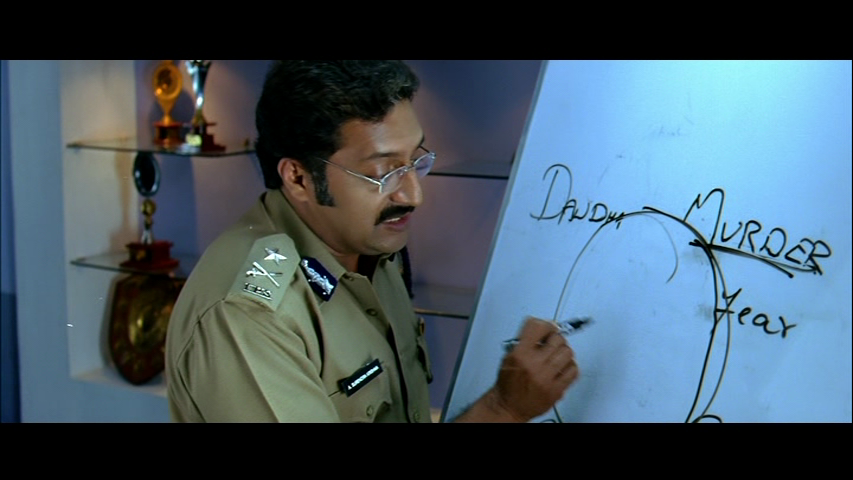
We do like that the intermission is called an interruption, but it does mark the point where the film starts to lose its way a little. Seenu eventually has a falling out with Manikyam and ends up crossing machetes with Manikyam’s source of political funding; the industrialist Yadav, slimily portrayed by Satya Prakash. The story is totally unbelievable at this point as the difference between the well equipped seasoned killers employed by Manikyam and Seenu’s youthful gang is ludicrous. However this doesn’t stop various members of the community approaching Seenu for his rather simplistic aid. Meanwhile Chinna has been avidly following his brother’s exploits and admiring his lifestyle, much in the same way that Seenu idolised Manikyam.  When finally Seenu heads off to kill Yadav, his younger brother wants to watch but events do not unfold as anyone anticipated. This does however mean that we get to see Prakash Raj in his familiar cop avatar expounding truth and justice and using a white board to illustrate the ‘cycle of violence’.
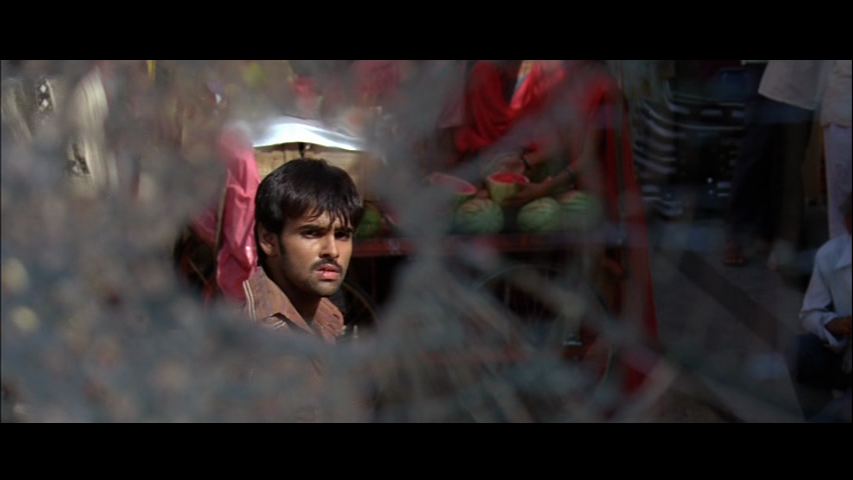
Ram plays the cocky and arrogant character of Seenu with ease. He manages to bring enough of his chirpy ‘boy next door’ persona to the rather dark role and makes Seenu a more sympathetic character despite his arrogance and obsession with violence. Seenu’s friends are from the usual pool of young actors, and in the main they manage to bring some individuality to their various characters. Pradeep Rawat is good in his fairly small role as Manikyam, and gives his scenes some badly needed menace. Ravikumar Chowdary also turns in a convincing performance as Ladanna in the first half, but disappears towards the end of the film. Ragubabu and Saranya are rather wasted as Seenu’s parents and Satya Prakash has very little to do in his role as Yadav. Isha tries, but her character has few redeeming features so she has to settle for pouting and crying in equal measures.

The music by Devi Sri Prasad is fine but not particularly memorable. Ram is a good dancer and the choreographer has utilised his skills well in the songs. We are happy to see that he shows plenty of commitment to the chicken step and is not afraid to dance while totally covered in mud. It’s always good to see this level of dedication even if it doesn’t totally make sense.
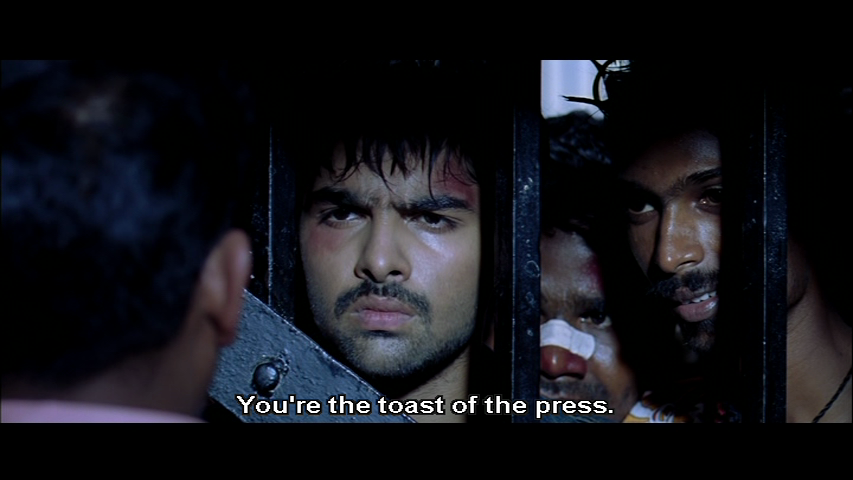
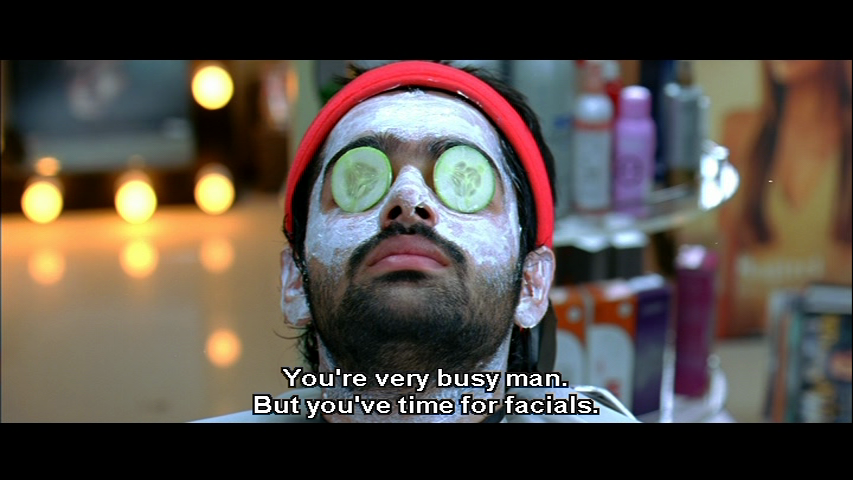
Overall the film doesn’t succeed as an edgy drama, nor does it succeed in its supposed anti-violence message . The moralistic tone at the end fails since it doesn’t seem as if Seenu will ever have to pay for his actions. Within the cycle of violence there is a sense that Seenu could stop any time he wants to, but at heart he is still that kid fascinated by killing. While it starts as an interesting attempt and is worth a watch for Ram’s performance, the film ultimately fails to rise above the standard gangland shoot ‘em up fare.

Heather says: Jagadam tries to be different and send a message about the inevitable consequences of violence. It just doesn’t succeed, as the story still glorifies aggression and shows that a life of crime gets you the girl, plenty of money and adulation from your peers. Take away the gang fights and there is really very little of substance left. The romance is just uninteresting and there is no chemistry between Seenu and Subbalakshmi. I really didn’t care about the couple at all and thought it detracted from what could have been a much edgier drama. Ram’s performance is what makes this watchable and I think he does an excellent job of showing the arrogance and sense of indestructibility that many young people display. His anguish at the end as he realizes the price he has had to pay for his lifestyle is well portrayed and believable. But then it’s promptly diluted by the horrific fight scene immediately afterwards. The sympathy shown by the police chief is at odds to the rest of the film as well, although it does fit better with the pacifist message that seems to have been intended. I’m professionally qualified to say that the best way to remove a foreign body from an eye is not to lick it. Be warned – saliva and eyes should never come into contact! Overall the film just fails to be anything other than average, so it gets 3 stars from me.

Temple says: This is 2 and a bit hours of ‘meh’. Once again, it seems the message the film is supposed to contain is not the message I get;  it glorifies violence, showing it to be the solution to many problems and the province of heroes. I know Seenu loses people he cares about but, as he hasn’t developed any sense throughout the film, there doesn’t seem much hope for character transformation despite a scene supposed to convince us of his redemption. Prakash Raj made the most of his character and opportunities but clearly his whiteboard was wasted on the director! Ram is quite memorable, partly because of his likeable presence, but mostly because of his annoyingly asymmetrical shirts. I don’t think contrast piping and looking like you’ve got your buttons done up wrong is really going to strike fear into your enemies or impress the ladies, but the costume designer had other ideas. Despite a handful of scenes that were strong and sometimes moving, the film just wasn’t grim enough to make the violence angle feel real and wasn’t entertaining enough for it to be a good popcorn film. The overt statement of the anti-violence message was at odds with the implied approval of the hero’s character and decisions. It just didn’t get the balance of light and dark right for my tastes. I give it 2 and 1/2 stars, mostly because despite seeing it twice now I can’t recall much outstanding or noteworthy apart from Ram, those shirts, and the eyeball licking scene. And that’s probably not a recommendation.

Anaganaga O Dheerudu

There has been so much hype about this film; the Disney involvement, the special effects, the budget. Warning: there are lots of spoilers ahead, but this IS a Disney film so you should know what to expect.

The story is simple – an evil queen lays waste to an idyllic kingdom and the only hope for survival lies in the hands of a child mystic and her blind bodyguard.

The film opens with very Disney style animated credits, and then we immediately see a warrior pursued through a spooky forest before being made into a sort of zombie, his mind controlled by Irendri the evil queen with the Medusa hair. So there was already a question of whether this was aimed at being a kids film or a high fantasy epic. And that is the problem – this film doesn’t know what it is and as a result, is a bit unsatisfying in either genre.

The screenplay relies heavily on flashbacks. There’s a flashback about Moksha (the mystic child played by Baby Harshita). Shortly after we meet Yodha (Sid) he pauses for a flashback about his lost love (Priya, played by Shruti Haasan). Then when he and Moksha leave on their journey, Yodha stops for a really long flashback that explains his history, more about his lost love and how he became blind. Then towards the end of the film we get more long flashbacks explaining Irendri. It halted the momentum of the story and these could have been condensed or the information conveyed by other means.

While on the subject of how Yodha was blinded. If your eyes are poked out with a metallic pointy thing, they do not grow back changing their iris colour to blue. They would be white sightless orbs covered in scar tissue, or all the fluid drains out and they shrivel up like raisins. It does have to be said that Sid was good at playing blind but the contact lenses were a bit distracting, as were the constant close ups of his ears.

Some scenes were shot on location and the natural light was particularly unforgiving on the set constructions at the beach camp. Things looked too new and perfect; there was no wear and tear or mends on the snail shaped structures, the lighting was too obvious and modern. It sometimes looked cheap and fake, and more suitable to a kids tv show than a high fantasy epic. The wonky papier mache buildings at the village looked like they should be inhabited by Munchkins. When scenes shifted to interiors, things worked much better as the diffuse lighting was kinder to all the painted polystyrene and fibreglass props. The peacock theme, started as a beautiful costume worn by Shruti was well worked into the colour and decor of her room. Irendri’s palace fortress looked great – there was a commitment to the snake theme and it looked substantial and daunting. The scenes in the spooky forest with the bird demons were quite effective and  helped build some tension. Moksha’s special gift was shown by her ability to create magical butterflies. Oh so many butterflies. We were grateful she wasn’t obsessed with My Little Pony or unicorns.

The costumes would have looked great as sketches but some of them didn’t work as something an actor had to be able to move freely in. Poor Lakshmi Manchu must have developed thighs of steel as she had to power up the steps to Irendri’s throne dragging metres of fabric that we could see was catching or getting stuck.  Some of her outfits were just insane, particularly the shoulder details which were of epic proportions.

Sid’s outfits seemed to be a cross between leftovers from Mu Lan, a bit of D’Artagnan and a dash of Joseph’s Amazing Technicolour Dreamcoat. And while some costumes were really beautiful, some of the outfits Sid and Shruti had to wear were just plain fugly. There were too many fabrics cobbled together, too many ruffles and frills, and again the feeling the costume was wearing them.

The final confrontation between good and evil occurs during a lunar eclipse and culminates in a fight between Yodha and Irendri – who morphs into a giant medusa squid. Well actually she seems to be multiple snakes joined together but the effect is squid like. Sid performs some amazing stunts and acrobatics, the lighting is moody and effective, and then we have to wait for ages as the CGI team show off their monster before the fight starts up again. It was strangely boring despite Sid clearly giving it his all. We both thought of the scene in Magadheera where Bhairava has to kill 100 men – We knew already how his character would die, we knew it was riddled with special effects (not all of them great) and we knew it was just plain impossible and yet that was edge of the seat stuff because of the editing, the music and the implacable pace. In contrast, this was unexpectedly pedestrian and didn’t get any emotional response from us. We did have ample time to notice that the medusa squid was frequently shot from what can only described as an upskirting angle (albeit there was no skirt).

So what were the successes?

Good performances by a charismatic cast (although we don’t really get all the fuss about Baby Harshita) who did all they could with a script that was lacking. Sid was charming and easily handled the comedy skits, the romance and the action sequences. Lakshmi Manchu made Irendri evil and despicable – a proper cartoon villain and a near relative of the evil queen in Snow White. Shruti was decorative and enigmatic, and had great chemistry with Sid.

The hair snake. Irendri would occasionally take a (fully clothed) bath in blood or venom or something and consult an entity called Sarpini who happened to manifest as a snake made of Irendri’s hair. This magical snake also created its own tiara and other accessories as it spouted prophecies of doom. It worked well as a piece of animation and suited the medusa theme. Irendri’s designers really used the snake imagery well, and added lots of serpentine detail to her lair and her costumes.

Ali in drag. Who knew? Well he did a very good Carmen Miranda fruit bowl hat, and fetching nipple enhancing propellers that picked up speed when he was near Sid (you can catch a glimpse in the theatrical trailer). We liked his mermaid ensemble a lot.

The soundtrack worked well as a soundtrack, and the few songs are not really outstanding. Yodha has his own heroic theme, and that generally works although the 80s power guitar version was a bit incongruous.

Fabric. This film is one for the textile fanciers. And there is lots of sparkle.

With a lot more editing of the screenplay, a little restructuring of some scenes, and a decision as to whether they are aiming at kids or adults, this could be great. As it is, it’s a bit too dark to be a kids film, not substantial enough to be a grown up epic and just ends up being a bit wishy washy. The audience jeered at the songs, laughed at some of the dialogues, and as always Brahmi got the biggest cheer.

Murari

One day our friend Indiequill asked for film recommendations, specifying that she wanted to see Mahesh Babu as something other than a baby faced killer. Murari was a popular pick amongst friends on Twitter, and for that reason as well as our commitment to research and possibly a bit of persuasion by The Mahesh Fan, we watched it too. And it wasn’t bad. There is nothing really out of the ordinary in the story, the jokes or the material so the film had to rely heavily on the appeal of the cast and the production design to keep us engaged.

The film opens with a bonus appearance by Prakash Raj in a wig (according to Liz he may have been channelling Jackie Shroff in this avatar) and it was obvious he was No Good. After insulting the deity at a local temple, he is promptly despatched by a green CGI monster and leaves a curse attached to family.

Goodbye and thanks for coming Prakash Raj.

The film skips forward several generations and we learn that every 48 years a member of the family dies to fulfil the requirements of the curse. Why 48 years is never explained, at least in our subtitles, and it really doesn’t seem to matter except as a device to show a few grisly deaths.  When we see Mahesh Babu leap onto the screen it is not only obvious he is the hero, but we were also sure that he is marked for death. He plays Murari, a bit of a too good to be true type who defends the defenceless and all that, but is saved from being a total prig by his good natured pranks and teasing. These were actually pretty funny and captured the adolescent nature of our hero.

This was apparently Peter Hein’s first film as a fight director, and certainly there are several heroic scuffles with bad guys thrown through the air like so much sweaty confetti. And one interesting fight scene in the water. But no baby faced killer.

Murari is from a feuding family. During one attempt to bring the two sides back together he meets his cousin Vasundhara, played by Sonali Bendre. Sparks and insults begin to fly as instant dislike signals the love story to come. Romance blossoms over pranks and practical jokes, as does some more dodgy CGI work.

In order to facilitate the growing relationship, Murari is intent on resolving the family schism as his grandmother Sabari is equally intent on removing the curse. Murari is blissfully unaware of the danger he is in, but the gods seem to like Mahesh Babu and his elephant Ganesh keeps a watchful eye on his owner. There are lots of close calls, and we know Murari is drawing closer to his death a long time before the family priest bothers to check the horoscopes.

Murari’s family approve of him marrying Vasundhara, hers are eventually persuaded and then grandmother puts the veto on this union. She is obsessed with saving Murari (who was named for her husband who was a previous victim of the curse), and keeping Vasundhara from being left a widow. In the midst of all the domestic drama, death is lurking and only an arduous and lengthy ritual can save Murari. Since the angry deity in question is Durga, the price for absolution had to be blood; and that is spilled in abundance before the film ends. Although the climax was powerful in its visual impact  the outcome was rather predictable as Sabari had always known what was needed to lift the curse. Along with all that blood of course. Why she held off on taking action until this particular generation is never adequately explained.

Mahesh Babu seems to be the actor who explains basic concepts in Telugu film, and we thank him for that. In Athadu he laid out the rules for killing and in Murari he explains the rules of obsessive filmi love. Apparently if he was thinking of Vasundhara, he needn’t worry about whether she loved him before going to politely kidnap her and bring her back to the family home. The reason he was thinking of her was that she was thinking of him. So his father told Murari there was no need for boring talking about feelings and plans and all that. She wanted him! It was all her fault! Just go grab her! Another filmi mystery solved!

It was interesting to see Mahesh Babu playing a young man who wasn’t a homicidal loner. This is also before maxi-layer Mahesh became quite so multilayered and developed his signature style. Although his favoured T-shirt and shirt combo make plenty of appearances there are quite a few scenes where only a single T-shirt was in evidence and nary a scarf in sight. We enjoyed his comedic flair in Khaaleja and he certainly milked the laughs from some of his scenes with Sonali. He did all the standard heroic stuff but this was much more character driven than action centred and relied on dialogue.  Sonali and Mahesh had some fun and flirty scenes that helped give the romance a bit more spark. Sonali is beautiful to look at and seemed to enjoy playing her more extrovert character in this.  She really excels at frustrated screams, and her performance appeared very genuine and heartfelt particularly in the latter half of the film.

Murari’s mother Gopamma was played by Lakshmi who did a great job of giving this teary filmi Ma some real character. She was very believable in her confrontational scenes when visiting her brother and family, and emanated a warm and loving personality in scenes with Mahesh Babu. The rest of the supporting cast were all OK without being exceptional. It’s often comforting seeing so many familiar faces in amongst all the cousins, uncles, aunts and servants but it does mean we tend to overlook them as they usually perform the same role over and over. The sets for the family homes were lovely and looked really lived in.

There were lots of knick-knacks and paintings scattered around to catch the eye and each house had a different feel that reflected the occupants’ tastes. The elephant fountain was fabulous and so was the actual elephant.

The music was forgettable, and so was most of the dancing although it was rather exuberant at times. See this film if you’re interested in watching one of the biggest stars in the industry before he adopted the cool calm killer persona and if you like a bit of domestic drama.

Temple says: This is an entertaining if unexceptional film. I like Mahesh Babu as an actor, and he did well in this romantic comedy hero style. It is kind of fun to see him playing such a young and flirty boy rather than the brooding loner role he has put his stamp on of late. Having seen Khaaleja recently, I am now surprised at how shocked everyone seemed to be at his ability to do comedy in that, as he had that under his belt in this film (along with snake wrangling skills). I particularly liked the teasing flirty interludes with Sonali as they each had their moments of triumph and of discomfort and the scenes flowed really well. I even tolerated the dreaded Filmi Child Actors as they were kept well under control and wore a pleasing array of stripey shirts. Speaking of costumes, Mahesh Babu in a lungi is always memorable (I’m thinking of you Jenni). It’s a shame the DVD copy is so bad as the visual design of the film is very nice, and it was a pleasure to watch – certainly these screencaps do it no justice. I don’t know that I would hurry to watch this again, but I did enjoy it for what it is – a romantic comedy with a bit of gore, a bit of divine intervention and excellent use of elephants. I give it 3 stars.

Heather Says: I liked Murari, but then it’s a romance and I’m a sucker for love stories. It also has elephants (an instant win), snakes (also a win), and the goddess revenge drama does spice up the storyline nicely. I enjoyed the way the two characters played it true to their supposed ages in the story and the little touches that were very typical of a guy trying to be macho and impress the girl. The teasing between Murari and Vasundhara appeared very natural and Mahesh showed that he has a natural flair for comedy. It was great to see him in a role where he wasn’t just a cool and competent killing machine, but had so much warmth and feeling. There seemed to have been quite a lot of thought put into the interactions between the various members of the two families as well, and I liked the way that they all had different characteristics within their roles in the family. Even the kids were ably utilised in this film, and the elephants weren’t just there for decoration.

My only complaint, apart from the terrible DVD quality, was that the ending dragged a little. The lead up to the climax was great, but then it seemed to take forever to actually get there. There were also perhaps a few too many near misses for Murari, especially since at least one appeared very contrived. However the rest of the film was fun and overall its an entertaining watch. I vote for more elephants and snakes in all movies! 3 ½ stars from me.