Kolamavu Kokila

Kolamavu Kokila

Nelson’s début film is a dark comedy that unusually for Tamil cinema, has a female lead and a strongly female-centric storyline.  Nayanthara is the titular Kokila who gets caught up in the drug trade when she needs to raise some money fast, but the success of the film is really down to the strong performances from Saranya Ponvannan and Yogi Babu, along with the family dynamics which help to keep the story grounded. I did struggle a little with some of the comedy as my DVD is not subtitled and the only subs I could find online were patchy and rarely made sense, but for the most part the story is self-explanatory and relatively easy to follow.

The film starts with gangster Bhai (Hareesh Peradi) flexing his muscles and getting rid of a police officer who has been interfering with his cocaine operation. Having convinced us that the drug dealers are a vicious bunch best avoided, the film then introduces Kokila (Nayanthara) who is looking for an increase in her sales assistant salary. She’s the main breadwinner in her family as her father’s job as an ATM security job doesn’t pay well and with her sister at college, every penny counts. However, her sleazy boss suggests that the only way she will get a raise is if she meets him after work and makes it worth his while, so Kokila promptly leaves her job to look for something more rewarding. She ends up working as the manager of a massage company which pays much better and seems to have less risk of sexual harassment. But things take a turn for the worse after Kokila’s mother (Saranya Ponvannan) is diagnosed with lung cancer and the family needs to raise 15 lakhs for her treatment.

These introductory scenes work well to introduce the different characters and give a quick sense of who they are. Although Kokila’s father (R.S. Shivaji) has little part to play in proceedings, his passive acceptance of his lot in life illustrates just why the family is in the situation of needing more funds. The interactions between Kokila’s more aggressive mother (Saranya Ponvannan), her sister Shobi (Jacqueline Fernandez) and her father are excellent vignettes of domestic life. Kokila is protective of her father against the rest of the family’s dismissive comments perhaps because Kokila understands the difficulties of working in a dead-end job every day. This introduction also shows Kokila as a strong personality who stands up for herself against her boss’s sordid suggestions, but unfortunately, she loses this confidence later in the film and seems terrified of her own shadow.

Nelson doesn’t let his leading lady jump straight into the drug trade as an easy fix for her problem. Kokila tries a number of different ways to raise the money first. She speaks to relatives, asks for an advance for work and even approaches an NGO, but during a visit to a broker to see if she can sell some land, she inadvertently helps the police apprehend a drug pusher in the building. His boss, Bobby, insists that Kokila make good her mistake and sends her in to retrieve the hidden drugs. So, when all else fails, Kokila decides to approach Bobby and work as a drug mule to raise the cash for her mother’s treatment.

Bobby introduces Kokila to Mohan (Charles Vinoth), one of Bhai’s gang members, who decides that she looks innocent and unlikely to be suspected of carrying drugs, and he immediately employs her to take cocaine to his partner Alphonse (Rajendran). However a number of close shaves with the police lead Kokila to decide she wants out of the operation, but of course it’s much harder to leave than it is to join the business. Finally, after an altercation with Mohan, Bobby comes up with a final delivery of 300kg of cocaine that Kokila must deliver before she can leave.

What makes the film work so well are the peripheral characters. The story starts off well, but a combination of unlikely scenarios and a few too many coincidences mar the second half. Also, Kokila seems way to meek and nervous to ever go against the gangsters so it doesn’t make sense that she would take such tremendous risks and try to beat them at their own game. Nayahthara always has the same expression, downcast eyes and a stammering voice when dealing with Mohan and Bhai, and this continual overly meek appearance that ensures that there is very little tension or suspense as the story unfolds. There is never any glimpse into what Kokila is really thinking, and although she deceives the gangsters it seems to be almost by accident, since she always seems so scared of everyone. I wish there had been some acknowledgment of her plans and visible reactions from her when she did outsmart the gangsters which would have put an entirely different spin on the whole shenanigans. Instead it’s Saranya Ponvannan who steps up and really makes her presence felt as a determined and very capable ally in Kokila’s fight against the gangs. She’s scared but feisty and steps out of her usual mother role to play a very competent scam artist! She is the strong character here, and I love how she deals with potential rapists while the rest of the family appear shell shocked by her capacity for violence. It’s a brilliant portrayal that literally saves the second half of the film.

Yogu Babu is also excellent here and he provides most of the comedy in the first half, first appearing as grocery store owner Sekar who is in love with Kokila and is determined to marry her. Although much is made of his appearance and the unlikely match-up between him and Kokila, the real jokes start when Sekar gets mixed up in the family’s attempts to deliver the 300kg of drugs. Also dragged in is Shobi’s suitor Lakshman Kumar (Anbu Thasan) who mostly seems mentally deranged to me but that could be partly due to the lack of subtitles.

The character of Shekar fits well into the narrative and  Yogi Babu has perfect comedy timing, particularly when he realises exactly what is happening and the danger he has mistakenly stumbled into. I also love this song where he declares his love for Kokila. A brilliant tune from Anirudh and simply perfect choreography!

https://www.youtube.com/watch?v=cHKa0OfnODg

The film looks incredibly stylish and cinematographer Sivakumar Vijayan sets up each frame beautifully. He contrasts colour and shape to produce some stunning images while still capturing Kokila’s reluctance to smuggle drugs and her family’s desperation. The images are also an excellent contrast to the sleazy world of drugs and the grubby men involved in the trade. Nelson uses these contrasts to good effect, and if only the character of Kokila had had the same light and shade this would have been a much better film. Instead, while there are many excellent individual scenes in the film, overall it starts to drag towards the end when the interactions between Kokila and the various gang members become repetitive and less convincing. On the plus side though, Nayathara is excellent in scenes with her family and in the first half her characterisation works well with the story. Also good is Anirudh Ravichander’s soundtrack and I really love the songs here. There is a good mix of haunting melody and more upbeat music, including the excellent Kabishabaa Coco (aka the gibberish song!)

Although Kolamavu Kokila isn’t perfect, there is enough here to make it a worthwhile watch. Using a heroine instead of a hero is inspired and the black comedy around the central figure of Kokila works well. There is a good story here and it just needed a little more variation in Kokila’s character to give it some extra tension and suspense which would make it a great story. Despite the one note in her characterisation, Nayanthara holds the film together well and does make an empathetic central character. As a début film it’s definitely better than average and well worth catching for Nayanthara, Yogi Babu, Saranya Ponvannan and the awesome soundtrack. 3 ½ stars.

Kolamavu Kokila

Sarkar (2018)

Sarkar

2018 seems to be the year for political movies, particularly those where the hero is an outsider deciding to run for office. After NOTA and Bharat Ane Nenu, this time it’s Sundar Ramasamy (Vijay) a self-styled ‘corporate criminal’ who decides to take on the corrupt Chief Minister during elections in Tamil Nadu. A.R. Murugadoss has added in some real-life scenarios which help add interest to a plot that otherwise features little more than a routine ‘Vijay saves the world’ storyline. After his recent films supporting education for women and rights for farmers, Sarkar seems to be Vijay’s most overt statement so far that he is considering a career in politics, although I do hope that if he ever does follow through, he has a better campaign manager than Sundar does here.

I’m not sure that being a ‘corporate criminal’, ‘monster’ or ‘the Genghis Khan of the corporate world’ are particularly desirable qualities for the CEO of a company in the USA, but that is how Sundar is described by both his rivals and his colleagues. Sundar himself seems to be more of a wealthy playboy as he runs around Las Vegas with an entourage of women and bodyguards before hopping onto a private jet back to India. Apparently we are to believe that Sundar makes this trip solely to cast a vote in the upcoming elections, which seems fairly extreme and makes him more of an environmental terrorist rather than corporate criminal. However, various CEO’s and company directors are able to breathe a sigh of relief that Sundar isn’t planning a takeover of their company, but is simply a strong believer in exercising his democratic right. Instead, after finding out that someone has already cast his vote due to the corrupt practices of the incumbent political party, Sundar turns his adversarial sights to CM Masilamani (Pala. Karuppiah) and his side-kick Malarvannan (Radha Ravi) aka Rendu.

Vijay is always excellent in these sorts of roles where he has to mix stirring speeches with action and a stern but righteous expression. He still looks incredibly young, but this time sports a salt and pepper beard, which does give him some maturity and suits the more serious situations. However, for the most part his character’s actions are not believable and many of the political issues are dealt with too simplistically to be completely engaging. Still, Vijay has plenty of charisma and is able to carry the film easily.

Sundar gives up his day job to run for office, which doesn’t ring true despite his spirited speech to an antagonist crowd about his lowly origins as a fisherman’s son. However the speech itself is excellent with a well thrown tomato is used as a metaphor for greed and the plight of humble workers. Later, Sundar uses his missed vote as a way to educate everyone about regulation 49-P and to convince his audience that every single vote is important. These are some of the best parts of the film, where Sundar motivates the masses and exposes the corruption at every level of government. When Vijay is in full speechifying mode he is very impressive but when it comes back to individual dialogue the unlikeliness of some scenarios does reduce their impact.

Both Pala. Karuppiah and Radha Ravi excel at traditional-minded, self-serving and corrupt politicians, but their conventional behaviour means that most of the confrontations between Sundar, Masilamani and Rendu follow an entirely predictable path.  As their power, prestige and ability to make millions in easy money is threatened, Rendu employs the police and multitudes of disposable minions to remove Sundar from the public eye. He never considers that every action will be recorded by the common man on his/her mobile phone, and that the media is on hand too to record every shady deal, even going as far as to walk out of a TV interview when Sundar arrives. However, Sundar’s response is also classic underdog reaction and despite all the wonderful slow-motion fight scenes and rousing rhetoric, for the most part Sundar is just as predictable as the politicians he opposes.

Perhaps to counteract this old-school predictability, Murugadoss adds another villain in the form of Komalavalli (Varalaxmi Sarathkumar), Masilamani’s daughter. This could have worked well, except for Varalaxmi’s stilted dialogue and odd expression, as if there is continually a bad smell right under her nose. I can’t understand how such a usually expressive actor is so lifeless here, but then little about her character makes sense. She tells her father not to worry, that while Sundar may be a corporate criminal she has been a criminal since birth, but there is no explanation of why. Why is Komalavalli the brains behind her father’s political career?  Why then was she in Canada instead of Tamil Nadu when the elections were being held? So many questions and absolutely no answers. Instead Komalavalli is a one-dimensional character whose sole reason to exist seems to be to cause general misery wherever she goes. While at least her presence does give Sundar an opponent with the smarts to fight back, she’s too little too late and just too shallow to be a completely worthy adversary.

Even worse though is the inclusion of Keerthy Suresh as Sundar’s love interest, Nila. Nila is Sundar’s sister-in-law, although the marriage between Nila’s sister and Sundar’s brother has broken down. Sundar and Nila restart a relationship seems to be more friendship rather than anything else apart from one dream sequence song. For most of the time Nila follows Sundar around, stands in the background, and then follows him around some more. This type of political film doesn’t need a romance, certainly not a nothing of a romance that doesn’t even deserve the word, and there really seems to be little point in including Nila or her jealous reaction when Sundar dances with someone else.

Sarkar isn’t a bad film, it’s just a surprisingly ordinary offering from a film-maker who normally delivers a more exciting and well-polished story. Vijay is excellent and the film technically looks great with well choreographed fight sequences and good use of crowd scenes. A shout-out to for the generally very good subtitles, although none of the writing (including a very long piece of text at the start of the film) was subbed. Still, good to see other groups using the same style as Rekhs and adding English idiom rather than direct and nonsensical translations. The other departments are all fine too. A.R. Rahman’s music doesn’t particularly stand out apart from Oru Viral Puratchi, but it is well placed in the film and works as a rousing to action song while the others generally blend into the screenplay without disrupting the action.

The support cast, including Yogi Babu and a large number of students, voters and election officials are all very good and the parts of the story that deal with the mobilisation and politicalisation of the ‘common man’ are well handled. It’s really the predictability of the film that brings it back to earth and the knowledge that whatever happens, Sundar will best his political foes. His path to power seems to happen very easy, and very quickly here – there are massive poll swings from 5% to 80% literally in the course of one day, and a voting result that can be swayed in just a few hours. If only it were that simple! Overall, Sarkar is a watchable and reasonably entertaining film that works fine as a political stepping stone for Vijay but just could have been that little bit better. Worth watching for Vijay, Radha Ravi and the idea of what could happen when ‘ common people’ take action!

Junga (2018)

Junga

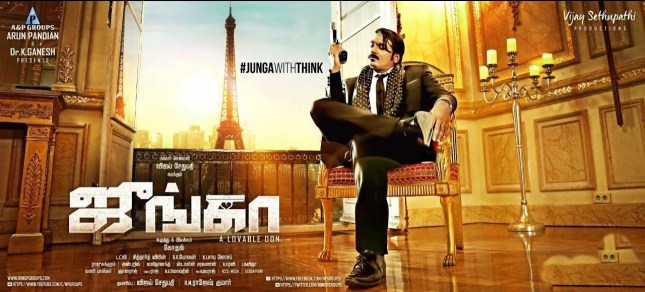
A Vijay Sethupathi film never fails to be entertaining even when, as in this case, the story fails to impress. Gokul’s latest is a comedy that alternates between some hilarious, laugh-out-loud moments and scenes that fall conspicuously flat, mainly due to the ridiculous plot. When the comedy is good, it’s very good, but when it’s bad it’s pretty meh and not helped at all by the glaring plot holes. Still, Junga is not meant to be taken seriously, and Vijay Sethupathi strolls through all the mayhem raising laughs with his take on a parsimonious criminal out to win back his family fortune.

The film starts with Junga (Vijay Sethupathi) being removed from jail by two policemen who plan to kill him in an encounter. Sadly, despite the presence of Rajendran as one of the officers, these are some of the least successful scenes in the film where the dialogue seems forced and not remotely amusing. Luckily this is only a brief introduction to allow Junga to begin relating his life story, which is where all the action happens.

The flashback shows Junga as a small-town bus conductor (all comparisons with Baasha are deliberate) whose love for a Telugu girl (Madonna Sebastian) leads to him taking on a persistent and unwanted stalker and his gang of friends. This foray into fighting shocks his mother who reveals that he is genetically predisposed to violence as he is actually the son of Don Ranga and the grandson of Don Lingaa; gangsters who lost all their money due to their extravagant celebrations and poor accounting skills. Junga’s mother (Saranya Ponvannan) and grandmother (Vijaya) bewail the loss of the family fortune, particularly a picture hall in Chennai which was Junga’s mother’s dowry. Junga vows to be a money conscious Don and heads back to Chennai to restore his inheritance along with his best mate YoYo (Yogi Babu).

Junga quickly builds up a reputation as a cheap option for those seeking intimidation or assassination skills, but fails in his attempts to buy back Cinema Paradise from its new owner, Chettiyar (Suresh Chandra Menon).  Plan B involves heading to Paris to kidnap Chettiyar’s daughter Yazhini (Sayyeshaa) and thus force him to hand over the theatre. Naturally all does not go to plan and Junga’s kidnap scheme is foiled by the Italian mafia who have their own plans for Yazhini.

The first half has plenty of excellent comedy, mainly based around Junga’s miserly tendencies and extreme economies to save money. The film is irreverently tongue in cheek and pokes fun at classic Tamil films as well as modern-day tropes and even at the actors themselves, most of which works well. Radha Ravi channels Marlon Brando as the head of the Committee of Dons who are morally outraged by Junga’s discounted thuggery while Yogi Babu provides solid back-up as Junga’s chief henchman.  The first half has some good fight scenes too along with the best of the songs, including the wonderfully colourful Amma Mela Sathiyam.

The second half falters when the action moves to Paris and the Italian mafia muscle in. What does work is Junga’s obvious pain when he realises just how much money he has spent and the various jokes around the confusion between Parry’s (in Chennai) and Paris (in France). Best of all are Saranya Ponvannan and Vijaya who swagger around as a brilliant double act and completely steal the show as Gangster Amma and Gangster Patti. They have the best lines as they try to shake down Chettiyar and it’s great to see Saranya Ponvannan have a chance to step out of her usual standard mother role, albeit in a small way.

What doesn’t work is the whole storyline with the Italian mafia and French police, although we do get a great fight scene with an umbrella and some good car chases. But there are just too many silly plot holes that stop some of the comedy dead in its tracks while the rather contrived romance between Junga and Yazhini doesn’t work at all. After good chemistry with Madonna Sebastian and an amusing end to that whole episode, the love story with Sayyeshaa is limp and anaemic without even the benefit of any comedy to lighten the romance.

As with Oru Nalla Naal Paathu Solren, Vijay Sethupathi gets to wear some outlandish costumes as part of his trip to France and when he plays the roles of his father and grandfather. There is plenty of moustache twirling along with flamboyant gestures which have become Vijay’s signature comedy style, but he is very funny in this persona and his charm and charisma are almost enough to carry the film through the problematic second half. Almost, but not quite. Thankfully, Vijay is ably supported by Yogi Babu and the double act of Saranya Ponvannan and Vijaya who ensure their scenes are funny and help to keep the plot (such as it is) moving along.

Junga is a film that works when the action is kept close to home with the comedy centred on Vijay Sethupathi and his Don Amma and Don Patti. The more action-based sequences disrupt the flow and don’t fit into the overall pace of the film, even though the fight sequences are well choreographed. They also drag out the film which is already overly long by the time Yazhini is kidnapped. However the songs are good, the comedy for the most part is very funny and Vijay Sethupathi is excellent in the title role. Junga isn’t consistent, but it is hilarious in parts and that, along with the enthusiastic cast make it worth at least a one-time watch.