Shakti

Here is a list of things we know the film makers didn’t spend the reputedly huge budget on:

  • A hairdresser for Ileana
  • Good quality CGI
  • Historical research
  • Decent wigs
  • A good story

Here is a list of things they did invest in:

  • Scarves
  • Stars
  • Helicopters
  • Excessive editing
  • Guns and rocket launchers
  • Cars (to be blown up)
  • Locations
  • Oversized glowing props
  • A slide announcing that no matter when or where people lived, for the purposes of this film everyone speaks Telugu.

The story opens at the pyramids with lots of Ancient Egyptian-ish folk speaking Hindi. We also catch our first glimpse of topless Sonu Sood, although not topless in our preferred sense. He first appears as a severed head in a bag. So of course, his grieving lover’s first reaction is to gouge his eyeballs out and preserve them in a jar of something orange and smoking.

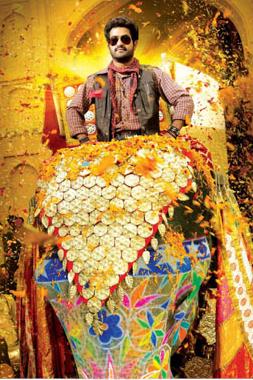
Skip forward to rich girl Aishwarya (Ileana) slipping away from her father’s security detail to go touring with her gang of friends which includes Ali as Tommy, a character at least 20 years too young for him. While in Jaipur they cross paths with Shakti (Tarak) and he appoints himself their groups’ highly paid guide and protector. How to resist a man who arrives on elephant back, kicks assorted bad guy arse and can get tickets to first day first show of Wanted?
To summarise: Aishwarya accidentally took a very large mystical jewel from her family safe and doesn’t notice she is carrying it in her bag. The Faux-gyptians want it to destroy the world or something. And there are the good guys seeking to protect the jewel and ensure it is used in the ritual required to keep several holy cities in India, or maybe the world, safe.  And Shakti is the son of the man killed performing the last saving the world ritual (either several hundred or maybe thirty years ago).
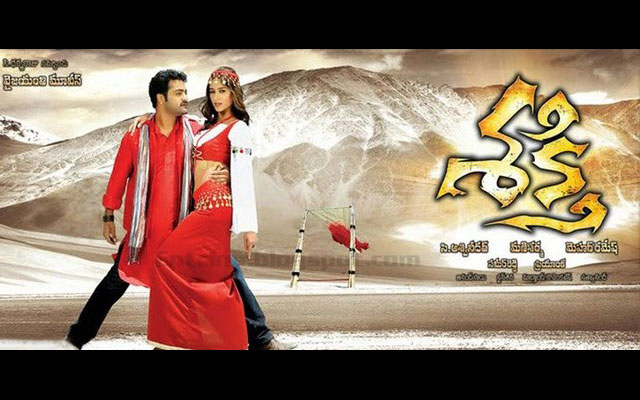
The first half of the film is a blend of road trip, romance and action in some lovely Indian locations as Shakti has to constantly rescue Aishwarya from her own stupidity as well as from the villains who are tracking her. The second half of the film is a less successful blend of exploding cars and storms of bullets with the mythology underpinning the story of the jewel and the elaborate ritual. We were slightly surprised to learn that the Ancient Egyptians, or a cult, who lived outside the pyramids at Giza had tried to invade Andhra Pradesh on horseback either a couple of thousand or twenty years ago. But compared to all the other nonsensical stuff going on (not a tourist in sight at the pyramids, roads in Hyderabad with no traffic at all), we were only very slightly surprised.

The special effects were cheap looking considering the budget. A sacred sword was made of red plastic, and the significant trishul was yellow plastic with little light bulbs inside it. There was clearly a vision, but it was translated in a very clumsy way. Even in the fight and dance sequences, where we expect Tarak to absolutely shine, the overly jumpy editing and poor effects were a distraction and really diminished his impact. We are well accustomed to seeing action footage sped up or slowed down for impact, but in Shakti the slow bits were often so slow they highlighted the CGI and wires, and the fast bits were jerky and cartoonish. A couple of the songs had huge sets and lots of costume changes but lacked the ‘Wow factor’ we expect from this style of film. The opening Rajasthani song was a great example of what didn’t work – the dancing and choreography were great, the costumes and sets were stunning, and the editing made it look bland and disjointed. We were very hopeful once the rocket launchers appeared, but sadly once the director had blown up umpteen cars and people, it was time for more ‘creativity’ and the film deteriorated. The climax set in an underground temple full of more glowing props was too repetitive as it mimicked a long preceding flashback and the visual effects were not great.

Every film comedian except Sunil made an appearance and it was just too much. We have no idea at all why Jackie Shroff was in this film. His role could have been played by anyone in a brocade jacket and every time we saw him poolside we just prayed he would keep his clothes on. From the look on their faces, so did the gori extras paid to cavort around him! Sonu Sood did his usual villain thing and made an appearance (head attached) in a flashback in the second half. The angrier he got the less he wore, so as you can imagine we were very interested in his scenes. The whole subplot with his lover and her supernatural vengeance was a confused mess, and not helped by the wig department. But there was lots of eye stuff happening, mostly anatomically correct too, which pleased Heather! The orc-like baddie sent to destroy Shakti was blind at first, but after years of punching and headbutting Egyptian columns into shards (think Juggernaut from X-Men), he was apparently given Sonu’s eyes although disappointingly we never saw the actual installation procedure.
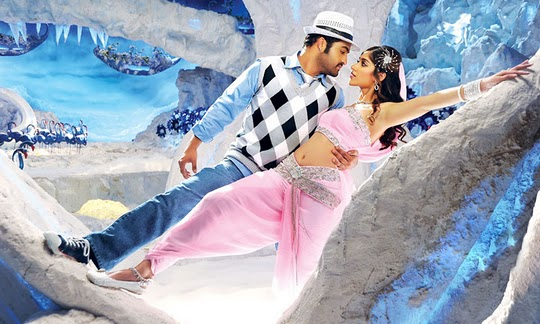
Tarak and Ileana were good considering what they had been given by writer/director Meher Ramesh. They had no chemistry as a couple but Ileana did what she could with an under developed character and the nonsensical behaviour required of her. Tarak delivered his usual robust physical performance and rousing speeches. Shakti (the character) had only two facial expressions for most of the film – surly and surlier. We would be peeved too if we got landed with The Wig. The flashback exposition was inexplicable in style and chronology. If this was 20 odd years ago, why was Shakti in a pageboy wig? We were a little bemused by the decision to try to create flowing warrior locks with the use of a wind machine. Sadly, the breeze lacked sufficient oomph to stir the clumpy and hideous wig so it was all for naught. And that inability to make a concept work sums up the whole film.
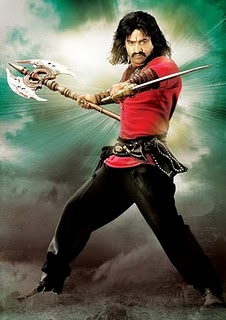
There were some positives. The audience were laughing a lot at some of the comedic dialogues and they appreciated Tarak’s big speeches. Some things were really fun – Shakti’s dramatic reveal as super agent A1 of the NSA, the rocket launchers, CGI snakes (especially when carried as a concealed weapon), Brahmi and Tarak’s scenes together and the backing dancers who really did give it their all. The Ladakh and Haridwar scenes were beautiful even with all the gimmicky camera work.

This is a film solely for the hardcore fans.

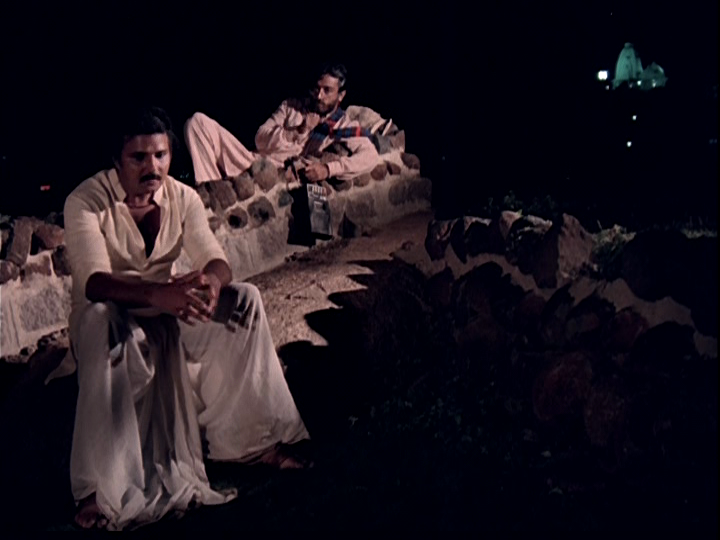
Sagara Sangamam

I had no luck finding a subtitled version of this film (legal or otherwise), which is a shame as I think that difficulty will stop a lot of people from watching. I’m not sure where Heather got her subtitled copy from. However this is the story of a dancer, often expressed in action rather than speech and many scenes required no further explanation.

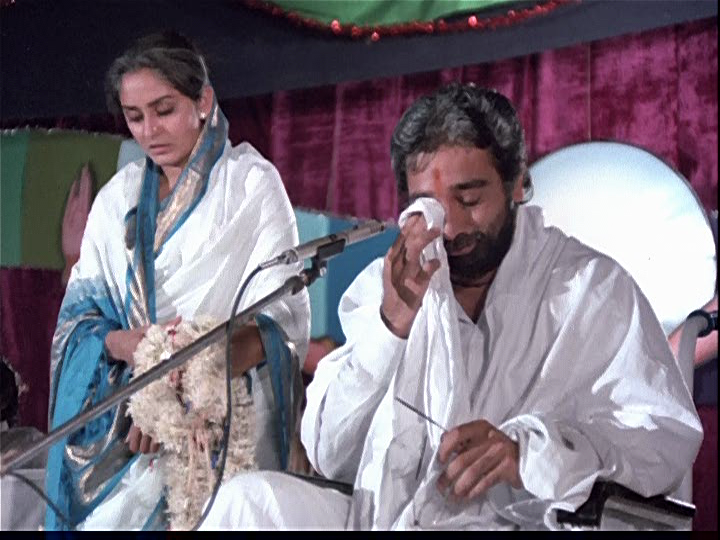
The film uses a flashback structure so we actually meet the older Balu (Kamal Haasan) first. He is a disgruntled drunk and newspaper critic who, despite all his issues, demands a high standard for dance. He writes a scathing review of the latest dance sensation Sailaja (SP Sailaja), and rather than apologise when she confronts him, belittles her by showing her how it should be done.

Young Balu is a poor boy, dedicated to dance in many forms – and a purist. He wants to be successful but is held back by his dislike of the shallow sexified version of dance that is in demand (and is perhaps dismayed by the outfits).

Balu’s world is small. He has his mother, dance, and his friend Ragu (Sarath Babu). He also meets Madhavi (Jayaprada) who is wealthy and happy to be his patron. She gives him many opportunities, and becomes more than a sponsor in his eyes.

Each episode reveals something more of Balu’s character and how he came to be in his current situation. It’s a big challenge for a film maker, and in this instance it is handled beautifully by K. Vishwanath. The fragments fall together to make a cohesive story, and it is easy to follow the narrative.

Kamal Haasan is fantastic. Since we more or less know how the story ends before it begins, it really does require a great performance to keep a viewer engaged on the way to the foregone conclusion, and he delivers. Yes, there are some dubious wardrobe moments and bizarre posturing, but they were intentionally ridiculous, being Balu’s commentary on the commercialisation of dance. Balu dances his joy, pain and despair – he dances his heart out and it is hard to look away.

This is one of my all time favourite film dance sequences and I love it for its joyous emotion, simplicity and the brilliant editing. Despite his dedication to dance as a pure art form, Balu isn’t a total stick-in-the-mud. He adds some sweet comedic flourishes dancing with kitchen utensils, and plays up to his mother who dreams of seeing Balu on stage. Madhavi is impressed too!

Life seems set and success is just around the corner so naturally, I expected a tragedy. Because he is such a perfectionist and intolerant of things that don’t fit his vision, Balu is ill equipped to deal with setbacks. He falls into a bottle after losing his mother, missing his big dance debut and then learning that Madhavi is not free to return his love (she is married to a man who looked absolutely miserable in their wedding photos). His character frustrated me greatly. I could empathise with Balu, but I really wanted him to see sense and find a way to bend before he broke.

Sarath Babu’s role was small but he is a constant and reassuring presence and instilled Ragu with an air of integrity and generosity.  I’m not entirely sure why Ragu stuck by his friend as he seemed to give endlessly to an often ungrateful sod. There were lively glimpses of Balu’s character in a couple of scenes that made me believe in the friendship, and perhaps I missed a lot in the dialogues.

Madhavi tracks down her old friend and would be lover through the newspaper and Ragu. Her side of the story is also revealed through flashbacks. This episodic style seems apt as her love for Balu is revealed through her candid and perceptive snapshots of him long before either of them acknowledges any feelings. Jayaprada is lovely and manages to be light and funny as young Madhavi without being shrill or giggly, ably matching Kamal Haasan in the physical comedy.

She gives a sensitive portrayal of a woman who is tempted by a love she cannot act on and manages to be sympathetic despite having been, at best, deceptive by omission.

As it happens, she is Sailaja’s mother, and so Balu’s life turns back on itself as Madhavi secretly engages him as a dance teacher for the stylish but shallow girl.

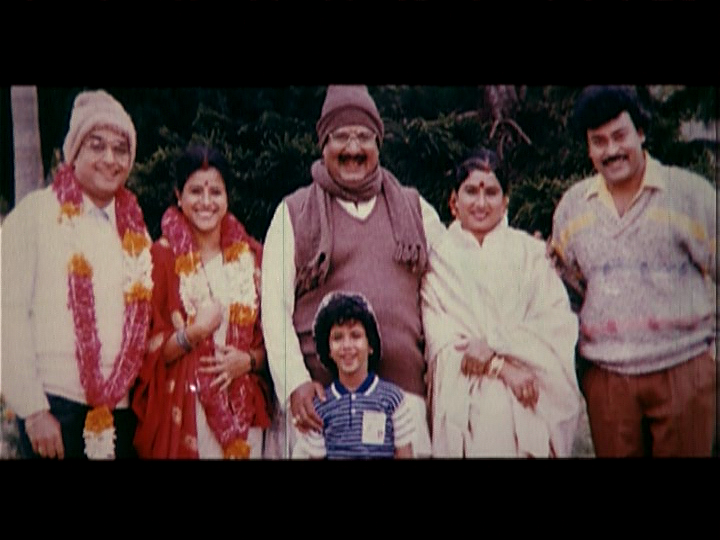
The photograph motif is used a lot. One of the most moving examples is when Balu and Madhavi try to use the timer thingie to take a picture of themselves together. The photo fails and all that can be seen is a worried Madhavi and ghostlike blur of Balu. They joke that it wasn’t meant to be. Then when Madhavi departs with her husband, Balu takes and keeps a photo of the couple as a reminder to himself of what had to be. It’s one of the few pictures he takes; usually Madhavi was the one to give him beautifully composed portraits showing what he was to her.

Their reunion is full on filmi and yet simple as Madhavi confronts Balu while he is stinking drunk. Balu’s drunken cavorting avoids being a mockery of his dance despite being accessorised with a bottle, perhaps as it comes straight from his heart with no artifice. Madhavi lets Balu see her sadness and fear for him while he seems to give her an earful for not teaching Sailaja to be a better dancer. In so many ways, they haven’t changed a bit. Balu doesn’t know that Madhavi is a widow, and once more she struggles with the pressure of family against her desire to move forward with Balu in her life.

Sailaja is unhappy at this revelation about her mother’s past, but she should be practicing her dancing more than spying, and do a bit of growing up as well. Happily for her, she does come around to seeing the value in Balu’s teaching (which he does from a hospital bed). Her performance was probably the weakest for me in terms of acting, but her dance scenes with Kamal Haasan were much more satisfying. And SP Sailaja can sing, so she was certainly talented.

The structure of the story is solid, and the characters seem believable. The Illaiyaraaja soundtrack is integrated into the drama and the dances reveal so much of the characters’ inner lives they are essential to the film, not just a pleasant addition. The dance practice and performance scenes are filmed beautifully.  I can’t comment on the lyrics by Veturi or the dialogues co-written by K. Vishwanath and Jandhyala (who wrote dialogues for Aaradhana) as I just made up what I thought was happening in some scenes.

The ending is over the top but despite all the silly trappings the leads keep it (mostly) restrained to let their characters’ emotions shine through. If nothing else grabs you, this film captures some exceptional dance performances. I wish I could fully appreciate the characterisations, as I did feel disconnected at times due to my lack of language skills, but it wasn’t a huge issue.

I give Sagara Sangamam 4 ½ stars.

Heather says: This is such a beautiful film and although I keep returning to it time and time again to watch the incredible dance scenes, there is so much more to enjoy in this film. To start with the dancing, there probably isn’t anyone other than Kamal Hassan who could manage to make it all look so effortless. The classical dance scenes are superb, and even the contemporary song (with that truly hideous yellow suit) is well added in to showcase his skills. Jayaprada is beautiful in her dance scenes and S P Sailaja is excellent, but it’s still Kamal Hassan who draws my eye each time. I absolutely love the dance scene in the kitchen which is fresh, spontaneous and makes such good use of the setting.

Leaving aside the amazing dancing, this is a really well told story. An alcoholic ‘hero’ is unusual and, since I work in the field, I like that it’s a useful public health message as well. The romance between Balu and Madhavi develops slowly and naturally considering their joint love of the arts and despite the difference in their social standing. The use of photography to link the story together is cleverly done and every image adds a little more to the story. Sarath Babu is excellent as Balu’s long suffering friend, and his generosity provides a stark contrast to Balu’s increasing selfishness as he beomes dependant on the demon drink. However Raghu is not a perfect saint either since he doesn’t scruple to use Balu’s guilt against him as a way to blackmail his friend into teaching the spoilt brat Sailaja. Of course it’s all for Balu’s own good and the fact that he gets treatment for his sick wife Sumathi is a bonus. All of the supporting cast is excellent here and K. Vishwanath develops their characters in enough detail to make their actions understandable and relevant.

I really like the way each flashback occurs when something which is happening in the present triggers a memory of a past event by one of the characters. It seems very natural and helps to link the past and the present. The film is very much about the arts: Raghu is a writer and poet, Madhavi is a singer and Balu’s dream that they all perform together seems a natural extension of their friendship. It’s also an excuse to have some beautiful songs and once again Illayaraja provides music that I love and I just wish I knew what the lyrics meant.  There are a few things I don’t enjoy quite so much. There are some really ridiculous co-incidences and the last few scenes are overly melodramatic. But then again this is a film from the eighties and we all know that wasn’t a time for restraint! This is a 5 star film for me.

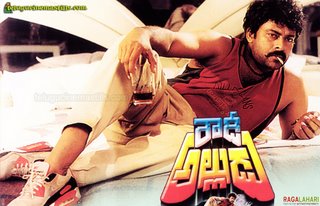
Rowdy Alludu

There are few things we like more than a Chiru movie, unless of course it’s a double role Chiru movie! Rowdy Alludu features Chiranjeevi taking on two classic characters; the smooth and suave businessman Kalyan and the strong, streetwise auto driver Johnny.  Add to this a dash of romance, intrigue, dastardly deeds and plenty of action and you have the perfect masala mix.

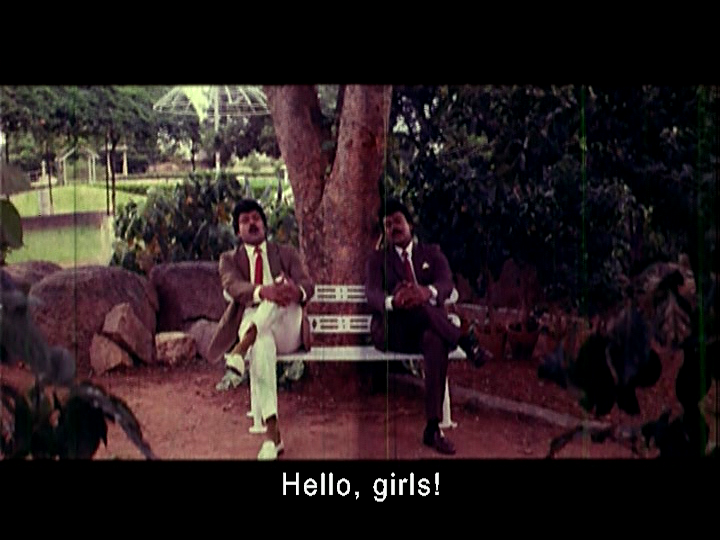
The movie starts with the above statement (which we took as A Sign) and there are a number of sections where there seem to be missing scenes as the action appears to skip. We really hope that there is someone in Hyderabad collecting and restoring, or at least preserving, all of these older films as quite a few we have watched recently have a similar problem.

Kalyan arrives back from the USA to take over the family hotel business from his ailing father and naive brother-in-law. With the help of his father’s trusted employee Mr Madhavayya (Raogopalrao) he discovers irregularities in the accounts and it’s not long before he has a few suspects in mind.

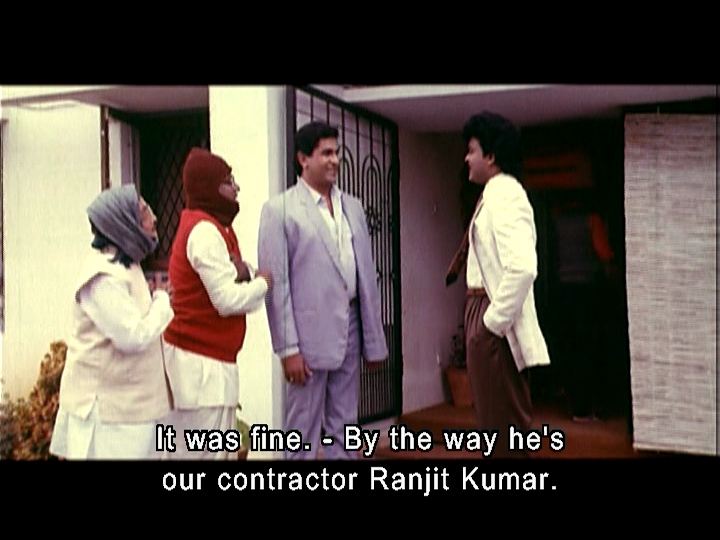
However, before he can investigate further, the whole family heads off to Ooty for a holiday. This seems to be an excuse for the wardrobe department to go mad buying a natty selection of sweaters for Chiru. Meanwhile, the fraudsters make efforts to cover their tracks and enlist the help of their partner in crime, the cat owning axe-murderer and construction contractor, Ranjit Kumar.

On a trip to Bombay, Venkat Raidu (Kota Srinivasa Rao) and Papi Kundalu (Allu Ramalingaiah) find Johnny, an auto driver who is the exact duplicate of Kalyan. They hatch a plot to get rid of their boss, put Johnny in his place and then take over the company.

Never one to resist a beautiful woman, Johnny dances up a storm to a bonus Bappi Lahiri song with the amazing Disco Shanti. Despite the fact that this was a film released in 1991, Disco Shanti’s outfit looks to have been stolen from Sam Fox circa the mid eighties. Luckily they are in fine form, and more than ready to take on the dubious choreography and make it their own. This may be the song that taught young Charan how to handle a fire hose.

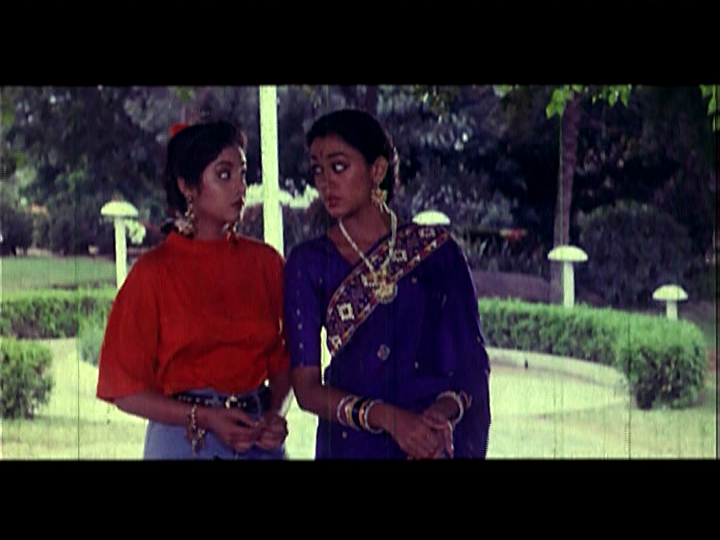
Kalyan is in love with Madhavayya’s daughter Sita (Shobana) who has the good sense to be a lawyer. This comes in very handy later on when the hapless Kalyan is accused of murder and thrown into jail. Rekha (Divya Bharti), the daughter of Venkat Raidu, hatches a scheme to marry Kalyan. Rekha does genuinely seem to love Kalyan but her father just sees the marriage as a way to control his nephew and the company. Naturally when she throws herself at Johnny thinking he is Kalyan, Johnny is delighted while Venkat Raidu desperately tries to separate the two.

Shobana doesn’t get much screen time at all, although she does make a lovely pairing with Chiru. Most of the romance is provided by the interactions of Johnny and Rekha, relying heavily on comedy, mistaken identity and innuendo. Divya Bharti throws herself at Chiru with wild enthusiasm  and really, who can blame her.

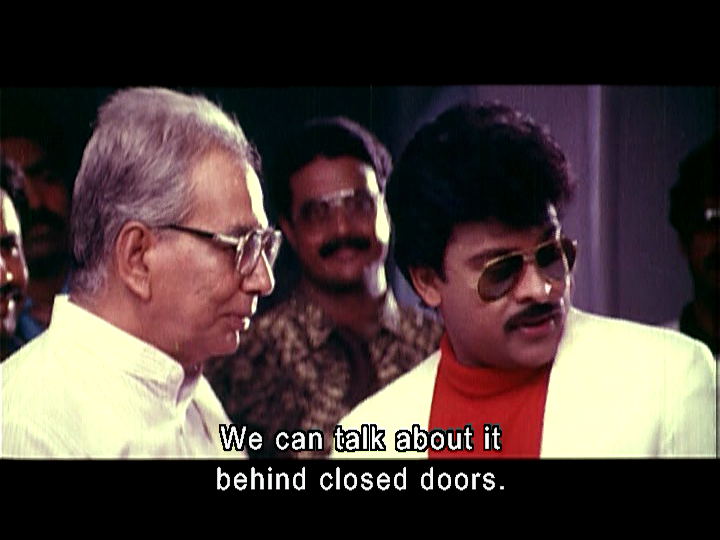
The success of the film rests on the portrayal of the two characters by Chiru. He exudes class and style as Kalyan and is also convincingly vulnerable when his family is attacked.  Johnny is as rough and tough as they come and Chiru makes him a different character in every respect. Kalyan has a blow-waved mullet and neatly pressed trousers, Johnny has a more exuberant moustache and prefers the timeless plaid and denim combo. Johnny’s attempts to impersonate Kalyan are laughable, but since he is supposed to convince everyone that Kalyan has become crazy that works perfectly. A very youthful and bald-spot free Brahmi makes an appearance as the psychiatrist enlisted to pronounce Kalyan insane, but most of the comedy falls to Chiru as Johnny and he does an excellent job.  The two fraudulent employees also ham it up with their inept schemes and it’s left to Ranjit Kumar and his henchman to provide the real menace.

The songs are mainly featured on Chiru and Divya Bharti and are upbeat as expected from Bappi Lahiri, with some interesting choreography by Prabhu Deva among others. There is one romantic song with Shobana in Switzerland which is quite subdued choreographically, but still contains potentially scarring images of mouth to mouth grape transfer technique. Chiru and Divya have an interesting encounter with some rather obvious symbolism of melting candles, dripping wax and a lot more besides. And we would love to know what the meaning was behind poor Divya getting hit in the face with suspended fruit.  More fruit! There was a theme here, but we just don’t know why. The costume designers also seem to have gone crazy in the local DIY store for some of the outfits and must be applauded for their belief that almost anything can be used as a headdress.

We enjoyed the scene in the hospital when Kalyan’s father’s heart beats in Morse code. There doesn’t appear to be any reason for this but is one really needed? Did it say anything significant? Are there any Telugu Morse Code experts out there? Johnny is obviously a man of steel as he is able to emerge from a coma and go straight into a major fight without so much as needing a bandage change.

We know that the story doesn’t have to make sense, but the police do seem to be particularly inept On learning that Kalyan has been arrested and  subsequently escaped, Johnny promptly flies back to Hyderabad. Surely the police would have been deployed at the airport looking for the escaped felon Kalyan? And since Kalyan and Johnny were identical it seems likely that the police might just have spotted Johnny returning to the city of his crimes. Perhaps they were looking for someone escaping from Hyderabad rather than entering the city so he was able to sneak in while their backs were turned.  Or are we over-thinking this?

Chiranjeevi is in his element and much of the film’s appeal lies with him, but his co-stars all turn in excellent performances to make this very entertaining. There is so much packed into this film with plenty of twists, plots and counter plots making it chock-full of masala goodness.

Temple says: This is not my favourite Chiru film, but it is very entertaining. All the requisite elements are there – fighting, flirting, bad denim, a sobbing mother, songs and multiple double-crosses. The comedy track is well integrated into the main story, and both Allu Ramalingaiah and Kota Srinivasa Rao make the most of their characters. Brahmi’s appearance is forgettable as he really doesn’t do much apart from fulfill what seems to be a law that he must appear. Divya Bharti plays an airhead and manages to be likeable enough but between her squeals and the wardrobe excesses, I was a bit over her character in a very short time. Shobana has less screen time but makes a stronger impression for me, as she down played a lot of her scenes and gave Sita a bit of presence. She might not have gotten a big dance number, but seeing what the costume team did to Divya, that may not be something she regrets. Chiru manages the characterisations of Johnny and Kalyan very well, and aside from obvious styling changes, his facial expressions and enunciation help keep the two roles quite distinct. It’s a fun film, if not a great one, and the songs are certainly memorable! I give this 3 and 1/2 stars.

Heather says: Perhaps it was the return to Telugu Masala after a month of watching only Tamil movies, or maybe just because it’s twice as much Chiru, but I really enjoyed this film. The songs were particularly entertaining although I’m not sure if I can say that’s because of the dancing or just due to the unbridled enthusiasm of the wardrobe department! This was one of the films that made Divya Bharti a star in the south but I found her a little too loud and over-excitable. I thought Shobana’s performance was superior and it’s a shame she didn’t have more screen time. The film however belongs to Chiru and he separated his two characters very well, with differences in speech, posture and attitude clearly defining Kalyan and Johnny. I did appreciate the tasteful sweater collection used by Kalyan compared to the more garish choices often seen in Hindi films of the same period. The bumbling conspirators Venkat Raidu and Papi Kundalu are inept and amusing, while their partner in crime Ranjit Kumar seems to be an amalgamation of a number of classic James Bond baddies. Overall the story works well and the various twists and turns are satisfactorily dealt with to make this a fun watch. 4 stars from me!

HELP!

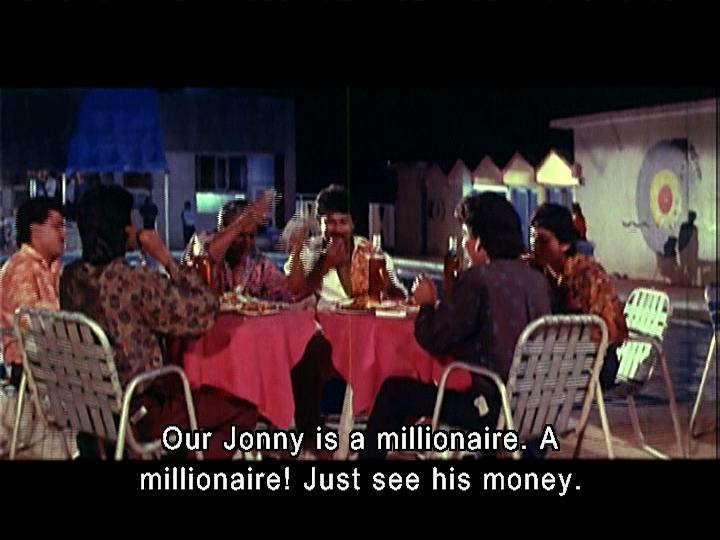
Our good friend Memsaab is trying to identify a particular function room and hotel swimming pool that feature in a lot of Hindi films. So imagine my delight when I saw The Pool in this film!

But I still have no idea which hotel it was at. Do you? Surely that distinctive wall decoration (on the right of the picture) has to ring a bell with someone. Please let us know! Temple