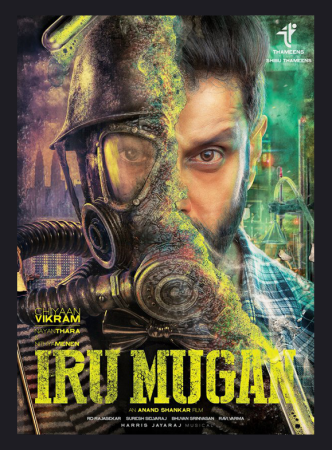
Iru Mugan

Iru Mugan.png

Vikram is on fine form playing a dual role in Anand Shankar’s latest action thriller, but the film is hampered by oddly placed songs, gaping plot holes and a meandering screenplay. There are some plus points – the action sequences are good, Nayanthara looks stunning and plays an interesting character, but none of it is quite enough to overcome the lack of suspense and surprising dullness of the storyline. Iru Mugan is a thriller without many thrills despite the best efforts of the cast, make-up department and stunt crew.

At least the start of the film is excellent. We see an old man queuing for a visa in the Indian Embassy in Malaysia, but rather than wait his turn, instead he uses a rather unique way of demanding attention. The result is classed as a terrorist attack against India and when the link is made between the pharmaceutically enhanced actions of the terrorist and über-villain Love, ex-RAW agent Akhilan Vinod (Vikram) is called back into service to discover exactly what is going on in Malaysia. Akhilan’s last action before he left RAW was to kill an illegal drug manufacturer by the name of Love (also Vikram), however Love is the chef suspect behind these latest attacks and Akhilan has a personal reason to find out if Love is really dead or not. Love was the man behind the death of Akhilan’s wife Meera (Nayanthara), although Akhilan has systematically slaughtered anyone else who was involved – hence the ‘retirement’ from active service.

Vikram’s Akhilan is a dour and haunted man with major anger management issues. He believes that violence is the answer to any problem no matter – whether he’s dealing with a suspect, a fellow agent or his boss. However, Malik (Nasser), head of RAW decides that his best option is to send Akhilan to Malaysia along with rookie agent Aayushi (Nithya Menen). So far so good, but Akhilan is the stereotypical ‘lone-wolf’ agent and displays every single hackneyed characteristic possible. Even worse, Aayushi is just as clichéd as a young inexperienced female agent. Her main role is to dress as a prostitute in order to get into a drug manufacturing lab. Really? That was the best option they could come up with? It’s trite, unoriginal and basically a complete waste of Nithya Menon’s acting skills.

Along with the frustration of watching a good actress in a badly written part, the first half suffers from a never-ending plague of flashbacks to Akhilan’s happier time with his wife. Unfortunately, these mainly occur as songs which act as effective speed breakers for the plot and completely destroy any tension that Anand Shankar has finally managed to build. The switch from drug labs and chemically enhanced violence to sundrenched beaches and Nayanthara in skimpy outfits is awkward and makes the film feel dated. Adding to this general late 90’s vibe is Thambi Ramaiah as a bumbling and inept Malaysian police officer and Riythvika as an exploited sex slave.

Vikram also plays the villain Love, a gay/transgender pharmacist who has managed to create a drug that gives superhuman strength and reaction time, but only for 5 minutes. Love is flamboyant and frequently feminine while maintaining his ruthless attitude and determination to cause mayhem with his invention. Although at the end of the day it’s the money that matters, selling the drug to terrorist organisations who will use it to attack governments worldwide is a bonus Love can’t pass up.

Despite all the clichés, it’s Vikram’s performance here as the two separate characters that makes Iru Mugan worth watching. The contrast between surly Akhilan and extravagantly ostentatious Love is excellent and although the two characters are somewhat extreme stereotypes, once both are together on-screen the deficiencies of each seems lessened. Perhaps this is where the ‘two faces’ of the titles comes in, since each character is ruthless in their own way and both are equally quick to jump to a lethal solution for any perceived problem. Nayanthara also makes an impression with her role as another RAW agent and does a good job with both her romantic and more action-orientated scenes, although her character would have better with just a little more depth. But then again Akhilan has very little backstory and Love even less, all of which adds to the scrappiness of the plot. It would have helped to have some idea how Love became such a genius pharmacist and why he decided to fuel international terrorism rather than turn his skills to more altruistic uses since there is a reason given for Akhilan’s excessive use of violence.

There are some more positives; the film looks slick and R.D. Rajasekhar makes the most of the Malaysian backdrop, both in the songs and for the chases through the city. Vikram’s transformation into Love is well done, and the fight choreography is impressive although it does get somewhat repetitive after a while. And although the placement could have been better and the picturisations a less abrupt change of pace, Harris Jayaraj’s songs are catchy and generally the soundtrack is good.

Overall Iru Mugan isn’t a terrible film, it’s just a lot duller than expected given the potential in the storyline. A drug that makes ordinary people into super-soldiers for 5 minutes should have made for a more exciting film than Anand Shankar ends up with here. Worth watching for Vikram, Nayanthara and the Malaysian backdrop, but go in prepared for the slow exposition and numerous plot holes.
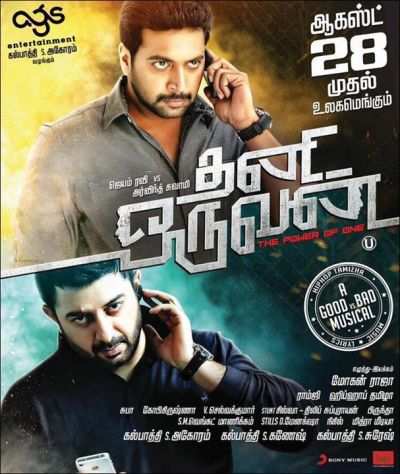


Thani Oruvan

thani-oruvan.jpg

Thani Oruvan pits a dedicated police officer against a corrupt scientist in psychological thriller that has plenty of drama and action. The writing collaboration between director Mohan Raja and Subha results in a cleverly plotted story with some unexpected twists, but the real success lies in the detailed development of the two main characters. Neither is completely black or white, although the shades of grey are relatively muted, while the cat and mouse relationship between the two provides good structure to the film. Excellent performances from the whole team but particularly Arvind Swamy as the villain of the piece ensure that Thani Oruvan is a better than average police drama and one that’s well worth a watch.

You know a film is going to be pretty epic when the story starts with a dramatic birth. Sengalvarayan (Thambi Ramaiah) is a party man through and through to the point where it’s more important to him that he ties flags for his leader’s appearance rather than take his heavily pregnant wife to hospital. The leader senses an opportunity for some good publicity and sure enough, the baby is born in the back seat of the politician’s car leading Sengalvarayan and his new son Pazhani to develop a relationship with the man who will later become Chief Minister (Nassar). The significance of these events doesn’t become apparent until later on but they provide an instantly intriguing start to the film.

After the dramatic opening, the story moves to a group of young police officers in training and their vigilante-style activities against the local criminal community. Despite the group’s best efforts, the crooks never stay in jail and Shakthi (Ganesh Venkatraman), Suraj (Harish Uthaman), Kathiresan (Sricharan) and Jana (Rahul Madhav) all look to their friend and natural leader Mithran (Jayam Ravi) for a solution. Naturally Mithran has a plan, having spent the last few years investigating all known criminal activity and discovering that all crimes are interlinked and ultimately committed by a small group of individuals. As a result he’s made it his mission in life to eliminate one of these top 15 criminals responsible for all of the crime in India, and of course his buddies want in on the action. He has a shortlist of three possible men to choose from; Ashok Pandian (Nagineedu), Perumal Swamy (Madhusudhan Rao) and Charles Chelladurai (Saiiju Kurup) who between them (according to Mithran) account for 80% of the criminal activity in the country.

Mithran’s biggest problem is which one to choose, although I’m not entirely sure why he couldn’t decide to eliminate all three given that he has his whole career ahead of him and could work on knocking off one every 10 years or so. Regardless, while he is working out which one to target, he discovers that all three actually work for a much bigger villain – highly respected scientist and Padma Shri awarded Siddharth Abimanyu (Arvind Swamy). Siddharth is known for his work in the pharmaceutical field but in reality he’s the mastermind behind all sorts of criminal activity and not a nice man at all, despite his designer suits, fashion model wife and impressive collection of University degrees.

Siddharth is of course the grown up young boy from the start of the film and his inept father is now the Health Minister in Nassar’s government, allowing Siddharth to do basically whatever he wishes. Mithran and Siddharth cross paths when an American drug company owner comes to India to open access to lifesaving medications – something that Siddharth and his associates will go to any lengths to prevent. Once Siddharth becomes aware of Mithran and his attempts to put him out of business, the contest between the two begins in earnest with each determined to eliminate the other no matter what it takes.

The characterisations are the key here and while Mithran doesn’t have all the answers he uses a methodical approach and informed reasoning to work out what Siddharth will do next. Almost too good to be true, Mithran is depicted as a dedicated and passionate police officer with a strong sense of social justice, who is almost hyper-aware of crime in his surroundings. However as he gets drawn into a battle of wits with Siddharth his obsession threatens to take over his life while his friends and allies become tools to use in his fight. His motto is that a man’s capability is defined by the quality of his enemies and by that measure he needs to be very capable indeed. Mithran’s passion for justice is what makes him get out of bed in the morning, so he has none left over for potential love interest Mahima (Nayantara) and as time goes on, little patience to deal with his friend and colleagues either. These shades of grey give Mithran more credibility and offset his tendency to indulge in pompous and long-winded speeches about truth, justice and the rights of all to obtain cheap pharmaceuticals when required. Jayam Ravi is perfectly capable as Mithran but he is very serious and it would have been good to see an occasional smile outside of the obligatory song with Mahima.

Siddharth is a more cerebral villain than usual and uses his political influence to neutralise any threat from Mithran while his quick reactions and scientific knowledge also stand him in good stead to outwit the police officer at almost every turn. He doesn’t throw tantrums, swear vengeance or send out gangs of thugs as Tamil criminal masterminds are wont to do, instead he simply adapts, moves on and changes direction.

Arvind Swamy is excellent as the criminal mastermind, with the beauty of his characterisation lying in just how very ordinary his Siddharth is. He’s rich  – designer suits, trophy wife and beautiful house all attest to how wealthy he is, but on the surface he could be any scientist working on medical breakthroughs with no indication of how cruelly callous he can be when required. Those moments when he casually orders someone’s death or explodes into controlled violence are almost totally unexpected and seem to come out of nowhere, making Siddharth a very effective and chilling villain despite his generally debonair persona.

Nayantara’s character Mahima is interesting too. On one hand she’s the typically dumb love interest who thinks that by following the hero around and declaring her love at every eventual opportunity she will eventually wear him down – and to be fair that is what happens here too. But on the other hand, she’s a forensic scientist who has some good ideas to help Mithran’s investigation, and appears coolly capable and professional in her work. If only Mohan Raja had avoided the ‘love at first sight’ cliché and given Mahima and Mithran a more plausible and realistic romance I would have liked her character more. But Nayantara does give Mahima professional competency and a no-nonsense approach most of the time that fits well with the overall tone of the film.

The rest of the cast are good with Thambi Ramaiah providing some laughs as an inept politician, but mainly giving a further insight into the character of Siddharth. Rahul Madhav is the best of Mithran’s friends, Vamsi Krishna is suitably menacing as Siddharth’s hitman, while Mugdha Godse is good in her brief but important role as Siddharth’s wife. The film looks good too, with effective use of split scenes and an effective mix of technology and good old-fashioned fight scenes. There are a few leaps of faith required but they aren’t too ridiculous and mostly the plot makes sense.

Thani Oruvan is an intelligent thriller with a good mix of action and drama and excellent characterisations. It is a little overlong, but the story keeps moving along at a good pace and like any good page-turner it’s always worth finding out what happens next. Worth watching for Arvind Swamy’s villainous scientist and the psychological cat and mouse game between Siddharth and Mithran. 4 stars.


Vedalam (2015)

Vedalam

Vedalam opens with a woeful assassination attempt in Milan where a team of supposedly crack soldiers are trying to rid the world of top Tamil crime boss Ratna Bhai (Rahul Dev) and end up failing miserably. It’s not a good start, and what makes it so terrible is a mixture of the ridiculousness of the scenario, bad dubbing, bad acting and a nonsensical dénouement. Thankfully though, with the exception of a few comedy scenes, the rest of Vedalam is miles better than the opening few minutes would suggest and Ajith scores another hit – mainly due to the force of his personality and considerable charisma on-screen. Siva adds special effects, a good story and plenty of action to make Vedalam an entertaining watch despite the dodgy start.

As an antidote to the opening scene, the film immediately moves to Kolkata and Rajendran as local gangster Kolkata Kaali. Rajendran is one of my favourite actors and I love that he’s moving more into comedy alongside his usual gangster roles. He is very funny here as he menaces and then befriends new arrival to the city Ganesh (Ajith Kumar) and his sister Thamizh (Lakshmi Menon). Thamizh is applying to study in a prestigious art college in the city and Ganesh appears as the perfect older brother – supportive and encouraging in every way, while maintaining an unruffled and happily smiling exterior no matter what the circumstances.  While Thamizh gets accepted into the art college, Ganesh manages to get a job driving a taxi, despite not speaking a word of Bengali or knowing anything about the city – sounds like your typical taxi driver really!

Siva adds more humour with Soori as the manager of the taxi company, but his brand of comedy only works part of the time and it reaches a nadir when the tired out trope of philandering husband is rolled out yet again. Shruti Haasan also shows up in a comedy role as an unscrupulous lawyer, Swetha, who ends up with a grudge against Ganesh. None of her intense overacting in her initial scenes is funny and her wardrobe choices are equally atrocious, but her character does have a few redeeming moments later on in the film. In one of those typical film coincidences, Swetha’s brother Arjun (Ashwin Kakumanu) falls in love with Thamizh which adds romance into the film and gives Ganesh the opportunity to deliver a good ‘big brother’ speech about women’s safety. It’s a shame that such a good message about how stalking ≠ love and men should respect women is immediately followed by a song featuring Shruti and backing dancers in skimpy outfits and terrible choreography, but at least the speech did get a cheer in Melbourne.

Just before the break Ganesh reveals his true persona, first in an excellent fight scene and then in a genuinely frightening exchange with Swetha that sets up a flashback sequence in the second half. All of the smiling and the ‘always cheery’ disposition starts to grate by then, so the switch to bad-ass fighter Ganesh (aka Vedalam) comes as a welcome change. No-one does the switch from happy smile to scary psychotic grimace as well as Ajith – it really is disturbing and Siva uses the transformation sparingly but to very good effect throughout the film.

The reason for Ganesh’s outburst of violence goes back to the gangster seen in the opening scene. Ratna Bhai and his two brothers Abhinay (Kabir Duhan Singh) and Aniket (Aniket Chouhan) control the skin trade out of India amongst various other criminal activities and Ganesh has come up against them in the past. The flash-back sequence is well done, generating an emotional reason for Ganesh to seek revenge but without becoming overly sentimental or clichéd. The villains do what villains in these films usually do, while there is really never any doubt that Ganesh will defeat them all in the end. However the lead up to the final fight scene is very well written with a few good surprises to build the suspense. The last fight is also brilliantly done and the film is worth watching for this last sequence alone.

Anirudh’s music is good and fits the screenplay well, with Aaluma Doluma standing out as the best track.  The background score is occasionally distractingly loud, but I like the theme and it suits the schizophrenic nature of Ajith’s character. Mostly the songs are well pictured too apart from the previously mentioned ‘Don’t You Mess With Me’, which really deserved better and isn’t helped by the skanky choreography. Technically the film is slick and well-edited with good effects and novel fight choreography. There isn’t too much blood and gore either, although it’s always surprising how quickly the bad guys run out of bullets and resort to fist fights when they really should know better!

Vedalam is Ajith’s film all the way and he does a superb job as a dangerous and scary man while still conveying kindness and sympathy in the scenes with Thamizh. The support cast are all just that – support for Ajith, but Lakshmi Menon is good as his oblivious sister while Sudha and Thambi Ramaiah make an impression in their small roles in the flashback sequence.  Vedalam isn’t a perfect film, the comedy isn’t great and the villains are standard caricatures with predictable habits, but Ajith is very watchable and the story works well with some unexpected twists, especially at the end.  Worth watching for Ajith and the excellent final fight scene – plus Rajendran of course!