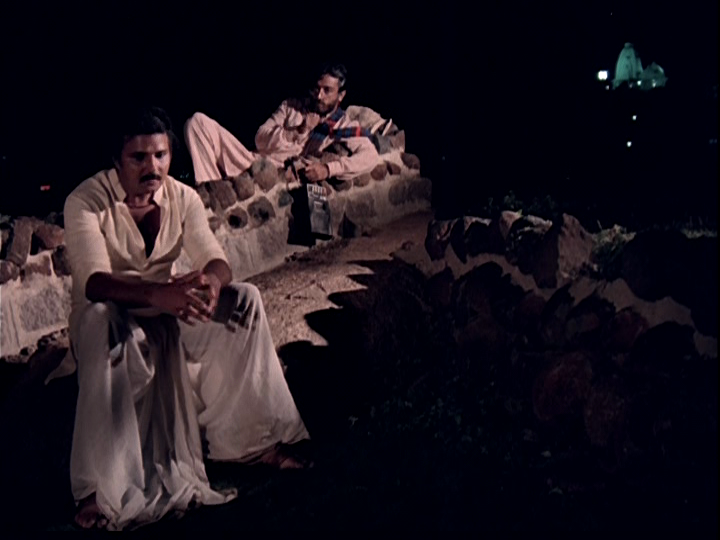
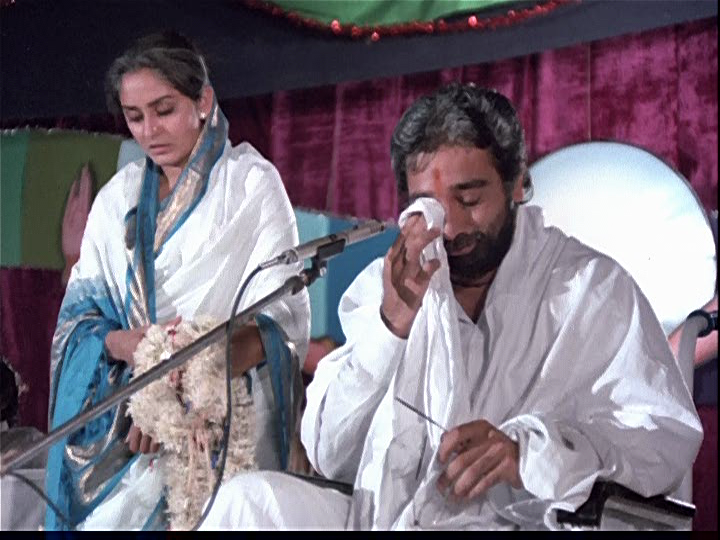
Godavari

Sekhar Kammula has become one of my favourite directors, always entertaining me with interesting observations and a satisfying story. In Godavari he deposits his characters and their relationship issues on a boat, adding a philosophical dog, a sideplot or two and some beautiful scenery to leaven the mix. I’m not totally convinced by all of the elements but I do really like this film.

This song sets up the main characters, and acts as the now familiar promotion clip for Andhra Pradesh.

Kamalinee Mukherjee is Seetha, a would-be fashion designer. She has nightmares about losing her independence and her close relationship with her parents after she marries. I liked Seetha’s spirit, and I really felt for her coming off a rejection from a groom her parents pressured her into accepting. That had to sting. Seetha is vain and bratty at times but she is funny, insecure and compassionate as well, and admits fault when she is wrong.

Sumanth is Sriram, an unassuming guy who wants to get into politics and make the world better. He reveals a manipulative side as he cons his way into appointments with party officials. Perhaps he is a precursor to Arjun Prasad from Leader? He isn’t as effective in his personal life however. Ram is inarticulate when he should speak up, and doesn’t really see things for how they are – he is lost in a vision of how it should be.

Raji (Neetu Chandra) is spoilt, silly, self centred and yet not totally unlikeable. Raji judges a relationship by the trappings of Valentines’ cards, fancy coffee shops and all the showy things, things that just never occur to Ram, and she uses this as an excuse to push him away. Her parents know Ram wants to marry her but refuse as his simply isn’t the best offer and they are quite honest with him about this. Perhaps they know their daughter better.

Ravi (Kamal Kamaraju) is a cashed up bully, making the most of his status in the IPS. He seems to have some notions of manners and decency underneath all the arrogance, but has done a marvellous job of burying his better side. I can’t say I liked him at all, but I did end up thinking he could be a good match for Raji if he got over himself a little.

All the characters are flawed, but not in a dramatically damaged way. They’re just a bunch of people who have good and bad points, and for the most part are quite unremarkable. I found them easy to relate to, even the unpleasant ones, as they were well rounded and I could imagine them having lives outside of the film setting.

The boat setting appealed to me for a number of reasons. Not only did it provide a great device for containing the characters and their interactions, it looked great. It had all sorts of strange little additions,extensions and even a tower of sorts. I thought it looked delightfully like something out of a Miyazaki film. Whoever did the set dressing did a fantastic job too. All the powers were invoked to keep the boat safe and sound.

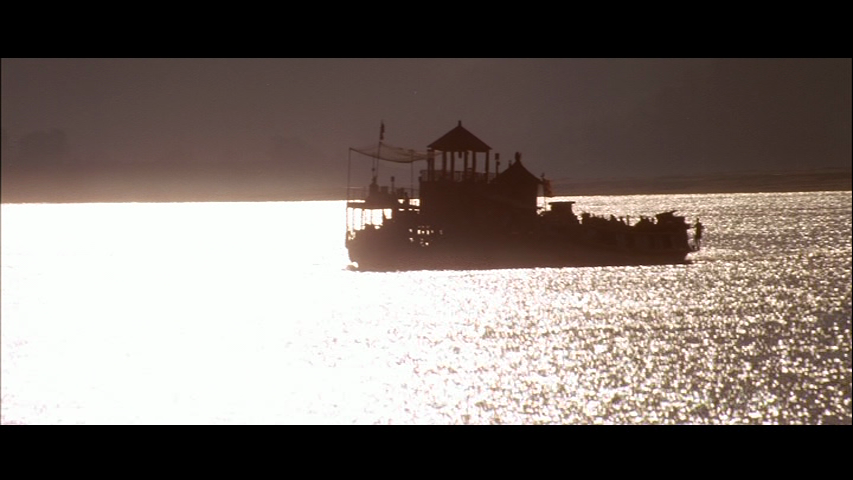
The boat trip also allowed the supporting characters to have things to do other than hang around Ram and Seetha.There was a nice sense of energy as the ever reliable Tanikella Bharani (the captain) and others bustled around. I enjoyed their presence all the more as they contributed to the background life and colour of the film. Seetha’s parents and sister had their own stuff going on at home, and there was a real lived-in feel to their domestic scenes as well. The nominal villains Raji and Ravi had their own issues to deal with, and even in their smaller roles showed some growth.

It wouldn’t be a boat story without stowaways. Chinna is a poor kid who pursues a mystery man (OK, it was Ravi) who does him out of the balloons he sells.  Koti, a dog, decides for his own reasons to get out of town. When Koti sees Chinna pay his bribe, he has a flashback to Daana Veera Suura Karna and swears fealty to his new master. They team up and give us their points of view but also provide the catalyst for people to reveal their own character – are they charitable, curious, mean or oblivious to the boy and dog?

While I liked the idea of Koti and the voiceover (by Sekhar Kammula, and what a world weary creature with a 3am whiskey voice he sounded), I did not like the CGI dog. The real dog had ample charm and verve and I don’t see the animation was necessary. I kept hoping it wasn’t because the real dog became, er, unavailable after a boating mishap. For those of you who demand pirates, there was a fairly silly episode involving a fugitive and a night ambush but it only served to show that Ram is reliable and Ravi isn’t so I will move on.

There is no surprise in the romantic pairing of our waterborne humans as their journey to Bhadrachalam follows that of Ram and Sita. Our Ram and Seetha are attracted to each other but there are obstacles, both real and imagined. I really enjoyed their conversations and the way both Sumanth and Kamalini showed the growing intimacy and comfort they felt in each other’s company as well as the pressure of the potential relationship.

They did daft things, sure, but there was no sense of them being stupid or unpleasant people. Kammula uses a lot of voiceover monologues, and both actors did a good job of mirroring the inner voice with their expressions, ranging from funny to heartfelt. Sometimes I find a voiceover can leave me at a distance, but in this case it worked well enough and suited the introspective nature of the characters.

I don’t like the background score at all. It is too cheesy, and seemed to try too hard to be whimsical. But the actual songs are more attuned to the mood of the scenes, and subtitled, so I could at least appreciate a fraction of Veturi’s lyrics as well as K.M Radha Krishnan’s melodies and the beautiful scenery. There is little dancing in the film, and it wouldn’t have been appropriate to much of the story; but if I have a criticism of Sekhar Kammula it is his over use of the montage. Then I saw Sumanth dance and I thought well, yeah, montages have their place— but there has to be a limit.

The lyrics draw attention to the beauty of the river and the power of unseen forces in our lives. The river is a metaphor for the forces in life that nudge us hither and thither, and the power of chance meeting and parting. But this Ram and Seetha also show that you can fight the current when you want to and make your own way.

Finally, I give Godavari 3 and ½ stars. For those who think 3 and ½ is just plucked from the air , it goes like this – Points on for the convincing performances, points off for the animated animals, points back on for the real dog, more points on for a parrot asserting her independence, some points off for too many montages, and finally points on for the film being so pretty. Watch it for the beautiful balance of observational style with a fresh twist on the filmi clichés.

Heather says: I really like the way that instead of road movies, the Telugu film industry has river films which surely do a great job for the tourist industry. The river looks beautiful here and the Godavari boat is fantastic. I love the way it’s at least 3 boats joined together, one of which has fantastic wooden panels and just to add a little more space it’s also towing a raft behind. It looks like a great way to travel from Rajamunday to Bhadrachalam, although I suspect in reality it would be rather wet and cold. I do appreciate the way that in time-honoured fashion everyone jumped underneath big blue plastic tarpaulins when the rain started. I remember those well from travelling on the top of buses in India and Nepal!

The story of the romance between Ram and Seetha, both rejected by their prospective partners, is different enough from the usual to be interesting and I like the way that Ram had to deal with being in such close proximity to Raji and her fiancé Ravi for the duration of the boat trip. Kamalinee Mukherjee’s Seetha is beautiful and chirpy and I really liked her character from the beginning. Even her obsession with her beauty is funny rather than irritating and I feel that she stayed true to her independent nature throughout the story. Although Ram is initially a very pedestrian character with his idealistic ways and mooning over Raji, he becomes more likeable in his interactions with Seetha and the young balloon seller Chinna. Ram and Seetha’s gradual attraction as they argue is realistically handled and I think both Sumanth and Kamalinee Mukherjee are well cast in their roles here. The cook Pullamma is a great character and her indignation when she thinks Ram has given her brother money because he feels sorry for him is one of my favourite scenes. I like the way Sekhar Kammula’s points out that poor people have pride and dignity very well, particularly since there is so much emphasis in the story about altruistic behaviour being the ideal to aim for.

As well as another reason to dislike Ravi (and I’m not sure we needed quite so many), Chinna’s character adds some funny comedy. The CGI talking dog is strange and I agree with Temple that it wasn’t necessary. The talking dog idea was fine and the voice-overs were quite funny and used well but I think this could all have been done with the real dog,  rather than introducing the CGI. But it wasn’t too much of a distraction and the story of Chinna and Koti is well written into the main story.  The characters of Raji and Ravi are also more than just part of the backstory and I appreciate the way that all of the supporting cast are used to further develop the romance between Seetha and Ram, either by helping them or by adding more obstacles to their path.

There are a few things that confuse me. I’m not sure why the fortune-teller decides to jump into the river. I can’t work out if he’s just chasing his parrot or if his declaration to Rama is more significant. The fight scene also seems totally unnecessary and the whole storyline of Veeraiah didn’t add anything other than a chance for Ram to be a hero.

There is so much to enjoy in this film. the boat setting, the lead actors, the story and the support characters are all excellent. I love the songs as well, especially Tippalu Tappalu in the rain, and the shots of the river are beautiful. Godavari is a really entertaining film and I give it 4 stars.

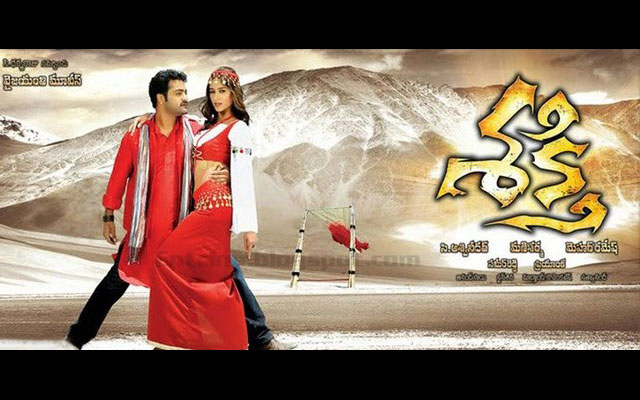
Shakti

Here is a list of things we know the film makers didn’t spend the reputedly huge budget on:

  • A hairdresser for Ileana
  • Good quality CGI
  • Historical research
  • Decent wigs
  • A good story

Here is a list of things they did invest in:

  • Scarves
  • Stars
  • Helicopters
  • Excessive editing
  • Guns and rocket launchers
  • Cars (to be blown up)
  • Locations
  • Oversized glowing props
  • A slide announcing that no matter when or where people lived, for the purposes of this film everyone speaks Telugu.

The story opens at the pyramids with lots of Ancient Egyptian-ish folk speaking Hindi. We also catch our first glimpse of topless Sonu Sood, although not topless in our preferred sense. He first appears as a severed head in a bag. So of course, his grieving lover’s first reaction is to gouge his eyeballs out and preserve them in a jar of something orange and smoking.

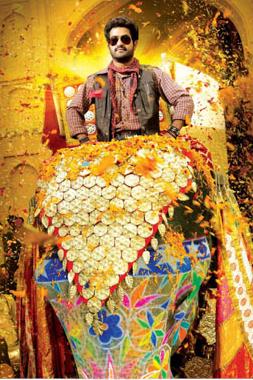
Skip forward to rich girl Aishwarya (Ileana) slipping away from her father’s security detail to go touring with her gang of friends which includes Ali as Tommy, a character at least 20 years too young for him. While in Jaipur they cross paths with Shakti (Tarak) and he appoints himself their groups’ highly paid guide and protector. How to resist a man who arrives on elephant back, kicks assorted bad guy arse and can get tickets to first day first show of Wanted?

To summarise: Aishwarya accidentally took a very large mystical jewel from her family safe and doesn’t notice she is carrying it in her bag. The Faux-gyptians want it to destroy the world or something. And there are the good guys seeking to protect the jewel and ensure it is used in the ritual required to keep several holy cities in India, or maybe the world, safe.  And Shakti is the son of the man killed performing the last saving the world ritual (either several hundred or maybe thirty years ago).

The first half of the film is a blend of road trip, romance and action in some lovely Indian locations as Shakti has to constantly rescue Aishwarya from her own stupidity as well as from the villains who are tracking her. The second half of the film is a less successful blend of exploding cars and storms of bullets with the mythology underpinning the story of the jewel and the elaborate ritual. We were slightly surprised to learn that the Ancient Egyptians, or a cult, who lived outside the pyramids at Giza had tried to invade Andhra Pradesh on horseback either a couple of thousand or twenty years ago. But compared to all the other nonsensical stuff going on (not a tourist in sight at the pyramids, roads in Hyderabad with no traffic at all), we were only very slightly surprised.

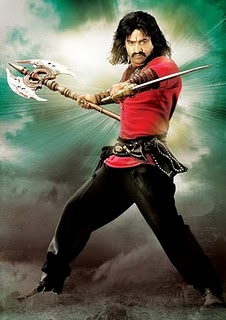
The special effects were cheap looking considering the budget. A sacred sword was made of red plastic, and the significant trishul was yellow plastic with little light bulbs inside it. There was clearly a vision, but it was translated in a very clumsy way. Even in the fight and dance sequences, where we expect Tarak to absolutely shine, the overly jumpy editing and poor effects were a distraction and really diminished his impact. We are well accustomed to seeing action footage sped up or slowed down for impact, but in Shakti the slow bits were often so slow they highlighted the CGI and wires, and the fast bits were jerky and cartoonish. A couple of the songs had huge sets and lots of costume changes but lacked the ‘Wow factor’ we expect from this style of film. The opening Rajasthani song was a great example of what didn’t work – the dancing and choreography were great, the costumes and sets were stunning, and the editing made it look bland and disjointed. We were very hopeful once the rocket launchers appeared, but sadly once the director had blown up umpteen cars and people, it was time for more ‘creativity’ and the film deteriorated. The climax set in an underground temple full of more glowing props was too repetitive as it mimicked a long preceding flashback and the visual effects were not great.

Every film comedian except Sunil made an appearance and it was just too much. We have no idea at all why Jackie Shroff was in this film. His role could have been played by anyone in a brocade jacket and every time we saw him poolside we just prayed he would keep his clothes on. From the look on their faces, so did the gori extras paid to cavort around him! Sonu Sood did his usual villain thing and made an appearance (head attached) in a flashback in the second half. The angrier he got the less he wore, so as you can imagine we were very interested in his scenes. The whole subplot with his lover and her supernatural vengeance was a confused mess, and not helped by the wig department. But there was lots of eye stuff happening, mostly anatomically correct too, which pleased Heather! The orc-like baddie sent to destroy Shakti was blind at first, but after years of punching and headbutting Egyptian columns into shards (think Juggernaut from X-Men), he was apparently given Sonu’s eyes although disappointingly we never saw the actual installation procedure.

Tarak and Ileana were good considering what they had been given by writer/director Meher Ramesh. They had no chemistry as a couple but Ileana did what she could with an under developed character and the nonsensical behaviour required of her. Tarak delivered his usual robust physical performance and rousing speeches. Shakti (the character) had only two facial expressions for most of the film – surly and surlier. We would be peeved too if we got landed with The Wig. The flashback exposition was inexplicable in style and chronology. If this was 20 odd years ago, why was Shakti in a pageboy wig? We were a little bemused by the decision to try to create flowing warrior locks with the use of a wind machine. Sadly, the breeze lacked sufficient oomph to stir the clumpy and hideous wig so it was all for naught. And that inability to make a concept work sums up the whole film.

There were some positives. The audience were laughing a lot at some of the comedic dialogues and they appreciated Tarak’s big speeches. Some things were really fun – Shakti’s dramatic reveal as super agent A1 of the NSA, the rocket launchers, CGI snakes (especially when carried as a concealed weapon), Brahmi and Tarak’s scenes together and the backing dancers who really did give it their all. The Ladakh and Haridwar scenes were beautiful even with all the gimmicky camera work.

This is a film solely for the hardcore fans.

Sagara Sangamam

I had no luck finding a subtitled version of this film (legal or otherwise), which is a shame as I think that difficulty will stop a lot of people from watching. I’m not sure where Heather got her subtitled copy from. However this is the story of a dancer, often expressed in action rather than speech and many scenes required no further explanation.

The film uses a flashback structure so we actually meet the older Balu (Kamal Haasan) first. He is a disgruntled drunk and newspaper critic who, despite all his issues, demands a high standard for dance. He writes a scathing review of the latest dance sensation Sailaja (SP Sailaja), and rather than apologise when she confronts him, belittles her by showing her how it should be done.

Young Balu is a poor boy, dedicated to dance in many forms – and a purist. He wants to be successful but is held back by his dislike of the shallow sexified version of dance that is in demand (and is perhaps dismayed by the outfits).

Balu’s world is small. He has his mother, dance, and his friend Ragu (Sarath Babu). He also meets Madhavi (Jayaprada) who is wealthy and happy to be his patron. She gives him many opportunities, and becomes more than a sponsor in his eyes.

Each episode reveals something more of Balu’s character and how he came to be in his current situation. It’s a big challenge for a film maker, and in this instance it is handled beautifully by K. Vishwanath. The fragments fall together to make a cohesive story, and it is easy to follow the narrative.

Kamal Haasan is fantastic. Since we more or less know how the story ends before it begins, it really does require a great performance to keep a viewer engaged on the way to the foregone conclusion, and he delivers. Yes, there are some dubious wardrobe moments and bizarre posturing, but they were intentionally ridiculous, being Balu’s commentary on the commercialisation of dance. Balu dances his joy, pain and despair – he dances his heart out and it is hard to look away.

This is one of my all time favourite film dance sequences and I love it for its joyous emotion, simplicity and the brilliant editing. Despite his dedication to dance as a pure art form, Balu isn’t a total stick-in-the-mud. He adds some sweet comedic flourishes dancing with kitchen utensils, and plays up to his mother who dreams of seeing Balu on stage. Madhavi is impressed too!

Life seems set and success is just around the corner so naturally, I expected a tragedy. Because he is such a perfectionist and intolerant of things that don’t fit his vision, Balu is ill equipped to deal with setbacks. He falls into a bottle after losing his mother, missing his big dance debut and then learning that Madhavi is not free to return his love (she is married to a man who looked absolutely miserable in their wedding photos). His character frustrated me greatly. I could empathise with Balu, but I really wanted him to see sense and find a way to bend before he broke.

Sarath Babu’s role was small but he is a constant and reassuring presence and instilled Ragu with an air of integrity and generosity.  I’m not entirely sure why Ragu stuck by his friend as he seemed to give endlessly to an often ungrateful sod. There were lively glimpses of Balu’s character in a couple of scenes that made me believe in the friendship, and perhaps I missed a lot in the dialogues.

Madhavi tracks down her old friend and would be lover through the newspaper and Ragu. Her side of the story is also revealed through flashbacks. This episodic style seems apt as her love for Balu is revealed through her candid and perceptive snapshots of him long before either of them acknowledges any feelings. Jayaprada is lovely and manages to be light and funny as young Madhavi without being shrill or giggly, ably matching Kamal Haasan in the physical comedy.

She gives a sensitive portrayal of a woman who is tempted by a love she cannot act on and manages to be sympathetic despite having been, at best, deceptive by omission.

As it happens, she is Sailaja’s mother, and so Balu’s life turns back on itself as Madhavi secretly engages him as a dance teacher for the stylish but shallow girl.

The photograph motif is used a lot. One of the most moving examples is when Balu and Madhavi try to use the timer thingie to take a picture of themselves together. The photo fails and all that can be seen is a worried Madhavi and ghostlike blur of Balu. They joke that it wasn’t meant to be. Then when Madhavi departs with her husband, Balu takes and keeps a photo of the couple as a reminder to himself of what had to be. It’s one of the few pictures he takes; usually Madhavi was the one to give him beautifully composed portraits showing what he was to her.

Their reunion is full on filmi and yet simple as Madhavi confronts Balu while he is stinking drunk. Balu’s drunken cavorting avoids being a mockery of his dance despite being accessorised with a bottle, perhaps as it comes straight from his heart with no artifice. Madhavi lets Balu see her sadness and fear for him while he seems to give her an earful for not teaching Sailaja to be a better dancer. In so many ways, they haven’t changed a bit. Balu doesn’t know that Madhavi is a widow, and once more she struggles with the pressure of family against her desire to move forward with Balu in her life.

Sailaja is unhappy at this revelation about her mother’s past, but she should be practicing her dancing more than spying, and do a bit of growing up as well. Happily for her, she does come around to seeing the value in Balu’s teaching (which he does from a hospital bed). Her performance was probably the weakest for me in terms of acting, but her dance scenes with Kamal Haasan were much more satisfying. And SP Sailaja can sing, so she was certainly talented.

The structure of the story is solid, and the characters seem believable. The Illaiyaraaja soundtrack is integrated into the drama and the dances reveal so much of the characters’ inner lives they are essential to the film, not just a pleasant addition. The dance practice and performance scenes are filmed beautifully.  I can’t comment on the lyrics by Veturi or the dialogues co-written by K. Vishwanath and Jandhyala (who wrote dialogues for Aaradhana) as I just made up what I thought was happening in some scenes.

The ending is over the top but despite all the silly trappings the leads keep it (mostly) restrained to let their characters’ emotions shine through. If nothing else grabs you, this film captures some exceptional dance performances. I wish I could fully appreciate the characterisations, as I did feel disconnected at times due to my lack of language skills, but it wasn’t a huge issue.

I give Sagara Sangamam 4 ½ stars.

Heather says: This is such a beautiful film and although I keep returning to it time and time again to watch the incredible dance scenes, there is so much more to enjoy in this film. To start with the dancing, there probably isn’t anyone other than Kamal Hassan who could manage to make it all look so effortless. The classical dance scenes are superb, and even the contemporary song (with that truly hideous yellow suit) is well added in to showcase his skills. Jayaprada is beautiful in her dance scenes and S P Sailaja is excellent, but it’s still Kamal Hassan who draws my eye each time. I absolutely love the dance scene in the kitchen which is fresh, spontaneous and makes such good use of the setting.

Leaving aside the amazing dancing, this is a really well told story. An alcoholic ‘hero’ is unusual and, since I work in the field, I like that it’s a useful public health message as well. The romance between Balu and Madhavi develops slowly and naturally considering their joint love of the arts and despite the difference in their social standing. The use of photography to link the story together is cleverly done and every image adds a little more to the story. Sarath Babu is excellent as Balu’s long suffering friend, and his generosity provides a stark contrast to Balu’s increasing selfishness as he beomes dependant on the demon drink. However Raghu is not a perfect saint either since he doesn’t scruple to use Balu’s guilt against him as a way to blackmail his friend into teaching the spoilt brat Sailaja. Of course it’s all for Balu’s own good and the fact that he gets treatment for his sick wife Sumathi is a bonus. All of the supporting cast is excellent here and K. Vishwanath develops their characters in enough detail to make their actions understandable and relevant.

I really like the way each flashback occurs when something which is happening in the present triggers a memory of a past event by one of the characters. It seems very natural and helps to link the past and the present. The film is very much about the arts: Raghu is a writer and poet, Madhavi is a singer and Balu’s dream that they all perform together seems a natural extension of their friendship. It’s also an excuse to have some beautiful songs and once again Illayaraja provides music that I love and I just wish I knew what the lyrics meant.  There are a few things I don’t enjoy quite so much. There are some really ridiculous co-incidences and the last few scenes are overly melodramatic. But then again this is a film from the eighties and we all know that wasn’t a time for restraint! This is a 5 star film for me.