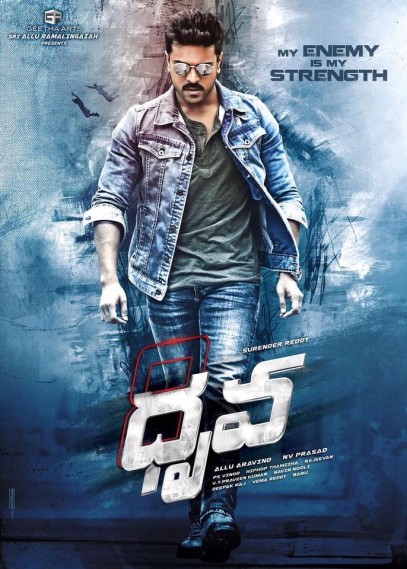
Dhruva (2016)

dhruva

Dhruva is a reasonably faithful remake of 2015 Tamil film Thani Oruvan that benefits from Arvind Swamy reprising his role as the villain of the story. Dhruva is definitely slicker and glossier than the original, but the story is essentially the same although the emphasis is even more on the two main characters than in Thani Oruvan. Thankfully both Ram Charan and Arvind Swamy are excellent and the cat and mouse game between the two makes Dhruva an entertaining and worthwhile watch.

The film is a thriller that follows the attempts of a young and righteous police officer, to track down and catch one of three über criminals. Dhruva (Ram Charan) believes that if he locks up the kingpin of any criminal organisation this will immediately impact on 100 petty criminals and be more effective than tackling each street thug individually. It doesn’t take long before he discovers that his three possible targets each themselves are controlled by an even bigger villain – Siddharth Abhimanyu (Arvind Swamy). Siddharth is a respected scientist, recipient of a Padma Shri award and all round respected businessman so Dhruva has to somehow find convincing enough evidence to send Siddharth to jail for his crimes.

In the original film Dhruva was helped by his close friends who all formed a posse to fight crime together while they were in training college. However their role in the story here has been reduced and although the friends are still there, they have less to do in the hunt for Siddharth.  Goutham (Navdeep) is the only one who has been kept fairly true to the original, but without the detail of their friendship as background, his character is less effective. This also has an impact on the characterisation of Dhruva who appears more isolated and less of a leader as a result, making his assumption of control of a crime task force immediately after his graduation rather less credible.

Another casualty of the re-write is Ishika (Rakul Preet Singh) whose character has even less to do than Nayantara in the Tamil version. Ishika is a victim of love at first sight when she sees Dhruva, and she pursues him relentlessly, knowing that in a Telugu film eventually her persistence will be paid off by Dhruva finally accepting her love – rather than arrest for stalking, which would be the most probable outcome in real life. Although she is a forensic specialist, this is barely mentioned in the film, and Ishika has little involvement in the search for evidence against Siddharth. Where Nayantara’s Mahima had useful ideas and forced her way into the investigation, Ishika is limited to appearing only as the romantic interest. However Rakul Preet Singh does a good enough job in this role and has reasonable chemistry with Ram Charan, which at least makes the scene where Dhruva finally does admit his feelings one of the better moments in the film.

The film is all about Dhruva and his developing relationship with Siddharth and Ram Charan is excellent as the obsessed police officer, determined to track down Siddharth no matter what it takes. He certainly looks the part, easily demonstrated since Surender Reddy is an equal opportunity director who ensures that for every shot where Rakul Preet Singh appears in a bikini there is a shot of Charan without his shirt. No complaints here!  While Ram Charan expertly channels his inner Salman Khan, he also does a good job of portraying the more cerebral side to his character and his monologues where he describes his theories about the local criminals are well delivered. He’s even better when Siddharth’s tactics begin to hit home and Dhruva begins to doubt himself as he loses Goutham and his every move is known by Siddharth even before he makes it. This gradual erosion of his self-confidence is well depicted and Charan gets the emotions across effectively while still maintaining his tough cop persona.

However, as in Thani Oruvan the real star of the film is Aravind Swamy, who is perfectly evil as the amoral and unscrupulous Siddharth. His callously dismissive way of ordering the execution of anyone from mere bystanders to major players in his plots is wonderfully chilling and his appreciation of a worthwhile enemy in Dhruva just adds more menace to his character. I think he is even better here than in Thani Oruvan, or perhaps it’s because there is less focus on the other criminals and his added screen time lets him play nasty more effectively. Posani Krishna Murali does well as Siddharth’s bumbling politician father and the contrast between the clever but absolutely evil son and his unaware and totally inept father is simply brilliant and works just as well here as in the original.

The story stands up well to the remake in Telugu, even if shifting the focus even more onto the two lead characters does make for a less believable plot. Ram Charan is suitably heroic and the only disappointment is that there is little opportunity for him to show off his dancing skills. The music from Hiphop Tamizha is fine but not as memorable as his Tamil soundtrack, and the songs occasionally seem rather oddly placed, particularly in the second half. Still, the picturisations are good, and the scenery for Choosa Choosa stunning. Neethoney has the best dance moves though.

Dhruva is a good remake of an excellent film and definitely well worth a watch. Ram Charan takes on the role of a dedicated police officer, but one with more flaws than a usual Telugu hero and performs his part admirably. Arvind Swamy is perfect as his nemesis while the psychological cat and mouse game between the two is beautifully played out. Mohan Raja is credited with the original storyline and Surender Reddy has aptly modified the plot to give a slick and entertaining thriller. One to catch in the cinema if you can.

Sahasam Swasaga Sagipo

sahasam-swasaga-sagipo

Gautham Menon’s latest released simultaneously in Tamil and Telugu, but I preferred this version, even though both are identical in terms of story and cast apart from the male lead. Naga Chaitanya is excellent in the lead role in this version, although Simbu is almost as good in the Tamil film, but the story seems to work better with the less physically imposing Chaitanya and the chemistry between him and female lead Manjima Mohan has significantly more sparkage too. Gautham Menon has stuck to his two favourite themes of action and romance but this time with a rather different approach to give a film with two distinct and very different halves. The first half is all about the romance with no indication about what lies ahead except for brief flashes during the opening credits that suggest there may be troubled times at some point, and a message that the film is inspired from a scene in the Godfather – not a film known as a touchy, feely love story! The second half explodes into violence and action just before the interval and the film quickly becomes a thriller with plenty of suspense and good action sequences. Overall the combination works well, although the action part of the film is somewhat let down by unlikely police corruption and a few too many co-incidences. Still, if you can just go with the flow and ignore the implausibility of parts of the plot then Sahasam Swasaga Sagipo is a good entertainer helped along by excellent performances and a better than average soundtrack.

Naga Chaitanya’s character doesn’t get a name until near the end of the film, and since it’s part of the plot I won’t reveal it here but will just refer to him as Chaitanya. At the start of the film we learn that the first love of his life is his Royal Enfield and that he plans to go on a road trip to Kanyakumari and watch the sun rise over the sea. Chaitanya has completed a degree in engineering and an MBA but now has to decide what he wants to do with the rest of his life. Around the same time his sister finishes her degree and starts an internship along with a friend, who also comes to stay with the family. As soon as Chaitanya sees Leela (Manjima Mohan) he falls in love with her, although he plays it cool and doesn’t immediately say anything. Instead he talks to his friends incessantly about Leela, spends more time at home so that he can see her and spends most evenings chatting to her after everyone else has gone to sleep. They develop a friendship and when Chaitanya finally leaves on his road trip Leela asks to come along too. Chaitanya happily drops his friend Mahesh (Sathish Krishnan) in favour of her company and without telling anyone the two set off on Chaitanya’s Royal Enfield for the South.

The romance is handled with a light touch as Chaitanya is determined to be ‘decent’ and Leela initially seems to think of him as just a friend. However, there are significant glances, chance looks and those late night conversations that slowly develop into significant chemistry between the couple when they head off on the road trip. A.R Rahman’s music provides emotional support to the romance and with that, and the wonderfully evocative sunrise it does seem inevitable that love will bloom before the couple return home. Chaitanya has improved significantly since his role in Ye Maaya Chesave and his performance here is excellent as a young man experiencing his first real love of the non-vehicular kind. He appears more mature and this gives him more plausibility when he talks about his feelings during the voiceover sections of the film. The scenes with his friends are also well written and include some comedy that helps keep the first half light. The combination of family life, friends and developing romance ensure Chaitanya is a likeable character with an easy-going personality and generally upbeat approach to life.

Manjima Mohan looks beautiful and does a good job with her character, successfully combining traditional (her father checking out the family before she starts her stay) with modern (her decision to go on a road trip with a guy she hardly knows) to give an overall picture of a confident young woman who has definite plans and the determination to follow through with them. I liked her in Oru Vadakkan Selfie and she is even better here, appearing very natural and coping well with a role that demands a range of emotions as events start to head out of control in the second half. She seems very natural and was just as good in the light romantic scenes as in the heavy emotional drama where she really got to pull out all the stops and give it her all. I loved her ability to still look amazing even with her make-up running down her face and as always I love it when a heroine contributes to her own rescue, even if she couldn’t quite manage it all by herself.

The action and violence of the second half comes as a real shock after the slow-building love story and everyday characterisations of the lead pair. Suddenly Chaitanya has to deal with situations that are far from his previous experience although as he frequently mentions in the voice-overs, he believes he has the confidence and capability to deal with whatever life throws at him. Luckily for both Chaitanya and Leela this does indeed seem to be the case. The action sequences are fast, frequently very violent and generally unexpected. Dan Macarthur’s camera work ensures these scenes seem full of energy and confusion, just as I’d expect in any real life fight. There is a blurriness and disorientation as the action unfolds which is in direct contrast to the periods of calm where events move slowly and there is a chance to breathe. The contrast is brilliantly done and makes the action sequences stand out even more as completely alien to Chaitanya’s experience and expectation.

Unfortunately, all of this technical excellence is let down by the screenplay which starts to become ever more fanciful, particularly with the inclusion of corrupt police officers led by Kamath (Baba Sehgal). The police appear to do whatever they want without any fear of being caught or held to account for their actions despite these occurring in full view of hospital staff, hotel patrons and numerous other witnesses. Baba Sehgal is ridiculously over the top, almost cartoonish in his portrayal, and this badly impacts the rest of the film, even when the story becomes more rational. The climax too is disappointing with the final events appearing rushed and too opportune and neatly packaged to be fully engaging.

Still, despite the issues with the second half, the film is still engaging. There is plenty of suspense and like everyone else in the cinema I was on the edge of my seat waiting to find out what was going to happen next. In particular, the picturisation of the song Vellipomake is unique and a great way to completely change the direction of the film while the rest of A.R. Rahman’s songs fit well into the screenplay and enhance the romance between the lead couple. Both Naga Chaitanya and Manjima Mohan are excellent, as too is Sathish Krishnan and the various actors who play members of Chaitanya’s family so that even though the story doesn’t always make sense, the actors draw you into their world regardless. Sahasam Swasaga Sagipo has its flaws but there is still much to enjoy despite the dodgy ending. Focus instead on the excellent performances from Naga Chaitanya and Manjima Mohan, enjoy the soundtrack and beautiful scenery, and suspend disbelief enough to appreciate the contrasts and suspense of the second half.

Ennum Eppozhum (2015)

poster

Mohanlal and Manju Warrier together sounds too good to miss but despite the casting and potentially interesting storyline, Sathyan Anthikad’s Ennum Eppozhum doesn’t quite meet up to expectations. The film tells the story of an erratic, middle-aged journalist and his attempts to interview a crusading local advocate but although the central storyline works well, diversions off the main path are rather less successful. However Mohanlal and Manju are excellent, the supporting cast is equally good and the down-to-earth ordinariness of the characters does work in the films favour.

Mohanlal is Vineeth N. Pillai, a lazy middle-aged bachelor who is notable more for his lack of hygiene and questionable work ethic than his skill with journalistic interviews. His lack of energy is noted by Vanitharatnam magazine’s new editor in chief, Kalyani (Reenu Mathews) which doesn’t bode well for Vineeth’s continued employment. Kalyani is just returned from London with plenty of new ideas and has no time for a slob of a journalist who doesn’t pull his weight. Luckily for Vineeth, the former chief editor still has a fond spot for him as the son of her dear friend and ensures that he gets a second chance to prove his skills.

Vineeth is sent to interview Deepa (Manju Warrier), an advocate who has been in the news for successfully campaigning to have potholes in the road fixed.

Deepa is the antithesis of Vineeth. She is a single mother and not only manages to raise her daughter, work as a successful advocate and campaign for better roads, but she also teaches dance and performs too, as seen in this beautiful piece from the film.

For more information on the dance style and more of Manju’s beautiful dancing check out the excellent post by Cinema Nritya here

In his attempts to speak to Deepa, Vineeth is accompanied by bumbling photographer Maathan (Jacob Gregory). Maathan also lives with Vineeth and the interactions between the two form one half of the comedy track to the film. The other half is supplied by a shady developer (Renji Panicker) and his inept security guard, but this is one of those diversions that doesn’t add anything to the storyline while the comedy is slapstick and not particularly funny. The comedy with Jacob Gregory also fails to raise much of a laugh but there are a few moments that warrant his inclusion. Vineeth is further hampered by his car that continually runs out of petrol, some dodgy advice from a young employee and his own inertia regarding the assignment. However as he watches Deepa, her busy life starts to make an impression and Vineeth is drawn into assisting when Deepa and her daughter are involved in an accident.

Deepa has her own problems to deal with, including her over-protective neighbour Kariachan (Innocent) and his wife Rosy (Usha S Karunagapally). They hover attentively around Deepa and her daughter Miya (Baby Adhvaitha) but seem to be more of a hindrance than a help. Deepa is also visited by a friend Farah (Lena Abhilash) who is another character who seems to run out of steam just when her story starts to get interesting. Farah talks about her marital problems which could potentially have been a major plot point, given that Deepa is also divorced from a rather obnoxious-sounding character. Instead the story goes nowhere and Farah’s inclusion seems fairly pointless except as a glimpse of ordinary middle class life in the suburbs.

There are more odd and pointless diversions that peter out just when they start to get interesting. Deepa has dealings with a gangster who seems to help her when she wants to keep some cases out of the court system. This had potential since Vineeth spots Deepa paying money to some shady looking characters, but instead the story fades away without reaching any resolution. Vineeth also seems to be on the cusp of developing a romance with Kalyani, who in turn has an amazing about-face when it comes to Vineeth and his work. For no apparent reason, other than perhaps a shared like of Rod Stewart songs, Kalyani decides that Vineeth can take as long as he likes to finish the interview, and even doesn’t seem to mind when he admits he may not be able to interview Deepa at all! The romance which almost starts in one scene then vanishes completely without Vineeth even appearing to notice.

The slow pace of the film suits the scenes of day-to-day living that form most of the story but it does mean that it takes a long time for Vineeth to approach Deepa. It takes even longer for the two to actually start speaking to each other, but when they do, they have a lovely and easy chemistry together. There is no real romance in the story, although the possibility is hinted at towards the end, but instead it is the characters and the details of their lives that are the focus of the story.

Ennum Eppozhum is at its best when showcasing the lives of the two main characters, their strengths and weakness and their interactions with the world around them. Without all the added threads that go nowhere this could have been an interesting picture of two very different personalities, but the noise created by the sub-stories dilutes the effect. However, it’s always good to have a strong female lead character and Manju Warrier is adept at portraying such roles. Mohanlal does an excellent job with his rather unpleasant reporter and yet still makes appealing enough that we want him to succeed and keep his job. Not a great film, but one still worth watching for excellent performances from all the cast and the pleasure of watching Manju Warrier dancing. It just could have been so much more. 3 stars.