Anegan

Anegan

Somewhat ironically I had to wait until I got back to Australia to see KV Anand’s latest film despite spending the last few weeks in Tamil Nadu.  I was keen to see Dhanush in a triple role, since the trailer looked promising and three times as much Dhanush can only ever be a good thing! I also loved both Ko and Ayan, and was hopeful that Anegan would be a return to KV Anand’s earlier form after the disappointment of Maattrraan. And overall I wasn’t disappointed with Anegan. The first half is a little slow, and Dhanush’s really quite terrible wig in his first incarnation is rather distracting, but the second half is much better with an improvement in the main relationship and some good plot twists. Although the story doesn’t really get going until after the interval, catchy songs, some stunning visuals and an entertaining story make Anegan well worth a trip to the cinema.

Anegan opens in Burma of the early sixties and tells of a romance between a Tamil labourer Murugappa (Dhanush) and the daughter of a high-ranking official Samudhra (Amyra Dastur). It’s all fairly typical stuff, including a damsel in distress and daring rescue scene, secretive meetings in full public view and the stiff parental opposition you would expect. What never fails to amaze me is how young Dhanush can appear to be when required – a shave plus a bad wig and suddenly he looks sixteen. Here he appears younger than his co-star despite her giddy antics and plaited pig-tails, and maybe that’s why the romance never seems to sizzle. It’s not the best start for a love story that is supposed to be strong enough to span time and involve a number of reincarnations, but there is a sweet song and at least the lead pair look reasonably cute together. Naturally fate intervenes when the military coup forces most of the Tamil workers to leave Burma and Samudhra tries to escape her abusive family by tagging along with the general Indian exodus.  However Samudhra’s escape is foiled by Mallika (Aishwarya Devan) who is jealous of Samudhra’s relationship with Murugappa and things don’t end well for the star-crossed lovers.

Fast forward to the present day, where Madhu (Amyra Dastur again) is undergoing regression therapy to help her deal with the stress of her job in a large gaming company in Chennai.  The story of Murugappa and Samudhra is revealed to be her ‘memory’ of a past life and Madhu is convinced that the different incarnations of Murugappa she remembers mean that he is her soul-mate, and that they are destined to finally be together. The previous lives she remembers all have the two separating in quite horrible circumstances, generally involving murder and death, but this possible outcome doesn’t seem to worry her at all. Instead Madhu’s only concern seems to be that she hasn’t managed to meet her ‘soul-mate’ so far in her current lifetime.

Naturally that is remedied almost immediately and Madhu meets Ashwin (Dhansh again), an IT expert, also working for the same company. Yet again he’s from a lower class family but unlike Madhu, Ashwin has no memories of a past life and very little interest in Madhu other than as a work colleague. But soon event start repeating – Ashwin steps in to save Madhu from serious injury, and co-worker Meera (Aishwarya Devan again) is a potential rival for Ashwin’s affections, while Madhu is relentless in her pursuit of Ashwin as her long-lost love.

For most of the first half Madhu is erratic and completely annoying as she veers between bratty rich girl behaviour and total mental instability, although I put most of her crazy psychotic behaviour down to the drugs she is taking from her therapist mixed with the natural remedies from the family’s guru. Her attitude makes her a rather unlikeable character for most of the first half and her attempts to convince Ashwin that they are MFEO should have been enough to see him run for the hills. But instead he seems to suffer from a similar mental disorder and for no particular reason at all (unless it’s her inherited millions – which would at least make sense!) Ashwin decides that he’s in love with Madhu.

Thankfully Madhu becomes somewhat less irritating in the second half. The film moves back in time again while she relives her past life as Kalyani which turns out to be one of the best parts of the film. Perhaps the effect of the wigs wears off after prolonged exposure, but Dhanush’s Kaali is vibrant and likeable while Kalyani is less naïve than Amyra’s other incarnations, leading to some definite sparkage between the couple. The present day scenes also step up a pace in the second half as Ashwin and Madhu work with Commissioner Gopinath (Ashish Vidyarthi) to find out what happened to Kali and Kalyani and Madhu’s boss Ravikiran (Karthik) starts to take an interest in his employee’s mental deterioration. Dhanush is excellent throughout and makes his three separate characters (four if you include one who only appears in a song) quite distinctly different personalities. Murugappa is sweet and innocent, Kaali is a rough and tough rowdy with a heart of gold while Ashwin is the quintessential computer nerd, who still manages to fight like a pro, filmi style. Ashwin provides the thread that binds them all togther, but the most successful is Kaali, and Dhanush looks as if he is having the time of his life dancing and singing through the streets in a mesh singlet!

Anegan is a good blend of romance and action with a reasonable thriller element woven into the story, and generally strong characterisations. There are a few totally unrealistic moments, Madhu speeding through the traffic in Chennai is one (hah! nope – couldn’t happen in Chennai traffic!), and the attempts to make Ravikiran a hip and trendsetting boss fall rather flat, but mostly the screenplay from KV Anad and Subha works well.  Amyra is rather overshadowed by Dhanush and her theatrics in the opening scenes are particularly wearing, but she does improve as the film progresses. Aishwarya Devan is better is her small role  and it’s a shame she didn’t have a longer time on-screen. The rest of the supporting cast including Jagan as Ashwin’s friend and Mukesh Tiwari as Madhu’s uncle are all good, and Om Prakash ensures the film looks stunning with the scenes in Burma particularly well shot. Harris Jayaraj’s songs fit the film well and the background music is also excellent. Overall the film mixes plenty of action, comedy, suspense with the romance, and even if the story is fairly predictable the different incarnations of the lead characters ensure the story feels fresh and engaging. Anegan may not be quite in the same league as Ayan, but it’s definitely a large step in the right direction and well worth a watch –  and not just for the multiple incarnations of Dhanush!
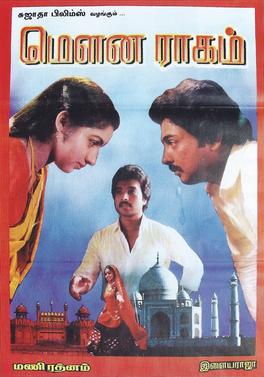
Mouna Ragam (1986)

Mouna Ragam

If you’re in the mood for a classic love story with just a touch of mushy sentimentality, you can’t really go past Mouna Ragam. Mani Ratnam’s beautiful 1986 film takes an arranged marriage between a compliant groom and a reluctant bride as the starting point for a look at relationships and how two strangers can learn to live with each other. It’s well worth watching for the excellent performances from the main leads, Mohan, Revathi and Karthik, but also for the simple but effective storyline and wonderful music.

The story follows Divya (Revathi) a fairly happy-go-lucky student whose world is shattered when her family arranges her marriage. The groom is Chandrakumar (Mohan) and even though Divya lists all her worst qualities on their uncomfortable first meeting, Chandra likes her honesty and decides that she will be the perfect wife for him. The opening scenes add to the realistic feel of the film as they illustrate just how young Divya is, playing tricks on her older sister and husband, and showing her simplistic and childish ideas to counteract the unwelcome marriage proposal. However, against all her objections, Divya is pressured into the wedding by that age-old family drama – a threatened heart attack / medical collapse. Divya is just as susceptible as every other film heroine and without further ado her husband whisks her off to a new life in Delhi.

The relationship is shown as difficult right from the start. As Chandrakumar shows Divya around his house in Delhi after the wedding, Divya’s body language makes it obvious that she doesn’t want to be there, while Chandrakumar is clearly feeling the hostile vibes but trying to be as welcoming as possible. This awkwardness seems exactly what I would expect from two strangers suddenly having to live together and Mani Ratnam has captured their uneasiness perfectly. I don’t know, never having been through it, but this seems to be a plausible reaction to the abrupt intimacy between two people who have only just met. It’s thought-provoking and one of the things I love about the film, that just a few moments can invoke such a complicated emotional response from me.

Despite her classy new abode, which is a world away in size and conveniences from her family home, Divya is very unhappy with her marriage. So much so that when asked what she would like most from her new husband, her immediate answer is a divorce. This is a pivotal scene and it’s beautifully played out by Mohan and Revathi. Chandrakumar’s shock and hurt are palpable while Divya appears to be no more than a sulky school girl trying to be as obnoxious as possible.  Needless to say as a rejection it works well, and since she follows it up with more nasty remarks it’s to his credit that Chandrakumar manages to keep his cool. This is the turning point of the film for me with Chandrakumar’s character partly due to his emotional responses (which make me feel sorry for him), and partly because he shows more personality in interactions with his work colleagues. It’s an important change since up until this point he’s fairly bland and unexciting, making Divya’s reluctance to go through with the marriage relatively understandable. But Chandrakumar seems a good catch. He’s got a good job, a nice house and is considerate and understanding, particularly when faced with Divya’s immature taunts. With just a few simple scenes, Mani Ratnam turns the story around, and suddenly it’s Divya’s reactions and inability to make the best of things that become difficult to understand and instead of wanting her to get divorced, I want Divya to fall in love with Chandrakumar and be happy in her marriage.

Eventually Chandrakumar asks Divya exactly why she is so against the idea of their marriage (possibly something he should have done before the wedding), and she tells him about her first love Manohar (Karthik), who was killed just as they were about to get married. The story of Manohar and Divya is told in flashback and although Karthik only has a small role, he’s an excellent romantic partner for Revathi and the two share great chemistry together.  The difference between the two relationships stands out clearly. Divya and Manohar have a light and happy relationship, their scenes together are full of life and there is a sense of energy that is missing between Divya and Chandrakumar. Karthik is very appealing here as the quintessential ‘bad boy’ who is of course not really bad at all. However, while the romance is well told and Divya with Manohar is happier and nicer person, she also seems quite mature, which seems at odds with her juvenile responses to Chandrakumar, and her earlier carefree attitude as a student.

In the face of such strong contempt from Divya, Chandrakumar tries to arrange a divorce, but the law states that the couple has to be together for a year before they can apply. Naturally over this time Divya comes to see the good side of Chandrakumar and slowly develops feelings for him, while Chandrakumar gets a little of his own back by throwing her earlier remarks back at her and ignoring her attempts to be more friendly. This being a Tamil film it’s not guaranteed that there will be a happy ending, and the developing relationship is compelling viewing as the deadline for the divorce looms.

There is so much to enjoy here. Revathi is excellent in her role as Divya and her self-realisation and development of maturity is captivating. Initially she lets her emotions track across her face just like any young girl and her petulance and hostility is perfectly nasty. Just think of how obnoxious any group of schoolgirls can be – that is exactly what Mani Ratnam has captured here. With Divya’s slow acceptance of her husband there is a softening of her expressions, and when the realisation of what she has done sinks in there is maturity in her actions too. However she is still a young girl at heart, as shown by the tricks she plays on the driver Sanjit Singh. I love the way Mani Ratnam emphasizes her isolation by moving the couple to Delhi where Divya cannot understand the language and is confused by the cultural differences. It adds to the problems she has and ensures that she has to resolve her problems by herself. There is no convenient family or friend to help her, although the lack of interference from Chandrakumar’s family is a little surprising.

Mohan is just as good and although his Chandrakumar initially seems too perfect to be true, he becomes more human and therefore more likeable in the second half. He does an excellent job of portraying a ‘nice guy’ and has just the right amount of revenge on Divya without becoming cruel or spiteful. He’s an ideal contrast to the passion of Karthik, and I kept thinking of the old proverb ‘still waters run deep’ when the camera focused on Chandrakumar’s patience and tolerance.

Although the story is nothing new it’s beautifully told using a simple style with well developed characters and situations. As an added bonus the music by Ilaiyaraaja is excellent and this song Nilaave Vaa, sung by SP Balasubrahmanyam is just beautiful.

Mouna Ragam rightly deserves to be called a classic and despite the fact that I know what is going to happen, I get drawn into the story every time. Each character is perfectly drawn, the actors all fit their roles easily and there is none of the overblown melodrama which usually infects similar love stories of the time.  It’s one of my favourite romances, and I thoroughly recommend watching. 5 stars.

I (2015)

poster

Shankar is a director who has proved in the past to have amazing vision and a seemingly unending wealth of imaginative ideas. Many of his previous films have been visually stunning with incredible effects and novel concepts, but he seems to have missed the mark somewhat with his latest movie I. He has the benefit of an excellent cast and a potentially interesting story, but somehow the sum of the whole is not as good as each individual part. The film has a few too many cringe-worthy moments to make me want to see it again although Vikram is superb, and Amy Jackson is also impressive despite a rather limited role. However their characters aren’t particularly likeable and the story meanders annoyingly along several inconsequential paths before finally reaching the predictable and cloyingly trite end. I’m not even going to complain about the dodgy medicine since there was so much else that bothered me more about the improbable and often distasteful screenplay, but the ‘science’ is just as far-fetched as the rest of the story. Really the only reason I can give to watch I is Vikram and his impressive ability to transform himself into just about anyone, and that’s not quite enough to justify the 3 hours plus of I.

The story revolves around Lingesan (Vikram), a body builder from the back streets whose ambition in life is to win the Mr India competition. Be warned, there is a lot of flexing and posing in the first half hour of the film, while Lingesan tries to win the Mr Tamil Nadu crown from a large number of other over-muscled and over-oiled men in very skimpy bathers. It’s quite impressive that Vikram managed to achieve this look, but it’s not attractive and I was much happier once he put his clothes back on and backed off on the oil. Unfortunately he doesn’t really stop the flexing and posing even when fully clothed.

There is also a ridiculous fight scene backstage at the Mr Tamil Nadu championships with Lingesan managing to fight off multiple opponents including his arch-rival Ravi (M. Kamaraj). Ravi is a much better contender for the title of Mr Tamil Nadu so it’s a little surprising that he takes Lingesan as an opponent so seriously, but at least there is a relatively valid reason for the ongoing enmity between the two men, even if it does seem unlikely.

Lingesan is also obsessed with model Diya (Amy Jackson) to the point where he purchases absolutely anything she has endorsed, and I do mean absolutely everything. It’s quite creepy initially but does move out of stalker territory once Diya and Lingesan meet and Lingesan starts behaving like a 13 year old besotted schoolboy instead. It’s not a lot better but at least it’s funnier. Santhanan provides the rest of the comedy as Lingesan’s brother Babu, and for the most part he’s reasonably amusing, although a comedy track really wasn’t needed given just how ridiculous the plot becomes in the second half of the film.

From body builder to model is apparently as simple as getting a haircut and shaving off a moustache and with that Lingesan transforms into successful model Lee on the basis of one ad campaign and a romance with his muse Diya. However to get to this point Lingesan has pissed off quite a few people including the obnoxiously sleazy model John (Upen Patel) who is furious at being foiled in his attempts to get Diya into bed. Diya’s transgender make-up artist Osma (Ojas Rajani) also falls in love with Lingesan and is hurt and vengeful after his rather forceful rejection of her advances. John’s behavior is fairly gross but nothing unexpected for a masala movie, but the ‘romance’ between Osma and Lee is badly developed and feels more homophobic and derogatory than necessary. I can’t decide if Shankar was trying to be clever here and make a point about how the world views people who are transgender given that the film is based in the advertising world and uses image and ideals of beauty to develop the plot, or if this really was just a bad piece of writing, but it’s hard to watch whatever the reasoning.

Interspersed with the frothy romance are flashes to the present day where a hunched and grossly deformed Lingesan has kidnapped Diya on her wedding day, and the story gradually shifts to a tale of vengeance and medical improbability. Here at least the idea of image and beauty does get a little more developed although the masala element is still very much to the fore. Lingesan seeks revenge on the people who have caused his illness and as scientific reality goes out the window the story gets ever more ridiculous until the Beauty and Beast song seems quite normal and believable by comparison. It’s also a pleasant relief from all the disfigurement and maiming, although like other songs in the film it’s not well integrated into the narrative.

There are a number of more mundane inconsistencies such as the sudden turnaround in Diya’s treatment of hunchback Lingesan and Lingesan’s continued strength and agility given his deformed body. Not that any of the rest of it makes any more sense, but there is too much that is implausible and the story becomes too far-fetched to take seriously. However there are also far too many scenes where the people variously handicapped as a result of Lingesan’s revenge are ridiculed and mocked for their appearance and disability. It’s part of the plot sure – these are people who now look as ugly on the outside as they are on the inside, but I found this really quite shocking and abhorrent, particularly as it’s meant to be part of the comedy and is anything but funny.

This is definitely Vikram’s show and he does do an amazing job in portraying the two different faces of Lingesan.  Amy Jackson is much better than I expected, and the rest of the cast are all good given that they are all overshadowed by the powerhouse that is Vikram. The special effects by Weta Workshop are also very well done, and it’s such a shame that the story doesn’t come anywhere close to matching the visuals of the film. Of course it’s a story set in a world where image is all and appearance trumps substance at every stage so perhaps that’s not too surprising after all.