Goli Soda

goli-soda-poster

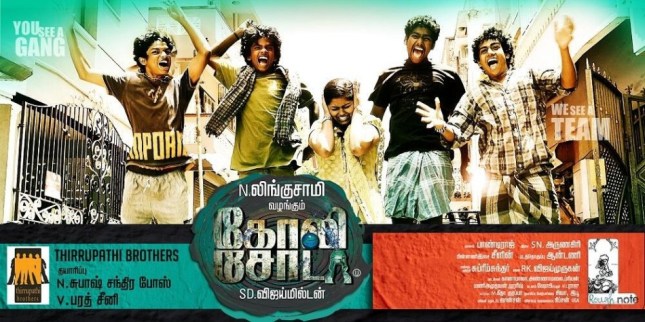
Goli Soda is a masala movie with a difference – there is the usual mixture of action, comedy and romance, but this time the protagonists are four adolescents from Koyambedu market in Chennai and the action mainly takes place within the confines of the marketplace. The four are all orphans who have grown up in Koyambedu and Goli Soda follows their struggle to discover their own identities and what happens when their livelihood and self-respect is threatened. While the scale of the story may be small, the theme of teenagers trying to fit in and develop their own self-worth is universal, even if most don’t have to face quite the same obstacles or start with quite so little. S.D. Vijay Milton’s film has engaging characters and an interesting and rather different story to tell, making Goli Soda well worth a watch.

Saetu (Sree Raam), Kuttimani (Murugesh), Pulli (Kishore) and Sitthappa (Pakoda Pandi) are all friends who live and work together in the market. They unload produce during the early hours of the morning, working for Aachi (Sujatha Sivakumar) who pays them according to the amount of bags they have carried into her business. The boys live rough in the market and spend the rest of their time running amuck, ogling the local girls on their way to school and wasting time with market porter Manthiravan (Imman Annachi). The relationship between the four is well depicted with the expected amount of teasing and banter in any group of young men, but there is also plenty of support for each other and together they form a tightly knit family. This is perfectly illustrated when they all share the same ‘best’ t-shirt to wear as they wave at their chosen girl from the safety of the building roof. Regardless of the fact that none of the girls can probably see exactly what they are wearing, they swap the t-shirt so that each feels he looks his best with the limited resources they have. It’s a brief moment but shows their easy camaraderie and how much they rely on each other.

When Aachi finds out that one of the girls they are chasing is her own daughter Yamini (Chandhini) she convinces the four that they ned to do something more with their lives and approaches market kingpin Naidu (Madhusudhan Rao) for a loan. Naidu gives them the use of an unused godown which the boys turn into a small restaurant, named Aachi’s mess in honour of their mentor. They are surprisingly successful too, and take everything very seriously, even down to selecting the right covering for their makeshift tables. They’re helped in their endeavours by Aachi and Yamini and also by Vanmathi (Seetha) another friend who has her own share of problems but manages to take a glass half full approach to life. However Vanmathi is quite committed to her philosophy of one plant, one flower in relationships and only being willing to help if it is definitely true love and not just time-pass!

Problems arise when Naidu’s brother-in-law Mayil (Vijay Murugan) starts to frequent Aachi’s mess, demanding alcohol and non-veg dishes, even spending the night there with his cronies. The subsequent fall-out when the boys turn on Mayil threatens Naidu’s hold over the market and it seems as if Saetu, Kuttimani, Pulli and Sitthappa will lose everything, including possibly their lives as they battle to hold on to the little they have. Aachi, Yamini and Vanmathi are also all affected and in a departure from the normal masala formula, the two girls end up taking part in the fights with Naidu’s men and help the boys in their campaign to regain their restaurant.

What Goli Soda does is take the usual masala issues of bad guys vs good guy and translate them into the world of four adolescents. Instead of land grabbing politicians and gangsters we get petty criminals who take over the boys’ space and take away their sense of self in the process. That space is important as it’s the first Saetu, Kuttimani, Pulli and Sitthappa have had that is theirs to do with as they please – or at least as much as they can in a rented shop. Their insistence on choosing the tablecloths and making tables and benches for the restaurant becomes significant as it’s the first time they have ever had any say in their surroundings. The restaurant becomes their space and defines how they appear to the rest of the market – they are no longer simply nameless coolies, but instead are Aachi’s mess boys.  The successful business confers a sense of self-worth they did not have before and makes each someone rather than just another orphan. Loss of their space means they are back to being nothing – and that’s not something they are going to let happen if at all possible.

The film has a number of fight scenes where the four adolescents take on Mayil and his gang. This could have been ridiculously unbelievable, although perhaps not any more so than in the usual mass film where the hero is able to fling villains around without too much effort, but the choreography here is better than that. There is a lot of slapping and basic survival tactics which makes it seem less incredible that the boys could take on grown men and not suffer horrendous injuries, while the casual brutality of the gang seems plausible. The story overall works as the boys are all typical young men with the usual wants and desires – new clothes to look cool in front of the girls for example, but they also have a sense of responsibility which comes from having something which is theirs alone. All the young actors are fantastic in their roles and each is completely believable – even down to the blubbering and pleading when they are first faced with the prospect of being beaten up by Mayil and his gang. Sujatha Sivakumar is also excellent in her role as Aachi, giving the boys a constant in their lives and imbuing discipline without losing their respect.

Although it’s a simple story, Goli Soda packs a lot into 2 hours. All the masala elements are there, but trimmed of any excess to suit the younger protagonists, making for a neat and crisp narrative that easily pulls the viewer into the world of Koyambedu market. The dialogue is fun, snappy and suits the characters while the documentary-style of the camera makes the scenes in the market feel very natural. Goli Soda is something just a little bit different and recommended viewing for a movie with a message that avoids being preachy or overly sentimental. 4 stars.

Theri (2016)


Theri Poster

After taking on the plight of farmers in Kaththi, Vijay tackles the topical issues of rape and violence against women in Atlee’s latest film Theri. The dash of social awareness is added in to a familiar story where a once tough and capable man is forced to live a quiet and peaceful existence after suffering a great loss, before being forced to take up the reins of his old life again. Sure, it’s predictable, but Atlee breathes a modicum of life into the well worn storyline and adds enough seasoning to ensure Theri is an engaging and entertaining enough watch.

The film opens with a nerdy Joseph Kuruvilla (Vijay) running a bakery in Kerala while looking after his young daughter Nivi (Baby Nainika). Rather incongruously he’s helped in his endeavours by Rajendran (Rajendran) who looks nothing at all like a baker, while Joseph’s unassuming persona seems very un-Vijay-like. However all is soon explained when the film moves into flashback mode to detail Joseph’s previous life as ruthless and efficient cop DCP Vijay Kumar and Rajendran as his driver.

Some years previously Vijay Kumar investigated the case of a gang-rape victim and took the law into his own hands when he found the culprit – the son of minister Vanamaamalai (J. Mahendran). In revenge, Vanamaamalai kills Vijay’s wife Mithra (Samantha) and his mother (Raadhika Sarathkumar), and believes he has killed Vijay and his daughter as well. However Vanamaamalai doesn’t follow the maxim that if you want something done properly you should do it yourself and Vijay escapes with his daughter to a life of anonymity in Kerala. Living as meek and mild-mannered Joseph Kuruvilla though doesn’t come naturally, so it’s no surprise that Vijay’s cover is blown and Vanamaamalai discovers the truth, leading to the inevitable final showdown between the two.

There is a lot that works well in Theri, but there are also a few aspects that don’t. Atlee has done a good job of revitalising the story, but there are few surprises and each step along the way is almost exactly as expected. However, there is a sweet romance between Vijay and Mithra which is well developed and doesn’t quite follow the usual conventions. Samantha too has a better role than most Tamil heroines, Mithra is more than just a decorative love interest and has an important part to play in the story. She has strong opinions of her own, and also commands her husband’s respect since it’s at her request that Vijay buries his desire for revenge and concentrates on ensuring his daughter’s well-being. One of my favourite scenes in the film is when Mithra has a conversation with Vijay’s mother which doesn’t involve the hero, or her wish to be a good wife/mother/daughter-in-law.  Although the content is overly emotional and it’s a very filmi moment, I like the way this scene makes Mithra her own person and not simply an extension of the hero. Samantha is excellent in her role, convincing even when she practically comes back from the dead to make her final plea to Vijay and as always she looks gorgeous throughout.

My biggest problem with the flashback sequence, and in fact the film in general, is the songs. They are particularly frustrating in the first half when they suddenly appear from nowhere and add no real value to the storyline. Not that the songs always have to move the story forward to be worthwhile, but here they have little impact other than to pause the action and don’t even have the benefit of a catchy tune or outstanding choreography to make their inclusion palatable. About the best thing I can say is that they are very colourful – very, very colourful in some cases, and Vijay is competent even if he doesn’t get the chance to bust out too many impressive moves. Eena Meena Teeka is a little better as Baby Nainika is very cute and along with Vijay she hams it up for the camera nicely, but I expect better from a Vijay film!

I have long suspected that Vijay has access to a time machine since as he is as young-looking as ever, even when gleefully bashing goons heads into various parts of a building, and impressively athletic in the action scenes. As Vijay Kumar he appears strong, confident and powerful, but allows a softer side to show during the romance scenes. However, he’s a little less successful as Joseph Kuruvilla, perhaps because docile Vijay seem to be against the natural order of things. He is good in the scenes with Baby Nainika and plays the part of a devoted father well, but very awkward with Amy Jackson in her role as Nivi’s school teacher. That may be because Amy herself looks incredibly ill at ease in a dreadful wig, while her character is so under-developed it takes some time to realise that there is actually a romance developing between the two! I can’t decide if Amy Jackson is just incredibly wooden here, or if her terrible portrayal is due to inadequate writing of her character, but whatever the reason this is the worst performance I’ve seen from her so far.

The support cast are all good. Baby Nainika is cute and appealing, without being too bratty when she demonstrates that she has a tough side too. Mahendran is great on the other side of the camera and is a credible adversary for Vijay, mainly because he is so very normal in every aspect. Like many rich men in politics, he has a sense of privilege and a belief that his wealth gives him a right to power and to do whatever he wants. He has no affectations or megalomaniacal schemes which makes him all the more chilling and a very plausible villain. I always feel a film is improved with the addition of some Rajendran and along with Vijay he provides most of the comedy in the film.

Although the story of Theri isn’t particularly original and Vijay as a cop is also nothing that hasn’t been seen many times before, there is enough action and drama to make the film an entertaining watch. The addition of a stronger female role in Mithra is a bonus and Atlee deserves praise for adding in a child actor without making her cloyingly sweet and too good to be true. The action scenes are all well shot and choreographed, and the film comes together well with a satisfying conclusion and well executed revenge. I would have preferred better songs and no romance with Nivi’s teacher but otherwise I enjoyed Theri and recommend watching for Vijay, Samantha and Mahendran.

Vasantha Maligai (1972)

Poster

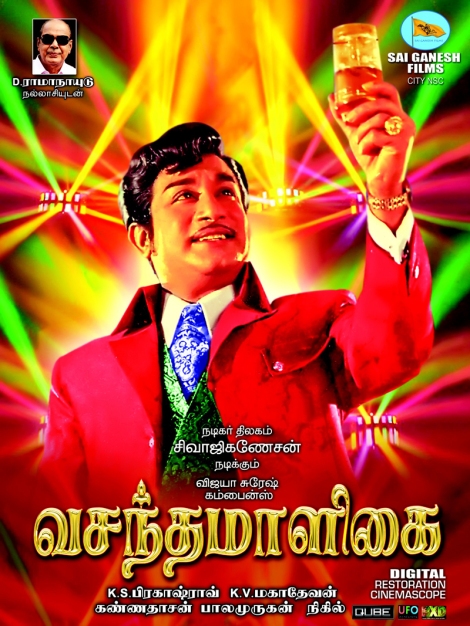
It’s been a while since I watched some seventies masala, and what better way to indulge than K.S. Prakash Rao’s wonderfully dramatic Vasantha Maligai. Sivaji Ganesan and Vanisri star in this adaptation of Koduri Kausalya Devi’s novel about a rich prince and his romance with a middle class woman working to support her family. Like all good masala films there is a dash of everything – romance, tragedy, filmi medicine, an evil overlord, oppressed villagers and even a comedy cook, but it’s the performances from the cast along with some beautiful songs that make Vasantha Maligai well worth a watch.

Anand (Sivaji Ganesan) is the alcoholic younger son of a royal family and the film opens with a song detailing his drunken antics on a plane where Latha (Vanisri) is working as an air hostess. The opening scenes focus on Anand with Latha merely a figure in the background concerned about fastening seatbelts when the plane hits turbulence, so it’s a surprise when the next scene shows Latha returning home to her family and attention moves to her situation. I like this way of building anticipation for the next meeting between the two, while providing the back story that establishes Latha’s character.

Latha is the main wage earner in the family as her brother (Sreekanth) is a wastrel and her father (Major Sundarrajan) is crippled from an accident. Her mother (Pandari Bai) is unhappy about Latha’s job and persuades her to look for something safer where she doesn’t have to risk life and limb in an aeroplane every day. However, Latha’s subsequent venture into employment turns out to be much more dangerous than her work as an air hostess and Anand returns to the story when he rescues Latha from her amorous new boss. Anand just happens to be grooving the night away in the same hotel celebrating his birthday party, and our hero is such a style icon that he even takes time during the ensuing fight scene to fix up his hair – such panache!

Despite his drunkenness and playboy appearance, Latha accepts a job as Anand’s personal secretary where her kind heart and overall decency start to have an effect on his behaviour. However Latha is also proud and her self-esteem leads her to appear arrogant, particularly when she clashes with Anand’s servant and drinking buddy Panchavarnam (Nagesh). Nagesh is determined to keep Anand drinking to ensure his own supply of grog, while Latha is equally determined to wean Anand off the demon drink and make him a useful member of society. In the end it’s Latha’s concern for his well being that starts to win Anand over but it’s not until he injures Latha during one of his drinking binges that he finally starts to mend his ways.

While Anand is intent on drinking himself into an early grave, his elder brother Vijay (K. Balaji) terrorises the local villagers who work on the estate. Vijay is a nasty piece of work and Balaji has a great demonic laugh and seems to be thoroughly enjoying his role as a brutal despot. His wife Vimala is equally evil and plots to get rid of Latha before she can redeem Anand, although whether this is to keep her husband in control of the estate or just because she is a horrible person is hard to decide. I’m not sure who the actress is playing Vimala but she has a great sneer and is wonderfully condescending in her attitude to just about everyone else although she does seem to care for her husband and child.

Her concern is valid since Anand secretly builds a wonderful palace for the woman he adores, although he refuses to name her until the building is complete – no surprises for who his secret love is, although he does win marks for the way he finally reveals his love.

I know tastes were different back in the seventies but even then surely this would be considered over the top pastel décor:

There are endless ornate pillars, arches, and latticework with tacky silver statues practically everywhere. The indoor pool has giant lotus flower fountains, and the room where Anand reveals the face of his true love is full of mirrors (expected) and revolving pillars (totally unexpected) that don’t seem to have any purpose whatsoever. And what else will they ever use this room for? Latha however is enraptured by the palace and the discovery that Anand loves her, ending up leaping through the gardens in true masala romance style in the gorgeous song Mayakkam Enna.

However there is still a long way to go before the end and Vimala and Vijay manage to turn Ananad against Latha, ultimately resulting in Anand becoming very ill. According to his doctor his cough and general malaise are caused by his sudden drop in alcohol consumption, and no-one ever mentions his chain smoking habit as a possible issue. Aah – the seventies – life was so much simpler back then – unless you were the heroine in a masala movie of course. Poor Latha has many more trials and setbacks to endure before true love wins out, and she has plenty of opportunity to practice her emoting skills while enduring gallons of fake tears. Although she does have the benefit of industrial strength no-run mascara to ensure her make-up stays perfect despite all the crying.

Sivaji Ganesan is perfect as the hero and makes the most of both his drunkenness and his illness later in the film. He spouts dramatic lines and clutches at his chest, a convenient pillar or a chair while gazing adoringly at his glass of brandy one minute, and then switches to amused indulgence as he watches Latha try to make him work the next. It’s not all just over the top drama either, he does have some moments where the subtle raise of an eyebrow is just as effective as his later histrionics and he manages to make his character more than just a typical rich playboy. Balaji too is effective in his role as the elder brother, although I would have liked to have seen a little more interaction between the two brothers.

Vanisri looks gorgeous and wears some stunningly beautiful saris that stand out, even in the opulent surroundings of the palace. She does wear a couple more than once too, which fits nicely with her character needing to work for a living. Her Latha is a determined young woman with plenty of attitude and no tolerance for bad behaviour. I like that even when she is distraught she still fights back and has no hesitation in saying what she thinks, no matter who she is speaking to. She has good chemistry with Sivaji Ganesan too, and the romance between the two works well despite the limited time they have together as a couple.  The support cast are all good too, with Nagesh a good fit as Anand’s upstart servant, although the comedy track between him and the cook (V.K. Ramaswamy) is rather less successful.

The songs by K.V. Mahadevan are beautiful and T.M. Soundararajan provides the voice for Anand, ensuring the songs are just as dramatic as the action.

The film looks gorgeous too – the colours of the fab costumes are vivid and bright, even in my unrestored copy and I love the seriously over the top décor of both palaces. The bar in the palace is as seedy as in any hotel, Anand’s bed is a glorious ornate version of a gondola, and I almost didn’t notice the stuffed animals in the main hallway with the enormous and imposing staircase taking centre stage. This is exactly what I want from my masala films – determined hero, tragic heroine, plenty of melodrama, beautiful costumes and sumptuous settings. Vasantha Maligai delivers on all fronts and is even more readily available now that the film has been digitally restored and re-released. Highly recommended. 4 stars.