Yennai Arindhaal

yennai-arindhaal-poster

Gautham Menon’s third and final instalment in his ‘police trilogy’ has a more complex and interesting storyline than the previous two films, although there is still plenty of action and more than a few thrills. This time Menon focuses more on relationships, using these to define top cop Sathyadev (Ajith) and his reactions to various events throughout his life. One of the most important is Sathyadev’s relationship with Victor (Arun Vijay), a thug who ends up running an illegal organ trade, and who has a significant history with Sathyadev. Gautham Menon plays with the similarities between the two men who seem polar opposites but in reality have much in common despite sitting on opposing sides of a thin line.  There is also his relationship with his step-daughter Eesha (Anikha Surendran),  Eesha’s mother Hemanika (Trisha Krishnan) and right at the start, his relationship with his father (Nasser) whose murder is the starting point for that thin line.

The film starts by introducing Thenmozhi (Anushka Shetty), a smart modern woman who works as a software engineer. On a flight back from Boston to visit her sister, Thenmozhi ends up sitting beside a man she describes as the most gorgeous she has ever seen, but since she spends most of the flight vomiting into a sick bag it isn’t the most auspicious of meetings.  Her flight companion is Sathyadev, who is there to protect Thenmozhi from a kidnap attempt from the gang of organ thieves, although she doesn’t discover this until later. Somehow Thenmozhi’s heart has been identified as a perfect match for one of the gang’s clientele and a team of dodgy doctors are ready and waiting to perform the surgery just as soon as they can get their hands on her. Sathyadev’s old rival Victor is leading the gang and the film moves into flashback mode to explain the enmity between the two men and Sathyadev’s involvement in the current case.

The flashback goes right back to the murder of Sathyadev’s father, a moment where he had to decide which path to follow and on which side of the line to fall. The possibilities were there – to become a gangster and seek revenge, or to become a police officer and seek justice. No prizes for guessing which way Sathyadev decided to go, or that the very next scene sees him in jail. Of course all is not as it seems. While inside, Sathyadev becomes friends with Victor and the two escape together allowing Victor to marry the love of his life Lisa (Parvathy Nair) and have a jolly good knees up at the wedding.

After Sathyadev reveals himself as a police officer who has only befriended Victor as a way to get to his boss Matthew (Stunt Selva), Victor is devastated at the double whammy of the betrayal and his bad judgement in trusting Sathyadev. Unfortunately Menon doesn’t spend much time establishing the character of Lisa, but from snippets later on, it’s clear that she is instrumental in much of Victor’s later actions and she has a passionate vendetta against Sathyadev. I really wanted to know more about Lisa and why she was so deeply involved in Victor’s wicked schemes, but she glossed over quickly and her motivation is sadly never explored. Victor too doesn’t get as much character development as I would have liked but since he is basically completely evil maybe there isn’t much else we needed to know. As the tension mounts and his schemes are thwarted by Sathyadev, Victor has a couple of excellent hissy fits that perfectly convey his frustration and anger. Although he doesn’t have much scope, Arun Vijay does a good job with the character of Victor and his screaming, spitting frustration boils off the screen in the final scenes.

Lisa is the love of Victor’s life, and as such is his greatest weakness. For Sathyadev, it’s Hemanika, a Bharatanatyam dancer he meets while working undercover as an auto driver. The romance between the two is sweet and develops slowly, allowing Sathyadev to show a more introspective and human side. Hemanika has a daughter, Eesha, and for all her modern outlook (divorced single mum) she’s strangely reluctant to believe that Sathyadev can really love another man’s daughter as his own. This part of the film is beautifully done and Trisha is superb as she expresses all of Hemanika’s hopes and fears for the relationship.  Her characterisation is subtle but effective and fits perfectly into this more emotive storyline.

Of course we know it’s not going to end well, and as events unfold Sathyadev is left to look after Eesha on his own. Rather than brushing this off as an inevitable consequence of the relationship and using Eesha purely as a bargaining tool against Sathyadev in the later scenes, Gautham Menon instead uses the developing relationship to give deeper insight into Sathyadev’s character. The way Sathya breaks the news of her mother’s death to Eesha is poignant and natural while the road trip the two take to allow Eesha to grieve for her mother is an excellent depiction of Sathyadev’s developing fatherhood, particularly when set against his memories of his own father. These two parts of the film, Sathyadev’s romance with Hemanika and the development of his relationship with Eesha are sweet and gentle and really should be out of place in a rough and tough cop drama, but their inclusion is perfectly done, and adds so much to Sathyadev’s characterisation that instead they feel essential to the story development. These are my favourite scenes in the film and Ajith is perhaps surprisingly good at showing this more tender side. I’m more used to his manic killer persona in films like Vedalam but he does an excellent job with a more introspective character here and is good at displaying compassion in his developing relationship with Eesha. Just as good is his frustration and helplessness as he tries to change to a desk job for her sake and realises he just can’t continue as a police officer if he wants to keep Eesha safe.

Perhaps the only misstep in the film is the character of Thenmozhi . Although she starts off as a strong and independent character, once she meets Sathyadev she seems to lose all reason and self-respect, propositioning him despite overhearing what appeared to be an intimate conversation he had with someone else. As the film progresses she becomes more and more of a doormat and seems to lose all of her gumption as the threat to her life increases. Anushka does the best she can but her character is too much a victim to allow much sympathy for her plight.

Along with the mostly excellent characterisations, the more mass elements of the film are also well done. The fight choreography works well and there is a good mix of different styles – knife fights, good old fisticuffs and a number of gun battles. Stunt Selva has cameo as the gangster Matthew and Gautham Menon himself pops up as a police intelligence officer. The film looks stunning too, and the cinematography by Dan Macarthur (an Aussie – yay!) is excellent, particularly during the scenes with Eesha and Sathyadev travelling around India. Harris Jayaraj’s music works well too and is a perfect soundtrack for some of the most poignant moments in the film, such as Eesha showing Thenmozhi her mother’s picture and Sathyadev braiding Eesha’s hair before she goes to school. A word too about Anikha Surendran who is very good as Eesha and conveys many emotions throughout the film simply and easily and perfectly suits the role of Sathyadev’s adopted daughter.

Yennai Arindhaal shows just how good an action thriller can be when there is more to the story than just the action. The characterisations are excellent and provide motive and the reason for Sathyadev and Victor to act the way they do. There is so much happening in this film and yet it is still the story of a cop and a villain and a plan to illegally harvest organs. Well written, well acted and beautifully put together this is definitely one to savour. 4½ stars.
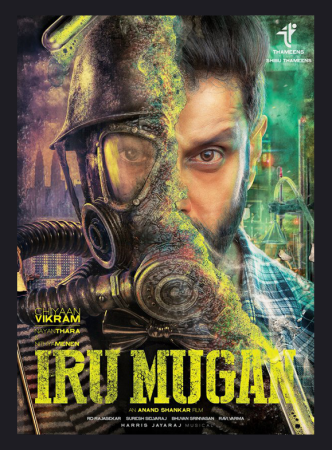
Iru Mugan

Iru Mugan.png

Vikram is on fine form playing a dual role in Anand Shankar’s latest action thriller, but the film is hampered by oddly placed songs, gaping plot holes and a meandering screenplay. There are some plus points – the action sequences are good, Nayanthara looks stunning and plays an interesting character, but none of it is quite enough to overcome the lack of suspense and surprising dullness of the storyline. Iru Mugan is a thriller without many thrills despite the best efforts of the cast, make-up department and stunt crew.

At least the start of the film is excellent. We see an old man queuing for a visa in the Indian Embassy in Malaysia, but rather than wait his turn, instead he uses a rather unique way of demanding attention. The result is classed as a terrorist attack against India and when the link is made between the pharmaceutically enhanced actions of the terrorist and über-villain Love, ex-RAW agent Akhilan Vinod (Vikram) is called back into service to discover exactly what is going on in Malaysia. Akhilan’s last action before he left RAW was to kill an illegal drug manufacturer by the name of Love (also Vikram), however Love is the chef suspect behind these latest attacks and Akhilan has a personal reason to find out if Love is really dead or not. Love was the man behind the death of Akhilan’s wife Meera (Nayanthara), although Akhilan has systematically slaughtered anyone else who was involved – hence the ‘retirement’ from active service.

Vikram’s Akhilan is a dour and haunted man with major anger management issues. He believes that violence is the answer to any problem no matter – whether he’s dealing with a suspect, a fellow agent or his boss. However, Malik (Nasser), head of RAW decides that his best option is to send Akhilan to Malaysia along with rookie agent Aayushi (Nithya Menen). So far so good, but Akhilan is the stereotypical ‘lone-wolf’ agent and displays every single hackneyed characteristic possible. Even worse, Aayushi is just as clichéd as a young inexperienced female agent. Her main role is to dress as a prostitute in order to get into a drug manufacturing lab. Really? That was the best option they could come up with? It’s trite, unoriginal and basically a complete waste of Nithya Menon’s acting skills.

Along with the frustration of watching a good actress in a badly written part, the first half suffers from a never-ending plague of flashbacks to Akhilan’s happier time with his wife. Unfortunately, these mainly occur as songs which act as effective speed breakers for the plot and completely destroy any tension that Anand Shankar has finally managed to build. The switch from drug labs and chemically enhanced violence to sundrenched beaches and Nayanthara in skimpy outfits is awkward and makes the film feel dated. Adding to this general late 90’s vibe is Thambi Ramaiah as a bumbling and inept Malaysian police officer and Riythvika as an exploited sex slave.

Vikram also plays the villain Love, a gay/transgender pharmacist who has managed to create a drug that gives superhuman strength and reaction time, but only for 5 minutes. Love is flamboyant and frequently feminine while maintaining his ruthless attitude and determination to cause mayhem with his invention. Although at the end of the day it’s the money that matters, selling the drug to terrorist organisations who will use it to attack governments worldwide is a bonus Love can’t pass up.

Despite all the clichés, it’s Vikram’s performance here as the two separate characters that makes Iru Mugan worth watching. The contrast between surly Akhilan and extravagantly ostentatious Love is excellent and although the two characters are somewhat extreme stereotypes, once both are together on-screen the deficiencies of each seems lessened. Perhaps this is where the ‘two faces’ of the titles comes in, since each character is ruthless in their own way and both are equally quick to jump to a lethal solution for any perceived problem. Nayanthara also makes an impression with her role as another RAW agent and does a good job with both her romantic and more action-orientated scenes, although her character would have better with just a little more depth. But then again Akhilan has very little backstory and Love even less, all of which adds to the scrappiness of the plot. It would have helped to have some idea how Love became such a genius pharmacist and why he decided to fuel international terrorism rather than turn his skills to more altruistic uses since there is a reason given for Akhilan’s excessive use of violence.

There are some more positives; the film looks slick and R.D. Rajasekhar makes the most of the Malaysian backdrop, both in the songs and for the chases through the city. Vikram’s transformation into Love is well done, and the fight choreography is impressive although it does get somewhat repetitive after a while. And although the placement could have been better and the picturisations a less abrupt change of pace, Harris Jayaraj’s songs are catchy and generally the soundtrack is good.

Overall Iru Mugan isn’t a terrible film, it’s just a lot duller than expected given the potential in the storyline. A drug that makes ordinary people into super-soldiers for 5 minutes should have made for a more exciting film than Anand Shankar ends up with here. Worth watching for Vikram, Nayanthara and the Malaysian backdrop, but go in prepared for the slow exposition and numerous plot holes.


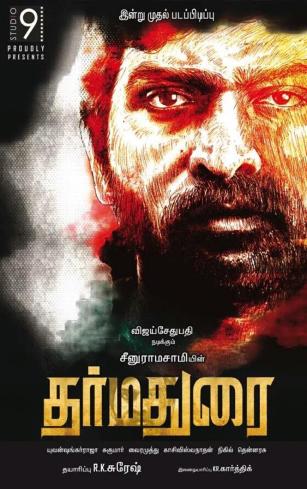
Dharma Durai (2016)

Dharma Durai poster

Seenu Ramasamy’s Dharma Durai tells the story of a doctor from a small village, his highs and lows and his final redemption through the love of a good woman – of course! The film has a slow start and even after the main character is established the pacing is occasionally uneven and erratic, but it has excellent performances from the main leads, a good story and plenty of thought provoking themes around social justice, caste, dowry and responsibility. However, it’s not as nearly as heavy as that sounds and even though the story is about an alcoholic, there are plenty of light hearted moments making the film an overall entertaining as well as a thought-provoking watch.

The film starts in the village where Dharma Durai (Vijay Sethupathi) roams around making a nuisance of himself, mainly to the embarrassment and general detriment of his brothers. Dharma is an alcoholic which explains his rather erratic behaviour, although it did take me a while to realise that alcohol addiction was the problem. It’s not immediately obvious and Vijay Sethupathi is subtle in his portrayal of a drunk, so it’s not until a village event that the full extent of his alcoholism is made clear.

Dharma accuses his brothers of cheating the villagers with the chit fund they run and seems intent on making life difficult for them, to the extent that I started to sympathise with the family, even though their method of dealing with Dharma is fairly extreme. The brothers decide to lock Dharma up in a shed until they can decide what to do with him, and the signs are clear that Dharma is not destined for a long and happy life. Dharma’s only well- wisher is his mother Pandiyamma (Radhika Sarathkumar) and in classic filmi style she arranges a way for him to escape his temporary prison.

Once he escapes the village, Dharma goes back to Madurai and the medical college where he had studied to become a doctor. The film moves into flashback as we relive Dharma’s years as a student and his romance with fellow student Stella (Srushti Dange). I would love to know if medical students in India really do wear white coats and stethoscopes round their necks all the time. It seems odd to me but at least means that they are easy to recognise as medical students rather than trainee engineers or something else entirely!

Dharma is a good student despite a tendency to spout poetry at the least provocation, and ultimately he follows his professor’s advice to return home and work for the village. After all, it’s the common people who have paid for his degree so he is morally obligated to go back and serve these people. The ethical message here is hammered home a little too much, and the students are all somewhat unnaturally altruistic, but overall the flashback is a pleasant interlude that shows Dharma is a much better light and starts to explain his past.

Back in the present day Dharma tries to track down his old friends – Stella and her friend Subhashini (Tamannaah) who also had an unrequited crush on Dharma. These were the last people he felt who really cared about him, and eventually he does manage to meet up with Subhashini and relates the series of events which led to him becoming an alcoholic.

This is the best part of the film and the flashback to the love story between Dharma and villager Anbuselvi (Aishwarya Rajesh) is beautifully done. Aishwarya is easily the best of the female leads and her characterisation of a farmer’s daughter is simply perfect. Anbuselvi is more than she first seems and it’s no surprise that Dharma is immediately smitten. Vijay and Aishwarya have wonderful onscreen chemistry and Sukumar’s excellent cinematography makes this golden time appear even more radiant as the two romance each other through song.

What makes Dharma Durai interesting is the clash between new and old. Dharma is college educated but comes back to his old village to work as he feels that is his duty. But once back at home, his modern ideas don’t sit well with his brothers’ ideas of caste and dowry and that leads to the serious conflict between them. There is also the contrast between Dharma’s old love – the beautiful and traditional Anbuselvi, and his new romance with the more modern and well educated Subhashini. Subhashini has a shiny new medical clinic of her own, but also has an ex-husband to deal with and her own share of past issues that make it difficult for her to reach out to Dharma. The only real downside to the story is the contrived and unlikely method that Seenu Ramasamy uses to get Dharma back to the village at the end. It’s all a little too far-fetched and unlikely, but why should we let any of that get in the way of a good ending!

One other issue is that the story has a few too many stops and starts as it moves from one portion of Dharma’s life to the next and as a result not all the scenes flow smoothly. The moral messages tend to be over-emphasised which also slow down the narrative and move attention away from the characters. However, once the camera is focusing on Dharma and Anbuselvi, or Dharma and Subhashini the film comes alive again and draws us back into the story. Vijay Sethupathi is wonderful throughout, and his Dharma is the absolute essence of a village boy done good for most of the film. Tamannaah is also excellent as Subhashini, although she doesn’t click quite as well with Vijay as Aishwarya, but her depiction of a career woman with a very definite set of values is nicely done. Radhika Sarathkumar is very good as Dharma’s long suffering mother while Rajesh makes a brief but notable appearance as the college professor. The portrayal of village life and a rural clinic is also very well done – I’m sure that I have seen many of those patients in my trips into rural Tamil Nadu on a health camp each year, which probably adds to the whole authentic vibe I got from the film.

Dharma Durai is an interesting story that just needs a little tighter editing to move proceedings along more consistently. The songs are good, the cinematography excellent and both Vijay Sethupathi and Aishwarya Rajesh are on top form, making a perfect match. Worth watching for their performances and for Tamannaah Bhatia and the rest of the cast who all do their part in bringing this fascinating slice of village melodrama to life.