Sye

The first half of Sye is director SS Rajamouli’s take on West Side Story – except that instead of knives two rival college gangs fight it out on the rugby field in a reasonable facsimile of Rugby Union. There is romance but no Romeo and Juliet inspired tragedy and by the second half the film has morphed into a fairly standard sports film, underdogs and inspirational speech included. Sye is Rajamouli’s third film and was another hit, proving that no matter what the subject matter he manages to tell a good story.

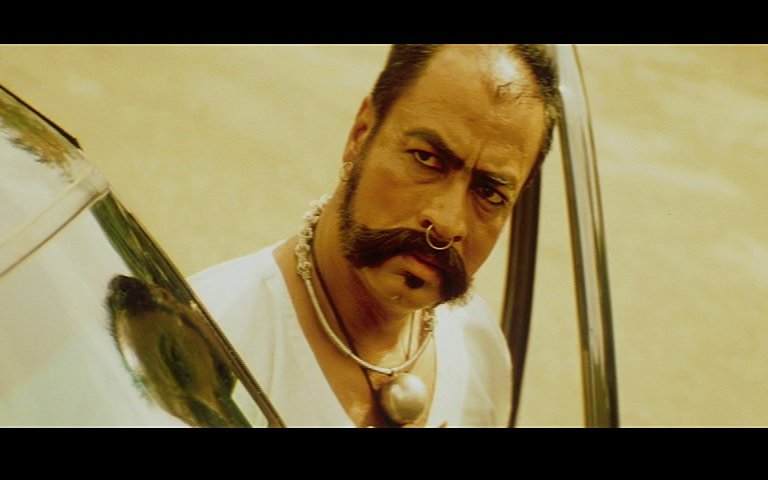
The film begins with a very violent over throw of local don Narayana by Bikshu Yadhav; the wonderfully evil Pradeep Rawat in totally over-the-top villain mode.  This all becomes very relevant later on, but initially seems quite disconnected from what follows. As a bonus though, there is Ajay as one of the gang.
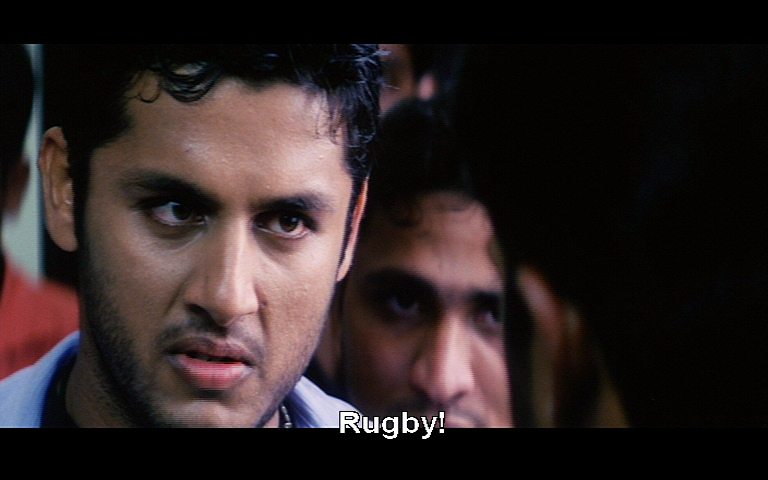
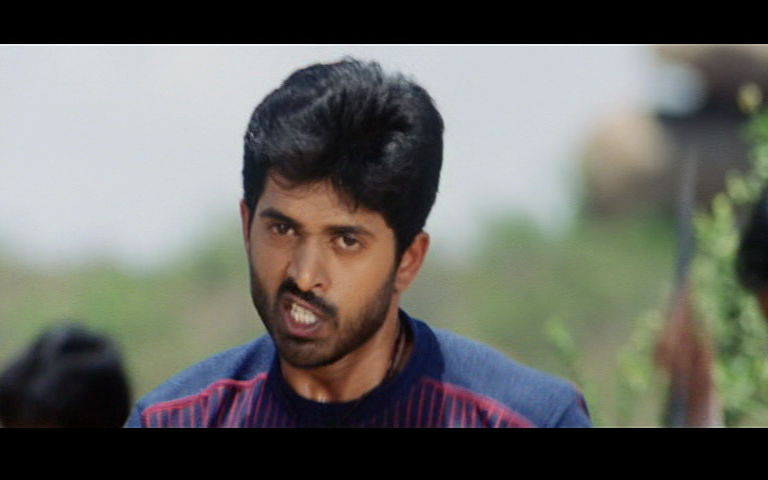
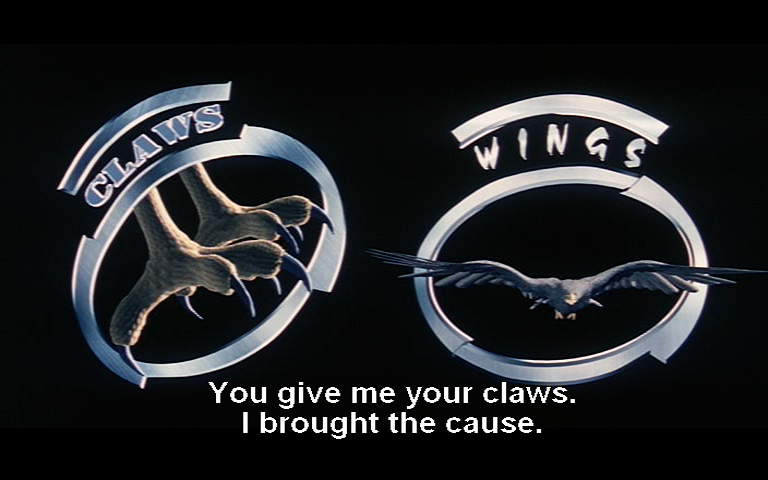
Next we move on to the MK College of Arts and Sciences or, as the film helpfully points out, Arts vs. Sciences. The college is split into two factions; one led by the son of the headmaster, Prithvi (Nitin)and the other by Shashank (Shashank). Science students have taken on the name of Wings and are self-confessed less disciplined than the Arts students: the Claws. I thought this was a little strange as most science students in my experience tend to be the nerdy conformist types – terrible generalisation I know but I was a science student which probably explains a lot! The hero Prithvi and his rival Shashank do a lot of taunting and grimacing at each other but there is very little actual violence – everything is settled on the rugby pitch.
Genelia plays Indu, an Arts student who acts as another point of contention between Prithvi and Shashank. Her introduction starts well enough as this rather cute song where the lyrics are made up of signs and posters Prithvi and Indu see along their route.

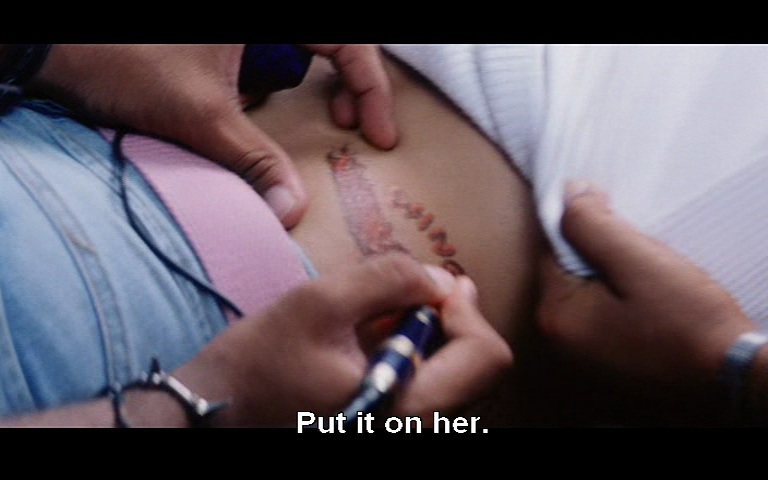
This pleasant introduction is totally ruined by the next scene which is probably the most ridiculous and stupid in the entire film. Getting onto the wrong bus, Indu is pursued and then forcibly tattooed by the rival Wings gang. Yes, tattooed! Never mind the difficulty of tattooing someone against their will when they are struggling, or that it would take more time than the few minutes shown to actual achieve such an intricate design, but then this act of outrage is NEVER MENTIONED AGAIN!!!! This really bothered me as I just couldn’t see that something as permanent and potentially disfiguring as a tattoo wouldn’t cause more of a reaction, but it didn’t seem to bother Indu much at all.
Moving quickly on, since everyone else in the film does, the two gangs take their rivalry onto the rugby field which is where I had my next ‘what the?’ moment. Now I’m a big fan of Rugby Union. It was the sport of choice for the guys at my school in Northern Ireland and I grew up watching the game. My husband also played for many years and it’s still my favourite sport, which was one of the reasons why I wanted to watch this film. But in all my years of watching Union games, I have never seen anything like the scoring system used here. Unless there is a strange form of the game in India (which I really do doubt), I suspect Rajamouli totally made it up. The rest of the game however did seem to mainly follow the usual rules and was fun to watch.

In another plot point that is never totally resolved, the headmaster Satyam pits the two gangs against each other to develop land behind the school as a rugby field, telling them that he will name the ground for whoever finishes first. They must have both finished together as the ground seems to end up as the MK Arts and Colleges ground. Despite Satyam’s good intentions, this accomplishment doesn’t manage to unite the two sides and with Indu rapidly becoming a bone of contention between the two gang leaders, the situation deteriorates further.  I’m not entirely sure why Nitin is wearing a vest underneath a see-through shirt here, but it really doesn’t work. Especially not with the puffy sleeves and a cap.

It all culminates in a huge fight between the two sides which the police try unsuccessfully to break up. Strangely they are about to do this by firing at the limbs of people in the crowd. Really? Whatever happened to other perhaps less potentially fatal options like water cannons or tear gas? Anyway, they don’t get the chance, as Bikshu Yadav (remember him?) shows up asserting his rights to the land, in a rather skilful display of coordinated 4-wheel drive manoeuvring.

It’s never very clear exactly why Bikshu Yadav wants this land so much, but he tortures and kills the legal owner to get it. There is a very unpleasant scene where he threatens a pregnant woman, which was really quite nauseating, but thankfully threats is as far as he goes.

The appearance of an enemy finally gets the Wings and Claws start to work together. You add together wings and claws, and you get Eagles – of course!
Rather sensibly advised by Prithvi, the Eagles decide to fight their enemy by subterfuge rather than by direct opposition. They use a variety of techniques to ruin his drug and alcohol businesses, derail his political career and even manage to stop his nights of passion with his mistress.

However they are too clever for their own good and are ratted out to Bikshu Yadav  by Venu Madhav, who appears periodically throughout the film in a rather silly comedy role. This leads to a final show down rugby match which is attended by a huge crowd and is also televised. Not only that but they even have a third umpire and there’s even a hakka. I loved the drums and team mascot for the Bulls and the half-time inspirational speech by the Eagles coach. Even if it was a mish-mash from the classics, political speeches and other sporting films – but then again aren’t they all?

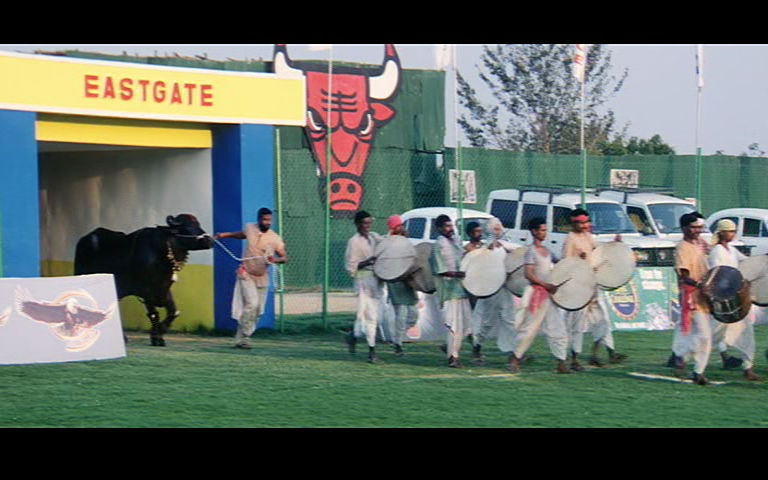
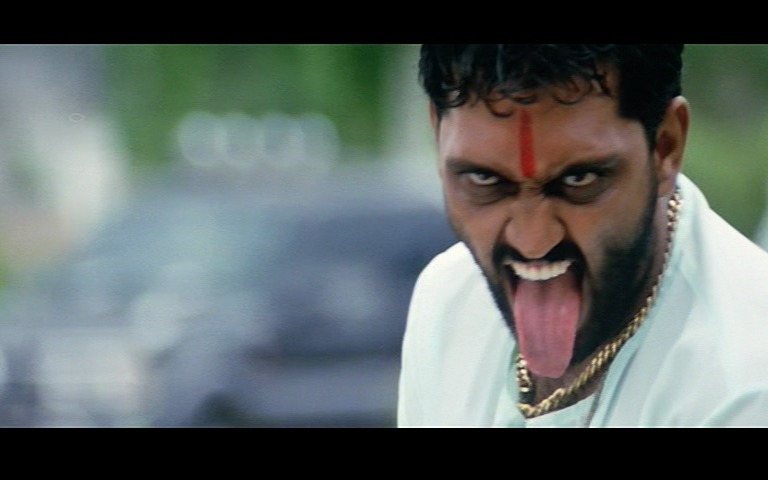
The film improves a lot in the second half where there are fewer totally ridiculous moments, and the story is more engaging. There are some clever ideas but overall the film is quite patchy and jumps around between the two different themes. The violence perpetrated by Bikshu Yadav is an abrupt contrast to the college story and for me this keeps disrupting the flow. Genelia really doesn’t have much to do in this film other than be the love interest and the reason for the two gangs to finally fight it out. Her character is annoyingly complacent with the antics of Prithvi and Shashank and finally is almost totally sidelined in the second half of the film. Nitin and Shashank do well as the two college kids, but are totally overshadowed by Pradeep Rawat who revels in as much violence as possible. I am a fan of Ajay and I love to see him turn up as one of the villains, since he always seems to be having such a great time being one of the bad guys. The various actors playing the students do a good job of creating a typical college atmosphere and stalwarts of Telugu cinema Tanikella Bharani and Nassar provide good support for the younger cast.  I was somewhat surprised that one of the songs Chantaina Bujjaina is a remix of the classic Hindi song Duniya Mein Logon Ko from Apna Desh but it didn’t work here quite as well as it might have.

Overall Sye is not a bad film, but it’s not a particularly good film either. Worth watching for the final rugby game which really is the high point and just bumps the film up to 3 stars for me.

Temple says:

I didn’t see any West Side story qualities in Sye, just a bunch of college boys with nothing better to do. Had there been stronger dramatic tension or real animosity between the school factions in the first half this would have been a better film. The rivalry between Arts & Sciences was childish and not terribly interesting as basically, the group members were pretty interchangeable. And to Heather’s point about the Science geeks being the quiet good kids…well, I was an Arts student and the Engineering parties at Melbourne Uni back in the day were legendary. The first half meandered from silly pranks to macho posturing and back again. It wasn’t until the rowdies became the common enemy uniting the college that there was any drama.

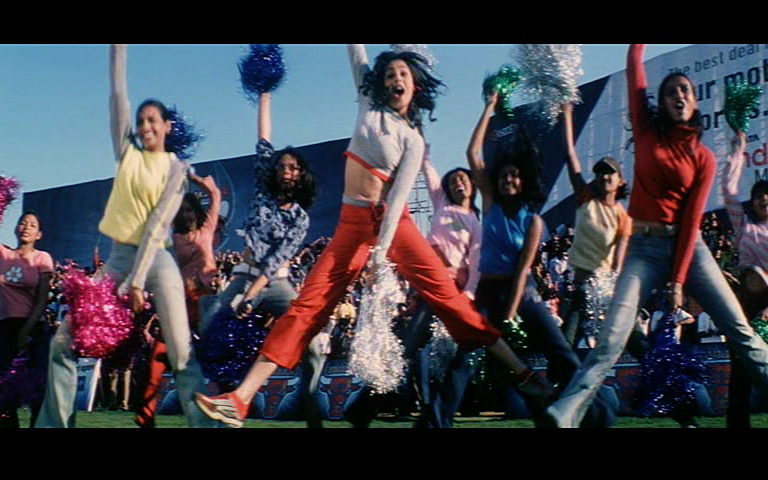
One of many problems I had with Indu’s character was  the supposed love triangle. It didn’t work as Shashank and Prithvi were pretty much the same so it didn’t matter which one got the girl. I actually really liked Genelia’s performance in this – Indu was energetic and engaging, not crazy bubbly. And she tried to dance which is always fun. Unfortunately her character is one of the most stupid I have ever endured. I was glad when Indu stuck to cheerleading in the second half as I was in danger of tearing an eye-rolling muscle. Prithvi constantly tricked her into inappropriate behaviour and it made me dislike the pair of them intensely (her for being so dumb and him for being an arsehole). Nitin and Shashank were, as I said, virtually the same in terms of their characters. Neither of them really stood out, apart from Nitin’s hideous song outfits. Certainly when Pradeep Rawat is in full throttle, I think you need a hero with a bit more testosterone.

And back to the dancing – a friend of ours once tried to teach a dance step with the instruction ‘sit into it lower and try and move like a really sexy duck’. I think perhaps someone said the same to Genelia in the ‘Duniya Mein’ remake but it turned out more funky chicken than sexy duck. I will never forget the look on Jag’s face when she saw the results and I think the choreographer for this may have felt a bit the same.

I have issues with a rugby try that was clearly not a try (especially when it is called a touchdown and is under the Chicago Bulls basketball team logo), as well as the bizarre scoring and some other things which were at odds with the bits they got right. I guess a proper college team played most of the games, which did make it more enjoyable and realistic, although the actors’ rugby scenes were noticeably less believable. The haka was both impressive and so very wrong.

Despite the woeful story Rajamouli has an eye for great set shots and action sequences, and really understands the tempo of a story. This was surprisingly enjoyable at times, but the good bits are few and far between. I give this 2 ½ stars.

Chatrapathi

There are three reasons that we ended up watching this film. It’s an S.S Rajamouli creation. It was name checked in the opening sequence of Desamuduru. The other was a throwaway remark by our good friend The Mahesh Fan: “Once you’ve seen Prabhas fight the CGI shark there’s not much else to it.” And she said that like it was a bad thing! We ordered the DVD immediately.

The film is a familiar ‘hero looking for lost mother’ tale intertwined with a search for social justice and a jealous half brother to flesh out the storyline.  Some time is spent setting up the back story for hero Shivaji (Prabhas). Separated from his doting step-mother and jealous step-brother after fleeing Sri Lanka, he and the other men who made it across the sea are working as bonded labourers to a local thug Baji Rao. By the time young Shivaji has grown all the way up into rather lanky Prabhas, apathy born of despair seems to be well entrenched into the refugees.  Inspired by his mother’s stories of the heroic Chatrapathi and traumatised by the brutality inflicted by the strong on the weak, Shivaji is truthful, defends the innocent and has never given up on finding his family. He also has a shell necklace given to him by his mother. This will become Very Significant.

But it’s the shark scene we were hanging out for! We applaud Rajamouli’s dedication to the CGI predators in his films. It really is fabulous, and this shark is a scene stealer. It growls!


This very silly episode gives Prabhas a highly memorable heroic entrance scene. It sets Shivaji up as resourceful, capable, tough, resilient and with exceptional lung capacity.

Life is cheap in this refugee settlement, and Katraj (Baji Rao’s man) rules the roost. The level of violence, both implied and actual and especially against women and children is very confronting. It does serve to illustrate the inhumanity of the thugs in charge, the general lack of support for the under classes and most importantly for a film of this type, it allows the hero to arise from the masses. The sight of a child lying near death as people watch on is not easy to view as a light entertainment.

The romantic interest, Neelu played by Shriya, works at a local government office and after some supposedly comic misunderstandings (she thought they thought she was a prostitute, puns on the words “repu” meaning tomorrow and “rape”) locates the necessary file but not the actual address of the missing mother.  Unknown to Shivaji, his mother and brother are alive and well and not far away. And his brother Ashok still doesn’t like him one little bit. Romance blooms. More rape jokes and sadism pranks ensue. And Bhardam, Shivaji’s oldest friend on the settlement and the voice of caution and moderation is killed.

Corruption and rowdyism are the bane of Shivaji’s people and the film takes a darker note when he becomes a popular leader and takes up the ruthless methods of the people he wants to displace.


The fight scenes are brutal and gory, leaving nothing to the imagination. The violence is cartoonish and unreal but still seriously dark. He takes to kidnapping, extortion, bombs and guns with no hesitation. The shocking end to a confrontation with his brother Ashok then propels the story into a final escalation of score-settling.


Neelu and Shivaji’s friends disappear into the background of the story, often appearing as silhouettes or blurry figures as the second half of the film is pure Prabhas revenge-o-drama. The machinations of Ashok continue to drive some truly bizarre behaviour and Shivaji is no closer to regaining the love of his mother. Baji Rao’s brother muscles in on the action to become the new face of evil and gives Shivaji another enemy to fight.  The final scenes include a travelogue of Hyderabad’s temples and a catalogue of lies, tears and betrayals before things go up in flames. Literally.

In the nick of time, Shivaji’s mother recognises the Very Significant shell necklace. Everyone who is still alive at the end of the film gets the life they deserve.

The fight scenes are beautifully choreographed and filmed, but may be too bloody for some tastes. The same care was given to the songs but Prabhas is not as comfortable dancing as he is in stunts and fights. The camera work in all the action sequences was excellent and really conveyed a sense of an epic struggle between heroic and villainous forces.

The support cast were effective although very much in support. Ajay played his usual sidekick role, and had a bit more range as his character was both a thug and a caring older brother. Kamal Kamaraju was another of Shivaji’s inner circle but mostly just had to stand around looking cross. Venu Madhav was the comic relief and supplied a few laughs especially in his “Anniyan” skit. Shriya was typically girly and shrill as the heroine but also displayed some good comic flair and had a few scenes allowing her to be a bit feistier. The mother (Bhanu Priya) was an irritatingly passive and trusting character for the most part, although conveyed the anguish over her sons very well. Ashok (Shafi) was a bit less successful in making his character seem at all real or memorable. He missed the mark on showing both the madness of twisted jealousy and the neediness of the overlooked son and just went for bug eyed, grimacing and grinning for comedic effect.


The soundtrack worked really well and suited both the drama and the performers. In particular, the Mumaith Khan item number was great fun and was tailor made for her. The backing cast and dancers all seemed to throw themselves into it with enthusiasm. The Chatrapathi chant that accompanied Shivaji added that element of mythical heroism, and suited the epic nature of the underlying themes.

Finally, a special shout out to whoever designed Prabhas’ outfits. We do want to know what they were on when they chose some of the shirts! It’s a bit cruel to put a tall lanky man in lolly pink and then make him dance like he means it.

Temple says: Chatrapathi is entertaining enough due to Rajamouli’s ability to make the most cliched story seem fresh and Prabhas’ likeable screen presence. The film is all his and it works most of the time. The story was secondary to the heroics and flexing, and the supporting characters were given little range. I am frequently bewildered by the White Queen style ability of a filmi mother to believe six impossible things before breakfast and this film continues that trend. Ashok’s character was a sketch rather than a fleshed out role and Shafi did what he could— but it felt like a missed opportunity as a bit more depth there would have added to the tension of the final scenes. I know Heather can’t stand Shriya but I think the heroine roles are generally written as irritating air-heads so I try to make allowances . On my personal scale of how annoying was Shriya? this is one of her least irritating roles (perhaps as there was no stupid meringue hair). I quite like the soundtrack and the songs were highlights as they were often a respite from the gore and gunshots.  Mumaith Khan is a favourite as she always looks like she is having such a great time and is totally in on the joke. I love that the South Indian heroes know that they can’t avoid dancing so regardless of their comfort levels, they just do it. I always giggle at the sight of Mahesh Babu in a lunghi (something about those long skinny pale legs) and now I can add Prabhas to the list of men who should stick to wearing trousers please!

This isn’t a film I will re-watch over and over, although the shark fight was on high rotation for a while. There was something endearingly Parvarish-like about the special effects in that scene, and I love that Rajamouli had his shark snarling, snapping and almost literally chewing the scenery. I give this 3 and 1/2 stars.

Heather says: Prabhas is a hero very much in the style of early Amitabh Bachchan in this film.  He is the ‘angry young man’ who is searching for his mother and will let no obstacle stand in his way.  Unlike Amitabh though, he makes a fair attempt at dancing!   In the first half of the film Shivaji is truly the hero with his drive to always do the right thing, and of course his constant search for his step-mother.  His switch from the hero of the docks to violent thug is quite abrupt and rather confronting, and he seems to be almost a  different character.  I did enjoy Ajay’s slightly more sensitive role here, and I like the way that both young Shivaji and the grown up version had the same mannerisms.  There really should have been no need for an identifying significant necklace!  This film also has one of my favourite lines, at least according to the subtitles: ‘trust your whiskers’!

Shriya is still not my preferred actress – there is just something about her that irritates, and I was quite relieved when her character was sidelined in the second half of the film. On the other hand, I thoroughly enjoyed Shafi’s characterisation of the jealous step-brother Ashok.  Especially when he has some money and can indulge his terrible taste in clothes and become as obnoxious as he has clearly always wanted to be.  Overall I felt the story works well, providing there is some major suspension of disbelief that Shivaji couldn’t find his step-mother even though she lives close by! Plus there is that shark scene, which really is fantastic! 3 1/2 stars from me.

Yamadonga

And so we come to the third film in our “South Indian Cinema Induction Programme” – Yamadonga.
Yamadonga features enough gilt to dazzle even our well trained Bollywood eyes, demonic antics from Lord Yama and some fantastic and well choreographed fight scenes. This is a film from the same director as Magadheera, and SS Rajamouli certainly knows how to entertain. His stories are engaging and full of action. This is no exception!

Yamadonga also features NTR Jr, grandson of NTR and renowned as one of the best dancers in the business. NTR Jr although a fine figure of a man, somehow just does not look like a dancer despite his much vaunted weight loss and fitness regime of late. And then he just pulls some astonishing moves and we are left gasping and dumbfounded :‘how did he do that – that’s just not physically possible!’ His ability allows the choreographers to push their limits, and those of the poor backing dancers, in order to showcase the amazing technique of this star. His extensive classical dance training is evident in the balance and control he exhibits in both dance and fight choreography. He certainly seems to exemplify the current mould of South Indian Cinema leading men as an all dancing all fighting all action Hero.

The film starts with an amulet which has been blessed by Lord Narasimha and is given to the young Maheshwari, known as Mahi. She gives it to a boy she meets at the fair who appears to her as a prince on a flying horse when he rescues her from a broken merry-go-round. This is Raja, a thief even at this young age, who later tries to sell the amulet. On finding out it is worthless in monetary terms he throws it away, but it always makes its way back to him, in sometimes quite bizarre ways.

12 years later, the young girl is now treated as a servant by her grandfather’s family who have taken over the house and fortune left to her when he died. Raja is a con-artist and thief who stumbles across an attempt by Mahi’s family to eliminate her and assume total control of her fortune.

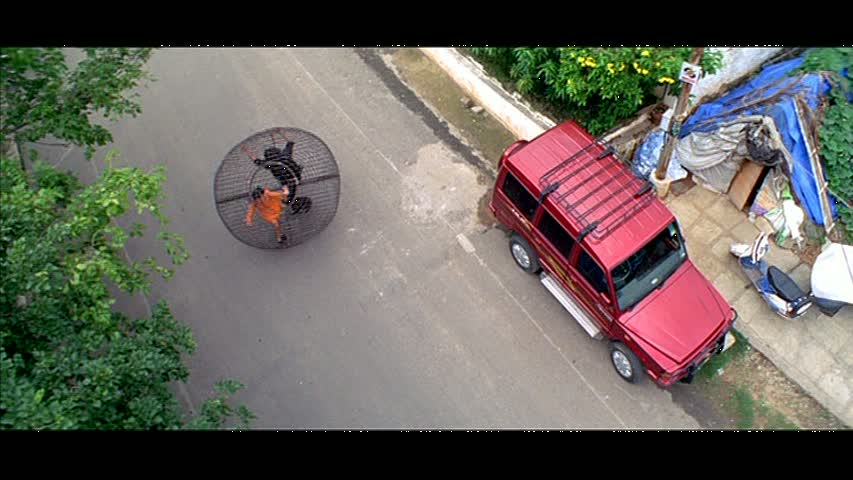
Raja and Mahi cross paths again when she is on the run from kidnappers (hired by her family) and mistakenly takes the dress Raja has been sent to steal. As he defends the dress (and incidentally Mahi) from the kidnappers, she once again sees a prince come to rescue her, but has no idea they have met before. Who else but Rajamouli would have his heroine hurtle around the street inside a gigantic wire ball, with the hero in pursuit battling goons, disrupting traffic and generally creating mayhem as he rescues her!

Raja tries to get rid of Mahi before he finds out that she is an heiress, whereupon he changes tactics and tries to ransom her to the family who really don’t want her back. Earlier, following a failed heist, Raja and his friend Sathi ended up drunkenly abusing Lord Yama, who overheard (of course he overheard – he’s a God!) took offence, and decided to arrange for Raja’s death. Once in Yamaloka (or Heaven as our subtitles call it) Raja manages to create havoc as he ends up in control of the realm. In order to get rid of him, Lord Yama has to return him to life. Things get even more complicated when Raja sees the truth and genuinely falls in love with Mahi, and Lord Yama comes to Earth to try and make Raja sin so that he will have to return to Heaven. There are many twists and turns with some great dancing and inspired fight scenes before Raja finally gets the girl and she gets her prince!

The movie does drag a little before the intermission when Raja is in Heaven. This whole sequence could have been shortened in our opinion without losing any of the story. However it does allow for a couple of great dance sequences and a chance for yet more gold and sparkle.

The dance scenes are a real highlight of this film. NTR Jr is a beautiful dancer and SS Rajamouli has made very good use of his talents. There is even a picturisation cleverly worked to look as if NTR and NTR Jr are dancing together– an awesome idea, sadly not fully realised due to some pretty clunky CGI work in a couple of spots. Rajamouli’s team make excellent use of modern technology with the sweeping camerawork adding to the sense of speed and movement in the dances.

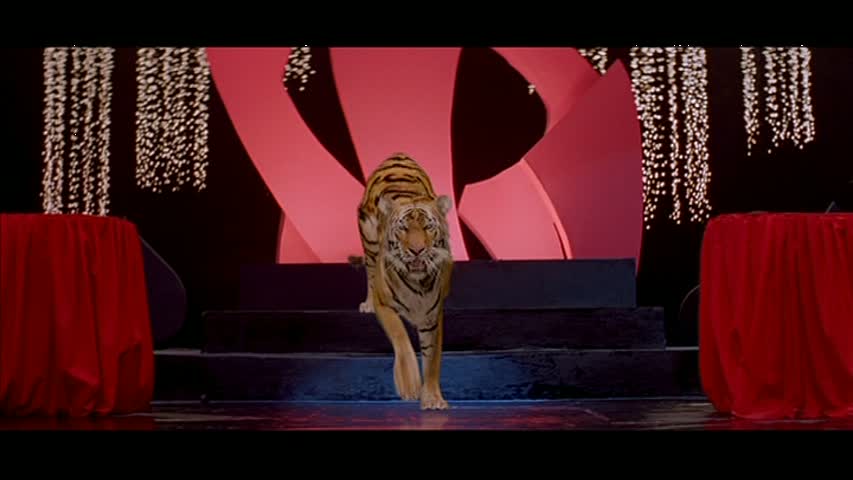
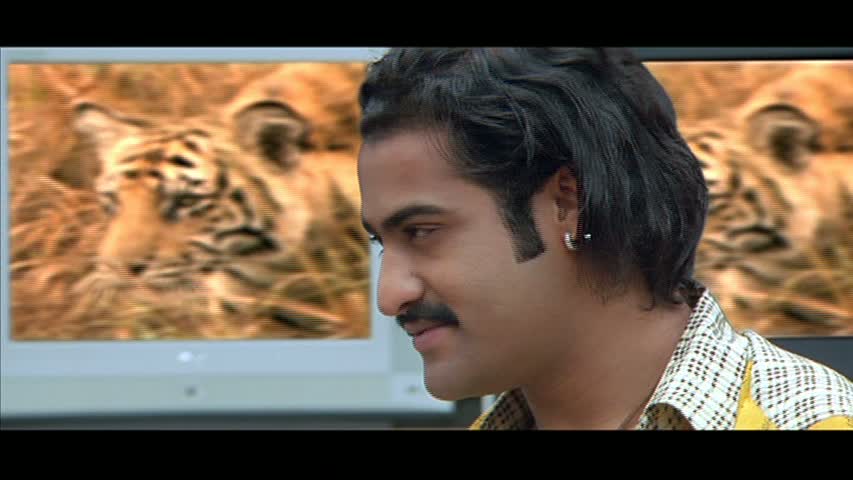
SS Rajamouli’s love of CGI tigers is shown again in one of the best filmi hero entrances when the tiger transforms into NTR Jr!

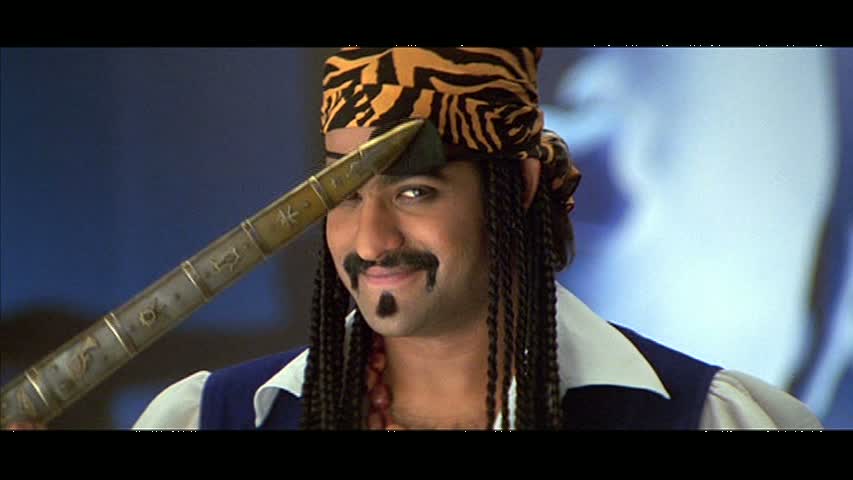
The tiger/leopard/big cat of your choice theme is used throughout the film:

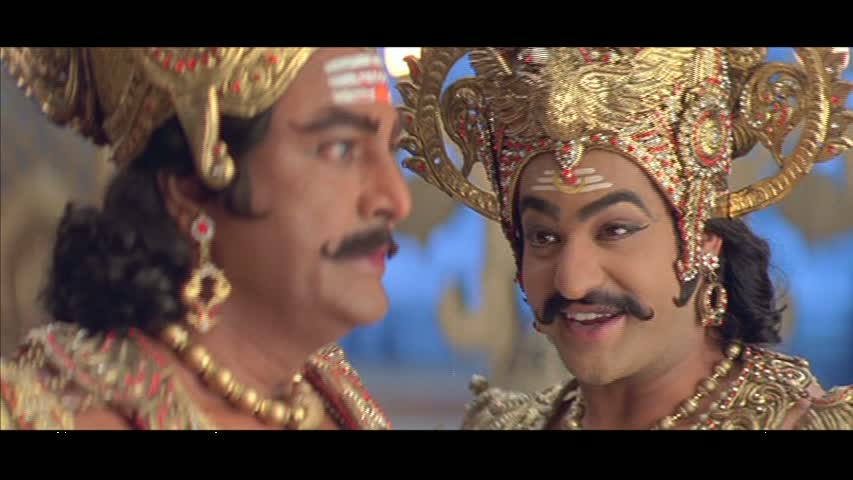
Heaven is wonderfully sparkly and golden, and you can imagine the artistic director just covering anything that didn’t move fast enough in gold paint. Lord Yama and Raja (when he is in Heaven) are fantastically costumed.

Priyamani as Mahi is beautifully moving as the girl badly treated by her abusive, grasping family and just joyous when she is falling in love with the oblivious Raja. She is an actress we will watch out for, after this and her pivotal performance in Ravanan. Mamta Mohandas makes the most of her role as the “other woman”, the scheming fence and loan shark Dhanalakshmi, and is great fun in scenes where Lord Yama assumes the form of Dhanalakshmi in order to tempt Raja. There are many clever visual and musical motifs recurring throughout the film, adding to the feeling of destiny at work.

Heather says: This is another fantastic film from Rajamouli. He really does know how to tell a story! This is also a great showcase for NTR Jr who combines his awesome dancing skills with some very good acting.  In particular his comedy is very well executed, and between Raja, Lord Yama and Chitraguptudu (nicely played by Brahmi) the comedy is very well integrated into the story.  Mahi’s character was also beautifully and sympathetically played by Priyamani.  Despite playing a downtrodden character for most of the film, she managed to show Mahi as capable of fighting back, and was excellent in her scenes with NTR Jr.  Also a word of praise for Mamta Mohandas who really was a delight to watch and did a fantastic job as Lord Yama pretending to be Dhanalakshmi.  This was the first NTR Jr film I watched and he totally blew me away with his dancing.  Needless to say I now have seen most of his films!  Yamadonga does tend to drag a little in the middle when they are in heaven, but the glorious costumes somewhat make up for the slower pace.  Overall an excellent film and I give this 4 1/2 stars.

Temple says: Yamadonga is a very engaging film, despite the flaws in pacing. I watched it again recently with a friend and it still keeps my attention. One major distraction for me was, I am somewhat ashamed to admit, the appalling hairstyle of NTR Jr. I don’t mind the long hair, but if you’re going to straighten your hair, do it properly! And that includes the back of your head! Anyway – apart from the unfortunate 70s era blow-waved Tarak, the rest of the film looked brilliant. Heaven looked so sparkly and fancy and rather like a Faberge egg – it was gorgeous and the attention to detail was lovely. I enjoyed little touches like Yamadharmaraja handing his mace to two soldiers who immediately buckle under the weight, and the cavalcade of NTR avatars. I really liked the wardrobe for the leading ladies too – the colours and fabrics looked great and seemed really appropriate for each character. The songs were a highlight, particularly for the dancing. Priyamani made a fantastic effort to keep up with NTR Jr and her energy was so appealing. On the downside, I really didn’t like Ali’s character in this film, and found his “comedy” track to be irritating. He is my least favourite Telugu comedian at this stage – perhaps because his characters are often a bit sleazy or negative. The film loses a star from me because of the draggy midsection and the really stupid tribal statue skit. I give this 4 stars.