Shutter (2012)

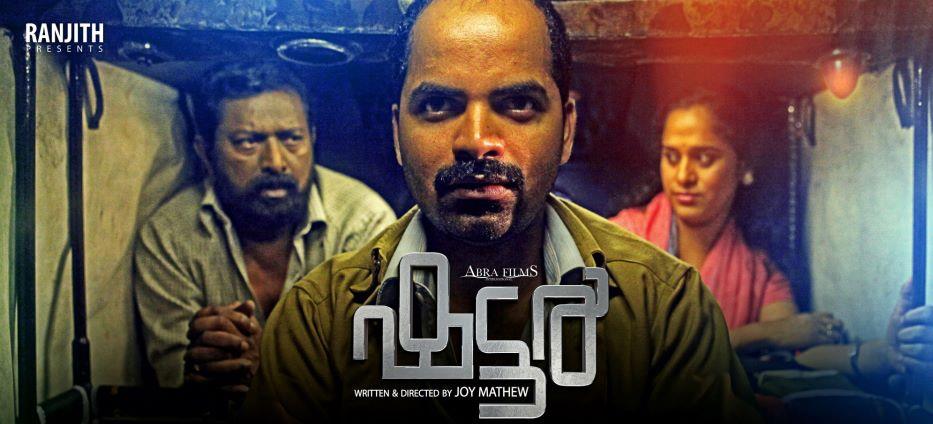
Shutter poster

Shutter is an intriguing début film from noted theatre actor and playwright Joy Mathew. The story sounds simple; a married man ends up locked in his own empty shop with a prostitute for a night and a day, but Mathew has developed rich and detailed characters with a complex story that says much about society and the double standards applied to men and women. There is suspense and plenty of drama as Rasheed (Lal) has to face his own hypocrisy and struggles to deal with the possible consequences of his actions. Although the film starts slowly and does take some time to fully introduce the characters and eventual situation, it is well worth the extended set up as the film features excellent performances from Lal, Vinay Forrt, Sreenivasan and Sajitha Madathil along with the clever storyline. Shutter is an excellent slice of social commentary and one I highly recommend as a memorable and thought provoking film.

The story follows Rasheed as he visits his family in Kozhikode during a break from his work in the Gulf. In the short time he is home, he manages to upset his eldest daughter Nyla (Riya Saira) by insisting she stops her studies and gets married, and alienates his wife (Nisha Joseph) by snubbing her relatives. Not bad for just a few days! However his views are not extreme and seem fairly typical for a man of his generation. While his belief that studying is wasted on girls is one that I personally find outrageous, it’s one that seems common in India even to-day. So Rasheed’s bluster to his friends that Nyla will do as he says and get married, even though she is underage, sounds plausible and typical of an Indian father, while the half-hearted objections of his friends also ring true.

Rasheed also owns some shops which are just in front of his family home. He rents one out to an auto mechanic and is renovating another, while in the evenings he invites his friends into the empty shop for a night of drinking. While on a trip to a bottle shop with his friend Suran (Vinay Forrt), Rasheed spots a prostitute Thankam (Sajitha Madathil) and decides to bring her back to the shop when they cannot find a hotel room. Suran locks them in while he goes to find food but fails to return following series of unfortunate events which leave him with his own predicament to solve. The story then follows Rasheed’s moral dilemma as he quickly realises what he has done and what will happen if he is discovered in the shop with a prostitute. To make matters worse he can see his house from the small window, which serves as a constant reminder of his wife, his family and everything he might lose as a result of his rash decision.

While Rasheed goes through his moral crisis, Thankam is a brilliant contrast to his misery and despair. She has a relaxed, take life it as it comes attitude, and her constantly ringing phone and cheery attitude infuriate Rasheed. Naturally Thankam can’t see his problem as she just needs to keep in contact with her clients and her only difficulty is that she may have to cancel appointments if she can’t escape the shop. For Rasheed every call risks discovery and he desperately tries to silence her conversations any way he can. The difference in their attitudes is summed up when Thankam lies down for a short nap, while Rasheed paces around the increasingly claustrophobic room with tears and sweat dripping down his face. I like that Thankam isn’t yet another beaten down woman who has turned to prostitution in desperation, but rather is portrayed as a businesswoman for whom the night is just one more transaction, albeit one that doesn’t go quite to plan.

Parallel to the main story, a film director Manoharan (Srineevasan) is shown trying to tie down dates for his lead actor and secure financial backing for his next venture. Unfortunately Manoharan is having some difficulty with this and adds to his problems when he leaves his script behind in Suran’s auto. This pulls Manoharan into Suran and Rasheed’s world and the two stories blend together seamlessly. Vinay Forrt is just superb in his role as the anxious and somewhat naïve auto driver who doesn’t know how to get his friend out of a locked shop without letting the cat out of the bag too. Sreenivasan is perhaps a little too understated for much of the film, but he provides a more stable and rational character and another different viewpoint of the situation.

Glimpses of the outside world through the shutter heighten the stuffy closeness of the shop, while Suran’s travels in his auto and Sreenivasan’s conversations in a car with his friend provide a counterpoint. Despite the illusion of freedom and travel, neither can solve their problems, while Rasheed, stuck in his small room without freedom of movement can achieve self-realisation and come to terms with the issues he faces, even if his main problem is one he cannot resolve himself.

There is so much I like about this film. I love the characterisations and the depiction of ordinary, everyday people with their conventional concerns. I like the  way Joy Mathew takes a simple story and layers more and more complexity to each character to finish with a rich and satisfying plot. The underlying social issues are expertly brought into the forefront of the story and I hope raise plenty of questions and lead to discussions around the inequalities portrayed. The performances are all outstanding and Hari Nair’s excellent cinematography adds to the drama and tension without over shadowing the very human story. It’s wonderful and definitely not a film to miss. 4 ½ stars.


Chapters (2012)

Chapters poster

Writer/director Sunil Ibrahim’s 2012 début film is an interesting watch despite a slow beginning and a story where the emphasis is more on relationships and friendship rather than fast-paced action.  Chapters uses a multi-linear narrative style to tell three separate stories which are broken down into four separate ‘chapters’ – the source of the film title.  The first and third chapters interconnect as do the second and fourth, although the final chapter is more concerned with tying everything together. It made more sense to me on the second watch through as I picked up more of the connections, possibly due to concentrating too much on the occasionally dodgy subtitle first time round.  The focus is on the ordinary lives of ordinary people and although it’s an admirable attempt to make a different type of film, sadly we don’t learn enough about these ordinary people to make them interesting!  However at just under two hours it’s an easy watch and worth a look at least for the third chapter which is the most engaging.

Chapter 1Chapters

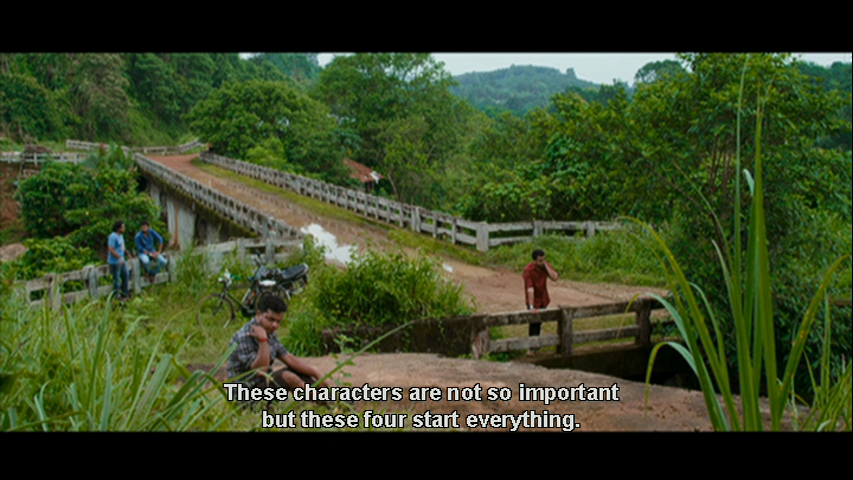
The film starts with a brief preface which sets up the first chapter.  Krishna Kumar (Nivin Pauly) enlists the help of his friends Anwar (Hemanth Menon), Joby (Vijeesh) and Kannan (Dhananjay) to raise some money to help pay for his sister’s wedding.  Rather interestingly his first option is to try for a bank loan, and when that fails the next plan is to try smuggling.  Hm – straight into illegal and criminal activity then without even the possibility of trying to get some work?  Must be the done thing in the Kerala highlands I guess since no-one seems to find this strange at all!  The first chapter deals with the friends attempt to find Nagamanikyam (the legendary snake pearl), to sell and raise money.  This naïve plan isn’t well developed in the narrative and as a result the first chapter feels laboured and unrealistic.  It’s unfortunate as it’s also the longest and the one that sets events in motion for subsequent chapters.  Although the theme of friendship is woven throughout, the individual relationships aren’t explored in any detail either and there never seems to be any reason for Kumar’s friends to sacrifice anything for him.

ChaptersChapters

None of it really makes sense until we get to the final chapter, and although that might work in a film such as Amores Perros, there just isn’t enough action here to justify the lack of character development.  I also found Krishna to be a rather unappealing character who never manages to redeem this initial impression, so perhaps I’m just biased against his story.  The other friends do seem as if they might have more interesting stories, but we don’t ever learn very much about them, and that is the major problem with this chapter.

Chapter 2ChaptersChaptersChapters

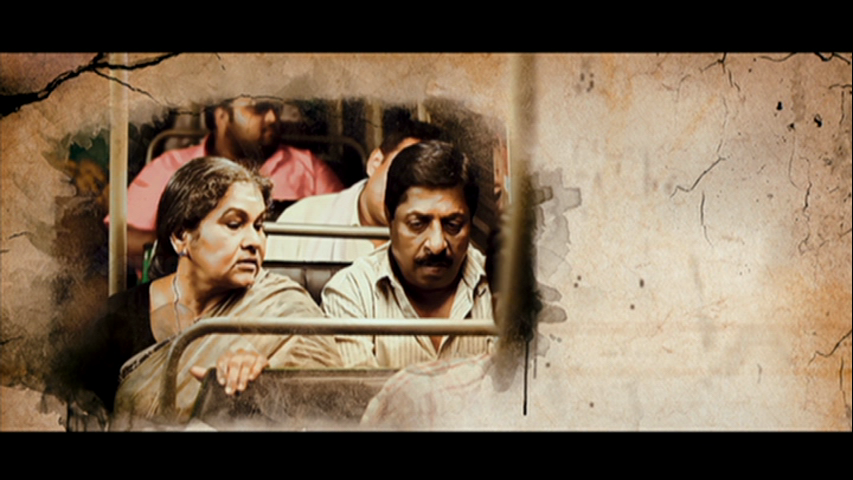
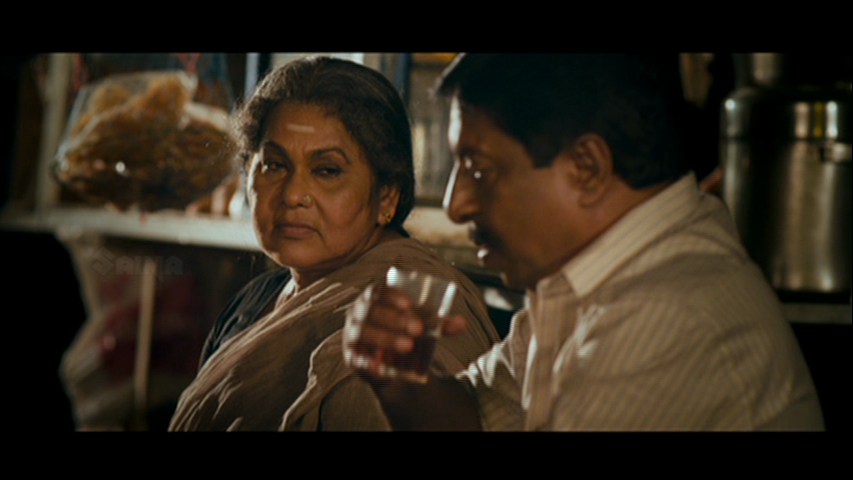
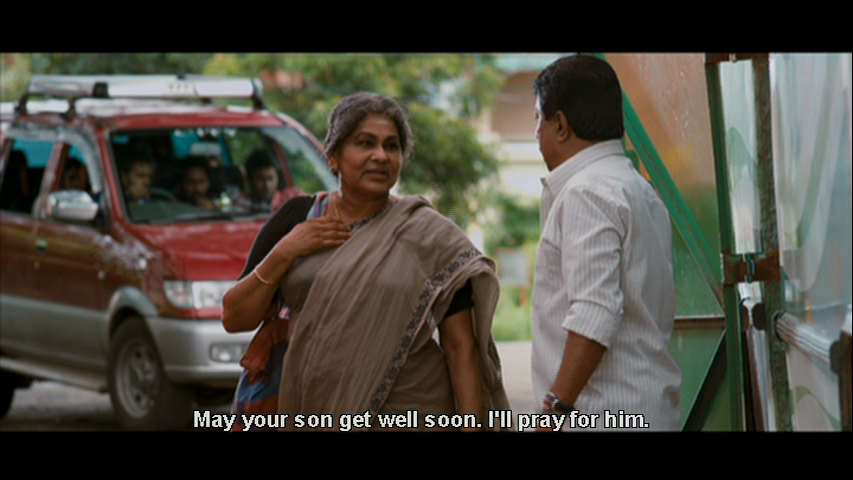
The second chapter tells the story of Sethu (Sreenivasan) and his bus trip to hospital to see his son.  On the way he meets an older woman, played by K.P.A.C. Lalitha, who is also on the way to visit her son, although her story is a little different.  This chapter is short and only seems to provide the background information to set up the last two, however the characters capture interest in their stories and it’s an improvement  after the slow beginning.   We never find out the older lady’s name or anything much else about her, but she is a reminder that there are many stories out there and we only see a small portion of each.  Although not much time is spent with Sethu there is a better sense of his life, his dreams and his problems, which makes his chapter more compelling.  Both Sreenivasan and K.P.A.C.Lalitha are excellent in their roles and as the camera concentrates on their faces while they chat on the bus, more is said by their facial expressions and demeanour than by their words. Maybe it’s a result of these roles being played by more seasoned actors but these characters have more rapport and more of a connection than the others in the story.

Chapter 3Chapters

The third chapter tells of an elopement orchestrated by Arun (Vineeth Kumar), Kaanu (Aju Varghese) and Jincy (Riya Saira) for their friends Priya (Gauthami Nair) and Shyam (Rejith Menon).  Arun brings along his friend Choonda (Shine), whom he introduces as a goonda, just in case they run into difficulties and need some muscle.  This is the most interesting story and there is attention to detail in the narrative, although again it suffers a little from lack of development of the various relationships. The obvious outsider in the group is Choonda and Shiny fits well into the role, while the rapport between the others helps to make later events more shocking.  Most of the action focuses on Arun, Shyam and Choonda, while the others have a more peripheral role in the proceedings.  However this lack of depth works here as the friendship theme is only the background reason for these people to be in a particular place at a particular time, allowing them to interconnect with the other characters in the preceding chapters.  More action and a sense of the different connections also help to make this the most appealing of the stories.  This chapter also has a love song which helps to develop the different relationships and as a bonus it features possibly the oddest pen holder I’ve ever seen!

Chapters

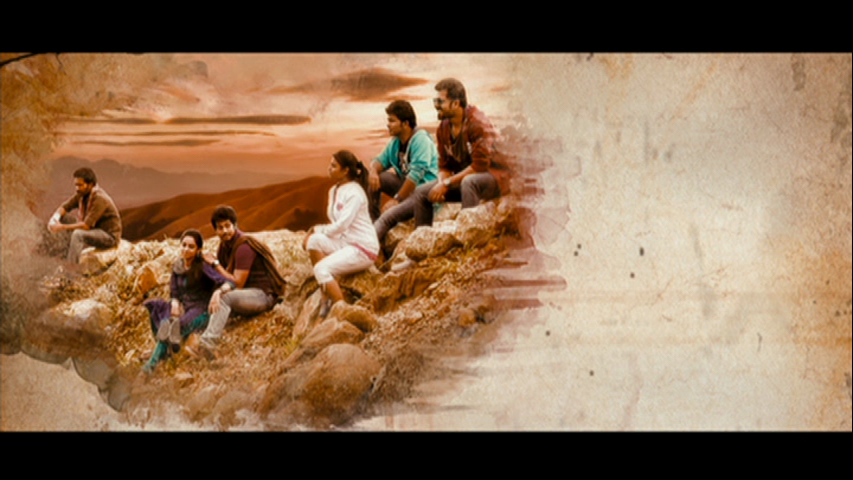
Each chapter recounts two particular days from different points of view, which add up to provide the full story.  There are a number of ways to bring this type of film together – one is by driving interest in one or more of the characters and their interconnecting relationships, but here there isn’t enough detail in most of the characters to feel any real rapport.  Another option is to take a piece of action and split it into the component parts, which is more the emphasis here.  Ibrahim doesn’t quite manage to pull it off though, which is mainly due to the slow beginning which doesn’t engage as much as the later chapters.  However once the story does pick up, there is enough interest generated in Sethu and the friends in the third chapter to make a more engaging and interesting film.  Making the first chapter as detailed as the rest would have definitely made this a better film.  As it is, the lack of consequence for the main character in the first section was somehow disappointing, particularly since everyone else seemed to have learned something from their experiences.  However, the actors are all well cast and feel genuine in their roles.  As in most Malayalam films, the cinematography by Krish Kymal is  excellent and the graphics between each chapter are beautifully done and capture the characters in defining moments.    There are two songs and both are used to develop the story, but I didn’t feel either was necessary and they didn’t really add anything more to the film.  Chapters is an interesting début and certainly merits a watch for a different approach to a multi-linear film and in particular good performances from Sreenivasan and the young actors in the third chapter . 3 ½ stars.