Gopala Gopala (2015)

film poster

Gopala Gopala, so good I watched it twice! Well, actually I would do that more often for more films if Melbourne had an extra show, which is what happened this week with Gopala Gopala. But it is a fun film and I enjoyed watching Venkatesh and Pawan Kaylan in their first movie together. I haven’t seen either the Hindi version of this movie, or the original Australian film that inspired both and that could be one of the reasons why I enjoyed Gopala Gopala as much as I did. I’ve read that this Telugu remake follows the original faithfully and as a result it may only be worth a watch if you haven’t seen OMG, or like me feel that Pawan Kalyan as God seems a more plausible choice than Akshay Kumar.

The Gopala of the title is a shopkeeper who decides to sue God when his insurance claim is rejected following an earthquake that has destroyed his livelihood. The insurance company representative points out that Gopala has signed the contract that lists (in small print) the exclusions for his insurance, including an ‘Act of God’ and since no-one else but God could have caused the earthquake, Gopala is out of luck and out of compensation. It’s a nice idea, even if the term act of god is a legal construct rather than anything remotely religious, but the film works on the premise that either God does not exist and therefore the insurance company has to pay, or God was responsible and the onus of care rests with his agents on Earth. Along the way the film questions the morality of the various religious orders and their representatives, but is clear throughout that despite Gopala’s own personal disbelief there is actually no question about the validity of God in any of his incarnations. It’s the charlatans and irrational customs that come up for criticism and the writers throw in some good questions about morality in general for later contemplation.

Venkatesh pitches his character perfectly as a non-believer who makes his living selling Hindu statues and religious artifacts even though he finds the rituals and superstitious involved in worship ridiculous. Just as much of a con in fact as his ordinary tap water masquerading as authentic water from the Ganges. His shady dealings aside, at heart Gopala is a compassionate man who is shown to indulge in random acts of kindness and generally feels some compassion for people less fortunate than himself. The problem here though is that his good deeds come across as rather contrived given the way they are somewhat haphazardly inserted into the narrative. However Venkatesh mixes his skepticism with obvious tolerance for his wife’s idiosyncrasies and his salesman has plenty of charm mixed in with his complaints, making Gopala a generally likeable character.

His wife however is Gopala’s polar opposite in all things religious. Meenakshi (Shriya Saran) prays to any and every possible God and shrine while falling for every piece of chicanery she sees during her devotions. I’ve mentioned before that Shriya seems to be better in roles that require her to have long hair, and she stays true to that judgement here, giving a good performance as a devoted wife and mother in every sense of the word. Although Shriya doesn’t have a lot of scope in her role, her presence does add grace and a human face to the otherwise random devotees who face Gopala’s scorn. Somewhere in the middle is Otthu (Krishnudu), Gopala’s assistant in his shop who prays to the gods and follows the rituals but is the one who suggests a religious trip to Varanasi will be the perfect time to stock up on cheap artifacts to sell at inflated prices back in Hyderabad. Krishnudu has good comedy timing but apart from funny early scenes he is also relegated to the sidelines once God appears to help Gopala in his quest for justice.

Ah, yes, God.

Gopala GopalaPawan Kalyan makes his grand entrance as Krishna just before the interval, and his presence immediately enriches the story and lifts the energy of the film. The reaction in Melbourne was loud and enthusiastic both times I saw Gopala Gopala, which somehow seems rather appropriate for the appearance of a deity, even if he doesn’t arrive with the classic blue skin and associated regalia I expected. The role suits Pawan Kalyan’s restrained delivery style when not in full action mode, and his Krishna is a little distant but very charismatic. As may be expected from a divine being he offers guidance rather than direct intervention and is often cryptic in his dialogue, although his explanation of why bad things happen to good people sounds like classical political spin. Gopala never asks any of the big questions (such as why just his shop was destroyed – would have been my first question. That and where do all the lost socks go?) but that makes the relationship between the two feel more genuine and does stay true to Gopala’s persistent disbelief in an all-powerful deity.

The film does slow down a little in the second half when Gopala takes the assorted bunch of priests and swami’s to court but Mithun Chakraborthy, Posani Krishna Murali and Diksha Panth are all good in their respective roles as unethical leaders of their temples and organisations and the comedy helps to keep things moving along. Mithun as Leeladhara Swamy in particular has an impressive collection of idiosyncrasies although all three are so obviously corrupt and self-aggrandising that it seems hard to believe they would lower themselves to appear in court. Gopala is an equal opportunity plaintive and also summons representatives from the Muslim and Christian churches, while receiving help from lawyer Akbar Bhai (Murali Sharma) and determined opposition from Shankar Narayana (Ashish Vidyarthi) who has the unenviable task of representing the religious leaders. Interspersed with all the courtroom drama there are a number of songs by Anoop Rubens which are mainly fairly upbeat and fit into the narrative well. My favourite is a beautiful flute piece, but this runs a close second, particularly since it includes both Venkatesh and Pawan Kalyan dancing.

https://www.youtube.com/watch?v=mFpJYsH2oDY

While Gopala Gopala is often rather simplistic with characters painted a little too black or white, Kishore Kumar Pardasany has made an entertaining movie that includes a discussion of superstition in religion without getting bogged down in dogma and matters of faith.   Pawan Kalyan and Venkatesh Daggubati have great chemistry and work well together while the rest of the cast provide excellent support and good comedy. This really was much better than I expected and is definitely well worth a watch – or two!

Manam (2014)

Manam

Manam is a beautiful film and a breath of fresh air in an industry usually dominated by beat-‘em-up heroes and the same old innuendo masquerading as comedy.  Featuring three generations of the Akkineni family and Nageswara Rao’s final screen appearance, it could very easily have tipped into trite sentimentality, but Vikram Kumar’s screenplay keeps the film on track with an novel storyline, sweet romances and genuinely funny comedy.  I have to admit that I almost didn’t buy a ticket when I read that Manam was being advertised as a comedy, since without subtitles most of the humour tends to pass me by (even with subtitles in some cases!) but Manam would have been a watchable and entertaining film even without subs.  As it was, being able to understand the jokes and laugh at the same time as the rest of the audience was excellent.  Long may this trend for subtitled Telugu films continue in Melbourne!

Manam Manam

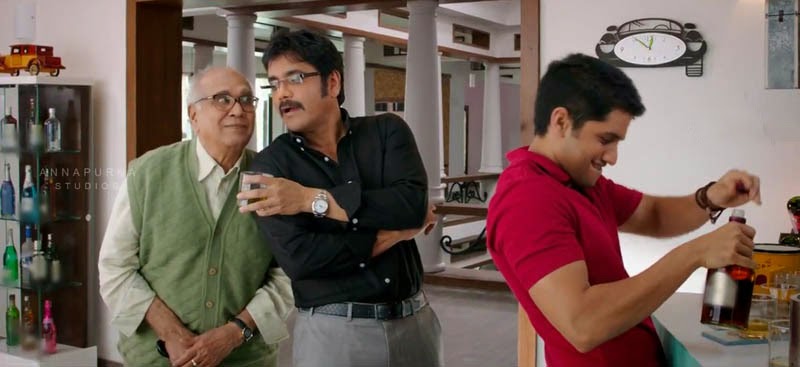
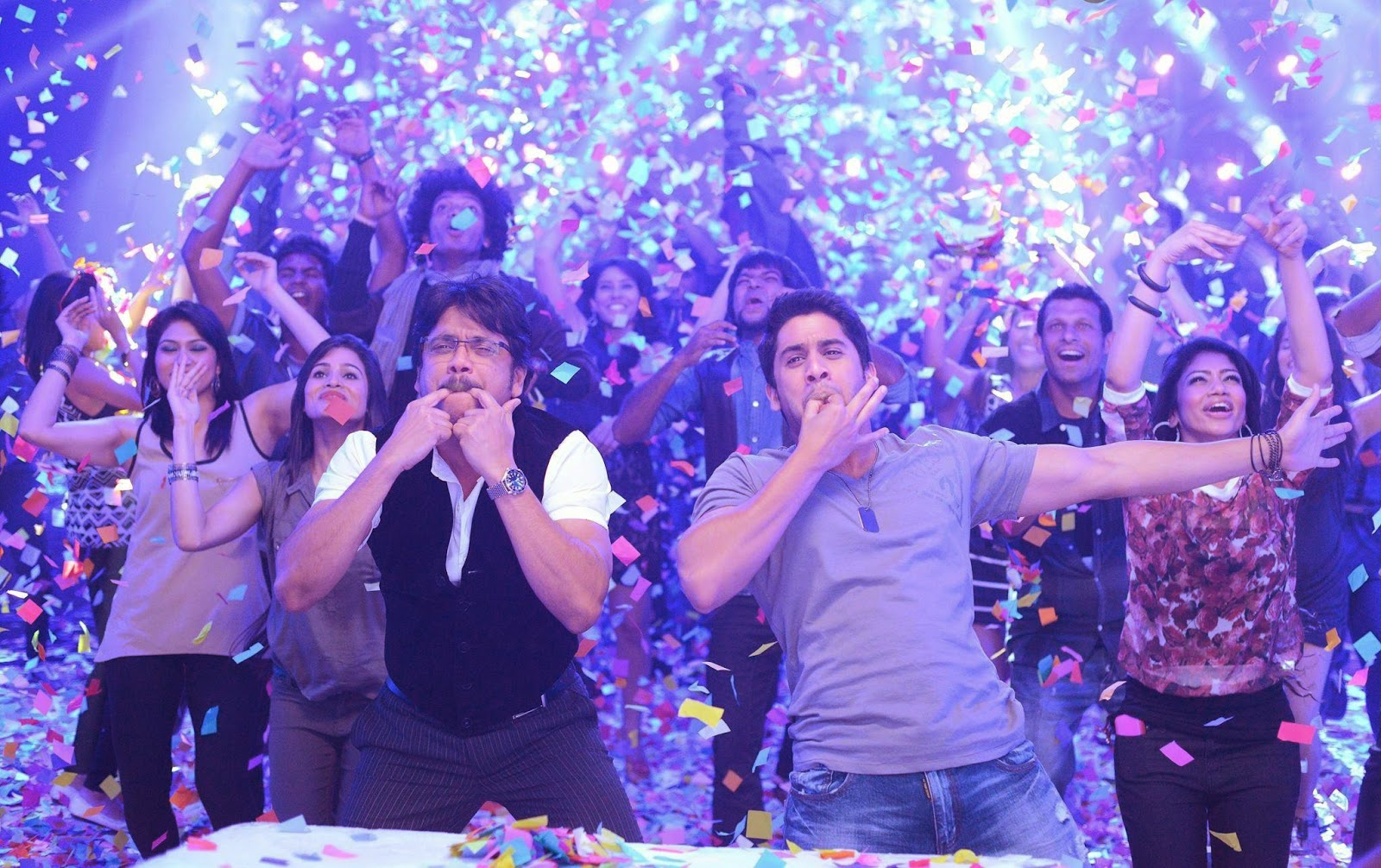
The film starts in the 1980’s with the unhappy marriage of Radha (Naga Chaitanya) and Krishna (Samantha) who bicker and fight even on the occasion of their son’s sixth birthday.  The very next day they are both killed in a car accident, leaving the young Bittu an orphan and his wish to see them happy together unfulfilled.  This doesn’t seem to have held Bittu back however, as the film moves to the present day, and the now grownup Nageshwar Rao (Nagarjuna) is in Mumbai to receive the Businessman of the Year award.  However, on the flight back to Hyderabad, Nageshwar is seated beside a young man who is the image of his late father, and this begins his crusade to bring his ‘parents’ back together again.  Nagarjuna is absolutely perfect here and his child-like wonder at discovering ‘his father’ is brilliantly portrayed.  The scene is well written too, with the just the right amount of comedy to keep it from cloying sentimentality and Vikram Kumar even manages to make the suggestion of such an occurrence seem perfectly plausible.

Samantha and ChaitanyaManamNageshwar reasons that if his father has been reborn, then his mother must be around somewhere too, and to this end he scours the streets of Hyderabad until he tracks down Priya (Samantha) who is the image of his mother and, luckily for Nageshwar and his plans, she immediately feels a connection.  Again Nagarjuna’s determined search is neatly summarised in just a few shots and the obvious unlikely coincidences feel much less contrived than expected.  It help that both Nageshwar and Priya are very likeable characters and Nagarjuna and Samantha ensure their interactions are full of genuine warmth and respect.

ManamNagarjuna

Having found his re-incarnated father and mother, Nageshwar has to find a way to re-ignite their romance.  In the midst of his attempts to bring about true love, Nageshwar finds love himself when Anjali (Shriya) commandeers his car to carry a sick man to hospital.  As it turns out, the older man is Chaitanya (Akkineni Nageswara Rao) who has seen his parents Seetharamudu and Ramalakshmi  reborn as Nageshwar and Anjali.  It’s then his turn to explain the past and try to reunite the lost lovers.

Manam

ANR is the absolute star of the show, and seems to take great delight in playing the octogenarian matchmaker.  He is mesmerising every time he appears, and his facial expressions and reactions to every other character are superb.  For his part, Nagarjuna is quietly competent as Nageshwar Rao with a subtle but effective performance, and his romance with Ramalakshmi in the second half is an absolute delight to watch.  There seems to be something in Temple’s theory that Shriya Saran’s irritation factor is related to the length of her hair, as here she has long hair and is actually pretty good.  Shriya looks beautiful and displays an engaging personality as a 1920’s traditional villager, and she is just as stunning as the cool and efficient Dr Anjali.  I vote Shriya always has long hair in her movies!

Manam

Nagarjuna and Shriya also share good chemistry together, which is sadly conspicuously absent in the romance between Samantha and Chaitanya, although to be fair the script really doesn’t ever let them develop much sparkage except in the way of confrontation.  Despite the lack of passion with Chaitanya, Samantha shines as Priya / Krishna.  She sparkles in her songs, and is full of bubbly enthusiasm as she meets Nageshwara, but her pain at her perceived husband’s betrayal is obvious as is her contempt of Chaitanya’s Nagarjuna.  Chaitanya is also better than usual, although that may be because his role mainly requires him to play a drunk and obnoxious college student which he seems to fit well.  The usual suspects pop up as various mothers, fathers, cousins etc, but do watch out for the brief cameo appearance of Amitabh Bachchan which garnered plenty of cheers from the audience.

Manam

It’s not all perfect though – the inclusion of Ali as a dance teacher is unnecessary and M.S. Narayana’s role is too obvious and crude to fit with the rest of the characterisation.  However Brahmi is good as Nagashwara’s assistant and without any misogynistic humour, he manages a restrained performance that proves he can act perfectly well when required.

Manam benefits from a sweet and  simple telling of a relatively convoluted story.  There are no exciting car chases, no big fight scenes and no cliff-hangers (even though the last few minutes attempt to raise the dramatic tension), but overall it’s an entertaining and watchable film.  All praise must go to Akkineni Nageswara Rao and Nagarjuna for their exemplary performances, but the younger generation hold their own, with even Chaitanya showing that he learnt something from the rest of his family while on set.  Definitely recommended viewing and a last performance to savour from one of the legends of Telugu cinema.

Sivaji (2007)

Sivaji is a wonderfully over-the-top film celebrating all things Rajinikanth. There are references to the superstar’s previous films and to his own life, plenty of classic Rajni style and he’s present in almost every frame. Sivaji also features stunning sets for the songs and a myriad of different looks for Rajinikanth throughout the film. While the story has an interesting plot involving corruption, the screenplay gets somewhat tangled in the numerous set-ups to introduce the next song or fight scene.  But in the face of so much else that is fantastic, the disjointed nature of the story doesn’t seem to matter. When the first song is as much fun as this, then the film is already a winner for me. This features Nayantara in a cameo role along with an incredible number of  men with round, jiggling painted bellies – I love it!

The film opens with Sivaji returning from the USA with truck-loads of money and deciding to set up a University and Hospital where everything will be available to the poor for free. His grand plans are opposed by local businessman Adisheshan (Suman) who blocks him at every turn. To make Sivaji’s life more difficult there is the practice of bribes and kick-backs that seems to be built in to the system at every stage. Despite his unwillingness to play along, Sivaji has no choice but to fall in line and pay everyone off if he wants to get his hospital and university built. I’m quite sure that all these people in yellow hats were the inspiration for minions in Despicable Me – or at least they should have been.

Ultimately this works to Adisheshan’s advantage when he contrives to have Sivaji arrested and charged in court. There Sivaji admits that he paid bribes to get permission to build and ends up losing everything. This might have been the end of the Sivaji foundation, but Adisheshan is the one person in Tamil Nadu who has no idea who he’s really dealing with and he rashly mocks his defeated enemy.  This sparks Sivaji’s quest for revenge, and the 1 rupee coin Adisheshan tosses at him to start his begging career becomes a talisman and also funds the start of the fight back. Sivaji devises a cunning plan to restore his finances and bring about Adisheshan’s downfall at the same time.

Rajinikanth is truly in his element here as the crusading Sivaji. He still has his trademark tricks, but this new  health conscious Sivaji spruiks the ‘cigarettes are bad for you’ message, catching mints and tossing his sunglasses instead of cigarettes. It’s all a little contrived, but the tricks are so much a part of any Rajni film that Sivaji would seem incomplete without them. There areplenty of fight scenes, and these are well choreographed by Peter Hein. The final showdown features some Matrix style action and Rajinikanth pulls it off with great style. If he has slowed down a little in some of the fight scenes and songs, well, that’s understandable but it’s barely noticeable. As well as the romantic songs, there is a fabulous sequence where Rajinikanth impersonates Sivaji Ganesan, MGR and Kamal Hassan and he gets really gets the mannerisms of the different stars very well.

During the course of his crusade against corruption, Sivaji meets and falls in love with Tamizhselvi (Shriya) and despite her family’s initial reluctance and dire predictions of disaster from the priest, the two go ahead and get married. Thankfully Shriya is much less annoying than usual, perhaps because she is totally overshadowed by Rajinikanth, but I stand by my previous observations that the more clothes she wears the less irritating she is. Her main raison d’être here is to look pretty in the songs which she does very well.

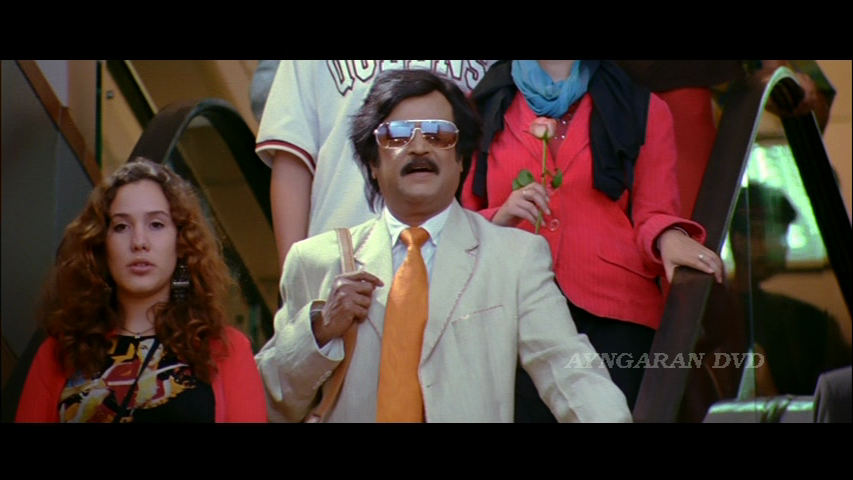
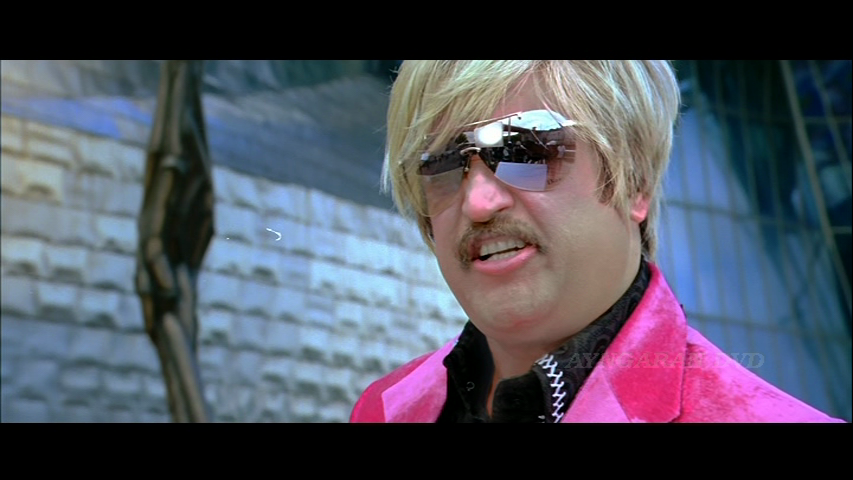
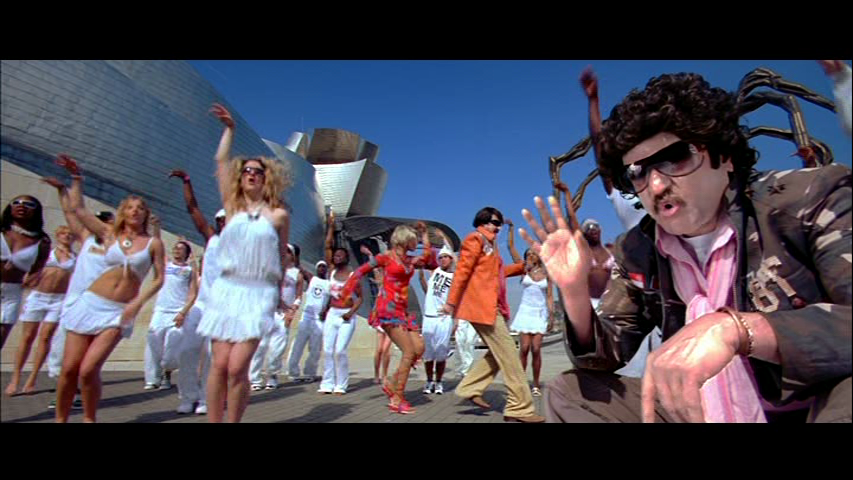
Other than her presence in the songs, Tamizhselvi is the ‘perfect Tamil girl’ of Sivaji’s dreams and that ensures plenty of traditional outfits and a fairly restrained performance, making her more tolerable than usual. Someone in wardrobe really does have a grudge against her though because she does appear in some of the worst outfits I’ve seen in the song ‘Style’.  I’m not quite sure what to make of this song for many reasons. As a song extoling style it has some truly dreadful costumes and the whole white-skinned Rajni just seems very wrong. I’m always perplexed by the quest for paler skin in India, but then I’m equally as baffled by the drive for tanned skin among Europeans. I don’t like the melody or the lyrics of this song at all, but it does feature an incredible selection of amazing wigs for Rajni and is worth watching for that alone. Pick your favourite style!

And the contrasting faces of Shriya.

While the film deals with the theme of corruption, there is still plenty of comedy along the way. Although much of the humour comes from Rajinikanth and his various mannerisms, Vivek is excellent in his role as Sivaji’s uncle Arivu and provides many funny moments. Even though I’d normally cringe at Arivu’s match-making technique of parading girls in front of Sivaji, Arivu’s character is self-aware enough to make this funny rather than crass.  There is more slapstick comedy in the scenes with Tamizhselvi’s family who disapprove of Sivaji and his exuberant family. The actor playing Tamizhselvi’s father (Pattimandram Raja) has some excellent expressions and I love the way he looks as if he smells something bad every time he sees Sivaji.

On the other hand, Suman’s Adisheshan is a very mild mannered villain without any real evil tendencies. Although I’m sure this is meant to make sure that all eyes are firmly on Sivaji, he still seems rather unimpressive in comparison. His demeanour however is quite realistic as a businessman with political leanings and his reasons for opposing Sivaji are understandable considering how much the free hospital and university will cut into his profits. His methods of opposition are also consistent with his character and perhaps S. Shankar is trying to point out that corruption can be present in even the most reasonable appearing businessman.

The second half of the film relies more heavily on the effects and gimmicks, and it’s disappointing that Vivek’s character gets more sidelined. But it’s still a lot of fun to watch mainly due to Rajinikanth’s performance. The music by A. R Rahman is excellent apart from the Style song mentioned previously, and the high budget of the film is easily explained by the song picturisations. The sets and costumes are totally fabulous and both Thotta Tharani as art director and K. V. Anand as cinematographer deserve the awards they received for their work. There are guest appearances by a number of established Tamil stars including Raghuvaran and Manivannan and  the support cast are all very competent, although generally overshadowed by the superstar.

Although Endhiran (S. Shankar’s latest film with Rajinikanth), had a bigger budget and even more special effects, I prefer Sivaji. The story is engaging despite the way it jumps around and Shankar shows corruption within government systems in a way that seems quite plausible. Even though the one man crusade requires a leap of faith, it is after all Rajni and so anything is possible. It’s one to watch for the lavishness of the sets and the larger than life presence of Rajinikanth. And for all those wigs! 4 stars.

Temple says: Sivaji is what I have come to think of as a typical Shankar blockbuster in that it is all spectacle and very little plot. I think Heather is being overly kind in saying there is a theme to the story as I see it more as a collection of ideas that never really develops. Shankar introduces statements about corruption, the brain drain overseas as bright graduates pursue careers outside of India, the returning NRI and how they navigate between worlds, the obsession with all things American being seen as ‘better’ than local, the clash between tradition and modern living and the nostalgic ideals that may no longer exist. All interesting, and yet there is no real exploration of these notions as there is too much else happening. We move from fight to song to comedy to spectacular song and rarely pause for breath. It’s hugely entertaining, but it doesn’t really bear analysis.

Rajnikanth is in excellent form and this is his film from go to whoa. Sure he is way older than his character, but it somehow works as he deadpans his youthful dialogues, daring you to not believe,  and throws himself into the action with gusto. The fights have been tailored to suit him, and the music shop sequence is one of my all time favourites from any film industry. Shriya can range from terrible (e.g. Kanthaswamy) to pretty good,  and this is one of her better performances. She handles the comedy really well  (I love her expressions in the “Chandramuhki” sequence), isn’t completely overshadowed by Rajni, and does justice to the massive song sets and costumes. And she manages to look like she isn’t staring intently at Rajni’s wigs in the romantic moments so I decided Shriya may be a better actress than I had previously thought.

See this for the spectacular sets and design, for a Superstar who can dominate the hyperactive pace and attention grabbing visuals, for the music (except Style) and for the filmi equivalent of a crazy amusement park ride. You’ll be dizzy and none the wiser at the end, but it was so much fun while it lasted. 4 stars!