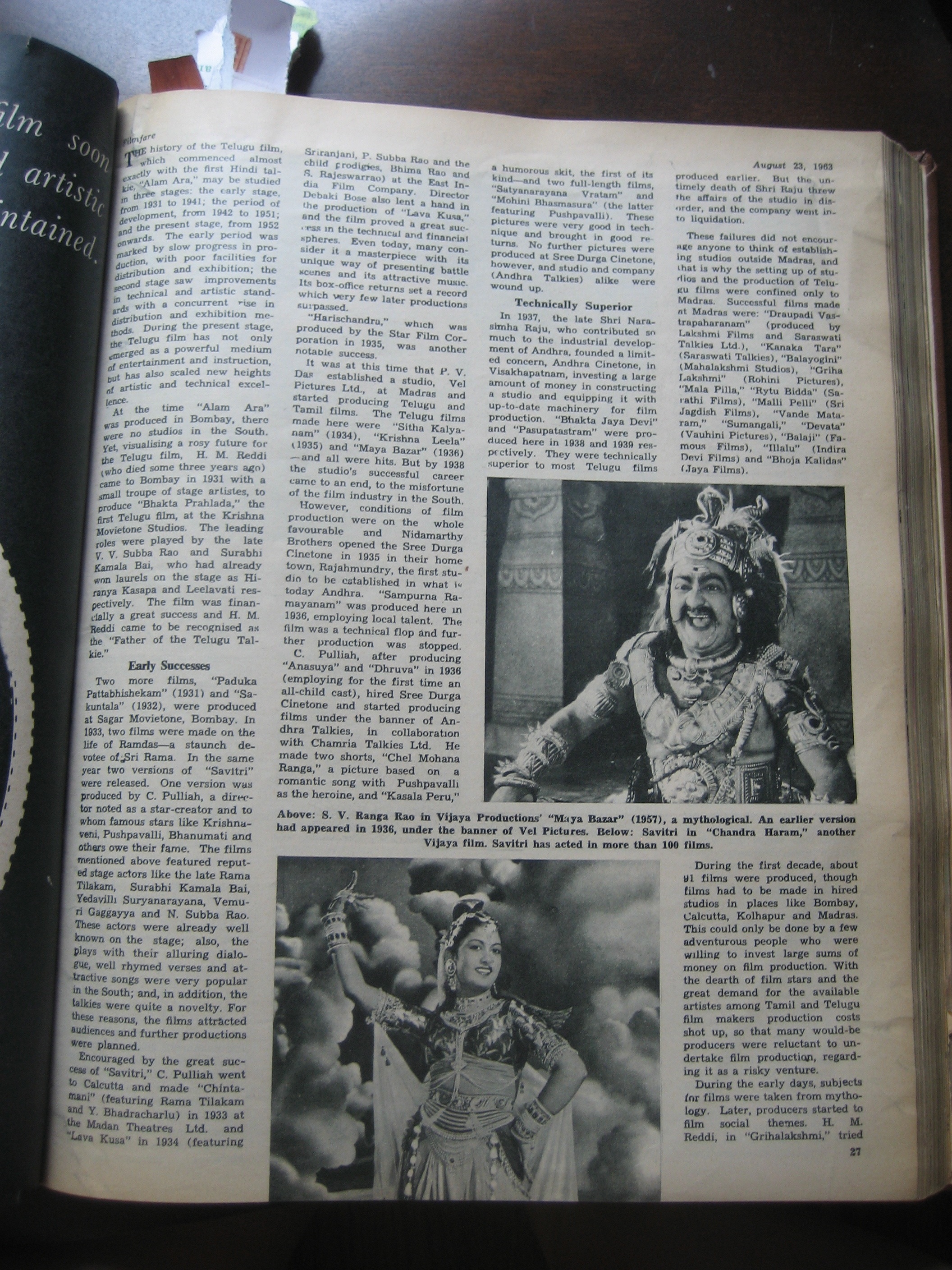
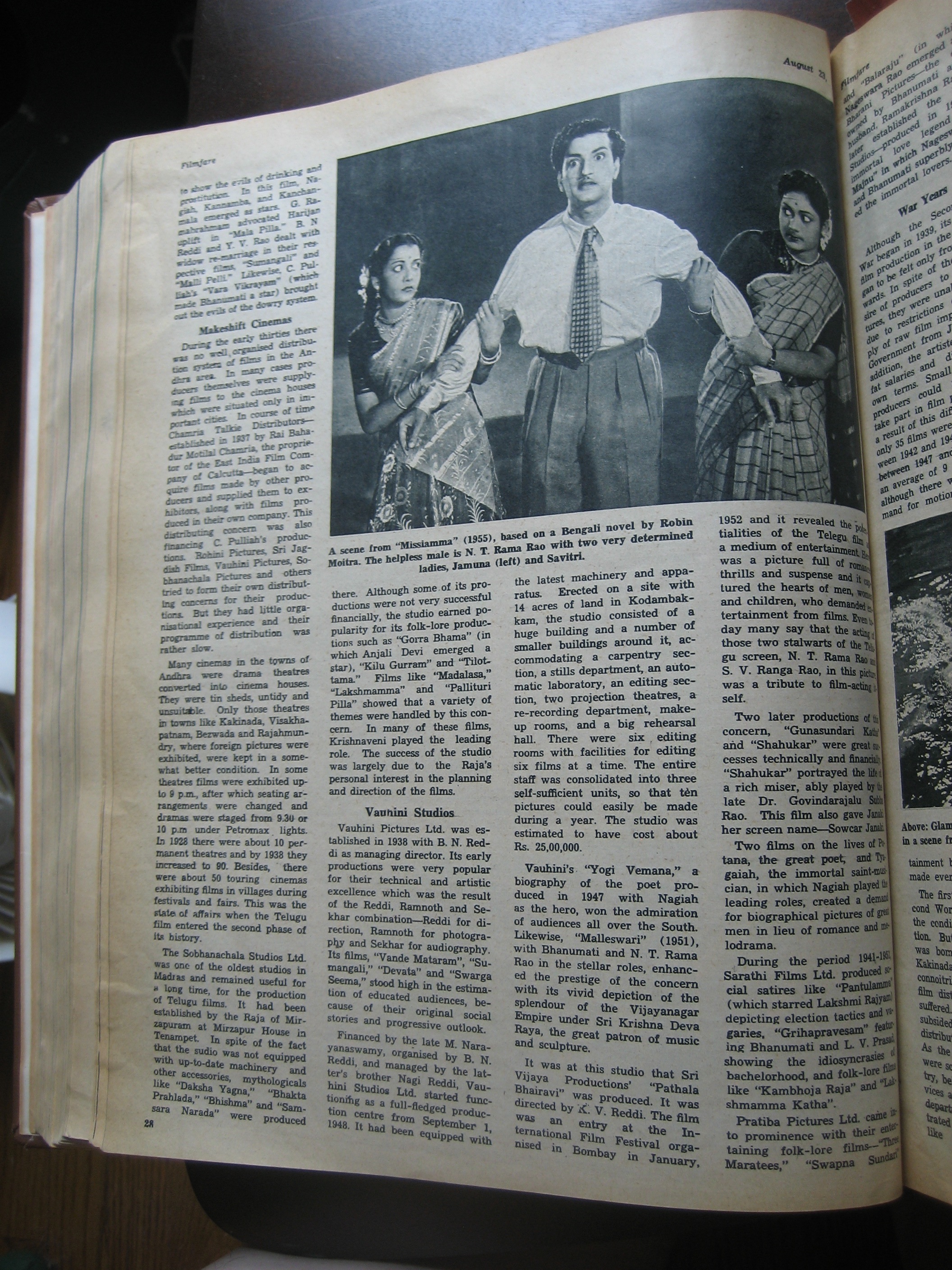
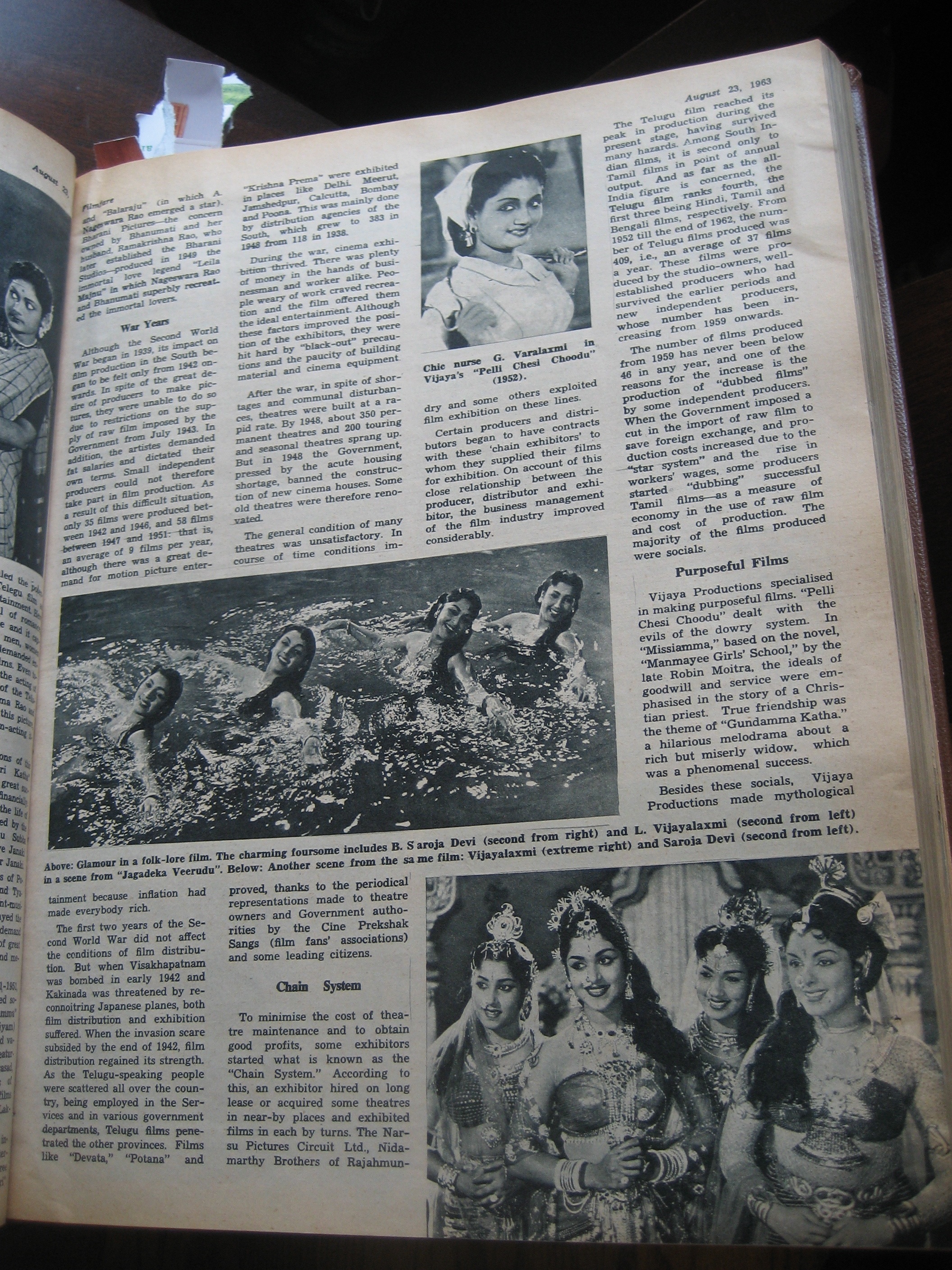
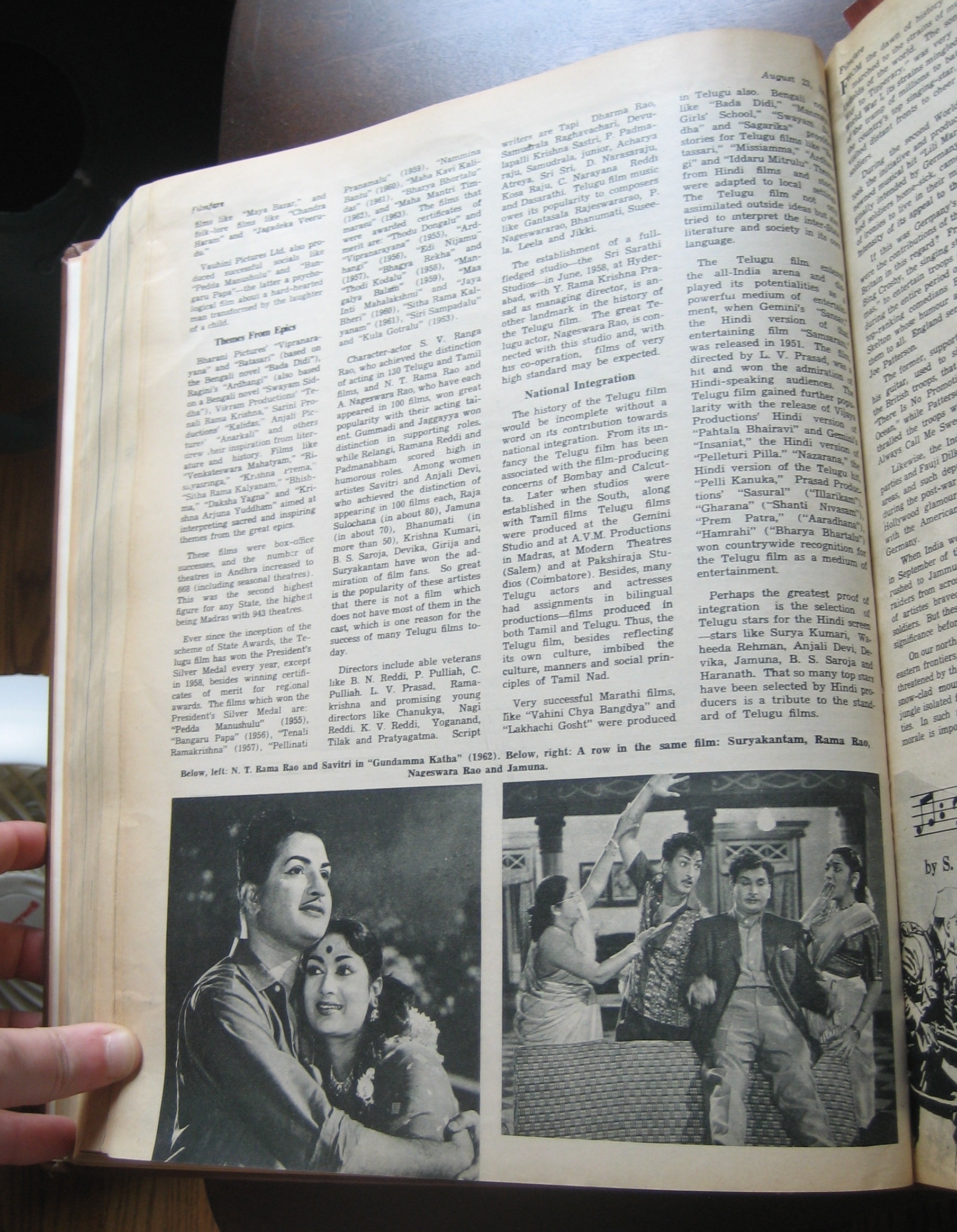
A kind reader with excellent research skills sent these photographs of a Filmfare article from 1963. If you click on the pictures below you should be able to see the full sized version and zoom in to read about the early years of this wonderful industry. If you’re observant you will spot a hand that may belong to our film historian/spy. The story starts in 1931 with ‘Bhakta Prahlada’, made by H.M Reddi and a troupe of Telugu stage artists who travelled to Bombay as there were no studios in the South. It also covers Vauhini Pictures and Vijaya Productions who made classics including Mayabazar and Missamma and provides some detail of the classical and mythological inspiration behind many successful films. I loved reading about the early cinemas and the ingenuity of film makers in an era before fancy technology. If you still need persuasion to see some vintage Telugu cinema, this may do the trick: “Telugu film has not only emerged as a powerful medium of entertainment and instruction, but has also scaled new heights of artistic and technical excellence.” Or you can just enjoy some lovely stills of favourites NTR, Savitri, ANR, Jamuna, SV Ranga Rao and L Vijayalakshmi, among others.
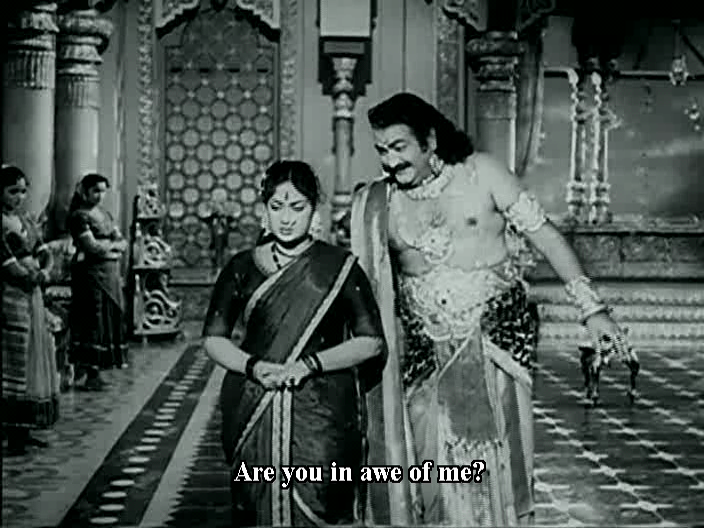
This 1963 classic has an exceptional cast, featuring NTR, Savitri and SV Ranga Rao, under the lively direction of Kamalakara Kameshwara Rao. Narthanasala renders a chapter of the Mahabharata in an accessible and highly entertaining style. The story as shown concentrates on the Pandavas efforts to serve out the 13th year of their exile, and how they deal with their tribulations. I’m sure there are many versions of this tale and this screenplay no doubt varies from those in some ways. My knowledge of the Mahabharata is basic, but all the information you need to know to enjoy Narthanasala is contained within the film, so don’t let that be an obstacle.
Arjuna is honoured by Indra, but manages to tick off Urvashi (Padmini Priyadarshini) when he rejects her advances. She curses him to become a eunuch. I cannot blame her for being mislead after watching him watching her in this dance:
And she looks furious!
The curse is mitigated somewhat by a time limitation granted in recognition of Arjuna’s essential manly goodness. This coincides with the 13th year of exile when the Pandavas must take refuge in a kingdom and remain anonymous for that final year. The set up of the characters and how they would conceal their identities was simply done in a conversation that pretty much spells out who’s who. There are spies and lures set to draw the Pandavas into the open, and the cat and mouse game with Duryodhana adds an edge of tension to the waiting game.
Dharmaraju (Mikkilineni Radhakrishna Murthy) is occupied as an advisor to King Viraat, and has little free time to spend with his brothers and wife. The twins Nakula and Sahadeva work with the livestock and are absent most of the time. This leaves Draupadi (Savitri), Arjuna (NTR) and Bhima (Olympic wrestler Dandamudi Rajagopal) on centre stage.
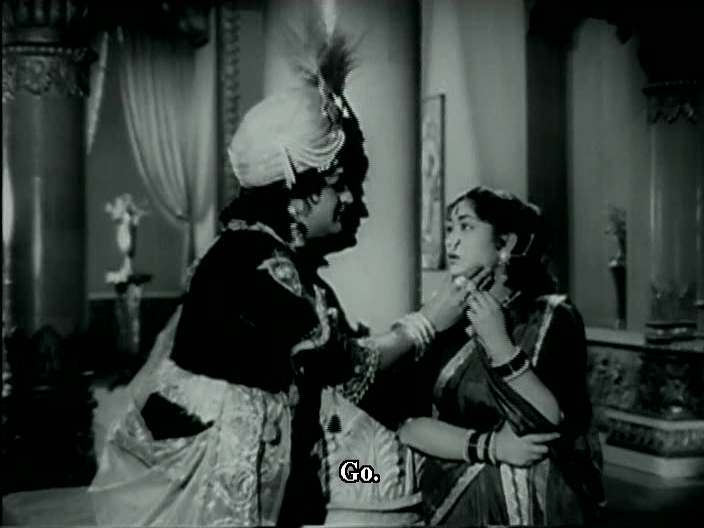
Draupadi is beautiful and deceptively delicate looking. Her husbands make a big deal of her having to undertake manual labour, but she is more resilient than they are in some respects. Although usually deferential to her husbands, when she needs to stand up for herself she leaves no doubt as to the consequences of drawing her anger. Calling herself Malini she goes to work as a ladies maid and beautician for Queen Sudheshna (Sandhya). She pleads with the queen that she be protected from tasks such as being sent off to entertain strange men and serve in other households, and Sudheshna agrees. Draupadi’s awareness of her vulnerability is clear, and despite her efforts she does attract unwanted attention.
How she attempts to deflect and ultimately stop this harassment is the main focus of the drama, and she tries many approaches before demanding her husbands step in. Krishna intervenes when called upon, but the solution lies with the human characters. Draupadi’s affection for Arjuna gives their complex life a strong emotional core, and their scenes had an element of romance that her interactions with the other husbands didn’t. She has a rare laugh when talking to him about their son. Savitri is, as I have come to expect, excellent in a role that demands both high emotion and restraint.
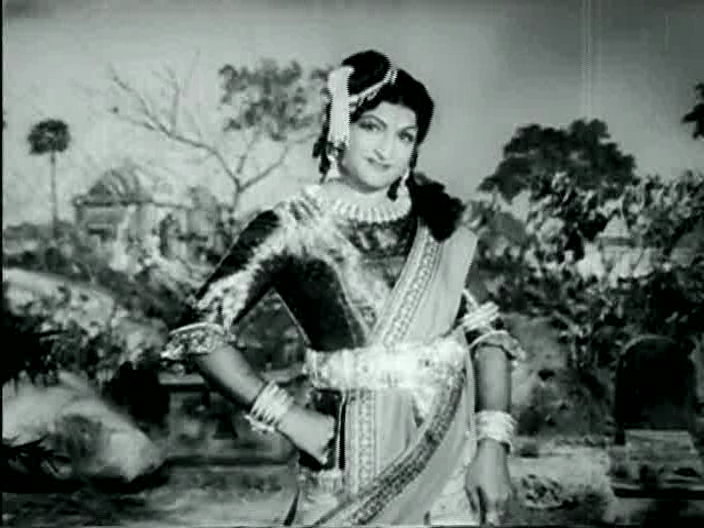
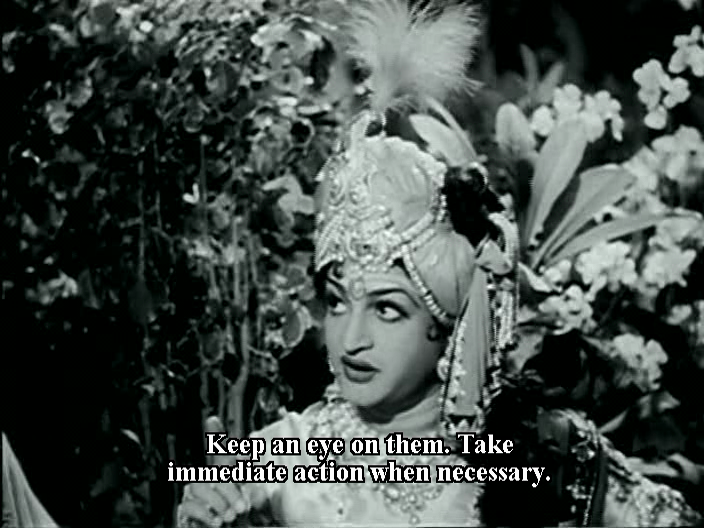
Arjuna is transformed into Bruhannala. He takes up the position as dance teacher to Uttara (L Vijayalakshmi) and embraces accessorising. He should have had those dance lessons as while Bruhannala’s expressions are flawless, his dance steps are not quite as graceful.
NTR looked knowing and effeminate as the eunuch, always slyly amused at fooling everyone around him. It falls to him to come up with the scheme to keep Draupadi from harm and to keep the Pandavas safe until the end of their exile.
The stolen conversations between him and Draupadi have an undertone of longing. When they touch there is chemistry; Arjuna, the husband missing his wife, is suddenly visible despite the fripperies of Bruhannala. When NTR re-appears as Arjuna he is quite regal although maintains the air of amusement. His scenes with Uttarakumar in the chariot are fun and he enjoys the consternation caused by his transition from Bruhannala back to Arjuna. It’s a warm, appealing performance, and the knowing looks to camera drew me into the asides and secrets.
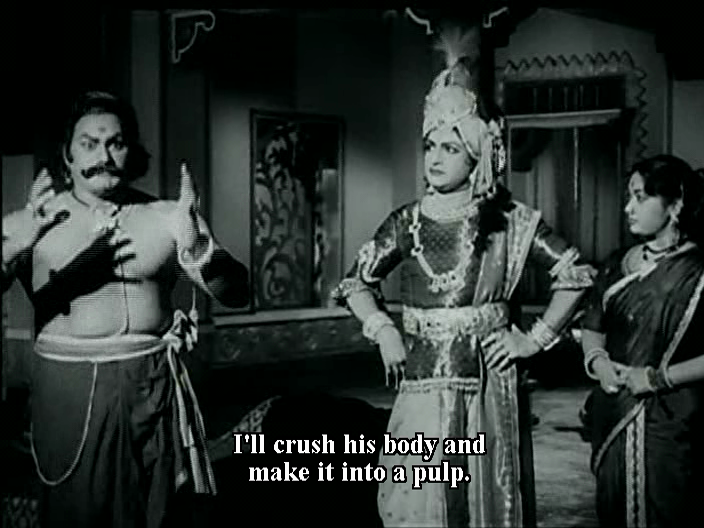
Arjuna is more philosophical about Draupadi’s situation and is prepared to manage each crisis as it happens. Bhima cannot contain his fury; he just wants to tear Keechaka apart.
He knows his own flaws and is guided by the more calculating Arjuna and Dharmaraju’s sense of justice. His powerful physique is an asset to the family but may also be the thing that gives them away. There wasn’t a lot of subtlety needed for this performance, but it wasn’t just posturing and roaring.
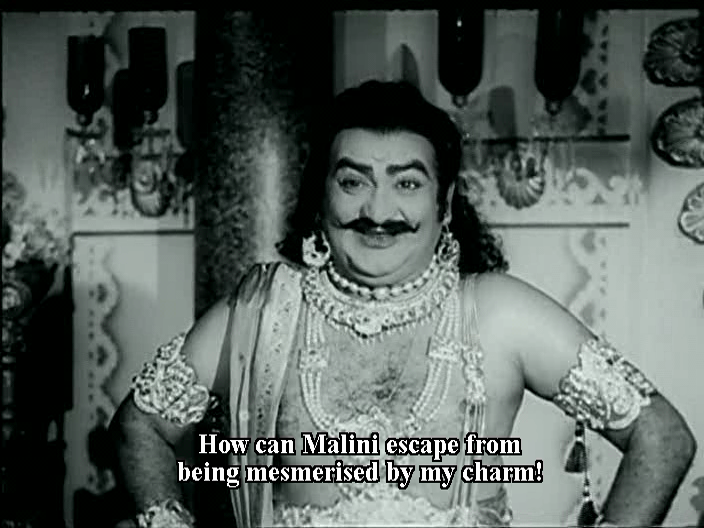
SV Ranga Rao is Keechaka, the queen’s larger than life brother, a jovial bully. His inability to control his lust does more than threaten Draupadi. It also jeopardises the safety of all the Pandavas who may not maintain their disguises under such insult, and threatens the kingdom as he forces the queen to give Malini over to him. He is literally blinded by desire.
How else could he mistake Bhima for Draupadi? His performance is excellent as he manages to be likeable and hateful. I was cheering when he got his just deserts.
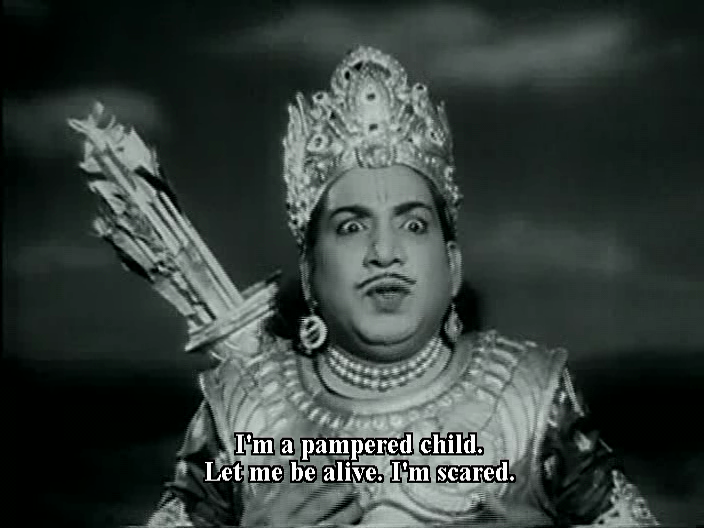
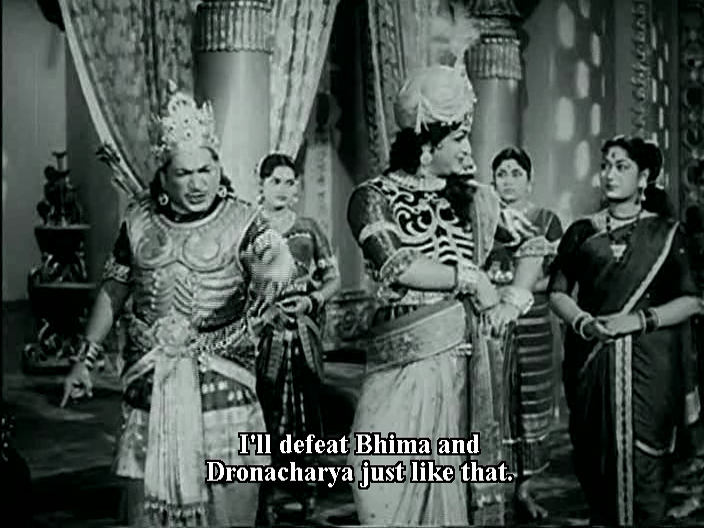
Relangi Venkata Ramaiah (a.k.a the ‘Clap Your Hands Behind Your Back guy’ from Mayabazar) is lots of fun as the pompous, cowardly but endearing Uttarakumar. He has delusions of being a great warrior and leader, and his preening and posturing amuses me as much as it does the Pandavas. He is followed around by his attendants, one of whom is Allu Ramalingaiah with perfect but unobtrusive comic timing. Uttarakumar is nice to his sister, and never gets angry or mean with the cooks despite their unfortunate comedic tendencies, so I like him.
L Vijayalakshmi is perfect as his sister Uttara. I really enjoy watching her dance and she has a sprightly, flirty, quality that enhances the role. She and Abhimanyu have a romantic subplot but really her purpose seems to be dancing and being decorative. This is only the third film I have seen her in, and I hope to find a few more.
The songs (original music by Susarla Dakshinamurthi) blend into the story and I wish they had been subtitled, as often they are used for exposition or introductions. The dancing is lovely, and the sets and costumes are opulent. The decorations are extravagant and yet allow the performers to be the focal point. It’s also a ripping good story, and the pace of the direction matches the tempo of the drama to perfection. It’s just gorgeous.
4 ½ stars! (a small deduction for too many squeaky comedy cooks in the kitchen)
Heather says: Narthanasala is just delightful to watch. The film’s all star cast are excellent and the sets and costumes are fabulous. Since I’m not very sure about all the characters in this part of the Mahabharata, I really appreciate the opening scenes where everyone introduces themselves and explains who they are, the alias they are going to assume and what they are going to do for their time in exile. Very helpful.
The stand out performance for me is by NTR. He is excellent as Arjuna in the film’s opening scenes and his transformation into the eunuch dancing teacher Bruhannala is brilliant. It’s not just the delivery of his lines or his posture, but his whole demeanour which changes, and he is wonderfully feminine. He also has the best costumes and totally awesome eyelashes! This looked like such a fun role to play and NTR had the right amount of playfulness and hauteur to make it work.
Savitri is as beautiful as ever although I was a little confused about her character as Malini. Since they were supposed to be in hiding it seemed rather odd that she would say that she had 5 husbands and needed shelter for a year. Surely that gave the game away as to who she really was? It didn’t seem to be a requirement of their exile since none of the other characters seemed to reveal quite as much about their identity. However, I only have a very limited knowledge of the Mahabharata, so this could just be an essential part of the original. The film drags a little in the middle while waiting for Draupadi’s rescue from the funeral pyre, but the previous scene with Bhima in drag pretending to be Malini was excellent. Dandamudi Rajagopal is very good in his portrayal of Bhima/Valala and as a professional wrestler he certainly looks the part. Unlike Temple, I love the minions in his kitchen who I think are really very funny, always fighting and squabbling and behaving more like troublesome children. The comedy with Uttarakumar is very well done as well, in particular the scenes with Arjuna when he goes out to fight the Kauravas
The dancing is lovely and although the fight scenes were quite stylised they are enjoyable to watch. I loved this line from the battle between the Kauravas and Arjuna towards the end “He greets the elders with his arrows. That is what makes him so adorable!” And NTR was! I really enjoyed this film – 4 ½ stars.
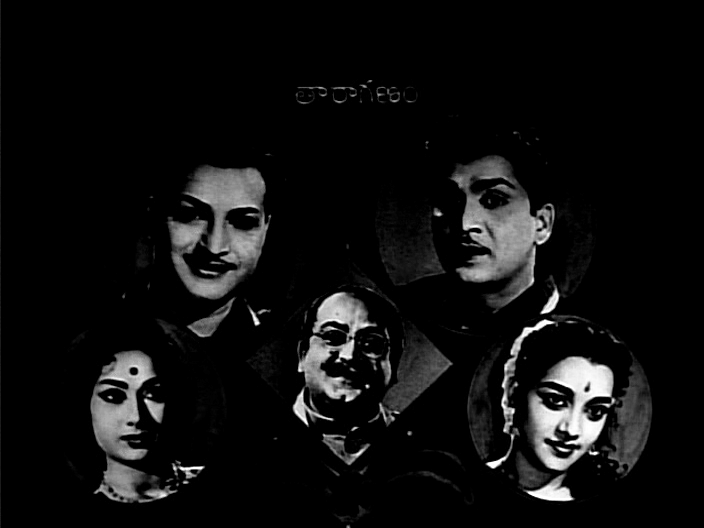
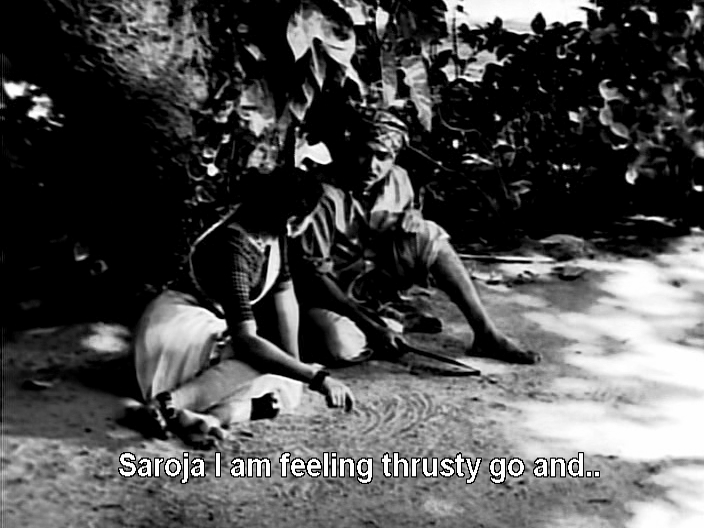
Gundamma Katha is a classic film from 1962 and is considered to be one of the last great films to be produced by B. Nagi Reddy and Chakrapani under the Vijaya Studios banner, which also gave us Mayabazar. It features an all-star cast, lovely production design and a lyrical score by Ghantasala. Sadly the Shalimar DVD has really ordinary subtitles which detract from what is supposedly a well written story.
Perhaps they meant thirsty? Who knows.
The story revolves around Gundamma, a wealthy widow who has one spoilt and indulged daughter, one Cinderella like step-daughter from her husband’s first marriage and one largely absent son. Gundamma rules the household with an iron fist and her reputation as a termagant is well known in the village. She wants to make an advantageous match for her daughter Saroja but her wastrel brother Gantayya throws a spanner into the works every time. As Gundamma casts her matrimonial nets wider she contacts wealthy Ram Bhadrayya, a friend of her deceased husband, who has two eligible sons. While Ram Bhadrayya wants to help his former friend’s family, he is concerned about the values and character of the girls and decides to put them to the test.
NTR plays Anjaneya or Anji and it is decided that Laxmi (Savitri) is the best match for him. Since Laxmi is effectively a servant in the household, he poses as a labourer in order to get closer to her, and to appear to Gundamma as an appropriate suitor. This part of the deception seems very typically filmi and almost justified, since Laxmi does deserve better than the life she has. NTR is charismatic as the exuberant Anji, and Savitri is beautiful as Laxmi. Their relationship develops over conversations and teasing, and they develop a true appreciation for each other. With a jaunty song Anji points out to Laxmi that women can do whatever they want to do in the world, and she should have no fear in letting herself be more than an unpaid servant to her step-mother. Sadly this enlightened attitude turns out to be lip service as the story progresses, but the partnership of Laxmi and Anji does seem to be a happy and balanced one.
Ram Bhadrayya’s second son Raja (ANR) woos the privileged and spoiled Saroja (Jamuna) and finally marries her. Playing out a drama concocted by his father and Anji, Raja tells Saroja that everything was a lie and that he is not even Ram Bhadrayya’s son. After some more drama Saroja is forced to choose between her home and comforts or leaving to an unknown future with her drunk and possibly criminal husband. This deception is all to ensure that Saroja has a proper wifely attitude and will look after her husband in the manner he feels appropriate. Saroja doesn’t seem to deserve all of the heartache she is put through, as her attitude already appears quite appropriate for the wife of a wealthy man. It doesn’t seem likely that she will have to clean pots and pans, plough fields and cook once she is established in her new household but she is forced to learn as she lives in near poverty with her husband. Why her father-in-law feels this trickery is necessary for her to become a better wife is not apparent to us. She actually seemed to be mellowing and becoming more empathetic as her romance blossomed with Raja. It certainly wasn’t a palatable part of the plot and made the second half of the film much less enjoyable.
Throughout all of the drama, ANR manages to instil the character of Raja with enough charisma that Saroja’s devotion to him is understandable to some degree, although her behaviour is clearly driven as much by wifely duty and the expectations of society as anything else. Jamuna is excellent in her early scenes as the lazy daughter and also as the bewildered wife whose world rapidly falls apart. Despite this couple’s rather dubious story there are some lovely duets which are beautifully depicted and in these scenes the two actors have great rapport with each other. The growing closeness is illustrated by the proximity of their sleeping mats – initially on opposite sides of the room, by the time ANR decides to reveal the truth they are happily snuggled up next to each other.
The cinematographer Marcus Bartley has a reputation for creating beautiful moonlit lighting effects, shown to great effect here and in Mayabazar. The costumes are lovely, and very much serve to illustrate the status of each character. A simple change in clothing is all it takes to make a prince a pauper and back again. Initially Laxmi wears cotton saris and simple blouses while Saroja gleams in silk and jewels. As the sisters’ fortunes change, so do their wardrobes.
The film excels in the story of Gundamma, played by Suryakantham (who apparently made her career out of playing wicked stepmother type characters). Gundamma’s scenes with the argumentative and shifty Durgamma (Chayadevi) are well written and enough to make anyone duck for cover when the two start fighting. Her clashes with the various members of her family are realistic and energetic. Her final humiliation, which eventually results in her reconciliation with Laxmi, is a nice twist to the story and a suitably sentimental resolution to the melodrama.
The lead actors were all at their peak when Gundamma Katha was made and they seem to share an easy rapport. In particular the many wordless exchanges between the two brothers are great to watch as they convey so much through their posture and gestures alone. Savithri and Jamuna are beautiful and show distinct personalities without ever falling into caricature. The sisters’ relationship is not as friendly as the boys’, but they exhibit familial love and loyalty regardless of their difference in status. Once again, the comedy track is hit and miss and we have different opinions as to what succeeded.
The film does end in a rushed few scenes of everyone reconciling. We were disappointed by this as it seemed a bit under-written and hasty, and also because there was never any sense of owing the ladies any explanation for what had been done to them. Granted, Gundamma, Laxmi and Saroja were none the worse off in a material sense at the end of the story, but they had been lied to and manipulated and that was hard to swallow. Certainly we expected more anger or argument between the couples. Setting up three strong and intelligent women and having them turn into doormats by the end of the film was a major let down.
We haven’t really mentioned the lovely L Vijayalakshmi who played the boys’ cousin Padma. She was actually the sensible and sane one who married the man she wanted (Gundamma’s son) and stood up for what she wanted. Apart from looking lovely and putting Gundamma back in her box, she also performed a very pretty classical dance which was a highlight in this largely non-dancing film.
The music is very melodic and the songs seem to suit the characters and the situation. We were amused to recognise the opening titles music, also used in that L Vijayalakshmi dance, as the riff from recent Hindi hit Pe Pe Pepein from Chance Pe Dance!
Temple says: I liked a lot about this film – the cast, the production design, the music and the cinematography. I strongly disliked the story. The message seems to be ‘be strong, intelligent, independent…until your husband tells you to stop’. In addition to my issues with that, the character of Saroja just wasn’t written as someone eligible for Taming of the Shrew type behaviour modification and so the treatment meted out to her seems harsh, unnecessary and not in keeping with her actions in the film. The acting style has really dated, especially that of the male cast members. ANR and NTR do have oodles of charisma, which makes the stomping and scenery chewing much more entertaining than it might have been. But the acting honours go to all the ladies – which is ironic in a film that certainly isn’t about girl power – with Savitri the stand-out performer. She is beautifully expressive without ever being over the top. The minor supporting cast didn’t make much of a contribution other than to add the alleged comedy (regular readers will know I suffer from Comic Sideplot Intolerance). It seemed a waste to have Allu Ramalingaiah as the hotel owner as he had so little to do. I really found Ramana Reddy as Gantayya (Gundamma’s dodgy brother) annoying and hammy and I fast-forwarded through many of his scenes just so I could get through the film. Actually, I think the fast forward button was essential to me getting through this – I was bored by the over-acting and repelled by the story so this wasn’t the pleasure to watch I had hoped for. Time hasn’t been kind to this classic. I give it 3 and 1/2 stars, just for the stars.
Heather says: This is a film which both looks and sounds very beautiful and from this point of view is an absolute winner. The story of Gundamma and her two daughters had a lot of potential, and it’s a shame that the writer D.V.Narasa Raju decided to turn the two sisters such perfect and therefore perfectly dull wives by the end. Both Laxmi and Saroja had plenty of personality at the start of the film and eradicating this in the quest to make them the ideal wives just made them rather less interesting to watch. The lack of a reaction from Saroja when she discovers the deception was particularly irritating considering she had just been put through absolute misery by the man proclaiming to love her. It was also a little odd that the start of the film featured a song all about women’s rights and then proceeded to firmly walk all over them. I suppose that in 1962 it was more important to adhere to conventional principles rather than allow a strong-minded woman to succeed. However, despite these issues with the storyline, I did enjoy the romance between Anji and Laxmi. Their songs, as well as the duets between Saroja and Raja, were really lovely.
The characters of Gundamma, her perpetually scheming and whining brother and the very shady Durgamma were much more entertaining. The interactions between them all were much more believable and seemed to be better written, although this could just be due to the subtitles. I found the comedy scenes with Ramana Reddy and Allu Ramalingaiah in the restaurant to be really funny, as were his scenes with NTR. What can I say? I’m Irish and it reminded me so much of similar scenes I’ve seen at home! The comedy track here worked well for me, and was much more enjoyable than the unsettling story of Saroja and Raja. ANR and NTR were excellent together and their relationship as brothers was very well portrayed. I also liked the minor characters and the way their individual stories were worked into the plot. The standout performance though was that of Gundamma, and for that alone this film deserves to be a classic. Without the Raja and Saroja storyline it would have been even better, but overall I enjoyed this film and it gets 3 ½ stars from me.





 Cinema Chaat