I haven’t been too impressed with the last few Puri Jagannadh films I’ve seen, but I was hopeful that this latest offering starring my favourite hero might offer something a little different. But although the film is visually very pretty and both Bunny and Amala Paul do their best with their respective characters, the story has far too many plot holes and is frequently too unbelievable to make Iddarammayilathi anything other than disappointing. While there is the expected excellent dancing from the stylish star, some good fight scenes and Bunny and Amala make a sweet couple, it’s just not enough to make up for the screechy, irritating Catherine Tresa and a dire comedy track which almost completely derails the film in the second half.
The film follows Akanksha (Catherine Tresa), the daughter of a prominent politician in India (Rao Ramesh) who moves to Barcelona to study psychology. She has a fantastic room which just happens to contain a box belonging to the last tenant. Inside is a diary which tells the story of a romance between Sanju (Allu Arjun) and the room’s previous occupant, Komali (Amala Paul). The romance is played out in flash-back as Akanksha talks endlessly to herself about the diary’s revelations and frankly seems far too interested in the details of a stranger’s love life.
Bunny looks great as Sanju Reddy, a singer/dancer who performs with his band in the streets of Barcelona and is surprisingly successful considering that the band seems to perform exclusively in Telugu in a Spanish/Catalan speaking city. He’s also pretty nifty when it comes to the obligatory biffo although his prowess in this area is never really explained – but then neither is anything else so at least there is consistency in the lack of elucidation. Sanju falls in love with Komali who is in Barcelona to learn classical music from Brahmi – again, completely nonsensical but there is even more absurdity to follow. Amala does a good job as a demure and rather shy violinist apart from being completely unable to fake playing a violin. She does look stunning though in some beautiful costumes and has good chemistry with Bunny so at least the romance part of the story is believable.
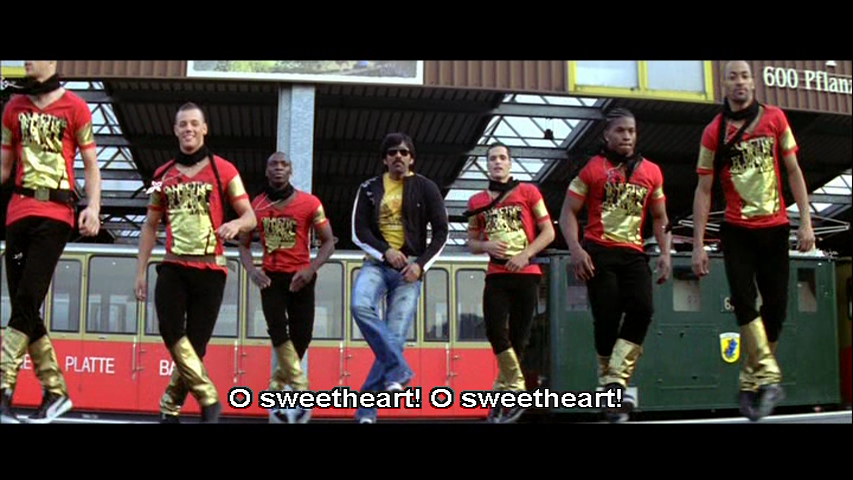
For a change I really liked Bunny’s various outfits too, which aren’t as over the top as his last few films and do appear fashionable with a European touch. Most of the songs by Devi Sri Prasad are fairly average, but the choreography is good if not exceptional and Bunny as always proves he really can dance. However a dance off between the classically influenced Brahmi and the more rock and roll Sanju would have been much better if the backing dancers had been able to keep up with the choreography. There is a short tribute to Chiru’s Gangleader which got the biggest cheers from the Melbourne crowd, but this was my favourite:
The love story ends abruptly in the diary so Akanksha tracks down Sanju to find out what happened and learns of a tragedy that occurred when Sanju and Komali crossed paths with a gangster (Shawar Ali). Shawar Ali has to be the dullest and most incompetent villain ever and it’s surely only by chance that Komali is the only person who sees him execute one of his gang on an incredibly public beach in broad daylight. Unbelievably, it takes all the might of his gang of assorted thugs, sword-wielding ninjas and Subbaraju in a rather dapper beanie to deal with one petite classical violinist and her guitar playing boyfriend!
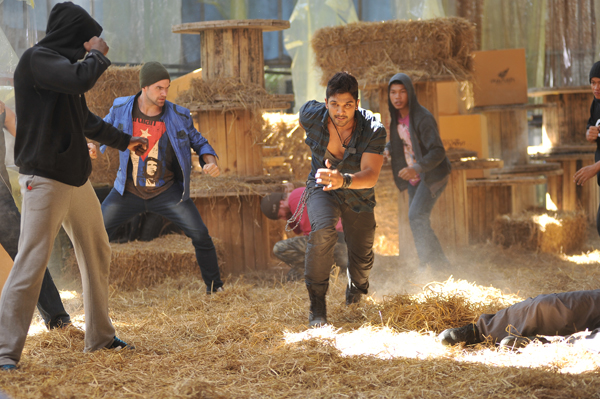
While Akanksha shrilly indulges in flagrant scenery chewing and desperately tries to persuade Sanju to fall in love with her, Sanju has his own agenda for revenge which ends up with a surprisingly good and effective plot twist with a flashback to some of those awesome sword fighting techniques from Badrinath. Overall, apart from the woeful comedy scenes with Brahmi and Ali, the second half moves faster and is a little better than the first, although that may just be that I stopped worrying about the lack of logic and settled back to enjoy Bunny’s dancing and the fact that he does look as if he can actually play a guitar. The fight scenes by Kecha are also beautifully choreographed and appear more like dancing than fighting, an effect which is heightened by Sanju’s total lack of emotion as he calmly and efficiently despatches everything and everyone that is thrown at him.
Iddarammayilatho looks beautiful and cinematographer Amol Rathod makes the most of the location in Barcelona, showcasing some of the beautiful buildings in the city, but the film is let down by a complete lack of logic in the story and very little in the way of character development . Although the cast in general put in good performances, most of the supporting mothers, fathers etc have very little to do and both Subbaraju and Srinivas Reddy are chronically underused. Brahmi is fine in the first half but the comedy with Ali is totally pointless and almost as irritating as Catherine Tresa. Perhaps understanding the dialogue might have made Akanksha a more appealing character, but somehow I doubt it. I still enjoyed the film, but more for the location, action scenes and dance numbers which were all good. Overall, Iddarammayilatho is worth a look for Allu Arjun fans and anyone who likes movies with pretty scenery and great architecture.
Neninthe is an enjoyable mass entertainer with a dollop of romance and a splash of action, all set in the Telugu movie making world. There are plenty of references to popular Telugu film personalities starting right from the opening titles, and lots of opportunities to guess who various characters are based on. The humour is funny and cynical, and I really like most of the performances. But despite pointing out the blurred line between reality and film fantasy almost all of the conflicts and questions are resolved in ‘only in movies’ style, and not always in tongue in cheek fashion. I don’t think it’s meant to be a realistic expose of the film industry, and that isn’t how I viewed it, but the story would have benefited from a more careful eye on how these elements were blended.
Ravi (Ravi Teja) is an aspiring director. He lives with his ailing ma (Rama Prabha), and is a driven character. Ravi navigates the ego traps and financial shenanigans of the movie industry, all with one goal – to direct his film, ‘Neninthe’. He is brutally honest at times and fiercely determined to succeed in directing his own story. Ravi Teja is a very good actor, especially when he tones down the sleazy uncle act, and this role is great as it spans drama, humour and action. Ravi observes the characters around him, often with a sarcastic muttered aside.
With characters like the infamous director Idli Vishwanadham (Brahmanandam) and associates including producer Sayaji Shinde and production assistants Venu Madhav and MS Narayana, he has lots of material.
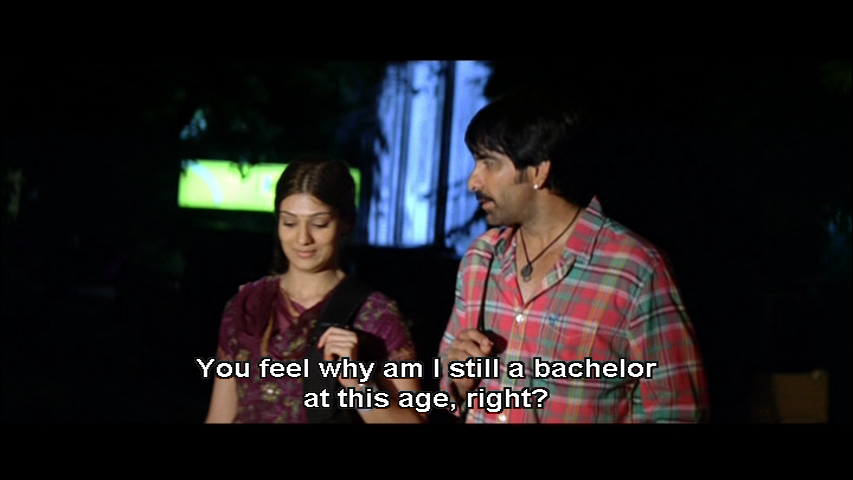
Ravi is pragmatic about love and expects marriage to wait on his priorities. I really liked seeing Ravi with his friends, especially his mate who is desperate to be a villain, and mother and they all had a nice rapport.
Ravi is a regular guy, albeit with heroic powers when required and can easily thrash a dozen hulking great rowdies. The trigger is more likely to be his career than a girl. Ravi is prepared to compromise over a lot of things, but not his film.
There are setbacks and sadness in his life, but he keeps going, even when it seems he must run out of energy. He represents the idealism and passion of film makers for their craft as well as being the vengeful, protective hero.
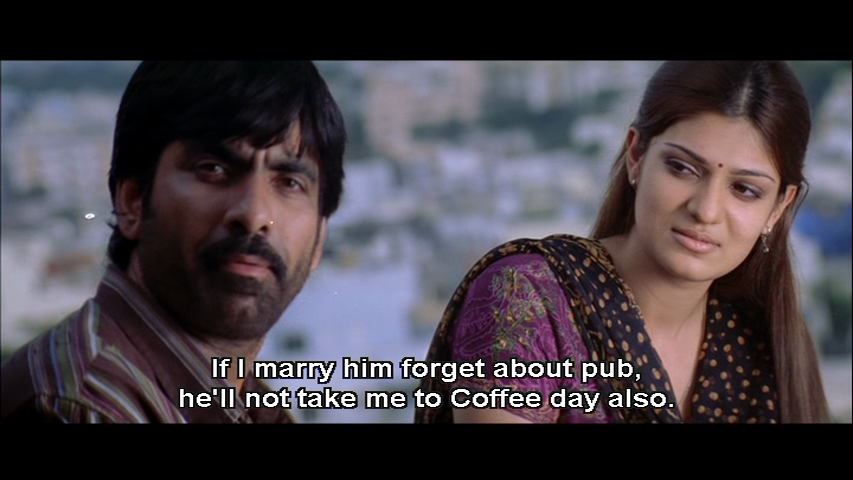
Sandhya (Siya) is an alleged dancer who has no ambition other than her next meal and not getting pimped out by her creepy brother-in-law (Krishna Bhagawan). Both the actress and the role are quite insipid and I wanted to slap her on more than one occasion. Sandhya is pursued by Yadu (Supreet), a local thug accustomed to taking what he wants. She, of course, falls for Ravi and seems to think that she can just leave every problem in her life for him to solve because her love places him under that obligation. It is quite annoying to hear her whining about how Ravi never helps her when she does bugger all to help herself. I am sure it would be hard to ditch the sadistic brother-in-law, but it’s even harder to walk away if you have no spine to speak of. Anyway, she seems set on Ravi, and equally set on changing him.
Ravi helps her get a starring role, and her fortunes improve especially as her brother-in-law stops trying to sell her, but the couple start to drift apart. The scenes where Sandhya and Ravi discuss their relationship are well written, and Ravi Teja is believable as the man in love but not blind to practicalities. Siya has some good moments, especially when she is annoyed at Ravi, but she fades when the other stars are present. There was potential for Sandhya to be more interesting but Siya is as convincing an actress as she is a dancer and the script is lightweight.
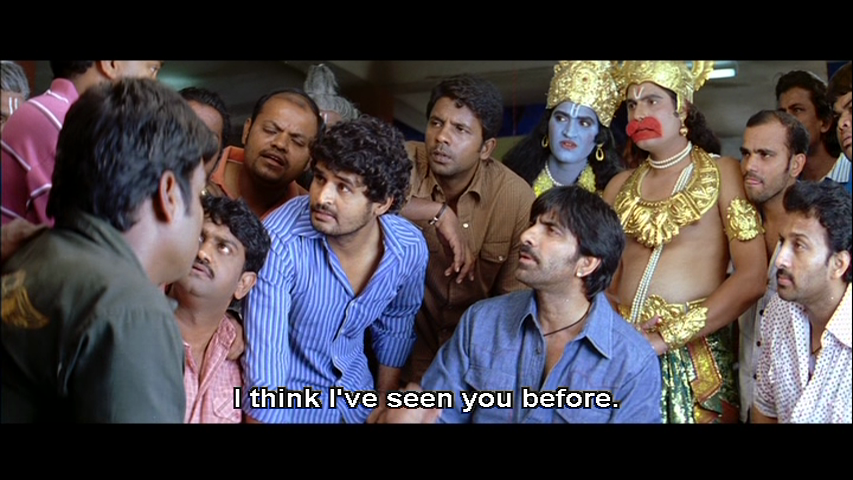
Subbaraju is ‘Miracle Star’ Mallik. He was one of the first Telugu ‘That Guys’ that I could pick out from the pack. You know the guys – always a sidekick, policeman or henchman (not to be confused with ‘That Comedy Uncle’). I admit I may have paid particular attention because Subbaraju is rather good looking, even in the shirts they dug up for this film (see them hanging up in the screencap above). But I also noticed him as he seems to be more of a character actor than just a stock ‘type’ and can handle a range of roles. So that got me thinking about the trajectory from supporting actor to hero, and why there are so many ‘types’ and so few honest to goodness character actors in Telugu films nowadays.
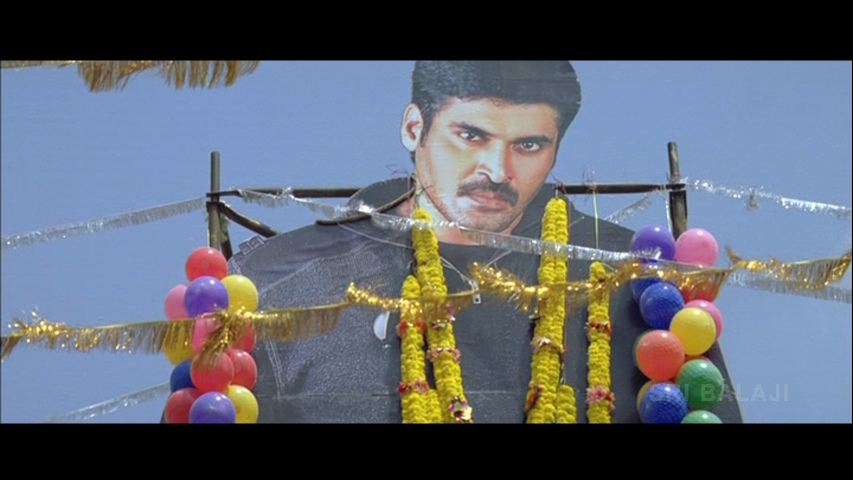
Puri Jagannadh has fun with Mallik as the stereotypical hero, and Subbaraju gives it the right balance of sincerity and parody. He spouts dialogue recycled from Pokiri and then asks if it isn’t a bit over the top, and has a flock of minions fussing over him. Mallik swans about like a total diva and he proves he isn’t above using his fame when it suits. But he also voices concern about the obsession of the die-hard fans and how far they go in the name of their idols, and that forms a substantial sub-plot.
There was a mix of gratitude, ego, and resentment in Mallik’s dialogue about the fans and the effect their expectation has on movie making. If he had spoken to one particular nutter at the right time there may not have been a funeral at which to make that speech, but I suppose that would have been too sensible.
Mumaith Khan is the item girl, and her character is Malik’s girlfriend. Their scenes together are good, except for Mumaith’s occasionally stilted dialogue delivery. They serve more to comment on the obsessions of the press than to provide another romantic element in the film.
That song rhymes bus station with frustration. I just thought I’d mention it as Chakri’s music is pretty lacklustre and that’s all I ever seem to remember.
A confronting ‘movie meets real life’ moments occurs after Mumaith and Mallik break up over scurrilous rumours in the press. Mumaith overdoses, and on the way to hospital her car is hijacked by a couple of Yadu’s men who then rape her. She gets out of her hospital bed to deliver a speech (full of bleeps) to the press about their penchant for creating news with no regard for the individuals or the effect these stories have. It’s a sharp observation, but I wish it had been delivered in a different setting. Anyway, once again a valid point was made via a sensational set-up.
There is a salacious element in the media when discussing many actresses, and I doubt the same journalists would approve if that tone was directed at their sister or cousin. This would have been an interesting story to film post the advent of Twitter, since that is often what passes for ‘news’ these days. I like Rana Daggubati as an actor but I don’t think his recent tweet about luggage going astray warranted several paragraphs in the Times of India!
Supreet as Yadu is hilarious and utterly repulsive as he tries to woo Sandhya instead of just assaulting her as per his usual approach. Yadu’s attempts to be appealing are amusing even as my skin was crawling. It was like watching a bear trying to eat with chopsticks –unnatural and bizarre yet compelling. And his gang have some of the worst hair I’ve seen in ages. He is menacing, and doesn’t hold back on the crazy. Yadu’s obsession with Sandhya and the ensuing conflict with Ravi bring the film to a gory final confrontation.
The other supporting actors are generally fine and their characters are integral to the story. There are ambitious would-be directors, assistants to uphold the status of their boss, financiers and distributors as well as family and friends. It’s a crowded film, but the story and relationships remain clear. There are some fairly awesome song costumes too!
Puri Jagannadh doesn’t stop at movie references in the dialogue – he uses music snippets and visuals, and Ravi even uses a reel of film as a weapon. The dialogue sometimes sounds like a lecture but overall I find the subject and the characters engaging enough. It’s a very well planned and designed film. I just wish he had put as much effort into executing the story. 3 ½ stars.
Quite apart from the potshots at various industry types, I’m also convinced that Puri Jagannadh may hate a segment of his audience. Specifically, me. Why?
Exhibit A
Exhibit B
So who gets a song requiring beachside cavorting?
You’ve been warned.
Heather says: Although there are a lot of elements I do like about this film, there are also a few I don’t like, and it was those that I noticed more on re-watching Neninthe for this review. However it’s one of the best performances I’ve seen by Ravi Teja who is very watchable and charismatic here, although (and I can’t believe I’m saying this) I do think I prefer him unwaxed! I also love the back-drop of the film industry as the setting for the story and the way that Puri Jagannadh manages to get across the routine repetitiveness associated with filming rather than the glitz and glamour that most people associate with movies. However I find the story rather bitty with elements that don’t gel together quite as well as they should. Sandhya has so much to deal with that perhaps it’s not surprising that she doesn’t seem to know where to start. Her character seems to veer between hang-wringing and ineffectual ‘woe-is-me’ to being quite strong and decisive when it comes to making sure that she gets exactly what she wants from Ravi. I found all this dithering to be annoying, and couldn’t feel very much sympathy for her character at all. In fact I think the film would have been better without the romance factor, as it could make just as much sense that Ravi helped her career because he was a nice guy who felt she deserved better. There didn’t seem to be any zing to the romance and apart from the songs, no chemistry between the two actors.
On the other hand I do like Brahmi’s bumbling director and think that the comedy is generally well integrated into the main story. Like Temple, I’m a big Subbaraju fan, and I totally loved him as the ‘miracle star’. Watching this for the second time and about a year and many films later, I did pick up more of the nuances in his performance, and in particular the way his character interacted with the cast and crew as well as the members of his fan association. I think he’s a great actor and apart from doing justice to his role as a stereotypical ‘hero’ he really looked the part too. Mumaith Khan is another of my favourite performers and while she seemed to be basically playing herself, I appreciated the way she appeared on camera with minimal make-up and gave a fairly convincing lecture about the evils of fame. As Temple has mentioned there are many good and valid points made about the way stars are treated by fans, the press and the industry but I agree that the set-up to deliver these messages tended to overshadow the points that Puri Jagannadh was trying to make.
I did notice that the subtitles appeared better than usual – there was a ‘shut your gob’ in there which I appreciated as a very English idiom rather than the usual more stilted direct translations and there were quite a few of these more colloquial interpretations. I also enjoyed the shots of the orchestra with real musicians playing violins properly rather than the usual half-hearted attempts that drive me crazy!
This is still an entertaining film despite the irritating heroine and lacklustre romance. I’d recommend watching at least once for some excellent performances and the general overall view of the movie industry. 3 ½ stars.
It started with text messages late at night. Then waiting while someone had a muttered conversation with the boss. Then the secret password (my name!). Finally a minion delved into a concealed pocket, and handed over tickets for the sold out opening show of Business Man! Armed with a stash of paper strips we made our way into the packed cinema and sat in the third row among some diehard fans, ready for an up-close Big Mahesh film experience. We’d been told that US prints were subtitled and were hopeful we would also get subs – but it was not to be so we enjoyed another Adventure without Subtitles.
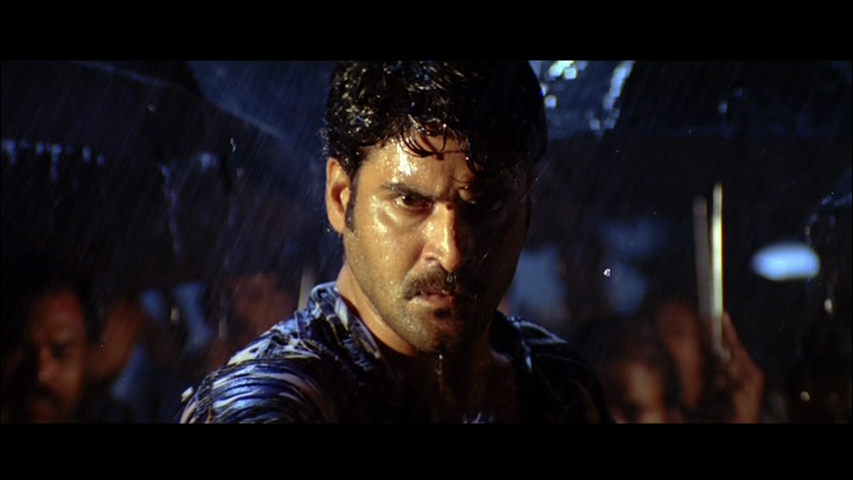
Business Man is a beautiful looking film directed with verve and confidence, and performed with commitment. The lighting and composition of each frame is superb. The editing, the effects the action sequences and the dialogues are zingy and zesty. The story is simple but it’s sustained and isn’t lost in the rich visuals. Mahesh Babu is a perfect fit for the pivotal role. He delivers a ruthless, brooding characterisation rounded out by some sharp humour and a bit of romance.
The basic story is easy to follow. Surya (Mahesh Babu) moves to Mumbai and proceeds to take over the criminal underworld. He is a logical and determined man who runs his gang as a business. They have defined tasks, get paid regularly and follow his orders. Surya is all about power not money, and lives quite simply. He is fair in his own way and wins grassroots support with some calculated acts designed to cement his place in the community. His motivation becomes clear as the action unfurls. And as for his methods – Guns don’t need agreements. Surya is an anti-hero in many respects, and a lot of what he does is reprehensible. He does offer some form of vigilante justice and fair treatment which contrasts with the corrupt politicians and ineffectual police.
Sayaji Shinde and Prakash Raj play politicians and power brokers with connections. Both are predictably competent without being exceptional. Sayaji Shinde is easily duped, but Prakash Raj has a history with Surya that sets up the climax of the film.
Once Mumbai is under control, Surya expands his business model nationally and is a serious threat in the political power struggle. Prakash Raj decides to nip this in the bud to assure his own position. This confrontation is just what Surya wanted, and so we rocket along to the gore splattered conclusion.
Nasser is a Police Commissioner and Kajal is his daughter Chitra. We debated whether Surya had engineered a meeting with Chitra so that their relationship started as a subterfuge but then developed into something genuine. Surya views the police as he does the politicians and the local goondas – they’re all just assets or liabilities in his business model. He seems to commit wholesale slaughter with remarkable ease. In fact the only ‘crime’ he commits that draws any police attention is fancying Chitra – that’s when the cops with guns turn out in force.
Brahmaji plays Surya’s sidekick but he merges back into the team as the story progresses. Subbaraju is wonderful as Prakash Raj’s enforcer. He is menacing and hilarious, and matches Mahesh’s intensity. There is a very funny scene where Subbaraju keeps trying to reload his gun as all hell breaks loose. It sounds like nothing much, but his fumbling shtick is hilarious and also contributes to the scene. The comedy emerges from characters and situations so it doesn’t slow the action. But WTF was going on with the dubbing for Ayesha (Chitra’s friend, played by Ayesha Shiva)? The voice, accent and dialogue delivery was terrible and too bad to even be funny. I don’t think her acting was much either, but the voice dominated her performance. Mahesh Babu is a really good comic actor and his reactions are priceless in some scenes, particularly with Dharmavarapu Subramanyam and with Kajal. We really wished for subtitles as the dialogue had the audience in stitches, athough the puns and wordplay never translate so well.
Kajal and Mahesh had good rapport and judging by the audience reaction some of his lines were quite naughty. A lot of the dialogue was bleeped so I missed an opportunity to learn some handy curses. I was perturbed by one romantic song which is set up when a driver (a cameo by Puri Jagannadh) chloroforms Chitra and delivers her to Surya. It was meant to be funny rather than a scary abduction, but so very wrong. Next thing she is unconscious on a huge bed and wearing a very sparkly saree. Kajal and Mahesh have some chemistry, especially in her few conscious intervals in that song. Many of their scenes together had a lively and spontaneous feel, and they made a nice looking couple. There is a fleeting kiss which elicited a deathly silent non-reaction from the audience. She had little to do but scream and cry, but I think this is one of her better efforts. And she didn’t get slapped around.
SS Thaman hasn’t done anything amazing with the soundtrack, but the brassy theme underscoring some of the action is great. The choreography was less delightful. The choreo in Sir Osthara was strange, mostly synchronised hand waving and a little bit of prancing so basic even Kajal could keep up.
Pilla Chao is fun, but reminiscent of the Ministry of Silly Walks with festive Santa backing dancers. The Mahesh Fan had a theory about the costumes. She thinks Puri Jagannadh said ‘If my wardrobe dude can have his way with you in the song picturisations, you can wear your own clothes and normal haircut for the rest of the film’. And I think she might be right.
Mahesh does look slightly taken aback by the ice cream colour themed outfits and blue suede shoes but he generally wears plain dark shirts and jeans. It’s an unfussy yet multi-layered look for a man who means business but doesn’t mind flaunting a bit of elbow and the merest hint of chest hair.
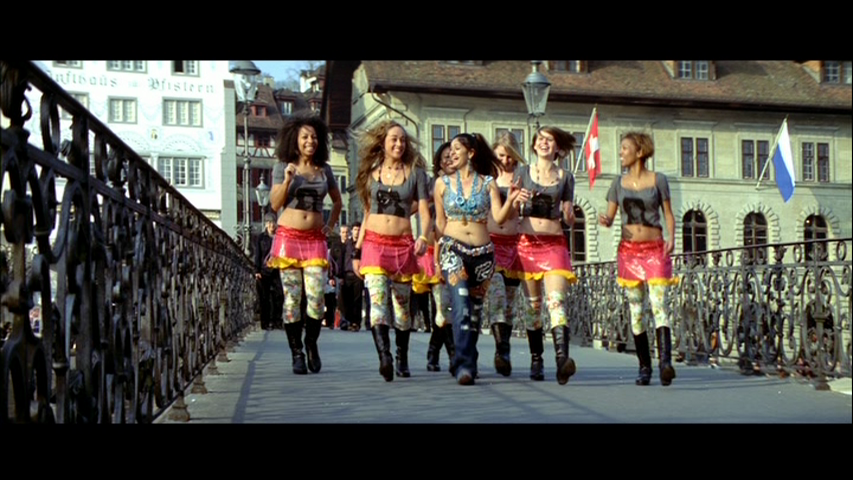
The censorship was really odd. Lots of dialogue was bleeped or muted, but I could easily substitute likely profanities. And the dancers – especially the skanky white chicks – were occasionally blurred out. In most scenes they were unobscured so the costumes and choreography were obvious and we couldn’t discern a substantial difference between the clear shots and those that had been censored.
Some angles were obviously a bit more ‘down the choli’ but most seemed to be similar. The Telugu film industry hires many female performers solely for their looks and physique, so it seems strangely prudish to censor some of the flesh some of the time. Who are they kidding?
Yes it defies logic, gravity and many other laws but Business Man never pretends to be a gritty realistic story. It’s a kickarse action film made with great style, a cracking pace and a star who can switch from baby faced killer to baby faced hero with a killer sense of humour. Highly recommended and a resounding 5 stars from me!
Heather says: Opening night of any Mahesh film is always worthwhile, no matter how good or bad the film, since the cinema is packed and there are plenty of enthusiastic and noisy fans – which includes The Mahesh Fan and us. And to our delight, this turned out to be a very Mahesh-centric film. He was in almost every shot and the story very firmly revolved around Surya and his business model version of rowdyism. This had the slightly unfortunate side effect that no-one else got very much to do, which was somewhat disappointing because the other actors were all so very good. Chitra’s friend the very glaring exception. Brahmaji as Surya’s friend started out well with some presumably funny lines, but was quickly sidelined and hardly appeared for the rest of the film. And although Nasser, Sayaji Shinde and Prakash Raj popped up now and again to provide more motivation for one of Surya’s awesome action scenes there didn’t seem to be much explanation of exactly why they acted the way they did. Although that could of course just be the lack of understanding the dialogues on my part. I totally agree with Temple that Subbaraju has some of the best moments in the entire film and I enjoyed many of the other support gangsters who had excellent expressions during some of the fight scenes.
Mahesh does do ‘angry’ very well, and he seemed to be alternating between simmering and boiling for most of the film which did get a little wearing towards the end. There was quite a lot of comedy in there too judging by the audience reaction, but this was mostly in the dialogue so I missed most of it. However the interplay between Surya and Chitra did have some very funny moments which came through loud and clear. I really liked Kajol here and thought she was in her element when she was angry and snapped back at Surya – it felt very authentic! She was animated and likeable throughout although does lose points for having an incredibly irritating and annoying friend. I really couldn’t understand why Chitra stayed with Surya since she obviously abhorred his gangster life style and the chloroform incident was just plain creepy. But otherwise I enjoyed the romance aspect of the film and I think it will be even better when I can understand the dialogue.
The Businessman is a very slick and well made film which looked fabulous and played to Mahesh’s strengths. Less bizarre and quite frankly pointless censoring, better choreography and a little more of the support actors and it would have been totally perfect.




















 Cinema Chaat